15) Determine the partial pressure of oxygen necessary to form an aqueous solution that is 6.5 × 10⁻⁴ M
O2 at 25°C. The Henry’s law constant for oxygen in water at 25°C is 1.3 × 10⁻³ M/atm.
A) 1.2 atm
B) 0.85 atm
C) 0.78 atm
D) 2.0 atm
E) 0.50 atm
16) Calculate the molarity of a solution that contains 0.250 moles of KF in 0.500 L of water.
A) 0.500 M
B) 2.00 M
C) 0.125 M
D) 8.00 M
E) 0.750
17) Parts per billion requires a multiplication factor of ________.
A) 10-9
B) 10-3
C) 103
D) 106
E) 109
18) Parts per million requires a multiplication factor of ________.
A) 10-9
B) 10-3
C) 103
D) 1015
E) 106
19) Calculate the molality of a solution formed by dissolving 34.8 g of LiI in 500.0 mL of water.
A) 0.254 m
B) 0.130 m
C) 0.696 m
D) 0.260 m
E) 0.520 m
20) What mass of CuCl2 is contained in 90.85 g of a 22.4% by mass solution of CuCl2 in water?
A) 20.4 g
B) 4.91 g
C) 24.6 g
D) 40.6 g
E) 11.2 g
21) Calculate the mole fraction of the total ions in an aqueous solution prepared by dissolving 0.400
moles of MgBr2 in 850.0 g of water.
A) 0.00841
B) 0.0270
C) 0.00900
D) 0.0252
E) 0.0167
22) Calculate the mole fraction of CaI2 in an aqueous solution prepared by dissolving 0.400 moles of
CaI2 in 850.0 g of water.
A) 0.00841
B) 0.0270
C) 0.00900
D) 0.0252
E) 0.0167
23) A 1.00 L sample of water contains 0.0044 g of Cl⁻ ions. Determine the concentration of chloride
ions in ppm if the density of the solution is 1.00 g/mL.
A) 3.3 ppm
B) 8.8 ppm
C) 4.4 ppm
D) 2.2 ppm
E) 6.6 ppm
24) A solution is 0.0480 m LiF. What is the molarity of the solution if the density is 1.10 g/mL?
A) 0.0441 M
B) 0.0480 M
C) 0.0436 M
D) 0.0528 M
E) 0.0417 M
18
25) What volume of a 0.716 M KBr solution is needed to provide 30.5 g of KBr?
A) 21.8 mL
B) 42.7 mL
C) 184 mL
D) 357 mL
26) What volume of 3.00 M CH3OH solution is needed to provide 0.220 mol of CH3OH?
A) 1.52 mL
B) 13.6 mL
C) 73.3 mL
D) 660 mL
27) To make a 0.500 M solution, one could take 0.500 moles of solute and add
A) 1.00 L of solvent.
B) 1.00 kg of solvent.
C) enough solvent to make 1.00 L of solution.
D) enough solvent to make 1.00 kg of solution.
28) How many grams of KBr are required to make 350. mL of a 0.115 M KBr solution?
A) 0.338 g
B) 3.04 g
C) 4.79 g
D) 40.3 g
29) What is the molality of a glucose solution prepared by dissolving 18.0 g of glucose, C6H12O6, in
125.9 g of water?
A) 7.94 × 10⁻⁴ m
B) 0.143 m
C) 0.695 m
D) 0.794 m
30) To make a 2.00 m solution, one could take 2.00 moles of solute and add
A) 1.00 L of solvent.
B) 1.00 kg of solvent.
C) enough solvent to make 1.00 L of solution.
D) enough solvent to make 1.00 kg of solution.
31) What molality of pentane is obtained by dissolving 15 g pentane, C5H12, in 245.0 g hexane,
C6H14?
A) 0.058 m
B) 0.068 m
C) 0.85 m
D) 61 m
32) A solution of LiCl in water has XLiCl = 0.0900. What is the molality?
A) 4.46 m LiCl
B) 5.00 m LiCl
C) 5.49 m LiCl
D) 9.89 m LiCl
33) A solution is prepared by adding 1.43 mol of KCl to 889 g of water. The concentration of KCl is
________ molal.
A) 1.61 × 10⁻³
B) 622
C) 0.622
D) 1.27 × 10³
E) 1.61
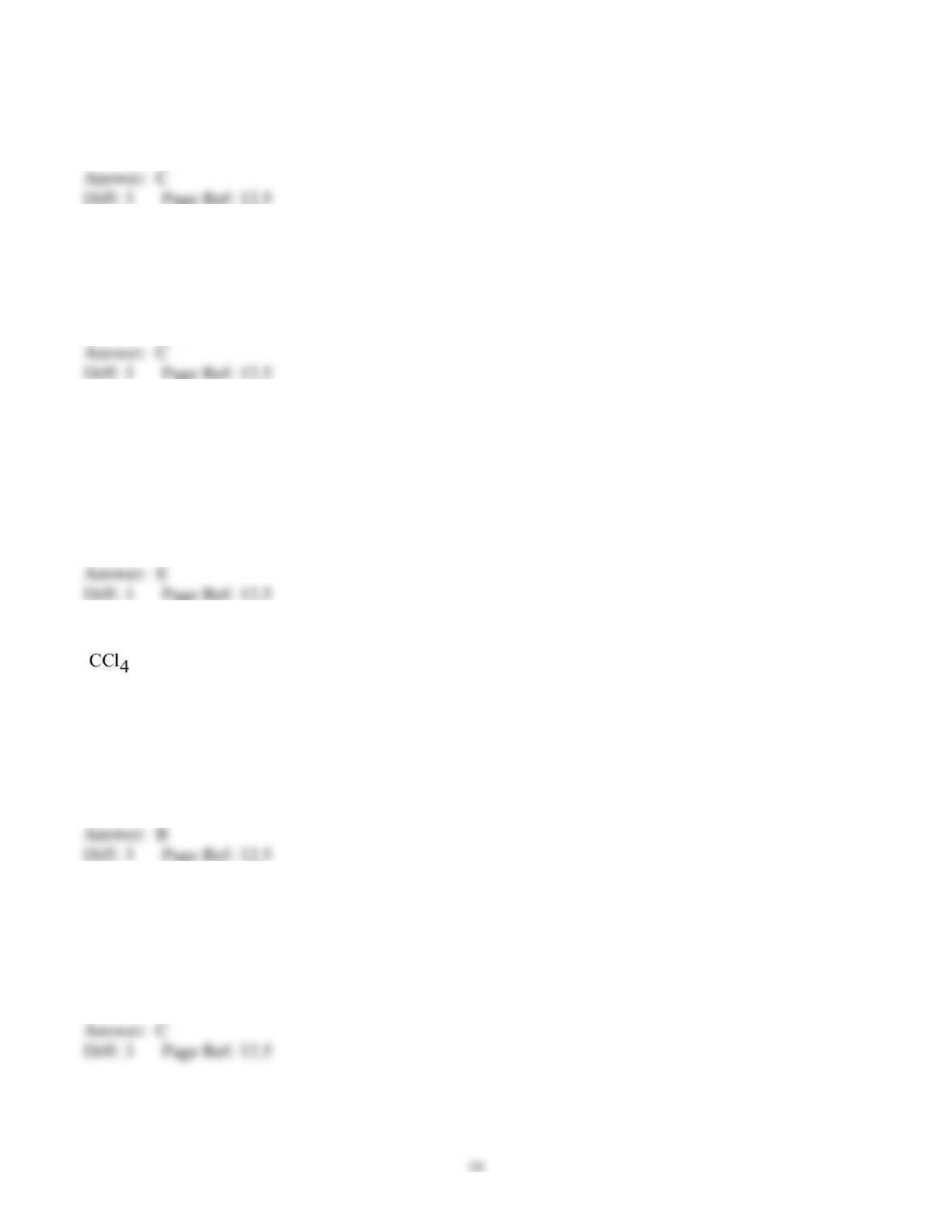
34) A solution is prepared by dissolving 16.2 g of benzene (C6H6) in 282 g of carbon tetrachloride
( ). The concentration of benzene in this solution is ________ molal. The molar masses of C6H6
and CCl4 are 78.1 g/mol and 154 g/mol, respectively.
A) 7.36 × 10⁻⁴
B) 0.736
C) 0.102
D) 0.0543
E) 5.43
35) What is the weight percent of vitamin C in a solution made by dissolving 6.50 g of vitamin C,
C6H8O6, in 55.0 g of water?
A) 0.547%
B) 1.21%
C) 10.6%
D) 11.8%
36) What is the weight percent of a caffeine solution made by dissolving 8.35 g of caffeine,
C8H10N4O2, in 75 g of benzene, C6H6?
A) 0.010%
B) 0.011%
C) 10%
D) 11%
37) How much water must be added to 40.0 g of CaCl2 to produce a solution that is 35.0 wt% CaCl2?
A) 54.0 g
B) 74.2 g
C) 87.5 g
D) 114 g
38) A solution of LiCl in water is 20.0 wt% LiCl. What is the mole fraction of LiCl?
A) 0.0960
B) 0.106
C) 0.472
D) 4.44
39) What is the mole fraction of ethanol in a solution made by dissolving 29.2 g of ethanol, C2H5OH, in
53.6 g of water?
A) 0.176
B) 0.213
C) 0.352
D) 0.545
40) What is the mole fraction of I2 in a solution made by dissolving 55.6 g of I2 in 245 g of hexane,
C6H14?
A) 0.0715
B) 0.0770
C) 0.133
D) 0.154
41) What is the mole fraction of oxygen in a gas mixture that is 37% oxygen and 63% nitrogen by
volume?
A) 0.34
B) 0.37
C) 0.25
D) 0.52
42) A solution is 2.25% by weight NaHCO3. How many grams of NaHCO3 are in 150.0 g of solution?
A) 1.50 g
B) 3.38 g
C) 66.7 g
D) 225 g
43) At 20°C, an aqueous solution that is 24.0% by mass in ammonium chloride has a density of 1.0674
g/mL. What is the molarity of ammonium chloride in the solution? The formula weight of NH4Cl is
53.50 g/mol.
A) 5.90
B) 0.479
C) 4.79
D) 0.0445
E) 22.5
44) At 20°C, a 2.32 M aqueous solution of ammonium chloride has a density of 1.0344 g/mL. What is
the molality of ammonium chloride in the solution? The formula weight of NH4Cl is 53.50 g/mol.
A) 2.55
B) 0.0449
C) 2.32
D) 0.446
E) 12.00
45) At 20°C, a 0.376 M aqueous solution of ammonium chloride has a density of 1.0045 g/mL. What is
the mass % of ammonium chloride in the solution? The formula weight of NH4Cl is 53.50 g/mol.
A) 0.381
B) 0.705
C) 0.374
D) 2.68
E) 2.00
46) An aqueous solution is 0.467 M in HCl. What is the molality of the solution if the density is 1.23
g/mL?
A) 0.115 m
B) 0.268 m
C) 0.374 m
D) 0.574 m
E) 0.318 m
47) Choose the solvent below that would show the greatest boiling point elevation when used to make a
0.10 m nonelectrolyte solution.
A) carbon tetrachloride, Kb = 5.03°C/m
B) benzene, Kb = 2.53°C/m
C) diethyl ether, Kb = 2.02°C/m
D) water, Kb = 0.512°C/m
E) acetic acid, Kb = 3.07°C/m
48) A solution is prepared by dissolving 40.0 g of sucrose, C12H22O11, in 250. g of water at 25°C.
What is the vapor pressure of the solution if the vapor pressure of water at 25°C is 23.76 mm Hg?
A) 0.198 mm Hg
B) 20.5 mm Hg
C) 23.6 mm Hg
D) 24.0 mm Hg
49) At a given temperature the vapor pressures of benzene and toluene are 183 mm Hg and 59.2 mm Hg,
respectively. Calculate the total vapor pressure over a solution of benzene and toluene with Xbenzene =
0.580.
A) 106 mm Hg
B) 121 mm Hg
C) 131 mm Hg
D) 242 mm Hg
50) Calculate the freezing point of a solution of 40.0 g methyl salicylate, C7H6O2, dissolved in 800. g
of benzene, C6H6. Kf for benzene is 5.10°C/m and the freezing point is 5.50°C for benzene.
A) -2.09°C
B) 2.09°C
C) 3.41°C
D) 7.59°C
51) An aqueous solution has a normal boiling point of 103.0°C. What is the freezing point of this
solution? For water Kb = 0.51°C/m and Kf = 1.86°C/m.
A) -0.82°C
B) -3.0°C
C) -3.6°C
D) -11°C
52) A solution is prepared by adding 30.00 g of lactose (milk sugar) to 110.0 g of water at 55°C. The
partial pressure of water above the solution is ________ torr. The vapor pressure of pure water at 55°C
is 118.0 torr. The MW of lactose is 342.3 g/mol.
A) 1.670
B) 94.1
C) 169.4
D) 116.3
E) 92.7
53) A solution is prepared by dissolving 7.00 g of glycerin (C3H8O3) in 201 g of ethanol (C2H5OH).
The freezing point of the solution is ________°C. The freezing point of pure ethanol is -114.6°C at 1
atm. The molal-freezing-point-depression constant (Kf) for ethanol is 1.99°C/m. The molar masses of
glycerin and of ethanol are 92.1 g/mol and 46.1 g/mol, respectively.
A) -121.3
B) 0.752
C) -107.9
D) -113.8
E) -115.4
54) Calculate the freezing point of a solution containing 5.0 grams of KCl and 550.0 grams of water.
The molal-freezing-point-depression constant (Kf) for water is 1.86°C/m.
A) -0.45 oC
B) +0.45 oC
C) -0.23 oC
D) +0.23 oC
E) 1.23 oC
55) The osmotic pressure of a solution formed by dissolving 25.0 mg of aspirin (C9H8O4) in 0.250 L of
water at 25°C is ________ atm.
A) 13.6
B) 1.14 × 10⁻³
C) 0.0136
D) 2.45
E) 1.38
56) Place the following aqueous solutions of nonvolatile, nonionic compounds in order of decreasing
osmotic pressure.
I. 0.011 M sucrose II. 0.00095 M galactose III. 0.0060 M glycerin
A) I > III > II
B) I > II > III
C) II > III > I
D) III > I > II
E) II > I > III
57) Place the following solutions in order of increasing osmotic pressure.
I. 0.15 M C2H6O2 II. 0.15 M BaCl2 III. 0.15 M NaI
A) III < I < II
B) II < III < I
C) I < II < III
D) II < I < III
E) I < III < II
58) Identify the solute with the highest van’t Hoff factor.
A) nonelectrolyte
B) KI
C) MgSO4
D) CaCl2
E) AlCl3
59) Identify the solute with the lowest van’t Hoff factor.
A) nonelectrolyte
B) KI
C) MgSO4
D) CaCl2
E) AlCl3
60) Choose the aqueous solution that has the highest boiling point. These are all solutions of nonvolatile
solutes and you should assume ideal van’t Hoff factors where applicable.
A) 0.100 m AlCl3
B) 0.100 m LiBr
C) 0.100 m BaCl2
D) 0.100 m C6H12O6
E) They all have the same boiling point.
61) Which of the following solutions will have the lowest freezing point?
A) 0.010 m K Br
B) 0.010 m Na2CO3
C) 0.035 m CH3CH2OH
D) 0.015 m BaCl2
62) Choose the aqueous solution that has the highest boiling point. These are all solutions of nonvolatile
solutes and you should assume ideal van’t Hoff factors where applicable.
A) 0.100 mKNO2
B) 0.100 m Li2SO4
C) 0.200 m C3H8O3
D) 0.060 m Li3PO4
E) They all have the same boiling point.
63) Choose the aqueous solution with the lowest vapor pressure. These are all solutions of nonvolatile
solutes and you should assume ideal van’t Hoff factors where applicable.
A) 0.120 m C2H6O2
B) 0.040 m (NH4)2SO4
C) 0.060 m Li2CO3
D) 0.030 m RbC2H3O2
E) They all have the same vapor pressure.
26
64) Choose the aqueous solution with the highest vapor pressure. These are all solutions of nonvolatile
solutes and you should assume ideal van’t Hoff factors where applicable.
A) 0.50 m C4H10O4
B) 0.50 m C2H6O2
C) 0.50 m C5H12O5
D) 0.50 m C11H24O11
E) They all have about the same vapor pressure.
65) Choose the aqueous solution below with the lowest freezing point. These are all solutions of
nonvolatile solutes and you should assume ideal van’t Hoff factors where applicable.
A) 0.075 m LiCl
B) 0.075 m (NH4)3PO4
C) 0.075 m NaBrO4
D) 0.075 m KCN
E) 0.075 m KNO2
66) Choose the aqueous solution below with the highest freezing point. These are all solutions of
nonvolatile solutes and you should assume ideal van’t Hoff factors where applicable.
A) 0.200 m Mg(ClO4)2
B) 0.200 m Na3PO3
C) 0.200 m HOCH2CH2OH
D) 0.200 m Ba(NO3)2
E) These all have the same freezing point.
67) What is the freezing point of a solution of 7.15 g MgCl2 in 100 g of water? Kf for water is
1.86°C/m.
A) -0.140°C
B) -1.40°C
C) -2.80°C
D) -4.18°C
68) What is the expected freezing point of a 0.50 m solution of Li2SO4 in water? Kf for water is
1.86°C/m.
A) -0.93°C
B) -1.9°C
C) -2.8°C
D) -6.5°C
69) A KCl solution is prepared by dissolving 25.0 g KCl in 250.0 g of water at 25°C. What is the vapor
pressure of the solution if the vapor pressure of water at 25°C is 23.76 mm Hg?
A) 21.6 mm Hg
B) 22.7 mm Hg
C) 23.2 mm Hg
D) 24.9 mm Hg
70) In an ________ solution, red blood cells ________.
A) isomotic, have a normal shape
B) hyperosmotic, have a normal shape
C) hyposmatic, lose water and shrivel
D) isosmotic, lose water and shrivel
E) isosmotic, swell and may burst
71) Define smoke as a colloid.
A) a liquid dispersed in a gas
B) a solid dispersed in a gas
C) a gas dispersed in a liquid
D) a liquid dispersed in a liquid
E) a solid dispersed in a liquid
72) Define fog as a colloid.
A) a liquid dispersed in a gas
B) a solid dispersed in a gas
C) a gas dispersed in a liquid
D) a liquid dispersed in a liquid
E) a solid dispersed in a liquid
73) The scattering of light by a collodial dispersion is known as
A) an emulsion
B) an aerosol.
C) micelle repulsion.
D) Brownian motion.
E) Tyndall effect.
28
Matching Questions
Match the following.
A) solution with ΔTb = 0.026°C
B) solution of ionic compound with highest freezing point
C) highest boiling point
D) solution that is most strongly dependent upon pressure
E) largest van’t Hoff factor
1) 0.050 m NaCl
Diff: 1 Page Ref: 12.6
2) 0.050 m C6H12O6 (aqueous)
Diff: 1 Page Ref: 12.6
3) 0.0050 m CO2
Diff: 1 Page Ref: 12.6
4) 0.020 m NH4Cl
Diff: 1 Page Ref: 12.6
5) 0.050 m NaCl
Diff: 1 Page Ref: 12.6
6) 0.010 m Al(NO3)3
Diff: 1 Page Ref: 12.7
Short Answer Questions
1) Explain why water does not dissolve in gasoline.
2) Why isn’t pentanol (CH3CH2CH2CH2CH2OH) very soluble in water?
3) What happens to a supersaturated solution of potassium acetate once it is cooled and a small crystal of
solid potassium acetate is added?
4) Give the preparation of rock candy.
5) How does a solution of two volatile components with strong solute-solvent attractions deviate from
Raoult’s law? Why?
6) Define osmosis.
7) Calculate the osmotic pressure, in torr, of a solution containing 3.00 mg of a sugar (342 g/mole) in
15.0 mL of water at 25°C.
8) Explain why the van’t Hoff factor for MgCl2 is less than it’s predicted value.
9) Define Tyndall effect.
10) Define a colloid.