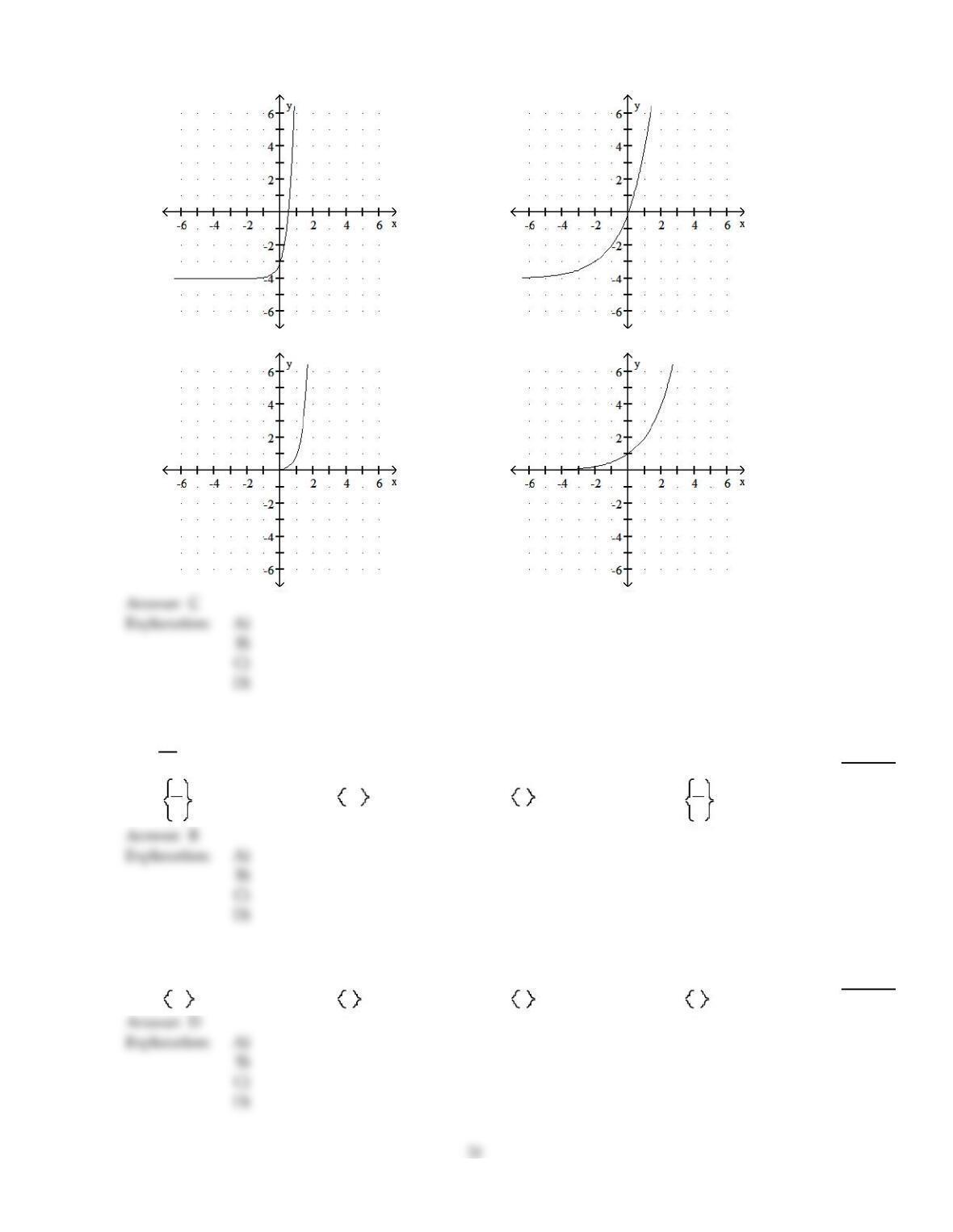
A)
B)
C)
D)
Solve the equation. Give the exact solution.
77)
5x=1
25
77)
A)
1
2
B)
–2
C)
2
D)
1
5
Solve the equation.
78)
4x=256
78)
A)
64
B)
5
C)
3
D)
4
Solve the problem.
79)
Sumi Kato’s savings account has a balance of $4119. After 19 years, what will the amount of interest
be at 1.5% compounded annually?
79)
A)
$1352.71
B)
$1346.71
C)
$7826.10
D)
$1335.71
Decide whether each function is one–to–one.
80)
(i) f(x) = x2+ 5
(ii)
80)
A)
(i) Yes; (ii) No
B)
(i) Yes; (ii) Yes
C)
(i) No; (ii) Yes
D)
(i) No; (ii) No
Express the given logarithm as a sum and/or difference of logarithms. Simplify, if possible. Assume that all variables
represent positive real numbers.
81)
log 4
3p5q
t2
81)
A)
3log 4p+ 5 log 4q– 2 log 4t
B)
3
4log 4p+5
4log 4q–2
4log 4t
C)
1
3log 4p·1
5log 4q÷ 2 log 4t
D)
1
3log 4p+1
5log 4q– 2 log 4t
Solve the problem.
82)
A city is growing at the rate of 0.4% annually. If there were 4,595,000 residents in the city in 1993,
find how many (to the nearest ten–thousand) were living in that city in 2000. Use
y =4,595,000(2.7)0.004t
82)
A)
12,410,000
B)
4,750,000
C)
4,720,000
D)
350,000
Determine whether or not the function is one–to–one.
83)
{(10, 4), (20, 17), (18, 9)}
83)
A)
Yes
B)
No
Solve the problem.
84)
Barry Newman’s savings account has a balance of $4239. After 20 years, what will the amount of
interest be at 5% compounded annually?
84)
A)
$7013.33
B)
$2119.50
C)
$6999.33
D)
$7008.33
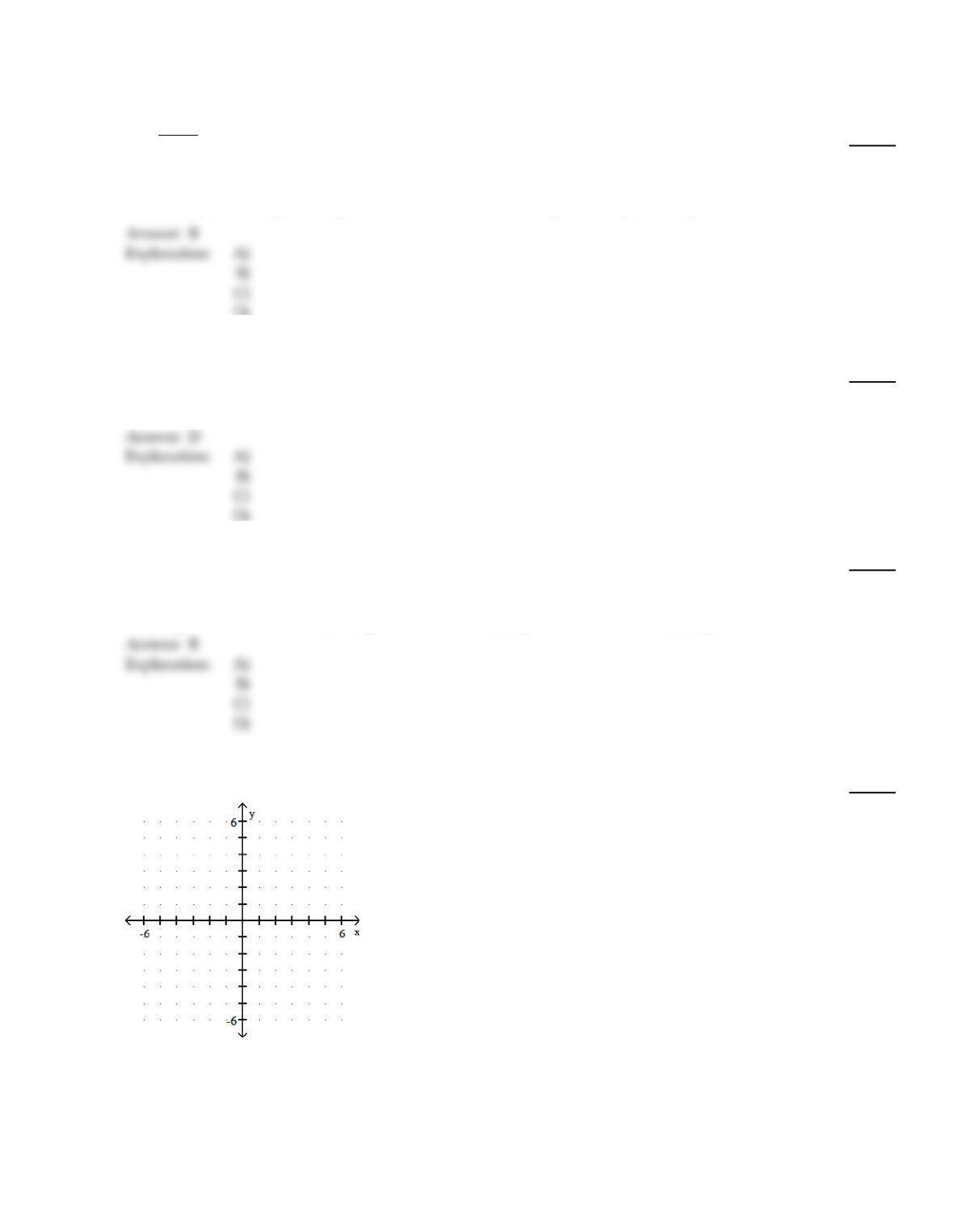
Graph the given function as a solid line (or curve) and its inverse as a dashed line (or curve) on the same set of axes.
85)
f(x) =5x
85)
23
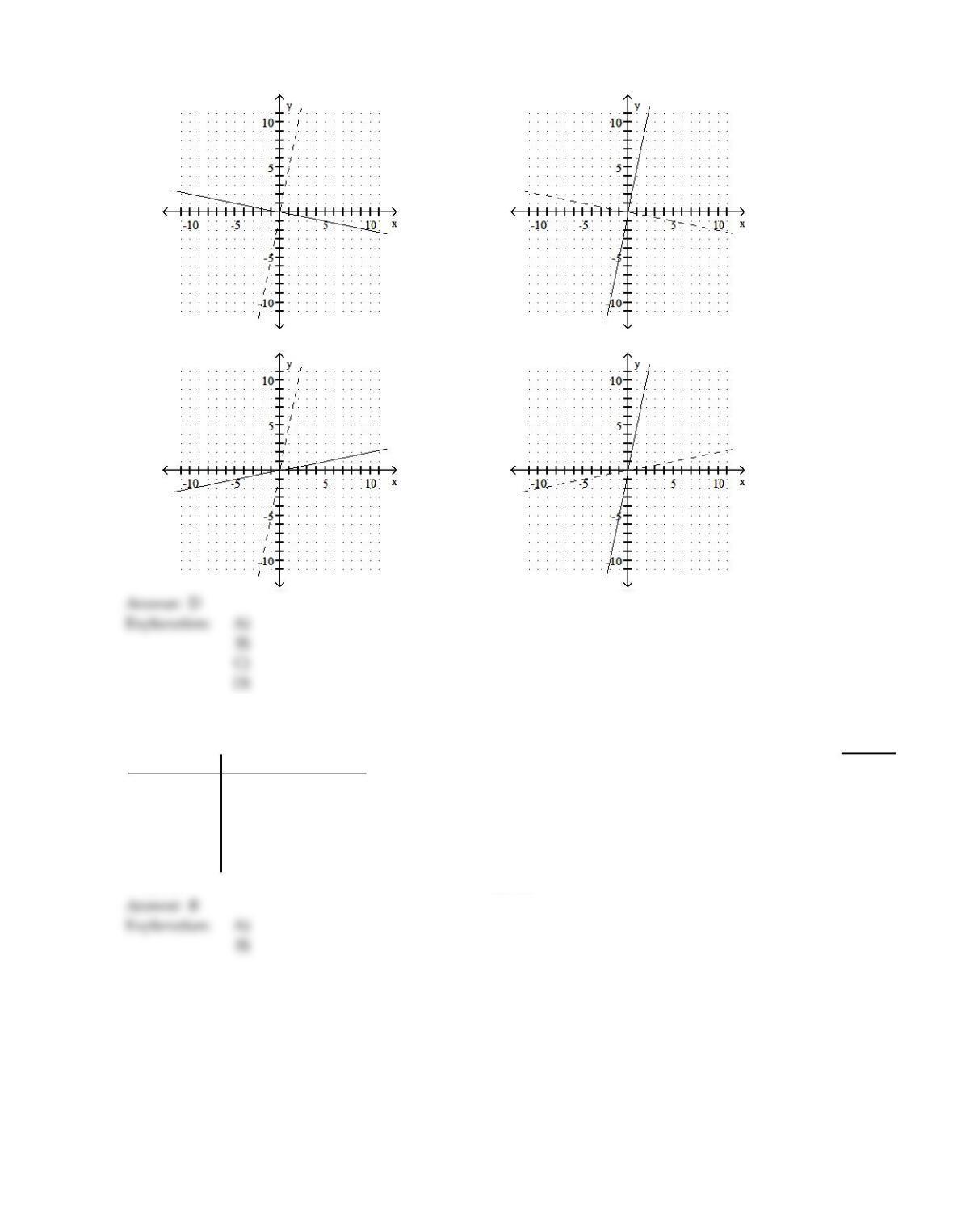
A)
B)
C)
D)
Determine whether or not the function is one–to–one.
86)
This chart shows the number of living relatives in five families.
Family Name Number of Relatives
Cohen 8
Kim 15
Carlson 16
O’Leary 19
Robinson 21
86)
A)
No
B)
Yes
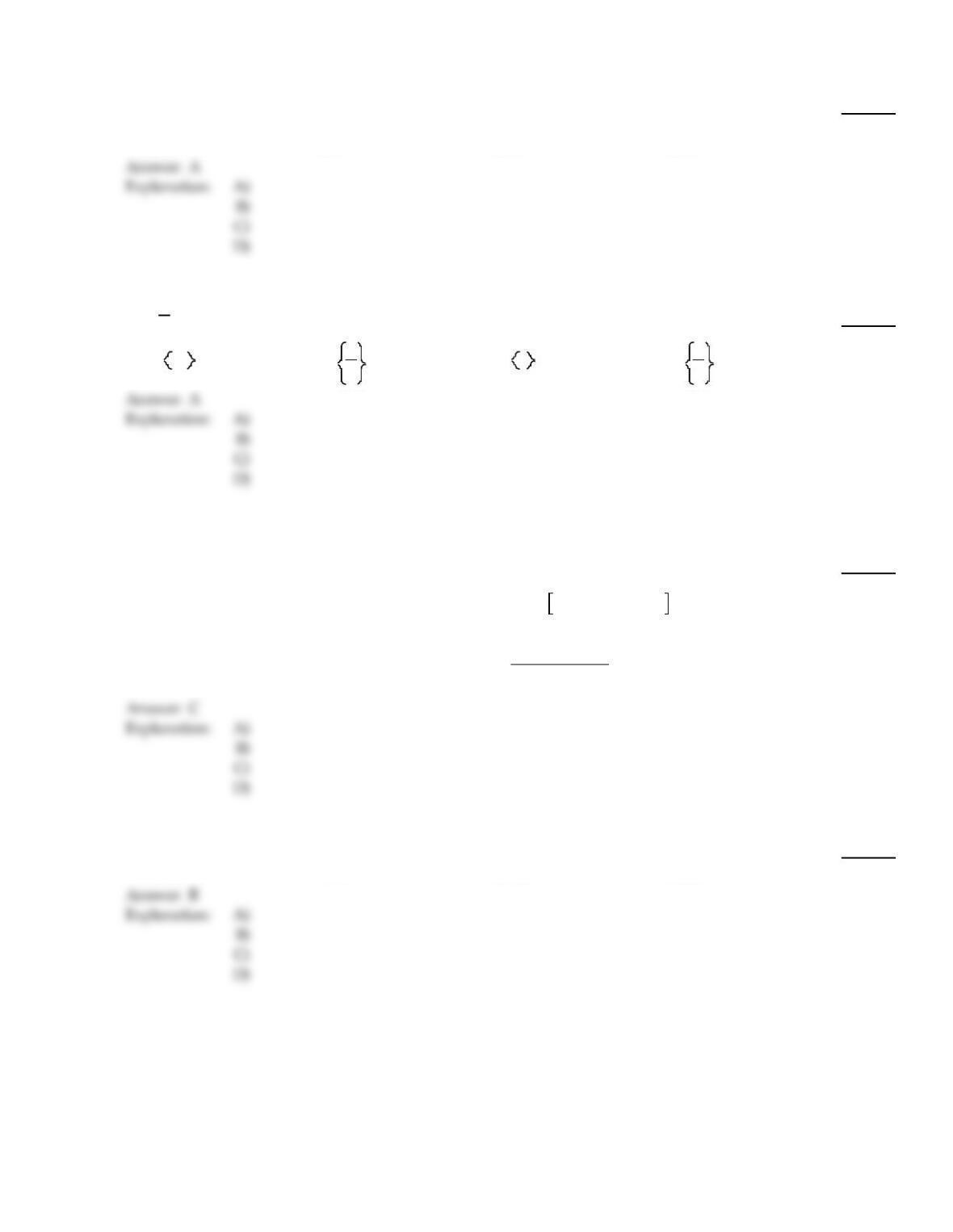
Graph the given function as a solid line (or curve) and its inverse as a dashed line (or curve) on the same set of axes.
24
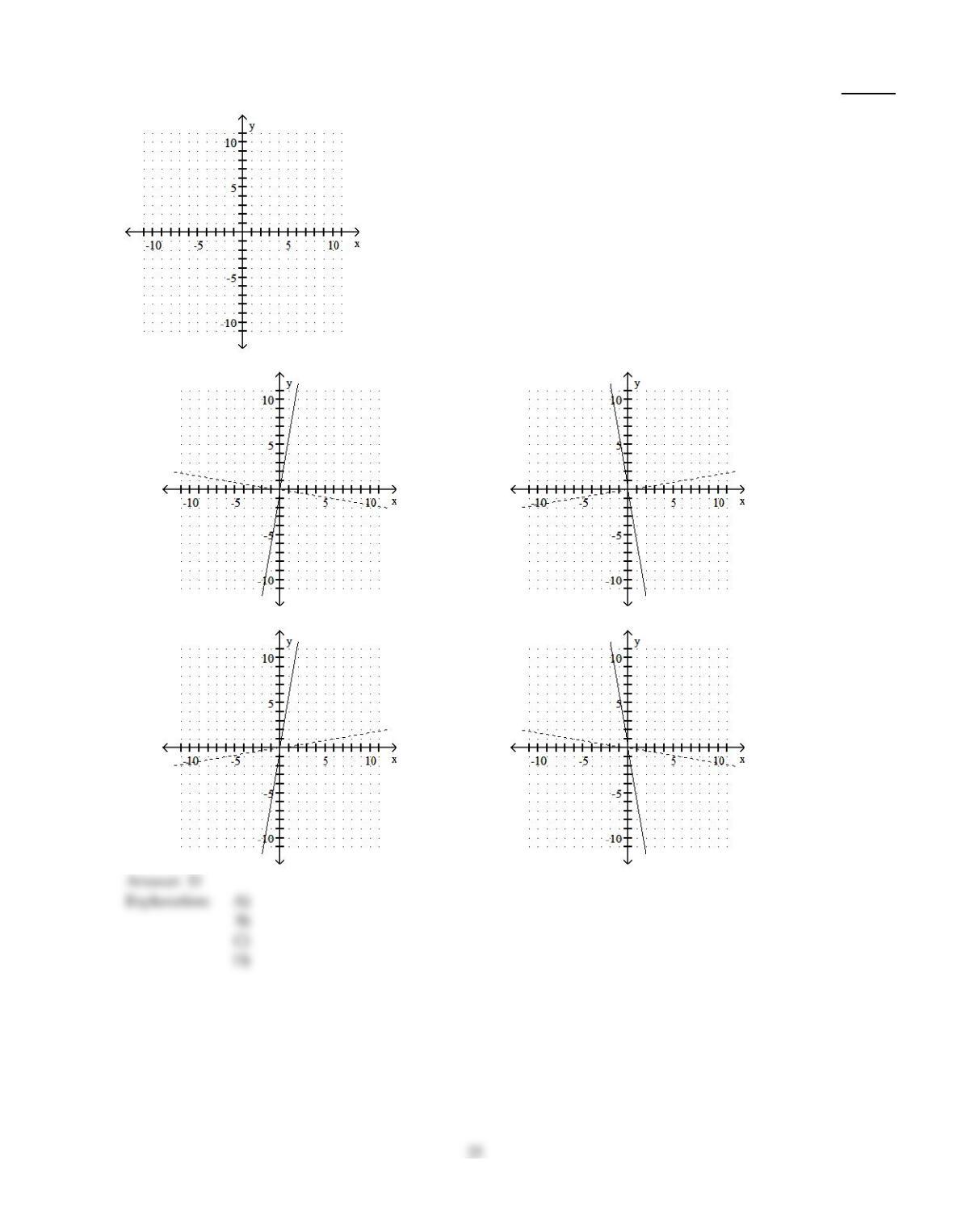
87)
f(x) = – 6x
87)
A)
B)
C)
D)
Solve the problem.
88)
Find the amount of money in an account after 8 years if $1000 is deposited at 7% annual interest
compounded semiannually.
88)
A)
$1733.99
B)
$1718.19
C)
$1747.83
D)
$1742.21
Solve the equation.
89)
2x=1
8
89)
A)
–3
B)
1
4
C)
3
D)
1
3
Rewrite the given expression as a single logarithm. Assume that all variables are defined in such a way that variable
expressions are positive and bases are positive numbers not equal to 1.
90)
logw (x2–25) –logw (x –5)
90)
A)
logw (x2–25)(x –5)
B)
logw(x2–25) – (x –5)
C)
logw (x +5)
D)
logw (x2–25)
logw (x –5)
Solve the equation. Give the exact solution or solutions.
91)
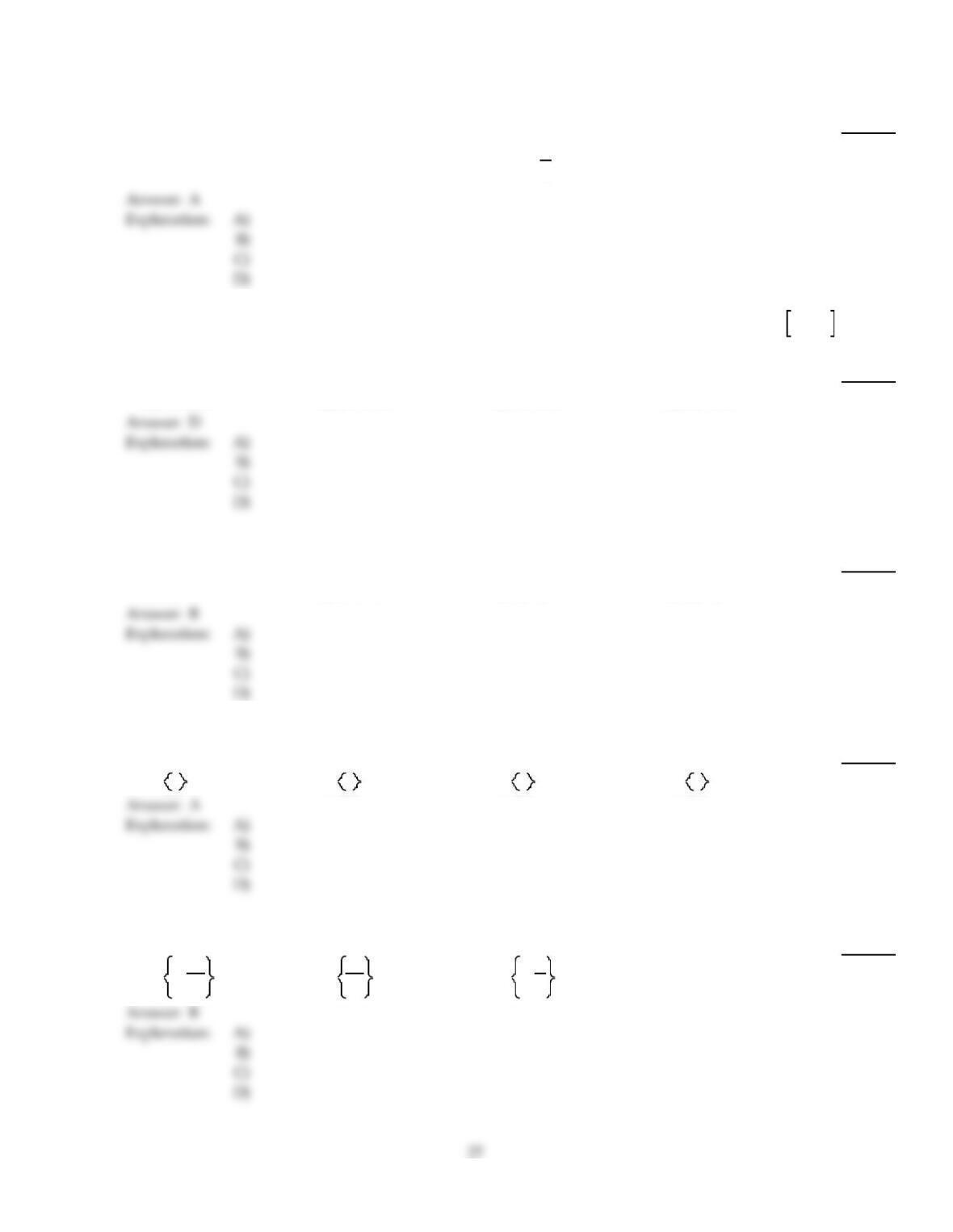
log 4(2x + 8 ) = log 4(2x + 5 )
91)
A)
{3}
B)
C)
{2}
D)
{0}
26
Rewrite the given expression as a single logarithm. Assume that all variables are defined in such a way that variable
expressions are positive and bases are positive numbers not equal to 1.
92)
logt 6 +logts
92)
A)
logt 6s
B)
logt 6 ·logts
C)
logt
6
s
D)
logt (6 +s)
Solve the problem. Round your answer to the nearest tenth, when appropriate. Use the formula pH = – log H3O+, as
needed.
93)
Find [H3O+] if the pH =13 .
93)
A)
3.0 x 10 –13
B)
2.0 x 10 13
C)
1.0 x 10 13
D)
1.0 x 10 –13
Provide an appropriate response.
94)
What is the range of the function y =log 2x?
94)
A)
(0, )
B)
( , )
C)
[0, )
D)
(2, )
Solve the equation.
95)
log 2x =3
95)
A)
8
B)
6
C)
9
D)
5
Solve the equation. Give the exact solution or solutions.
96)
log(4x – 3) = log 9– log(x – 3)
96)
A)
0, 15
4
B)
15
4
C)
3, 3
4
D)
Solve the equation.
97)
log 446= x
97)
A)
6
B)
6
C)
12
D)
24
Solve the problem.
98)
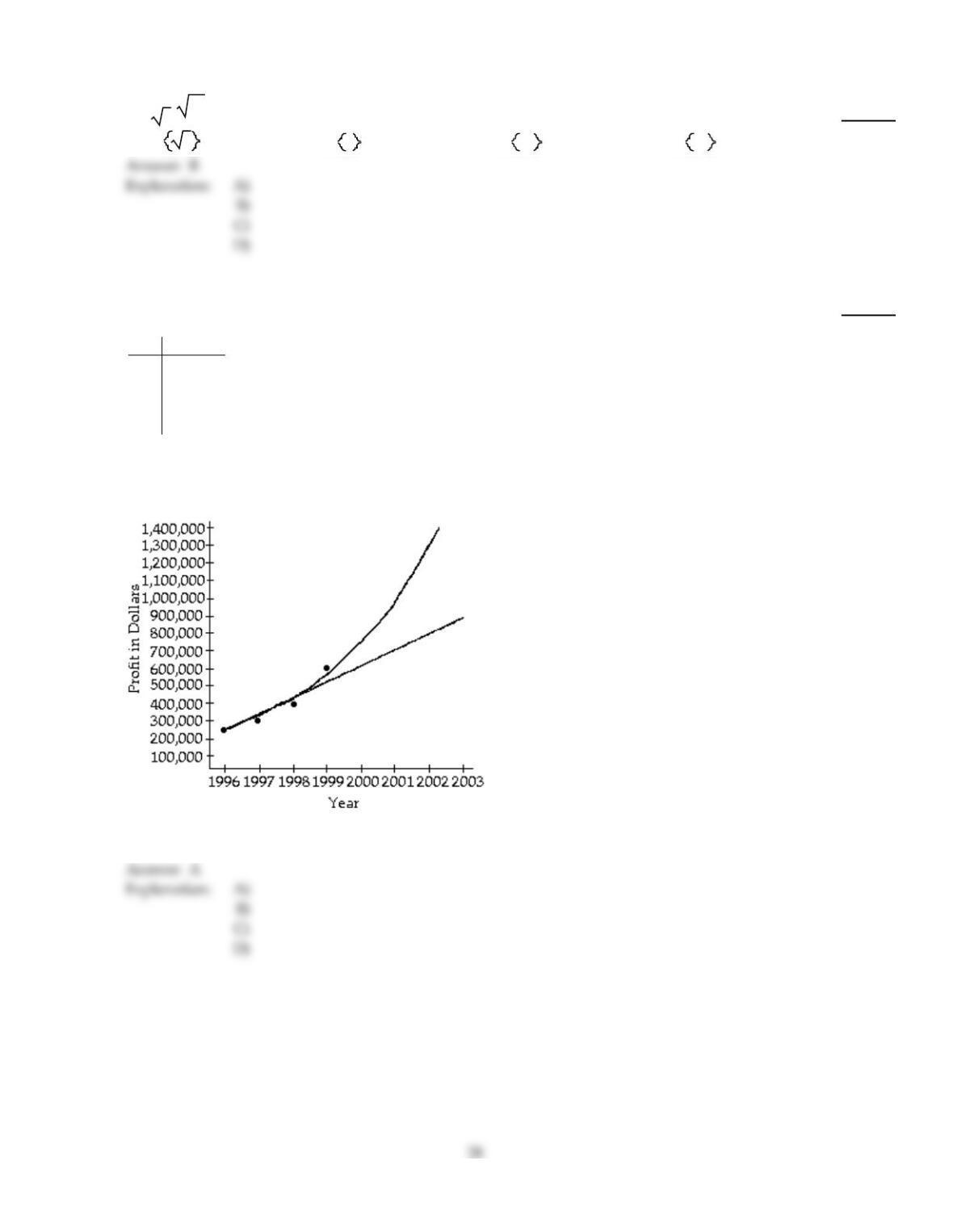
An accountant tabulated a firm’s profits for four recent years in the following table:
Year Profits
1996 $250,000
1997 $300,000
1998 $400,000
1999 $600,000
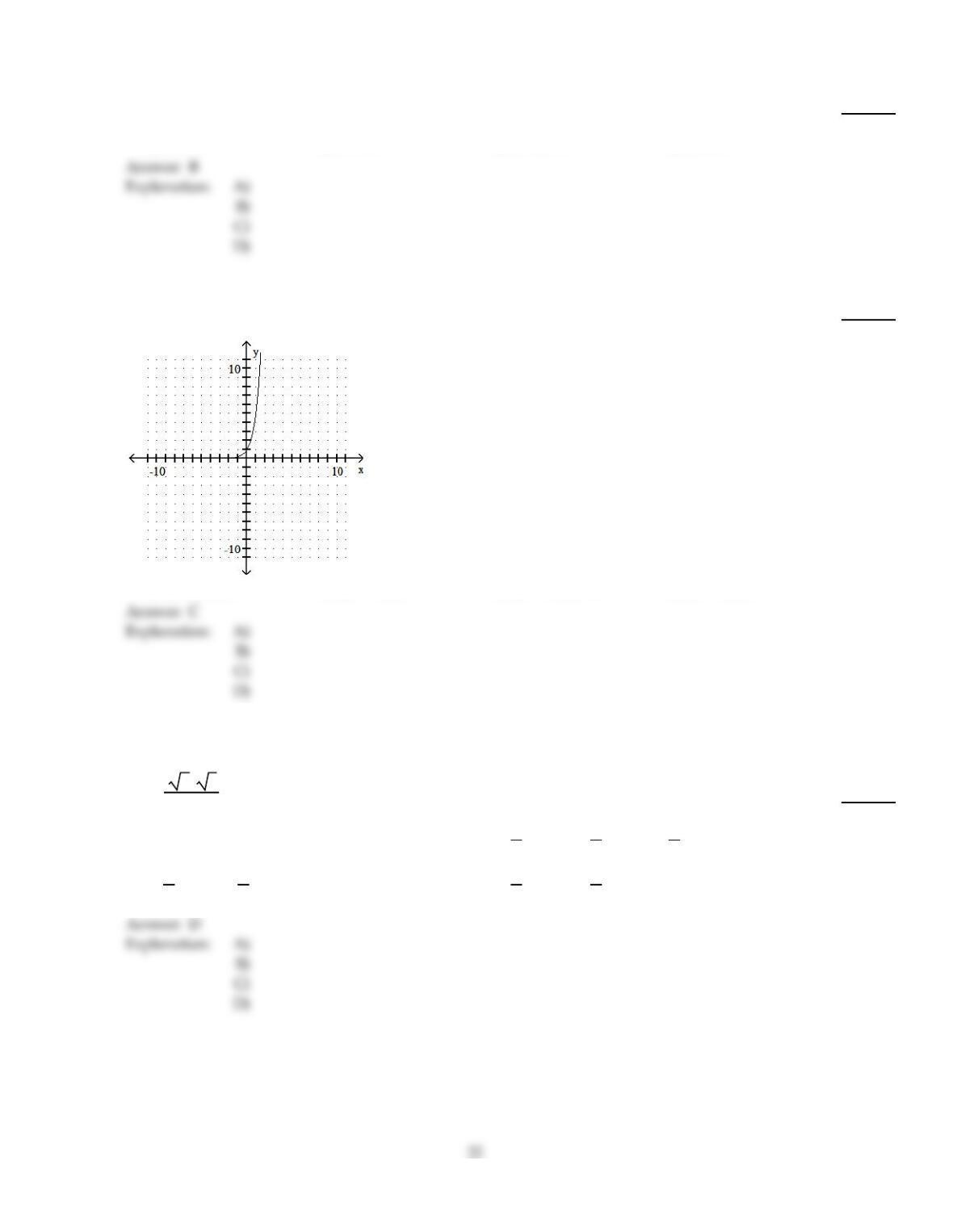
The accountant then fit both a linear graph and an exponential curve (seen below) to the data, in
order to estimate future profits. Use the exponential graph to estimate the profits in the year 2002.
98)
A)
About $1,300,000
B)
About $1,700,000
C)
About $750,000
D)
About $1,000,000
Evaluate the given logarithm by applying the appropriate rule(s). DO NOT USE A CALCULATOR.
99)
Given log 10 2 = 0.3010 and log 10 3 = 0.4771, evaluate log 10 6.
99)
A)
0.9030
B)
0.7781
C)
0.1436
D)
0.9542
Solve the problem.
100)
A computer is purchased for $4300. Its value each year is about 75% of the value the preceding
year. Its value, in dollars, after t years is given by the exponential function V(t) =4300(0.75)t. Find
the value of the computer after 9 years.
100)
A)
$322.86
B)
$181.61
C)
$29,025.00
D)
$242.15
Solve the equation.
101)
log4 (x + 2) +log4 (x – 4) =2
101)
A)
x = – 4
B)
x =6, x = – 4
C)
x =6
D)
x =7
Solve the problem.
102)
The loudness of a sound can be approximated by the formula d = 10 log10 I
Io, where d is the
number of decibels. The higher the value of d, the louder the sound. Find the number of decibels
when I =10,000 and Io= 1.
102)
A)
10,000 decibels
B)
40 decibels
C)
4 decibels
D)
14 decibels
103)
The population growth of an animal species is described by F(t) =500 + 30 log3 (2t + 1) where t is
measured in months. Find the population of this species in an area 13 month(s) after the species is
introduced.
103)
A)
675
B)
305
C)
590
D)
1310
If the following defines a one–to–one function, find its inverse. If not, write “Not one–to–one.”
104)
f(x) =x + 3
104)
A)
f–1(x) = x2– 3, x 0
B)
f–1(x) = (x + 3)2
C)
f–1(x) =x – 3
D)
Not one–to–one
Determine whether or not the function is one–to–one.
105)
f(x) =3x2+ 2
105)
A)
No
B)
Yes
30
Provide an appropriate response.
106)
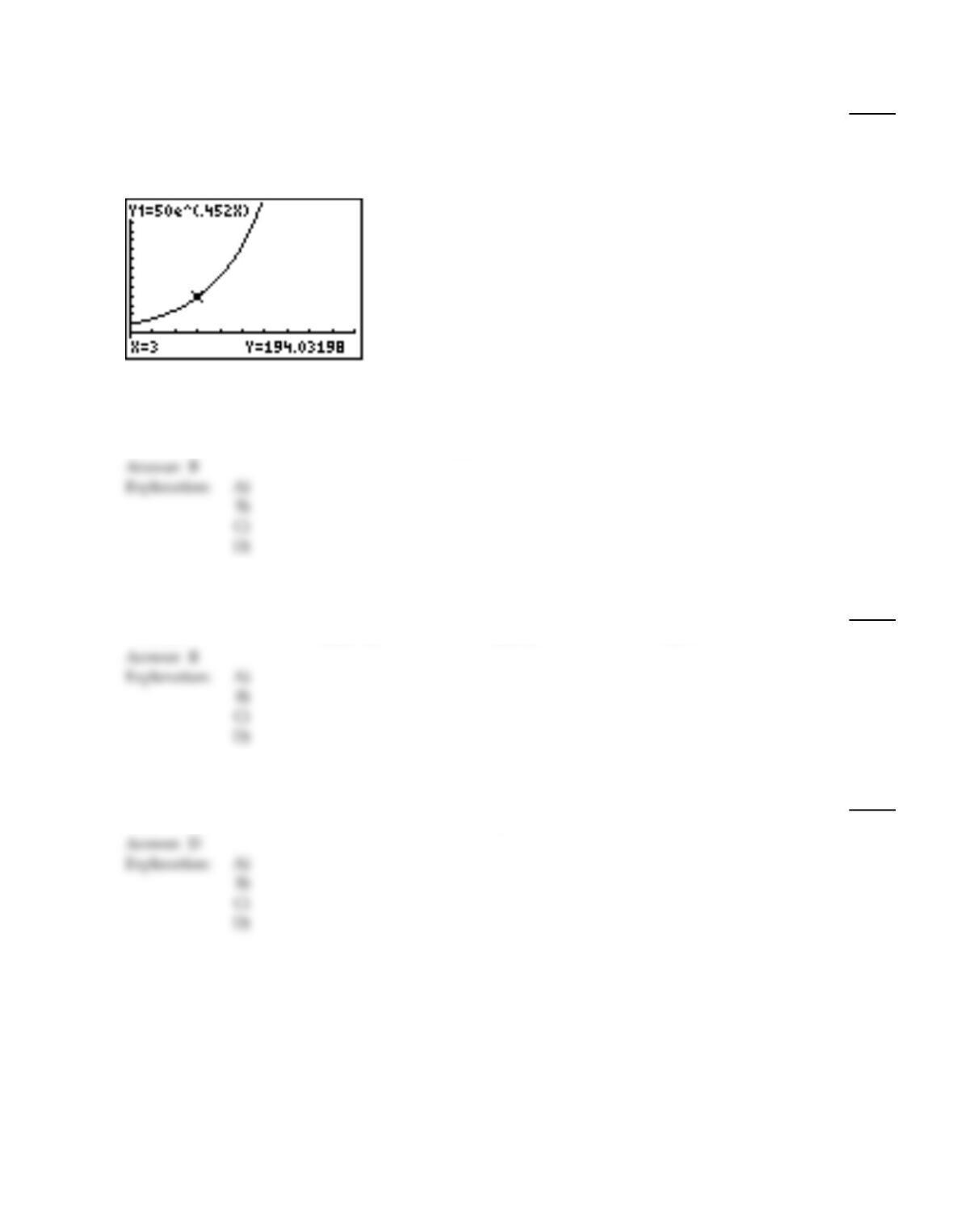
The total number N of rabbits on a farmer’s property, assuming unlimited resources and space, can
be approximated by the function N(x) = 50e0.452x, where x = 0 corresponds to the initial number of
rabbits, and x = 1 corresponds to the number of rabbits after one year, and so on. The function is
graphed on a graphing calculator–generated screen. Interpret the meanings of x and y in the
display at the bottom of the screen.
106)
A)
It means that after 3 years, there will be approximately 50 rabbits on the farm.
B)
It means that after 3 years, there will be approximately 194 rabbits on the farm.
C)
It means that with 194 rabbits on the farm, 3 new offspring will be born that year.
D)
It means that after 3 months, there will be approximately 194 rabbits on the farm.
Solve the equation. Give the exact solution or solutions.
107)
log 2 x2= log 2 (2x + 15)
107)
A)
{5}
B)
{5, –3}
C)
{–3}
D)
Solve the equation. Give the solution to three decimal places.
108)
6x + 1 =32
108)
A)
{1.934 }
B)
{2.934 }
C)
{5.210 }
D)
{0.934}
31
Write in logarithmic form.
109)
10–4=0.0001
109)
A)
log 10 –4=0.0001
B)
log 4–4= 0.10
C)
log 40.10 = – 4
D)
log 10 0.0001 = – 4
Solve the equation. Give the exact solution or solutions.
110)
log (x + 5 ) = log ( 2x – 1 )
110)
A)
{6}
B)
{–6}
C)
D)
{0}
A
Write in exponential form.
111)
log1/81 1
3=1
4
111)
A)
1
3
1/4=1
81
B)
1
81
1/4=1
3
C)
1
4
1/81 =1
3
D)
1
81
1/3=1
4
B
Solve the problem.
112)
The function Y(x) =51.38 ln x
4.5 can be used to estimate the number of years Y(x) after 1980
required for a certain country’s population to reach x million people. In what year will the country’s
population reach 13 million?
112)
A)
About 2025
B)
About 2040
C)
About 2045
D)
About 2035
D
Determine whether or not the function is one–to–one.
113)
The function that pairs a student’s ID number with their GPA.
113)
A)
No
B)
Yes
A
D
Use properties of logarithms to write each expression as a sum or difference of logarithms. Assume that variables
represent positive real numbers.
114)
log 6xy2
114)
A)
log 6x + 2 log 6y
B)
log 3x +log 3y
C)
2log 6x –log 6y
D)
2log 3x – 2 log 3y
Express the given logarithm as a sum and/or difference of logarithms. Simplify, if possible. Assume that all variables
represent positive real numbers.
115)
log 3(209 ·244)
115)
A)
log 209 3+log 244 3
B)
log 33+log 209 209 +log 244 244
C)
log 350,996 +log 350,996
D)
log 3209 +log 3244
Evaluate the logarithm.
116)
log 1/91
116)
A)
–1
B)
1
C)
2
D)
0
Write in logarithmic form.
117)
70= 1
117)
A)
log01 =7
B)
log7 0 = 1
C)
log17= 0
D)
log7 1 = 0
Solve the problem.
118)
The space (in m3) in a landfill decreases with time as given by the function
F(t) =260 –30 log 5(4t + 1), where t is measured in years. How much space is left when t =6?
118)
A)
110 m3
B)
180 m3
C)
200 m3
D)
320 m3
Evaluate the logarithm.
119)
log 22
119)
A)
–2
B)
–1
2
C)
2
D)
1
2
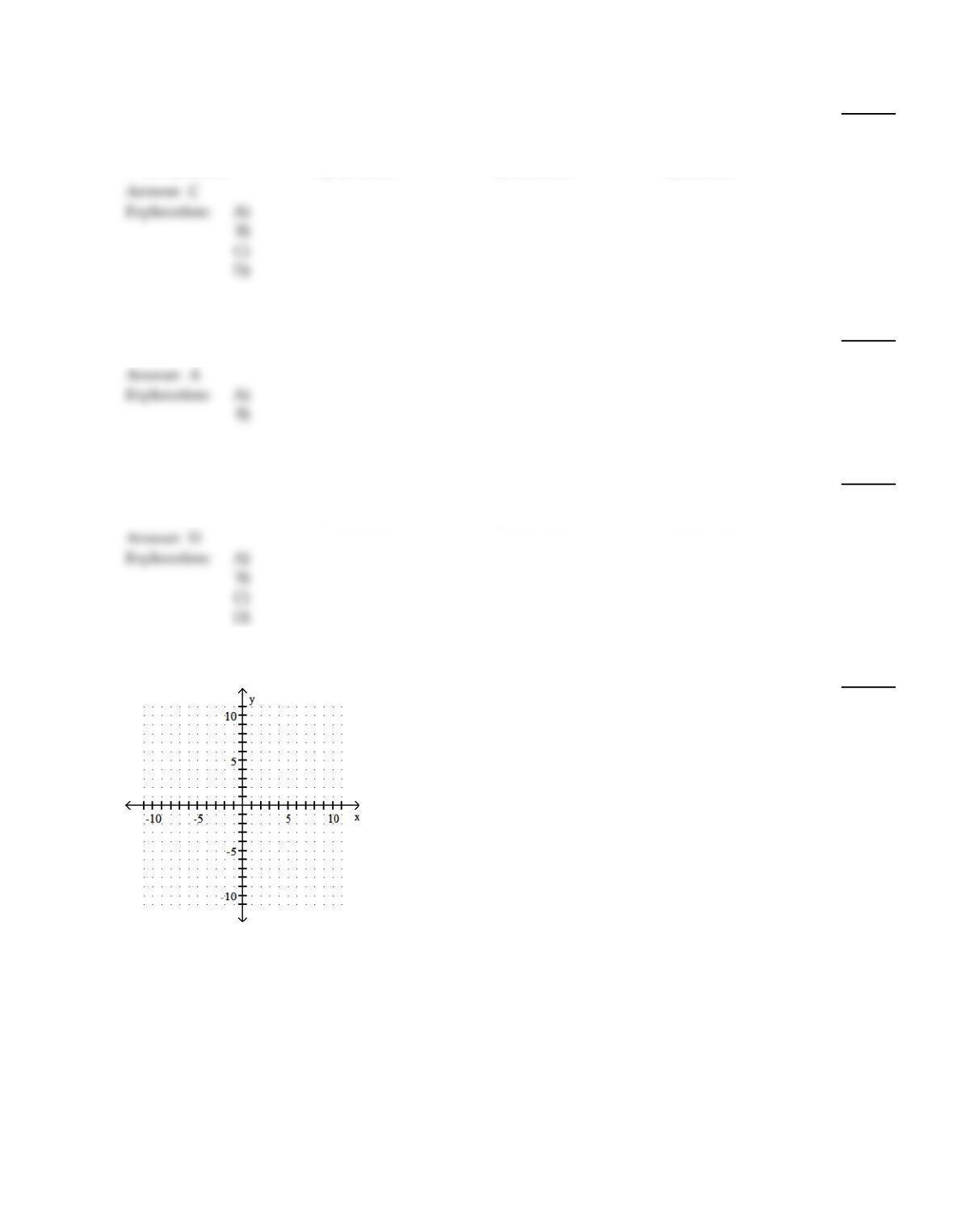
Graph the function.
120)
f(x) =3x
120)
A)
B)
34
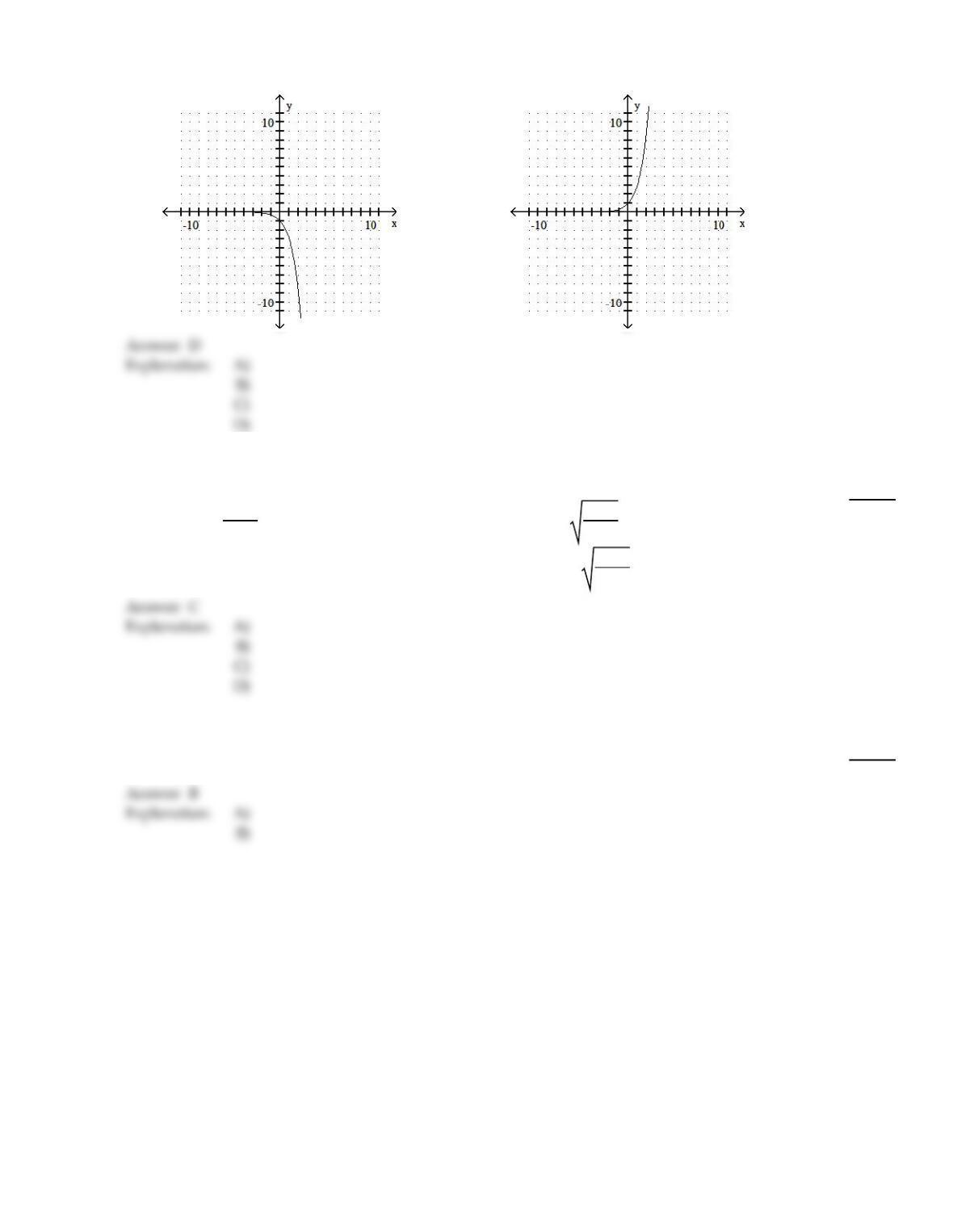
C)
D)
If the following defines a one–to–one function, find its inverse. If not, write “Not one–to–one.”
121)
f(x) =4x2+ 8
121)
A)
f–1(x) =x – 8
4
B)
f–1(x) =x – 8
4
C)
Not one–to–one
D)
f–1(x) = ± x – 8
4
Determine whether or not the function is one–to–one.
122)
f(x) = x2+ 3
122)
A)
Yes
B)
No
35
Express the given logarithm as a sum and/or difference of logarithms. Simplify, if possible. Assume that all variables
represent positive real numbers.
123)
logn5 4x3
z7
123)
A)
1
5log n4–3
5log nx –7
5log nz
B)
1
5log n4+3
5log nx +7
5log nz
C)
1
5log n4+3
5log nx –7
5log nz
D)
1
5log n4+ 3 log nx – 7 log nz
Find the indicated value.
124)
Let f(x) =3x. f–11
81
124)
A)
–1
81
B)
–4
C)
–3
D)
4
Write in exponential form.
125)
log 4
1
16 = – 2
125)
A)
1
16
2=4
B)
24=1
16
C)
4–2=1
16
D)
416 =2
Solve the equation.
126)
log 81 = x
126)
A)
0
B)
1
C)
64
D)
8
Express the given logarithm as a sum and/or difference of logarithms. Simplify, if possible. Assume that all variables
represent positive real numbers.
127)
log5x7 y6
7
127)
A)
7log 5x + 6 log 5y +log 57
B)
7log 5x + 6 log 5y –log 57
C)
7log 5x – 6 log 5y –log 57
D)
(7 log 5x)(6log 5y) –log 57
D)
Solve the problem.
128)
$1000 is invested at 6% compounded quarterly. In how many years will the account have grown to
$14,000? Round your answer to the nearest tenth of a year.
128)
A)
45.3 years
B)
1.6 years
C)
23.0 years
D)
44.3 years
D)
129)
A sample of 400 grams of radioactive substance decays according to the function A(t) =400e–0.025t,
where t is the time in years. How much of the substance will be left in the sample after 20 years?
Round your answer to the nearest whole gram.
129)
A)
0 g
B)
243 g
C)
1 g
D)
33 g
D)
Graph the given logarithmic function.
130)
y =log 2x
130)
37
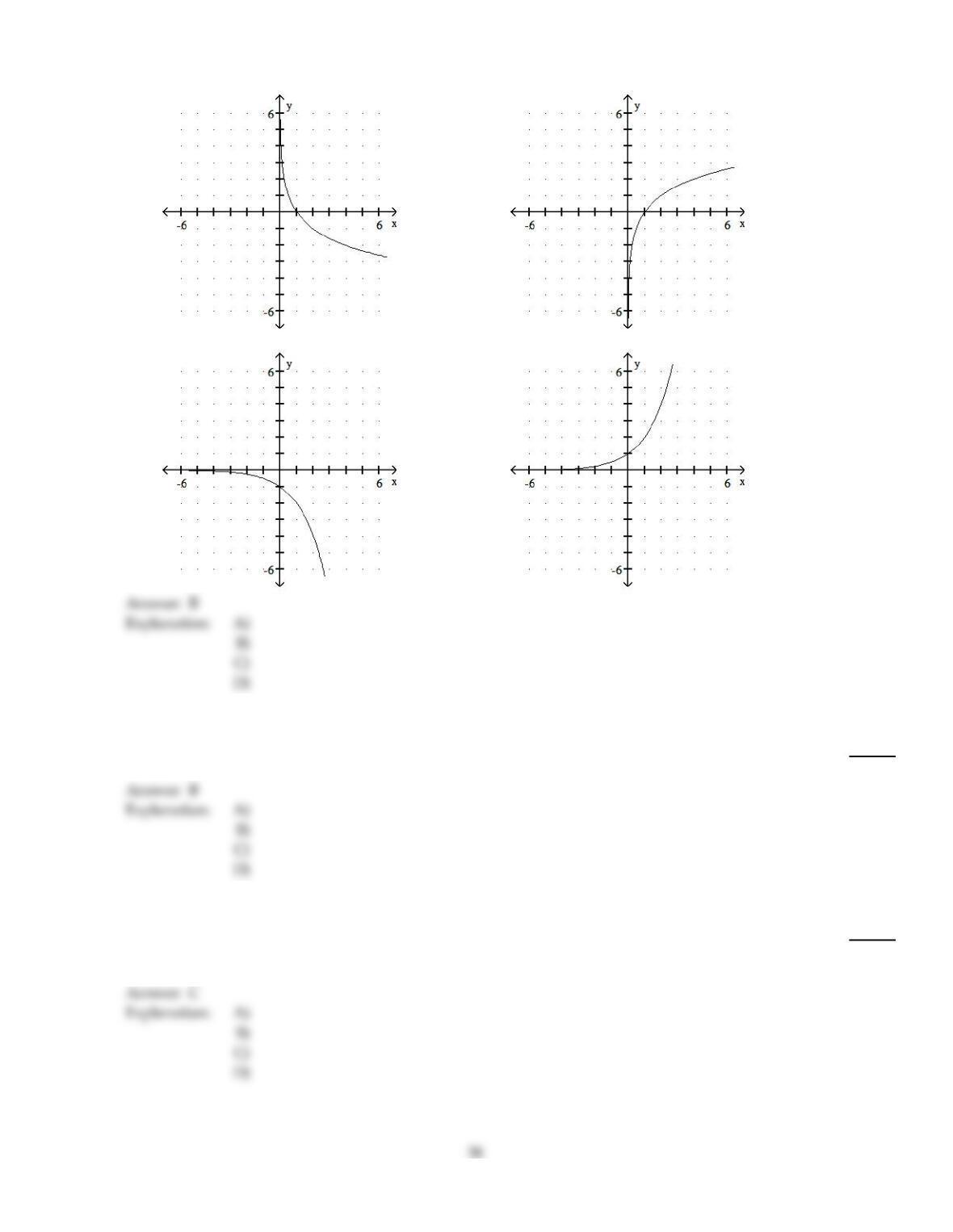
A)
B)
C)
D)
Solve the equation. Give the solution to three decimal places.
131)
3 x – 1 =20
131)
A)
{2.897}
B)
{3.727}
C)
{1.727}
D)
{7.667}
If the following defines a one–to–one function, find its inverse. If not, write “Not one–to–one.”
132)
{(1, 11), (–13, 11), (–5, –7)}
132)
A)
{(1, 11), (11, –13), (–7, –5)}
B)
{(11, 1), (11, –13), (–7, –5)}
C)
Not one–to–one
D)
{(11, 1), (–5, –13), (–7, 11)}
Write in logarithmic form.
133)
105=100,000
133)
A)
log 5100,000 = 10
B)
log 10 100,000 =5
C)
log 510 =100,000
D)
log 10 5=100,000
Solve the problem.
134)
The decibel level D of a sound is related to its intensity I by D = 10 log I
Io. If Io is 10–12, then what
is the intensity of a noise measured at 63 decibels? Express your answer in scientific notation,
rounding to three significant digits, if necessary.
134)
A)
5.45 × 10¹⁴ watt/m2
B)
2× 10⁻⁵ watt/m2
C)
2× 10⁻⁶ watt/m2
D)
6.3 × 10⁻¹⁰ watt/m2
Determine whether or not the function is one–to–one.
135)
f(x) =5x – 6
135)
A)
Yes
B)
No
Solve the problem.
136)
Coyotes are one of the few species of North American animals with an expanding range. The future
population P of coyotes in a region of Mississippi can be modeled by the equation
P(t) =55 +17 ln(18t + 1), where t is time in years. How long will it take for the population to reach
140? Round your answer to the nearest tenth, if necessary.
136)
A)
5517 years
B)
8.3 years
C)
8.2 years
D)
8.4 years
Find f–1(x) for the one–to–one function f(x) shown.
137)
f(x) =3x + 7
137)
A)
f–1(x) =x2+ 7
B)
f–1(x) =x3– 7
C)
f–1(x) =x2– 7
D)
f–1(x) =x3+ 7
Use a calculator and the change–of–base formula to find the logarithm to four decimal places.
138)
log33 42.22
138)
A)
0.9342
B)
1.0705
C)
1.2794
D)
1.6255
Determine whether or not the function is one–to–one.
139)
f(x) =36 – x2
139)
A)
Yes
B)
No
Solve the problem.
140)
The function A =A0e–0.01386x models the amount in pounds of a particular radioactive material
stored in a concrete vault, where x is the number of years since the material was put into the vault.
If 400 pounds of the material are initially put into the vault, how many pounds will be left after 140
years?
140)
A)
560 lb
B)
71 lb
C)
312 lb
D)
57 lb
Express as a product.
141)
log b33
141)
A)
blog 30 33
B)
3log b33
C)
3log b3
D)
blog 33