Chapter 12 – Differential Analysis: The Key to Decision Making
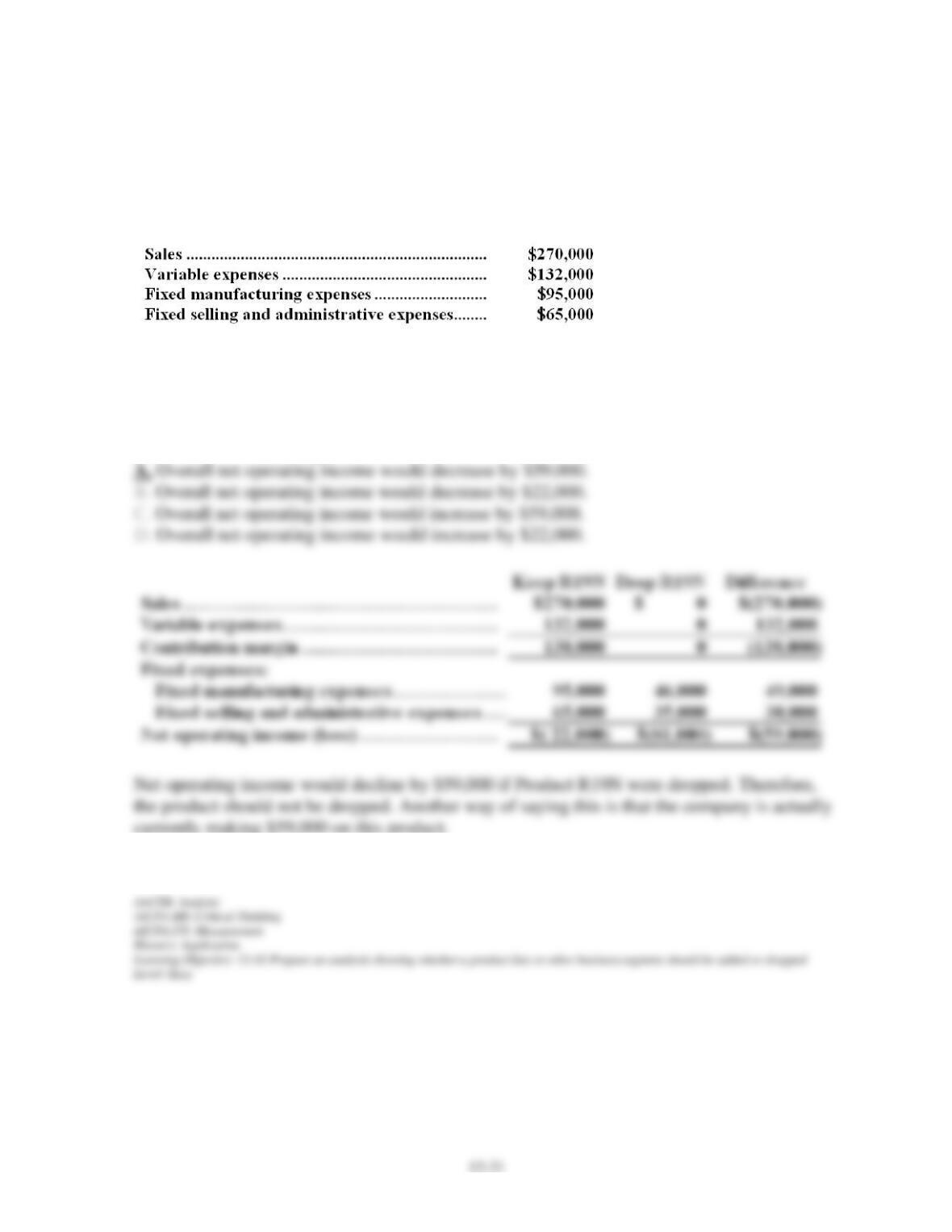
35. Product R19N has been considered a drag on profits at Buzzeo Corporation for some time
and management is considering discontinuing the product altogether. Data from the
company’s accounting system appear below:
In the company’s accounting system all fixed expenses of the company are fully allocated to
products. Further investigation has revealed that $49,000 of the fixed manufacturing expenses
and $30,000 of the fixed selling and administrative expenses are avoidable if product R19N is
discontinued. What would be the effect on the company’s overall net operating income if
product R19N were dropped?
Chapter 12 – Differential Analysis: The Key to Decision Making
36. Lusk Company produces and sells 15,000 units of Product A each month. The selling
price of Product A is $20 per unit, and variable expenses are $14 per unit. A study has been
made concerning whether Product A should be discontinued. The study shows that $70,000 of
the $100,000 in fixed expenses charged to Product A would continue even if the product was
discontinued. These data indicate that if Product A is discontinued, the company’s overall net
operating income would:
Chapter 12 – Differential Analysis: The Key to Decision Making
37. Peluso Company, a manufacturer of snowmobiles, is operating at 70% of plant capacity.
Peluso’s plant manager is considering making the headlights now being purchased from an
outside supplier for $11 each. The Peluso plant has idle equipment that could be used to
manufacture the headlights. The design engineer estimates that each headlight requires $4 of
direct materials, $3 of direct labor, and $6.00 of manufacturing overhead. Forty percent of the
manufacturing overhead is a fixed cost that would be unaffected by this decision. A decision
by Peluso Company to manufacture the headlights should result in a net gain (loss) for each
headlight of:
Chapter 12 – Differential Analysis: The Key to Decision Making
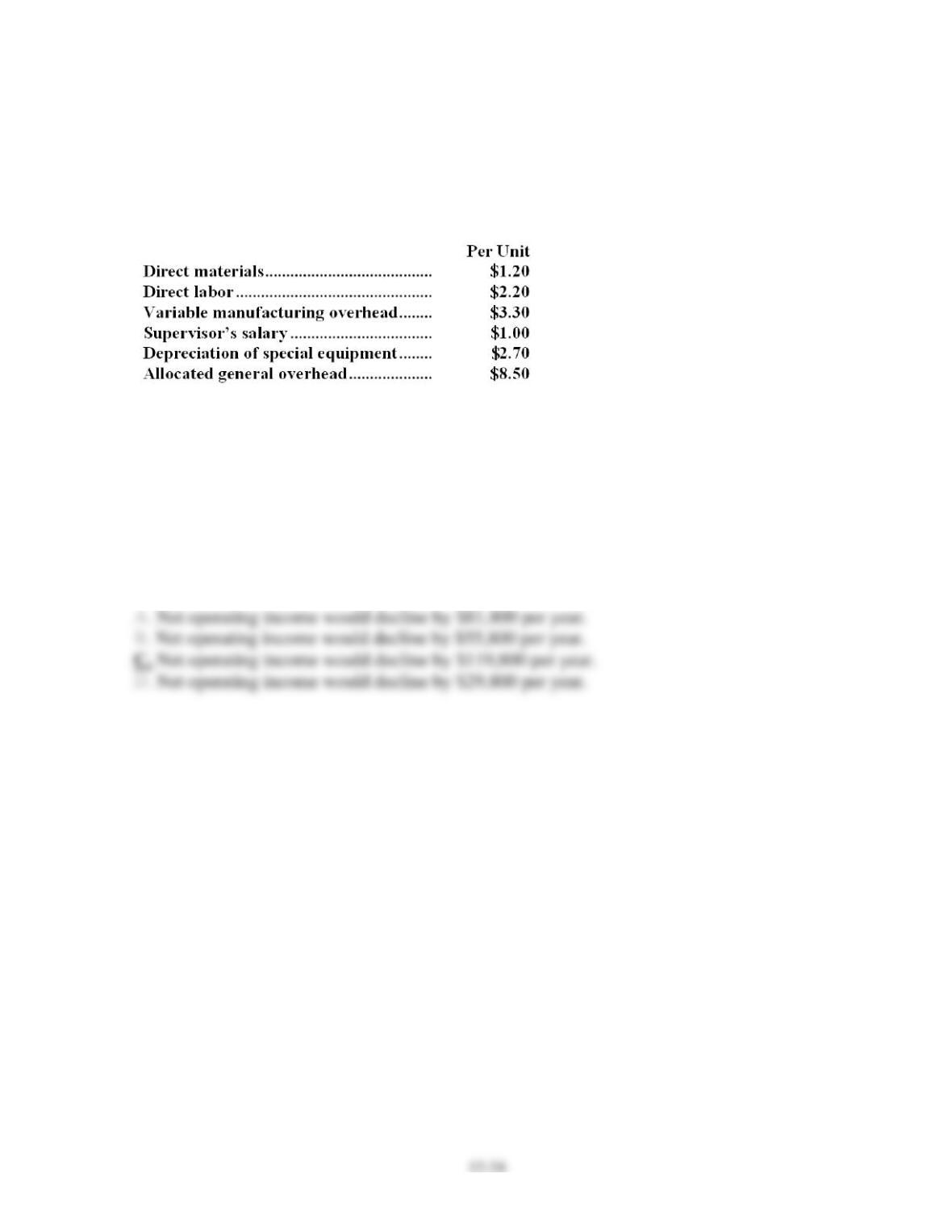
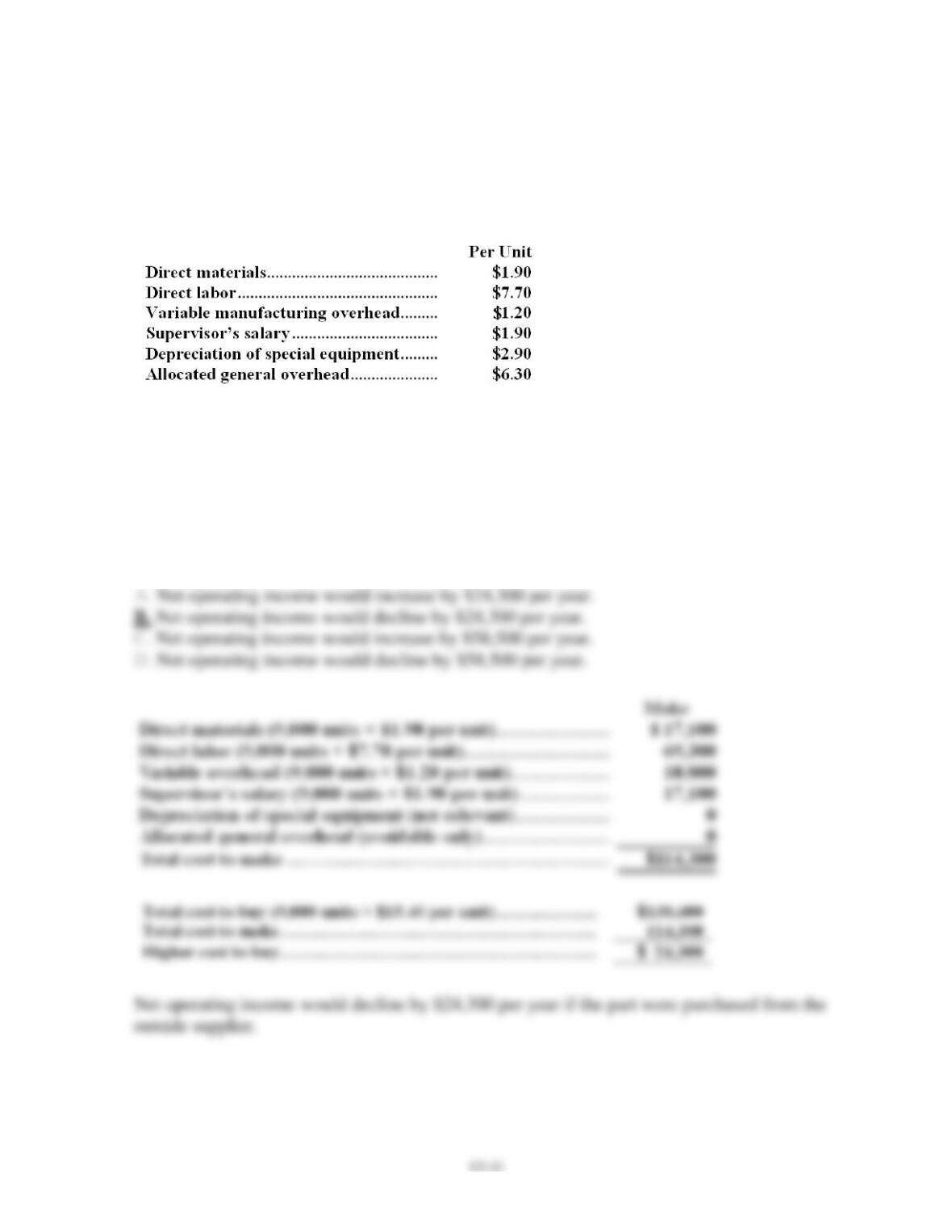
38. Part I51 is used in one of Pries Corporation’s products. The company makes 18,000 units
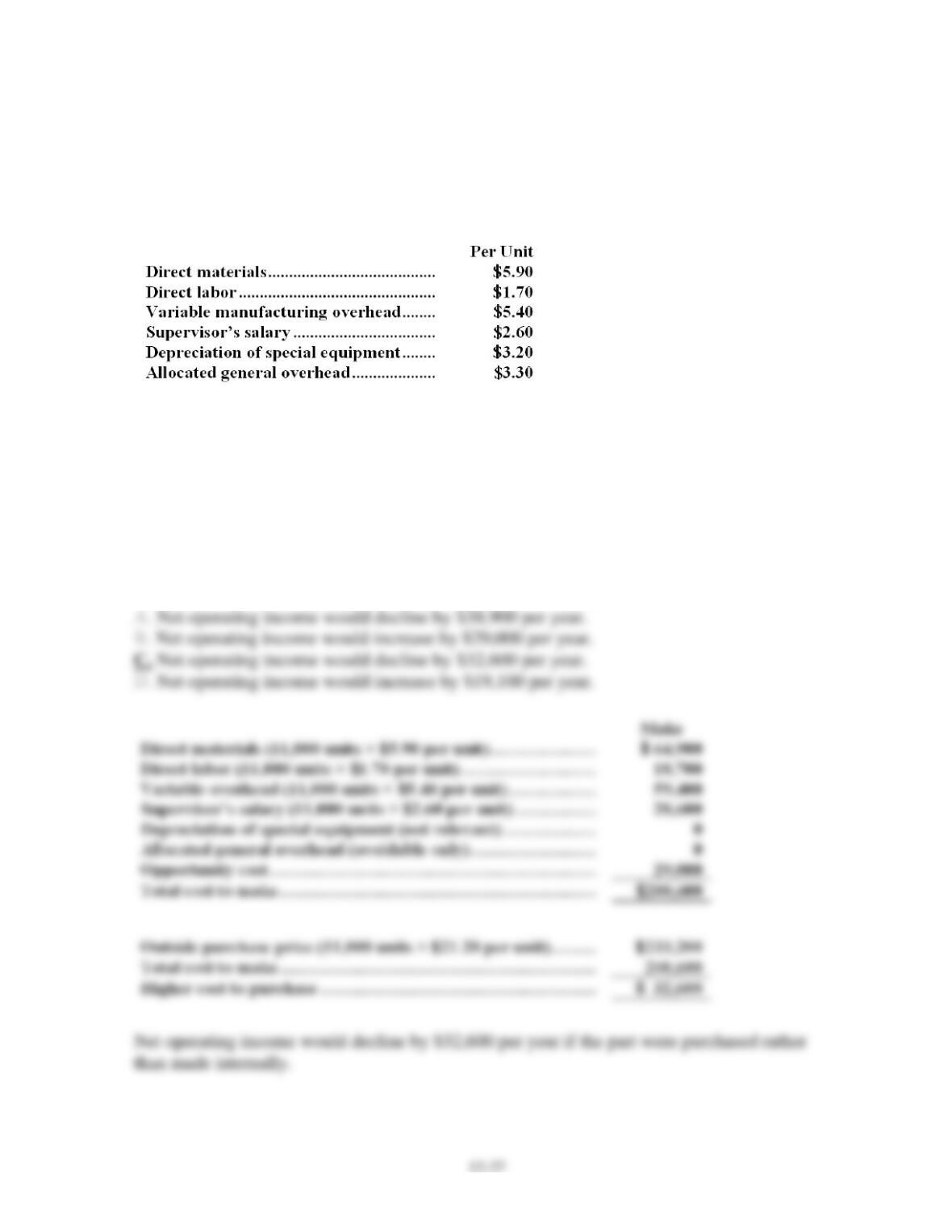
of this part each year. The company’s Accounting Department reports the following costs of
producing the part at this level of activity:
An outside supplier has offered to produce this part and sell it to the company for $15.80
each. If this offer is accepted, the supervisor’s salary and all of the variable costs, including
direct labor, can be avoided. The special equipment used to make the part was purchased
many years ago and has no salvage value or other use. The allocated general overhead
represents fixed costs of the entire company. If the outside supplier’s offer were accepted,
only $26,000 of these allocated general overhead costs would be avoided.
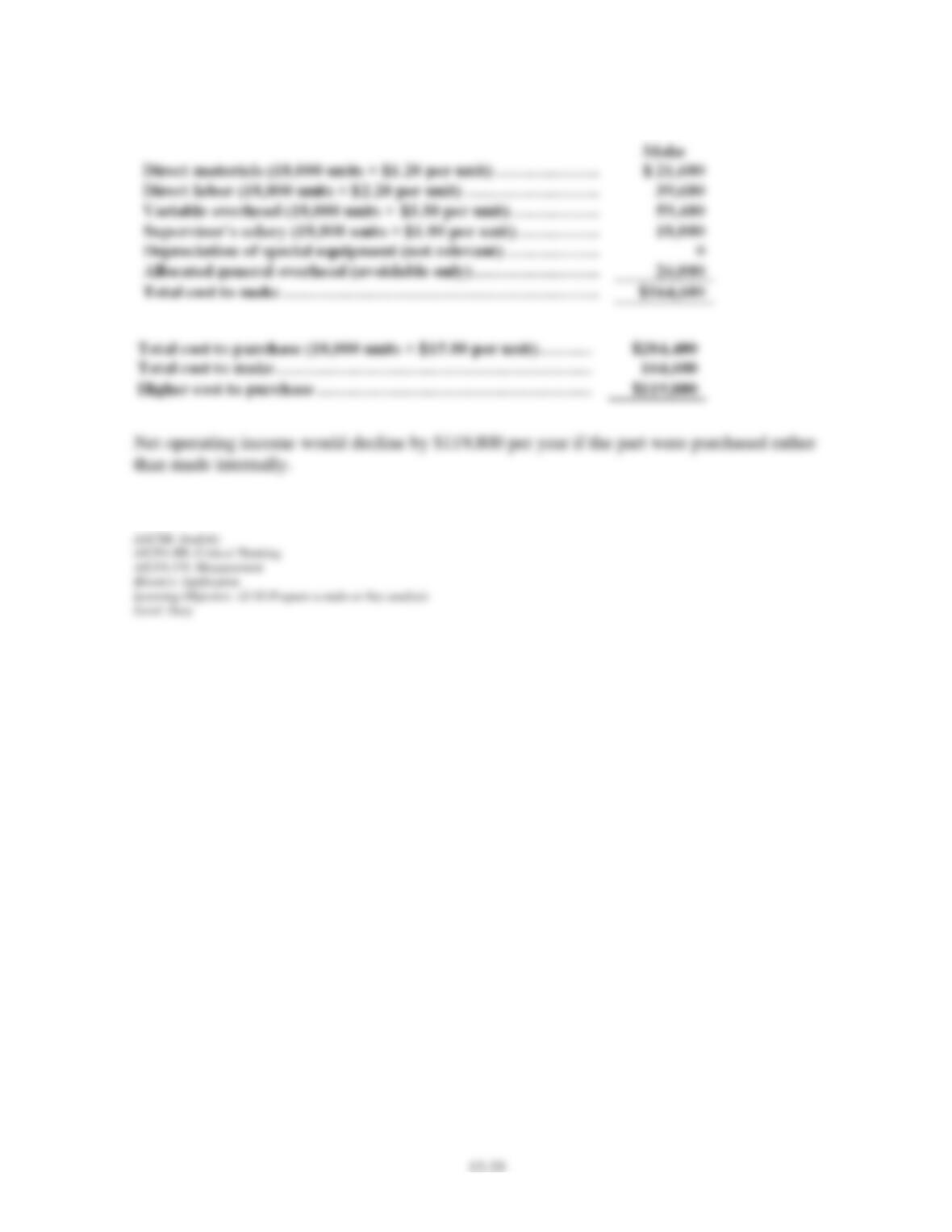
If management decides to buy part I51 from the outside supplier rather than to continue
making the part, what would be the annual impact on the company’s overall net operating
income?
Chapter 12 – Differential Analysis: The Key to Decision Making
Chapter 12 – Differential Analysis: The Key to Decision Making
39. Iwasaki Inc. is considering whether to continue to make a component or to buy it from an
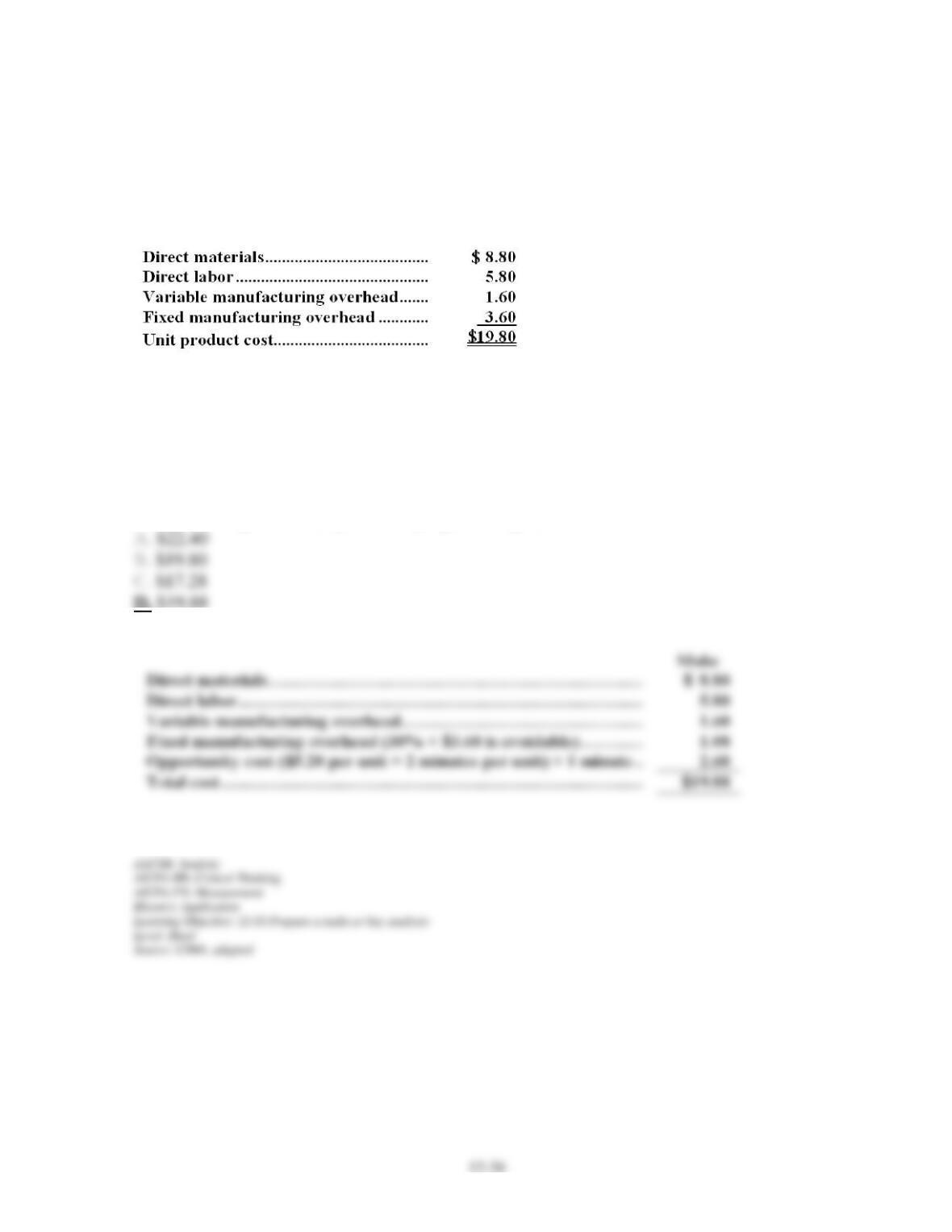
outside supplier. The company uses 13,000 of the components each year. The unit product
cost of the component according to the company’s cost accounting system is given as follows:
Assume that direct labor is a variable cost. Of the fixed manufacturing overhead, 30% is
avoidable if the component were bought from the outside supplier. In addition, making the
component uses 1 minute on the machine that is the company’s current constraint. If the
component were bought, this machine time would be freed up for use on another product that
requires 2 minutes on this machine and that has a contribution margin of $5.20 per unit.
When deciding whether to make or buy the component, what cost of making the component
should be compared to the price of buying the component?
Chapter 12 – Differential Analysis: The Key to Decision Making
40. Part N29 is used by Farman Corporation to make one of its products. A total of 11,000
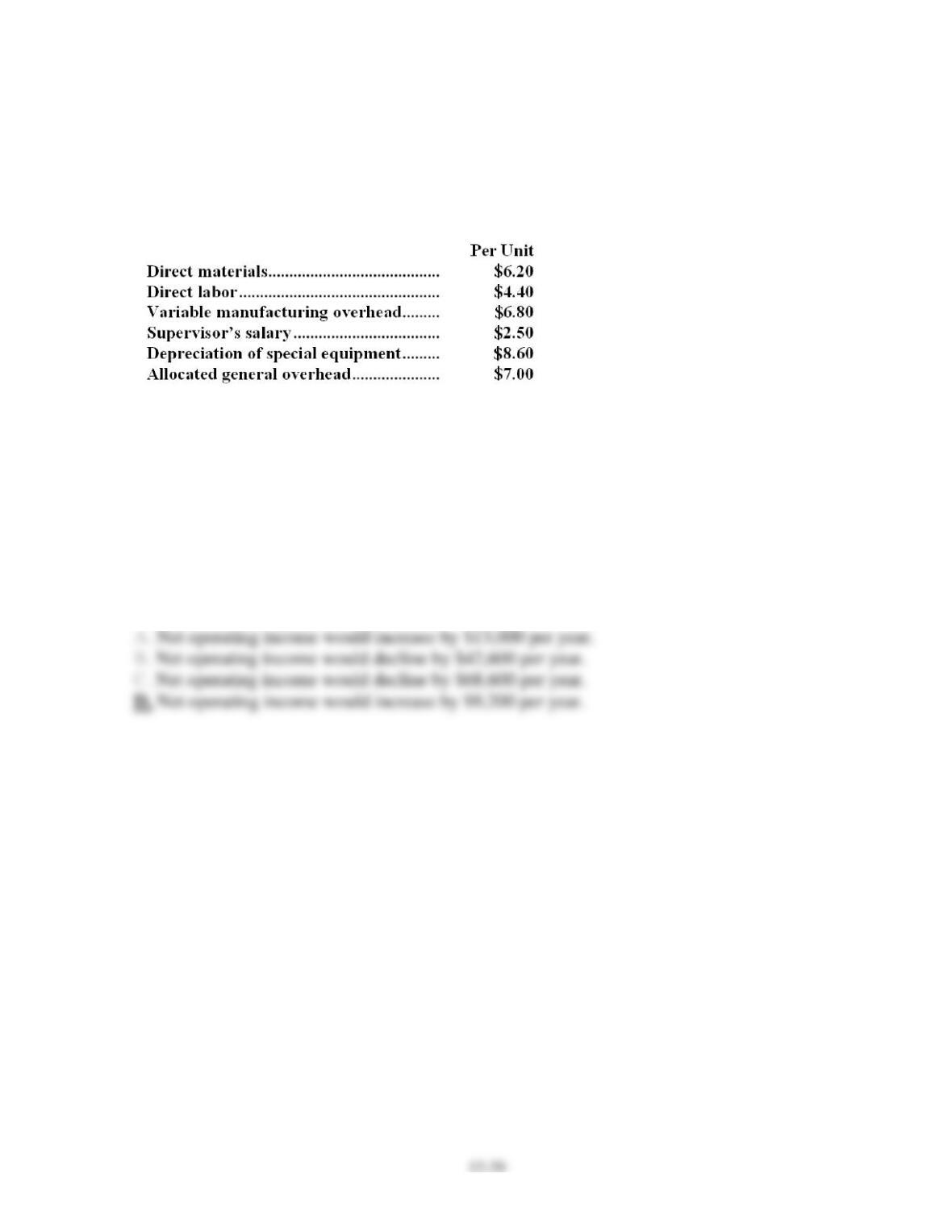
units of this part are produced and used every year. The company’s Accounting Department
reports the following costs of producing the part at this level of activity:
An outside supplier has offered to make the part and sell it to the company for $21.20 each. If
this offer is accepted, the supervisor’s salary and all of the variable costs, including the direct
labor, can be avoided. The special equipment used to make the part was purchased many
years ago and has no salvage value or other use. The allocated general overhead represents
fixed costs of the entire company, none of which would be avoided if the part were purchased
instead of produced internally. In addition, the space used to make part N29 could be used to
make more of one of the company’s other products, generating an additional segment margin
of $29,000 per year for that product. What would be the impact on the company’s overall net
operating income of buying part N29 from the outside supplier?

Chapter 12 – Differential Analysis: The Key to Decision Making
Chapter 12 – Differential Analysis: The Key to Decision Making
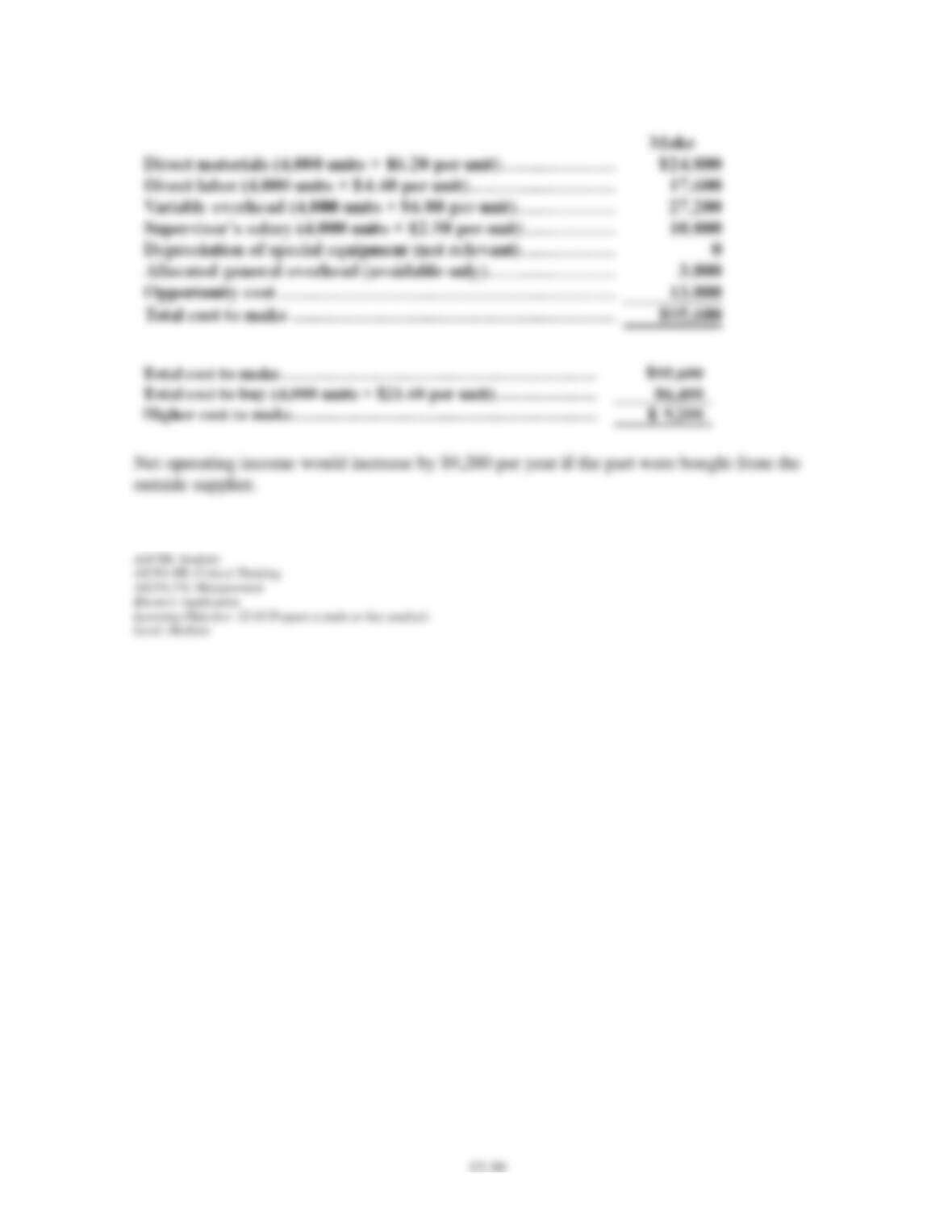
41. Fillip Corporation makes 4,000 units of part U13 each year. This part is used in one of the
company’s products. The company’s Accounting Department reports the following costs of
producing the part at this level of activity:
An outside supplier has offered to make and sell the part to the company for $21.60 each. If
this offer is accepted, the supervisor’s salary and all of the variable costs, including direct
labor, can be avoided. The special equipment used to make the part was purchased many
years ago and has no salvage value or other use. The allocated general overhead represents
fixed costs of the entire company. If the outside supplier’s offer were accepted, only $3,000 of
these allocated general overhead costs would be avoided. In addition, the space used to
produce part U13 would be used to make more of one of the company’s other products,
generating an additional segment margin of $13,000 per year for that product.
What would be the impact on the company’s overall net operating income of buying part U13
from the outside supplier?
Chapter 12 – Differential Analysis: The Key to Decision Making
Chapter 12 – Differential Analysis: The Key to Decision Making
42. Ethridge Corporation is presently making part H25 that is used in one of its products. A
total of 9,000 units of this part are produced and used every year. The company’s Accounting
Department reports the following costs of producing the part at this level of activity:
An outside supplier has offered to make and sell the part to the company for $15.40 each. If
this offer is accepted, the supervisor’s salary and all of the variable costs can be avoided. The
special equipment used to make the part was purchased many years ago and has no salvage
value or other use. The allocated general overhead represents fixed costs of the entire
company, none of which would be avoided if the part were purchased instead of produced
internally. If management decides to buy part H25 from the outside supplier rather than to
continue making the part, what would be the annual impact on the company’s overall net
operating income?
Chapter 12 – Differential Analysis: The Key to Decision Making
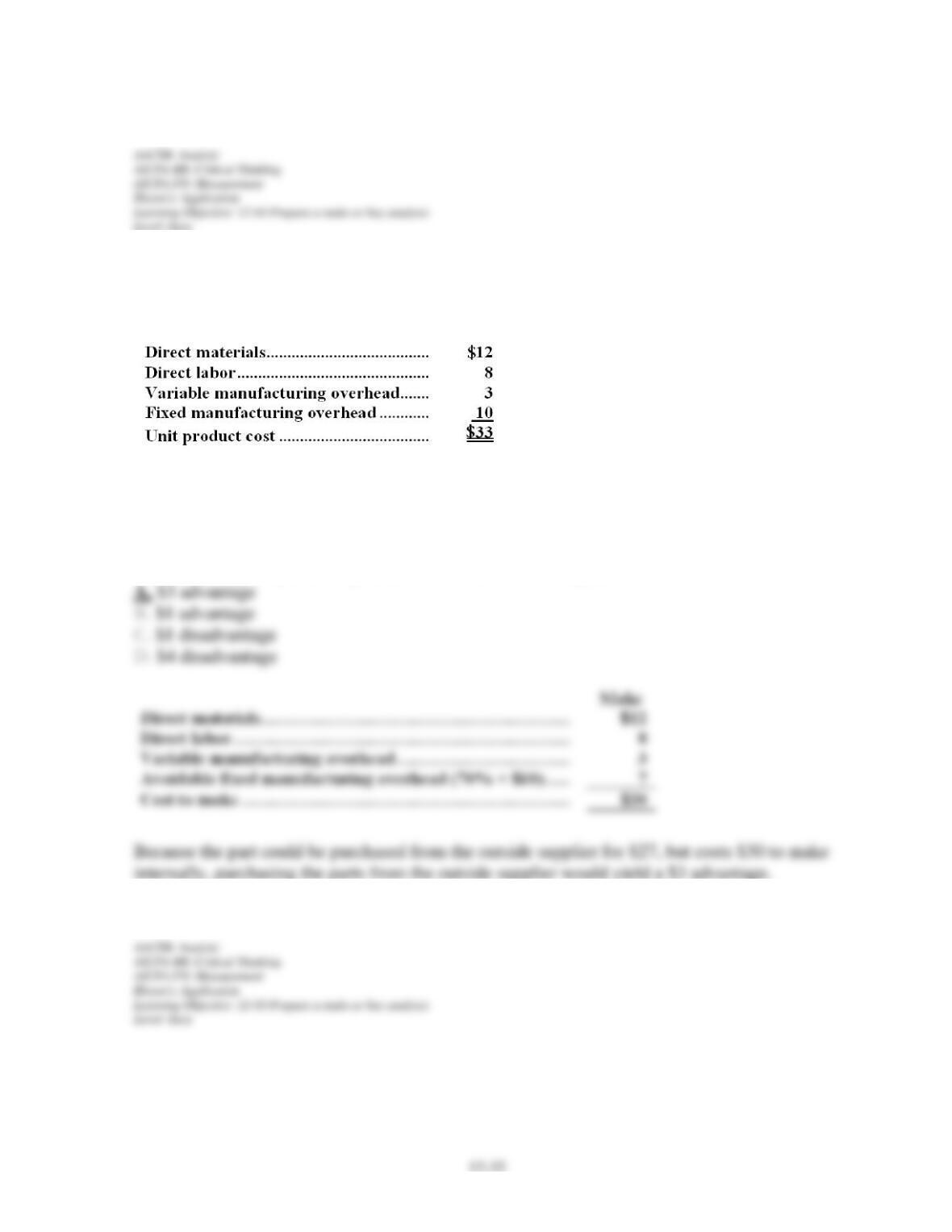
43. Pitkin Company produces a part used in the manufacture of one of its products. The unit
product cost of the part is $33, computed as follows:
An outside supplier has offered to provide the annual requirement of 10,000 of the parts for
only $27 each. The company estimates that 30% of the fixed manufacturing overhead costs
above will continue if the parts are purchased from the outside supplier. Assume that direct
labor is an avoidable cost in this decision. Based on these data, the per unit dollar advantage
or disadvantage of purchasing the parts from the outside supplier would be:
Chapter 12 – Differential Analysis: The Key to Decision Making
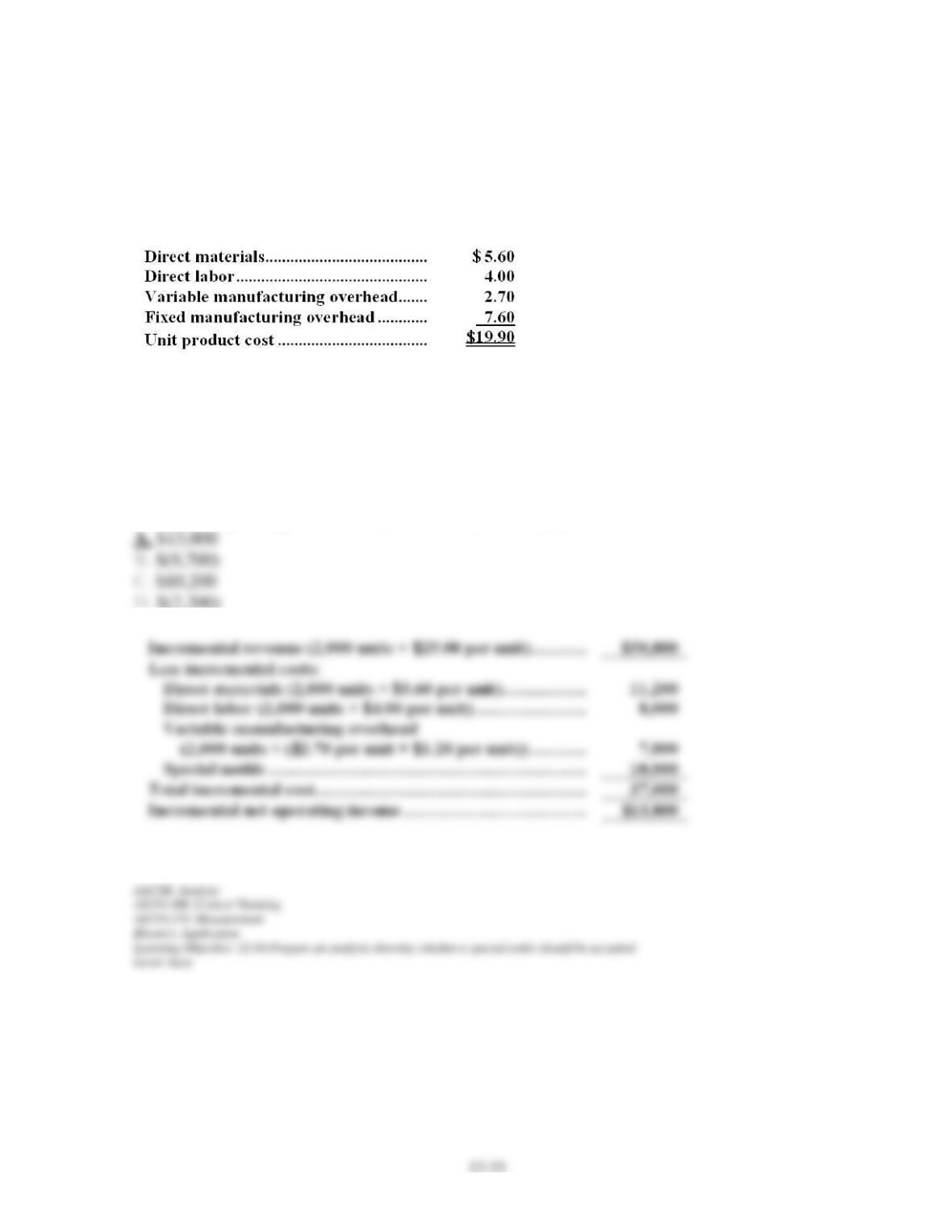
44. A customer has requested that Inga Corporation fill a special order for 2,000 units of
product K81 for $25.00 a unit. While the product would be modified slightly for the special
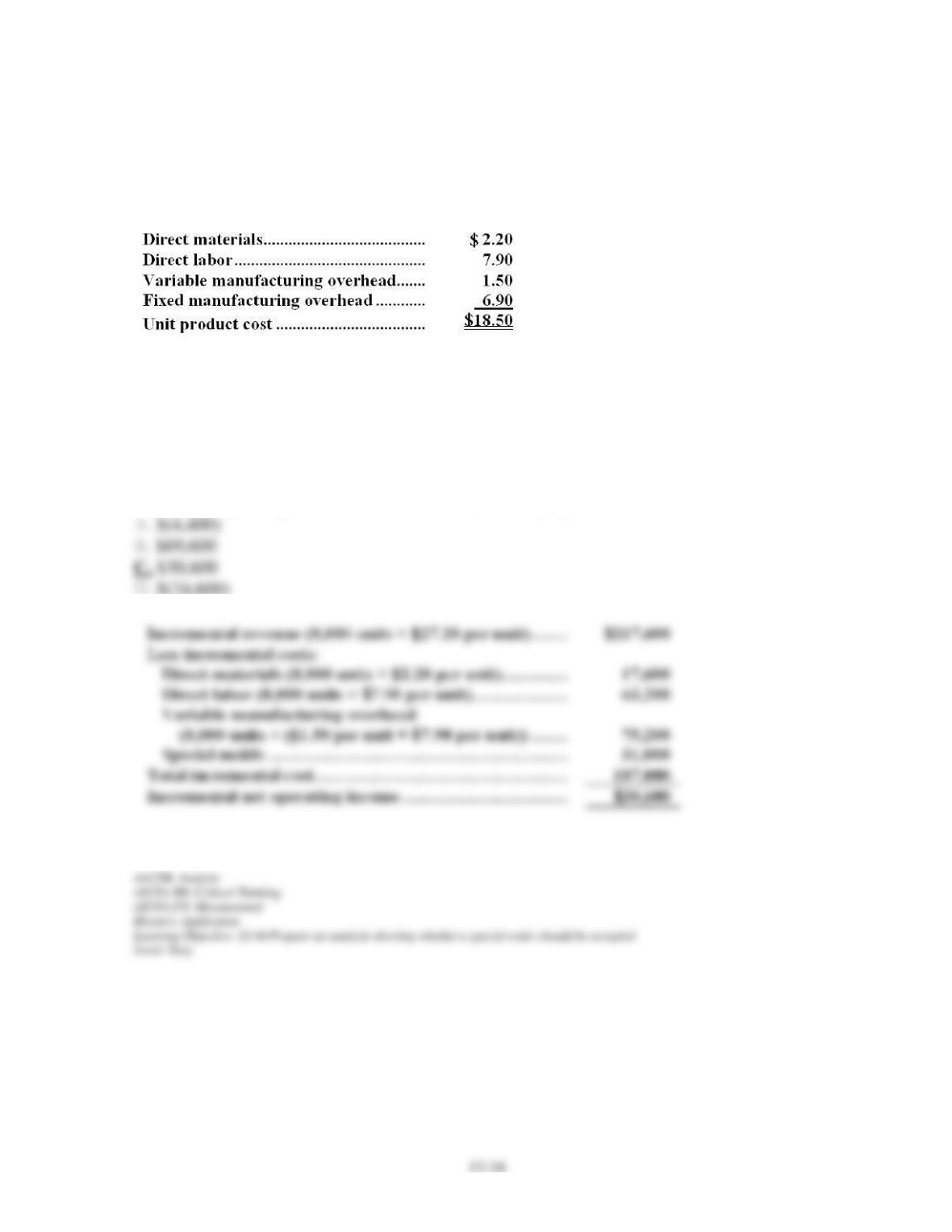
order, product K81’s normal unit product cost is $19.90:
Direct labor is a variable cost. The special order would have no effect on the company’s total
fixed manufacturing overhead costs. The customer would like modifications made to product
K81 that would increase the variable costs by $1.20 per unit and that would require an
investment of $10,000 in special molds that would have no salvage value.
This special order would have no effect on the company’s other sales. The company has ample
spare capacity for producing the special order. If the special order is accepted, the company’s
overall net operating income would increase (decrease) by:
Chapter 12 – Differential Analysis: The Key to Decision Making
45. Rojo Corporation has received a request for a special order of 8,000 units of product W68
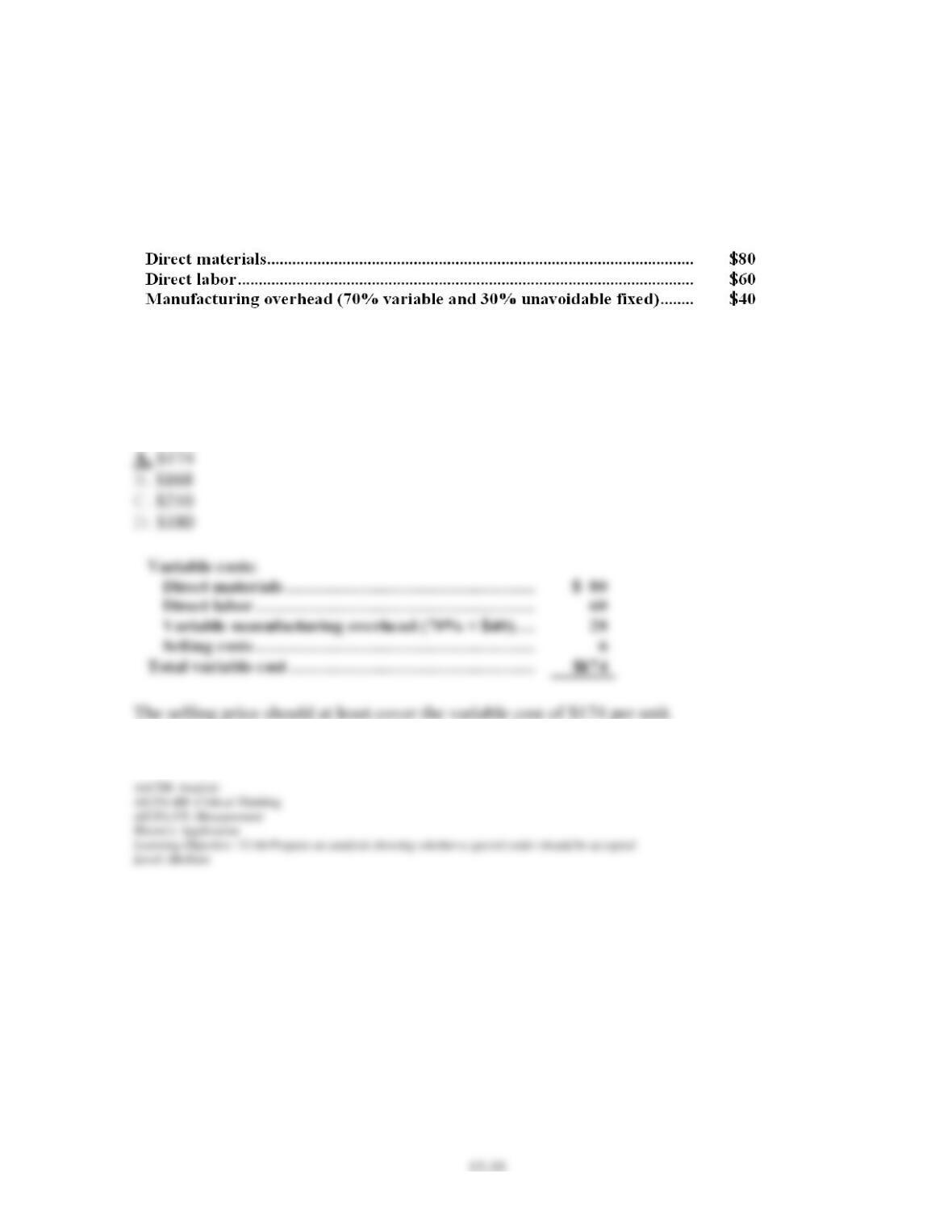
for $27.20 each. Product W68’s unit product cost is $18.50, determined as follows:
Direct labor is a variable cost. The special order would have no effect on the company’s total
fixed manufacturing overhead costs. The customer would like modifications made to product
W68 that would increase the variable costs by $7.90 per unit and that would require an
investment of $31,000 in special molds that would have no salvage value.
This special order would have no effect on the company’s other sales. The company has ample
spare capacity for producing the special order. If the special order is accepted, the company’s
overall net operating income would increase (decrease) by:
Chapter 12 – Differential Analysis: The Key to Decision Making
46. Ellis Television makes and sells portable televisions. Each television regularly sells for
$210. The following cost data per television is based on a full capacity of 10,000 televisions
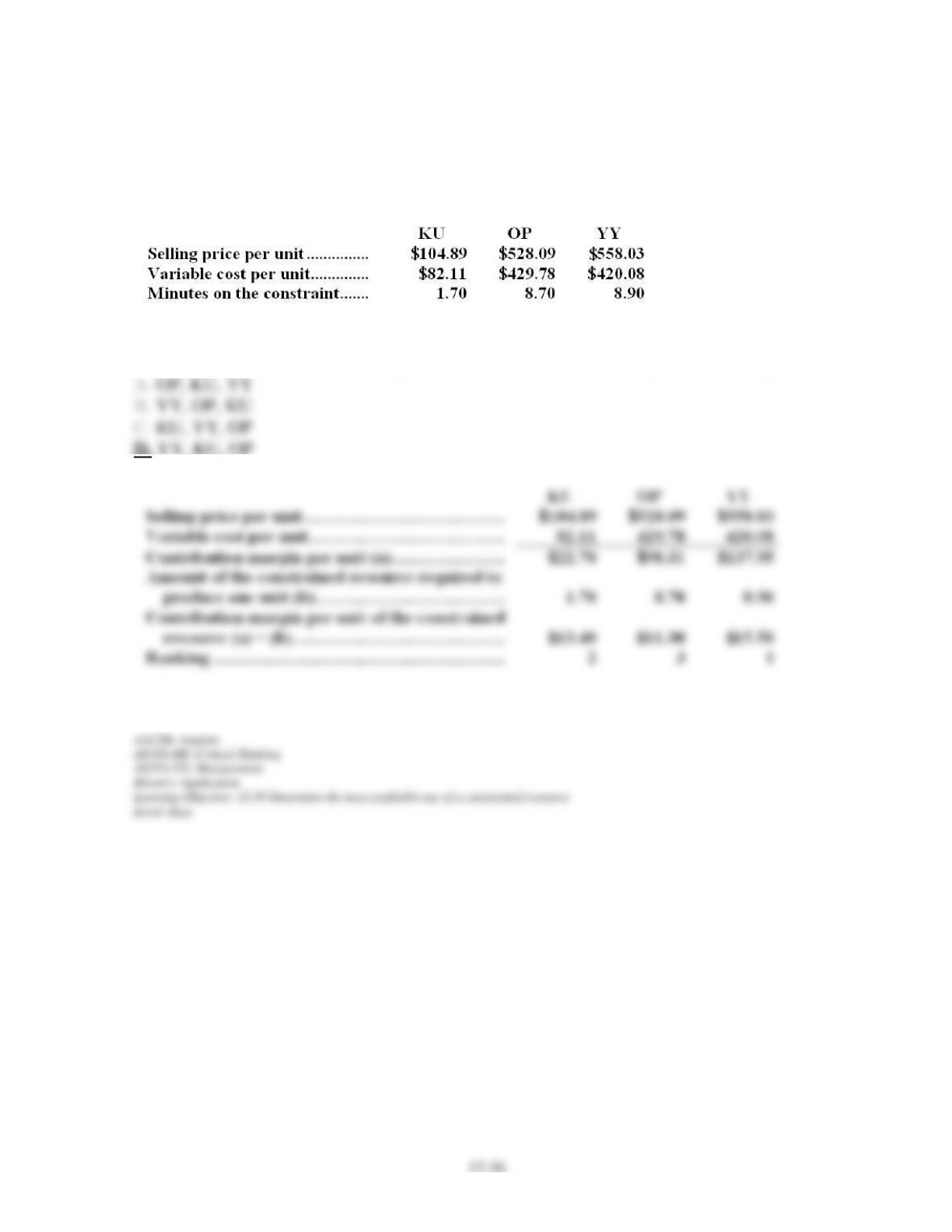
produced each period.
A special order has been received by Ellis for a sale of 2,000 televisions to an overseas
customer. The only selling costs that would be incurred on this order would be $6 per
television for shipping. Ellis is now selling 6,000 televisions through regular channels each
period. What should be the minimum selling price per television in negotiating a price for this
special order?
Chapter 12 – Differential Analysis: The Key to Decision Making
47. An automated turning machine is the current constraint at Naik Corporation. Three
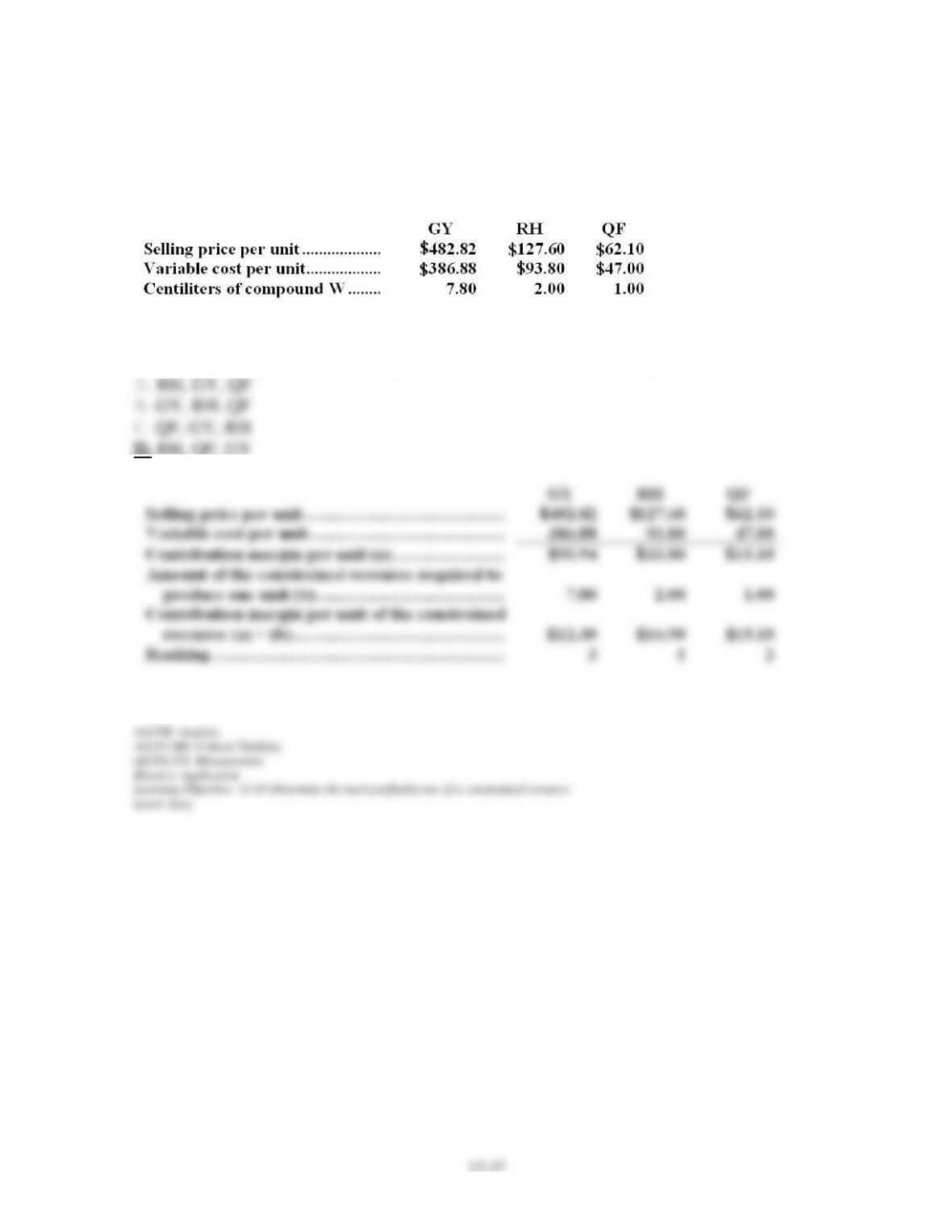
products use this constrained resource. Data concerning those products appear below:
Rank the products in order of their current profitability from most profitable to least
profitable. In other words, rank the products in the order in which they should be emphasized.
Chapter 12 – Differential Analysis: The Key to Decision Making
48. Pappan Corporation makes three products that use compound W, the current constrained
resource. Data concerning those products appear below:
Rank the products in order of their current profitability from most profitable to least
profitable. In other words, rank the products in the order in which they should be emphasized.
Chapter 12 – Differential Analysis: The Key to Decision Making
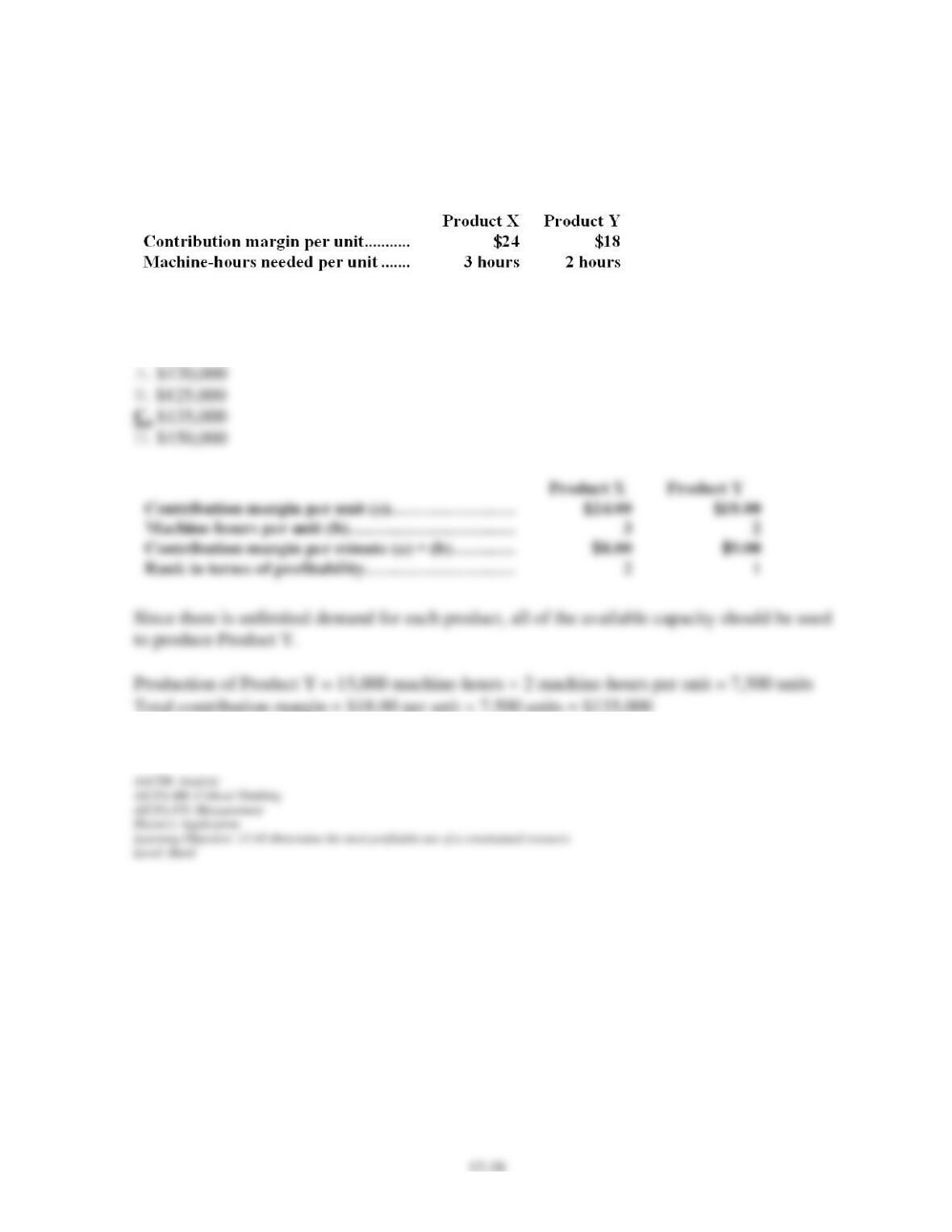
49. Consider the following production and cost data for two products, X and Y:
The company has 15,000 machine hours available each period, and there is unlimited demand
for each product. What is the largest possible total contribution margin that can be realized
each period?
Chapter 12 – Differential Analysis: The Key to Decision Making
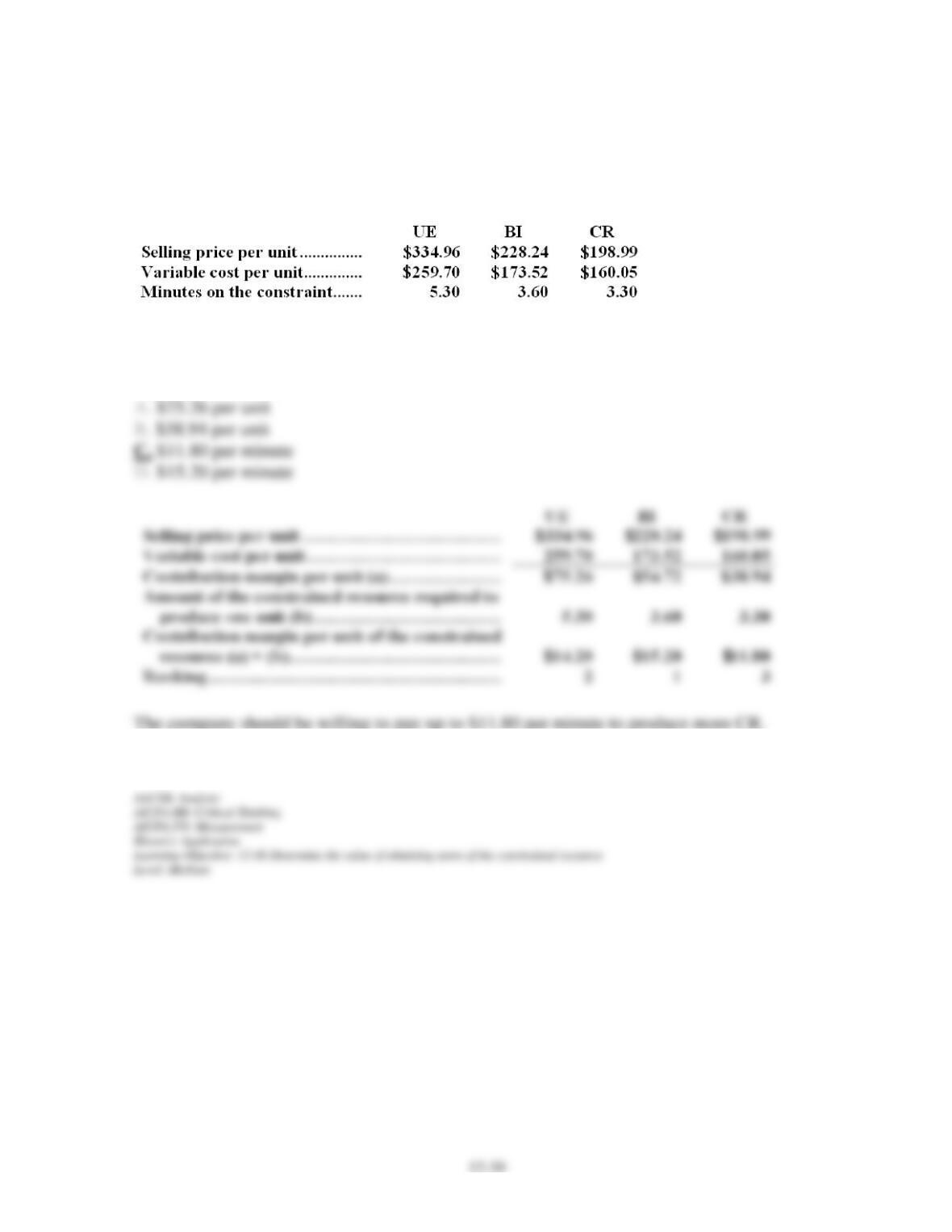
50. The constraint at Mcglathery Corporation is time on a particular machine. The company
makes three products that use this machine. Data concerning those products appear below:
Assume that sufficient time is available on the constrained machine to satisfy demand for all
but the least profitable product. Up to how much should the company be willing to pay to
acquire more of the constrained resource?
Chapter 12 – Differential Analysis: The Key to Decision Making
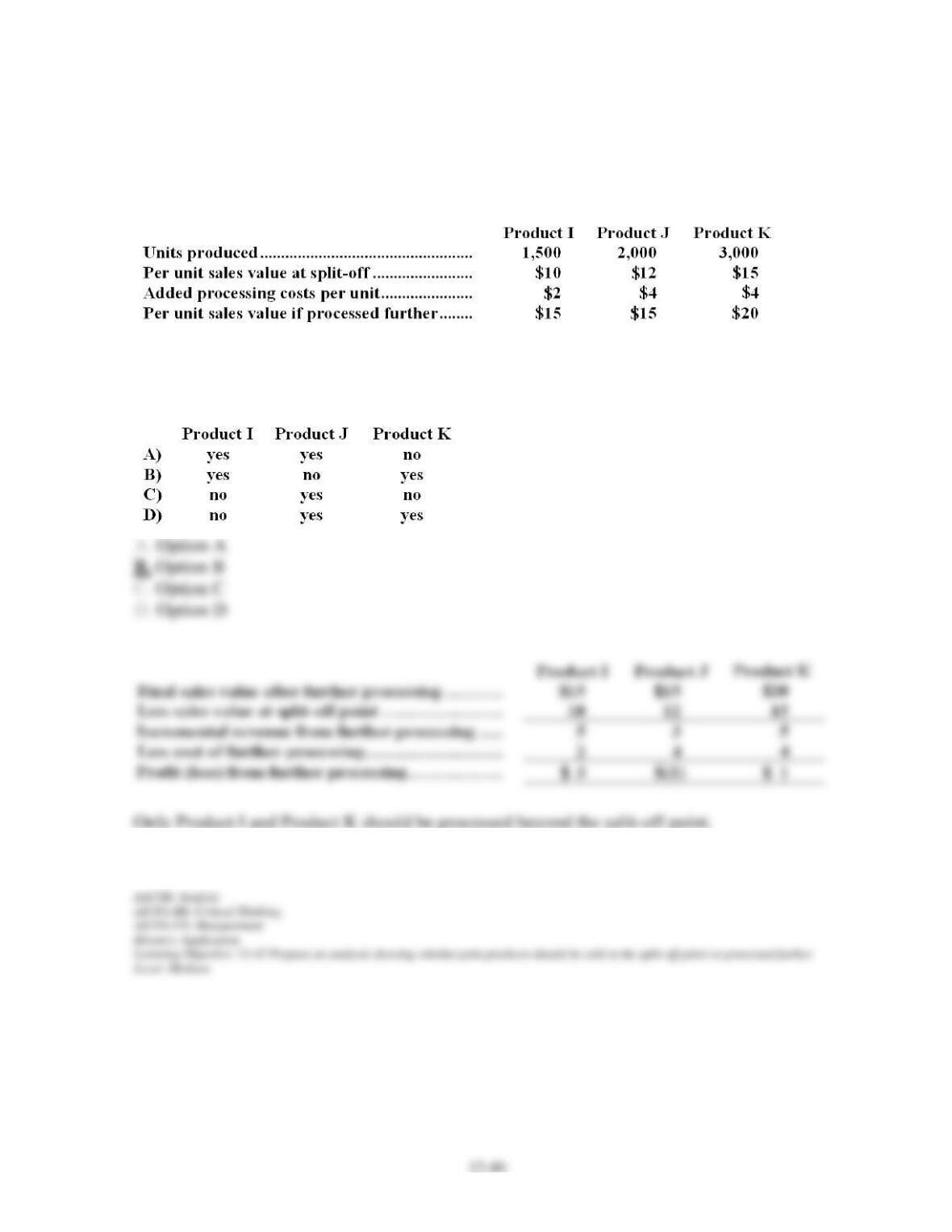
51. Wright Company produces products I, J, and K from a single raw material input.
Budgeted data for the next month follows:
If the cost of the raw material input is $78,000, which of the products should be processed
beyond the split-off point?