89) Seasonal sales patterns cause cash balances to fluctuate dramatically, creating the need for
cash forecasts.
90) To manage cash efficiently, business owners should strive to accelerate their accounts
payable and stretch out their accounts receivable.
91) Forty percent of industrial and wholesale sales are on credit, and 90 percent of retail sales are
on account.
92) Most small businesses conduct a thorough credit investigation before selling to a new
customer.
93) The first line of defense against bad debt losses is to have a financial institution extend loans
to credit-seeking customers.
94) One effective technique for improving cash management is to establish a firm credit policy
in writing and let customers know in advance what it is.
95) Some businesses use cycle billing, in which a company bills a portion of its credit customers
each day of the month to smooth out uneven cash receipts.
96) As soon as an account receivable becomes past due, a business owner should turn it over to a
collection agency.
97) If an account receivable becomes past due, the best strategy is simply to wait; statistics show
that customers eventually pay their bills if business owners do not bother them with repeated
collection attempts.
98) Small business owners should not press customers for payment of their past due accounts for
fear of losing them as customers altogether.
99) A small business owner should concentrate collection efforts on the top 20 percent of the
company’s customers since they typically account for 80 percent of all accounts receivable.
100) A security agreement is a contract in which a business selling an asset on credit gets a
security interest in that asset, protecting its legal rights in case the buyer fails to pay.
101) Communication in a timely and professional manner is key to effective collection activities.
102) Proper cash management techniques call for a small business owner to pay invoices as soon
the invoices arrive.
103) Efficient cash managers set up a payment calendar each month, which allows them to pay
their bills on time and to take advantage of cash discounts for early payment.
104) A basic principle of cash management is verifying all invoices before paying them.
105) A cash discount offers a price reduction if the owner pays an invoice on time.
106) Small business owners generally should not take advantage of cash discounts vendors offer,
choosing instead to maintain control of their cash for as long as possible.
107) It is considered unethical for small business owners to regulate payments to their
companies’ advantage.
108) Because inventory is not a liquid asset, cash invested there is tied up and cannot be used for
other purposes.
109) Only about 20 percent of a typical business’ inventory turns over quickly.
110) Roughly 80 percent of the typical business’ inventory turns over quickly.
111) It is much wiser to carry too little inventory rather than too much because there are no costs
associated with carrying too little inventory.
112) Cash and quantity discounts allow business owners to receive a price break in the goods
they purchase.
113) Bartering-exchanging goods and services for other goods and services, is an effective way
for small business owners to conserve cash.
114) Bartering is an opportunity to transform slow-moving inventory into much-needed products
and services.
115) The real benefit to a business owner engaging in barter is the ability to “pay” for goods and
services at her wholesale cost and to get credit for the retail price.
116) Most business owners should avoid leasing as a cash management strategy because it
requires large capital outlays as down payments, and total lease payments typically are greater
than those for conventional loans.
117) Important advantages of leasing include the flexibility of the lease agreement and protection
against obsolescence.
118) When a small business encounters a sales slowdown, the first thing the owner should do is
cut marketing and advertising expenditures to conserve cash.
119) Many banks allow entrepreneurs to schedule their loan payments to fit their company’s cash
flow cycles.
120) Changing your firm’s shipping terms from “F.O.B. buyer” to “F.O.B. seller” can improve
your cash flow, as it switches the cost of shipping from you to your buyer.
121) Companies lose billions of dollars each year due to employee theft.
122) Rather than build the current year’s budget on increases from the previous year’s budget,
zero-based budgeting starts from a budget of zero and evaluates the necessity of every item.
123) In order to deter employee theft, it is best to separate cash management duties between at
least two different employees.
124) When trying to prevent employee theft, business owners should create a “police state”
environment and trust no one.
125) Because small business owners often rely on informal procedures for managing cash, they
are most likely to become victims of embezzlement and fraud by their employees.
126) A sweep account is a checking account that automatically “sweeps” all funds in a
company’s checking account above a predetermined minimum into an interest-bearing account.
127) Small business managers need not be concerned about investing surplus cash since small
amounts of cash sitting around for a few days or weeks are not worth investing.
128) When investing surplus cash, the small business owner should seek the highest returns
possible on the money.
129) When investing surplus cash, an owner’s primary objective should be on the safety and
liquidity of the investments.
130) A sweep account automatically “sweeps” all funds in a company’s checking account above
a predetermined minimum into an interest-bearing account, enabling it to keep otherwise idle
cash invested until it is needed to cover checks.
131) Revising business plans annually forces owners to focus on managing the business more
effectively.
132) Why is cash a unique asset? What are the advantages of efficient cash management?
133) Your friend Jake owns a business that is achieving phenomenal growth. Explain why it is
said that: “Fast-growing companies are most likely to experience cash shortages.”
134) The profits your small business is generating are high; however, you never seem to have
enough cash to pay your bills on time. Are cash and profit the same thing? Why or why not?
135) What are the basic steps in preparing a cash budget? Which forecast is the “heart” of the
cash budget?
136) How are sales forecasts developed for an established business? How are sales forecasts
developed for a new business enterprise?
137) Identify the “big three” of cash management. As a small business consultant, what would
you recommend your clients do to control the “big three” more effectively?
138) What steps can a small business owner take to minimize bad debt losses?
139) What steps can a small business owner take to avoid the cash “crunch”?
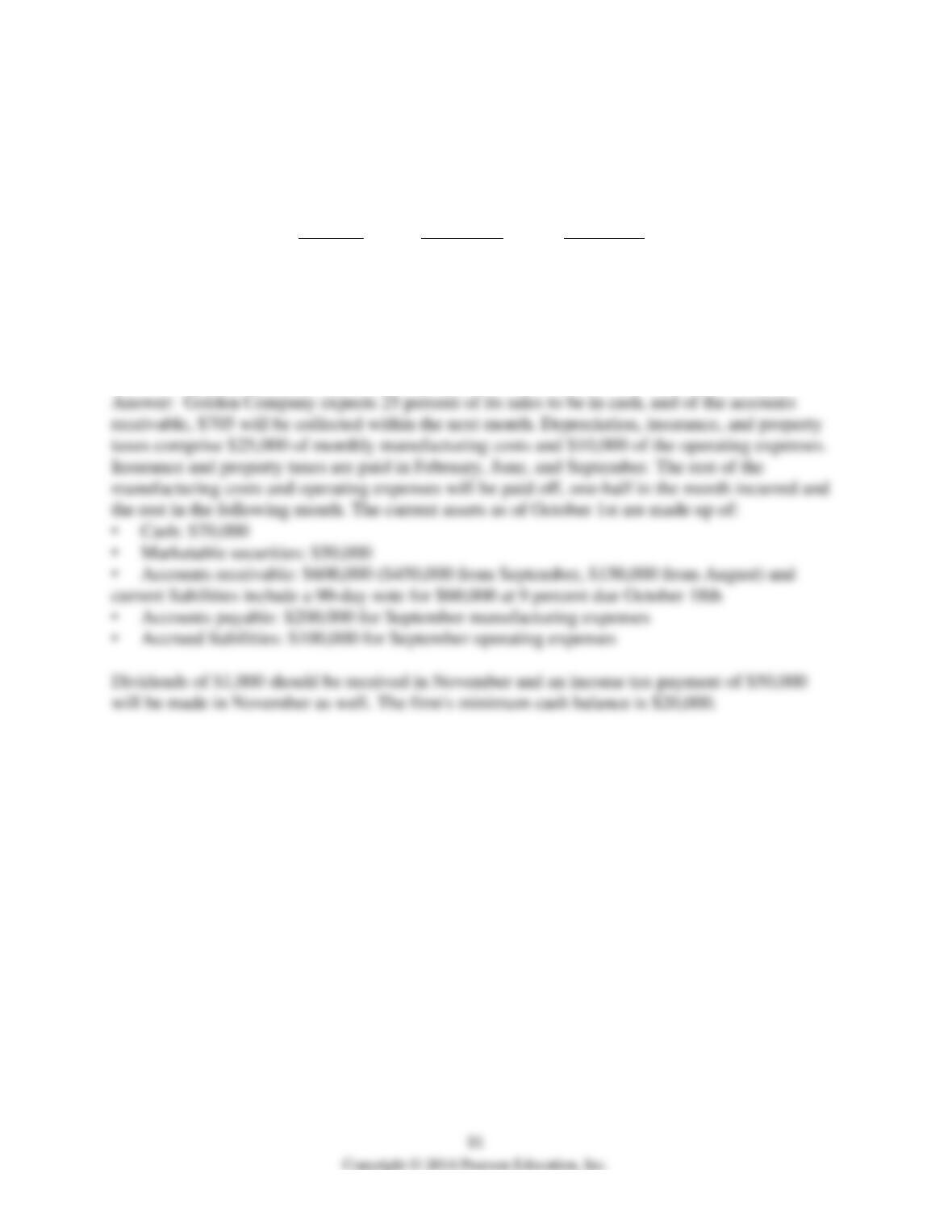
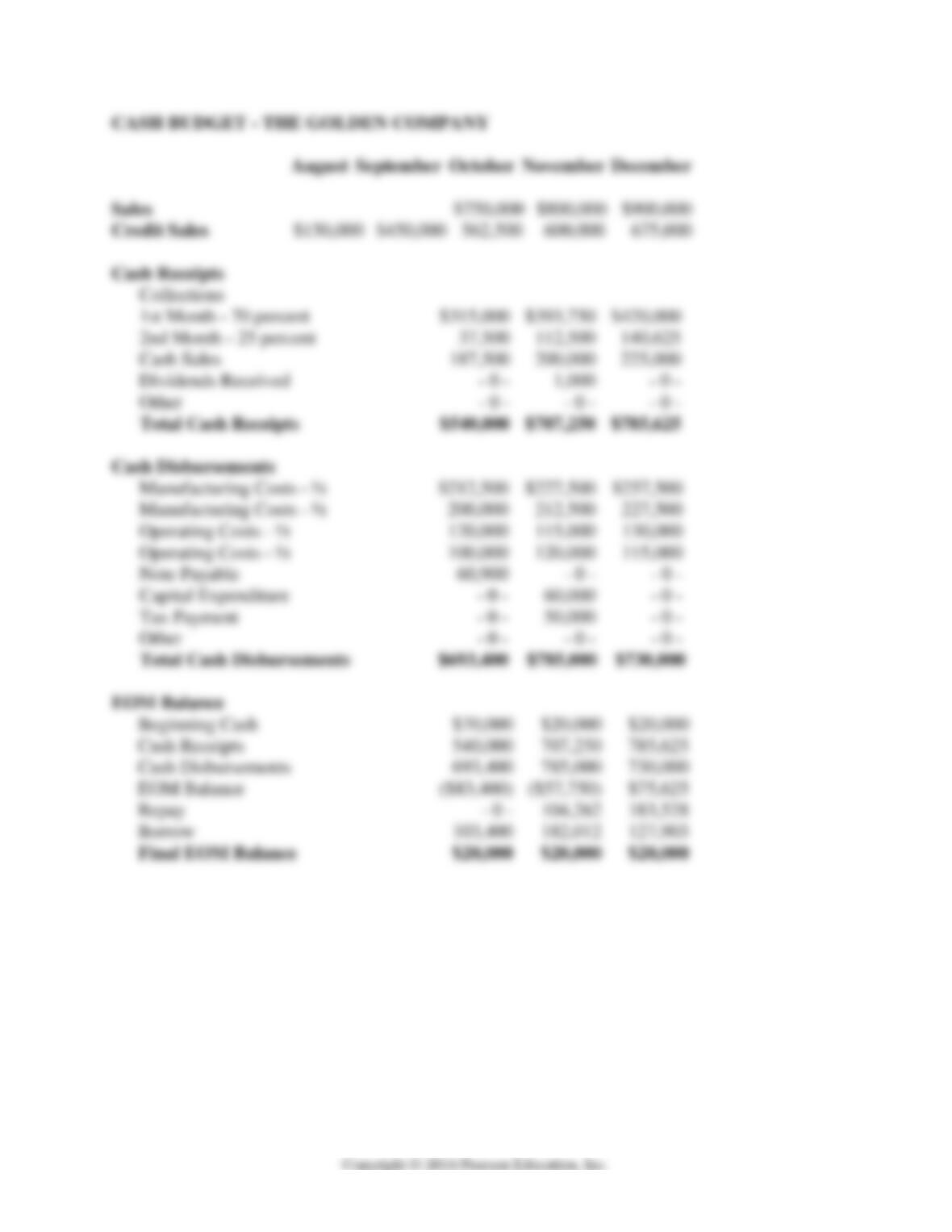
Mini-Case 12-1: The Golden Company
This is a summary of the monthly cash budget for the next quarter (October through December)
for the Golden Company.
October November December
Sales $750,000 $800,000 $900,000
Manufacturing Costs 450,000 480,000 540,000
Operating Expenses 225,000 240,000 270,000
Capital Expenditures – 0 – 60,000 – 0 –
140) From the information provided, prepare a monthly cash budget for the next quarter
(October-December) for the Golden Company.
32
33
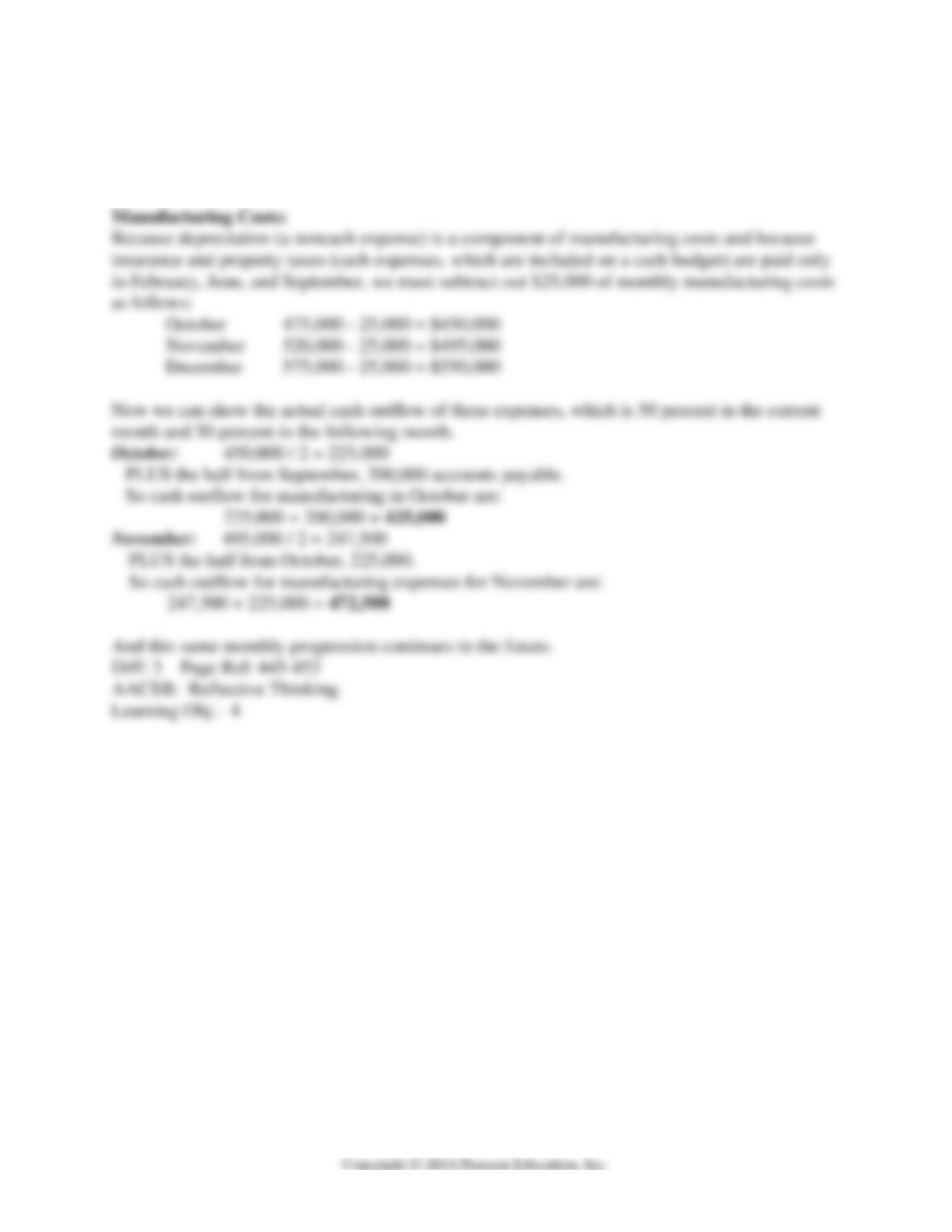
Calculations:
October 18th notes payable:
$60,000 principal + $60,000 × .09 × ¼ of a year = $61,350

34
Mini-Case 12-2: The Laurens Corporation
In past years, Sue Salgado, owner of the Laurens Corporation, has been plagued by unexpected
cash flow problems. Her banker, worried about her lack of cash flow management, has suggested
that Sue create a cash budget for the upcoming quarter. Sue does this, using the following
information:
October November December
Sales $800,000 $900,000 $950,000
Manufacturing Costs 475,000 520,000 575,000
Operating Expenses 250,000 270,000 290,000
Capital Expenditures 20,000 70,000 – 0 –
Laurens Corporation expects 35 percent of its sales to be in cash, and that of the accounts
receivable, 70 percent will be collected within the next month, and 25 percent in the second
month after sale. Depreciation, insurance, and property taxes comprise $25,000 of monthly
manufacturing costs and $12,000 of operating expenses. Insurance and property taxes are paid in
February, June and September. One-half of the remaining manufacturing costs and operating
expenses will be paid in the month in which incurred, and the rest in the following month. As of
October 1st, the following facts are relevant:
• Current assets consist of $50,000 in cash, $50,000 in securities
• Credit sales for August and September were $500,000 and $450,000 respectively
• The firm has a line of credit with a local bank at 18 percent APR, and loan is due the
following month
• Accounts payable of $200,000 for September manufacturing expenses
• Accrued liabilities of $100,000 for September operating expenses
Dividends of $1,000 should be received in November and an income tax payment of $20,000
will be made in November. The firm’s minimum cash balance is $10,000.
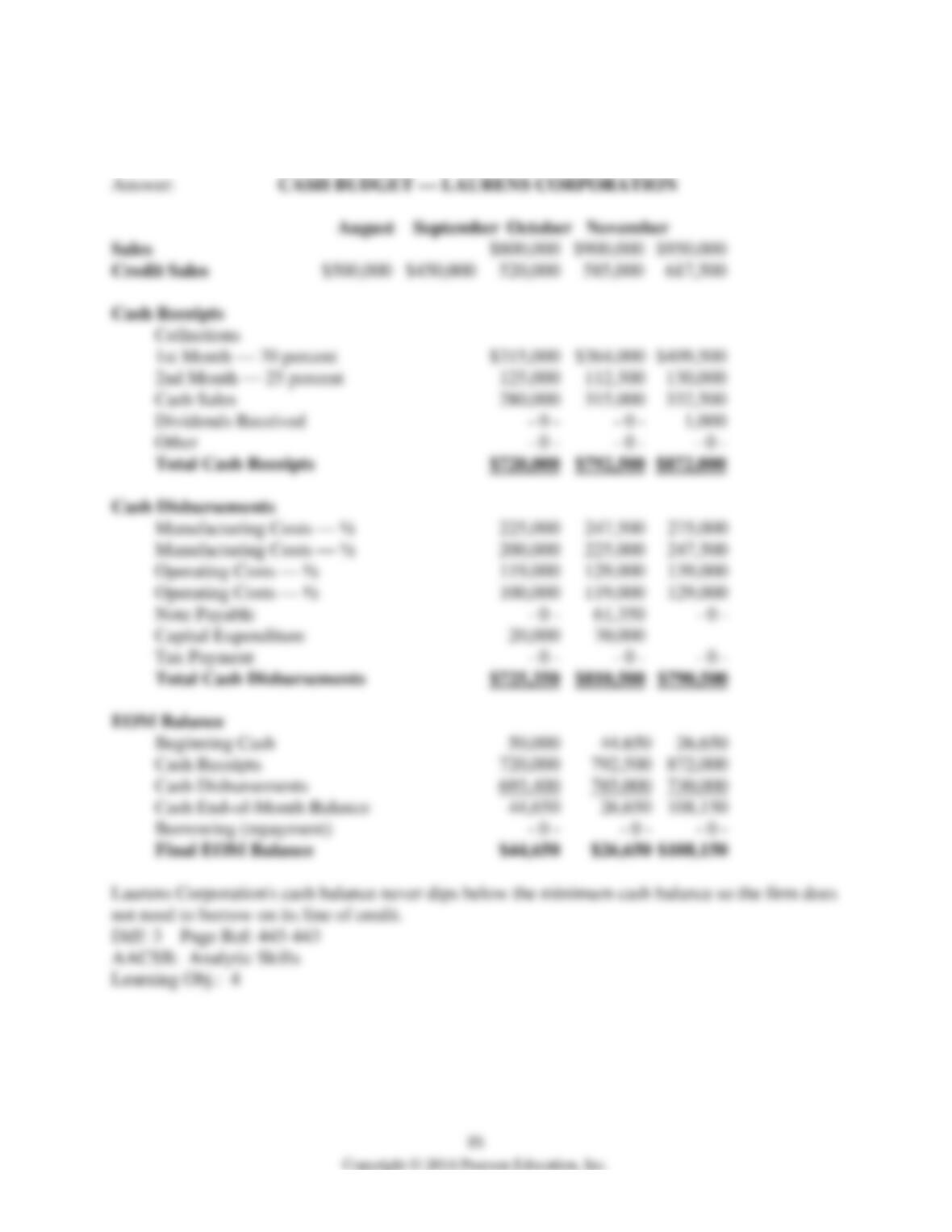
141) From the information given, prepare a monthly cash budget for the next quarter (October
through December) for the Laurens Corporation.

36
Mini-Case 12-3: Rent-A-Nerd Computer Consultants
The owners of Rent-A-Nerd Computer Consultants have prepared the partial cash budget for the
upcoming quarter:
CASH BUDGET – RENT-A-NERD COMPUTER CONSULTANTS
Month 1 Month 2 Month 3
Cash Receipts:
Total Sales $42,650 $45,500 $47,000
Credit Sales 25,590 27,300 28,200
Collections:
10 percent same month 2,559 2,730 2,820
80 percent next month 19,941 20,472 21,840
8 percent following month 1,864 1,994 2,048
Cash Sales 17,060 18,200 18,800
Total Cash Receipts ________ ________ ________
Cash Disbursements:
Purchases $32,404 $33,267 $35,490
Wages/Salaries 4,212 4,897 5,126
Rent/Utilities 1,865 1,910 2,250
Other 2,400 3,750 6,105
Total Cash Disbursements ________ ________ ________
End of Month Balance:
Beginning Cash $4,750 ________ ________
Cash Receipts ________ ________ ________
Cash Disbursement ________ ________ ________
EOM Balance ________ ________ ________
Borrow ________ ________ ________
Repay ________ ________ ________
Calculate the final end-of-month balance for months 1-3 and answer the following questions.
142) How much would Rent-A-Nerd have to borrow if its desired minimum cash balance is
$4,000?
a. $2,224 in Month 3
b. Nothing. Rent-A-Nerd’s end of the month cash balance is below $4,000.
c. $2,598 in Month 3
d. $20,771 in Month 3
143) Total cash receipts for months 1, 2, and 3, respectively are:
a. $42,650, $45,400, and $47,000.
b. $25,590, $27,300, and $28,200.
c. $68,240, $72,800, and $75,200.
d. $41,424, $43,396, and $45,508.
144) The end-of-the-month balances for months 1, 2, and 3, respectively are:
a. $5,293, $4,865, and $1,402.
b. $6,519, $8,195, and $6,224.
c. -$10,541, -$12,524, and -$16,771.
d. $32,109, $61,085, and $87,314.