Chemistry, 7e (McMurry/Fay)
Chapter 12 Solutions and Their Properties
12.1 Multiple-Choice Questions
1) Which of the following mixtures have components which can be separated by filtration?
A) colloids
B) solutions
C) suspensions
D) all of these
2) In most liquid solutions, the component present in the larger amount is called the
A) dispersed medium.
B) emulsifying agent.
C) solute.
D) solvent.
3) The rubbing alcohol sold in drug stores often is composed of 70% isopropyl alcohol and 30% water. In
this solution
A) isopropyl alcohol is the solvent.
B) water is the solvent.
C) both water and isopropyl alcohol are solvents.
D) neither water nor isopropyl alcohol is a solvent.
4) For a liquid solution made by dissolving a solid or a gas in a liquid, the
A) liquid is the solute.
B) liquid is the solvent.
C) solute is the component present in the greatest amount.
D) solvent is the component present in the greatest amount.
5) Iodine, I2(s), is more soluble in dichloromethane, CH2Cl2(l), than in water because
A) both iodine and dichloromethane have strong ion-dipole interactions.
B) the dipole-dipole forces in dichloromethane are much stronger than the dispersion forces in iodine.
C) the intermolecular forces are similar in both iodine and dichloromethane.
D) iodine is polar and dichloromethane has a large number of hydrogen bonds.
6) For which case would ΔHsoln be expected to be negative?
A) if solute-solute interactions are much greater than solvent-solvent and solute-solvent interactions
B) if solvent-solvent interactions are much greater than solute-solvent and solute-solute interactions
C) if solute-solvent interactions are much greater than solvent-solvent and solute-solute interactions
D) if solute-solvent interactions are the same as solvent-solvent and solute-solute interactions
7) Commercial cold packs often contain solid NH4NO3 and a pouch of water. The temperature of the
pack drops as the NH4NO3 dissolves in water. Therefore, for the dissolving of NH4NO3 in water,
A) ΔHsoln is negative and ΔSsoln may be negative or positive.
B) ΔHsoln is negative and ΔSsoln is positive.
C) ΔHsoln is positive and ΔSsoln may be negative or positive.
D) ΔHsoln is positive and ΔSsoln is positive.
8) When a particular solid begins to dissolve in water, the temperature rises dramatically. For the
dissolving of this solid in pure water
A) ΔHsoln is always negative and ΔSsoln may be negative or positive.
B) ΔHsoln is always negative and ΔSsoln is always positive.
C) ΔHsoln is always positive and ΔSsoln may be negative or positive.
D) ΔHsoln is always positive and ΔSsoln is always positive.
9) One reason ionic compounds do not dissolve well in nonpolar solvents is that
A) ion-dipole interactions are too large for effective solvation to occur.
B) ion-solvent interactions are not strong enough to solvate the ions in solution.
C) not all cations and anions have the same magnitude of charge and therefore do not form neutral ion
pairs.
D) there are no forces of attraction between ions and nonpolar molecules.
10) Which cation in each set is expected to have the larger (more negative) hydration energy?
I. Mg2+ or Ca2+
II. Li+ or Al3+
A) Mg2+ in set I and Li+ in set II
B) Mg2+ in set I and Al3+ in set II
C) Ca2+ in set I and Li+ in set II
D) Ca2+ in set I and Al3+ in set II
11) Although there are exceptions, which is most likely to be true for the dissolving of a solid in a liquid?
A) ΔHsoln is positive.
B) ΔHsoln is negative.
C) ΔSsoln is positive.
D) ΔSsoln is negative.
12) When two similar liquids mix to form a solution, the entropy of solution (ΔSsoln) is expected to be
A) negative.
B) zero.
C) positive.
D) negative at low temperatures but positive at high temperatures.
13) When an ionic solute dissolves in water to form an unsaturated solution, the free energy change
(ΔGsoln) is
A) negative.
B) zero.
C) positive.
D) either A or C, depending on the ionic compound.
14) The change in the Gibbs free energy for dissolving more solute in a supersaturated solution is
A) negative.
B) zero.
C) positive.
D) positive at low temperatures and negative at high temperatures.
15) The change in the Gibbs free energy for dissolving solute in a saturated solution is
A) negative.
B) zero.
C) positive.
D) positive at low temperatures and negative at high temperatures.
16) For the process of dissolving a solid in a liquid, which of the following statements is true?
A) ΔHsoln is always negative and ΔSsoln is usually positive.
B) ΔHsoln is always positive and ΔSsoln is usually negative.
C) ΔHsoln is either positive or negative and ΔSsoln is usually positive.
D) ΔHsoln is either positive or negative and ΔSsoln is usually negative.
17) Most gases become less soluble in water as the temperature increases. What can be concluded about
the signs of ΔHsoln and ΔSsoln in this case?
A) ΔHsoln is negative and ΔSsoln is negative.
B) ΔHsoln is negative and ΔSsoln is positive.
C) ΔHsoln is positive and ΔSsoln is negative.
D) ΔHsoln is positive and ΔSsoln is positive.
18) Which of the following should most favor the solubility of an ionic solid in water?
A) a low lattice energy for the solid and a low hydration energy for its ions
B) a low lattice energy for the solid and a high hydration energy for its ions
C) a high lattice energy for the solid and a low hydration energy for its ions
D) a high lattice energy for the solid and a high hydration energy for its ions
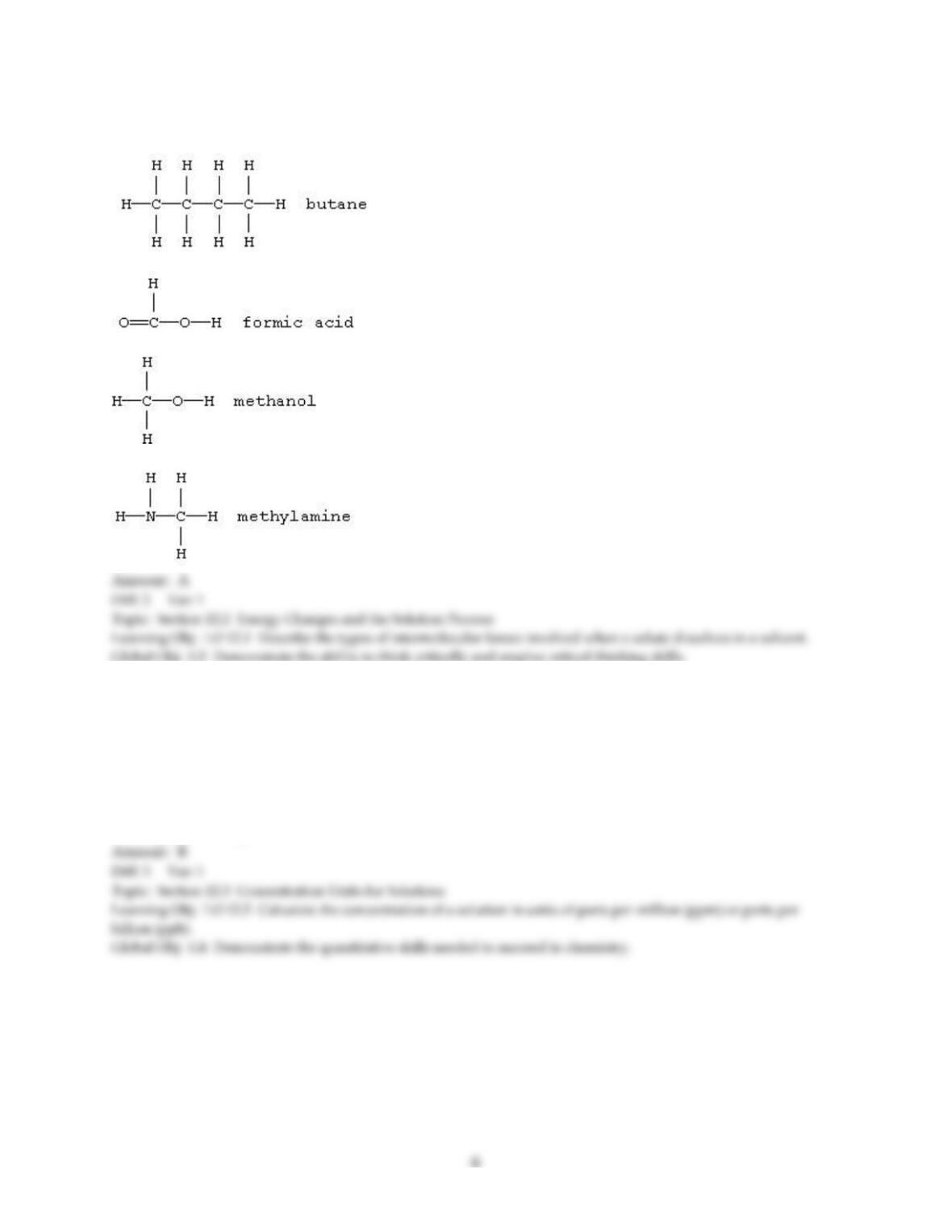
19) Which should be least soluble in water?
A)
B)
C)
D)
20) Formaldehyde is a carcinogenic volatile organic compound with a permissible exposure level of 0.75
ppm. At this level, how many grams of formaldehyde are permissible in a 6.0-L breath of air having a
density of 1.2 kg/m3?
A) 3.8 × 10⁻² g formaldehyde
B) 5.4 × 10⁻⁶ g formaldehyde
C) 3.8 g formaldehyde
D) 5.4 g formaldehyde
21) What is the mole fraction of ethanol in a solution made by dissolving 25.0 g of ethanol, C2H5OH, in
53.6 g of water?
A) 0.154
B) 0.846
C) 0.214
D) 0.272
22) What is the mole fraction of I2 in a solution made by dissolving 27.8 g of I2 in 260 g of hexane, C6H14?
A) 0.0350
B) 0.965
C) 1.03
D) 28.57
23) What is the mole fraction of oxygen in a gas mixture that is 40.0% oxygen and 60.0% nitrogen by
volume?
A) 0.632
B) 0.368
C) 0.400
D) 0.600
24) A solution is prepared by dissolving 17.75 g sulfuric acid, H2SO4, in enough water to make 100.0 mL
of solution. If the density of the solution is 1.1094 g/mL, what is the mole fraction H2SO4 in the solution?
A) 0.0181
B) 0.0338
C) 0.0350
D) 19.0
25) A solution is prepared by dissolving 17.75 g sulfuric acid, H2SO4, in enough water to make 100.0 mL
of solution. If the density of the solution is 1.1094 g/mL, what is the molarity?
A) 0.1775 M H2SO4
B) 0.1810 M H2SO4
C) 1.810 M H2SO4
D) 1.940 M H2SO4
26) A solution is prepared by dissolving 17.75 g sulfuric acid, H2SO4, in enough water to make 100.0 mL
of solution. If the density of the solution is 1.1094 g/mL, what is the molality?
A) 0.1775 m H2SO4
B) 0.1810 m H2SO4
C) 1.810 m H2SO4
D) 1.940 m H2SO4
27) A solution is prepared by dissolving 17.75 g sulfuric acid, H2SO4, in enough water to make exactly
100.0 mL of solution. If the density of the solution is 1.1094 g/mL, what is the weight % H2SO4 in the
solution?
A) 16.00%
B) 18.00%
C) 19.00%
D) 84.00%
28) A solution is prepared by dissolving 171 g of CdCl2 in enough water to make 250.0 mL of solution. If
the density of the solution is 1.556 g/mL, what is the molarity of the solution?
A) 0.440 M
B) 0.684 M
C) 0.933 M
D) 3.73 M
29) A solution is prepared by dissolving 171 g of CdCl2 in enough water to make exactly 250.0 mL of
solution. If the density of the solution is 1.556 g/mL, what is the weight percent of CdCl2 in the solution?
A) 7.17%
B) 44.0%
C) 56.0%
D) 68.4%
30) What is the weight percent of vitamin C in a solution made by dissolving 8.00 g of vitamin C,
C6H8O6, in 55.0 g of water?
A) 87.3%
B) 14.5%
C) 12.7%
D) 85.5%
31) What is the weight percent of a caffeine solution made by dissolving 4.00 g of caffeine, C8H10N4O2,
in 75.0 g of benzene, C6H6?
A) 0.0506%
B) 0.0533%
C) 5.06%
D) 5.33%
32) What volume of 0.716 M KBr solution is needed to provide 13.0 g of KBr?
A) 6.55 mL
B) 9.31 mL
C) 18.5 mL
D) 153 mL
33) What volume of 3.00 M CH3OH solution is needed to provide 0.500 mol of CH3OH?
A) 3.12 mL
B) 9.38 mL
C) 167 mL
D) 150 mL
34) How much water must be added to 42.0 g of CaCl2 to produce a solution that is 40.0 wt% CaCl2?
A) 56.7 g
B) 63.0 g
C) 16.8 g
D) 120 g
35) To make a 3.0 M solution, one could take 3.00 moles of solute and add
A) 1.00 L of solvent.
B) 1.00 kg of solvent.
C) enough solvent to make 1.00 L of solution.
D) enough solvent to make 1.00 kg of solution.
36) To make a 3.00 m solution, one could take 3.00 moles of solute and add
A) 1.00 L of solvent.
B) 1.00 kg of solvent.
C) enough solvent to make 1.00 L of solution.
D) enough solvent to make 1.00 kg of solution.
37) What molality of pentane is obtained by dissolving 50.0 g pentane, C5H12, in 245.0 g hexane, C6H14?
A) 0.200 m
B) 0.240 m
C) 2.83 m
D) 200. m
38) A solution is 4.50% by weight NaHCO3. How many grams of NaHCO3 are in 450.0 g of solution?
A) 1.000 g
B) 20.2 g
C) 400 g
D) 450 g
39) How many grams of KBr are required to make 850. mL of a 0.115 M KBr solution?
A) 0.0978 g
B) 85.9 g
C) 11.6 g
D) 13.7 g
40) What is the molality of a glucose solution prepared by dissolving 9.00 g of glucose, C6H12O6, in 125.9
g of water?
A) 2.38 × 10⁻⁴ m
B) 0.0715 m
C) 0.347 m
D) 0.397 m
41) Aqueous solutions of 30% (by weight) hydrogen peroxide, H2O2, are used to oxidize metals or
organic molecules in chemical reactions. Given that the density of the solution is 1.11 g/mL, calculate the
molarity.
A) 0.794 M
B) 6.78 M
C) 9.79 M
D) 12.6 M
42) Aqueous solutions of 30.0% (by weight) hydrogen peroxide, H2O2, are used to oxidize metals or
organic molecules in chemical reactions. Calculate the molality of this solution.
A) 0.974 m
B) 6.78 m
C) 9.79 m
D) 12.6 m
43) Sodium hydroxide is available commercially as a 50.0% by weight aqueous solution. The density of
the solution is 1.53 g/mL. Calculate the molarity of this sodium hydroxide solution.
A) 0.450 M
B) 19.1 M
C) 25.0 M
D) 125. M
44) Sodium hydroxide is available commercially as a 50.0% by weight aqueous solution. Calculate the
molality of this sodium hydroxide solution.
A) 0.450 m
B) 19.1 m
C) 25.0 m
D) 125. m
45) A 3.17 m solution of CaCl2 in water has a density of 1.24 g/mL. What is the molarity?
A) 2.56 M CaCl2
B) 2.91 M CaCl2
C) 3.50 M CaCl2
D) 3.93 M CaCl2
46) A 2.00 M solution of CaCl2 in water has a density of 1.17 g/mL. What is the mole fraction of CaCl2?
A) 0.0348
B) 0.0360
C) 0.0366
D) 0.0380
47) A solution of LiCl in water has XLiCl = 0.0400. What is the molality?
A) 4.16 m LiCl
B) 2.22 m LiCl
C) 2.31 m LiCl
D) 4.21 m LiCl
48) A solution of LiCl in water is 9.00 wt% LiCl. What is the mole fraction of LiCl?
A) 0.0407
B) 0.0466
C) 0.212
D) 2.28
49) At 25.0°C, a solution has a concentration of 3.179 M and a density of 1.260 g/mL. The density of the
solution at 50.0°C is 1.249 g/mL. What is the molarity of the solution at 50.0°C?
A) 2.545 M
B) 3.151 M
C) 3.179 M
D) 3.230 M
50) Which of the following aqueous salt (NaCl) solutions has the greater concentration?
A) 0.5 M
B) 2.3 m
C) 3.0 % by mass
D) 11.1 g/L
51) Which of the following statements is true for a supersaturated solution?
A) The solute in the solution is at equilibrium with undissolved solute.
B) The solution contains more than the equilibrium amount of solute.
C) The solution is stable and the solute will not precipitate.
D) A supersaturated solution is more than 50% solute by mass.
52) In general, as the temperature increases, the solubility of gases in water ________ and the solubility of
most solids in water ________.
A) decreases, decreases
B) decreases, increases
C) increases, decreases
D) increases, increases
53) The solubility of gaseous solutes in liquid solvents is greater when the
A) external pressure over the solution is increased.
B) external pressure is decreased.
C) partial pressure of the gas above the solution is increased.
D) partial pressure of the solvent is increased.
54) The Henry’s Law constant of methyl bromide, CH3Br, is k = 0.159 mol/(L ∙ atm) at 25°C. What is the
solubility of methyl bromide in water at 25°C and at a partial pressure of 250. mm Hg?
A) 0.0523 mol/L
B) 0.329 mol/L
C) 0.483 mol/L
D) 39.8 mol/L
55) The solubility of argon in water at 25°C is 0.0150 mol/L. What is the Henry’s Law constant for argon if
the partial pressure of argon in air is 0.00934 atm?
A) 1.40 × 10⁻⁴ mol/(L ∙ atm)
B) 0.623 mol/(L ∙ atm)
C) 1.61 mol/(L ∙ atm)
D) 4.10 mol/(L ∙ atm)
56) Which of the following is not an application of colligative properties?
A) adding silver to mercury to lower the vapor pressure of mercury
B) desalinating sea water by reverse osmosis
C) melting snow by application of salt
D) reduced boiling points of pure liquids at increased altitudes
57) A solution is prepared by dissolving 20.0 g of sucrose, C12H22O11, in 250. g of water at 25°C. What is
the vapor pressure of the solution if the vapor pressure of water at 25°C is 23.76 mm Hg?
A) 0.198 mm Hg
B) 20.5 mm Hg
C) 23.7 mm Hg
D) 24.0 mm Hg
58) A KCl solution is prepared by dissolving 60.0 g KCl in 250.0 g of water at 25°C. What is the vapor
pressure of the solution if the vapor pressure of water at 25°C is 23.76 mm Hg?
A) 20.5 mm Hg
B) 21.3 mm Hg
C) 22.5 mm Hg
D) 25.5 mm Hg
59) At a given temperature the vapor pressures of benzene and toluene are 183 mm Hg and 59.2 mm Hg,
respectively. Calculate the total vapor pressure over a solution of benzene and toluene with Xbenzene =
0.400.
A) 110 mm Hg
B) 133 mm Hg
C) 109 mm Hg
D) 242 mm Hg
60) At a given temperature the vapor pressures of benzene and toluene are 183 mm Hg and 59.2 mm Hg,
respectively. Calculate the mole fraction of benzene in the vapor phase over a solution of benzene and
toluene with Xbenzene = 0.600.
A) 0.600
B) 0.678
C) 0.756
D) 0.823
61) How many grams of sucrose, C12H22O11, must be added to 500. g of water at 100°C to change the
vapor pressure to 752 mm Hg?
A) 0.295 g
B) 5.32 g
C) 10.6 g
D) 101 g
62) At 25°C the vapor pressures of benzene and toluene are 96.0 mm Hg and 30.5 mm Hg, respectively.
When a 1:1 molar mixture of benzene and toluene is fractionally distilled, the first fraction will have a
mole fraction of benzene that is closest to
A) 0.0.
B) 0.5.
C) 0.7.
D) 1.0.
63) Which of the following solutions will have the lowest freezing point?
A) 0.0100 m NaCl
B) 0.0120 m Li2SO4
C) 0.0400 m CH3CH2CH2OH
D) 0.0150 m MgCl2
64) What is the expected freezing point of a 0.50 m solution of Na2CO3 in water? Kf for water is 1.86°C/m.
A) -0.93°C
B) -1.9°C
C) -2.8°C
D) -6.5°C
18
65) Calculate the freezing point of a solution of 50.0 g methyl salicylate, C7H6O2, dissolved in 800. g of
benzene, C6H6. Kf for benzene is 5.10°C/m and the freezing point is 5.50°C for benzene.
A) -2.61°C
B) 2.61°C
C) 2.89°C
D) 8.39°C
66) What is the freezing point of a solution of 8.00 g MgCl2 in 100 g of water? Kf for water is 1.86°C/m for
water.
A) 1.56°C
B) -1.56°C
C) 4.69°C
D) -4.69°C
67) The normal boiling point of pure benzene is found to be 80.10°C. What is the approximate molecular
weight of a nonionizing substance if a solution of 3.55 g of the substance dissolved in 100. g of benzene
has a normal boiling point of 80.19°C? Kb = 5.12°C/m for benzene, C6H6.
A) 20 amu
B) 500 amu
C) 2000 amu
D) 20,000 amu
68) An aqueous solution has a normal boiling point of 105.0°C. What is the freezing point of this solution?
For water Kb is 0.51°C/m and Kf = 1.86°C/m.
A) 14.7°C
B) -14.7°C
C) 18.2°C
D) -18.2°C
69) A solution of 0.2113 g of water dissolved in 25.0 g of a solvent freezes at 11.5°C below the freezing
19
point of the solvent. What is Kf for this solvent?
A) 0.735°C/m
B) 1.36°C/m
C) 5.39°C/m
D) 24.5°C/m
70) An aqueous CsCl solution is 8.00 wt% CsCl and has a density of 1.0643 g/mL at 20°C. What is the
boiling point of this solution? Kb = 0.51°C/m for water.
A) 100.27°C
B) 100.53°C
C) 103.8°C
D) 104.3°C
71) When 0.500 g of vitamin K is dissolved in 10.0 g of camphor (Kf = 40.0°C/m), the freezing point of the
solution is 4.43°C lower than that of pure camphor. Assuming vitamin K is a nonelectrolyte in camphor,
calculate its molar mass.
A) 0.451 g/mol
B) 55.4 g/mol
C) 451 g/mol
D) 3.54 × 10⁴ g/mol
72) When ethylene glycol, HOCH2CH2OH, is added to the water in an automobile radiator, the effect is
to
A) lower the boiling point and lower the freezing point.
B) lower the boiling point and raise the freezing point.
C) raise the boiling point and lower the freezing point.
D) raise the boiling point and raise the freezing point.
73) The coolant in automobiles is often a 50/50 % by volume mixture of ethylene glycol, HOCH2CH2OH,
and water. At 20°C, the density of ethylene glycol is 1.1088 g/mL and the density of water is 0.9982 g/mL.
Assuming that the volumes are additive, what is the expected freezing point of a 50/50(v/v)% ethylene
glycol/water solution? Kf = 1.86°C/m for water.
A) -16°C
B) -17°C
C) -30°C
D) -33°C
74) Two aqueous solutions, A and B, are separated by a semipermeable membrane. The osmotic pressure
of solution A immediately begins to decrease. Which of the following statements is true?
A) Solvent molecules are moving from solution B into solution A.
B) The initial osmotic pressure of solution B is greater than that of solution A.
C) The solvent molecules are moving from the solution of higher osmotic pressure to that of lower
osmotic pressure.
D) Both B and C are true statements.
75) Red blood cells are placed into pure water. Which of the following statements is true?
A) Water molecules flow out of the red blood cells, causing them to collapse.
B) Water flows into the red blood cells, causing them to swell and burst.
C) The osmotic pressure of the cell contents increases, causing the cells to burst.
D) The osmotic pressure inside the cells equals the osmotic pressure outside.