General Chemistry: Atoms First, 2e (McMurry and Fay)
Chapter 12 The Rates and Mechanisms of Chemical Reactions
12.1 Multiple Choice Questions
1) Which term describes the measure of the increase in the concentration of a product per unit
time?
A) activation energy
B) kinetics
C) reaction rate
D) reaction time
2) “Instantaneous rate” is defined as the
A) change in concentration per unit time.
B) equation showing how the rate depends on the concentration of each reactant.
C) rate of reaction at a particular time.
D) rate of reaction during a time interval.
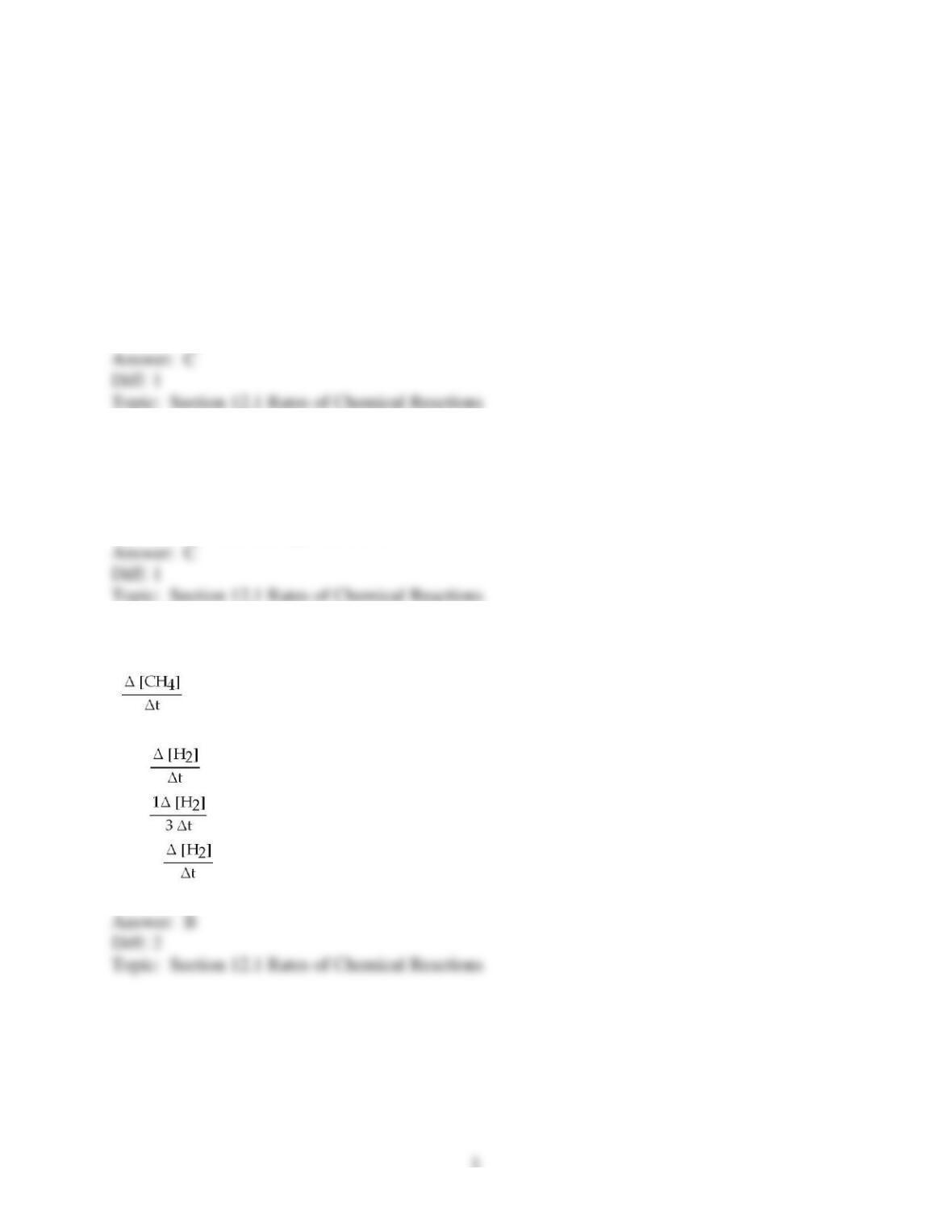
3) Molecular hydrogen can be made from methane gas by the reaction below. How is the rate of
disappearance of CH4 related to the rate of appearance of H2?
– = ?
CH4 (g) + H2O (l) → CO (g) + 3H2 (g)
A) +
B) +
C) + 3
D) none of these
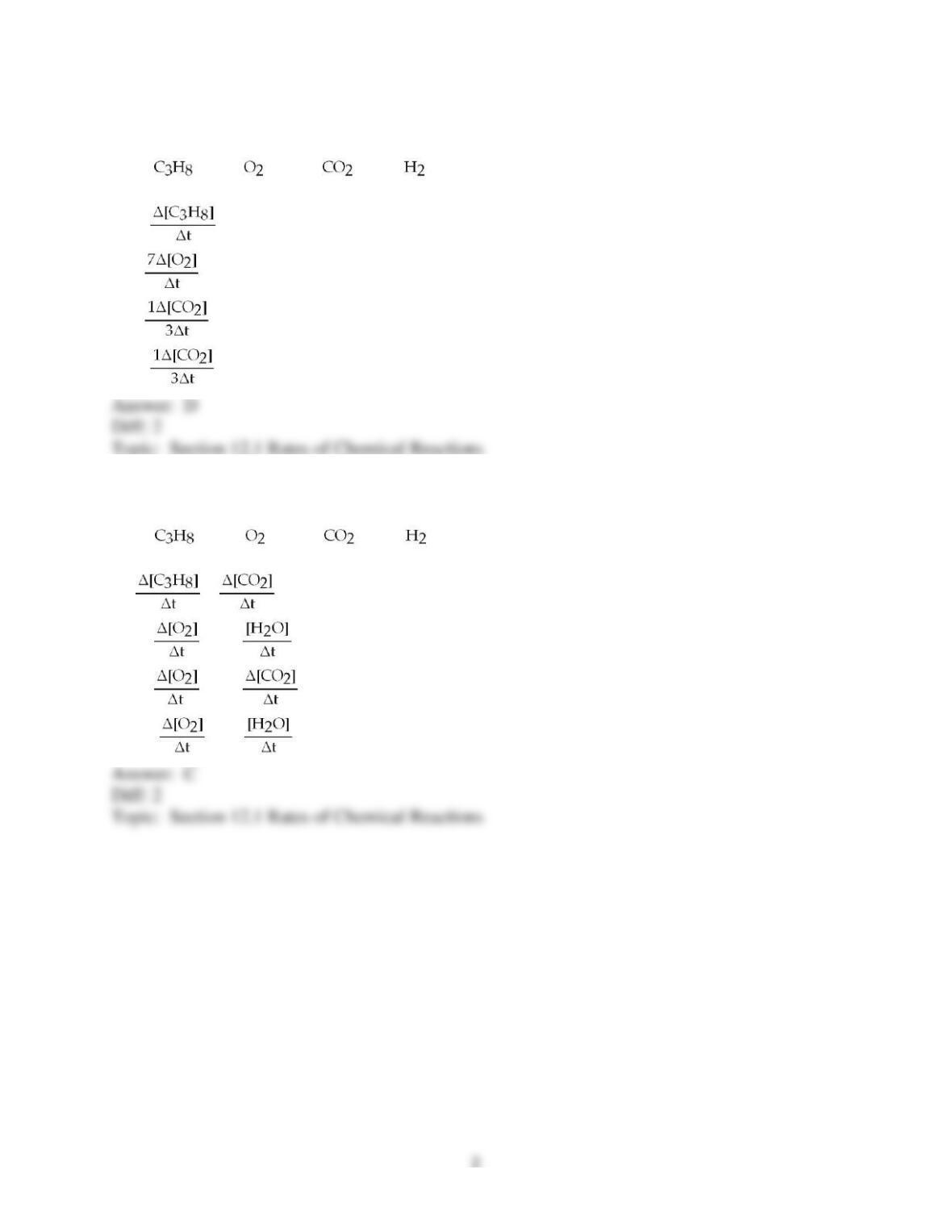
4) The burning of propane can be represented by the following equation:
(g) + 7 (g) → 3 (g) + 4 O(g)
The general rate of this reaction may be expressed as:
A) +
B) –
C) –
D) +
5) The burning of propane can be represented by the following equation:
(g) + 7 (g) → 3 (g) + 4 O(g)
Which of the following relationships is true?
A) =
B) – 7 = + 4
C) – 3 = + 7
D) + 7 = – 4
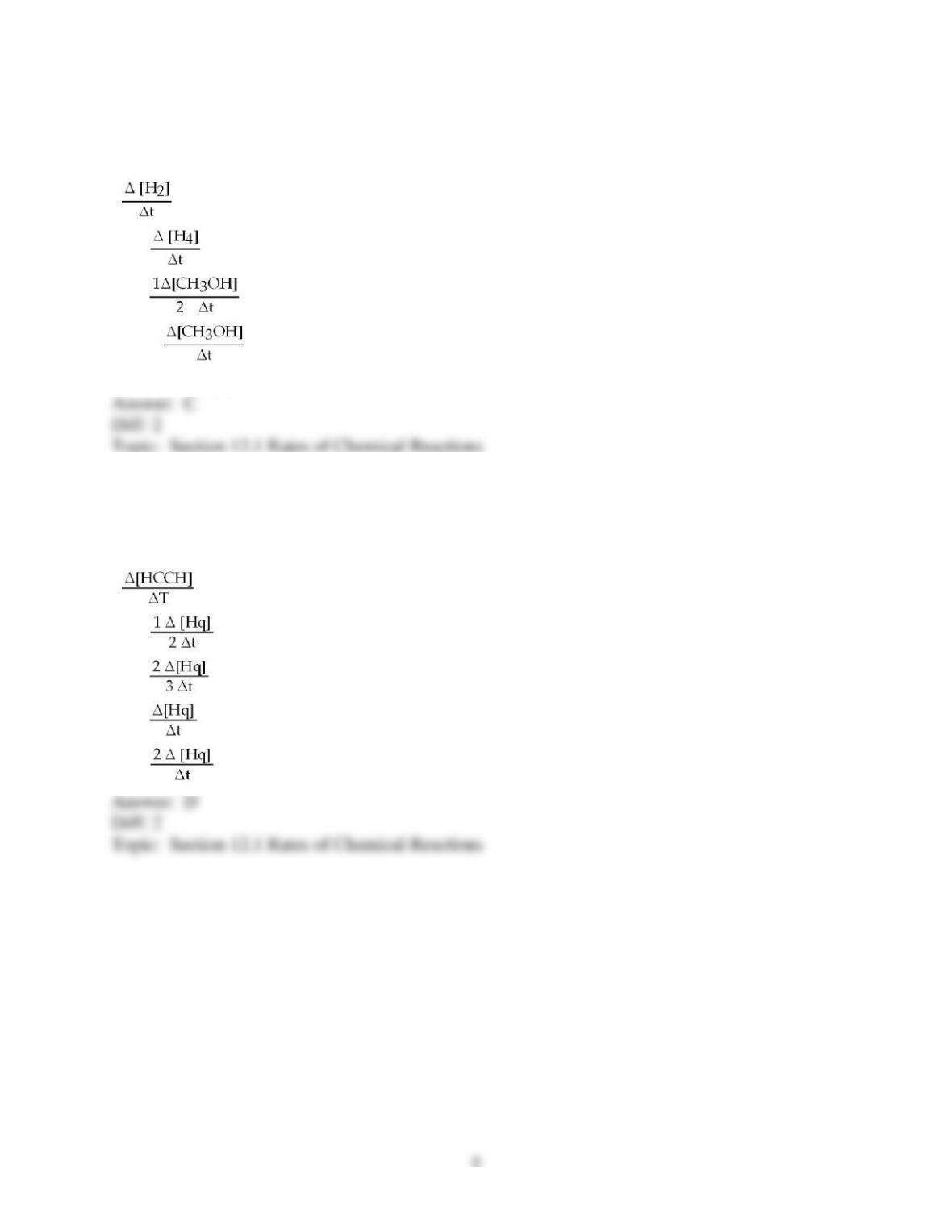
6) Methanol can be produced by the following reaction:
CO(g) + 2 H2(g) → CH3OH(g).
How is the rate of disappearance of hydrogen gas related to the rate of appearance of methanol?
– = ?
A) +
B) +
C) + 2
D) none of these
7) Hydroquinone, HOC6H6OH, can be formed by the reaction with acetylene below:
2 HCCH + 3 CO + H2O → HOC6H4OH + CO2
How is the rate of disappearance of acetylene, HCCH, related to the appearance of hydroquinone
(Hq)?
– = ?
A) +
B) +
C) +
D) +
8) The reaction that occurs in a Breathalyzer, a device used to determine the alcohol level in a
person’s bloodstream, is given below. If the rate of appearance of Cr2(SO4)3 is 1.24 mol/min at
a particular moment, what is the rate of disappearance of C2H6O at that moment?
2 K2Cr2O7 + 8 H2SO4 + 3 C2H6O → 2 Cr2(SO4)3 + 2 K2SO4 + 11 H2O
A) 0.413 mol/min
B) 0.826 mol/min
C) 1.86 mol/min
D) 3.72 mol/min
9) The decomposition of dinitrogen pentoxide is described by the chemical equation
2 N2O5(g) → 4 NO2(g) + O2(g)
If the rate of disappearance of N2O5 is equal to 1.40 mol/min at a particular moment, what is the
rate of appearance of NO2 at that moment?
A) 0.700 mol/min
B) 1.40 mol/min
C) 2.80 mol/min
D) 5.60 mol/min
10) The decomposition of dinitrogen pentoxide is described by the chemical equation
2 N2O5(g) → 4 NO2(g) + O2(g)
If the rate of appearance of NO2 is equal to 0.560 mol/min at a particular moment, what is the
rate of appearance of O2 at that moment?
A) 0.140 mol/min
B) 0.280 mol/min
C) 1.12 mol/min
D) 2.24 mol/min
11) The decomposition of dinitrogen pentoxide is described by the chemical equation
2 N2O5(g) → 4 NO2(g) + O2(g)
If the rate of appearance of O2 is equal to 2.40 mol/min at a particular moment, what is the rate
of disappearance of N2O5 at that moment?
A) 0.600 mol/min
B) 1.20 mol/min
C) 4.80 mol/min
D) 9.60 mol/min
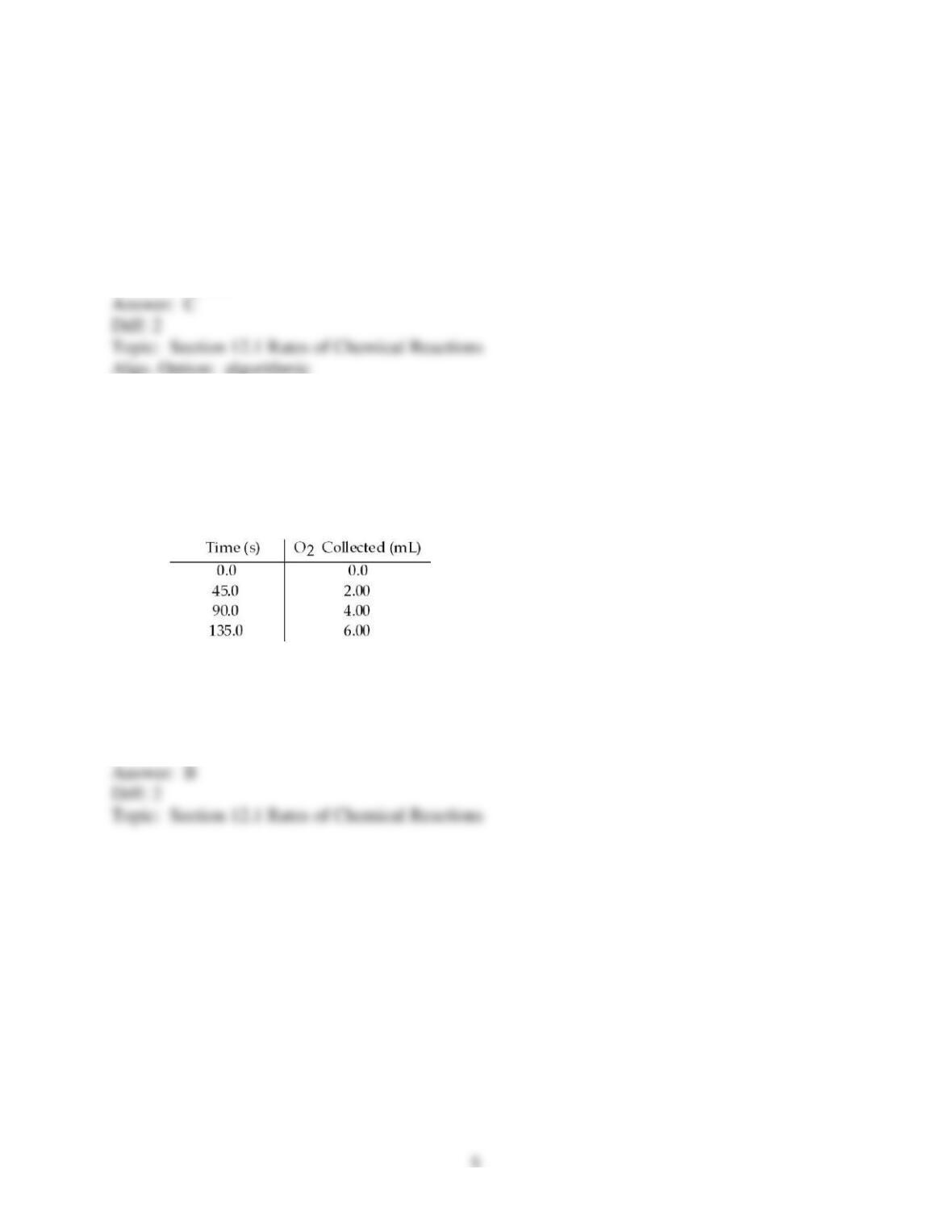
12) Hydrogen peroxide decomposes to water and oxygen according to the reaction below:
2 H2O2(aq) → 2 H2O(l) + O2(g)
In the presence of large excesses of I– ion, the following set of data is obtained. What is the
average rate of disappearance of H2O2(aq) in M/s in the first 45.0 seconds of the reaction if
1.00 L of H2O2 reacts at 25°C and 1.00 atm pressure?
A) 9.09 × 10⁻⁷ M/s
B) 3.63 × 10⁻⁶ M/s
C) 4.33 × 10⁻⁵ M/s
D) 1.64 × 10⁻⁴ M/s
13) A concentration-time study of the gas phase reaction 2 A3 → 3 A2 produced the data in the
table below.
Time (s) [A3] (M) [A2] (M)
0 4.00 × 10⁻⁴ 0
10 2.00 × 10⁻⁴ 3.00 × 10⁻⁴
20 1.00 × 10⁻⁴ 4.50 × 10⁻⁴
30 5.00 × 10⁻⁵ ?
What is the average rate of decomposition of A3 in the time interval 20-30 seconds?
A) 4.00 × 10⁻⁴ M/s
B) 3.50 × 10⁻⁵ M/s
C) 5.00 × 10⁻⁶ M/s
D) 4.00 × 10⁻⁶ M/s
14) A concentration-time study of the gas phase reaction 2 A3 → 3 A2 produced the data in the
table below.
Time (s) [A3] (M) [A2] (M)
0 4.00 × 10⁻⁴ 0
10 2.00 × 10⁻⁴ 3.00 × 10⁻⁴
20 1.00 × 10⁻⁴ 4.50 × 10⁻⁴
30 5.00 × 10⁻⁵ ?
What is the average rate of formation of A2 in the time interval 20-30 seconds?
A) 6.00 × 10⁻⁴ M/s
B) 5.25 × 10⁻⁵ M/s
C) 7.50 × 10⁻⁶ M/s
D) 6.00 × 10⁻⁶ M/s
7
15) A concentration-time study of the gas phase reaction 2 A3 → 3 A2 produced the data in the
table below.
Time (s) [A3] (M) [A2] (M)
0 4.00 × 10⁻⁴ 0
10 2.00 × 10⁻⁴ 3.00 × 10⁻⁴
20 1.00 × 10⁻⁴ 4.50 × 10⁻⁴
30 5.00 × 10⁻⁵ ?
What is the concentration of A2 after 30 seconds?
A) 5.00 × 10⁻⁴ M
B) 5.25 × 10⁻⁴ M
C) 5.50 × 10⁻⁴ M
D) 6.00 × 10⁻⁴ M
16) Which statement is true for the general rate law: Rate = k[A]m[B]n?
A) It can be written from the stoichiometry of the overall reaction.
B) The overall order of the reaction is equal to m times n.
C) The values for the exponents must be determined by experiment.
D) The exponents in the rate law must be positive integers.
17) The reaction shown below has the rate law: Rate = k[BrO3–][Br–][H+]2.
BrO3–(aq) + 5 Br–(aq) + 6 H+(aq) → 3 Br2(aq) + 3 H2O(l)
What is the overall order of reaction?
A) first
B) second
C) third
D) fourth
8
18) For a reaction that follows the general rate law, Rate = k[A][B]2, what will happen to the rate
of reaction if the concentration of A is increased by a factor of 3.00? The rate will
A) decrease by a factor of 1/9.00.
B) decrease by a factor of 1/3.00.
C) increase by a factor of 3.00.
D) increase by a factor of 9.00.
19) For a reaction that follows the general rate law, Rate = k[A][B]2, what will happen to the rate
of reaction if the concentration of B is increased by a factor of 2.00? The rate will
A) decrease by a factor of 1/4.00.
B) decrease by a factor of 1/2.00.
C) increase by a factor of 2.00.
D) increase by a factor of 4.00.
20) The reaction between chlorine and nitric oxide to form nitrosyl chloride is shown below. If
the reaction rate doubles when the concentration of Cl2 is doubled and the rate quadruples when
the concentration of NO is doubled, by what factor will the rate increase if both concentrations,
NO and Cl2, are doubled?
Cl2(g) + 2 NO(g) → 2 NOCl(g)
A) 2
B) 4
C) 8
D) 16
21) The hydrolysis of tert-butyl chloride is given in the reaction below:
(CH3)3CCl(aq) + H2O(l) → (CH3)3COH(aq) + H+(aq) + Cl–(aq)
If the rate law is: Rate = k[(CH3)3CCl], what is the order of the reaction with respect to water?
A) zero
B) first
C) second
D) third
22) Given the following hypothetical reaction: 2 E(g) + F(g) + G(g) → products. If the rate law
is: Rate = k[E]2[F]-1, what is the order of reaction with respect to E?
A) zero
B) first
C) second
D) third
23) Given the following hypothetical reaction: 2 E(g) + F(g) + G(g) → products. If the rate law
is: Rate = k[E]2[F]-1, what is the overall order of reaction?
A) zero
B) first
C) second
D) third
24) The decomposition of ammonia to nitrogen and hydrogen on a tungsten filament at 800°C is
independent of the concentration of ammonia at high pressures of ammonia. What is the order of
the reaction with respect to ammonia?
A) zero
B) first
C) second
D) third
25) Cerium(IV) ion reacts with thallium(I) ion in a one-step reaction shown below:
2 Ce4+(aq) + Tl+(aq) → 2 Ce3+(aq) + Tl3+(aq).
If the rate law is: Rate = k[Ce4+]2[Tl+], what is the overall order of the reaction?
A) first
B) second
C) third
D) fourth
26) What is the overall reaction order for the reaction that has the rate law: Rate = k[H2][NO]2?
A) zero order
B) first order
C) second order
D) third order
27) Iodide and hypochlorite ion react in aqueous solution according to the reaction below:
I– + OCl– → OI– + Cl–
If the concentration of OH– in the solution is doubled, the rate of the reaction is halved. What is
the order of the reaction with respect to OCl–?
A) -2
B) -1
C) +1
D) +2
28) Chlorine reacts with chloroform according to the reaction given below:
Cl2 + CHCl3 → CCl4 + HCl
When the initial concentration of Cl2 is doubled the reaction rate increases by a factor of 1.41.
What is the order of the reaction with respect to Cl2?
A) -1/2
B) -1
C) 1/2
D) 2
29) If the units for rate are M s-1, what are the units for the rate constant, k, if the overall order
of the reaction is three?
A) s-1
B) M2 s-1
C) M-1 s-1
D) M-2 s-1
30) Using the method of initial rates for the reaction A → B, if the initial concentration of A is
doubled and the rate of reaction quadruples, what is the order of reaction with respect to A?
A) zeroth
B) first
C) second
D) fourth
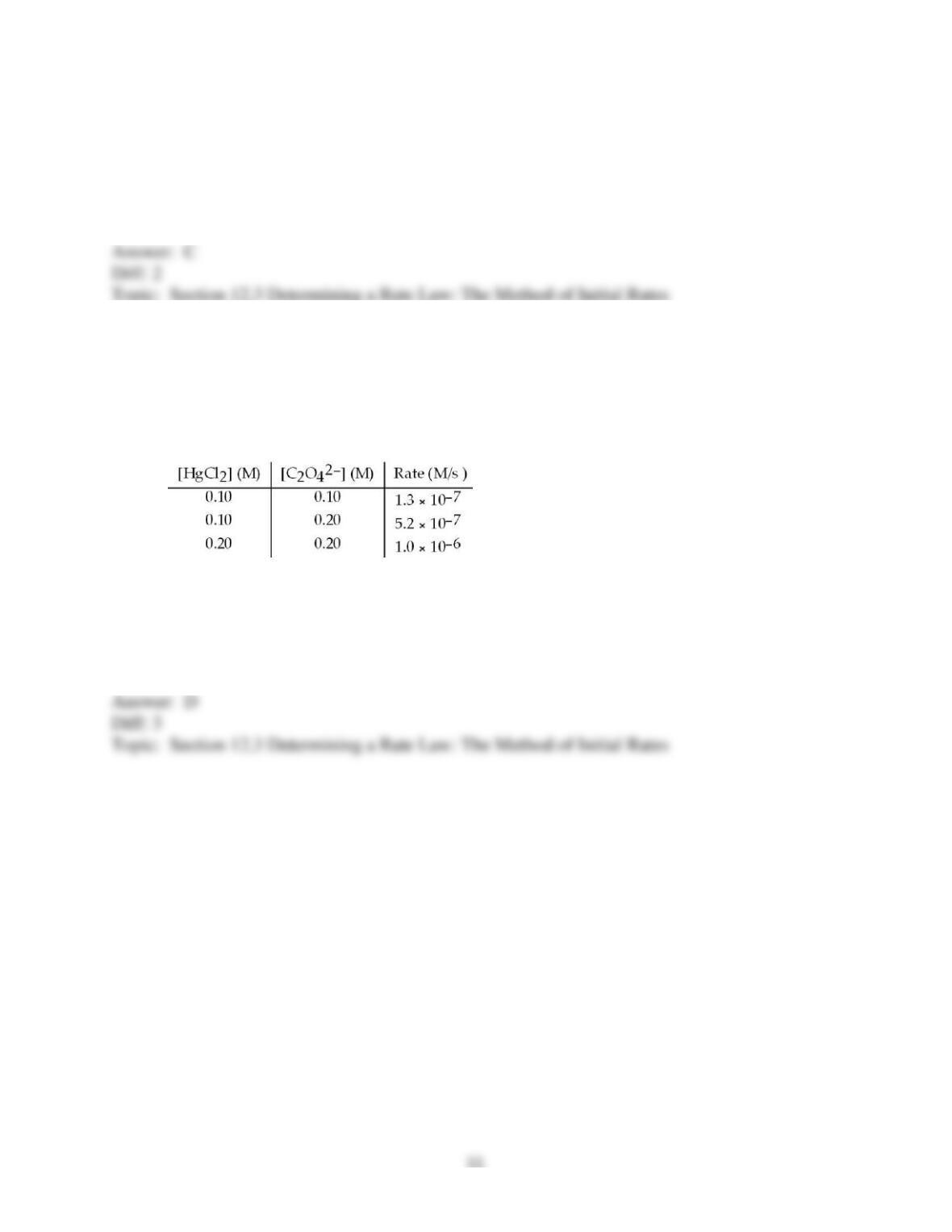
31) The following set of data was obtained by the method of initial rates for the reaction:
2 HgCl2(aq) + C2O42-(aq) → 2 Cl–(aq) + 2 CO2(g) + Hg2Cl2(s)
What is the rate law for the reaction?
A) Rate = k[HgCl2][C2O42-]-2
B) Rate = k[HgCl2][C2O42-]-1
C) Rate = k[HgCl2]2[C2O42-]
D) Rate = k[HgCl2][C2O42-]2
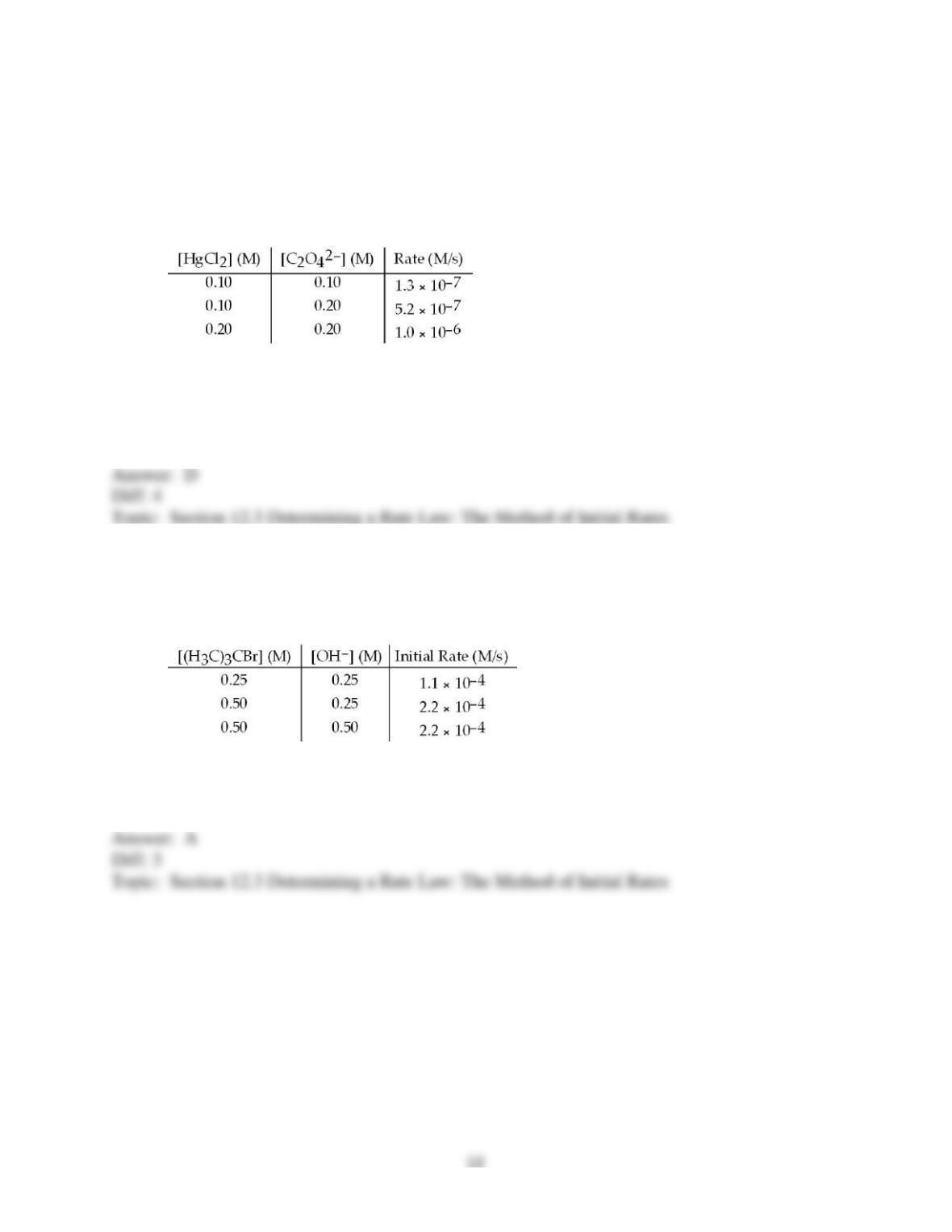
32) The following set of data was obtained by the method of initial rates for the reaction:
2 HgCl2(aq) + C2O42-(aq) → 2 Cl–(aq) + 2 CO2(g) + Hg2Cl2(s)
What is the value of the rate constant, k?
A) 1.4 × 10⁻⁸ 1/M2∙s
B) 1.3 × 10⁻⁷ 1/M2∙s
C) 1.4 × 10⁻⁵ 1/M2∙s
D) 1.3 × 10⁻⁴ 1/M2∙s
33) The following set of data was obtained by the method of initial rates for the reaction:
(H3C)3CBr + OH– → (H3C)3COH + Br–
What is the order of reaction with respect to ion, OH–?
A) zero
B) first
C) second
D) none of these
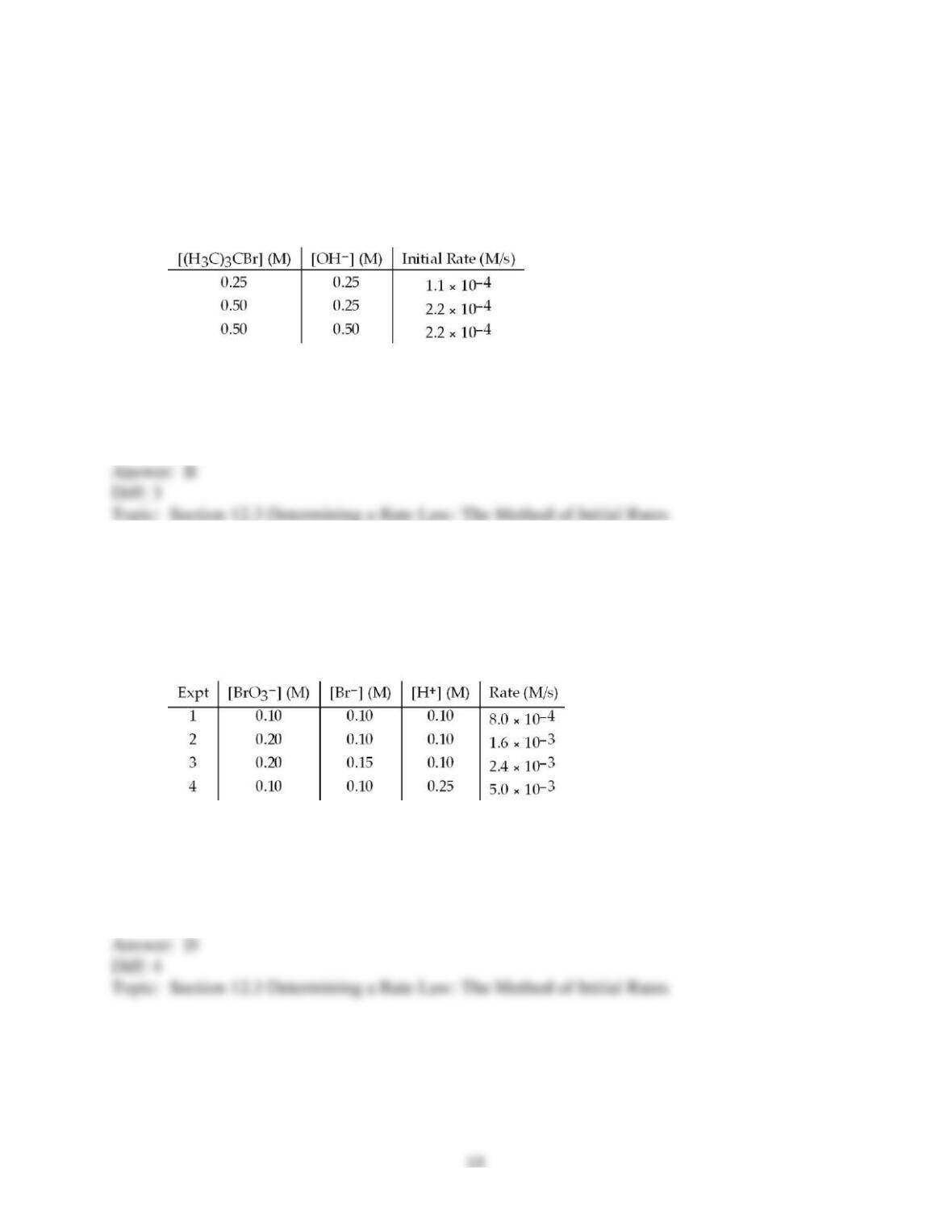
34) The following set of data was obtained by the method of initial rates for the reaction:
(H3C)3CBr + OH– → (H3C)3COH + Br–
What is the value of the rate constant, k?
A) 8.8 × 10⁻⁴ s-1
B) 4.4 × 10⁻⁴ s-1
C) 1.8 × 10⁻⁴ s-1
D) none of these
35) The following set of data was obtained by the method of initial rates for the reaction:
BrO3–(aq) + 5 Br–(aq) + 6 H+(aq) → 3 Br2(aq) + 3 H2O(l).
What is the rate law for the reaction?
A) Rate = k[BrO3–][Br–][H+]4
B) Rate = k[BrO3–][Br–][H+]-4
C) Rate = k[BrO3–][Br–][H+]-2
D) Rate = k[BrO3–][Br–][H+]2
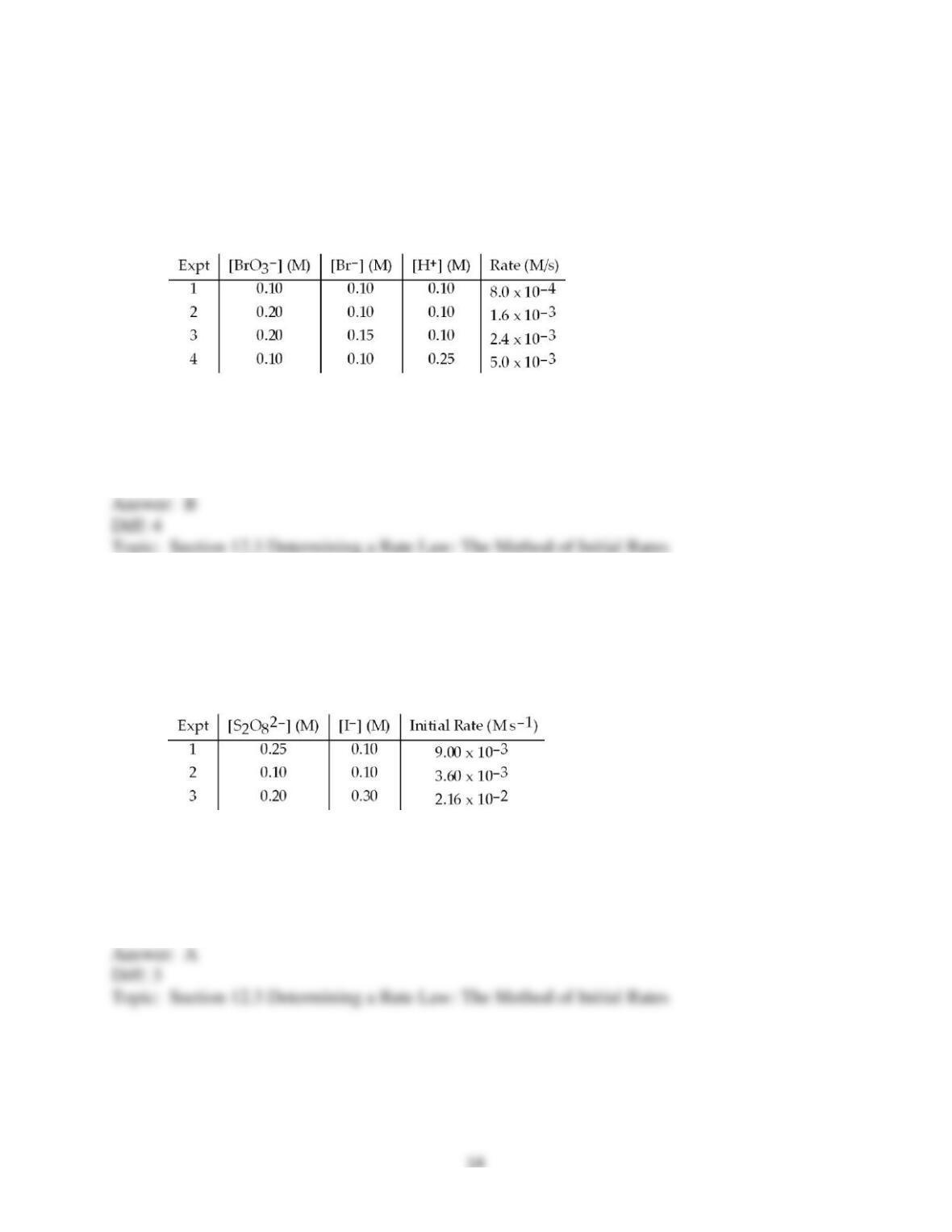
36) The following set of data was obtained by the method of initial rates for the reaction:
BrO3–(aq) + 5 Br–(aq) + 6 H+(aq) → 3 Br2(aq) + 3 H2O(l).
Calculate the initial rate when BrO3– is 0.30 M, Br– is 0.050 M, and H+ is 0.15 M.
A) 6.1 × 10⁻⁵ M/s
B) 2.7 × 10⁻³ M/s
C) 5.3 × 10⁻² M/s
D) 8.4 × 10⁻² M/s
37) The following set of data was obtained by the method of initial rates for the reaction:
S2O82-(aq) + 3 I–(aq) → 2 SO42-(aq) + I3–(aq)
What is the rate law for the reaction?
A) Rate = k[S2O82-][I–]
B) Rate = k[S2O82-][I–]5
C) Rate = k[S2O82-][I–]2
D) Rate = k[S2O82-]2[I–]
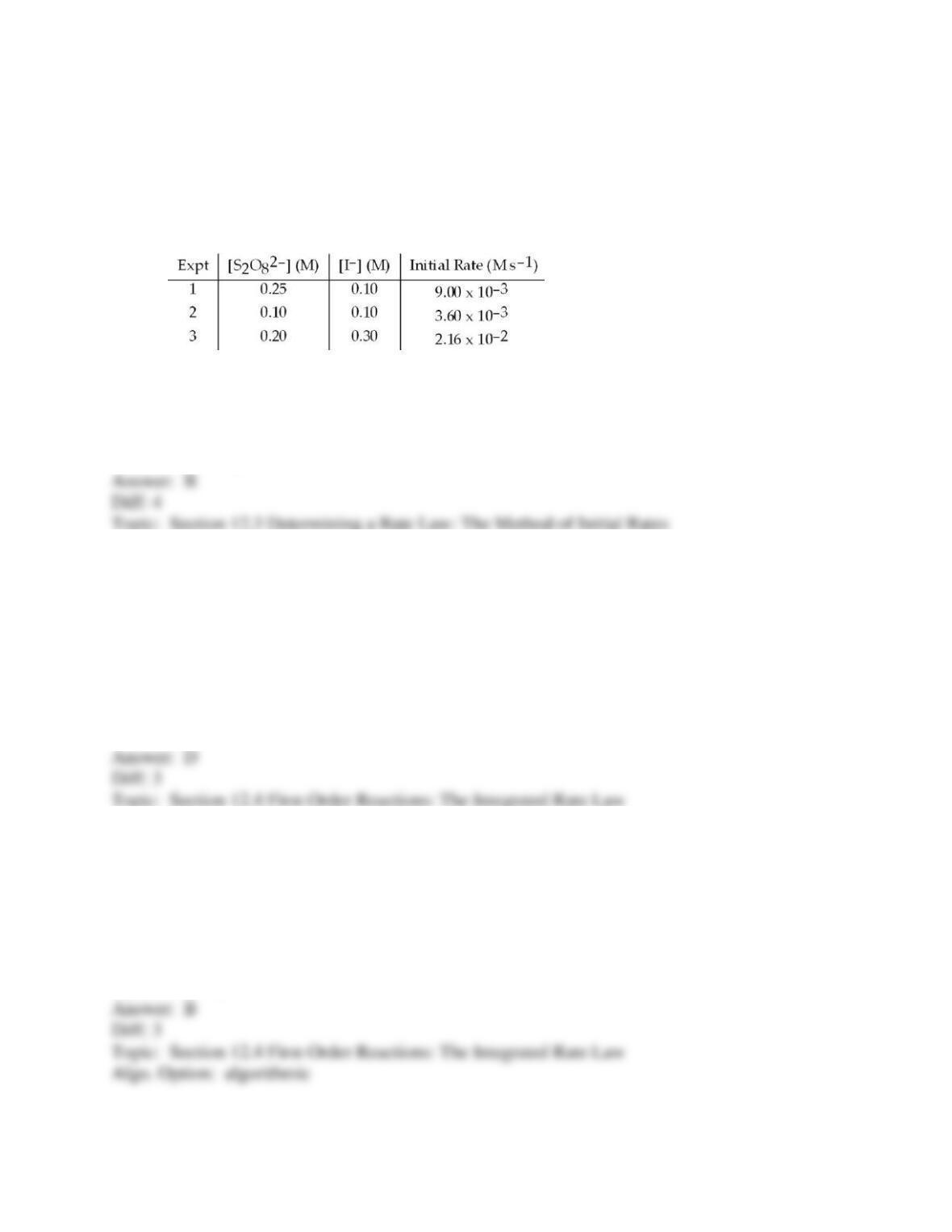
15
38) The following set of data was obtained by the method of initial rates for the reaction:
S2O82-(aq) + 3 I–(aq) → 2 SO42-(aq) + I3–(aq)
What is the initial rate when S2O82- is 0.15 M and I– is 0.15 M?
A) 4.10 × 10⁻⁶ M s-1
B) 8.10 × 10⁻³ M s-1
C) 1.22 × 10⁻² M s-1
D) 5.40 × 10⁻² M s-1
39) The first-order decomposition of hydrogen peroxide occurs according to the equation
2 H2O2(aq) → 2 H2O(l) + O2(g)
Using data from a concentration-time study of this reaction, which plot will produce a straight
line?
A) [H2O2] versus time
B) [H2O2]2 versus time
C) 1/[H2O2] versus time
D) ln[H2O2] versus time
40) For a particular first-order reaction, it takes 48 minutes for the concentration of the reactant
to decrease to 25% of its initial value. What is the value for rate constant (in s-1) for the
reaction?
A) 1.0 × 10⁻⁴ s-1
B) 4.8 × 10⁻⁴ s-1
C) 6.0 × 10⁻³ s-1
D) 2.9 × 10⁻² s-1
41) The first-order reaction, SO2Cl2 → SO2 + Cl2, has a rate constant equal to 2.20 × 10⁻⁵ s-1
at 593 K. What percentage of the initial amount of SO2Cl2 will remain after 2.00 hours?
A) 1.00%
B) 14.7%
C) 17.1%
D) 85.4%
42) The first-order reaction, 2 N2O(g) → 2 N2(g) + O2(g), has a rate constant equal to 0.76 s-1
at 1000 K. How long will it take for the concentration of N2O to decrease to 42% of its initial
concentration?
A) 0.88 s
B) 1.1 s
C) 1.8 s
D) 2.4 s
43) The isomerization reaction, CH3NC → CH3CN, is first order and the rate constant is equal
to 0.46 s-1 at 600 K. What is the concentration of CH3NC after 0.20 minutes if the initial
concentration is 0.10 M?
A) 4.0 x 10⁻⁴ M
B) 9.1 x 10⁻⁴ M
C) 4.0 x 10⁻² M
D) 9.1 x 10⁻² M
44) The following reaction is first order: C2H6 → 2 CH3. If the rate constant is equal to 5.5 ×
10-4 s-1 at 1000 K, how long will it take for 0.35 mol of C2H6 in a 1.00 L container to decrease
to 0.10 mol in the same container?
A) 7.6 min
B) 38 min
C) 106 min
D) 131 min
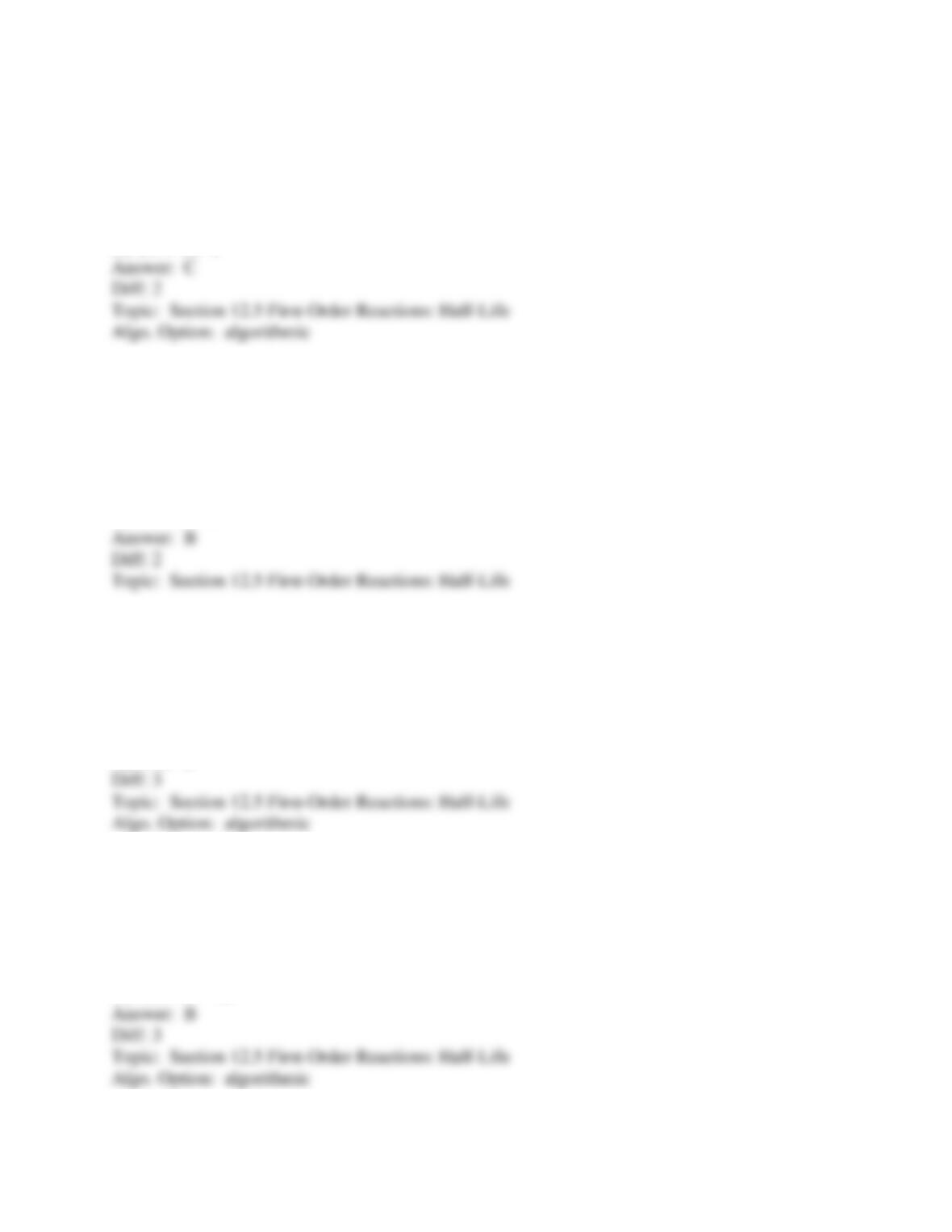
45) The decomposition of cyclopropane, was observed at 500°C and its concentration was
monitored as a function of time. The data set is given below. What is the order of the reaction
with respect to cyclopropane?
A) zero
B) first
C) second
D) third
46) The half life of the reaction shown below is found not to depend on the concentration of
H2O2(aq).
2 H2O2(aq) → 2 H2O(l) + O2(g)
What is the order of this reaction?
A) zeroth
B) first
C) second
D) third
18
47) The rate constant, k, for a first-order reaction is equal to 4.2 × 10⁻⁴ s-1. What is the half-life
for the reaction?
A) 2.9 × 10⁻⁴ s
B) 1.2 × 10³ s
C) 1.7 × 10³ s
D) 2.4 × 10³ s
48) Acetaldehyde decomposes at 750 K: CH3CHO → CO + CH4. The reaction is first order in
acetaldehyde and the half-life of the reaction is found to be 530 seconds. What is the rate
constant for the reaction at this temperature?
A) 2.7 x 10⁻³ s-1
B) 1.3 x 10⁻³ s-1
C) 2.7 x 10² s-1
D) 7.6 x 10² s-1
49) The first-order reaction, SO2Cl2 → SO2 + Cl2, has a half-life of 8.75 hours at 593 K. How
long will it take for the concentration of SO2Cl2 to fall to 12.5% of its initial value?
A) 0.165 hr
B) 3.22 hr
C) 6.06 hr
D) 26.2 hr
Answer: D
50) For the first-order reaction, 2 N2O(g) → 2 N2(g) + O2(g), what is the concentration of N2O
after 3 half-lives if 0.15 mol of N2O is initially placed into in a 1.00-L reaction vessel?
A) 9.4 × 10⁻³ M
B) 1.9 × 10⁻² M
C) 3.8 × 10⁻² M
D) 7.5 × 10⁻² M
51) Fluorine-18 is an isotope used in Positron Emission Tomography (PET) to scan the brain. If
19
a researcher has 1.50 μg of 18F, how long before it decays to 1.0 ng? The half-life of 18F is
109.8 minutes.
A) 5.2 × 10⁻² hr
B) 4.6 × 10⁻² hr
C) 19 hr
D) 51 hr
52) Iodine-131 is one of the many radioactive isotopes resulting from nuclear bomb explosions.
How long would it take for 99% of the iodine-131 produced a nuclear explosion to disappear?
The half-life of iodine-131 is 8.02 days.
A) 53.3 days
B) 80.2 days
C) 40.7 days
D) 802 days
53) Recent nuclear reactor accidents have contaminated many soils around the world. One of the
isotopes deposited in soils is cesium-137. If the activity must fall by a factor of for
contamination to disappear, how long will it take before uncontaminated crops may be grown in
these soils? The half-life of cesium-137 is 30.2 years.
A) 301 years
B) 0.23 year
C) 33.1 years
D) 0.03 year
54) A plot of 1/[BrO–] vs time is linear for the reaction:
3 BrO–(aq) → BrO3–(aq) + 2 Br–(aq)
What is the order of the reaction with respect to the hypobromite ion, BrO–?
A) 0
B) 1
C) 2
D) 3
55) In aqueous solution, hypobromite ion, BrO–, reacts to produce bromate ion, BrO3–, and
bromide ion, Br–, according to the following chemical equation.
3 BrO–(aq) → BrO3–(aq) + 2 Br–(aq)
A plot of 1/[BrO–] vs. time is linear and the slope is equal to 0.056 M-1s-1. If the initial
concentration of BrO– is 0.80 M, how long will it take one-half of the BrO– ion to react?
A) 4.5 × 10⁻² s
B) 7.1 s
C) 12 s
D) 22 s
56) The second-order reaction, 2 Mn(CO)5 → Mn2(CO)10 has a rate constant equal to 3.0 × 10⁹
M-1s-1 at 25°C. If the initial concentration of Mn(CO)5 is 1.0 × 10⁻⁵ M, how long will it take
for 90.% of the reactant to disappear?
A) 3.3 × 10⁻¹⁶ s
B) 3.7 × 10⁻¹⁵ s
C) 3.0 × 10⁻⁴ s
D) 3.0 × 10³ s
57) Nitrogen dioxide decomposes at 300°C via a second-order process to produce nitrogen
monoxide and oxygen according to the following chemical equation.
2 NO2(g) → 2 NO(g) + O2(g).
A sample of NO2(g) is initially placed in a 2.50-L reaction vessel at 300°C. If the half-life and
the rate constant at 300°C are 11 seconds and 0.54 M-1 s-1, respectively, how many moles of
NO2 were in the original sample?
A) 0.17 mol
B) 0.42 mol
C) 5.9 mol
D) 15 mol