Chapter 12 – Financial statement analysis
TRUE/FALSE
1. The owners of an entity are regarded as equity investors whether they are sole traders, partnerships
or shareholders in a multinational corporation, whereas preference shareholders may be classified
as equity or debt investors depending on the characteristics of the shares.
2. The owners of a small entity, such as a sole tradership, have greater access to the entity’s
accounting information than the equity participants of a large entity such as a public company.
However, for the purposes of financial statement analysis, the accounting information needs of
equity participants are the same.
3. Of all the user groups identified for financial statement analysis, it is the equity investor who is
most interested in information on management efficiency.
4. As a user group, lenders can be classified as short, medium, or long-term lenders, and all three
have an interest in the net realisable value of assets. However, it is generally only certain long-term
lenders who have a particular interest in the net realisable value of specific assets.
5. If financial statement analysis is to be effective, it requires that the information needs of the person
or group for whom the analysis is being done are clearly identified.
6. The most common information needs of users of financial statement analysis relate to profitability,
liquidity and risk.
7. The social environment in which an entity operates includes factors such as concern for the natural
environment and ensuring full employment, and is directly relevant to an analysis of business
performance.
8. External sources can provide relevant information when industry trends and business risk are being
analysed.
9. Effective financial analysis relies on internal sources of information such as the financial
statements and notes to the accounts, as well as external sources such as the financial press and
trade journals.
10. Consistency implies that the measurement and display of transactions and events need to be carried
out in a consistent manner throughout an entity, and over time for that entity, but does not imply
there is consistency between entities.
11. Although the financial statements are important sources of information for financial analysis, it is
true to say that they lose some relevance in assessing the entity’s current position, due to the
historical nature of the information involved.
12. Financial analysis is only useful if it is measured relative to something else, such as past periods
and similar entities in the same industry.
13. Measuring profits against sales over a period of time provides information on the
increasing/decreasing profitability of the entity, and can determine whether the entity is
increasing/decreasing its efficiency in each sale made.
14. If profit has increased over a period of time relative to sales, and owners’ investments have not
increased at the same rate, then it would be reasonable to conclude that management has been
efficient in increasing returns to shareholders.
15. Solvency and profitability are important aspects of financial statement analysis, as an entity can be
in the position of not being able to repay debt, which could result in liquidation, even though the
entity is making profits.
16. An entity has debt finance that exceeds its equity finance by 20%. Under the traditional ‘best-
practice’ approach used by Australian banks and financial institutions, it would be considered that
the debt finance is too high.
17. Trend analysis is a financial analysis technique for comparing the relationship between different
items over a period of time.
18. Trend analysis is a technique commonly used in financial statement analysis to assess a business’s
growth prospects.
19. Index number trends are calculated relative to a base year at 100, and all other numbers are set
according to that index.
20. Ratio analysis is a technique used for analysing financial statements, but it is only useful if it is
based on items from the same financial statement; that is, if the items being compared are either all
from the statement of comprehensive income or all from the balance sheet.
21. Asset turnover, return on assets, and debt to total assets are all examples of long-term solvency
ratios.
22. If a company has a debt to equity ratio of 1.48, it means that for every $1 of equity, the company
has $1.48 in liabilities.
23. When measuring short-term solvency, the current ratio compares current assets to current
liabilities, but inventory is normally excluded when calculating the quick ratio.
24. After analysing a company’s financial statements over a five-year period, it was determined that
the current ratio was as follows: 1.6:1 (20X9); 1.5:1 (20X8); 1.1:1 (20X7); 0.95:1 (20X6). From
this information we can conclude that the company has been increasing the amount of cash at
bank.
25. A company has no prepayments and has a current ratio of 0.98:1 and a quick ratio of 0.95:1. This
indicates that the company cannot pay its debts if called upon to do so.
26. Under the efficient markets hypothesis (EMH), it is possible that individual shares may be under–
or over-priced.
27. An implication of the EMH is that managers will choose accounting policies in order to influence
reported net profit.
28. Unlike ordinary shareholders, preference shareholders are more likely to be interested in the extent
to which profit is safe, rather than in profit growth, due to the fact that the return on their
investment is typically fixed.
29. A secured lender is exposed to a higher level of financial risk than an unsecured lender.
30. The statement of cash flow is considered a source of internal information for the financial analysis
of an entity’s solvency and its capacity to continue as a going concern.
31. Comparability, as a qualitative characteristic of useful information, calls for consistency in the
application of accounting policy choice.
32. The ‘true and fair view’ of the auditor with respect to the financial statements of an entity, asserts
that the financial assertions contained in the report are accurate in detail.
33. Trend analysis involves choosing a base year and plotting the trend in key outcome indicators,
such as sales and profits, in subsequent years.
34. The accounts receivable and inventory turnover ratios are important in evaluating the short-term
efficiency of an entity.
35. General purpose reporting by corporations contributes to the efficiency of the share market and,
ultimately, the allocation of scarce resources.
MULTIPLE CHOICE
1. Which of the following is a technique for analysing financial statement data?
A.
Trend analysis
B.
Financial ratio analysis
C.
Vertical analysis
D.
All of the above.
2. Lenders can be classified as short, medium or long-term lenders. In regard to financial statement
analysis for lenders, which of the following statements is incorrect?
A.
All lender groups are interested in the profitability of the entity.
B.
Short-term lenders are particularly interested in the net realisable value of specific assets.
C.
All lender groups are interested in the capacity of the entity to repay its debt.
D.
Long-term lenders are particularly interested in how well their interest is covered by the
profits being made.
3. Financial statement analysis must be:
A.
viewed in the wider context of the industry and the political and social environments.
B.
targeted to the needs of the users of the analysis.
C.
as good as the base information on which the analysis is made.
D.
All of the above are correct.
4. What are some of the factors that are directly relevant to an analysis of business performance?
A.
Size and riskiness of the business.
B.
Economic, social and political environment.
C.
Industry trends and effects of changes in technology.
D.
All of the above.
5. Comparing the performance of an entity with the industry norms is complicated by:
A.
not all businesses in the industry being the same.
B.
different businesses using different accounting methods.
C.
business being diversified.
D.
all of the above.
6. Which of the following statements concerning the comparison of financial information between
firms is not true?
A.
The selection of industry norms based on averages is problematic.
B.
The financial and business risks of firms differ.
C.
Firms use similar accounting policies.
D.
The size of the business influences the operating results.
7. Which of the following is not typically part of the annual report published by a company for
investors and other decision makers?
A.
Financial statements
B.
Notes to the financial statements
C.
Budgets prepared by management
D.
The audit report
8. For financial information to be useful for analysis, it must be both relevant and reliable. Other
required qualitative characteristics are:
A.
predictability and conservatism.
B.
timeliness and cost.
C.
understandability and comparability.
D.
consistency and creativity.
9. When evaluating the return on a shareholder’s investment, it is necessary to consider the return
relative to:
A.
the shareholders’ funds.
B.
the industry average.
C.
the rate of inflation.
D.
earnings per share.
10. The statements of comprehensive income of LMA Ltd reveal the following information:
20X3
20X2
20X1
Profit before tax
$30,000
$25,000
$20,000
Sales
120,000
90,000
75,000

Based on this information, which of the following statements is incorrect?
A.
Profit has increased in 20X3 by 20% over 20X2, 66.7% from 20X1 to 20X2, and 50%
from 20X1 to 20X3.
B.
Profit in 20X3 has decreased from 20X2 and 20X1 for each sale made.
C.
The information shows that in 20X2 management was more efficient in creating profits
from the sale of goods compared to the other years.
D.
Sales have increased in 20X3 by 33.4% over 20X2, 20% from 20X1 to 20X2, and 60%
from 20X1 to 20X3.
11. The use of debt to increase a company’s return on equity is:
A.
financial leverage.
B.
financial lift.
C.
measured by the debt to equity ratio.
D.
liquidity.
12. As the proportion of debt increases in a firm’s capital structure, what can we say with certainty
about the firm’s risk and financial leverage?
A.
Both remain the same.
B.
Both decrease.
C.
Both increase
D.
Leverage increases and risk may increase.
13. Which of the following analysis techniques selects a base year, sets it at 100 and then calculates
the change in subsequent years as a percentage of the base year?
A.
Common-size statements
B.
Percentage changes
C.
Index number trends
D.
Trend analysis
14. The analysis technique that shows each item on the financial statements as a percentage of one
item on that statement is known as:
A.
trend analysis.
B.
comparative financial statements.
C.
common size financial statements.
D.
working capital schedule.
15. The current ratio indicates the:
A.
funds employed by the shareholders of the company.
B.
amount of readily liquid current assets for each dollar of urgent liabilities.
C.
amount of current assets to meet each dollar of current liabilities.
D.
profitability of the business.
16. Profit is not relevant when calculating:
A.
return on equity.
B.
price/earnings ratio.
C.
earnings per share.
D.
debtors turnover.
17. Inventory turnover in days indicates:
A.
the average number of days to purchase inventory.
B.
the average number of days to convert inventory into cash.
C.
the average number of days taken to sell the inventory.
D.
the overall earning power of the inventory.
18. Which of the following assets would be used in calculating the current ratio but not normally in
determining the quick ratio?
A.
Debtors
B.
Cash
C.
Short-term investments
D.
Inventory
19. Profit from ordinary operations divided by sales is:
A.
working capital.
B.
income from operations.
C.
net profit margin.
D.
return on assets.
20. Gross profit margin measures the:
A.
efficiency of management in turning over the company’s goods at a profit.
B.
efficiency of the use of assets in generating assets.
C.
effectiveness of investments in inventories.
D.
effectiveness of the collection of debtors’ accounts.
21. The conclusion that a company was able to generate 79.5c of net profit for every dollar of sales
reflects which of the following?
A.
Operating leverage
B.
Return on assets
C.
Net profit margin
D.
Asset turnover
22. The ratio of cost of goods sold to inventory is known as:
A.
inventory turnover.
B.
asset turnover.
C.
accounts receivable turnover.
D.
return on sales.
23. Given a high value, which of the following ratios best indicates that a company is controlling its
product costs?
A.
Gross profit margin
B.
Operating profit margin
C.
Return on assets
D.
Return on equity
24. Inventory turnover:
A.
is the ratio of inventory to sales.
B.
measures the success of a company in converting its investment in inventory into sales.
C.
is the ratio of sales to inventory.
D.
measures the success of the company’s purchasing department.
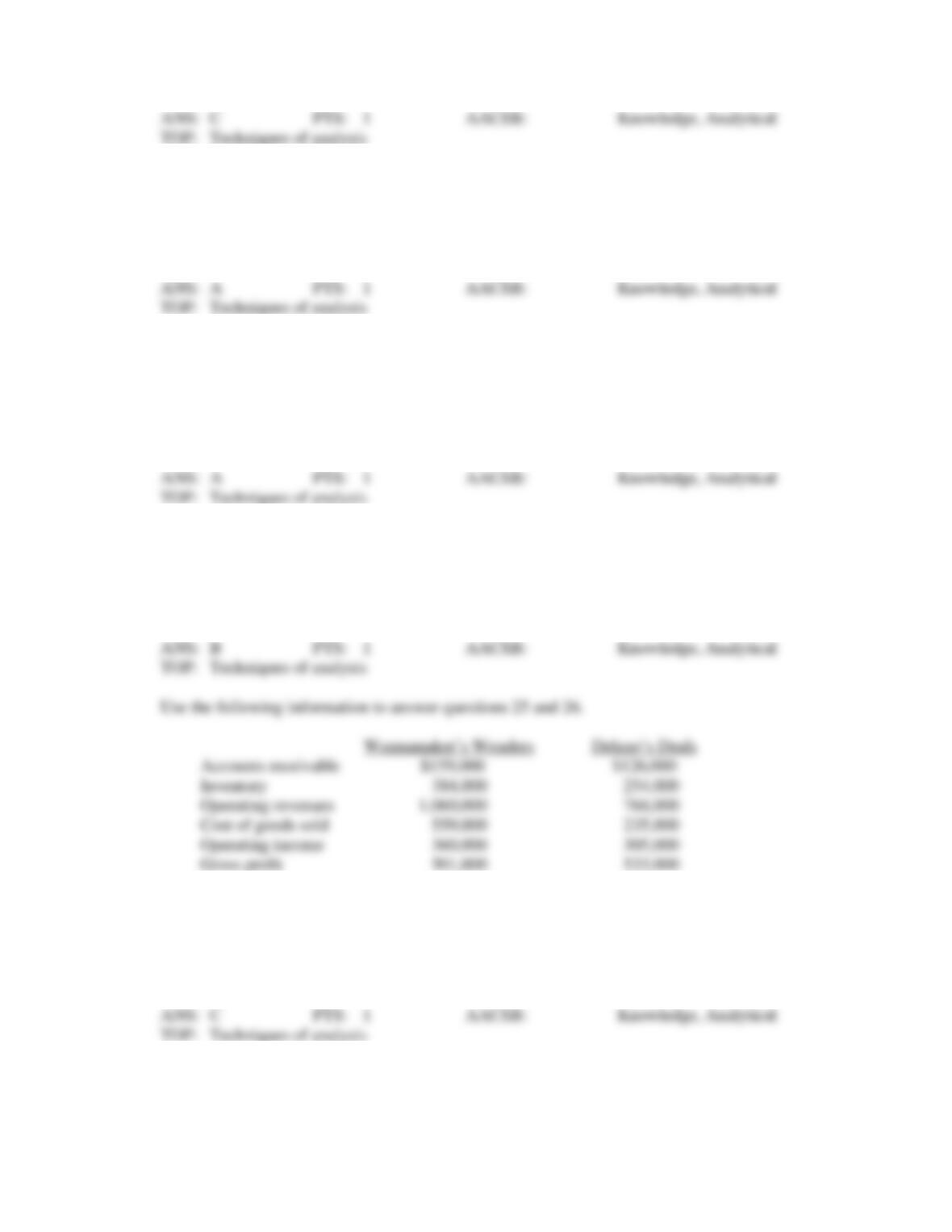
25. What are the inventory turnovers for Wannamaker’s and Delano’s?
A.
2.76 and 3.02
B.
0.93 and 1.20
C.
1.46 and 0.93
D.
1.30 and 2.18
26. What are the debtor’s turnovers for Wannamaker’s and Delano’s?
A.
6.67 and 6.10
B.
3.51 and 1.86
C.
1.63 and 2.42
D.
3.15 and 4.23
27. Which of the following is a measure of short-term solvency?
A.
Debt to assets ratio
B.
Assets to equity ratio
C.
Current ratio
D.
Dividend payout ratio
28.What is the asset turnover for 20X7?
A.
2
B.
0.5
C.
0.7
D.
11.11
29. What is the return on equity for 20X7?
A.
9%
B.
12%
C.
12.9%
D.
17.1%
30. Thorpedo Ltd reported a return on assets of 15% for 20X4. It also acquired a licence for cash by
paying $1m at the end of 20X4. This licence is expected to generate net profits of $0.1m per year
and the asset is not amortised. Assuming the 20X5 results mirror 20X4 and the licence did increase
net profit by $0.1m. What is the effect on Thorpedo Ltd’s return on assets for 20X5?
A.
A decrease
B.
An increase
C.
No change
D.
Cannot be determined

31. Return on equity is a measure of:
A.
financial leverage.
B.
firm value.
C.
company performance.
D.
liquidity.
32. If an investor (shareholder) discovers by analysing financial statements that she ‘lost 5 cents for
each dollar invested in the company’, which ratio did she examine?
A.
Debt to equity
B.
Debt to assets
C.
Return on equity
D.
Financial leverage
33. A company has the following accounts:
I Paid up capital
II Reserves
III Retained profits
IV Dividends payable
Return on equity is net profit divided by:
A.
I only
B.
I and II Only
C.
I, II and III
D.
1, II, III and IV
34. The financial structure of an entity can be assessed using the:
A.
current ratio.
B.
quick asset ratio.
C.
times interest earned.
D.
debt to equity ratio.
35. A price earnings ratio shows:
A.
the earnings yield based on market values.
B.
the amount the market is willing to pay for $1 of profits
C.
the comparison between earnings of different companies.
D.
the profitability of ordinary shares
36. A clear distinction between return on assets and return on equity is that return on assets:
A.
must always be a smaller percentage than is return on equity.

B.
is a measure of management’s investment decisions that excludes any consideration of
how the investments were financed.
C.
is of greater interest to investors than is return on equity.
D.
measures operating leverage while return on equity measures financial leverage.
37. The ratio that shows the percentage of a company’s assets financed by equity is the:
A.
rate of return on ordinary shareholders’ equity.
B.
return on assets ratio.
C.
asset turnover ratio.
D.
equity ratio.
38. The following information was taken from the annual report of Blake Company:
Net profit
Interest
$400
$50
Total assets
$5000
Total liabilities
$3400
What are the return on assets (ROA) and return on equity (ROE)?
ROA ROE
A.
0.25 0.09
B.
0.09 0.25
C.
0.08 0.25
D.
0.05 0.08
39. Which of the following companies, whose ROE and ROA are given, is probably the most valued
by shareholders?
Co. A
Co. B
Co. C
Co. D
ROA
10.5%
6.2%
9.0%
8.0%
ROE
5.4%
10.6%
11.5%
13.5%
A.
Co. A
B.
Co. B
C.
Co. C
D.
Co. D
40. Which of the following would be an appropriate interpretation of a current ratio of 1.76?
A.
The company earned $1.76 for every dollar of assets.
B.
The company has $1.76 of current assets for every dollar of current liabilities.
C.
The company’s debt is 176% of its capital structure.
D.
The company has $1.76 of current assets for every dollar of total assets.

41. Return on equity for Delta company is 7%. This means that:
A.
Delta will pay a dividend of $0.07 on each ordinary share.
B.
The market value of Delta’s ordinary shares will increase.
C.
Delta earned $0.07 for each dollar of equity.
D.
The book value of Delta’s ordinary shares will increase by 7%.
42. The conclusion that a company ‘earned 12.5c of profit for every dollar invested in assets’ by the
company reflects which of the following?
A.
Operating leverage
B.
Return on assets
C.
Profit margin
D.
Asset turnover
43. A low debtors turnover ratio could indicate that:
A.
few customers are defaulting on their debts.
B.
the company is making collections from its customers very quickly..
C.
the company is making collections from its customers very slowly.
D.
a small proportion of the company’s sales are credit sales.
44. A low debtors turnover in days could indicate that:
A.
few customers are defaulting on their debts.
B.
the company is making collections from its customers very quickly.
C.
the company is making collections from its customers very slowly.
D.
a small proportion of the company’s sales are credit sales.
45. A higher than normal price/earnings ratio could mean:
A.
the company’s shares are undervalued.
B.
the market is expecting future EPS to be higher.
C.
the market is expecting future EPS to be lower.
D.
shareholders are receiving a high return.
46. A lower than normal price/earnings ratio could mean:
A.
the company’s shares are undervalued.
B.
the market is expecting future EPS to be higher.
C.
the company’s shares are overvalued.
D.
shareholders are receiving a high return.
SHORT ANSWER
1. For what purpose is horizontal analysis used by management? Is this information provided to
shareholders? If so, in what form? If not, why?
2. What is the best way to assess solvency? Explain.
3. Charmaine Company has a return on assets of 12% and a return on ordinary shareholders’ equity
of 15%. What causes the difference in the two returns?
4. What situations could cause a decrease in the current ratio, but an increase in the quick ratio? If
this happens, is management to be commended or is a problem evident? Explain.
PROBLEM
1. The following financial data relate to Bandara Pty Ltd for the years ended 30 June 20X7 and 30
June 20X6.
Financial item
30 June 20X7
30 June 20X6
Net credit sales
Cost of goods sold
Cash
Debtors
Inventory
Current liabilities
$630,000
290,000
18,000
70,000
130,000
105,000
$490,000
250,000
12,000
60,000
150,000
81,000
Additional information
The debtors figure at 30 June 20X5 was $78,000 (net). The inventory figure at 30 June 20X5 was
$130,000. The company provides its credit customers 30 days to pay. The average inventory
turnover for the industry in which the company operates is 101 days.
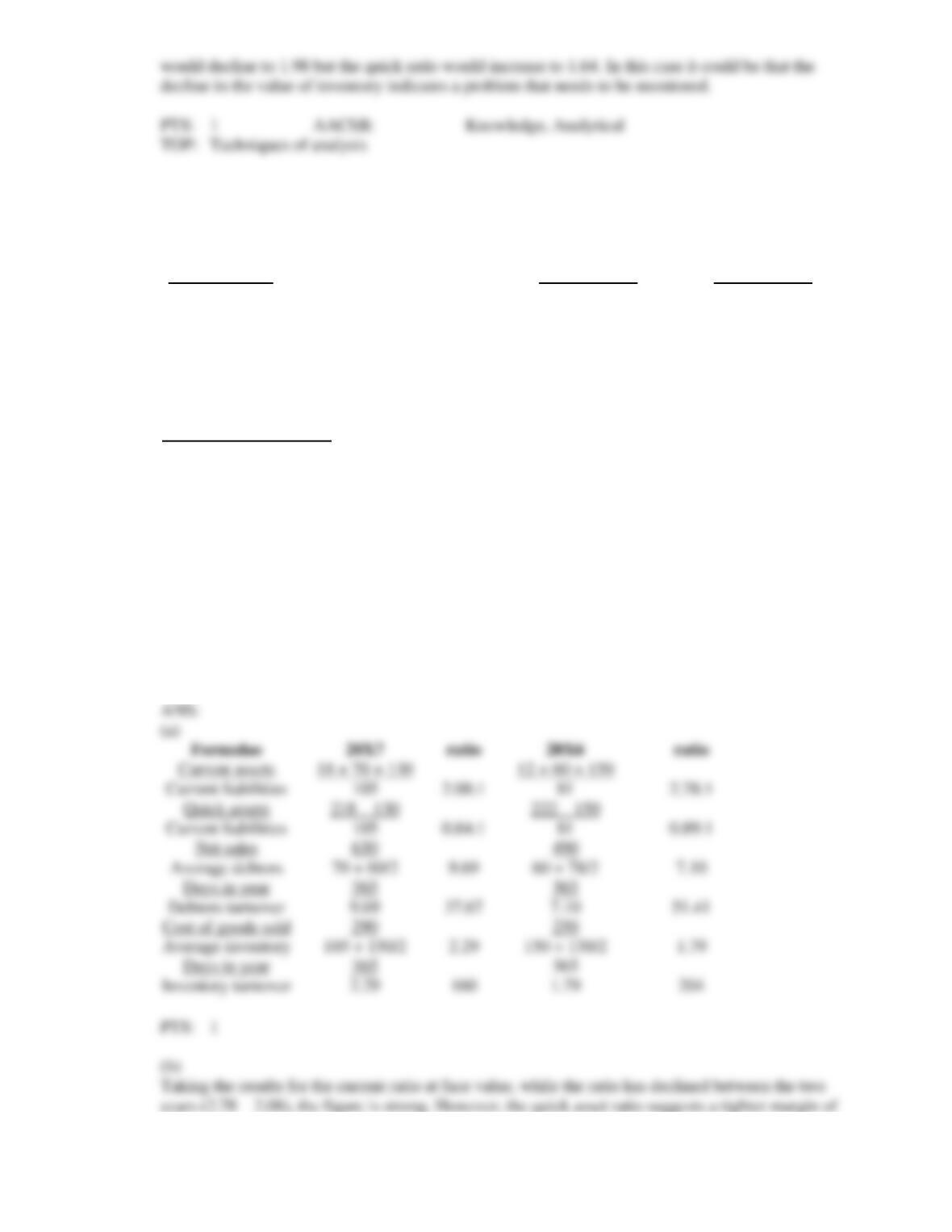
(a)
Calculate the following ratios for the years ended 30 June 20X7 and 30 June
20X6:
– current ratio;
– quick ratio;
– debtors’ turnover (times and in days); and
– inventory turnover (times and in days).
(b)
Comment on the short-term solvency, including the efficiency of the business,
given the ratio results obtained in answering part (a).
2. The following information relates to Dante Pty Ltd for the years ended 30 June 20X7 and 20X6:
20X7
$
20X6
$
Total assets
Owners’ equity
6,020,000
3,250,000
5,470,000
3,200,000
Annual sales
Net profit (after tax)
Weighted average number of ordinary
shares issued
6,100,000
810,000
10,234,518
3,154,350
475,200
10,046,430
Required:
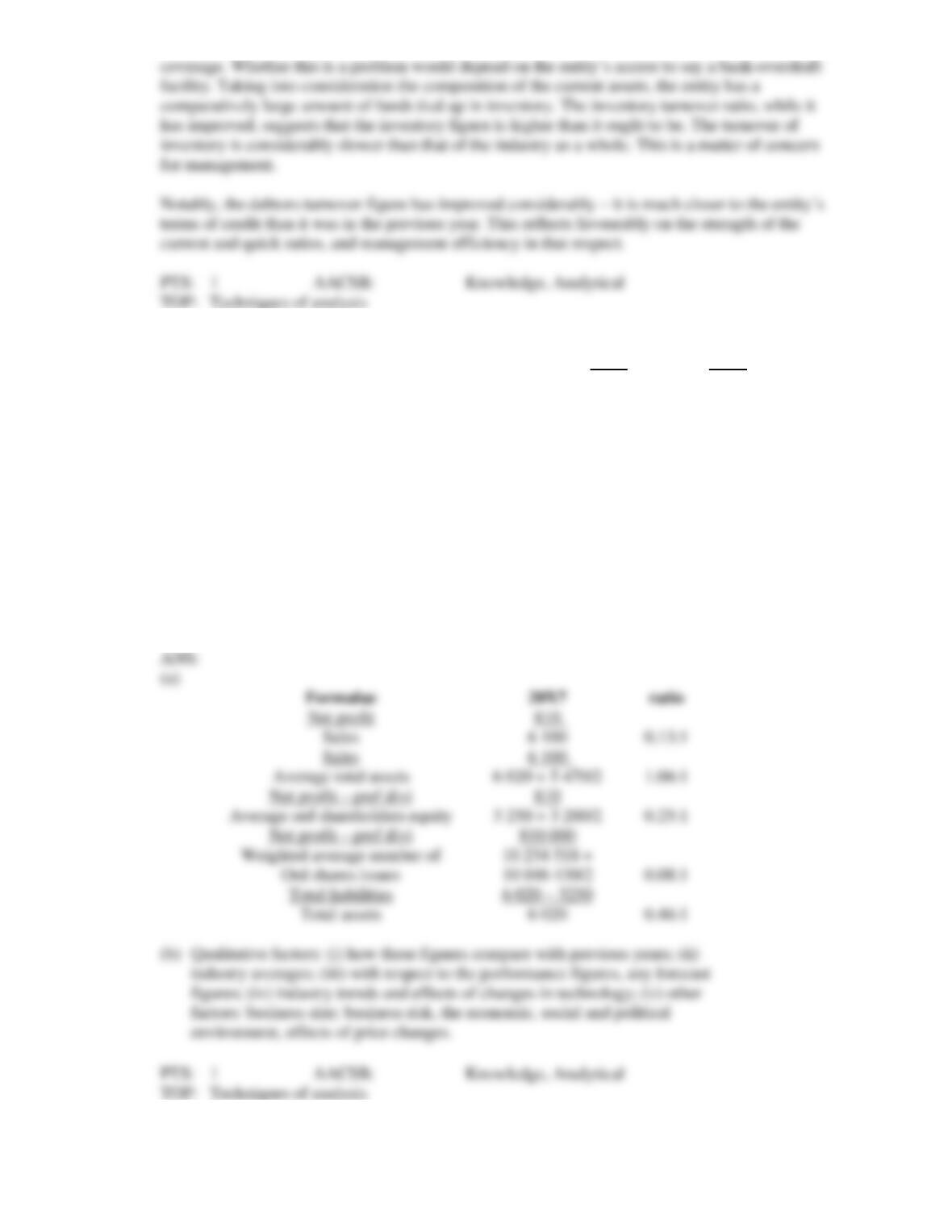
(a)
Calculate the net profit margin, asset turnover, earnings per share and debt to
total assets ratios for Dante Ltd for the 30 June 20X7.
(b)
Describe four qualitative factors that ought to be taken into consideration in order
to put the foregoing analysis in context?
factors: business size; business risk, the economic, social and political