
Chapter 12: Comparing Two Means – Quiz A
Name_________________________
Data were collected on annual personal time (in hours) taken by a random sample of 16
women and 7 men employed by a medium-sized company. The women took an average
of 24.75 hours of personal time per year with a standard deviation of 2.84 hours. The
men took an average of 21.86 hours of personal time per year with a standard deviation
of 3.29 hours. The Human Resources Department believes that women tend to take more
personal time than men because they tend to be the primary child care givers in the
family.
12.1.3 Construct and interpret a confidence interval for a two‐sample t‐test.
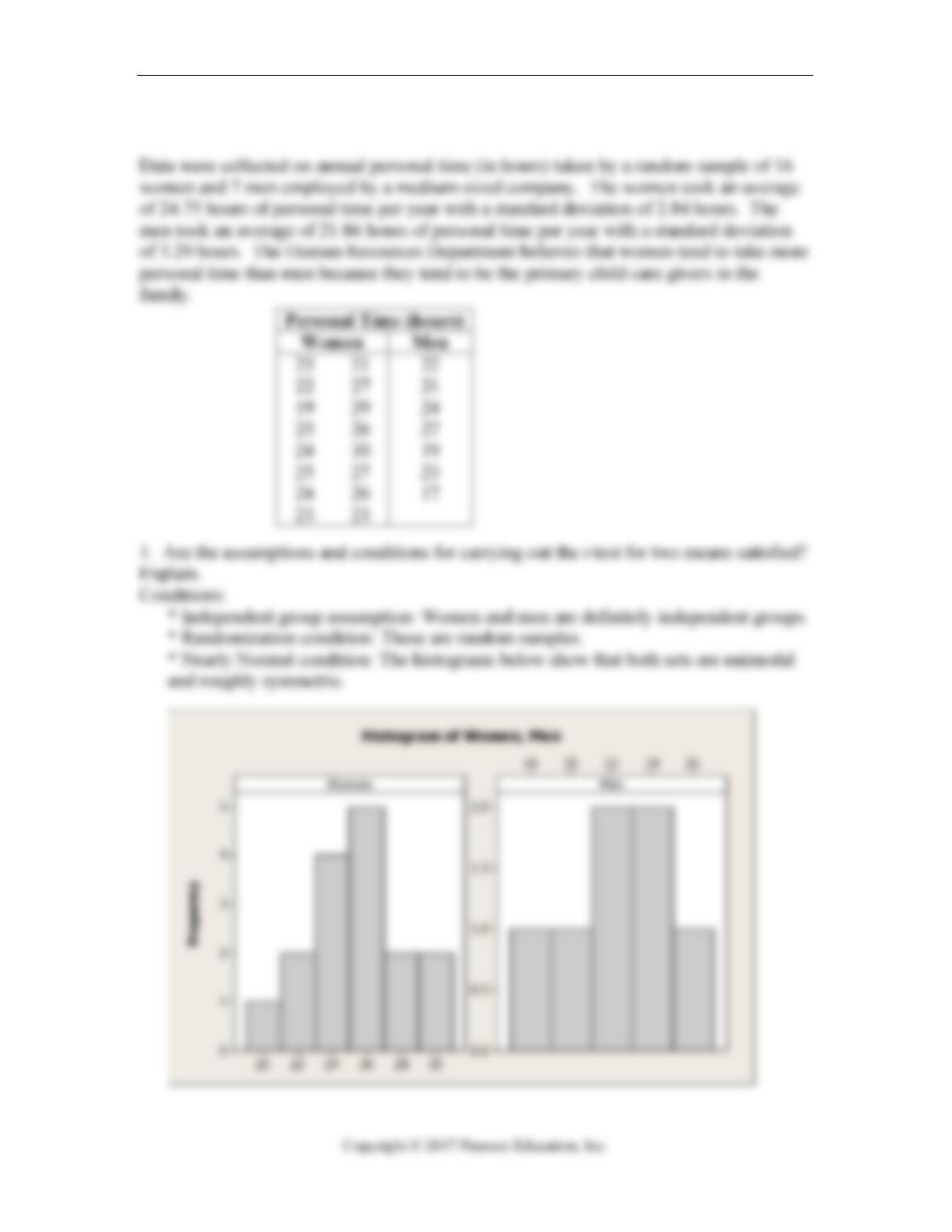
1. Are the assumptions and conditions for carrying out the t–test for two means satisfied?
Explain.
12.1.3 Construct confidence intervals and perform hypothesis tests.
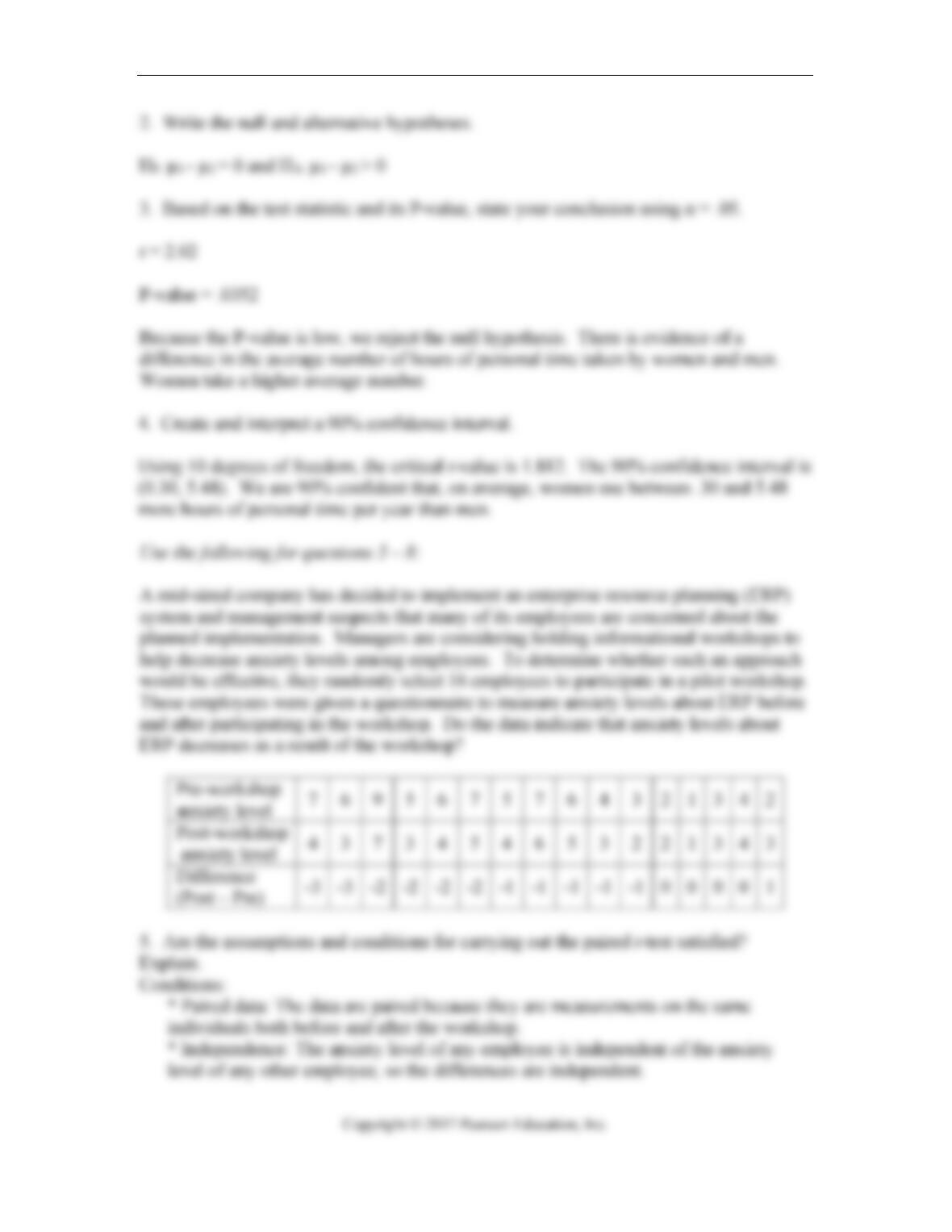
2. Write the null and alternative hypotheses.
12.4.2. Investigate and interpret P‐values in the context of t‐tests.
3. Based on the test statistic and its P-value, state your conclusion using α = .05.
12.1.3 Construct confidence intervals and perform hypothesis tests.
4. Create and interpret a 90% confidence interval.
Personal Time (hours)
Women Men
25 21 22
22 27 21
19 29 24
25 26 27
24 30 19
25 27 23
24 26 17
23 23

12-2 Chapter 12 Comparing Two Means
Use the following for questions 5 – 8:
A mid-sized company has decided to implement an enterprise resource planning (ERP)
system, and management suspects that many of its employees are concerned about the
planned implementation. Managers are considering holding informational workshops to
help decrease anxiety levels among employees. To determine whether such an approach
would be effective, they randomly select 16 employees to participate in a pilot workshop.
These employees were given a questionnaire to measure anxiety levels about ERP before
and after participating in the workshop. Do the data indicate that anxiety levels about
ERP decreases as a result of the workshop?
Pre-workshop
anxiety level 7 6 9 5 6 7 5 7 6 4 3 2 1 3 4 2
Post-workshop
anxiety level 4 3 7 3 4 5 4 6 5 3 2 2 1 3 4 3
Difference
(Post – Pre) -3 -3 -2 -2 -2 -2 -1 -1 -1 -1 -1 0 0 0 0 1
12.3.5. Determine whether two samples are independent or paired.
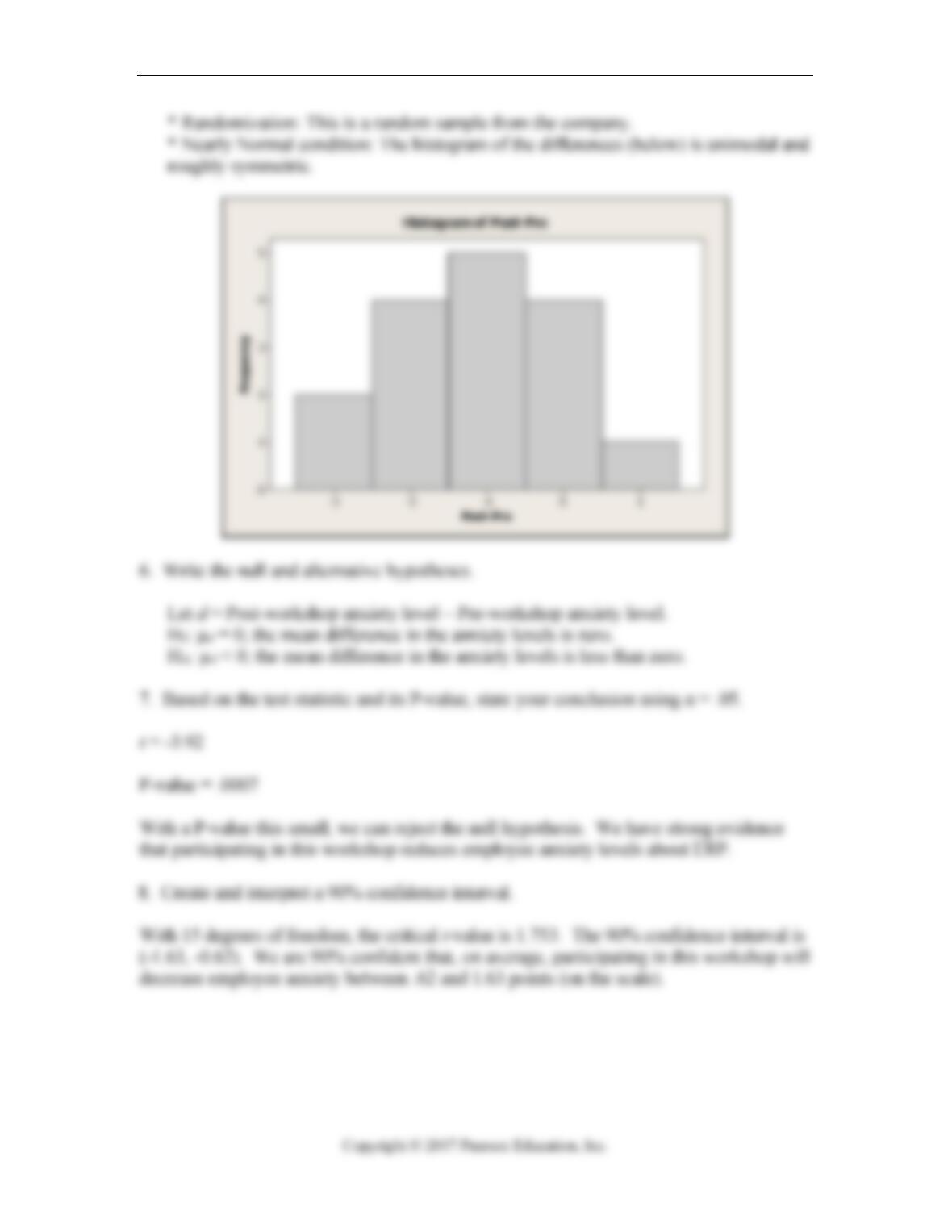
5. Are the assumptions and conditions for carrying out the paired t-test satisfied?
Explain.
12.7.3. Construct and interpret a confidence interval for a two‐sample t‐test.
6. Write the null and alternative hypotheses.
12.7.6. Determine and perform the appropriate t‐test.
7. Based on the test statistic and its P-value, state your conclusion using α = .05.
12.7.3 Construct confidence intervals and perform hypothesis tests.
8. Create and interpret a 90% confidence interval.
12.5.4. Perform a pooled t‐test.
9. We want to know whether people are likely to offer a different amount for used
exercising equipment when buying from a friend than when buying from a stranger. We
wonder whether the difference between mean amounts is zero. We have bid prices from 8
subjects buying from a friend and 7 subjects buying from a stranger, found in a
randomized experiment.
a. What assumptions can we make?
b. What type of test can we perform?
Quiz A 12-3
Chapter 12: Comparing Two Means – Quiz A – Key
12-4 Chapter 12 Comparing Two Means
Quiz A 12-5
12-6 Chapter 12 Comparing Two Means

Quiz B 12-7
Chapter 12: Comparing Two Means – Quiz B
Name_________________________
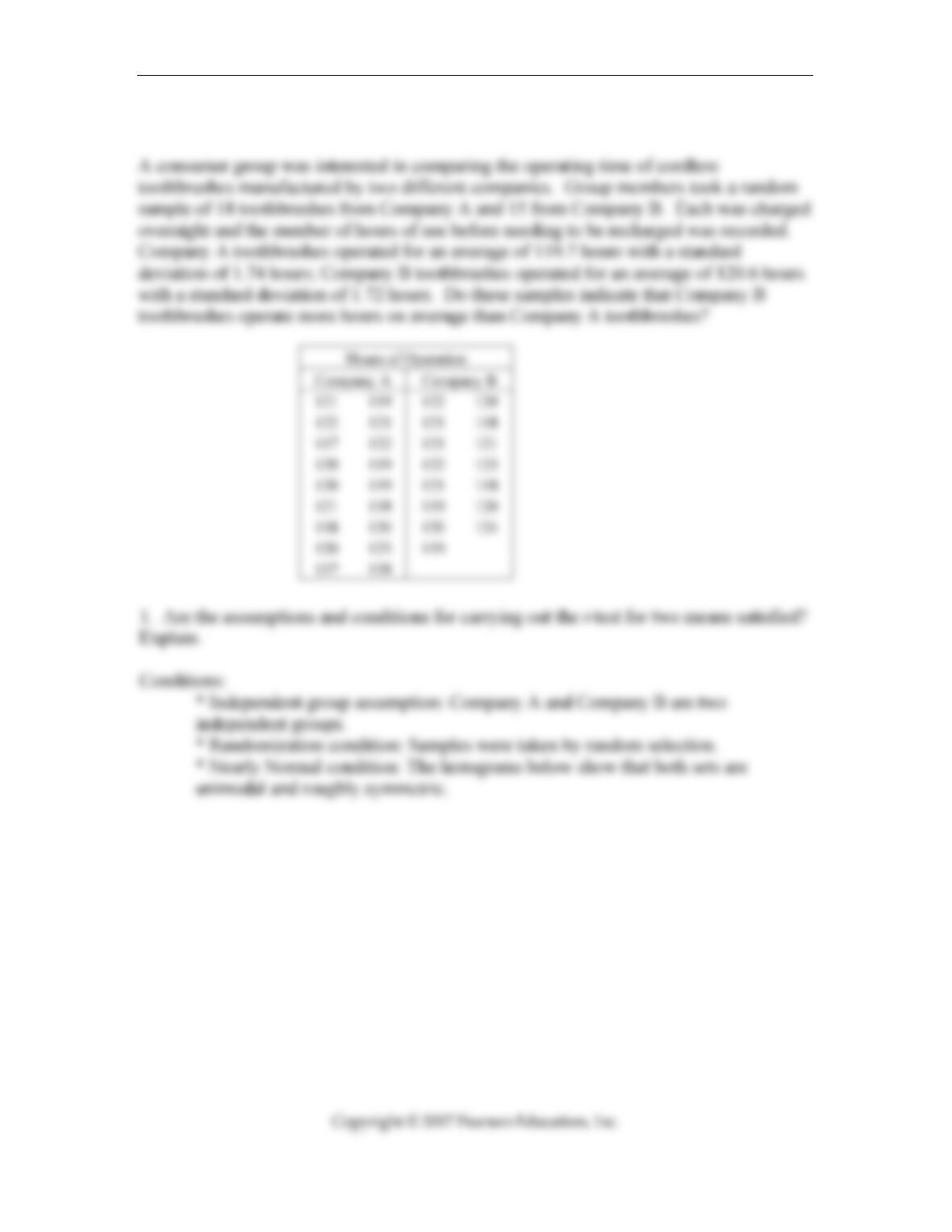
A consumer group was interested in comparing the operating time of cordless
toothbrushes manufactured by two different companies. Group members took a random
sample of 18 toothbrushes from Company A and 15 from Company B. Each was charged
overnight and the number of hours of use before needing to be recharged was recorded.
Company A toothbrushes operated for an average of 119.7 hours with a standard
deviation of 1.74 hours; Company B toothbrushes operated for an average of 120.6 hours
with a standard deviation of 1.72 hours. Do these samples indicate that Company B
toothbrushes operate more hours on average than Company A toothbrushes?
12.3.5. Determine whether two samples are independent or paired.
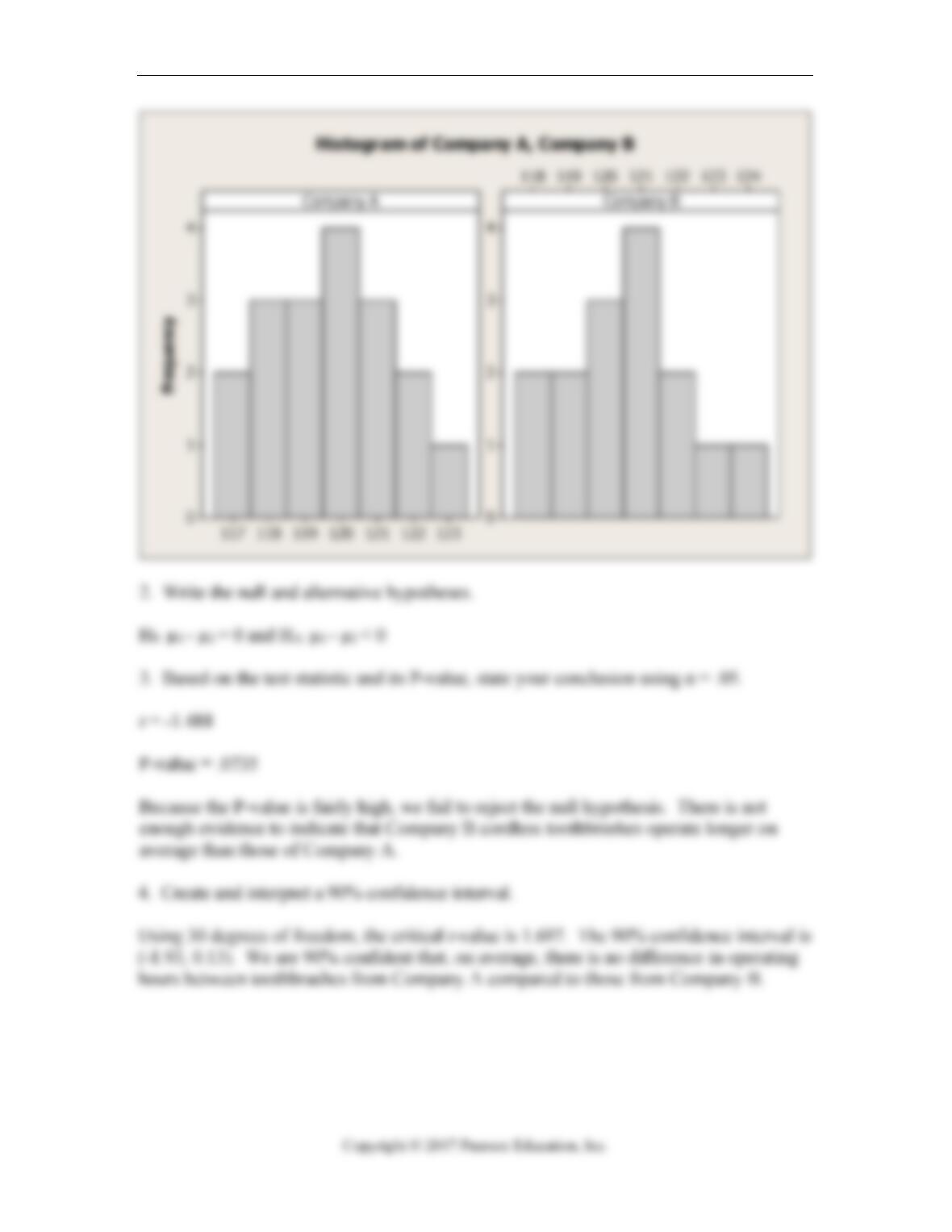
1. Are the assumptions and conditions for carrying out the t–test for two means satisfied?
Explain.
12.2.3. Construct and interpret a confidence interval for a two‐sample t‐test.
2. Write the null and alternative hypotheses.
12.2.6. Determine and perform the appropriate t‐test.
3. Based on the test statistic and its P-value, state your conclusion using α = .05.
12.7.3 Construct confidence intervals and perform hypothesis tests.
4. Create and interpret a 90% confidence interval.
Hours of Operation
Company A Company B
121 119 122 120
122 121 121 118
117 122 121 121
120 119 122 123
120 119 121 118
121 118 119 120
118 120 120 124
120 123 119
117 118

12-8 Chapter 12 Comparing Two Means
Use the following for questions 5 – 8:
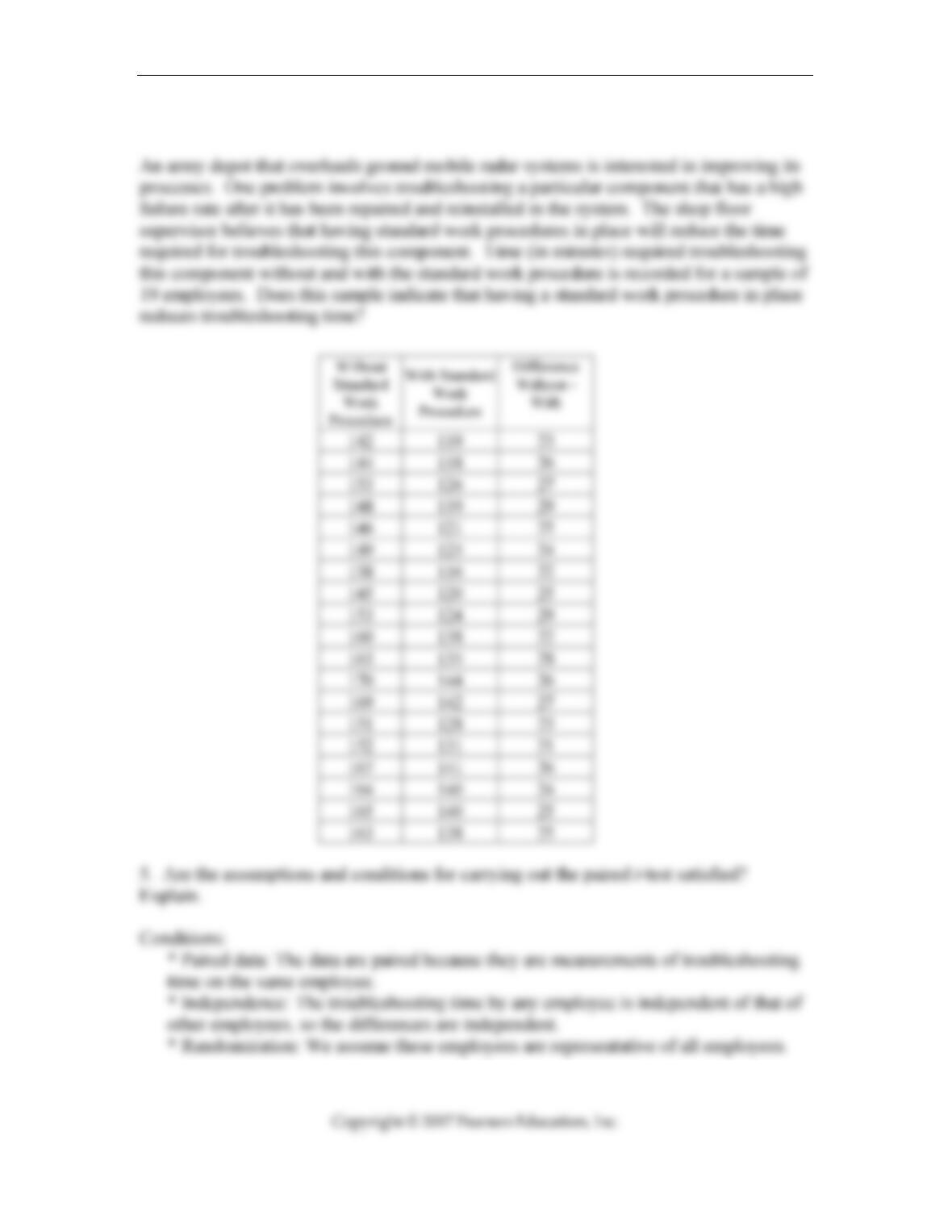
An army depot that overhauls ground mobile radar systems is interested in improving its
processes. One problem involves troubleshooting a particular component that has a high
failure rate after it has been repaired and reinstalled in the system. The shop floor
supervisor believes that having standard work procedures in place will reduce the time
required for troubleshooting this component. Time (in minutes) required troubleshooting
this component without and with the standard work procedure is recorded for a sample of
19 employees. Does this sample indicate that having a standard work procedure in place
reduces troubleshooting time?
12.7.3 Construct confidence intervals and perform hypothesis tests.
5. Are the assumptions and conditions for carrying out the paired t-test satisfied?
Explain.
12.7.3 Construct confidence intervals and perform hypothesis tests.
6. Write the null and alternative hypotheses.
12.2.2. Investigate and interpret P‐values in the context of t‐tests.
7. Based on the test statistic and its P-value, state your conclusion using α = .05.
Without
Standard
Work
Procedure
With Standard
Work
Procedure
Difference
Without –
With
142 119 23
144 118 26
153 126 27
148 119 29
146 121 25
149 125 24
138 116 22
145 120 25
153 124 29
160 138 22
163 135 28
170 144 26
169 142 27
151 128 23
152 131 21
167 141 26
164 140 24
165 140 25
163 138 25

Quiz B 12-9
12.7.3 Construct confidence intervals and perform hypothesis tests.
8. Create and interpret a 95% confidence interval.
12-10 Chapter 12 Comparing Two Means
Chapter 12: Comparing Two Means – Quiz B – Key
Quiz B 12-11
12-12 Chapter 12 Comparing Two Means
Use the following for questions 5 – 8: