Exam
Name___________________________________
MULTIPLE CHOICE. Choose the one alternative that best completes the statement or answers the question.
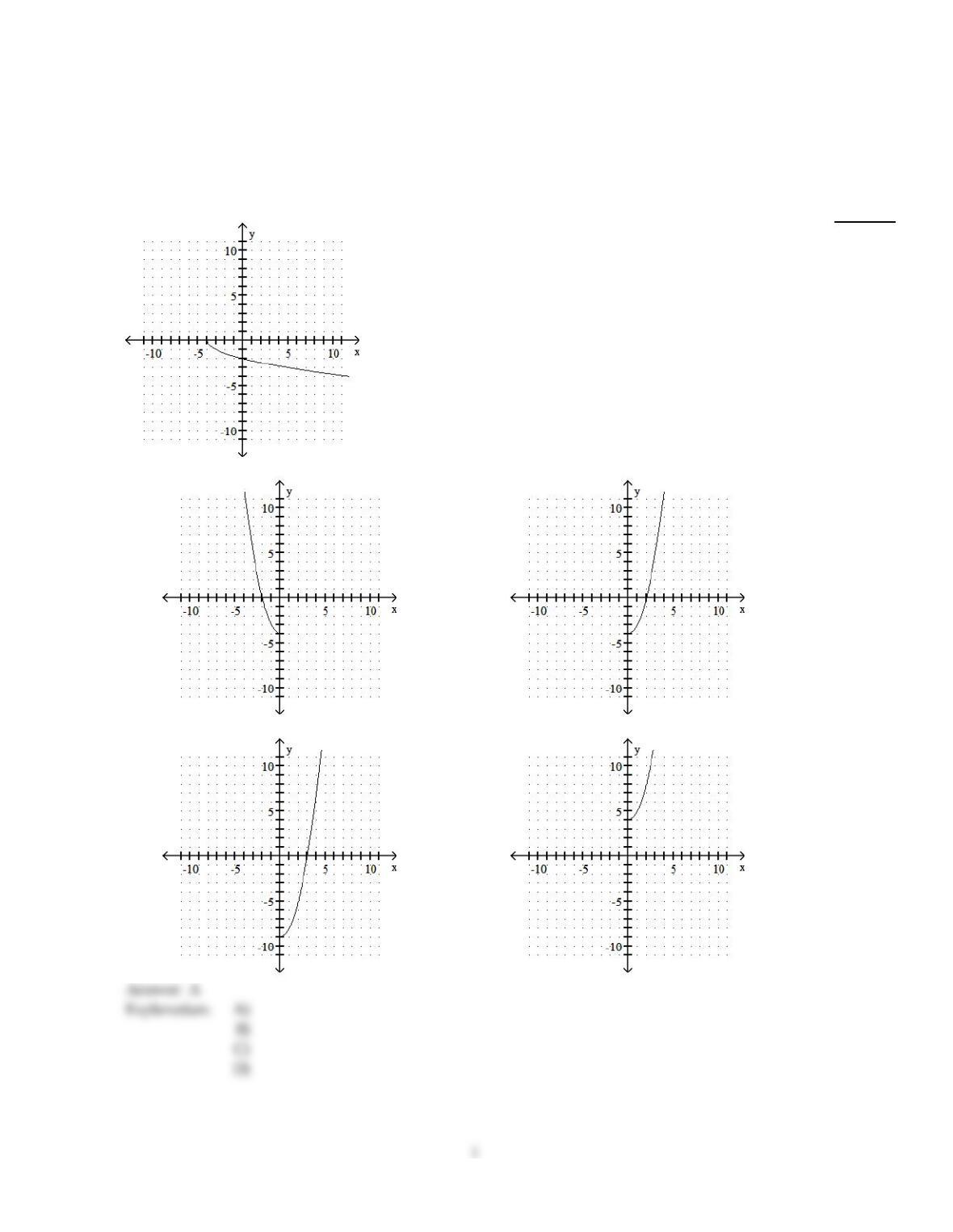
Graph the inverse of f, given the graph of f below.
1)
1)
A)
B)
C)
D)
SHORT ANSWER. Write the word or phrase that best completes each statement or answers the question.
Provide an appropriate response.
2)
Why does a quadratic function never have an inverse?
2)
Answer the question.
3)
With the exponential function f(x) =ax, why must a
0?
3)
Provide an appropriate response.
4)
Give a definition for the following term: Exponential function .
4)
5)
Why can’t 1 be the base of a logarithmic function?
5)
6)
In your own words, explain what a logarithm is.
6)
Answer the question.
7)
Why can’t we call y = (–2)x an exponential function?
7)
Provide an appropriate response.
8)
Is the logarithm to the base 3 of 2 written as “ log 23” or” log 32“?
8)
9)
With the function f(x) =log ax, why can’t x be less than 0?
9)
Answer the question.
10)
Why is an exponential function one–to–one?
10)
Provide an appropriate response.
11)
Explain how the graph of the function g(x) =log 7x can be obtained from the graph of the
functionf(x) =7x.
11)
12)
A student claims that since log bx = a is not defined for negative values of x, then a must
also not be negative. What is wrong with this statement?
12)
13)
Explain why this sequence of steps is incorrect.
log 364 =log 3–8–8
=log 3–8+log 3–8
13)
14)
Can you solve this equation without using logarithms? Why or why not? 5 = 3x
14)
15)
Your classmate missed the lecture on how to find the inverse of a one–to–one function.
When your classmate calls you on the phone for an explanation, what will you say to
explain the process?
15)
16)
When solving a logarithmic equation, why must you not automatically reject all negative
solutions?
16)
17)
When asked to describe logarithms in one simple sentence, the teacher said, “Logarithms
are exponents“. What is meant by this sentence?
17)
18)
Why does the horizontal line test (checking if a function is one–to–one) work?
18)
19)
When solving an exponential equation using logarithms, when is it easier to use natural
logarithms?
19)
20)
A classmate missed the lecture concerning the power rule of logarithms. When your
classmate calls you on the phone for an explanation of why it works, what should you say
to explain it?
20)
Answer the question.
21)
With the exponential function f(x) =ax, why must a
1?
21)
Provide an appropriate response.
22)
If a number has a negative natural logarithm, then the number must be ___.
22)
Answer the question.
23)
Why can’t y = 2x have an x–intercept?
23)
Provide an appropriate response.
24)
If a > 1, what two points on the graph of f(x) =log ax can be found with no computation?
24)
25)
Explain how exponential and logarithmic functions are related.
25)
26)
Give a definition for the following term: product rule of logarithms .
26)
Answer the question.
27)
What is one ordered pair that is always on the graph of f(x) =ax?
27)
Provide an appropriate response.
28)
Why is finding the value of alog a12 like answering the question “What is the name of
the boy whose name is John?”
28)
29)
What is the connection between ex and ln x?
29)
30)
Why is e used as a base for exponential and logarithmic functions?
30)
31)
Explain how this statement needs to be changed so that it is true.
log 39+9=log 39+log 39
31)
32)
Why does a linear function always have an inverse?
32)
33)
Is it possible to solve the equation 7x=6 by taking the natural logarithm of 6, the
common logarithm of 7, and finding the quotient ln 6
log 7? Explain.
33)
34)
Why is evaluating ln eamuch like answering the question “What is the name of the boy
whose name is Jose?”
34)
35)
When solving a logarithmic equation, why must you always check that each solution
works in the original equation?
35)
36)
What is the difference between ln a and log a?
36)
37)
If the graph of a one–to–one function and its inverse intersect, what is true about any such
point of intersection?
37)
38)
A student argues that the best choice for the logarithmic base to be used in solving 8x=76
is 8. What is wrong with this thinking?
38)
39)
Why is finding the value of log aa6 like answering the question “What is the name of the
girl whose name is Jane?”
39)
40)
Why can the equation log 6(x – 7 ) = log 6(7 – x) be said to have no solution?
40)
41)
Logarithms simplify calculations by changing multiplication to ___.
41)
42)
When solving an exponential equation using logarithms, when is it easier to use common
logarithms?
42)
MULTIPLE CHOICE. Choose the one alternative that best completes the statement or answers the question.
Solve the equation. Give the solution to three decimal places.
43)
3x=14
43)
A)
{2.402}
B)
{4.667}
C)
{0.416}
D)
{1.541}
If the following defines a one–to–one function, find its inverse. If not, write “Not one–to–one.”
44)
f(x) =x3– 9
44)
A)
f–1(x) = ± 3x + 9
B)
Not one–to–one
C)
f–1(x) =3x + 9
D)
f–1(x) = x + 9
Write in exponential form.
45)
log 1/464 = – 3
45)
A)
(–3)1/4=64
B)
641/4=3
C)
1
4
3=64
D)
1
4
–3=64
Solve the problem.
46)
The population of a small country increases according to the function B =1,800,000e0.02t, where t
is measured in years. How many people will the country have after 10 years?
46)
A)
2,198,525
B)
2,896,988
C)
2,852,808
D)
1,258,146
Express the given logarithm as a sum and/or difference of logarithms. Simplify, if possible. Assume that all variables
represent positive real numbers.
47)
log 16
17 r
s
47)
A)
log 16 s–log 16 17 –1
2log 16 r
B)
log 16 (17 r) –log 16 s
C)
log 16 17 ·1
2log 16 m ÷log 16 s
D)
log 16 17 +1
2log 16 r–log 16 s
Solve the equation. Use natural logarithms. When appropriate, give solutions to three decimal places unless otherwise
indicated.
48)
eln 3x =eln(2x + 6)
48)
A)
{6}
B)
–6
5
C)
6
5
D)
{–6}
10
Provide an appropriate response.
49)
What is the range of the function y =1
3
x?
49)
A)
( , 0)
B)
[0, )
C)
( , )
D)
(0, )
Find the logarithm. Give an approximation to four decimal places.
50)
log( 2.21 × 10 5)
50)
A)
5.0000
B)
5.3444
C)
–4.6556
D)
0.3444
Solve the problem.
51)
The number of bacteria growing in an incubation culture increases with time according to
B =6200(3)x, where x is time in days. Find the number of bacteria when x = 0 and x =5.
51)
A)
6200; 167,400
B)
6200; 93,000
C)
18,600; 1,506,600
D)
6200; 1,506,600
Solve the equation.
52)
log x16 =4
52)
A)
4
B)
4 or –4
C)
2
D)
2 or –2
Write in logarithmic form.
53)
27–4/3 =1
81
53)
A)
log8127 = – 4
3
B)
log27
4
3= – 1
81
C)
log4/381 =27
D)
log27
1
81 = – 4
3
54)
16–3/2 =1
64
54)
A)
log16
3
2= – 1
64
B)
log6416 = – 3
2
C)
log16
1
64 = – 3
2
D)
log3/264 =16
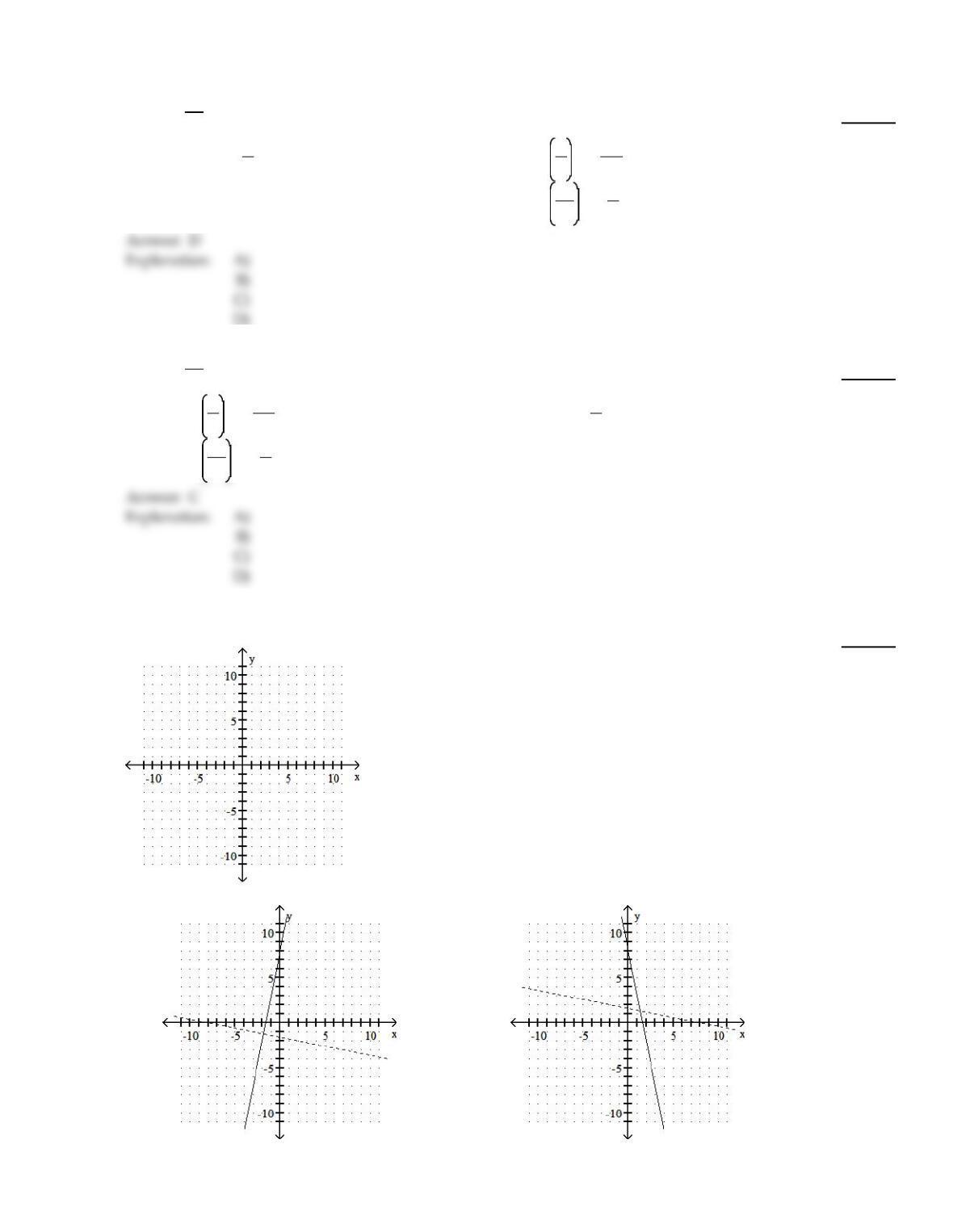
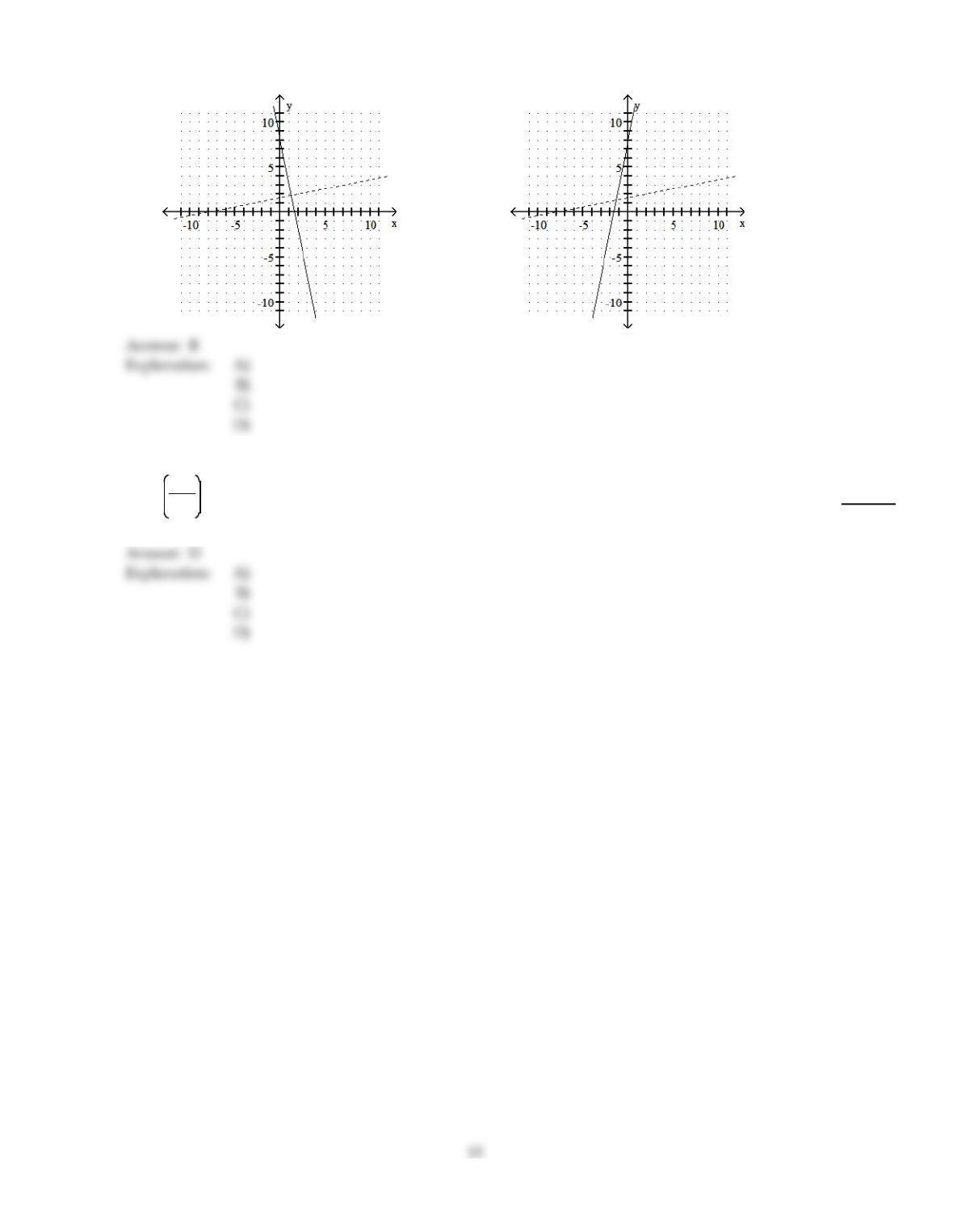
Graph the given function as a solid line (or curve) and its inverse as a dashed line (or curve) on the same set of axes.
55)
f(x) = – 5x +8
55)
A)
B)
12
C)
D)
Evaluate the logarithm.
56)
log 9
1
729
56)
A)
3
B)
81
C)
–81
D)
–3
Provide an appropriate response.
57)
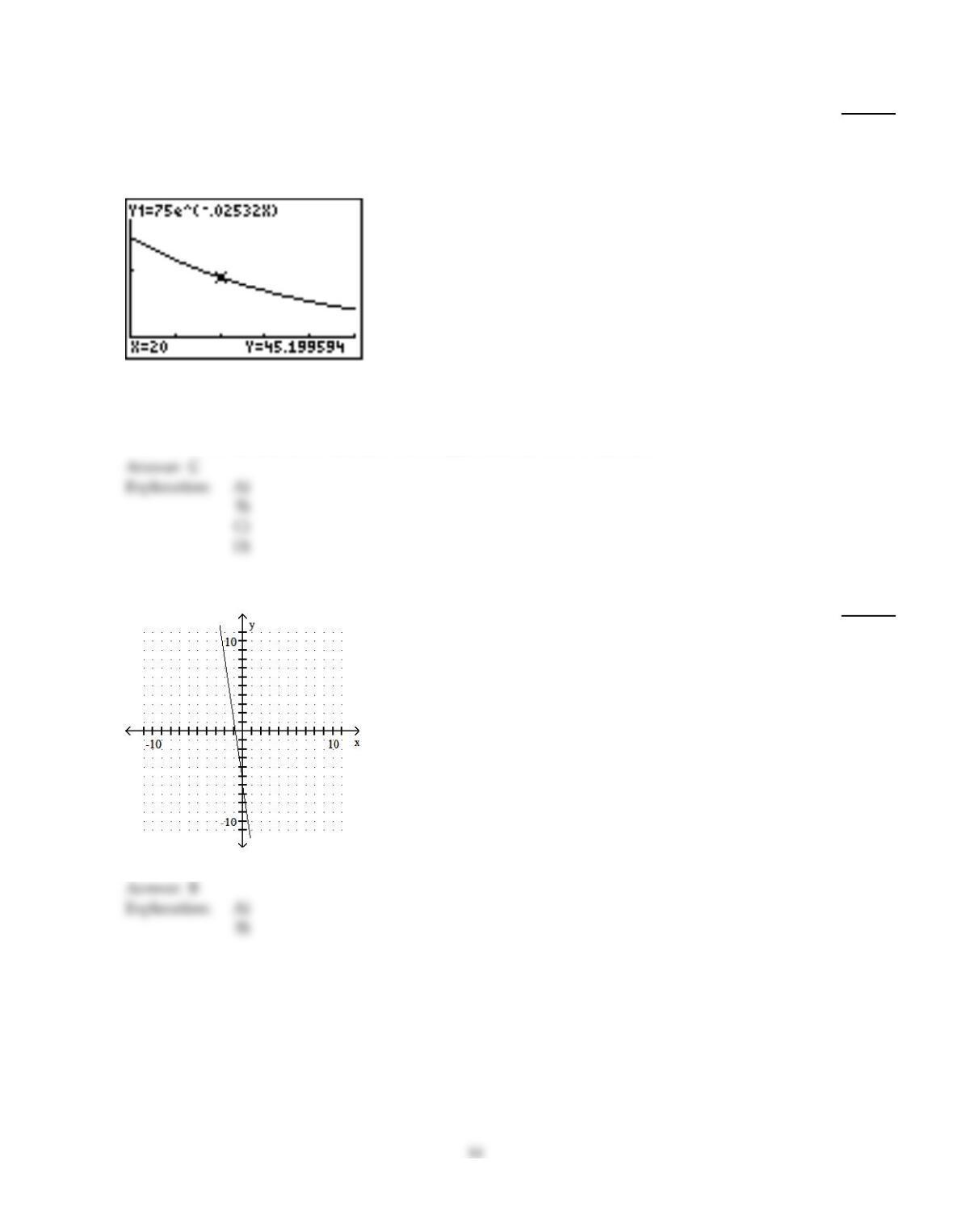
The total number N of bacteria cells in a petri dish when exposed to a new drug can be
approximated by the function N(x) = 75e–0.02532x, where N is measured in thousands; and x = 0
corresponds to the initial number of cells, x = 1 corresponds to the number of cells after one hour,
and so on. The function is graphed on a graphing calculator–generated screen. Interpret the
meanings of x and y in the display at the bottom of the screen.
57)
A)
It means that after 75 hours, there will be approximately 45,200 bacteria cells.
B)
It means that the drug is helping the bacteria grow.
C)
It means that after 20 hours, there will be approximately 45,200 bacteria cells.
D)
It means that after 20 hours, there will be approximately 45 bacteria cells.
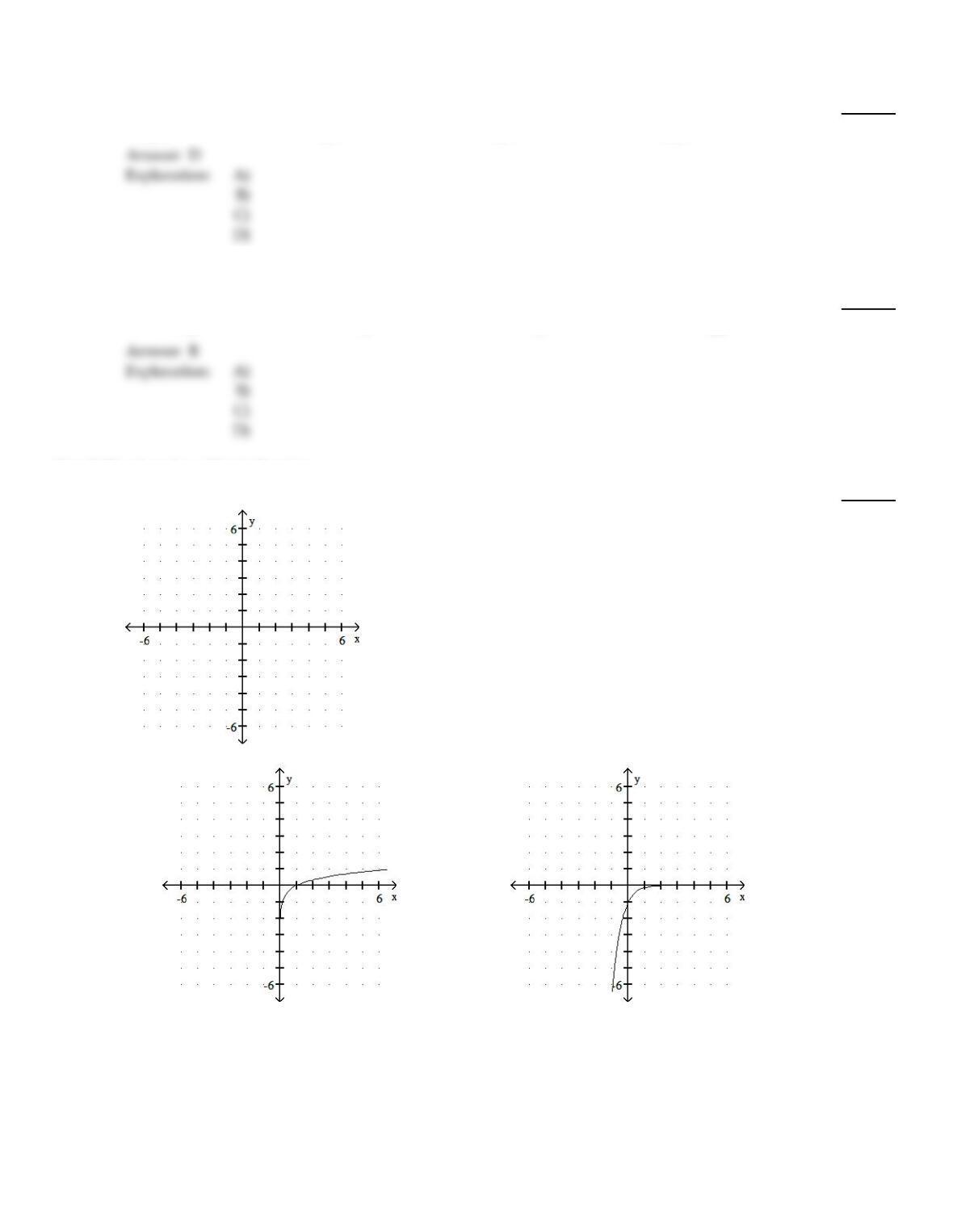
Use the horizontal line test to determine if the function is one–to–one.
58)
58)
A)
No
B)
Yes
B
C
Evaluate the logarithm.
59)
log 10 1
59)
A)
2
B)
3
C)
1
D)
0
Write in logarithmic form.
60)
43=64
60)
A)
log 364 =4
B)
log 464 =3
C)
log 43=64
D)
log 64 4=3
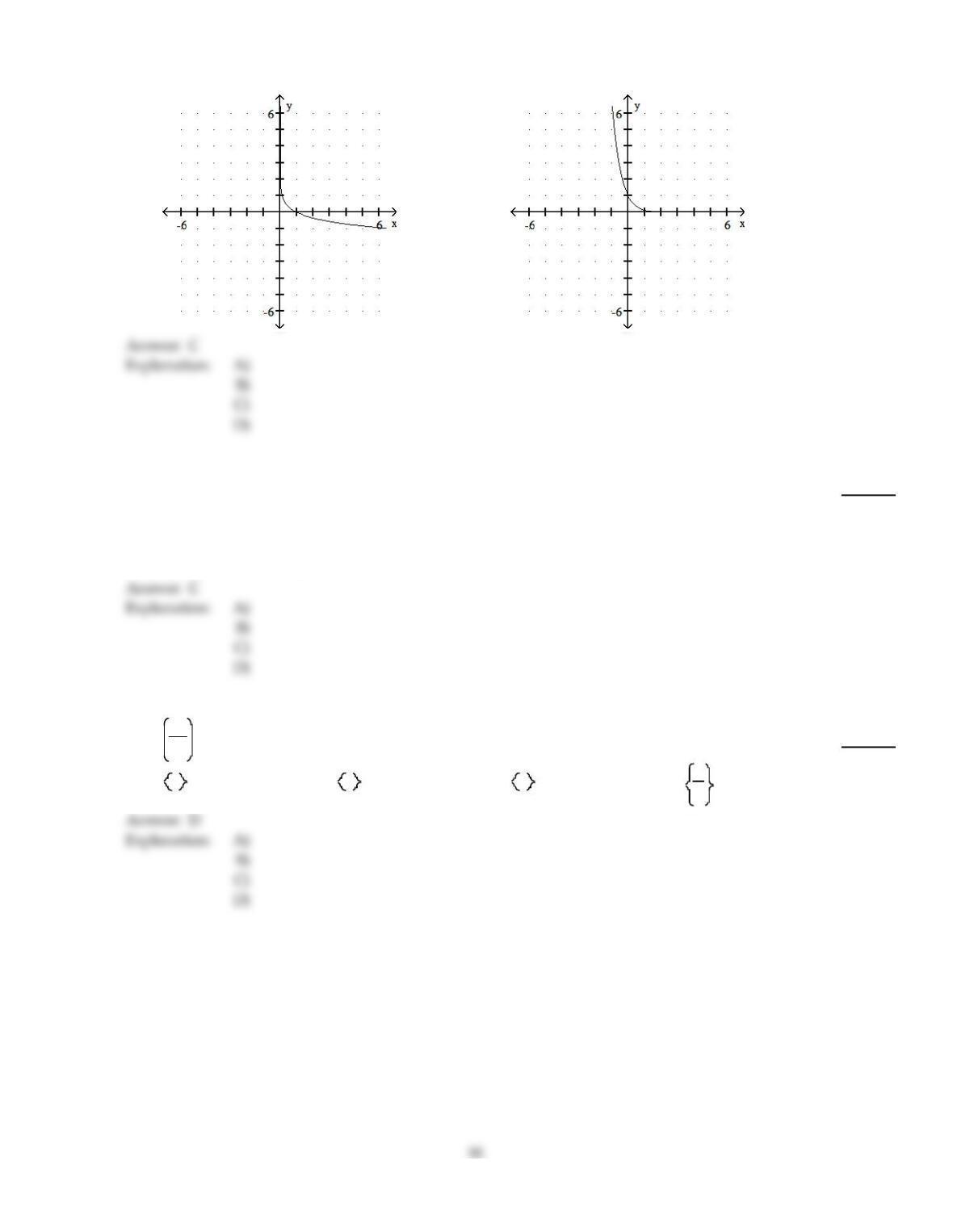
Graph the given logarithmic function.
61)
y =log 1/7x
61)
A)
B)
15
C)
D)
Solve the problem.
62)
Suppose $6000 is invested at 4.25% annual interest, compounded continually. (i) What will be the
amount in the account in 7 years if no money is withdrawn? (ii) How long will it take for the initial
principal to double? Round to the nearest tenth of a year.
62)
A)
$6260.50; (ii) 25.8 years
B)
$2294.58; (ii) 9.5 years
C)
(i) $8078.93; (ii) 16.3 years
D)
$6000.00; (ii) 21.6 years
Solve the equation.
63)
log x
1
81 =4
63)
A)
1
B)
3
C)
4
D)
1
3
Rewrite the given expression as a single logarithm. Assume that all variables are defined in such a way that variable
expressions are positive and bases are positive numbers not equal to 1.
64)
log 713 –log 7a
64)
A)
log 14
13
a
B)
log 7(13 – a)
C)
log 7
a
13
D)
log 7
13
a
Decide whether the statement is true or false.
65)
log55–1+log55= 0
65)
A)
False
B)
True
Solve the problem.
66)
How long would it take $7000 to grow to $28,000 at 5% compounded continuously? Round your
answer to the nearest tenth of a year.
66)
A)
27.7 years
B)
28.6 years
C)
28.0 years
D)
35.0 years
Provide an appropriate response.
67)
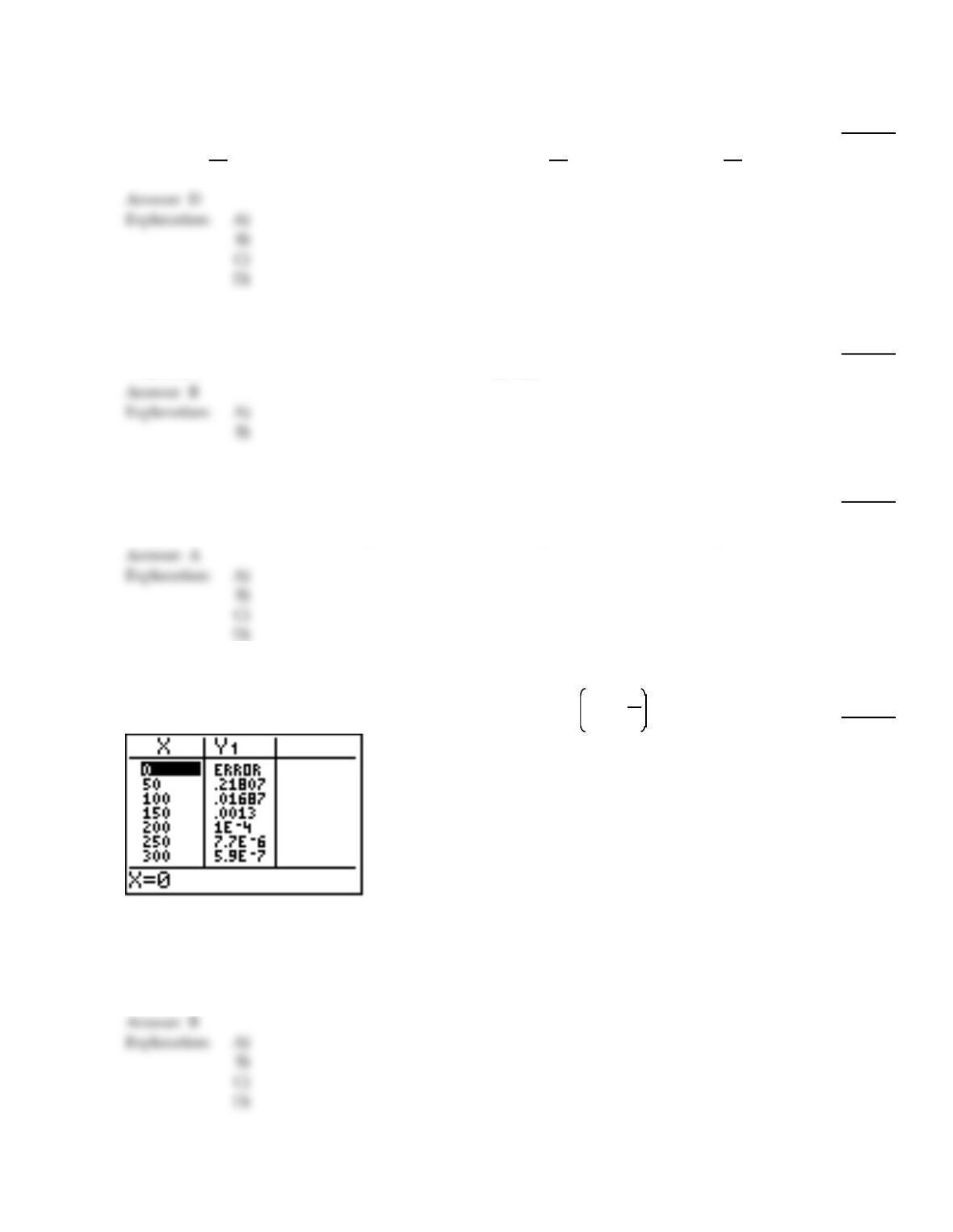
The screen shows a table of values for the function defined by Y1=0.95 +1
X
X.
Why is there an error message for x = 0?
67)
A)
An exponent of zero is not defined.
B)
Division by zero is not defined.
C)
The calculator made a mistake.
D)
The value of the function is too large for the calculator to comprehend.
17
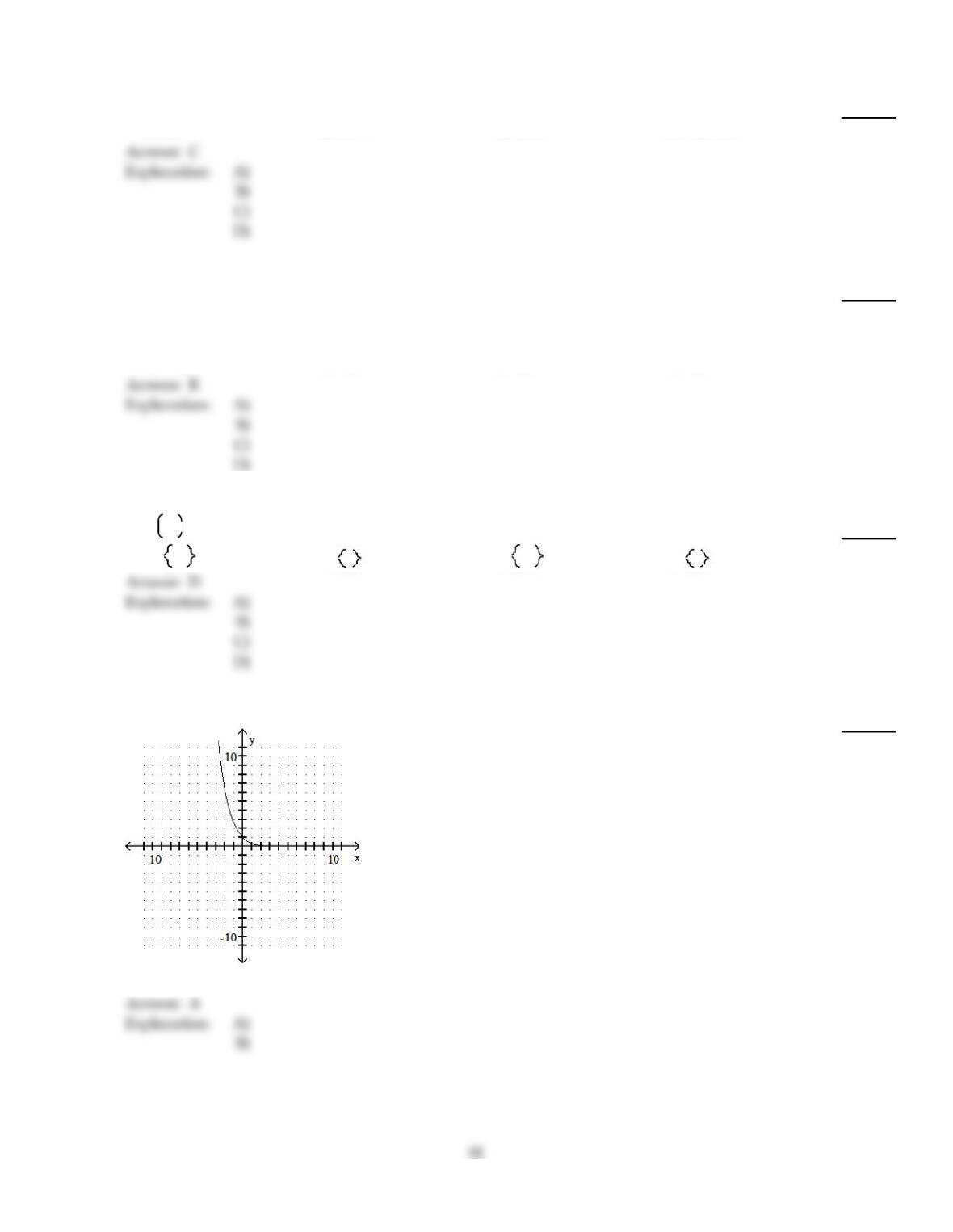
Using the exponential key of a calculator to find an approximation to the nearest thousandth.
68)
0.64.458
68)
A)
3.6
B)
2.675
C)
0.103
D)
7849.471
Solve the problem.
69)
The population of a particular city is increasing at a rate proportional to its size. It follows the
function P(t) = 1 + ke0.12twhere k is a constant and t is the time in years. If the current population
is 40,000, in how many years is the population expected to be 100,000? (Round to the nearest year.)
69)
A)
59 yr
B)
8 yr
C)
5 yr
D)
3 yr
Solve the equation.
70)
log 994= x
70)
A)
94
B)
9
C)
49
D)
4
Use the horizontal line test to determine if the function is one–to–one.
71)
71)
A)
Yes
B)
No
Rewrite the given expression as a single logarithm. Assume that all variables are defined in such a way that variable
expressions are positive and bases are positive numbers not equal to 1.
72)
2log cq–3
5log cr+1
3log cf– 3 log cp
72)
A)
log cq2r3/5
f1/3p3
B)
log cq2f1/3
r3/5 p3
C)
log cq2p3
f1/3r3/5
D)
log c (2 q –3
5r+1
3f– 3 p )
Solve the problem.
73)
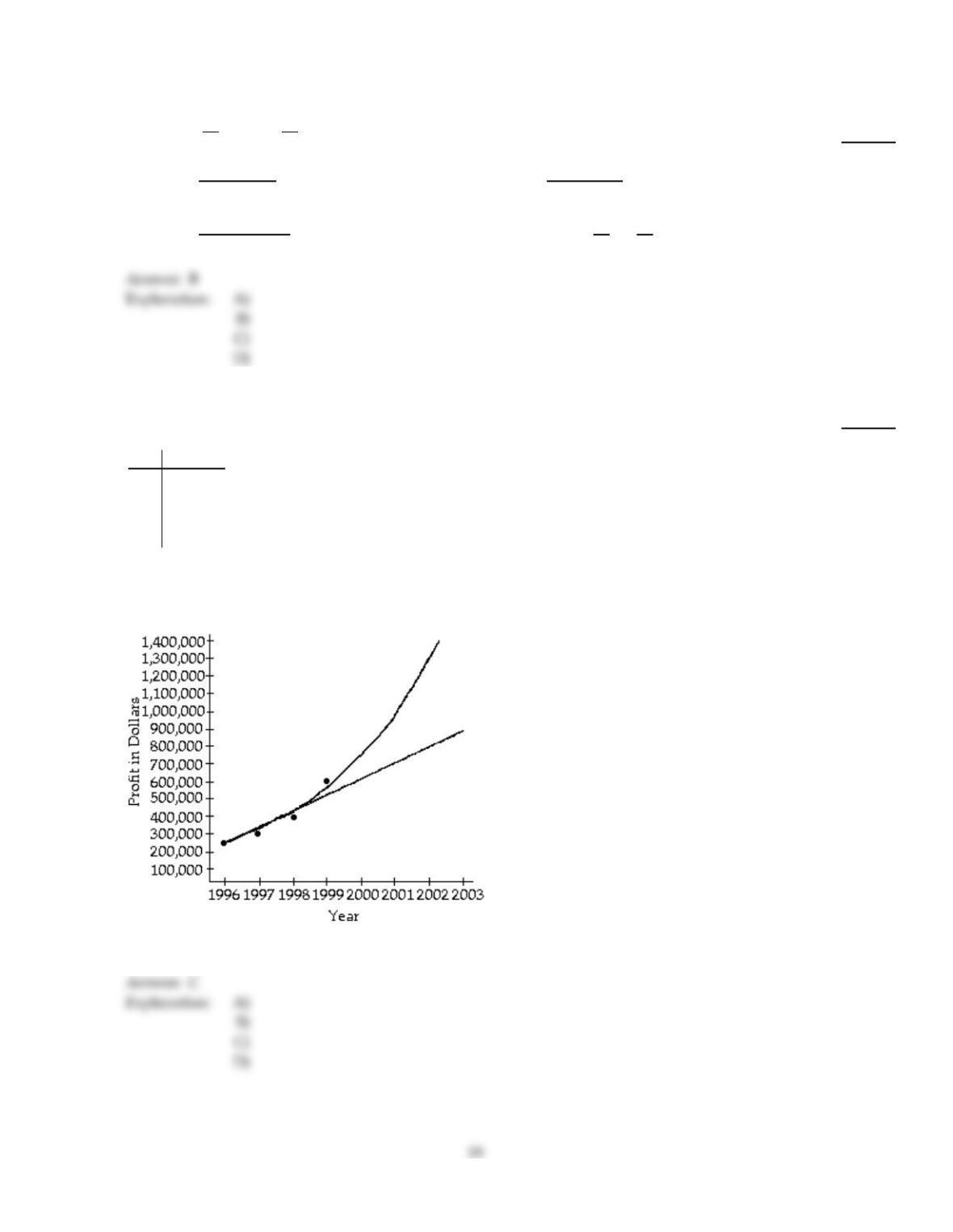
An accountant tabulated a firm’s profits for four recent years in the following table:
Year Profits
1996 $250,000
1997 $300,000
1998 $400,000
1999 $600,000
The accountant then fit both a linear graph and an exponential curve (seen below) to the data, in
order to estimate future profits. Use the exponential graph to estimate the profits in the year 2001.
73)
A)
About $750,000
B)
About $300,000
C)
About $1,000,000
D)
About $1,300,000
74)
Suppose that the salinity S of ocean water at a given depth d is modeled by the equation
S(d) =33.9 +1.4 log (d + 1), where S is measured in grams salt per kilogram water and d is
measured in meters. What is the salinity when the depth is 688 m? Round your answer to the
nearest hundredth.
74)
A)
94.82 g salt/kg water
B)
97.62 g salt/kg water
C)
37.87 g salt/kg water
D)
–29.93 g salt/kg water
Use properties of logarithms to write each expression as a sum or difference of logarithms. Assume that variables
represent positive real numbers.
75)
log11
99
s2r
75)
A)
log11 9–log11 s–log11 r
B)
9 log11 9– 2 log11 s–log11 4
C)
1
9log11 9– 2 log11 s– 2log11 r
D)
1
9log11 9– 2 log11 s–log11 r
Graph the function.
76)
f(x) =24x – 4
76)