Exam
Name___________________________________
SHORT ANSWER. Write the word or phrase that best completes each statement or answers the question.
Solve the problem.
1)
A team of engineers is testing an experimental high–voltage fuel cell with a potential
application as an emergency back–up power supply in cell phone transmission towers.
Unfortunately, the voltage of the prototype cell drops with time according to the equation
V(t) = – 0.0306t3+ 0.373t2– 2.16t + 15.1, where V is in volts and t is the time of operation in
hours. The cell provides useful power as long as the voltage remains above 5.6 volts. Use
Newton’s method to find the useful working time of the cell to the nearest tenth of an hour
(that is, solve V(t) =5.6 volts). Use t = 7 hours as your initial guess and show all of your
work to find x3 as your approximation.
1)
Explanation:
Prepare an amortization schedule for the loan.
2)
An insurance firm pays $30,000 for a new copy machine. It amortizes the loan in 8 annual
payments at 7% compounded annually. Prepare an amortization schedule showing the
first three payments.
2)
Explanation:
3)
A construction company pays $70,000 for a truck. It amortizes the loan in semiannual
payments for 5 years at 8.5% compounded semiannually. Prepare an amortization
schedule showing the first three payments.
3)
Solve the problem.
4)
Marcus Tool and Die Company produces a specialized milling tool designed specifically
for machining ceramic components. Each milling tool sells for $4, so the company’s
revenue in dollars for x units sold is R(x) = 4x. The company’s cost in dollars to produce x
tools can be modeled as C(x) =301 +29x5/8. Use Newton’s method to find the break–even
point for the company (that is, find x such that C(x) = R(x)). Use x = 370 as your initial
guess and show all of your work to find x3 as your approximation.
4)
MULTIPLE CHOICE. Choose the one alternative that best completes the statement or answers the question.
Use Newton’s method to find the given root to the nearest thousandth.
5)
3121
5)
A)
4.942
B)
4.944
C)
4.946
D)
4.949
Use Newton’s method to find a solution for the equation in the given interval. Round your answer to the nearest
hundredth.
6)
ex+4x –4= 0; [0, 1]
6)
A)
0.56
B)
0.57
C)
0.55
D)
0.54
Find an for the given geometric sequence.
7)
1
9, –1
63 , 1
441, –1
3087 , . . .
7)
A)
an=1
9–1
7
n – 1
B)
an=1
9–1
7(n – 1)
C)
an=1
9
n – 1
–8
63
D)
an=1
7–1
9
n – 1
Find the present value of the ordinary annuity. Round to the nearest cent.
8)
Payments of $4900 are made annually for 9 years at 7% compounded annually.
8)
A)
$49,289.53
B)
$31,924.64
C)
$37,277.66
D)
$24,661.47
9)
Payments of $1700 are made semiannually for 8 years at 5% compounded semiannually.
9)
A)
$12,189.23
B)
$10,987.46
C)
$18,424.21
D)
$22,193.51
Use the appropriate Taylor polynomial of degree 3 at x = 0 to approximate the quantity. Round the answer to four
decimal places.
10)
e1.80
10)
A)
6.1595
B)
6.0590
C)
5.4295
D)
0.8200
Use Newton’s method to find a solution for the equation in the given interval. Round your answer to the nearest
hundredth.
11)
2x4– 5x3– 9x2+ 3x – 5 = 0; [3, 4]
11)
A)
3.68
B)
3.67
C)
3.64
D)
3.65
Find the amount of the ordinary annuity. Round to the nearest cent.
12)
R =$2900, 6% interest compounded quarterly for 12 years
12)
A)
$195,900.63
B)
$201,739.14
C)
$395,072.47
D)
$91,751.10
Use l’Hospital’s rule, if applicable, to find the limit.
13)
lim
x
2
ln(x –1)
x –2
13)
A)
1
2
B)
1
C)
0
D)
Does not exist
14)
lim
x
0
e2x – 1
5x2+3x
14)
A)
2
3
B)
0
C)
2
5
D)
Does not exist
15)
lim
x
3
x2– 9
x – 3
15)
A)
–3
B)
–6
C)
6
D)
3
Solve the problem.
16)
Find the amount of each payment into a sinking fund if $14,000 must be accumulated. Payments
are made at the end of each quarter for 3 years, with interest of 12% compounded quarterly.
16)
A)
$986.47
B)
$737.80
C)
$829.92
D)
$1378.02
Use the formula for the sum of the first n terms of a geometric sequence to evaluate the sum.
17)
4
i=0
2(–4)i
17)
A)
–51
B)
410
C)
–250
D)
–102
D)
Find the amount of the ordinary annuity. Round to the nearest cent.
18)
R =$4700, 5% interest compounded semiannually for 11 years
18)
A)
$153,116.09
B)
$135,655.42
C)
$127,761.39
D)
$323,655.42
D)
Use l’Hospital’s rule, if applicable, to find the limit.
19)
lim
x
5x
ln(ex+ 1)
19)
A)
1
5
B)
5
C)
D)
0
D)
Solve the problem.
20)
Use the first five terms of the Taylor series to approximate the area of the region bounded by
f(x) = xe–3x, x = 0, x = 1, and the x–axis.
20)
A)
0.4
B)
0.2125
C)
4.0875
D)
0.2875
D)
21)
An object is rolling with a driving force that suddenly ceases. The object then rolls 10 meters in the
first second, and in each subsequent interval of time it rolls 80% of the distance it had rolled the
second before. This slowing is due to friction. How far will the object eventually roll?
21)
A)
20 m
B)
50 m
C)
12.2 m
D)
It will roll an infinite distance.
Find the Taylor series for the given function. Give the interval of convergence.
22)
f(x) =e9x2
22)
A)
1 +9x2+92
2! x4+93
3! x6+ . . . +9n
n! x2n + . . . ; (–9, 9)
B)
1 –9x2+92
2! x4–93
3! x6+ . . . +(–1)n9n
n! x2n + . . . ; ( , )
C)
1 +9x2+92
2! x4+93
3! x6+ . . . +9n
n! x2n + . . . ; ( , )
D)
1 +9x +92
2! x2+93
3! x3+ . . . +9n
n! xn+ . . . ; ( , )
Use the formula for the sum of the first n terms of a geometric sequence to evaluate the sum.
23)
3
i=0
5
3
1
2
i
23)
A)
75
8
B)
5
3
C)
5
8
D)
25
8
Use Newton’s method to find a solution for the equation in the given interval. Round your answer to the nearest
hundredth.
24)
x3– x – 1 = 0; [1, 2]
24)
A)
1.31
B)
1.32
C)
1.34
D)
1.33
Find an for the given geometric sequence.
25)
a2= – 10, r = – 2
25)
A)
an=5(–2)n – 1
B)
an=5(–2n)
C)
an= – 10(–2)n – 1
D)
an=5(–2)n
Use the appropriate Taylor polynomial of degree 3 at x = 0 to approximate the quantity. Round the answer to four
decimal places.
26)
ln 1.155
26)
A)
1.1442
B)
–0.0608
C)
0.1442
D)
0.0872
Solve the problem.
27)
For a particular product, the revenue and cost functions are R(x) =121 –x2 and C(x) =6x +5.
Approximate the break–even point to the nearest hundredth.
27)
A)
0.85
B)
0.89
C)
0.94
D)
0.99
28)
In a lottery, a winner is paid $45,000 per year for 20 years. Assume that these payments form an
ordinary annuity and that the lottery managers can invest money at 6% compounded annually.
Find the lump sum that the management must put away to pay off the winner.
28)
A)
$677,083.37
B)
$1,040,164.74
C)
$516,146.44
D)
$1,655,351.59
Use Newton’s method to find a solution for the equation in the given interval. Round your answer to the nearest
hundredth.
29)
2x4– 3x2– 7x + 1 = 0; [1, 2]
29)
A)
1.79
B)
1.82
C)
1.80
D)
1.81
7
List the first n terms of the geometric sequence satisfying the given conditions.
30)
a3=100, a4=50, n = 5
30)
A)
200, 100, 50, 25, 25
2
B)
500, 200, 100, 50, 25
C)
25
2, 25, 50, 100, 200
D)
400, 200, 100, 50, 25
Find the indicated term of the geometric sequence.
31)
a1=4, r =2; Find a4.
31)
A)
a4=32
B)
a4=8
C)
a4=1
2
D)
a4=512
Use l’Hospital’s rule, if applicable, to find the limit.
32)
lim
x
16x2–5
x ln x
32)
A)
0
B)
C)
1
D)
16
Find the indicated term of the geometric sequence.
33)
a2=3, r =1
3; Find a4.
33)
A)
1
3
B)
10
C)
27
D)
1
9
8

Find the Taylor series for the given function. Give the interval of convergence.
34)
f(x) =e4x +e–4x
2
34)
A)
1 +4x +42
2! x2+43
3! x3+ . . . +4n
n! xn+ . . . ; ( , )
B)
1 +42
2! x2+44
4! x4+46
6! x6+ . . . +42n
(2n)! x2n + . . . ; (–4, 4)
C)
1 +42
2! x2+44
4! x4+46
6! x6+ . . . +42n
(2n)! x2n + . . . ; ( , )
D)
1 +42x2+44x4+46x6+ . . . +42nx2n + . . . ; ( , )
List the first n terms of the geometric sequence satisfying the given conditions.
35)
a1=1
4, r = – 9, n = 4
35)
A)
1
4, –9
4, 81
4, –729
4
B)
1
4, –9
16 , 9
64 , –729
256
C)
1
4, –9
4, –81
4, –729
4
D)
1
4, –9
16 , –9
64 , –6561
256
Solve the problem.
36)
While bungee jumping, Gregory falls from a height of 162 feet. He continues to bounce one–third
the height from which he last fell. Write out the first five terms of this geometric sequence and find
the general term.
36)
A)
162, 54, 18, 6, 2; an=162
3n
B)
162, 54, 18, 6, 2; an=162
3n – 1
C)
54, 18, 6, 2, 2
3; an=162
3n – 1
D)
162, 159, 156, 153, 150; an=162 –3(n – 1)

List the first n terms of the geometric sequence satisfying the given conditions.
37)
a1=8, r =1
3, n = 4
37)
A)
8, 8
3, 8
9, 8
27
B)
8
3, 8
9, 8
27 , 8
81
C)
8, 25
3, 26
3, 9
D)
8, 24, 72, 216
The nth term of a sequence is given. Calculate the fifth partial sum.
38)
an=1
(n +2)(n +3)
38)
A)
5
27
B)
7
24
C)
5
24
D)
7
27
List the first n terms of the geometric sequence satisfying the given conditions.
39)
a2=6, a3=12, n = 4
39)
A)
3, 6, 12, 48
B)
3, 6, 12, 24
C)
6, 12, 24, 48
D)
1, 6, 12, 24
Use the formula for the sum of the first n terms of a geometric sequence to evaluate the sum.
40)
4
i=0
2(4)i
40)
A)
170
B)
54
C)
85
D)
682
Find the indicated term of the geometric sequence.
41)
a1=7, r =7
4; Find a5.
41)
A)
a5=117,649
1024
B)
a5=16,807
256
C)
a5=256
343
D)
a5=5,764,801
256
Find the common ratio for the geometric sequence.
42)
3, 9, 27 , 81 , 243, . . .
42)
A)
r =81
B)
r = 1/3
C)
r =3
D)
r =9
Use Newton’s method to find a solution for the equation in the given interval. Round your answer to the nearest
hundredth.
43)
2x5– 3x2– 7x + 1 = 0; [–2, –1]
43)
A)
–1.19
B)
–1.22
C)
–1.20
D)
–1.21
Use the formula for the sum of the first n terms of a geometric sequence to evaluate the sum.
44)
5
i=0
2
5(–4)i
44)
A)
410
5
B)
–1638
5
C)
1638
D)
–819
5
Find the amount of the ordinary annuity. Round to the nearest cent.
45)
R =$12,500, i =0.045, n =8 (Interest is compounded annually.)
45)
A)
$395,027.95
B)
$37,801.72
C)
$100,239.40
D)
$117,250.17
Find the payment necessary to amortize the loan. Round to the nearest cent.
46)
$2000, 8% compounded annually, 11 annual payments
46)
A)
$280.15
B)
$298.06
C)
$111.98
D)
$265.39
List the first n terms of the geometric sequence satisfying the given conditions.
47)
a1= – 2, r =3, n = 4
47)
A)
–2, 1, 4, 7
B)
–2, 6, –18, 54
C)
–6, –18, –54, –162
D)
–2, –6, –18, –54
Use l’Hospital’s rule, if applicable, to find the limit.
48)
lim
x
19x2– 3x – 8
12x2– 8x + 8
48)
A)
B)
1
C)
19
12
D)
0
49)
lim
x
0
1
x–1
x2
49)
A)
0
B)
1
2
C)
–1
D)
Does not exist
Solve the problem.
50)
Ms. Patterson proposes to give her daughter Claire an allowance of $0.10 on the first day of her
13–day vacation, $0.20 on the second day, $0.40 on the third day, and so on. Find the allowance
Claire would receive on the last day of her vacation.
50)
A)
$1.30
B)
$819.20
C)
$4096.10
D)
$409.60
Find the lump sum deposited today that will yield the same total amount as the payments described. Interest is
compounded annually.
51)
Payments of $12,500 at the end of each year for 10 years at an interest rate of 8%.
51)
A)
$181,082.03
B)
$101,386.20
C)
$150,076.34
D)
$83,876.02
Find the Taylor polynomial of degree 3 at 0.
52)
f(x) =1
3– x
52)
A)
1
3x +1
9x2+1
27 x3+1
81 x4
B)
1
3–1
9x +1
27 x2–1
81 x3
C)
1
3x –1
9x2+1
27 x3–1
81 x4
D)
1
3+1
9x +1
27 x2+1
81 x3
Solve the problem.
53)
Scott deposits $100 each month into a savings account paying annual interest of 5.5% compounded
monthly. How much will his account have in it at the end of 11 years? Round to the nearest dollar.
53)
A)
$17,927
B)
$1458
C)
$18,210
D)
$18,081
List the first n terms of the geometric sequence satisfying the given conditions.
54)
a1=3, r = – 7, n = 4
54)
A)
3, –21, 147, –1029
B)
3, –21, –63, –189
C)
3, –21, 63, –189
D)
3, –21, –147, –1029
Find the amount of the ordinary annuity. Round to the nearest cent.
55)
R =$5400, i =0.055, n =15 (Interest is compounded annually.)
55)
A)
$109,579.89
B)
$219,188.60
C)
$20,776.17
D)
$121,006.78
Solve the problem.
56)
Looking ahead to retirement, you sign up for automatic savings in a fixed–income 401K plan that
pays 10% per year compounded annually. You plan to invest $2500 at the end of each year for the
next 30 years. How much will your account have in it at the end of 30 years? Round to the nearest
dollar.
56)
A)
$412,533
B)
$409,692
C)
$411,235
D)
$413,005
The nth term of a sequence is given. Calculate the fifth partial sum.
57)
an=(–1)n+11
n(3n + 1)
57)
A)
4481
21,840
B)
19,949
87,360
C)
1223
6720
D)
991
6240
Find the sum of the first five terms of the indicated geometric series.
58)
5, 15, 45, 135, . . .
58)
A)
595
B)
605
C)
606
D)
608
Find an for the given geometric sequence.
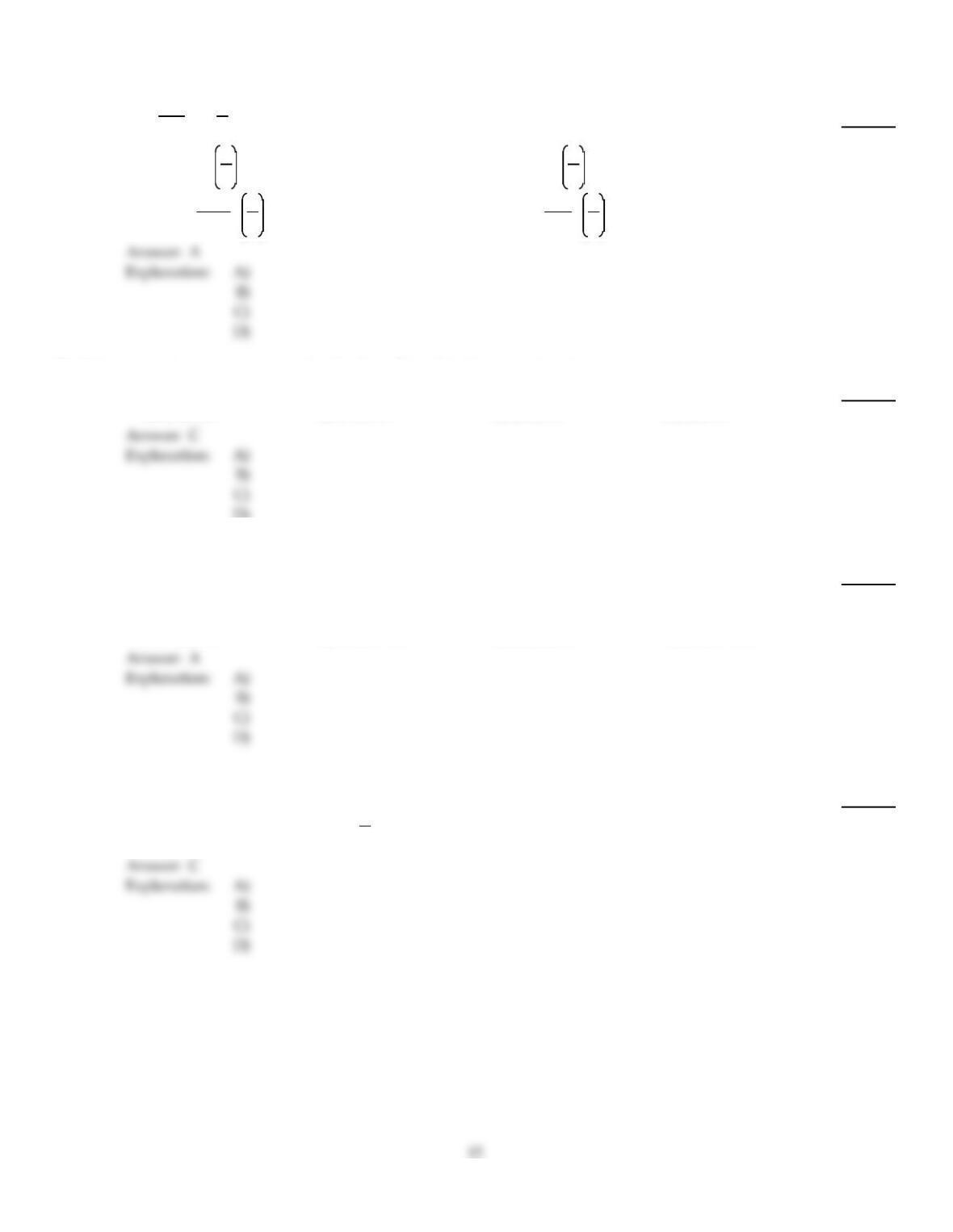
59)
a5=9
625, r =1
5
59)
A)
an=9·1
5
n–1
B)
an=9·1
5
n
C)
an=9
3125 ·1
5
n
D)
an=9
625 ·1
5
n–1
Find the payment necessary to amortize the loan. Round to the nearest cent.
60)
$3200, 14% compounded quarterly, 6 quarterly payments
60)
A)
$523.34
B)
$708.74
C)
$600.54
D)
$61.76
D)
Solve the problem.
61)
In her will the late Mrs Barbaroni said that each child in her family could have an annuity of $2100
at the end of each year for 9 years, or the equivalent present value. If money can be deposited at 7%
compounded annually, what is the present value?
61)
A)
$13,681.99
B)
$10,569.20
C)
$21,124.08
D)
$15,976.14
D)
Find the common ratio for the geometric sequence.
62)
2, 6, 18, 54, 162, . . .
62)
A)
r =6
B)
r =1
3
C)
r =3
D)
r =2
D)
D)
Use Newton’s method to find the given root to the nearest thousandth.
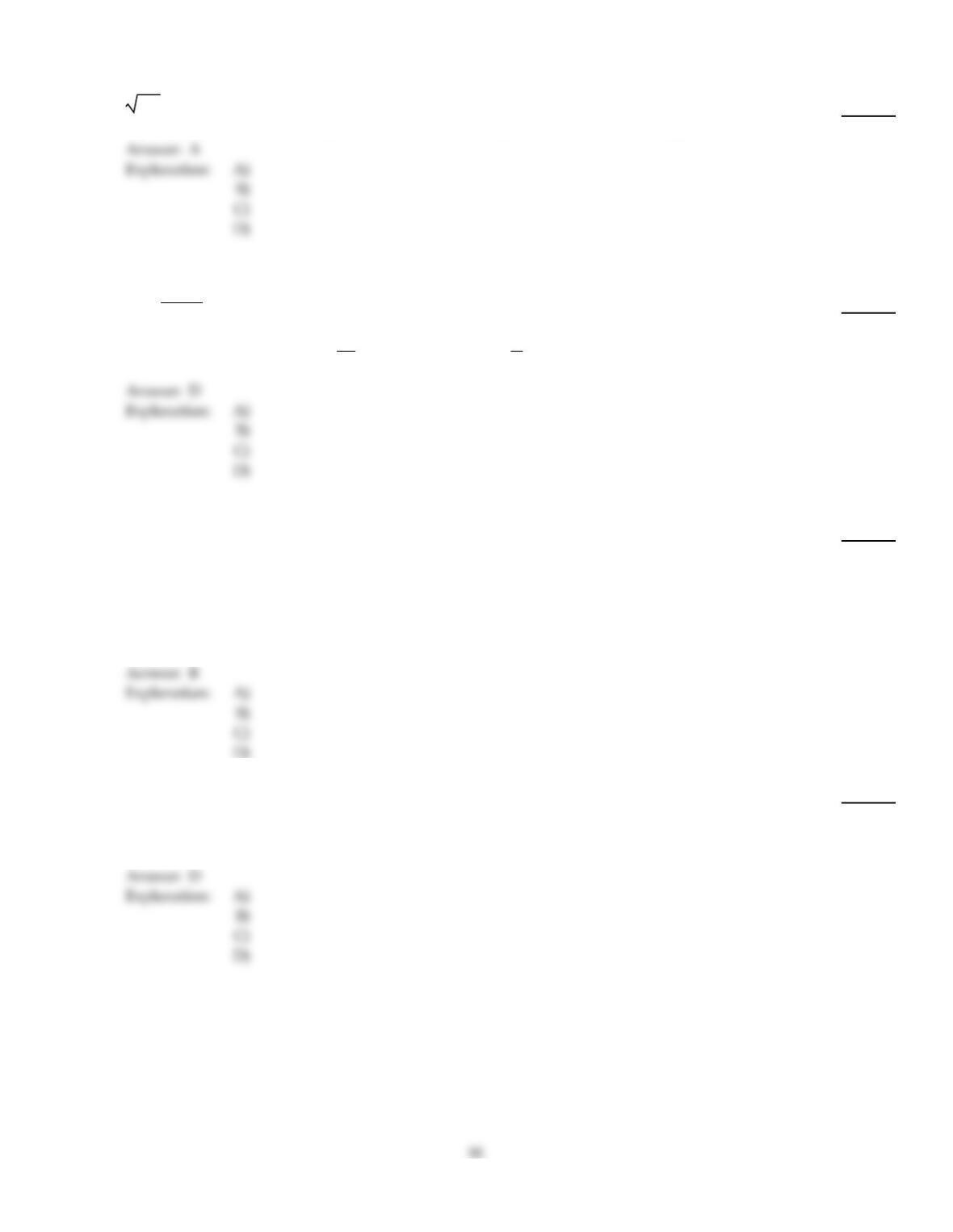
63)
112
63)
A)
10.583
B)
10.586
C)
10.579
D)
10.585
Use l’Hospital’s rule, if applicable, to find the limit.
64)
lim
x
0
ex– 1
x4
64)
A)
0
B)
1
24
C)
1
4
D)
Does not exist
Solve the problem.
65)
Acetone is a solvent frequently used to clean lubricants from machine components. Once used, the
dirty solvent need not be discarded. It may be distilled to recover pure acetone from the soiled
mixture. During a distillation cycle, 69% of the acetone can be recovered. Calculate the effective
volume of 1 liter of acetone. [The effective volume is the original 1 liter plus the accumulated
amount recovered from an infinite number of distillation cycles].
65)
A)
1.690 L
B)
3.226 L
C)
1.449 L
D)
An infinite number of liters
66)
On a gambling trip to Las Vegas, Anthony doubled his bet each time he won. If his first winning
bet was $4 and he won six consecutive bets, find how much he won on the sixth bet. Find the total
amount he won on these six bets.
66)
A)
$256; $252
B)
$256; $508
C)
$64; $124
D)
$128; $252
Identify which geometric series converge. Give the sum of a convergent series.
67)
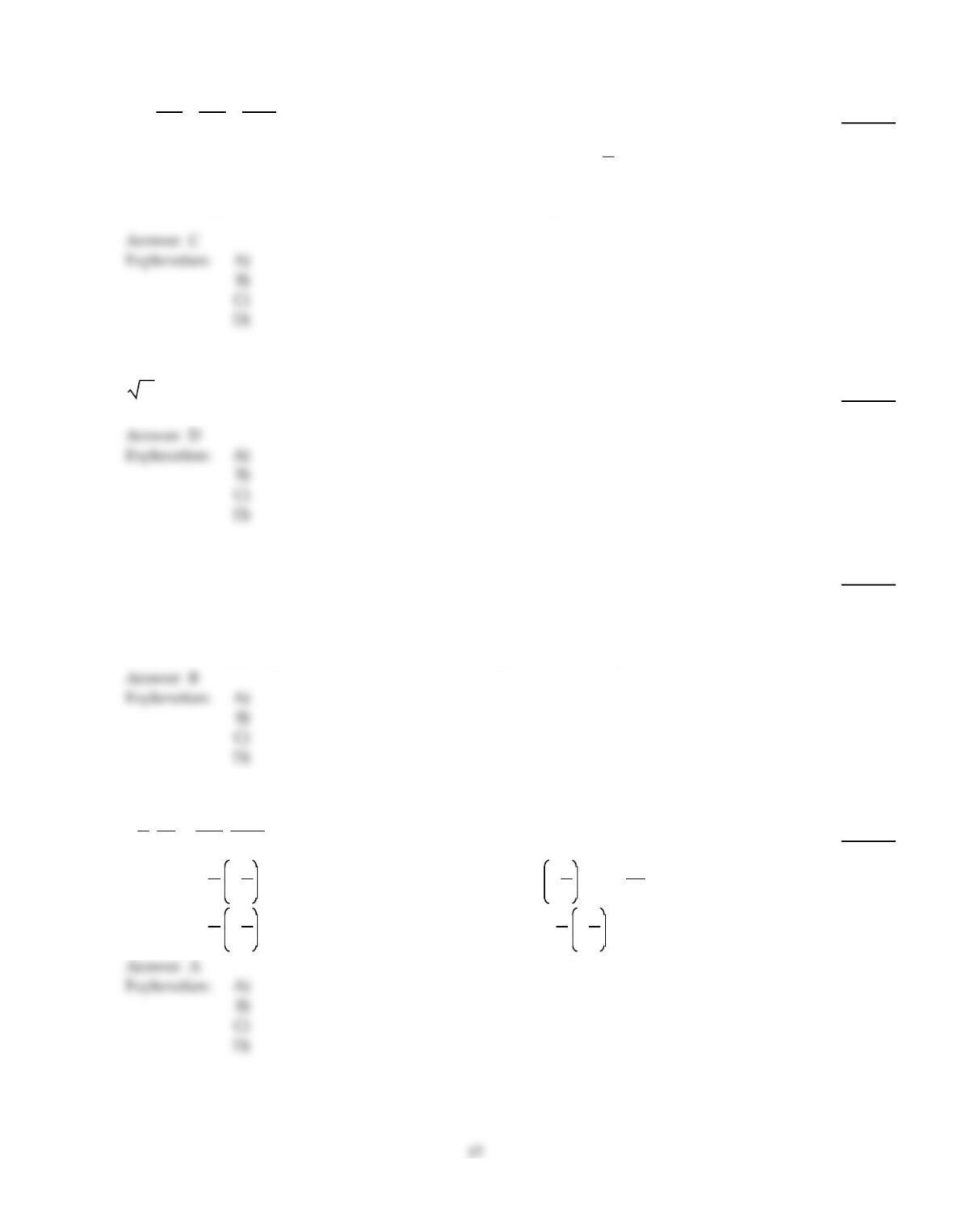
40 +120
7+360
49 +1080
343 + . . .
67)
A)
Converges to 30
B)
Converges to 7
4
C)
Converges to 70
D)
Diverges
Use Newton’s method to find the given root to the nearest thousandth.
68)
313
68)
A)
2.354
B)
2.345
C)
2.348
D)
2.351
Solve the problem.
69)
A job pays a salary of 35,000 the first year. During the next 11 years, the salary increases by 3% each
year. What is the salary for the 12th year? What is the total salary over the 12–year period? (Round
to the nearest cent.)
69)
A)
$48,448.19; $448,272.85
B)
$48,448.19; $496,721.03
C)
$49,901.63; $546,622.67
D)
$49,901.63; $448,306.18
Find an for the given geometric sequence.
70)
–1
8, 1
72 , –1
648, 1
5832 , . . .
70)
A)
an= – 1
8–1
9
n – 1
B)
an= – 1
8
n – 1
+5
36
C)
an= – 1
9–1
8
n – 1
D)
an= – 1
8–1
9
n
Find the lump sum deposited today that will yield the same total amount as the payments described. Interest is
compounded annually.
71)
Payments of $8500 at the end of each year for 10 years at an interest rate of 7%.
71)
A)
$70,691.15
B)
$117,439.81
C)
$99,716.84
D)
$59,700.44
Find the present value of the ordinary annuity. Round to the nearest cent.
72)
Payments of $1300 are made annually for 13 years at 6% compounded annually.
72)
A)
$11,504.35
B)
$12,083.50
C)
$11,508.49
D)
$10,898.94
Use the appropriate Taylor polynomial of degree 3 at x = 0 to approximate the quantity. Round the answer to four
decimal places.
73)
24.91
73)
A)
4.9910
B)
4.9919
C)
4.9915
D)
4.9903
Find an for the given geometric sequence.
74)
2, 4, 8, 16, 32, . . .
74)
A)
an=2+ 2(n – 1)
B)
an=2n
C)
an=2n–1+ 1
D)
an=2n
Use Newton’s method to find a solution for the equation in the given interval. Round your answer to the nearest
hundredth.
75)
x3e–x+ x – 4 = 0; [2, 3]
75)
A)
2.68
B)
2.76
C)
2.66
D)
2.54
18
Find the payment necessary to amortize the loan. Round to the nearest cent.
76)
$81,000, 7% compounded annually, 12 annual payments
76)
A)
$9691.72
B)
$3926.56
C)
$10,198.06
D)
$10,801.91
Use l’Hospital’s rule, if applicable, to find the limit.
77)
lim
x
ln(ln x)
x
77)
A)
B)
0
C)
1
2
D)
–1
Solve the problem.
78)
Use Newton’s method to find the critical point of the function f(x) =x3– 6x2+ 11x – 5 that
corresponds to a relative maximum. Round your answer to the nearest hundredth.
78)
A)
1.42
B)
1.43
C)
1.44
D)
1.45
79)
If P dollars are invested at an annual interest rate of r compounded n times a year, then the
accumulated amount after t years is given by
A = P 1 +r
n
nt.
If $3000 is invested for 15 years at a rate of 9% compounded monthly, then what is the difference, in
thousands of dollars, between the actual accumulated amount and the amount given by the Taylor
polynomial of degree 2 at r = 0 for
f(r) = P 1 +r
n
nt?
79)
A)
2.65 thousand dollars
B)
0.97 thousand dollars
C)
1.75 thousand dollars
D)
0.84 thousand dollars
80)
A particular substance decays in such a way that it loses half its weight each day. How much of the
substance is left after 9 days if it starts out at 128 grams?
80)
A)
1
4 g
B)
2 g
C)
1
2 g
D)
4 g
Find the Taylor polynomial of degree 3 at 0.
81)
f(x) =3x –64
81)
A)
–4+1
48 x +1
9216 x2+5
2,654,208 x3
B)
–4+1
48 x +1
9216 x2+5
5,308,416 x3
C)
–4+1
48 x –1
9216 x2+5
2,654,208 x3
D)
–4+1
48 x –1
9216 x2+5
5,308,416 x3
Solve the problem.
82)
A pendulum bob swings through an arc 50 inches long on its first swing. Each swing thereafter, it
swings only 79% as far as on the previous swing. What is the length of the arc after 11 swings?
Round to two decimal places.
82)
A)
395.00 in.
B)
2.95 in.
C)
4.73 in.
D)
3.74 in.