Chapter 12
Shareholders’ Equity
MULTIPLE CHOICE QUESTIONS
1. A corporation issued common stock instead of debt to finance the purchase of non–
depreciable property. Which statement is true?
a. Ownership by existing shareholders will be diluted.
b. The company’s debt/equity ratio will be higher.
c. Income tax expense will be lower because expenses increase.
d. Net income will be lower.
2. Which one of the following is a result of a company issuing common stock instead of
debt to finance the purchase of property?
a. Leverage will be more effective.
b. The company will probably experience cash flow problems.
c. It will have a lower debt/equity ratio.
d. It will report a lower net income.
3. What is the effect of a corporation appropriating retained earnings for the cost of
treasury stock purchased?
a. Contributed capital is overstated.
b. A portion of retained earnings is restricted from the payment of dividends.
c. Owner’s equity is reduced by the amount of the appropriation.
d. Income is overstated.
12-2 Test Bank – Chapter 12 – Shareholders’ Equity
4. Information related to Lamar Co. for the years ending December 31, 2017 and 2016
follows:
12–31–17
12–31–16
Common stock
$120,000
$80,000
Retained earnings at year end (after closing)
100,000
70,000
Dividends declared for 2017 totaled $20,000. How much was generated through
operations?
a. $30,000
b. $50,000
c. $10,000
d. $70,000
5. A corporation generated assets by issuing equity securities and through profitable
operations. Which effects likely occurred?
a. Common stock and retained earnings increased.
b. Common stock increased and retained earnings stayed the same.
c. Retained earnings increased, and there was no effect on common stock.
d. Liabilities and common stock increased.
6. Which one of the following is a valid reason for a stock split?
a. To increase ownership percentages of individual shareholders
b. To adjust the market price of the shares to a level where more individuals can afford
to invest in the stock
c. To increase reported net income during subsequent accounting periods
d. To increase the book value per share of common stock
7. Which one of the following transactions always causes a decrease to retained earnings?
a. Selling treasury stock
b. Incurring net income for the period
c. Declaring a stock dividend
d. Paying a cash dividend that was previously declared
Test Bank – Chapter 12 – Shareholders’ Equity 12-3
8. On which date would you make no journal entry?
a. Date of declaration of cash dividend
b. Date of record of cash dividend
c. Date of payment of cash dividend
d. Date of declaring a stock dividend
9. Baker Company has 200,000 shares of common stock outstanding. The company
declares a stock dividend of 58,000 shares. According to GAAP, this dividend should be
treated as:
a. a small stock dividend.
b. a prior period adjustment.
c. a large stock dividend.
d. a purchase of treasury stock.
10. Cash dividends are paid based on the number of shares which are
a. authorized.
b. issued.
c. outstanding.
d. outstanding minus the number of treasury shares.
11. Which one of the following represents the economic effects of declaring and issuing a
stock dividend?
a. Has no effect on total assets or total shareholders’ equity
b. Decreases the debt/equity ratio
c. Decreases total shareholders’ equity
d. Increases the current ratio
12. Which one of the following represents the economic effects of issuing a 2-for-1 stock
split?
a. No effect on par value per share or retained earnings
b. Decrease par value per share, and no effect on retained earnings
c. No effect on par value per share, and decrease retained earnings
d. Increase par value per share and retained earnings
12-4 Test Bank – Chapter 12 – Shareholders’ Equity
13. Which one of the following is an effect when a company buys back its own shares of
stock?
a. Leverage is not affected.
b. It will pay more dividends.
c. It will have a higher debt/equity ratio.
d. Fixed assets will decrease.
14. On January 1, 2017, Garner Corp. had 10,000 shares of $1 par value common stock
issued and outstanding. The stock was selling at $10 per share. During 2017, Garner
declared and issued a 10% stock dividend. The stock dividend causes
a. total shareholders‘ equity to increase by $1,000.
b. net income to decrease by $1,000.
c. earnings per share to decrease by $10,000.
d. no change in total shareholders’ equity
15. If a corporation uses retention of earnings to finance the purchase of property instead of
issuing equity securities, then
a. the debt/equity ratio will be the same under both options.
b. it will pay more dividends.
c. leverage is being used.
d. a company’s earnings per share will decrease.
16. If a corporation issues debt instead of common stock to finance the purchase of
property, then the corporation has
a. a disadvantage of higher tax payments because dividends are a bigger deduction
than interest.
b. no ability to avoid interest payments from the debt issuance under any
circumstances.
c. required dividend payments that are usually double-taxed.
d. a higher earnings per share.
Test Bank – Chapter 12 – Shareholders’ Equity 12-5
17. Which one of the following is a characteristic of equity as opposed to debt?
a. Voting rights are typically attached.
b. There is a fixed maturity date.
c. There is a legal contract.
d. There is a fixed payment schedule.
18. Which one of the following serves to differentiate debt from equity?
a. Interest on debt may be deferred, but dividends are a legal liability and must be paid
every year.
b. Interest on debt is tax deductible while dividends to equity investors are not.
c. Debt has a maturity date which is much shorter than the maturity period of equity.
d. Debt holders are appointed while the board of directors elects equity holders.
19. Which of the following is considered to be an important economic consequence of
incentive compensation plans using stock options?
a. dilution of ownership interests.
b. the current ratio is affected.
c. the effects on the financial statements are costly to quantify.
d. the effect on cash flows
20. If preferred stock, which can be exchanged for long-term debt in three years, is classified
as an equity financial instrument instead of a liability, then
a. the current ratio declines.
b. earnings per share is less than if the preferred stock was reported as debt.
c. fixed assets and net worth increase.
d. the debt/equity ratio is less than if the preferred stock was reported as debt.
21. Which one of the following is ‘debt’ with the appearance of ‘equity’?
a. Long-term debt with a rate of interest that depends upon the current prime rate of
interest
b. Long-term debt that can be converted into common stock
c. Notes payable due in ten years
d. Stock options
12-6 Test Bank – Chapter 12 – Shareholders’ Equity
22. If preferred stock is cumulative, then
a. preferred dividends are a percentage of corporate profits.
b. dividends in arrears must be paid before common shareholders receive dividends.
c. dividends are a percentage of the market value of the preferred stock.
d. payment of dividends is legally guaranteed to shareholders each year.
23. If preferred stock is participating, then
a. preferred dividends are a percentage of corporate profits.
b. preferred shareholders vote in the election of the members of the board of directors.
c. preferred shareholders share in the remaining amount of dividend with common
shareholders.
d. dividends in arrears must be paid before common shareholders receive dividends.
24. Which one of the following would always restrict a portion of retained earnings?
a. The sale of a plant asset
b. A sale of treasury stock
c. A declaration of cash dividends
d. An appropriation declared by the Board of Directors
25. Simon Corp’s $1 par value, common stock was selling for $20 per share. Simon Corp’s
owners’ equity accounts were as follows:
Common stock
$800,000
Additional paid-in capital
200,000
Retained earnings
400,000
How many shares of common stock have been issued?
a. 30,000
b. 600,000
c. 800,000
d. Not enough information to determine.
Test Bank – Chapter 12 – Shareholders’ Equity 12-7
26. Which one of the following events increases the debt/equity ratio?
a. Purchase of inventory on account
b. Sale of treasury stock for less than its cost
c. The payment of cash dividends that were previously recorded
d. Recognition of net income for the year
27. Treasury stock is
a. an asset representing a corporate investment in itself.
b. highly-valued stock owned by a corporation.
c. illegal for U.S. corporations.
d. a decrease of shareholders’ equity.
28. If preferred stock is specified as 8% preferred stock, then preferred
a. dividends are a percentage of the par value of the preferred stock.
b. shareholders vote in the election of the members of the board of directors.
c. dividends are a percentage of corporate profits.
d. dividends in arrears must be paid before common shareholders receive dividends.
29. Dividends in arrears
a. are preferred dividends that have been declared but not paid.
b. must be legally paid in the future.
c. are dividends that have not been declared on cumulative preferred stock.
d. are reported as a liability on the balance sheet until paid.
30. Preferred stock may be preferred by investors as compared to common stock because
a. it pays higher dividends than common.
b. it has advantages of special rights to dividends and/or asset claims during
liquidation.
c. preferred stock pays dividends and common stock pays interest.
d. dividends are expected to grow exponentially.
12-8 Test Bank – Chapter 12 – Shareholders’ Equity
31. Dividends in arrears on cumulative preferred stock
a. increase liabilities.
b. decrease retained earnings.
c. have no effect on the balance sheet but are disclosed in the footnotes.
d. increase the debt/equity ratio.
32. Which one of the following events decreases the current ratio?
a. A stock split
b. Sale of treasury stock for more than its cost
c. Sale of treasury stock for less than its cost
d. Purchase of treasury stock
33. On January 1, 2017, Susann, Inc. declared a 15% stock dividend on its common stock
when the market value of the common stock was $20 per share. Shareholders’ equity
before the stock dividend was declared consisted of:
Common stock, $10 par value, authorized 40,000 shares;
issued and outstanding 5,000 shares
$ 50,000
Additional paid-in capital on common stock
200,000
Retained earnings
60,000
Total shareholders’ equity
$310,000
What happened to retained earnings as a result of the stock dividend declaration?
a. $6,000 decrease
b. $7,500 decrease
c. $15,000 decrease
d. No change
Solution: (5,000 X 15%) X $20 = $15,000
34. Dividends are not paid on
a. noncumulative preferred stock.
b. nonparticipating preferred stock.
c. treasury common stock.
d. outstanding common shares.
Test Bank – Chapter 12 – Shareholders’ Equity 12-9
35. If a company sells its treasury stock for more than it cost and records a gain on the
income statement, then
a. income and shareholders’ equity are overstated.
b. only income is overstated.
c. only shareholders’ equity is overstated.
d. the income statement and balance sheet are properly stated.
36. What effect will the acquisition of treasury stock have on shareholders‘ equity?
a. No effect
b. Increase
c. Depends on whether it cost more or less than the par value of the stock
d. Decrease
37. Which one of the following events increases the debt/equity ratio?
a. Purchase of treasury stock
b. Sale of treasury stock for more than its cost
c. Sale of treasury stock for less than its cost
d. Payment of cash dividends that were previously declared
38. A company declared cash dividends in 2016, and paid the dividends in 2017. The
payment in 2017
a. decreases the debt/equity ratio.
b. increases the number of shares of stock outstanding.
c. decreases shareholders’ equity.
d. decreases net income.
39. The declaration of cash dividends
a. increases total expenses.
b. decreases current liabilities.
c. decreases earnings per share.
d. increases the debt/equity ratio.
12–10 Test Bank – Chapter 12 – Shareholders’ Equity
40. The payment of previously declared cash dividends
a. increases the debt/equity ratio.
b. increases current liabilities.
c. increases earnings per share.
d. decreases total liabilities.
41. Dividends payable is recorded at the date of
a. issue.
b. record.
c. declaration.
d. payment.
42. If dividends paid are recorded as an expense, then
a. income and retained earnings are understated.
b. only income is understated.
c. only retained earnings is understated.
d. the income statement and balance sheet are correct.
43. An ordinary 20% stock dividend
a. causes no change in retained earnings.
b. decreases assets.
c. increases contributed capital.
d. is reported on the income statement.
44. All of the following statements are true regarding the appropriations of retained earnings
except:
a. Appropriations of retained earnings restrict retained earnings from future dividend
payments.
b. Appropriations of retained earnings involve the restriction of cash.
c. Appropriations of retained earnings must be decided upon by the board of directors.
d. Appropriations of retained earnings do not change the amount of total stockholders’
equity.
Test Bank – Chapter 12 – Shareholders’ Equity 12–11
45. Chambers Corporation has total assets of $800,000 as of December 31, 2017 and total
liabilities of $400,000. Contributed capital as of December 31, 2016 and December 31,
2017 is $150,000. Chambers Corporation incurred a $50,000 net loss for the year
ended December 31, 2017. If Chambers declared and paid $80,000 in dividends in
2017, its retained earnings at the beginning of 2017 would have been.
a. $220,000.
b. $280,000
c. $380,000.
d. $440,000.
46. Garnett Corporation’s balance sheet reflects total assets of $500,000 as of December
31, 2016 and total liabilities of $150,000. Garnett’s balance sheet also reflects $50,000
of preferred stock outstanding on December 31, 2016. In the early 1990’s, when Garnett
was formed, it issued 50,000 shares of no-par common stock, a one-time event that
accounted for its entire contributed capital, other than the preferred stock. Garnett had
repurchased 15,000 shares of its common stock in 2015 from a retiring shareholder,
which is now treasury stock. As of December 31, 2016 the book value of each
outstanding share of Garnett’s common stock is:
a. $6.00
b. $8.57
c. $10.00
d. $14.29.
47. Smith Corporation’s balance sheet reflects total assets of $3 million as of December 31,
2017 and total liabilities of $1.8 million. Smith has 100,000 shares of common stock
outstanding. The market value of the stock is $9 per share. Smith’s market to book ratio
is:
a. 0.75.
b. 7.50.
c. 12.00.
d. 13.33.
12–12 Test Bank – Chapter 12 – Shareholders’ Equity
48. Cavendish Corporation’s balance sheet reflects total assets of $250 million as of
November 30, 2017 and total liabilities of $200 million. Cavendish issues $100 million of
preferred stock, receiving $100 million in cash. After issuing the preferred stock
Cavendish’s debt to equity ratio is:
a. 0.67.
b. 1.33.
c. .4.00
d. 6.00
49. Choice Corporation had 100,000 shares of commons stock outstanding on January 1,
2017. On January 1, 2017 Choice purchased 5,000 shares of its own common stock to
fund a stock option plan for its executives. On December 31, 2017 Choice announced a
3 to 1 stock split. Choice’s net income for 2017 was $400,000. How much should Choice
report as earnings per share for 2017?
a. $1.33.
b. $1.40.
c. $4.00
d. $4.21
50. The following information was taken from the statement of shareholders’ equity of
Carnival Industries:
2017
2016
Preferred stock (no par)
$900
$400
Common stock ($1 par value)
1,000
900
Additional paid-in capital:
Common stock
40
20
Treasury stock
10
—
Less: Treasury stock
130
150
The journal entry to record the issuance of preferred stock during 2017 would include:
a. a debit to Preferred Stock for $900.
b. a credit to Preferred Stock for $500.
c. a credit to Additional Paid in Capital for $500.
d. a credit to Cash for $500.
Test Bank – Chapter 12 – Shareholders’ Equity 12–13
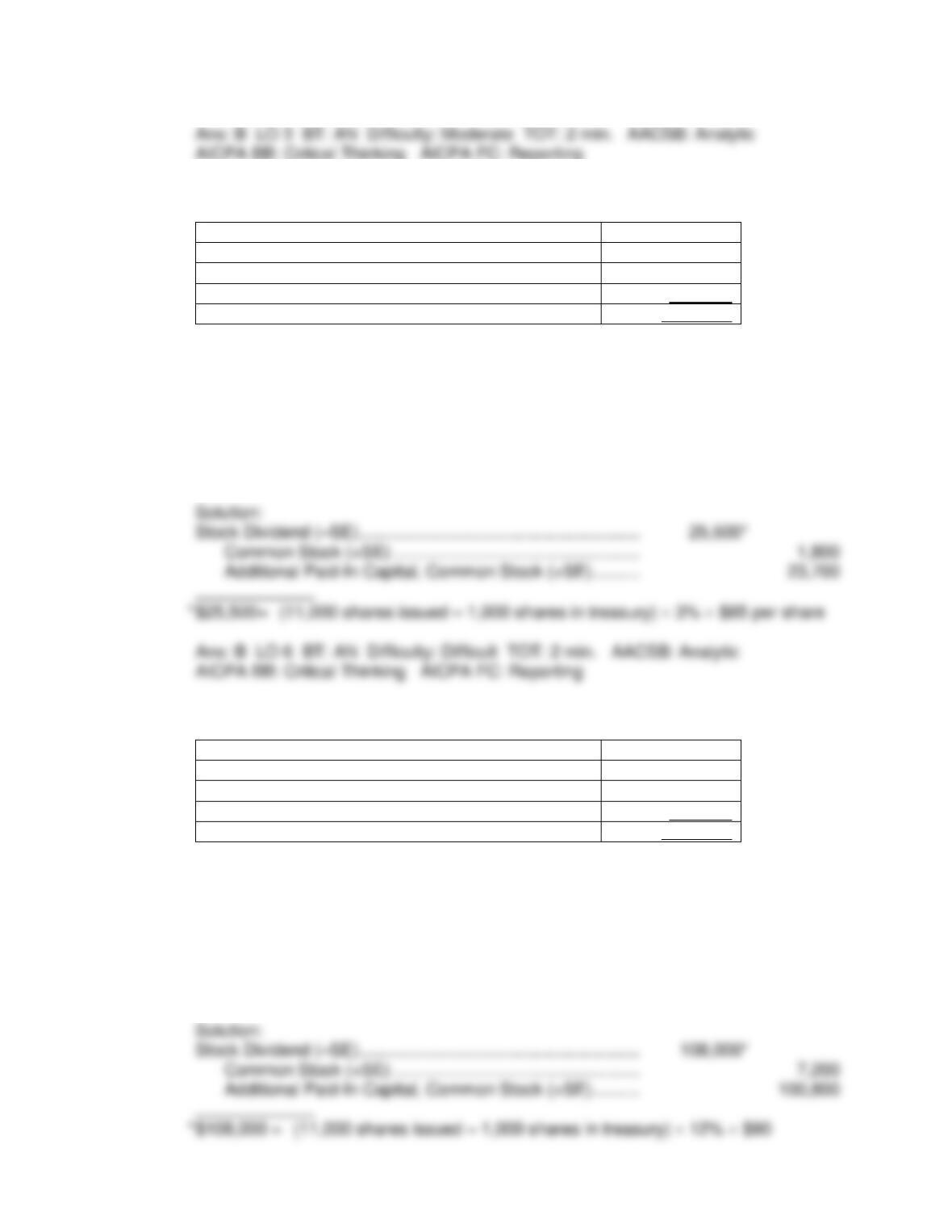
51. The equity section of Manning Company as of December 31, 2017 follows:
Common stock (11,000 shares issued @ $6 par)
$66,000
Additional paid-in capital (Common stock)
100,000
Retained earnings
60,000
Less: Treasury stock (1,000 shares @ $12)
(12,000)
Total shareholders’ equity
$214,000
The company declares and distributes a 3 percent stock dividend on the outstanding
shares. The market price of the stock is $85 per share. The journal entry to record the
stock dividend would include:
a. a debit to Additional Paid-In Capital, Common Stock for $25,500.
b. a credit to Common Stock for $1,800.
c. a credit to Stock Dividend for $25,500.
d. a debit to Additional Paid-In Capital, Common Stock for $23,700.
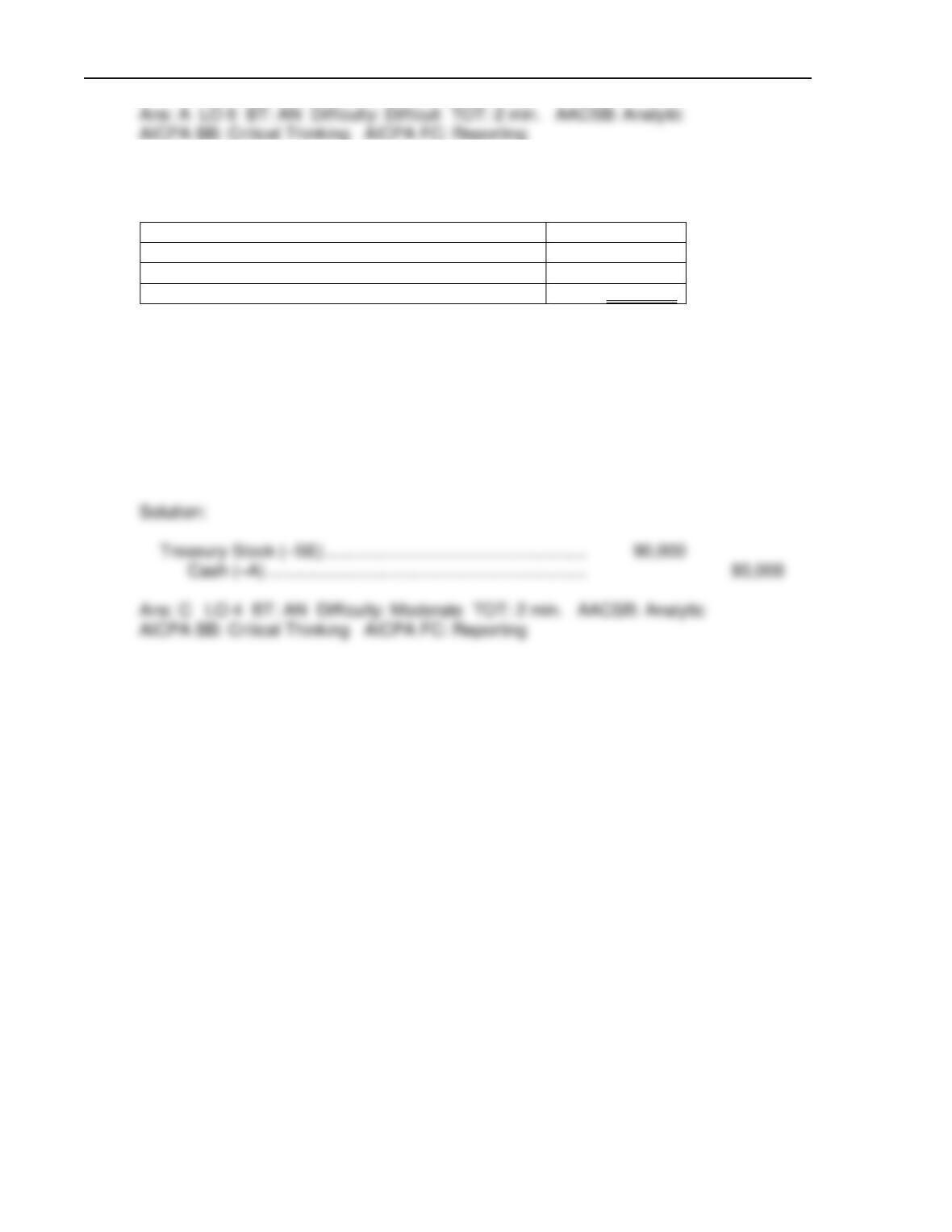
52. The equity section of Manning Company as of December 31, 2017 follows:
Common stock (11,000 shares issued @ $6 par)
$66,000
Additional paid-in capital (Common stock)
100,000
Retained earnings
60,000
Less: Treasury stock (1,000 shares @ $12)
(12,000)
Total shareholders’ equity
$214,000
The company declares a 12 percent stock dividend on the outstanding shares. The
market price of the stock is $90. The journal entry to record the stock dividend would
include:
a. a credit to Additional Paid-In Capital, Common Stock for $100,800.
b. a debit to Common Stock for $7,200.
c. a credit to Stock Dividend for $108,000.
d. a debit to Additional Paid-In Capital, Common Stock for $108,000.
12–14 Test Bank – Chapter 12 – Shareholders’ Equity
53. The shareholders’ equity section of Jason Company as of December 31, 2017 follows:
Common stock
$180,000
Additional paid-in capital (Common stock)
110,000
Retained earnings
160,000
Total shareholders’ equity
$450,000
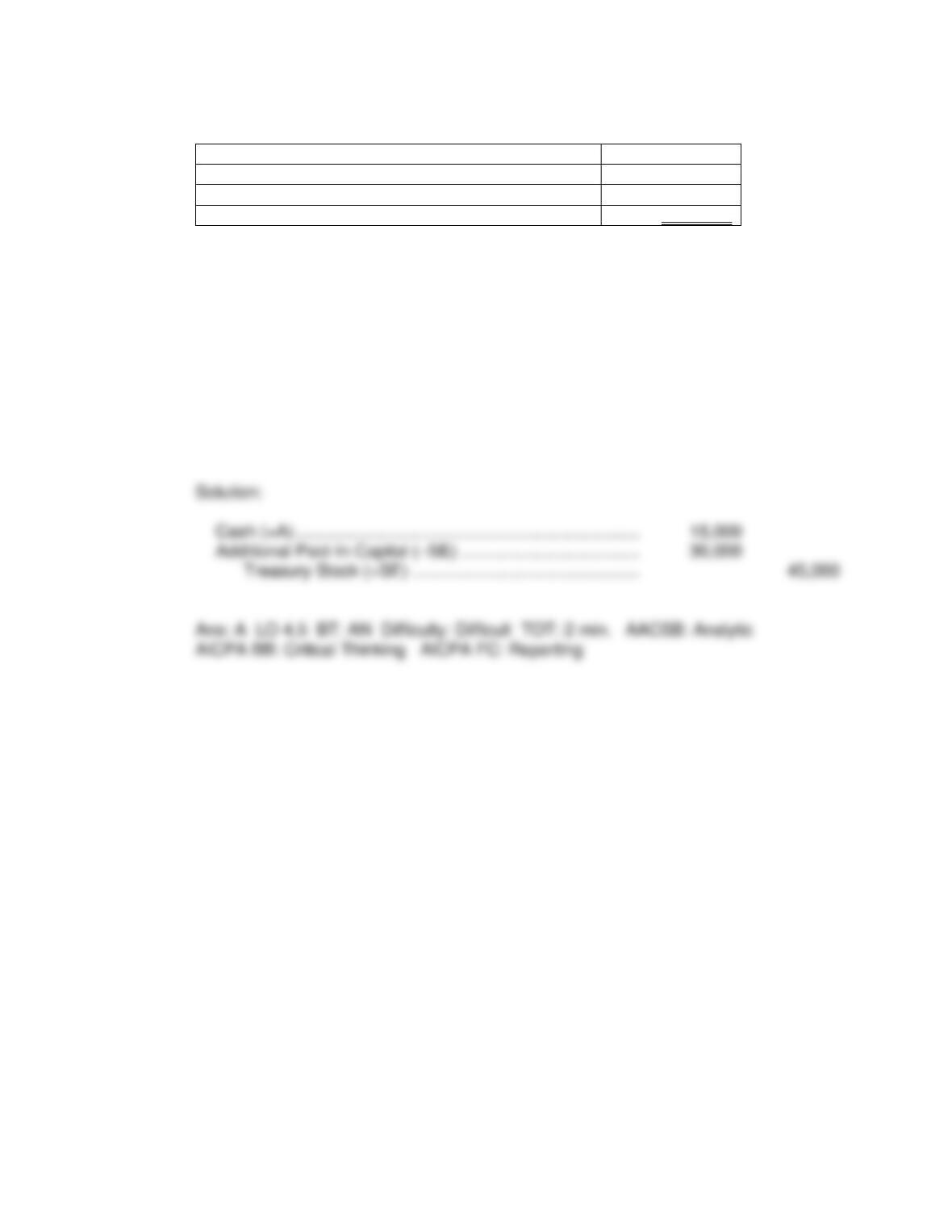
On January 15, the company repurchased 1,500 shares of its own common stock at $60
to hold as treasury stock. Which of the following would be included in the journal entry
recorded on January 15?
a. a credit to Retained Earnings for $90,000.
b. a debit to Cash for $90,000.
c. a debit to Treasury Stock for $90,000.
d. a debit to Common Stock for $90,000.
Test Bank – Chapter 12 – Shareholders’ Equity 12–15
54. The shareholders’ equity section of Jason Company as of December 31, 2017 follows:
Common stock
$180,000
Additional paid-in capital (Common stock)
110,000
Retained earnings
160,000
Total shareholders’ equity
$450,000
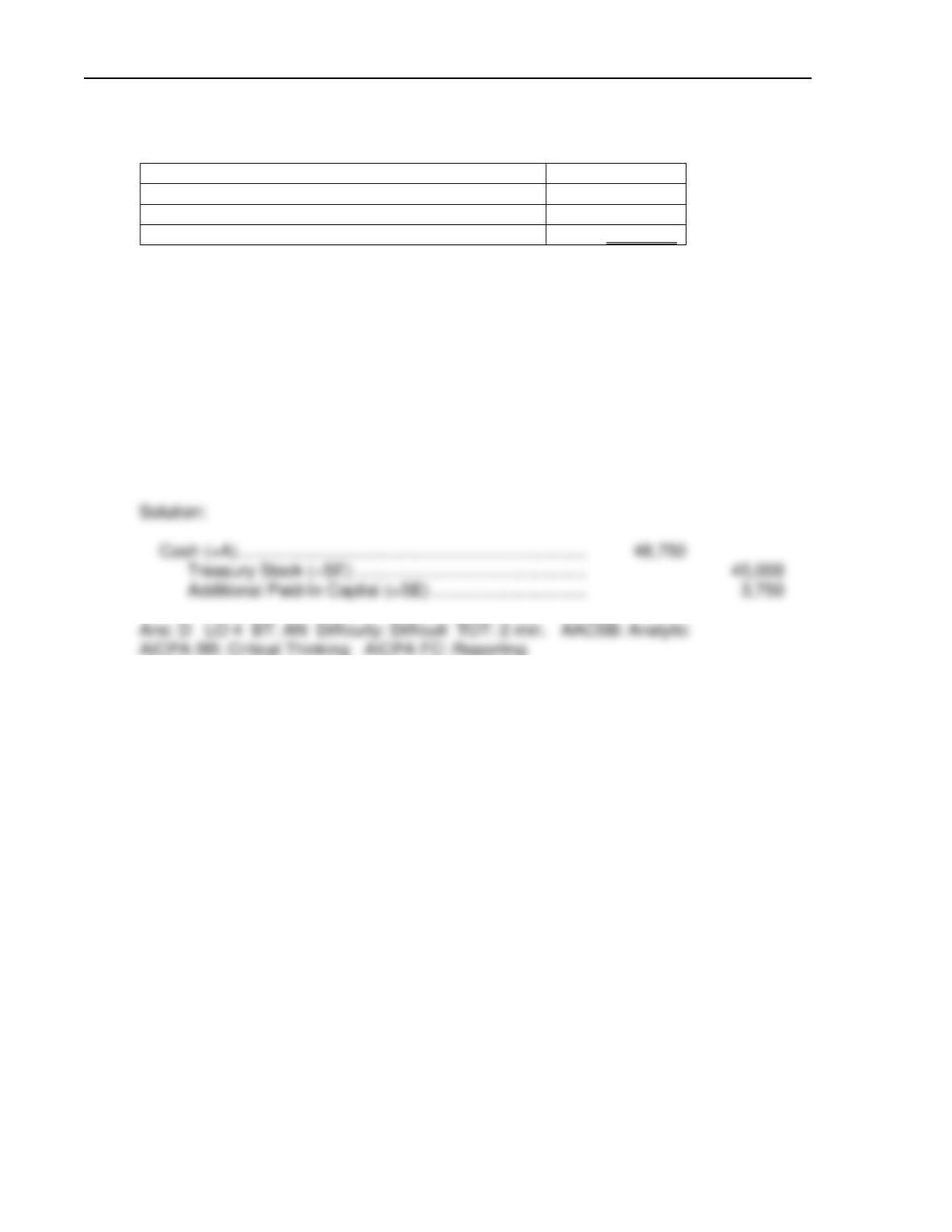
On January 15, the company repurchased 1,500 shares of its own stock at $60 for
treasury stock. On January 16, as part of a compensation package, the company
reissued half of the treasury shares to executives who exercised stock options for $20
per share. On January 28, the company reissued the remainder of the treasury stock on
the open market for $66 per share. Which of the following would be included in the
journal entry recorded on January 16?
a. a debit to Cash for $15,000.
b. a debit to Treasury Stock for $45,000.
c. a credit to Additional Paid-In Capital for $45,000.
d. a credit to Additional Paid-In Capital for $15,000.
12–16 Test Bank – Chapter 12 – Shareholders’ Equity
55. The shareholders’ equity section of the Jason Company as of December 31, 2017 is as
follows:
Common stock
$180,000
Additional paid-in capital (Common stock)
110,000
Retained earnings
160,000
Total shareholders’ equity
$450,000
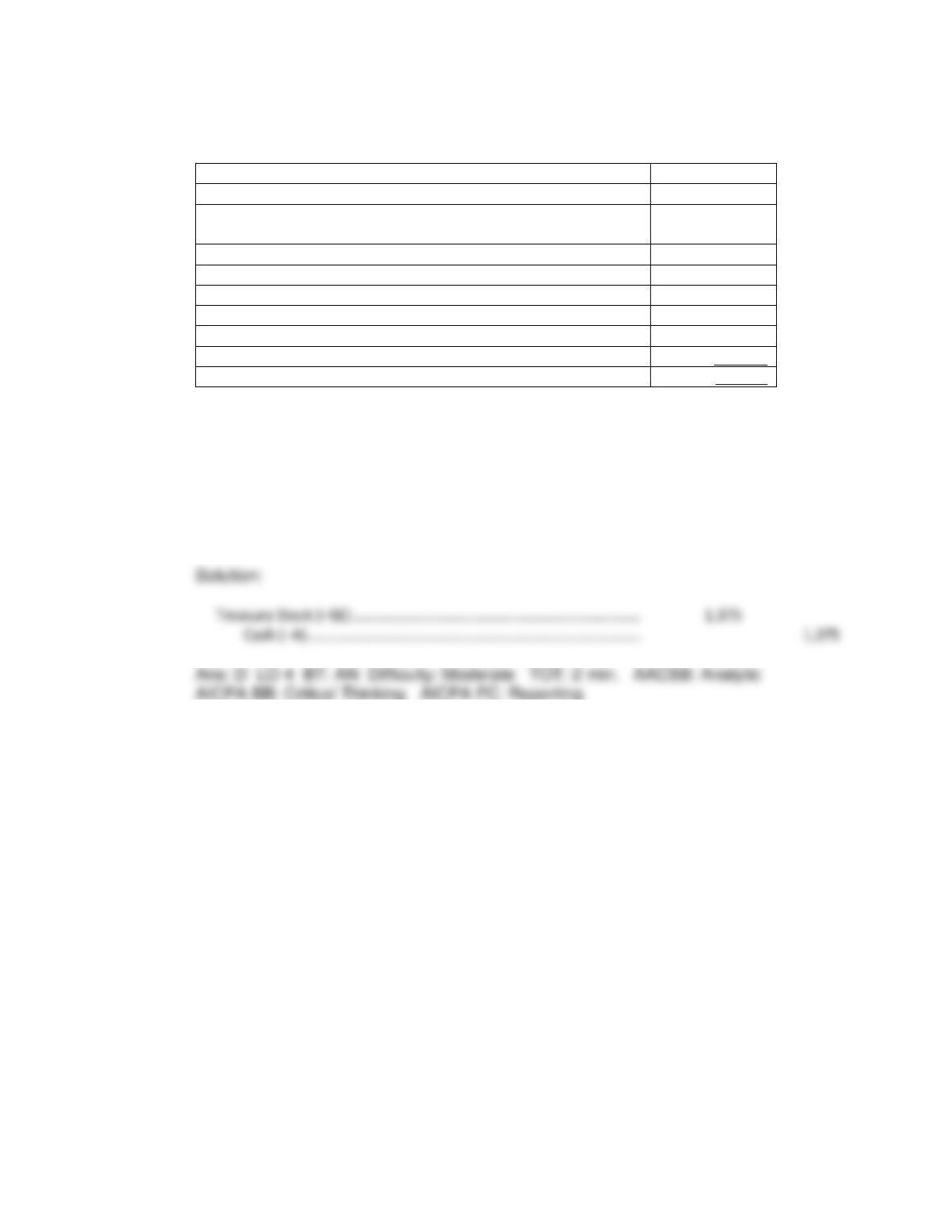
On January 15, the company repurchased 1,500 shares of its own stock at $60 for
treasury stock. On January 16, as part of a compensation package, the company
reissued half of the treasury shares to executives who exercised stock options for $20
per share. On January 28, the company reissued the remainder of the treasury stock on
the open market for $65 per share. Which of the following would be included in the
journal entry recorded on January 28?
a. a credit to Treasury Stock for $48,750.
b. a credit to Additional Paid-In Capital, Treasury Stock for $48,750.
c. a debit to Cash for $45,000.
d. a credit to Additional Paid-In Capital, Treasury Stock for $3,750.
Test Bank – Chapter 12 – Shareholders’ Equity 12–17
56. The shareholders’ equity section of Winters Company contained the following balances
as of December 31, 2017:
Preferred stock (10%, $15 par value, cumulative)
$1,500
Preferred stock (12%, $10 par value , noncumulative)
1,500
Common stock ($1 par value, 5,000 shares authorized,
3,500 issued and 400 held in treasury)
3,500
Additional paid-in capital:
Preferred stock (10%)
1,050
Preferred stock (12%)
1,275
Common stock
2,345
Retained earnings
4,256
Less: Treasury stock
(5,750)
Total shareholders’ equity
$9,676
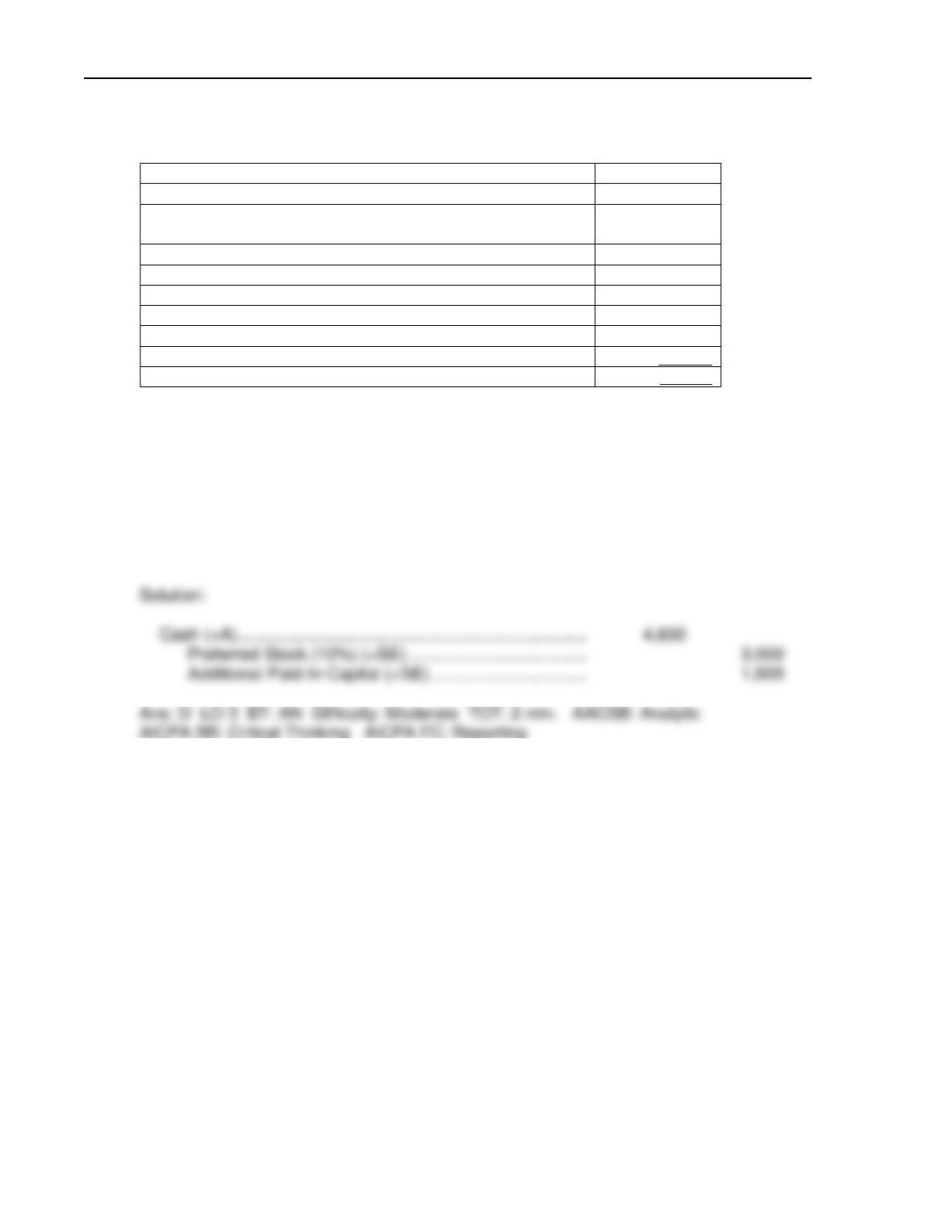
During 2018, Winters entered into the following transaction: On May 13, the company
repurchased 55 shares of its common stock in the open market at $25 per share. Which
of the following would be included in the journal entry for May 13?
a. a debit to Cash for $1,375.
b. a credit to Common Stock for $1,375.
c. a debit to Common Stock for $1,375.
d. a debit to Treasury Stock for $1,375.
12–18 Test Bank – Chapter 12 – Shareholders’ Equity
57. The shareholders’ equity section of Winters Company contained the following balances
as of December 31, 2017:
Preferred stock (10%, $15 par value, cumulative)
$1,500
Preferred stock (12%, $10 par value , noncumulative)
1,500
Common stock ($1 par value, 5,000 shares authorized,
3,500 issued and 400 held in treasury)
3,500
Additional paid-in capital:
Preferred stock (10%)
1,050
Preferred stock (12%)
1,275
Common stock
2,345
Retained earnings
4,256
Less: Treasury stock
(5,750)
Total shareholders’ equity
$9,676
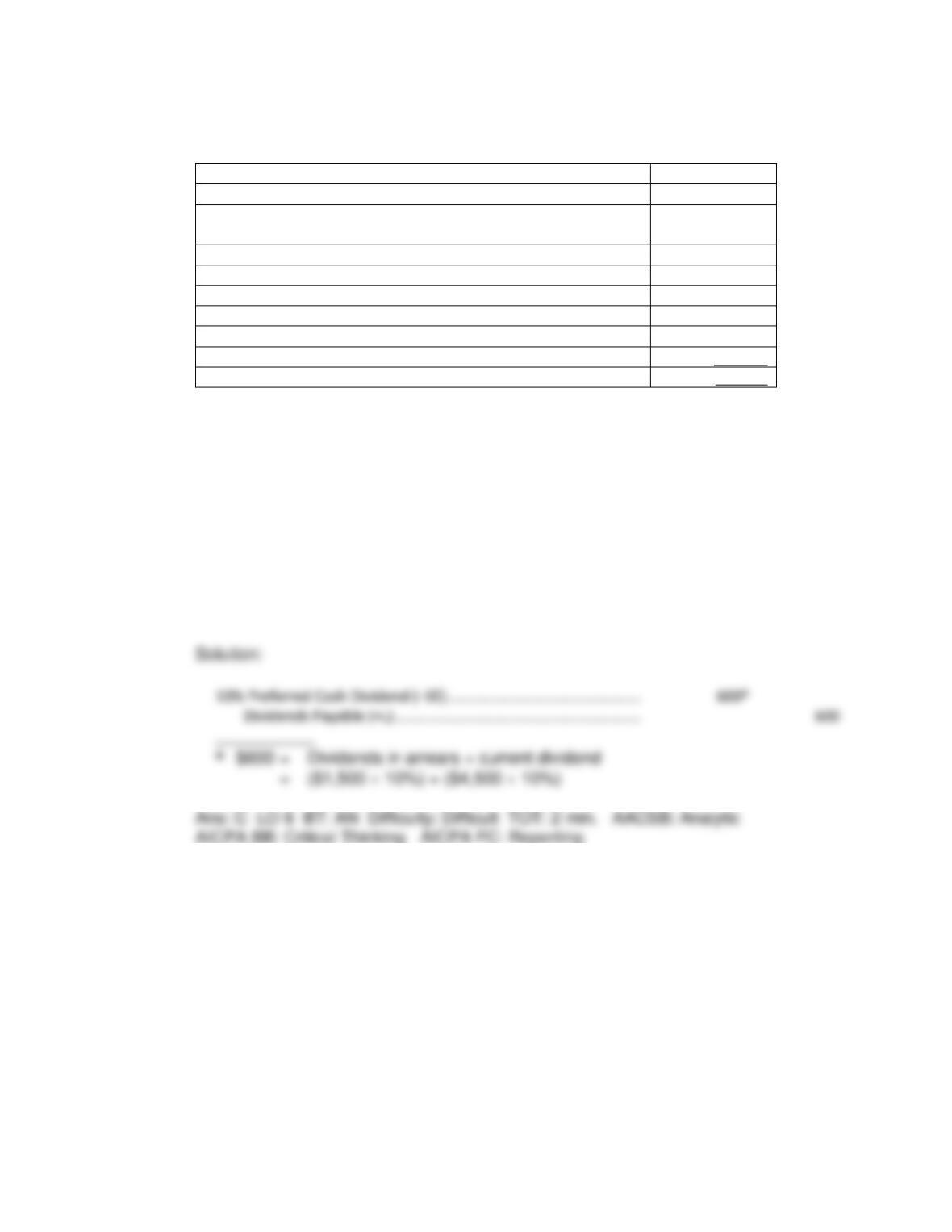
During 2018, Winters entered into the following transaction: On September 26, the
company issued 200 shares of its 10 percent preferred stock at $23 per share. Which of
the following would be included in the September 26 journal entry?
a. a debit to Preferred Stock for $3,000.
b. a credit to Cash for $4,600.
c. a debit to Cash for $3,000.
d. a credit to Additional Paid-In Capital for $1,600.
Test Bank – Chapter 12 – Shareholders’ Equity 12–19
58. The shareholders’ equity section of Winters Company contained the following balances
as of December 31, 2017:
Preferred stock (10%, $15 par value, cumulative)
$1,500
Preferred stock (12%, $10 par value , noncumulative)
1,500
Common stock ($1 par value, 5,000 shares authorized,
3,500 issued and 400 held in treasury)
3,500
Additional paid-in capital:
Preferred stock (10%)
1,050
Preferred stock (12%)
1,275
Common stock
2,345
Retained earnings
4,256
Less: Treasury stock
(5,750)
Total shareholders’ equity
$9,676
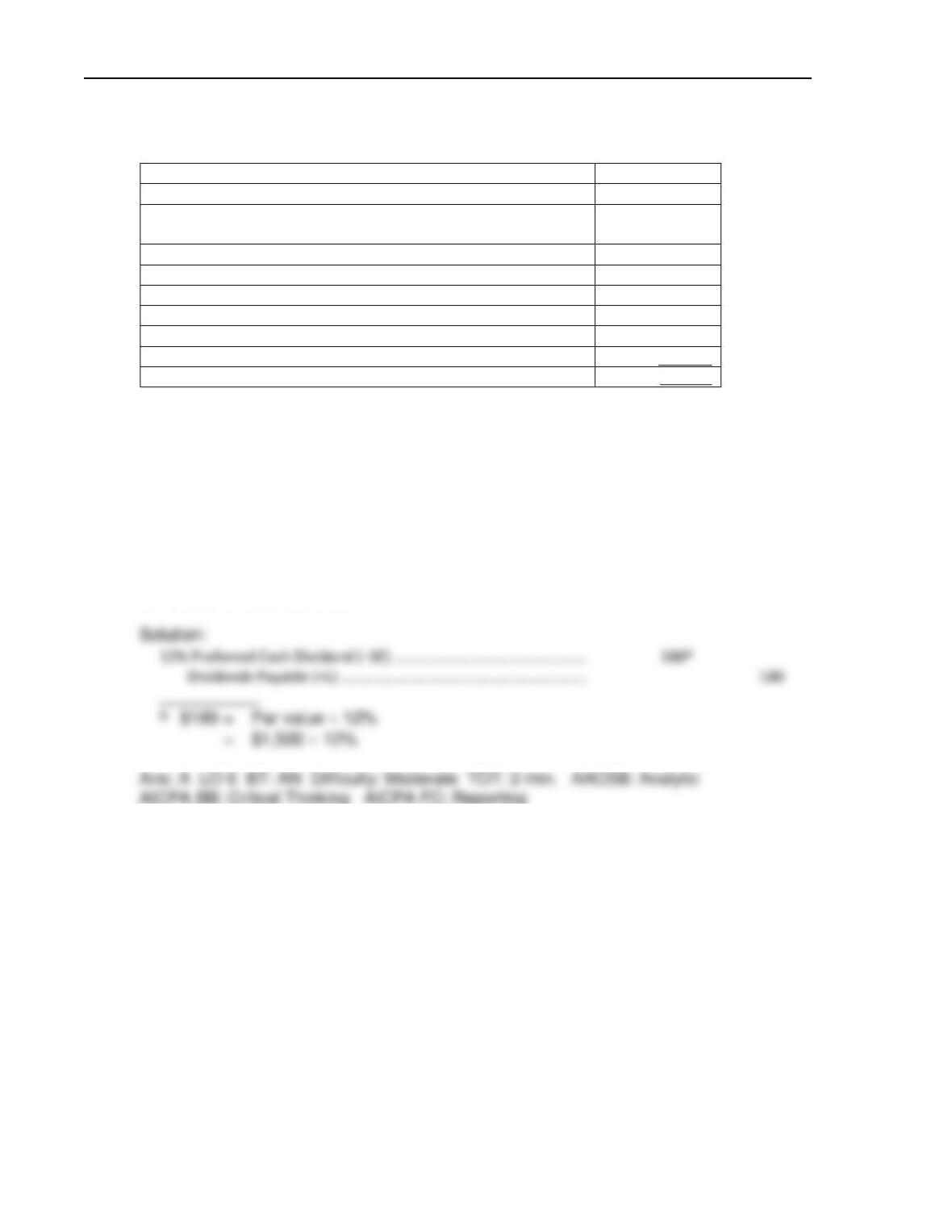
On September 26, 2018, Winters issued 200 shares of its 10 percent preferred stock at
$23 per share. On December 2, the company declared a cash dividend of $1,050,
which was paid on December 27. Winters did not declare or pay any dividends during
2017. If Winters uses a separate dividend account for each type of stock, which of the
following would be included in the journal entry to record the declaration of the 10%
preferred stock dividend?
a. a credit to 10% Preferred Cash Dividend for $600.
b. a debit to Dividend Expense for $600.
c. a credit to Dividends Payable for $600.
d. a debit to Cash for $600.
12–20 Test Bank – Chapter 12 – Shareholders’ Equity
59. The shareholders’ equity section of Winters Company contained the following balances
as of December 31, 2017:
Preferred stock (10%, $15 par value, cumulative)
$1,500
Preferred stock (12%, $10 par value , noncumulative)
1,500
Common stock ($1 par value, 5,000 shares authorized,
3,500 issued and 400 held in treasury)
3,500
Additional paid-in capital:
Preferred stock (10%)
1,050
Preferred stock (12%)
1,275
Common stock
2,345
Retained earnings
4,256
Less: Treasury stock
(5,750)
Total shareholders’ equity
$9,676
During 2018, Winters entered into the following transaction: On December 2, the
company declared a cash dividend of $1,050, which was paid on December 27. Winters
did not declare or pay any dividends during 2017. If Winters uses a separate dividend
account for each type of stock, which of the following would be included in the journal
entry to record the declaration of the 12% Preferred stock dividend?
a. a debit to 12% Preferred Cash Dividend for $180.
b. a debit to Dividend Expense for $180.
c. a debit to Dividends Payable for $180.
d. a debit to Cash for $180.