Exam
Name___________________________________
MULTIPLE CHOICE. Choose the one alternative that best completes the statement or answers the question.
1)
The procedure used for the AC Norton equivalent circuit is the same as used for
1)
A)
AC circuits to determine the Thevenin equivalent circuit.
B)
DC circuits to determine the Norton equivalent circuit except phasors and impedances are
used.
C)
DC circuits to determine the Norton equivalent circuit and only the resistors are used.
D)
DC circuits to determine the Thevenin equivalent circuit except phasors and impedances are
used.
2)
The Thevenin resistance is found by
2)
A)
deactivating all sources in the original circuit with RL still removed and determining the total
resistance between the terminals.
B)
activating all sources in the original circuit with RL still removed and determining the total
resistance between the terminals.
C)
activating all sources in the original circuit with RL attached and determining the voltage
across and current through the load resistance.
D)
deactivating all sources in the original circuit with RL still attached, and determining the total
resistance between the terminals.
3)
When determining the DC Thevenin equivalent circuit, the load
3)
A)
is removed from the original circuit and the polarity is important.
B)
is removed from the original circuit and the polarity is irrelevant.
C)
must remain attached to the original circuit and the polarity is important.
D)
is removed from the original circuit and replaced with ashort circuit.
1
4)
When determining the DC Norton circuit current source you must
4)
A)
disregard the direction of the short circuit current but you need to determine the magnitude of
the short circuit current between the terminals. This is IN.
B)
labelthe direction of the short circuit (Norton) current between the terminals and determine
the open circuit voltage across the terminals. That voltage divided by the load resistance is IN.
C)
labelthe direction of the short circuit (Norton) current between the terminals and determine
the open circuit current (including direction) between the terminals. This is IN.
D)
labelthe direction of the short circuit current and determine the short circuit current
(including direction) between the terminals. This is IN.
5)
Once the Thevenin equivalent circuit has been determined, build the Thevenin equivalent circuit
and
5)
A)
reattach the load and short the terminals, then analyze the simplified circuit for the load
voltage and current.
B)
reattach the load and short the Thevenin source, then analyze the simplified circuit for the load
voltage and current.
C)
reattach the load to the original terminals, and analyze the simplified circuit for the load
voltage and current.
D)
short the terminals, attach the load in parallel with the Thevenin resistance and analyze the
simplified circuit for the load voltage and current.
C
6)
ADC Thevenin equivalent circuit includes
6)
A)
a voltage source in series with aresistance.
B)
a voltage source in parallel with aresistance.
C)
acurrent source in series with aresistance.
D)
acurrent source in parallel with aresistance.
A
2
D
7)
The Thevenin equivalent circuit for an AC circuit consists of
7)
A)
aphasor voltage source in series with an impedance.
B)
aphasor current source in parallel with an impedance.
C)
aphasor current source in series with an impedance.
D)
aphasor voltage source in parallel with an impedance.
8)
When determining the DC Norton equivalent resistance you must
8)
A)
deactivate all sources in the original circuit and with RLstill removed and the short removed,
determine the total resistance between the terminals. This is RN.
B)
deactivate all sources in the original circuit and with RLstill removed and the short in–place,
determine the total resistance between the terminals. This is RN.
C)
deactivate all sources in the original circuit and with RLreturned to the circuit, determine the
total resistance between the terminals. This is RN.
D)
keep all sources in the original circuit active and with RLstill removed and the short removed,
determine the total resistance between the terminals. This is RN.
A
9)
The Norton equivalent DC circuit consists of
9)
A)
a voltage source in parallel with aresistance.
B)
a voltage source in series with aresistance.
C)
acurrent source in parallel with aresistance.
D)
acurrent source in series with aresistance.
C
10)
Maximum power transfer from the source to the load in an AC circuit occurs when the load
impedance equals the
10)
A)
real part of the Thevenin (or Norton) impedance.
B)
Thevenin (or Norton) impedance.
C)
complex conjugate of the Thevenin (or Norton) impedance.
D)
complex part of the Thevenin (or Norton) impedance.
C
3
A
11)
The AC Norton equivalent circuit consists of
11)
A)
aphasor voltage source in parallel with an impedance.
B)
aphasor current source in series with an impedance.
C)
aphasor voltage source in series with an impedance.
D)
aphasor current source in parallel with an impedance.
12)
Maximum power transfer from the source to the load in an AC circuit, when the load is apure
resistance, occurs when the load resistance equals the
12)
A)
magnitude of the imaginary part of the Thevenin (or Norton) impedance.
B)
magnitude of the real part of the Thevenin (or Norton) impedance.
C)
magnitude of the Thevenin (or Norton) impedance.
D)
sum of the real and imaginary parts of the Thevenin (or Norton) impedance.
13)
Once you have determined the Norton equivalent circuit you can analyze the simplified circuit for
the load voltage and current by building the Norton equivalent circuit and
13)
A)
reattaching the load in series with the Norton resistance and analyzing the simplified circuit
for the load voltage and current.
B)
reattaching the load and shorting the Norton source, then analyzing the simplified circuit for
the load voltage and current.
C)
reattaching the load to the original terminals, and analyzing the simplified circuit for the load
voltage and current.
D)
reattaching the load and shorting the terminals, then analyzing the simplified circuit for the
load voltage and current.
14)
An equivalent circuit is needed because an equivalent circuit
14)
A)
is asimplified representation of the original circuit.
B)
is useful when the voltage and/or current is desired when the load is being changed.
C)
results in the same voltage and current performance for aload as the original circuit.
D)
All of the above
4
15)
When determining the DC Norton circuit current source you must
15)
A)
determine the load in the original circuit, remove the load from the original circuit, keep an
open between the terminals.
B)
determine the load in the original circuit but keep the load attached.
C)
determine the load in the original circuit, remove the load from the original circuit, replace the
load with aknown resistance.
D)
determine the load in the original circuit, remove the load from the original circuit, place a
short between the terminals.
16)
When determining the DC Thevenin equivalent circuit, VThis the
16)
A)
open circuit voltage between the terminals.
B)
open circuit voltage divided by the load resistance.
C)
product of the short circuit current and the load resistance.
D)
load voltage when aload is connected across the terminals to which the original load was
attached.
17)
Maximum power transfer from the source to the load in aDC circuit occurs when the load resistance
17)
A)
is an open.
B)
is twice the value of the Thevenin (Norton) resistance.
C)
equals the Thevenin (Norton) resistance.
D)
is zero, i.e., ashort.
5
SHORT ANSWER. Write the word or phrase that best completes each statement or answers the question.
18)
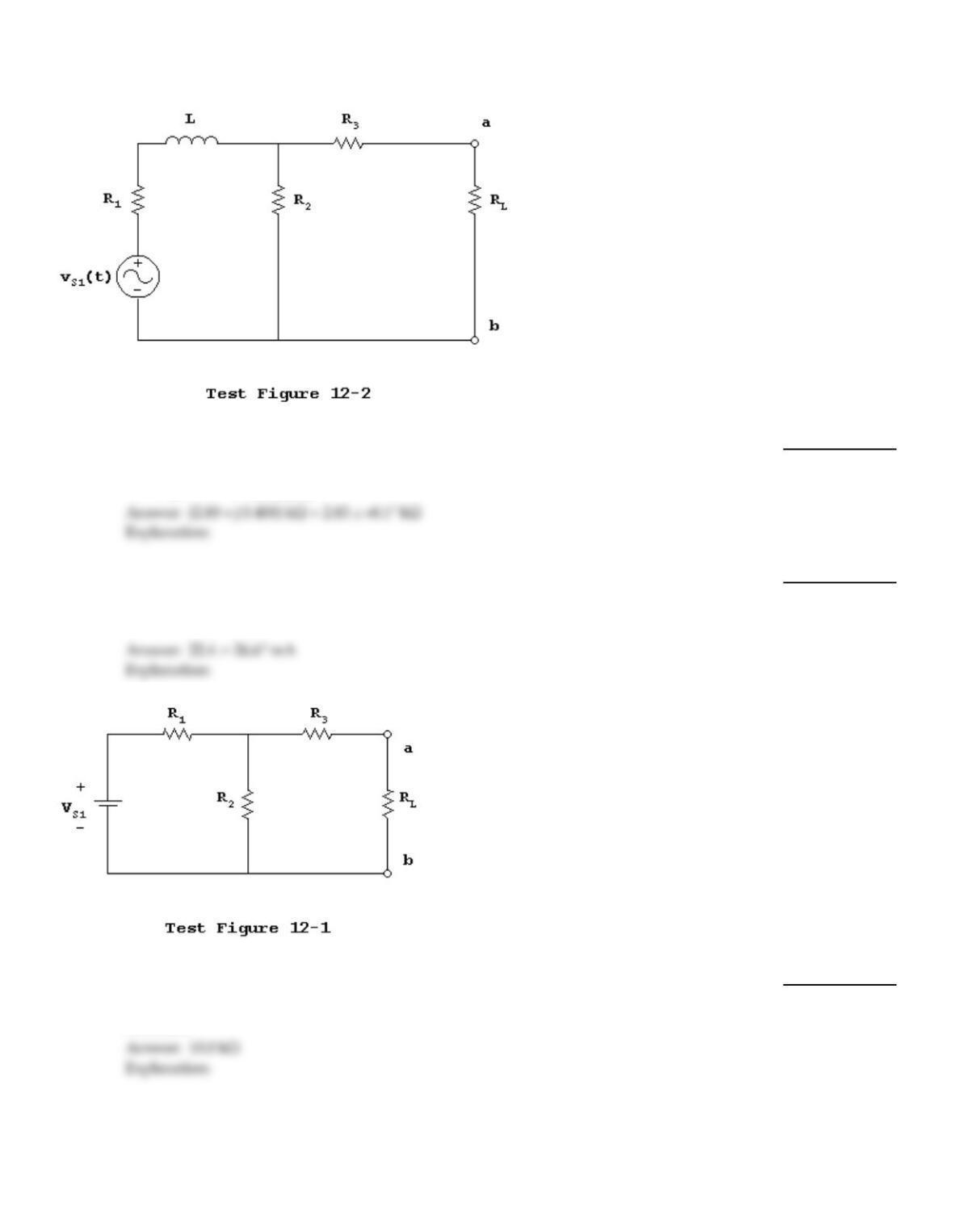
Assume that vS1(t) = 141.4sin(1000t), R1 = 1.0 k, R2 = 2.0 k, R3 = 2.0 k, XL = 1.0 k
and RL = 5.0 k.The Thevenin impedance seen by the load resistor, RL,in the circuit in
Test Figure 12–2is ________.
18)
19)
Assume that vS1(t) = 141.4sin(1000t), R1 = 1.0 k, R2 = 2.0 k, R3 = 2.0 k, XL = 1.0 k
and RL = 5.0 k.The RMS Norton current for the circuit in Test Figure 12–2as seen by the
load resistor, RL,is ________.
19)
20)
Assume VS = 100VDC, R1 = 10.0 k, R2 = 10.0 k, R3 = 5.0 k,and RL = 7.5 k.The
Thevenin resistance seen by the load resistor, RL,in the circuit in Test Figure 12–1is
________.
20)
6
21)
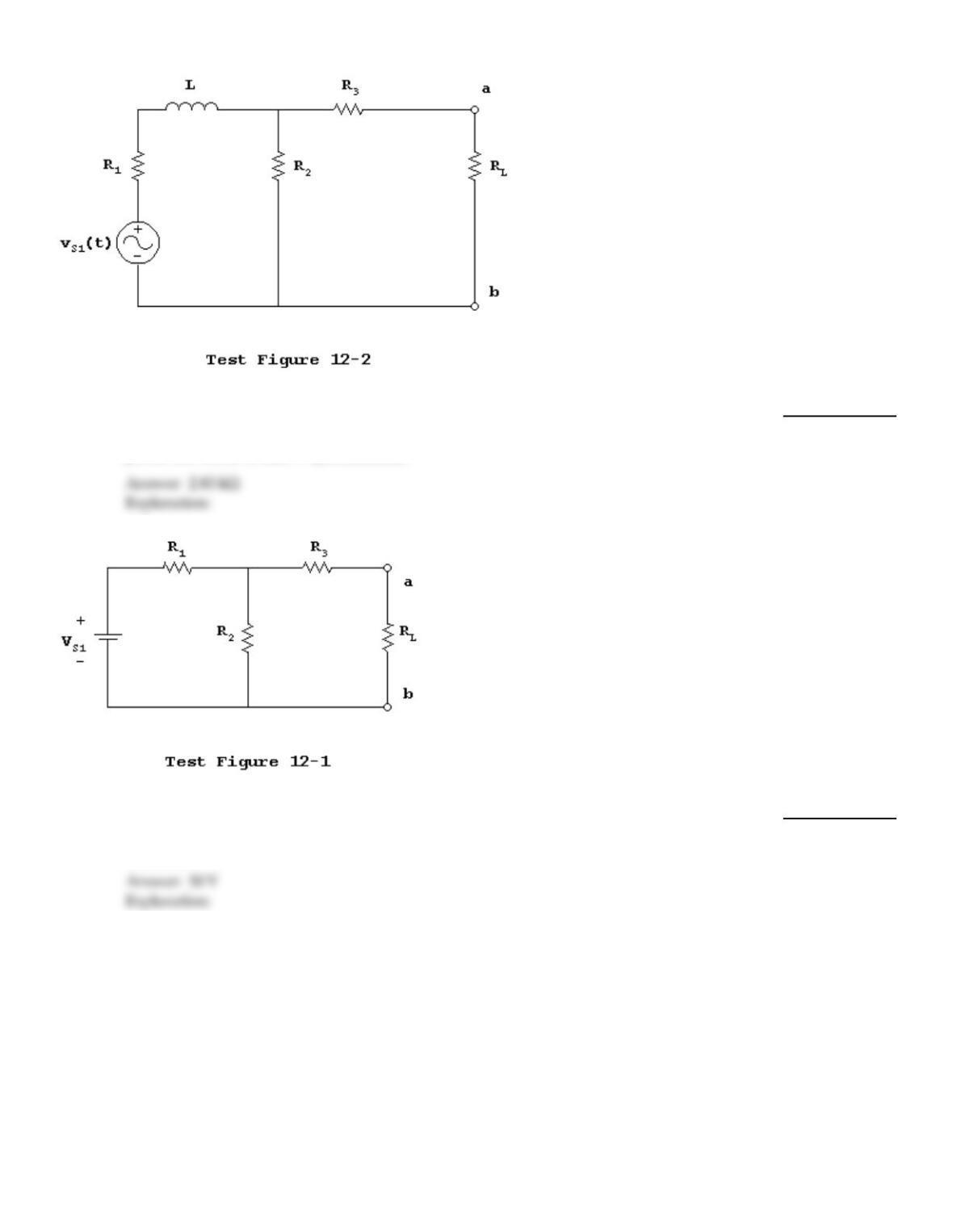
Assume that vS1(t) = 141.4sin(1000t), R1 = 1.0 k, R2 = 2.0 k, R3 = 2.0 k, XL = 1.0 k
and RL = 5.0 k.For the circuit in Test Figure 12–2, the source will deliver maximum
power to aresistive load if RLis ________.
21)
22)
Assume VS = 100VDC, R1 = 10.0 k, R2 = 10.0 k, R3 = 5.0 k,and RL = 7.5 k.The
Thevenin voltage for the circuit in Test Figure 12–1as seen by the load resistor, RL,is:
________.
22)
7
23)
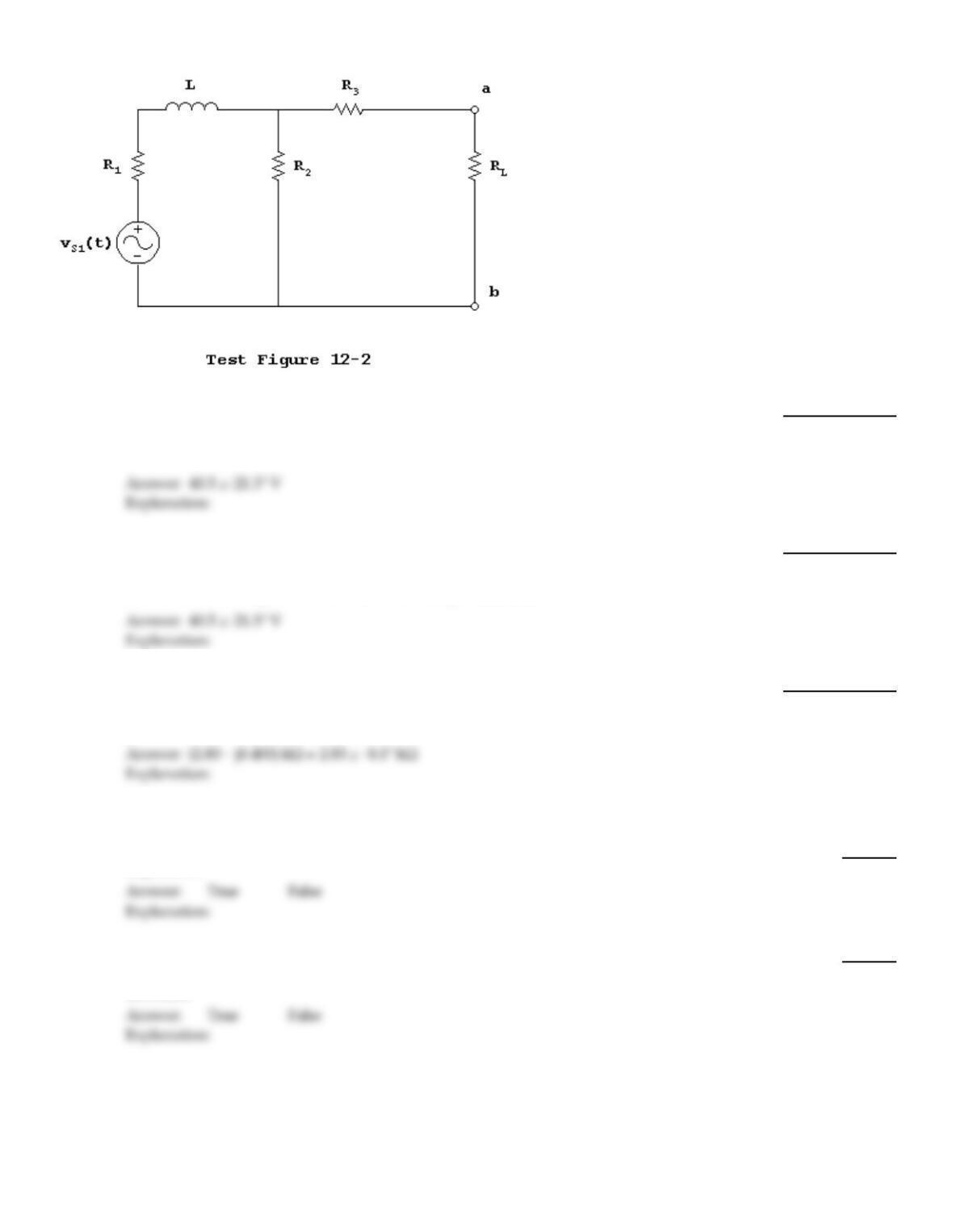
Assume that vS1(t) = 141.4sin(1000t), R1 = 1.0 k, R2 = 2.0 k, R3 = 2.0 k, XL = 1.0 k
and RL = 5.0 k.Based on the Norton equivalent circuit for the circuit in Test Figure 12–2,
the RMS voltage across the load resistor, RL,is ________.
23)
24)
Assume that vS1(t) = 141.4sin(1000t), R1 = 1.0 k, R2 = 2.0 k, R3 = 2.0 k, XL = 1.0 k
and RL = 5.0 k.Based on the Thevenin equivalent circuit for the circuit in Test Figure
12–2, the RMS voltage across the load resistor, RL,is ________.
24)
25)
Assume that vS1(t) = 141.4sin(1000t), R1 = 1.0 k, R2 = 2.0 k, R3 = 2.0 k, XL = 1.0 k
and RL = 5.0 k.For the circuit in Test Figure 12–2, the source will deliver maximum
power to aload impedance of ________.
25)
TRUE/FALSE. Write ‘T’ if the statement is true and ‘F’ if the statement is false.
26)
The Norton equivalent AC circuit consists of aphasor AC current source in series with an
impedance.
26)
27)
When you are determining the DC Norton equivalent current source and you have replaced the
load with ashort, you must label the direction of the short circuit (Norton) current between the
terminals.
27)
8

28)
Maximum power transfer from an AC source to aresistive load occurs when the value of the
resistive load equals the magnitude of the Thevenin (or Norton) equivalent circuit impedance.
28)
29)
When you have determined the DC Thevenin equivalent circuit, you can analyze the simplified
circuit for the load voltage and current.
29)
30)
The Norton equivalent DC circuit consists of aDC current source in parallel with aresistance.
30)
31)
Maximum power transfer from an AC source to the load occurs when the load impedance is equal to
the Thevenin (or Norton) equivalent circuit impedance.
31)
32)
An equivalent circuit is asimplified representation of the original circuit but may not result in the
same voltage and current performance for aload as the original circuit.
32)
33)
Adifferent procedure than that used for DC circuits is used to determine the Thevenin equivalent
AC circuit because phasors and impedances are used.
33)
34)
Once the Norton equivalent circuit has been determined, you can attach aload and analyze the
simplified circuit for the load voltage and current.
34)
35)
The Thevenin equivalent for an AC circuit consists of aphasor voltage source in series with an
impedance.
35)
36)
To determine the DC Thevenin equivalent circuit you must first label the terminals at each end of
the load and remove the load from the original circuit.
36)
37)
Apractical voltage source appears to be the same as the Thevenin equivalent circuit.
37)
9

38)
When determining the DC Thevenin equivalent circuit, after you have removed the load, the
polarity of the open circuit terminals is not important.
38)
39)
When determining the DC Thevenin equivalent circuit, after you have determined the open circuit
voltage between the terminals, you must deactivate all sources in the original circuit with RLstill
removed and determine the total resistance between the terminals. This is RTh.
39)
40)
The same procedure as used for DC circuits is used to determine the Norton equivalent circuit
except phasors and impedances are used.
40)
41)
When you determine the DC Norton equivalent resistance, you must determine the load in the
original circuit, label the terminals at each end of the load, remove the load from the original circuit,
and make sure that there is ashort between the terminals.
41)
42)
An equivalent circuit is useful when the voltage and/or current is desired and you want to vary the
value of the load.
42)
43)
Maximum power transfer from the source to aresistive load occurs when the load resistance is
equal to the Thevenin equivalent circuit resistance.
43)
44)
The Thevenin equivalent circuit for aDC circuit consists of aDC voltage source in parallel with a
resistance.
44)
45)
Apractical current source is not the same as the Norton equivalent circuit.
45)
46)
The Norton resistance is determined in the same way as the Thevenin resistance.
46)
10
Answer Key
Testname: C12
11