1
Environment: Science Behind the Stories, 2e Cdn. Ed. (Withgott)
Chapter 12 Freshwater Systems and Water Resources
12.1 Graph and Figure Interpretation Questions
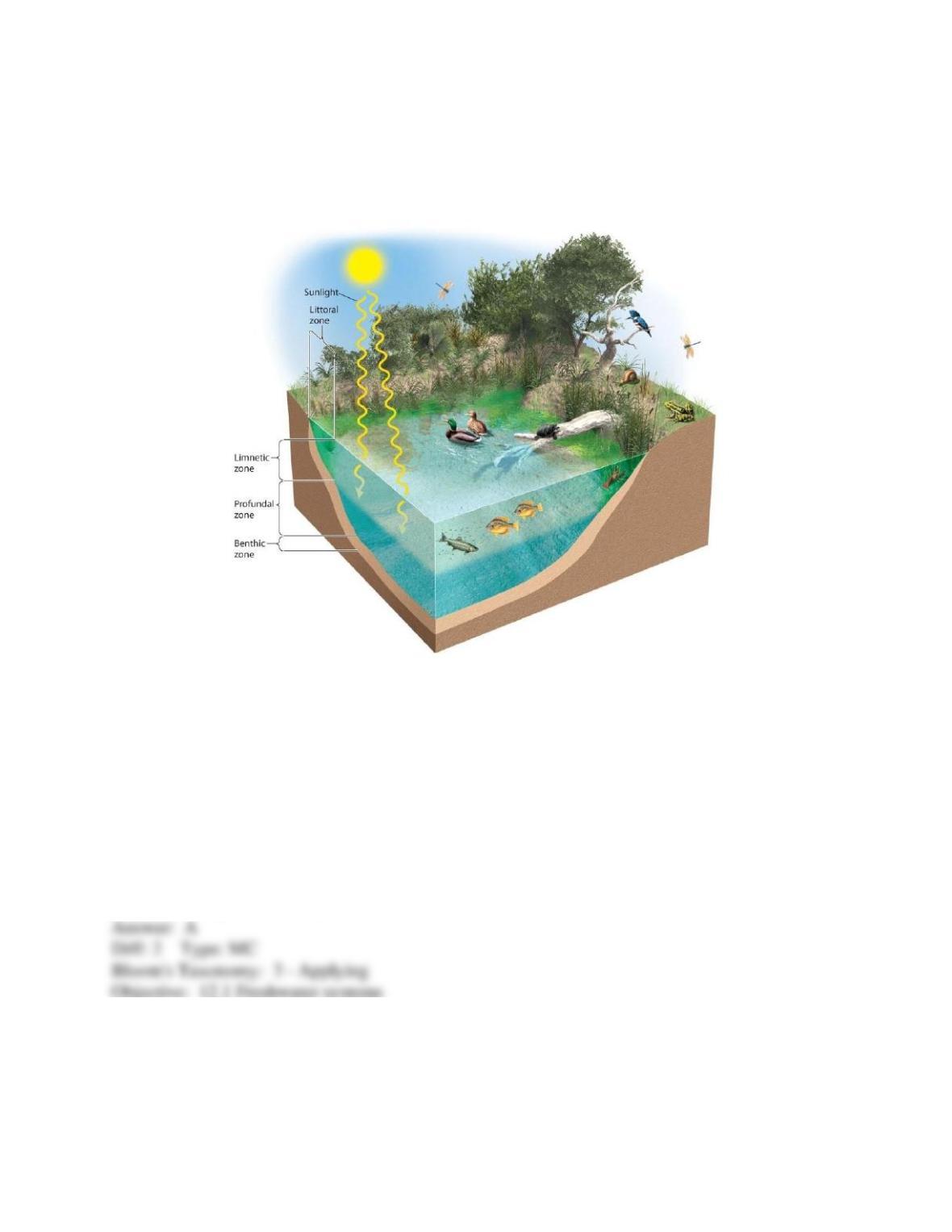
Figure 12.1
Use Figure 12.1 to answer the following questions.
1) Refer to Figure 12.1. The mallard ducks in the figure eat floating plants such as duckweed,
seeds of shoreline plants, and very small organisms at or near the surface. They would be most
affected by any change to the ________.
A) littoral or limnetic zones
B) limnetic or benthic zones
C) littoral or benthic zones
D) littoral or profundal zones
E) limnetic or profundal zones
2) Refer to Figure 12.1. Frog eggs are usually attached to vegetation or rocks near the surface of
a pond. Tadpoles can use essentially all areas of a shallow pond, or the top metre or so of a
deeper pond or lake. Adult frogs can live on land or in the water. A frog’s life would be least
likely to be disrupted by a change in the ________.
A) profundal zone
B) limnetic zone

C) benthic zone
D) littoral zone
E) abyssal zone
3) Refer to Figure 12.1. Rooted freshwater plants cannot live below the ________.
A) zone of demarcation
B) benthic zone
C) profundal zone
D) littoral zone
E) limnetic zone
12.2 Matching Questions
Match the following.
A) soft water
B) hard water
C) Ogallala aquifer
D) unconfined and confined aquifer
E) oligotrophic
F) zone of aeration and saturation
G) eutrophic
H) aquifers
J) Okefenokee aquifer
K) artesian reservoirs
I) high turbidity
1) Porous, sponge-like layers of rock, sand, or gravel that are capable of holding water
2) The world’s largest aquifer
3) Separated by the boundary of a water table
4) Rain water from the point of view of its dissolved mineral concentration
5) Water carrying a lot of suspended matter
6) Lakes that provide good conditions for fast swimming fish such as trout
Diff: 3 Type: MA
Bloom’s Taxonomy: 4 – Analyzing
Objective: 12.1 Freshwater systems
1) How has the quantity of water that reaches the Gulf of California from the Colorado River
changed in the last hundred years?
2) Ignoring human alterations to the landscape, what causes floods, and what is their value
ecologically?
3) What are the goals of dam removal?
4) Describe two ways that salt can be removed from seawater.
5) Why is too much plant growth, as a result of eutrophication, a problem in a freshwater
system?
6) What was the Colorado River dispute with Mexico the result of?
7) Overpumping of groundwater in coastal areas can cause ________ into aquifers, making the
water undrinkable.
8) The best-known technological approach to increasing water supply by generating freshwater is
________, the removal of salt from seawater.
9) One way to conserve water is by ________, replacing lawns and water-loving plants with
drought-tolerant species adapted to arid environments.
10) Several states in the United States and Mexico remove water from the Colorado River for a
variety of purposes. (See page 352 for more on the Colorado River problem.) How is this a case
of “tragedy of the commons”?

12.4 Multiple-Choice Questions
1) Only about 2.5% of all the water on our planet is freshwater. However, ________.
A) most of this is in large, freshwater lakes
B) most of this is far from where humans live
C) most of this is in underground aquifers
D) over half of this is extremely hard water and is nearly unusable for drinking or agriculture
E) over half of this is in wetlands near coastlines and is becoming contaminated with salt water
2) Wetlands are ________.
A) where zone of saturation reaches the surface
B) where zone of aeration reaches the surface
C) confined aquifers
D) artesian aquifers
E) profundal aquifers
3) Precipitation that falls on Earth’s surface ________.
A) is usually already unusable because of acid rain
B) mostly runs off into salt marshes or the ocean
C) almost entirely filters down into the underground aquifers
D) may take a variety of pathways through surface water or groundwater flow
E) is mostly taken up by plants or other organisms
4) One-fifth of Earth’s total freshwater supply is in ________.
A) ponds
B) the ocean
C) groundwater
D) estuaries
E) the tundra

7
5) An artesian aquifer occurs when ________.
A) there are several aquifers that have merged
B) granite is overlain by a sandy substrate, allowing percolation into the aquifer
C) a water–bearing layer is trapped between two layers that are less permeable
D) a well is dug through layers of sand and gravel into the water table
E) a water–bearing porous layer of rock, sand, or gravel has accumulated groundwater over a
long period of time
6) Globally, humans use freshwater primarily for ________.
A) drinking and cooking
B) washing and home use
C) agricultural irrigation
D) mining and industrial processes
E) electrical production
7) Which of the following best describes floodplains?
A) a region of land that is periodically flooded when a river overflows
B) an area that is periodically flooded because humans have altered the landscape
C) an area that is incidentally flooded when farming or mining operations change the course of
rivers
D) an area where flood irrigation of crops is used, such as a rice paddy
E) a region of land that has been deliberately, permanently flooded because of a human
disturbance, such as dam building
8) We build dams to ________.
A) drain wetlands for urban development
B) generate electricity, prevent flooding, and provide irrigation
C) control the spread of waterborne diseases
D) transform watersheds into farms, towns, and recreational areas
E) improve habitat for native fish
9) Dam removal in Canada ________.

8
A) is controversial because dams provide such good habitats for native species
B) will probably continue because there is increased awareness that not all dams are good for the
environment
C) will assist with our transition to more natural forms of renewable energy
D) provides many new jobs and opportunities and so is economically beneficial
E) will probably increase rapidly as we move to a more fossil-fuel-dependent society
10) Data indicate that the present rate of freshwater consumption in most developed countries is
________.
A) sustainable for the foreseeable future
B) unsustainable
C) irrelevant, as water is not currently limiting
D) only a problem in areas not on the coast
E) increasing groundwater storage and decreasing surface water storage
11) Why was the irrigation of Soviet cotton farming operations a problem?
A) There was governmental opposition that limited water access, killing crops.
B) Irrigation water came from rivers feeding into one of the largest lakes on Earth and resulted in
major contamination of that source.
C) It drained the Aral Sea and increased the salt content of soils.
D) It angered local resort communities, which did not want farming in the region.
E) It was, for the most part, not a problem.
12) Sinkholes result from ________.
A) overconsumption of water from aquifers weakening the substrate
B) building on floodplains
C) flood damage and chemical erosion
D) poorly drilled wells in soft soils
E) substrates that become weak following rain
13) Which of the following will contribute to water conservation?
A) using aerial sprays for crop irrigation

B) planting non-native wetland plants for landscaping
C) washing dishes by hand
D) watering lawns at night, using low-flow faucets, landscaping with native plants
E) watering lawns during peak sunlight hours, when plants need water most
14) Grey water can ________.
A) usually be used with little or no treatment for irrigation
B) usually be used with little or no treatment for homes
C) not be used for washing cars
D) be used for fish ponds and park lakes
E) be used in place of tap water to water home vegetable and flower gardens
15) Which of the following is one of the major pollutants of groundwater?
A) acid rain
B) treated sewage from cities
C) agricultural fields
D) carbon dioxide
E) home garbage
16) The fish in the lake at the local park are dying. A professor from the local college comes to
investigate, and first she measures the dissolved oxygen. She wants to check the ________.
A) presence of heavy metals
B) presence of bacteria
C) possibility of eutrophication
D) aquatic biodiversity
E) influence of acid precipitation

17) You want to maintain a healthy pond at your school site. Last year another pond became
eutrophic; to avoid that, you want to ________.
A) increase the carbon-based fertilizers in the littoral zone
B) provide nitrogen for good nutrient mixing in the benthic zone
C) increase the ozone in the littoral zone
D) avoid increasing phosphorus in the limnetic zone
E) decrease the calcium available in the profundal zone
18) The “blue-baby” syndrome that suffocates infants is a consequence of excess ________ in
the water supply.
A) E. coli
B) nitrates
C) phosphates
D) chlorine
E) carbon
19) Water pollution has ________.
A) decreased in the last 30 years in Canada
B) increased in the last 30 years in Canada
C) remained constant in the last 30 years
D) not been addressed by legislation the way air pollution has
E) been addressed only in the last 10 years, so changes will be seen over the next decade
20) Which of the following has contributed to aquifer contamination?
A) natural gases, such as carbon monoxide, dissolving into aquifers
B) fungi entering through wells
C) hazardous waste disposal, by pumping waste underground
D) leaching of excess water into aquifers
E) inappropriate use of household detergents

11
21) You have been sent out to a small town where residents have recently begun complaining
about a funny taste to the water. Which of the following items would you measure as you first
begin to assess water quality in this reservoir?
A) turbidity, hard water ions, and pH
B) buffering capacity
C) presence of E. coli
D) CO2 level
E) amounts of heavy metals
22) Which of the following, when it starts disappearing, best describes the initial ecological
consequences of falling water tables?
A) bird species
B) mammals
C) lake fish
D) permanent wetlands
E) agricultural irrigation water
23) A septic system is ________.
A) a toxic or badly polluted waterway
B) a rural method of handling sewage
C) an early version of a wastewater treatment plant
D) a second level mechanism to remove bacteria at a wastewater treatment plant
E) the use of natural wetlands to cleanse waste water
24) In a municipal wastewater treatment plant, the primary treatment step consists of ________.
A) filtering the sewage
B) chlorinating the sewage
C) adding bacteria to the sewage
D) leaving the sewage to sit in large tanks so suspended solids settle out of it
E) stirring the sewage to increase oxidation
25) Much of the “biosolids” material that is the end product of a wastewater treatment plant is