Survey of Economics, 6e (O’Sullivan/Sheffrin/Perez)
Chapter 12 Unemployment and Inflation
12.1 Examining Unemployment
1) During periods of poor economic performance, real GDP
A) declines and unemployment rises.
B) declines and unemployment declines.
C) declines but unemployment typically does not change.
D) is unchanged but unemployment rises sharply.
2) An economic ________ refers to either an upturn or a downturn in the economy.
A) stagnation
B) model
C) fluctuation
D) chain index
3) Economists define the unemployed as individuals who are
A) not currently working.
B) not currently working but are actively looking for work.
C) working but looking for a different job.
D) working less than their desired amount of time.
4) Economists define the labor force to include
A) only people who are working full time.
B) people who are working.
C) people who are not working but are actively looking for a job, and people who are working.
D) all individuals of working age, regardless of whether they are working or looking for a job.
5) The unemployment rate is the number of unemployed people
A) divided by the number of people who are working.
B) divided by the total working-age population.
C) divided by the sum of the number of people who are working and the number of people who
are looking for work.
D) and the number of people working fewer than their desired number of hours, divided by the
number of people who are working or looking for work.
6) If Sam does not have a job and is not looking for work, he is considered
A) unemployed and in the labor force.
B) unemployed and not in the labor force.
C) not in the labor force.
D) unemployed.
7) If Sam does not have a job and is not currently looking for work but has looked in the past, he
is considered
A) unemployed and in the labor force.
B) unemployed and not in the labor force.
C) not in the labor force.
D) unemployed.
8) People who are currently not working but are actively looking for work are officially
classified as
A) unemployed and in the labor force.
B) unemployed and out of the labor force.
C) employed and in the labor force.
D) employed and out of the labor force.
9) People who are only working part-time, but want to be working full-time, are classified
officially as
A) unemployed and in the labor force.
B) unemployed and out of the labor force.
C) employed and in the labor force.
D) employed and out of the labor force.
10) The fraction of the working-age population that is in the labor force is called the
A) employment rate.
B) unemployment rate.
C) labor force participation rate.
D) nonresponse rate.
11) What is the threshold age for individuals to be considered as being in the “labor force” for
statistical purposes?
A) 16
B) 18
C) 21
D) Over 21
12) Suppose an economy consists of 500,000 individuals 16 years and older, 260,000 are
employed, and 21,000 are unemployed but actively seeking work. In this example the labor force
is
A) 239,000.
B) 260,000.
C) 281,000.
D) 500,000.
13) Suppose an economy consists of 500,000 individuals 16 years and older, 260,000 are
employed, and 21,000 are unemployed but actively seeking work. In this example the labor force
participation rate is approximately
A) 4%.
B) 48%.
C) 52%.
D) 56%.
14) Suppose an economy consists of 500,000 individuals 16 years and older, 260,000 are
employed, and 21,000 are unemployed but actively seeking work. In this example the
unemployment rate is approximately
A) 4.2%.
B) 6.1%.
C) 7.5%.
D) 8.0%.
15) In June 2012, the U.S. labor force consisted of 142,415,000 employed and 12,749,000
unemployed. The U.S. unemployment rate for June 2012 was about
A) 7.4%.
B) 8.2%.
C) 9.0%.
D) 11.2%.
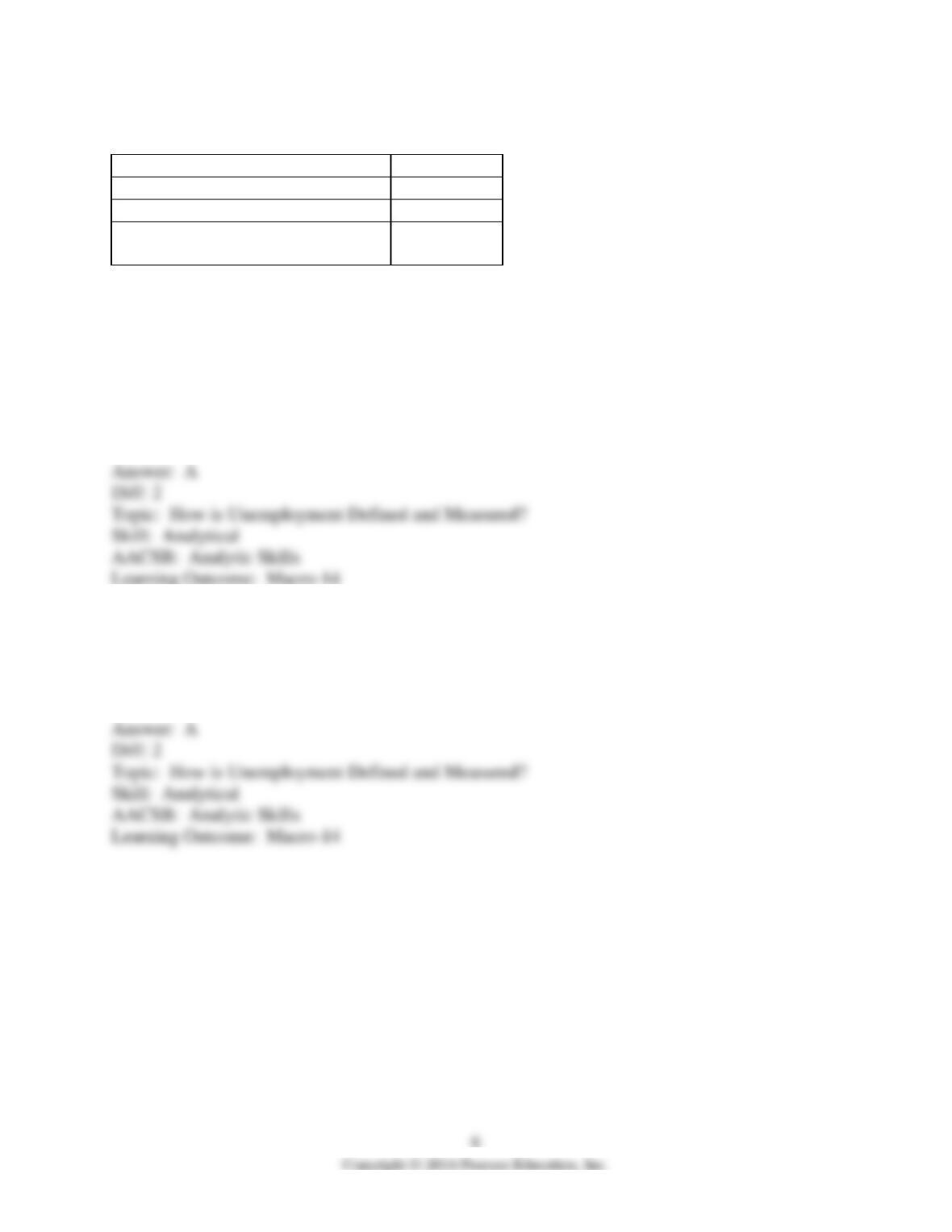
Employment status of the working age
population of Metropolis is approximately:
Employed full-time:
4,200
Employed part-time:
700
Not employed and looking for work:
300
Not employed and not looking for
work:
200
Table 12.1
16) Given the data in Table 12.1, the labor force participation rate of Metropolis is
approximately
A) 96%.
B) 91%.
C) 83%.
D) 78%.
17) Given the data in Table 12.1, the unemployment rate of Metropolis is approximately
A) 6%.
B) 9%.
C) 12%.
D) 22%.
18) Suppose that 50% of the part-time workers of Metropolis are looking for full-time jobs.
Given the data in Table 12.1, if these workers were counted as not employed and looking for
work, the unemployment rate of Metropolis would be approximately
A) 6%.
B) 13%.
C) 16%.
D) 21%.
19) Given the data in Table 12.1, if the workers who are “not employed and not looking for
work” were counted as not employed and in the labor force, the unemployment rate of
Metropolis would be approximately
A) 4%.
B) 7%.
C) 9%.
D) 10%.
Recall the Application about declining U.S. labor force participation since 1999 to answer
the following question(s).
20) Recall the application. One explanation for the decline in the U.S. labor force participation
rate since 1999 is
A) the decline in the overall population.
B) the increasing number of retiring baby boomers.
C) the increase in immigration to the United States.
D) the increase in outsourcing by U.S. companies.
21) Recall the application. One explanation for the decline in the U.S. labor force participation
rate since 1999 is
A) higher college enrollment.
B) the increase in foreign ownership of U.S.-based companies.
C) sluggish economic growth that resulted in more discouraged workers.
D) the growing number of workers who have postponed retirement.
22) Since 1997, the labor force participation rate for women in the United States has
A) remained virtually constant.
B) increased more than 10%.
C) decreased more than 20%.
D) equaled the participation rate for men.
23) People who want to work but have stopped looking for work because they could not find
jobs after actively searching are called
A) employed.
B) unemployed.
C) discouraged workers.
D) empowered.
24) The existence of discouraged workers will lead to an official unemployment rate that is
A) overstated.
B) understated.
C) either overstated or understated.
D) unbiased.
25) If a large number of workers are classified as being out of the labor force when they are
really looking for work, this will lead to an official unemployment rate that is
A) overstated.
B) understated.
C) neither overstated or understated.
D) unbiased.
26) Which specific government agency monitors unemployment?
A) Commerce Department
B) Bureau of Labor Statistics
C) Executive Branch
D) State Department
27) For the purpose of statistically reporting the unemployment rate, “discouraged workers,” are
A) counted.
B) not counted.
C) offered other jobs.
D) trained to do different work.
28) Individuals who have stopped looking for work after an active search because of the lack of
transportation or lack of affordable child care, etc. are classified as ________ workers.
A) non-contributing
B) nonfunctional
C) marginally attached
D) very lazy
Recall the Application about the impact of the federal Disability Insurance program on the
unemployment rate to answer the following question(s).
29) Recall the Application. If the federal Disability Insurance program leads to a decrease in the
labor force participation rate, the ________ will be ________.
A) frictional unemployment rate; higher
B) structural unemployment rate; higher
C) measured unemployment rate; lower
D) measured unemployment rate; higher
30) Recall the application. The federal Disability Insurance Program has had ________ on the
measured unemployment rate.
A) a very large effect
B) no effect
C) a negligible
D) an inconsequential effect
31) Recall the Application. Assume 5,000 unemployed workers left the workforce to participate
in the federal Disability Insurance program, leaving the size of the labor force at 195,000. If
13,000 workers remain unemployed and in the labor force, what was the unemployment rate
before and after the 5,000 unemployed workers left the workforce?
A) 9.0%; 6.7%
B) 6.5%; 2.3%
C) 12.8%; 4.3%
D) 38.5%; 27.8%
32) The unemployment rate
A) rises during booms and falls during recessions.
B) rises during recessions and falls during booms.
C) rises during times of rapid economic growth and falls during times of slow economic growth.
D) tends to remain the same in booms and recessions.
33) Seasonally adjusted unemployment rates
A) adjust for the predictable summer increase in the unemployment rate for teenagers.
B) adjust for the predictable summer decrease in the unemployment rate for teenagers.
C) are the same as the unadjusted rates in periods of bad weather.
D) are not calculated for the U.S. economy.
34) The unemployment rate is calculated by dividing the number unemployed and looking for
work by the sum of the number employed and the number unemployed and looking for work.
35) Individuals who are not working and are not actively looking for work are counted as
unemployed if they have looked for work in the past.
36) The labor force participation rate is the fraction of the population over 16 years of age that is
looking for work.
37) A person who is not working and who has looked for work in the past, but is not looking for
work now is not considered “unemployed.”
38) If a person without a job is not actively looking for work, that person is classified as not
being in the labor force.
39) If a large number of people are classified as being out of the labor force when they are really
looking for work, this will lead to an official unemployment rate that is lower than the true
unemployment rate.
40) People who stopped looking for work because they could not find jobs are called
discouraged workers.
41) Marginally attached workers are discouraged workers who have stopped their job search for
reasons other than the lack of jobs.
42) Explain what is meant by the terms “labor force,” “unemployment rate,” and “labor force
participation rate.”
43) Name two types of jobs most likely affected by “seasonal unemployment.”
12.2 Categories of Unemployment
1) Unemployment that naturally occurs during the normal workings of an economy as people
change jobs and move across the country is called
A) natural unemployment.
B) frictional unemployment.
C) structural unemployment.
D) cyclical unemployment.
2) Hector voluntarily left his job to search for a job in accounting, the field in which he has his
bachelor’s degree. Hector is considered
A) structurally unemployed.
B) cyclically unemployed.
C) frictionally unemployed.
D) not to be unemployed.
3) Juanita quit her job to move to Santa Fe to be closer to her family. She is actively looking for
a new job in Santa Fe. Juanita is considered
A) structurally unemployed.
B) cyclically unemployed.
C) frictionally unemployed.
D) not to be unemployed.
4) Auto workers laid off from Hot-Rod Autoworks as the result of a recession are considered
A) structurally unemployed.
B) cyclically unemployed.
C) frictionally unemployed.
D) seasonally unemployed.
5) Steel workers laid off from their jobs as the result of a recession are considered
A) structurally unemployed.
B) cyclically unemployed.
C) frictionally unemployed.
D) seasonally unemployed.
6) Customer service representatives who have lost their jobs as a result of call centers being
outsourced to India are an example of
A) structural unemployment.
B) cyclical unemployment.
C) frictional unemployment.
D) voluntary unemployment.
7) ________ unemployment is most closely associated with periods of falling GDP.
A) Structural
B) Cyclical
C) Frictional
D) Voluntary
8) ________ unemployment is NOT associated with economic fluctuations.
A) Structural
B) Cyclical
C) Frictional
D) both A and C
9) Cyclical unemployment occurs
A) because the government labels some people who aren’t really in the labor force as
unemployed.
B) with economic fluctuations; it increases during bad times and decreases during good times.
C) naturally during the normal workings of an economy, as people change jobs, move across the
country, etc.
D) because of a mismatch between the jobs that are available in the economy and the skills of
workers seeking jobs.
10) ________ unemployment occurs due to a mismatch between the jobs that are available and
the skills of workers seeking jobs.
A) Structural
B) Cyclical
C) Frictional
D) Voluntary
11) When the “real” GDP falls, the rate of unemployment generally
A) increases.
B) decreases.
C) stays constant.
D) equals the natural rate.
12) When displaced workers require retraining before entering the labor force again, it is the
result of ________ unemployment.
A) cyclical
B) frictional
C) structural
D) seasonal
13) At full employment the unemployment rate equals the
A) cyclical unemployment rate.
B) structural unemployment rate.
C) structural unemployment rate plus the cyclical unemployment rate.
D) structural unemployment rate plus the frictional unemployment rate.
14) Economists say that the economy is at “full employment” when the
A) structural unemployment rate is zero.
B) total unemployment rate is zero.
C) frictional unemployment rate is zero.
D) cyclical unemployment rate is zero.
15) At full employment there is no
A) structural unemployment.
B) cyclical unemployment.
C) frictional unemployment.
D) all of the above
16) The economy needs some unemployment to operate efficiently, because without it
A) firms will find it difficult to recruit workers, leading to increased wages and prices.
B) firms will find it difficult to recruit workers, leading to reduced wages and prices.
C) workers will find it difficult to find a job, leading to increased wages and prices.
D) workers will find it difficult to find a job, leading to reduced wages and prices.
17) In the United States today, economists estimate that the natural rate of unemployment is
between ________ and ________%.
A) 3; 5.5
B) 3; 4
C) 5; 6.5
D) 6.5; 7.5
18) The natural rate of unemployment
A) can vary over time and will differ across countries.
B) can vary over time but tends to be the same across countries.
C) tends to remain constant over time but at different levels for different countries.
D) tends to remain constant over time and is the same across countries.
19) As compared to the estimates of the natural rate of unemployment for the United States,
those for Europe are
A) the same.
B) higher.
C) lower.
D) higher and more variable.
20) Compared to the natural rate of unemployment, the actual unemployment rate is
A) always higher.
B) always lower.
C) always the same.
D) higher in periods when GDP fails to grow at its normal rate.