College Physics: A Strategic Approach, 3e (Knight)
Chapter 12 Thermal Properties of Matter
12.1 Conceptual Questions
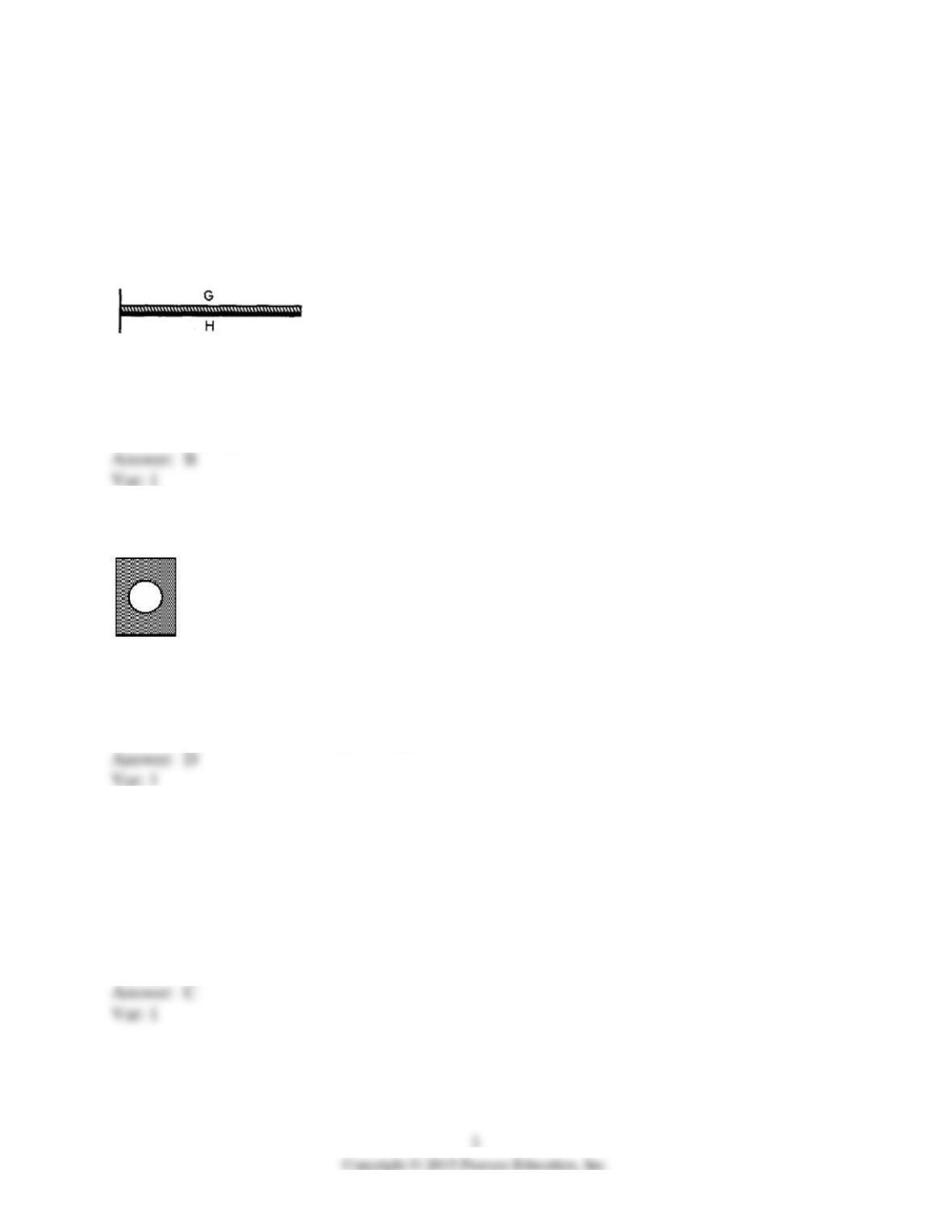
1) As shown in the figure, a bimetallic strip, consisting of metal G on the top and metal H on the
bottom, is rigidly attached to a wall at the left. The coefficient of linear thermal expansion for
metal G is greater than that of metal H. If the strip is uniformly heated, it will
A) curve upward.
B) curve downward.
C) remain horizontal, but get longer.
D) remain horizontal, but get shorter.
E) bend in the middle.
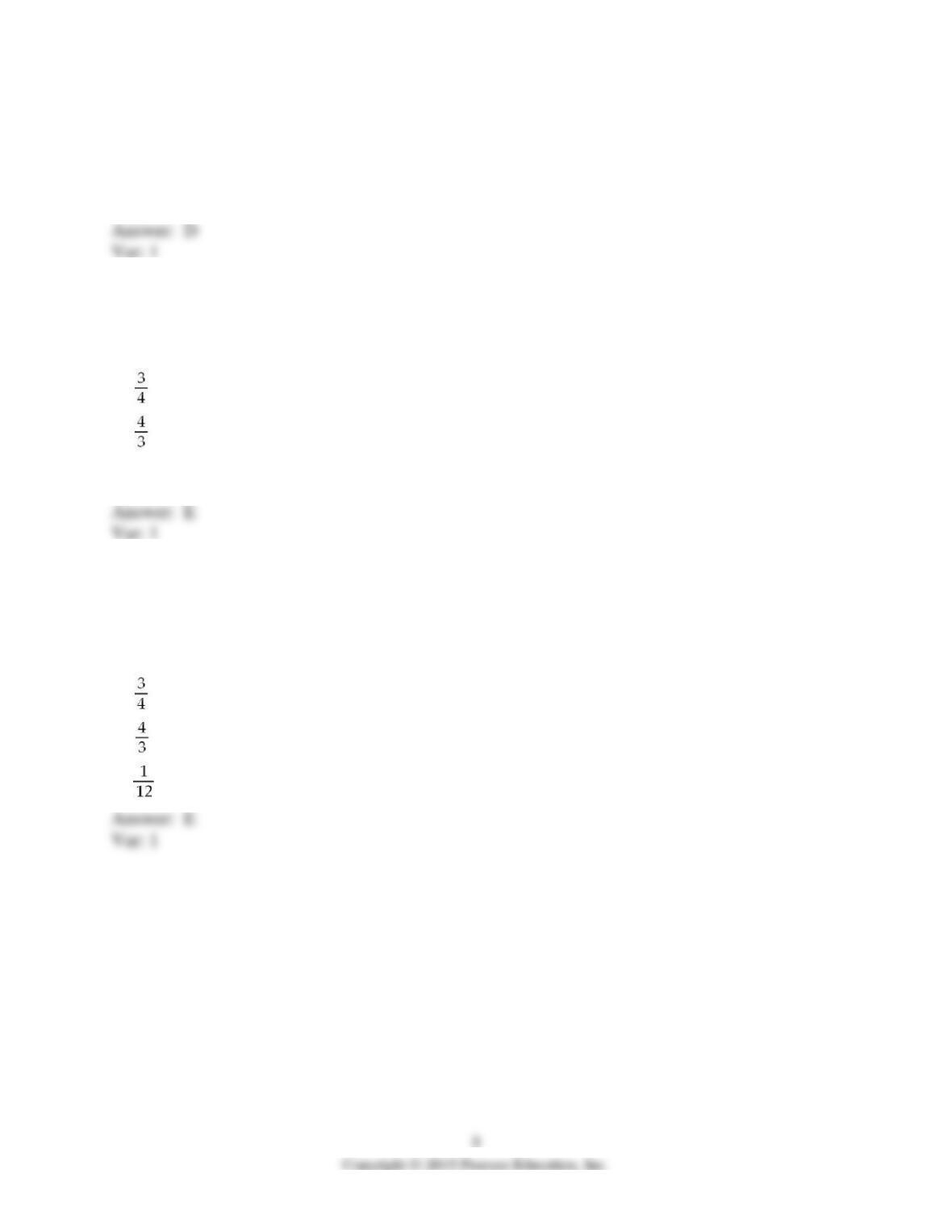
2) Consider a flat steel plate with a hole through its center as shown in the figure. When the
temperature of the plate is increased, the hole will
A) expand only if it takes up more than half the plate’s surface area.
B) contract if it takes up less than half the plate‘s surface area.
C) always contract as the plate expands into it.
D) always expand with the plate.
E) remain the same size as the plate expands around it.
3) The coefficient of linear expansion for aluminum is 1.8 × 10⁻⁶ K-1. What is its coefficient of
volume expansion?
A) 9.0 × 10⁻⁶ K-1
B) 5.8 × 10⁻¹⁸ K-1
C) 5.4 × 10⁻⁶ K-1
D) 3.6 × 10⁻⁶ K-1
E) 0.60 × 10⁻⁶ K-1

4) Two metal spheres are made of the same material and have the same diameter, but one is solid
and the other is hollow. If their temperature is increased by the same amount,
A) the solid sphere becomes bigger than the hollow one.
B) the hollow sphere becomes bigger than the solid one.
C) the two spheres remain of equal size.
D) the solid sphere becomes denser and the hollow one less dense.
E) the solid sphere becomes less dense and the hollow one denser.
5) If you wanted to know how much the temperature of a particular piece of material would rise
when a known amount of heat was added to it, which of the following quantities would be most
helpful to know?
A) initial temperature
B) specific heat
C) density
D) coefficient of linear expansion
E) thermal conductivity
6) A thermally isolated system is made up of a hot piece of aluminum and a cold piece of copper,
with the aluminum and the copper in thermal contact. The specific heat capacity of aluminum is
more than double that of copper. Which object experiences the greater magnitude gain or loss of
heat during the time the system takes to reach thermal equilibrium?
A) the aluminum
B) the copper
C) Neither one; both of them experience the same size gain or loss of heat.
D) It is impossible to tell without knowing the masses.
E) It is impossible to tell without knowing the volumes.
7) A thermally isolated system is made up of a hot piece of aluminum and a cold piece of copper,
with the aluminum and the copper in thermal contact. The specific heat capacity of aluminum is
more than double that of copper. Which object experiences the greater temperature change
during the time the system takes to reach thermal equilibrium?
A) the copper
B) the aluminum
C) Neither one; both of them experience the same size temperature change.
D) It is impossible to tell without knowing the masses.
E) It is impossible to tell without knowing the volumes.
8) Which one of the following quantities is the smallest unit of heat energy?
A) calorie
B) kilocalorie
C) Btu
D) joule
9) Object 1 has three times the specific heat capacity and four times the mass of Object 2. The
two objects are given the same amount of heat. If the temperature of Object 1 changes by an
amount ΔT, the change in temperature of Object 2 will be
A) ΔT.
B) ΔT.
C) ΔT.
D) 6ΔT.
E) 12ΔT.
10) Object 1 has three times the specific heat capacity and four times the mass of Object 2. The
two objects are heated from the same initial temperature, T0, to the same final temperature Tf.
During this process, if Object 1 absorbs heat Q, the amount of heat absorbed by Object 2 will be
A) 12Q.
B) 6Q.
C) Q.
D) Q.
E) Q.
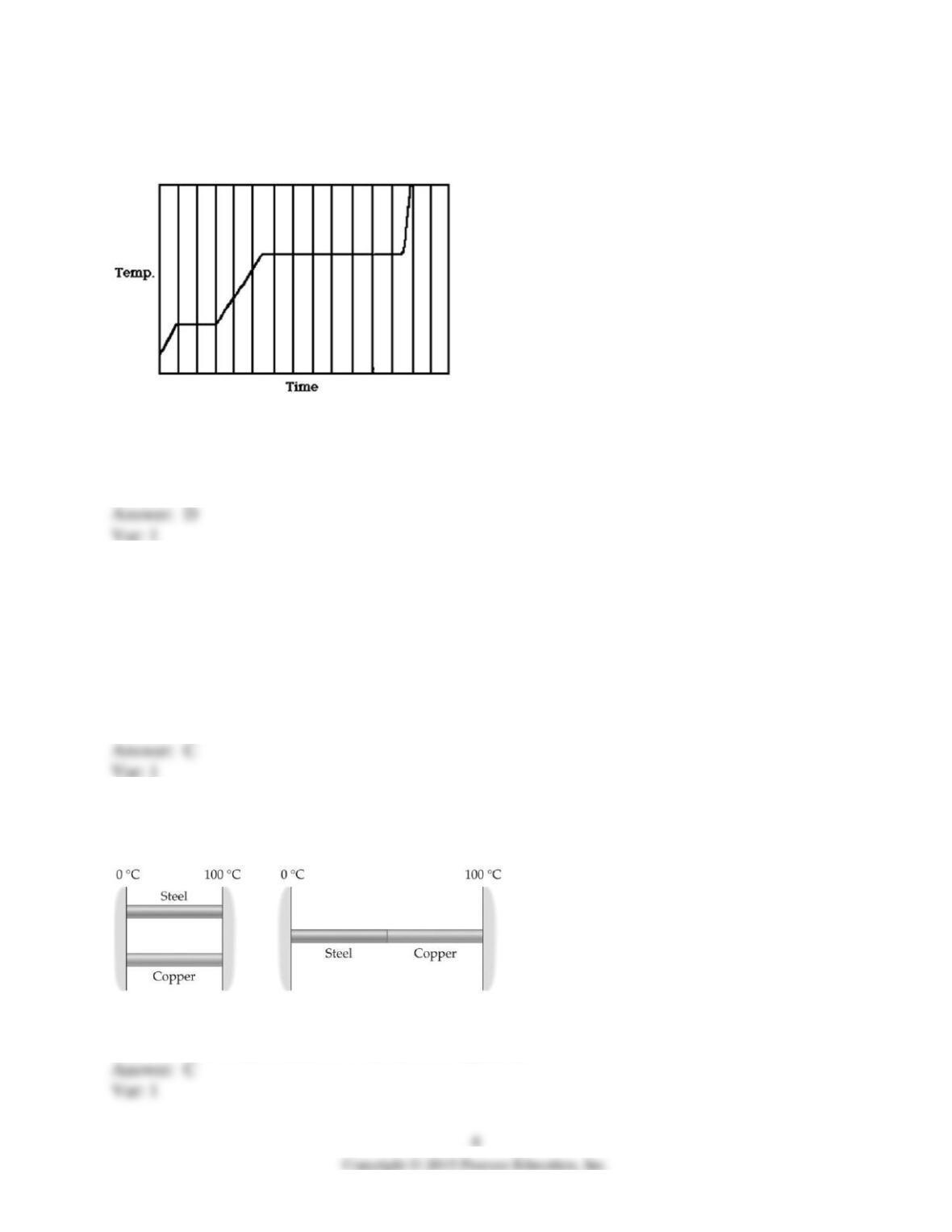
11) The figure shows a graph of the temperature of a pure substance as a function of time as heat
is added to it at a constant rate in a closed container. If LF is the latent heat of fusion of this
substance and LV is its latent heat of vaporization, what is the value of the ratio LV/LF?
A) 5.0
B) 4.5
C) 7.2
D) 3.5
E) 1.5
12) A solid cylindrical bar conducts heat at a rate of 25 W from a hot to a cold reservoir under
steady state conditions. If both the length and the diameter of this bar are doubled, the rate at
which it will conduct heat between these reservoirs will be
A) 200 W
B) 100 W
C) 50 W
D) 25 W
E) 12.5 W
13) Two metal rods are to be used to conduct heat from a region at 100°C to a region at 0°C as
shown in the figure. The rods can be placed in parallel, as shown on the left, or in series, as on
the right. When steady state flow is established, the heat conducted in the series arrangement is
A) greater than the heat conducted with the rods in parallel.
B) the same as the heat conducted with the rods in parallel.
C) less than the heat conducted with the rods in parallel.
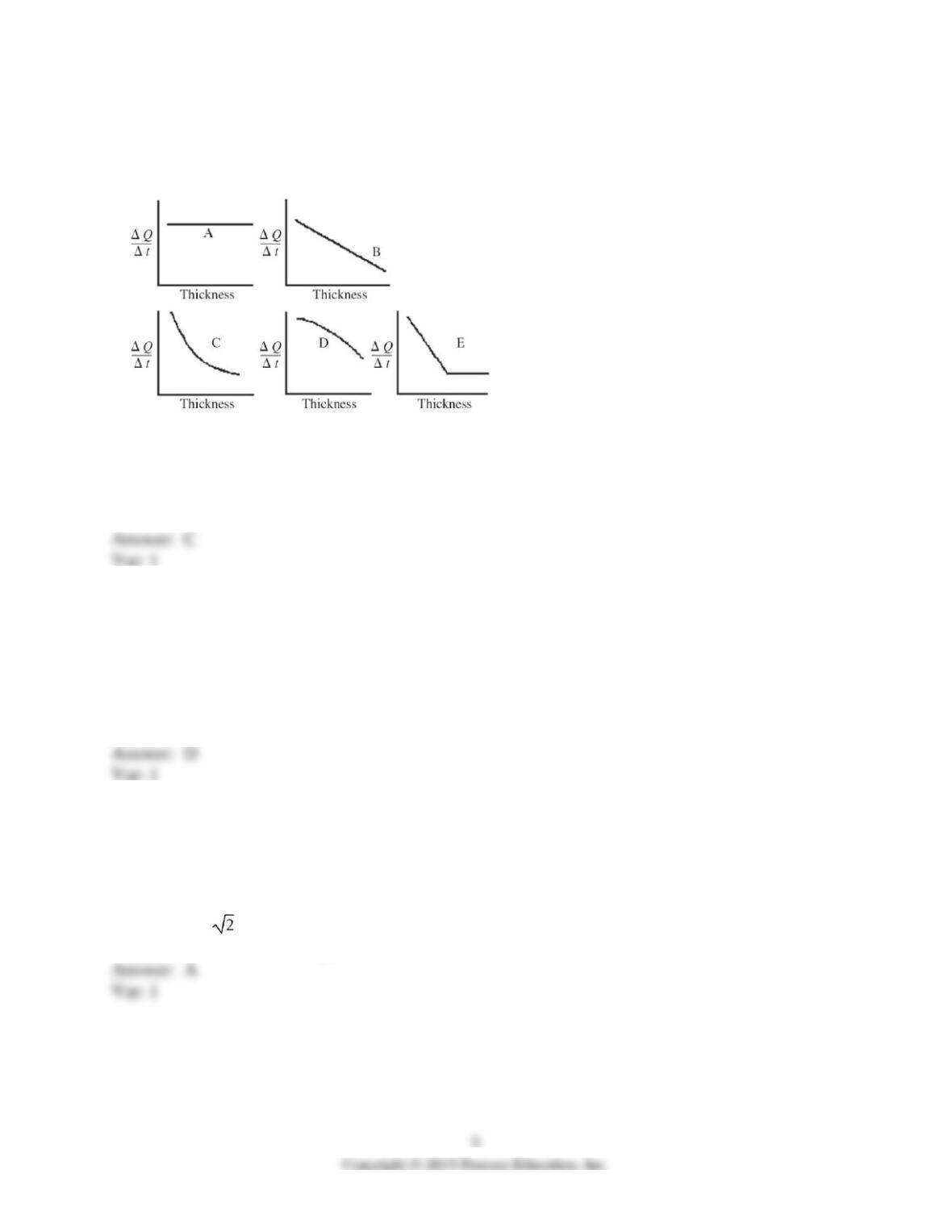
14) An architect is interested in estimating the rate of heat loss, ΔQ/Δt, through a sheet of
insulating material as a function of the thickness of the sheet. Assuming fixed temperatures on
the two faces of the sheet and steady state heat flow, which one of the graphs shown in the figure
best represents the rate of heat transfer as a function of the thickness of the insulating sheet?
A) A
B) B
C) C
D) D
E) E
15) On a cold day, a piece of metal feels much colder to the touch than a piece of wood. This is
due to the difference in which one of the following physical properties of these materials?
A) density
B) specific heat
C) emissivity
D) thermal conductivity
E) mass
16) If, with steady state heat flow established, you double the thickness of a wall built from solid
uniform material, the rate of heat loss for a given temperature difference across the thickness will
A) become one-half its original value.
B) also double.
C) become one-fourth its original value.
D) become 1/ of its original value.
E) become four times its original value.

17) The process in which heat flows by the mass movement of molecules from one place to
another is known as
A) conduction.
B) convection.
C) radiation.
18) An object having a fixed emissivity of 0.725 radiates heat at a rate of 10 W when it is at an
absolute temperature T. If its temperature is doubled to 2T, at what rate will it now radiate?
A) 20 W
B) 40 W
C) 80 W
D) 160 W
E) 320 W
19) If the absolute temperature of an object is tripled, the thermal power radiated by this object
(assuming that its emissivity and size are not affected by the temperature change) will
A) increase by a factor of 3.
B) increase by a factor of 9.
C) increase by a factor of 18.
D) increase by a factor of 27.
E) increase by a factor of 81.
20) By what primary heat transfer mechanism does the sun warm the earth?
A) convection
B) conduction
C) radiation
D) All of the above processes are equally important in combination.
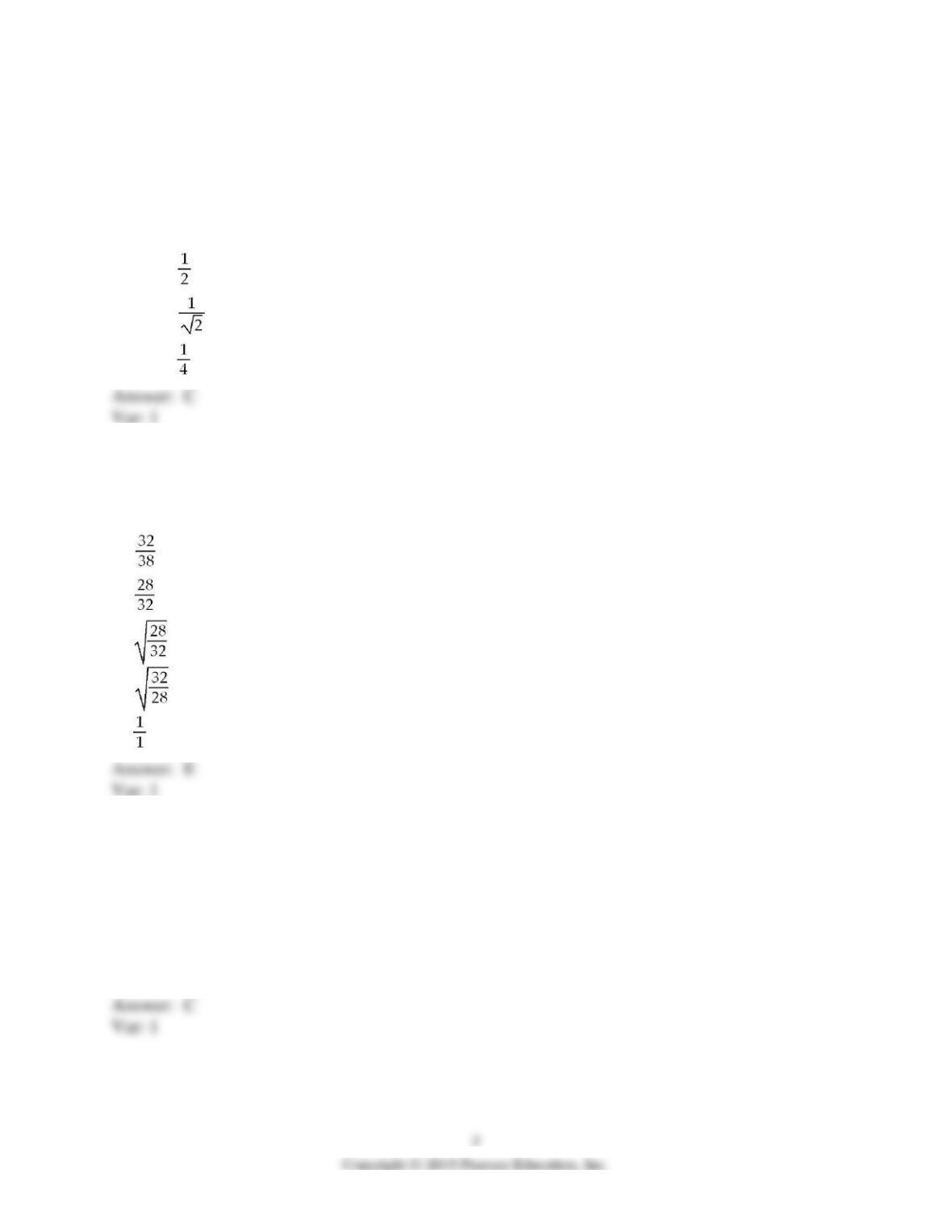
21) Two containers of equal volume each hold samples of the same ideal gas. Container A has
twice as many molecules as container B. If the gas pressure is the same in the two containers, the
correct statement regarding the absolute temperatures TA and TB in containers A and B,
respectively, is
A) TA = TB.
B) TA = 2TB.
C) TA = TB.
D) TA = TB.
E) TA = TB.
22) Consider two equal-volume flasks of gas at the same temperature and pressure. One gas,
oxygen, has a molecular mass of 32. The other gas, nitrogen, has a molecular mass of 28. What
is the ratio of the number of oxygen molecules to the number of nitrogen molecules in these
flasks?
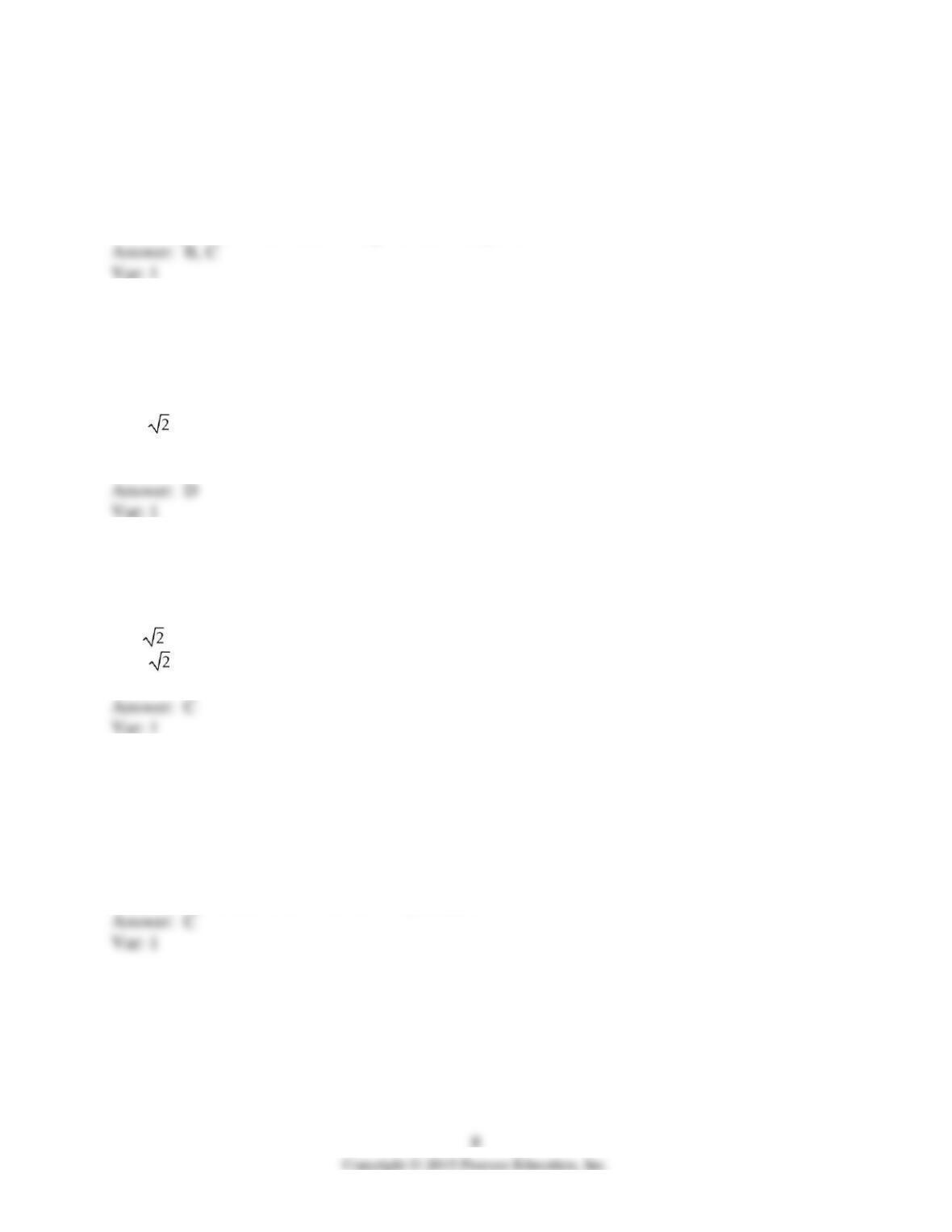
A)
B)
C)
D)
E)
23) An ideal gas is held in a container of volume V at pressure p. The rms speed of a gas
molecule under these conditions is v. If now the volume and pressure are changed to 2V and 2p,
the rms speed of a molecule will be
A) v/2
B) v
C) 2v
D) 4v
E) v/4
24) A mole of diatomic oxygen molecules and a mole of diatomic nitrogen molecules are at STP.
Which statements are true about these molecules? (There could be more than one correct choice.)
A) Both gases have the same average molecular speeds.
B) Both gases have the same number of molecules.
C) Both gases have the same average kinetic energy per molecule.
D) Both gases have the same average momentum per molecule.
25) The root-mean-square speed of the molecules of an ideal gas is v. The gas is now slowly
compressed to one-half its original volume with no change in temperature. What is the root-
mean-square speed of the molecules now?
A) 4v
B) 2v
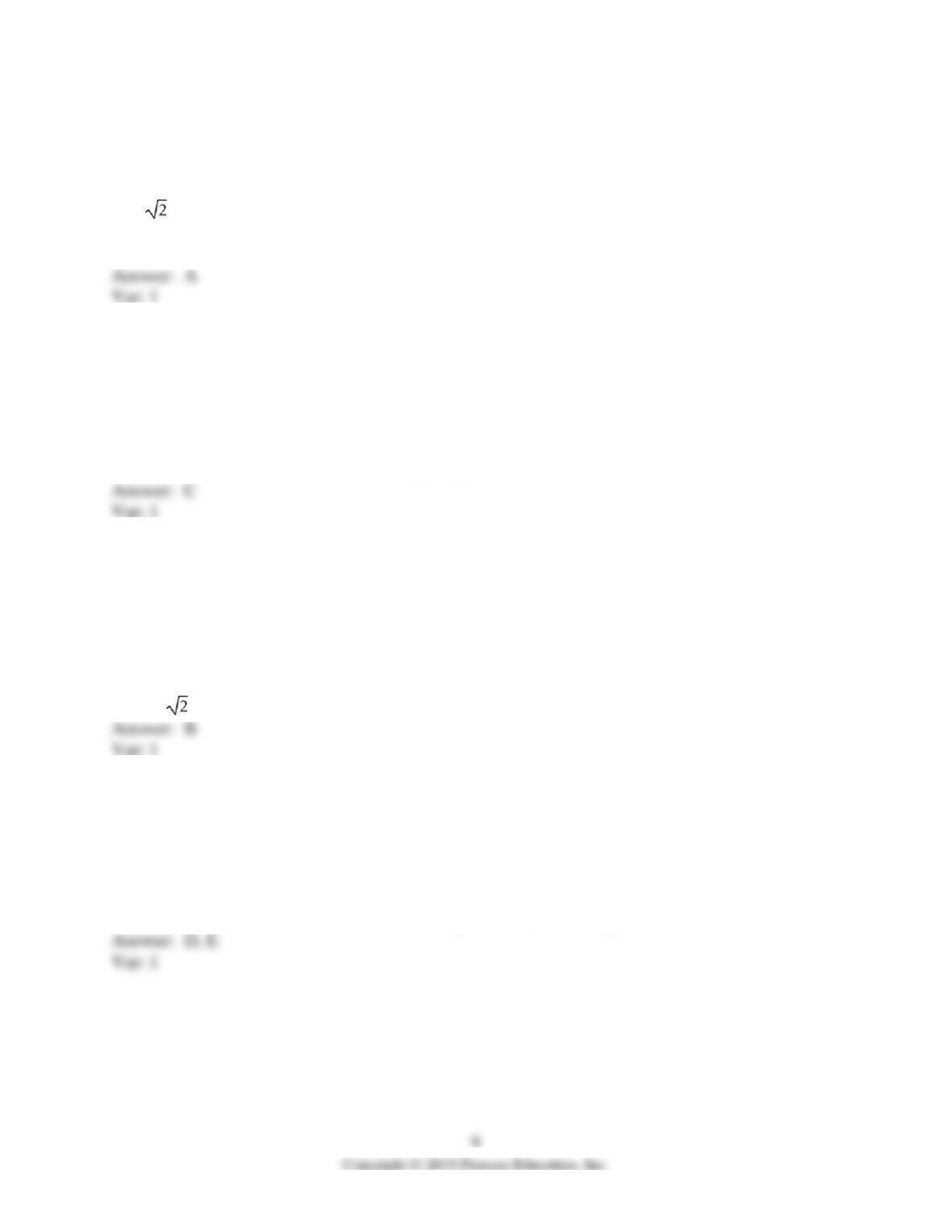
C) v/
D) v
E) v/2
26) A sample of an ideal gas is heated and its Kelvin temperature doubles. If the root-mean-
square speed of its molecules was originally v, what is the new root-mean-square speed?
A) 4v
B) 2v
C) v
D) v/
E) v/4
27) The absolute temperature of an ideal gas is directly proportional to which of the following
quantities?
A) the average speed of its molecules
B) the average momentum of its molecules
C) the average kinetic energy of its molecules
D) the mass of its molecules
E) It is proportional to all of the above quantities.
28) The absolute temperature of a gas is T. In order to double the rms speed of its molecules,
what should be the new absolute temperature?
A) 4T
B) 2T
C) T
D) 8T
E) 16T
29) Oxygen molecules are 16 times more massive than hydrogen molecules. At a given
temperature, the average molecular kinetic energy of oxygen molecules, compared to that of
hydrogen molecules,
A) is greater.
B) is less.
C) is the same.
D) cannot be determined without knowing the pressure and volume.
30) Oxygen molecules are 16 times more massive than hydrogen molecules. At a given
temperature, how do their average molecular speeds compare? The oxygen molecules are
moving
A) four times faster than the hydrogen molecules.
B) at 1/4 the speed of the hydrogen molecules.
C) sixteen times faster than the hydrogen molecules.
D) at 1/16 the speed of the hydrogen molecules.
E) at 1/ the speed of the hydrogen molecules.
31) A fixed container holds oxygen and helium gases at the same temperature. Which of the
following statements are correct? (There could be more than one correct choice.)
A) The oxygen molecules have the greater average kinetic energy.
B) The helium molecules have the greater average kinetic energy.
C) The oxygen molecules have the greater speed.
D) The helium molecules have the greater speed.
E) The helium molecules have the same average kinetic as the oxygen molecules.
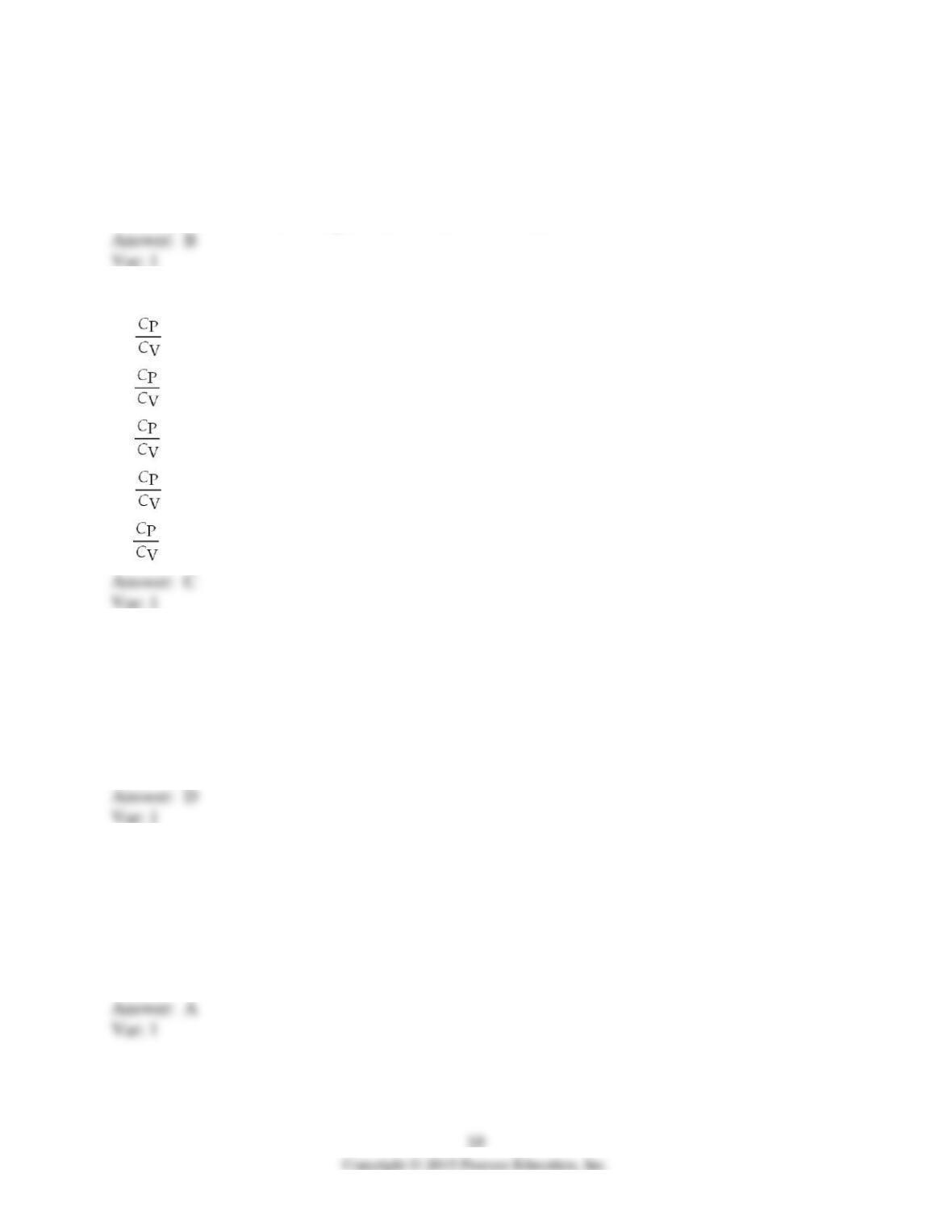
32) For an ideal gas,
A) CP = CV for all ideal gases.
B) CP > CV for all ideal gases.
C) CP < CV for all ideal gases.
D) it depends on whether the gas is monatomic or diatomic.
33) For an ideal gas,
A) = 1 for all ideal gases.
B) < 1 for all monatomic and diatomic gases.
C) > 1 for all monatomic and diatomic gases.
D) < 1 only for a monatomic gas.
E) < 1 only for a diatomic gas.
34) A certain ideal gas has a molar specific heat at constant volume 7R/2. What is its molar
specific heat at constant pressure?
A) 5R/2
B) 3R/2
C) 8R
D) 9R/2
E) 6R
35) A certain ideal gas has a molar specific heat at constant pressure of 7R/2. What is its molar
specific heat at constant volume?
A) 5R/2
B) 3R/2
C) 8R
D) 9R/2
E) 6R
36) A certain ideal gas has a molar specific heat at constant pressure of 33.2 J/mol ∙ K. Its molar
specific heat at constant volume is closest to which of the following values? (R = 8.31J/mol ∙ K)
A) 41.9 J/mol ∙ K
B) 16.6 J/mol ∙ K
C) 25.1 J/mol ∙ K
D) 24.9 J/mol ∙ K
E) 49.8 J/mol ∙ K
37) When a gas expands adiabatically,
A) the internal (thermal) energy of the gas decreases.
B) the internal (thermal) energy of the gas increases.
C) it does no work.
D) work is done on the gas.
E) the temperature of the gas remains constant.
38) An ideal gas is compressed isothermally to one-third of its initial volume. The resulting
pressure will be
A) three times as large as the initial value.
B) less than three times as large as the initial value.
C) more than three times as large as the initial value.
D) equal to the initial value.
E) impossible to predict on the basis of this data.
39) An ideal gas is compressed isobarically to one-third of its initial volume. The resulting
pressure will be
A) three times as large as the initial value.
B) equal to the initial value.
C) more than three times as large as the initial value.
D) impossible to predict on the basis of this data.
40) In a given reversible process, the temperature of an ideal gas is kept constant as the gas is
compressed to a smaller volume. Which one of the following statements about the gas is correct?
A) The gas must absorb heat from its surroundings.
B) The gas must release heat to its surroundings.
C) The pressure of the gas also stays constant.
D) The process is adiabatic.
E) It is impossible to predict on the basis of this data.
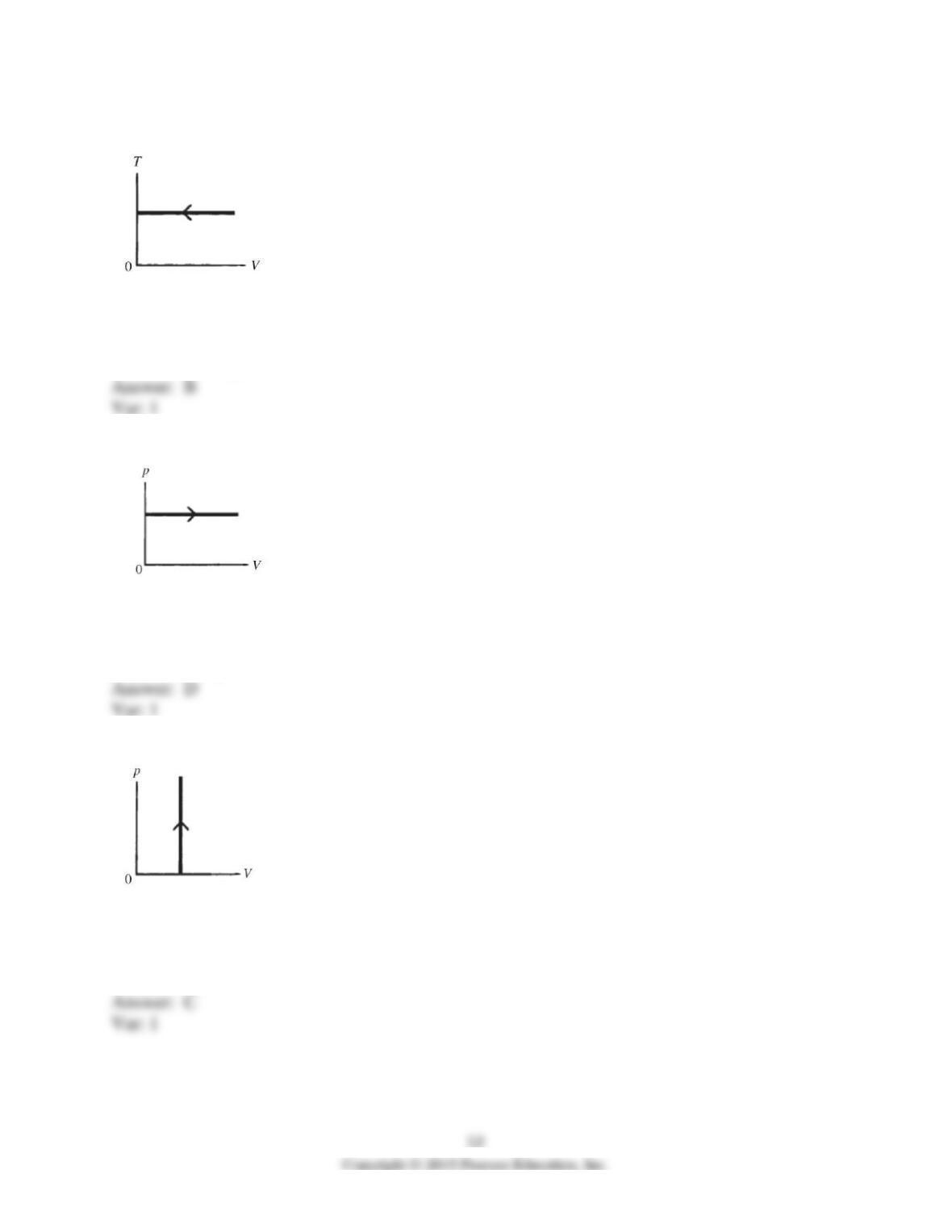
41) The process shown on the TV graph in the figure is an
A) adiabatic compression.
B) isothermal compression.
C) isochoric compression.
D) isobaric compression.
42) The process shown on the pV diagram in the figure is an
A) adiabatic expansion.
B) isothermal expansion.
C) isometric expansion.
D) isobaric expansion.
43) The process shown on the pV diagram in the figure is
A) adiabatic.
B) isothermal.
C) isochoric.
D) isobaric.
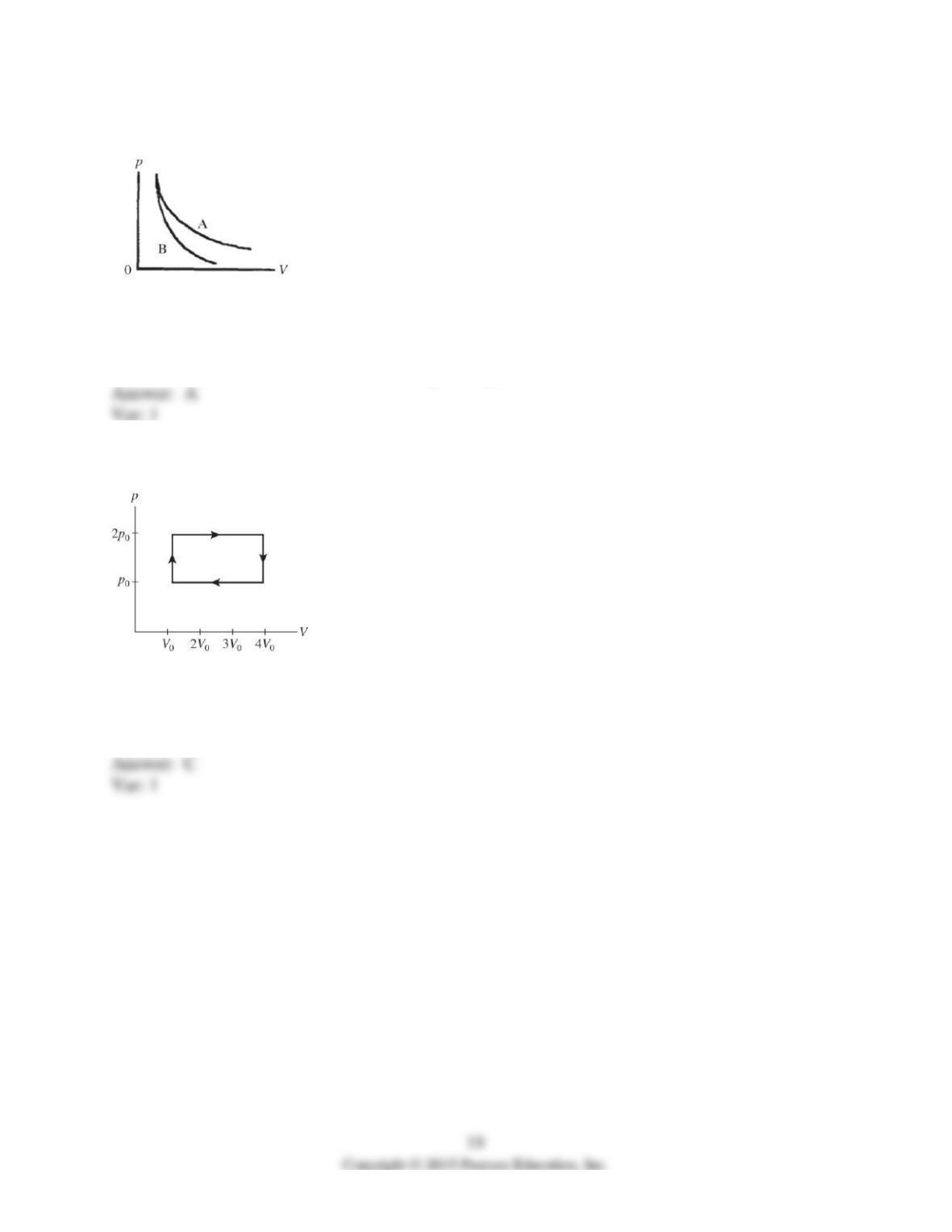
44) Two processes are shown on the pV diagram in the figure. One of them is an adiabat and the
other one is an isotherm. Which process is the isotherm?
A) process A
B) process B
C) The processes shown are neither isotherms nor adiabats.
D) It is not possible to tell without knowing if the gas is monatomic or diatomic.
45) A gas is taken through the cycle shown in the pV diagram in the figure. During one cycle,
how much work is done by the gas?
A) p0V0
B) 2 p0V0
C) 3 p0V0
D) 4 p0V0

1) The coefficient of linear expansion of steel is 12 × 10-6 K-1. What is the change in length of a
25-m steel bridge span when it undergoes a temperature change of 40 K from winter to summer?
A) 1.2 cm
B) 1.4 cm
C) 1.6 cm
D) 1.8 cm
E) 2.0 cm
2) A steel bridge is 1000 m long at -20°C in winter. What is the change in length when the
temperature rises to 40°C in summer? The average coefficient of linear expansion of this steel is
11 × 10-6 K-1.
A) 0.33 m
B) 0.44 m
C) 0.55 m
D) 0.66 m
3) An aluminum rod 17.400 cm long at 20°C is heated to 100°C. What is its new length?
Aluminum has a linear expansion coefficient of 25 × 10-6 K-1.
A) 17.435 cm
B) 17.365 cm
C) 0.348 cm
D) 0.0348 cm
4) By what length will a slab of concrete that is originally 18 m long contract when the
temperature drops from 24°C to -16°C? The coefficient of linear thermal expansion for this
concrete is 1.0 × 10⁻⁵ K-1.
A) 0.50 cm
B) 0.72 cm
C) 1.2 cm
D) 1.5 cm

5) A hole in a brass plate has a diameter of 1.200 cm at 20°C. What is the diameter of the hole
when the plate is heated to 220°C? The coefficient of linear thermal expansion for brass is 19 ×
10-6 K-1.
A) 1.205 cm
B) 1.195 cm
C) 1.200 cm
D) 1.210 cm
6) A quantity of mercury occupies 400.0 cm3 at 0°C. What volume will it occupy when heated to
50°C? Mercury has a volume expansion coefficient of 180 × 10-6 K-1.
A) 450 cm3
B) 409.7 cm3
C) 403.6 cm3
D) 401.8 cm3
7) A large vat contains 1.000 L of water at 20°C. What volume will this water occupy when it is
heated up to 80°C? Water has a volume expansion coefficient of 210 × 10-6 K-1.
A) 1.600 L
B) 1.013 L
C) 0.987 L
D) 0.9987 L
8) The volume coefficient of thermal expansion for gasoline is 950 × 10-6 K-1. By how many
cubic centimeters does the volume of 1.00 L of gasoline change when the temperature rises from
30°C to 50°C?
A) 6.0 cm3
B) 12 cm3
C) 19 cm3
D) 37 cm3

9) For the mercury in a thermometer to expand from 4.00 cm3 to 4.10 cm3, what change in
temperature is necessary? The mercury has a volume expansion coefficient of 1.80 × 10⁻⁴ K-1.
A) 400 C°
B) 140 C°
C) 14 C°
D) 8.2 C°
10) A mercury thermometer has a glass bulb of interior volume 0.100 cm3 at 10°C. The glass
capillary tube above the bulb has an inner cross-sectional area of 0.012 mm2. The coefficient of
volume expansion of mercury is 1.8 × 10⁻⁴ K-1. If the expansion of the glass is negligible, how
much will the mercury rise in the capillary tube when the temperature rises from 5°C to 35°C if
the bulb was full at 5°C?
A) 0.45 mm
B) 4.5 mm
C) 45 mm
D) 45 cm
11) The coefficient of linear expansion of copper is 17 × 10-6 K-1. A sheet of copper has a round
hole with a radius of 3.0 m cut out of it. If the sheet is heated and undergoes a change in
temperature of 80 K, what is the change in the radius of the hole?
A) It decreases by 4.1 mm.
B) It increases by 4.1 mm.
C) It decreases by 8.2 mm.
D) It increases by 8.2 mm.
E) It does not change.
12) Suppose that a rigid aluminum wire were to be strung out in a loop that just fits snugly
around the equator (assuming a perfectly spherical Earth with a radius of 6.37 × 10⁶ m). If the
temperature of the wire is increased by 0.50°C, and the increase in length is distributed equally
over the entire length, how far off the ground will the wire loop be if it remained centered on the
earth? The coefficient of linear expansion of aluminum is 24 × 10-6 K-1.
A) 7.6 mm
B) 76 mm
C) 76 cm
D) 76 m
E) 760 m

13) The coefficient of linear expansion of copper is 17 × 10-6 K-1. A block of copper 30 cm
wide, 45 cm long, and 10 cm thick is heated from 0°C to 100°C What is the change in the
volume of the block?
A) 2.3 × 10⁻⁵ m3
B) 4.6 × 10⁻⁵ m3
C) 5.2 × 10⁻⁵ m3
D) 6.9 × 10⁻⁵ m3
E) 14 × 10-5 m3
14) The coefficient of linear expansion of aluminum is 24 × 10-6 K-1 and the coefficient of
volume expansion of olive oil is 0.68 × 10⁻³ K-1. A novice cook, in preparation of some pesto,
fills a 1.00-L aluminum pot to the brim and heats the oil and the pot from an initial temperature
of 15°C to 190°C. To his consternation some olive oil spills over the top. How much?
A) 0.11 L
B) 0.12 L
C) 0.13 L
D) 0.14 L
E) 0.15 L
15) The coefficient of volume expansion of a certain olive oil is 0.68 × 10⁻³ K-1. A 1.0-L glass
beaker is filled to the brim with olive oil at room temperature. The beaker is placed on a range
and the temperature of the oil and beaker increases by 25 C°. As a result, 0.0167 L of olive oil
spills over the top of the beaker. Which of the following values is closest to the coefficient of
linear expansion of the glass from which the beaker is made?
A) 1 × 10⁻⁶ K-1
B) 4 × 10⁻⁶ K-1
C) 1 × 10⁻⁵ K-1
D) 2 × 10⁻⁵ K-1
E) 3 × 10⁻⁵ K-1

16) The coefficient of linear expansion of aluminum is 24.0 × 10⁻⁶ K-1, and the density of
aluminum at 0°C is 2.70 × 10³ kg/m3. What is the density of aluminum at 300°C?
A) 3.93 × 10³ kg/m3
B) 2.73 × 10³ kg/m3
C) 2.70 × 10³ kg/m3
D) 2.67 × 10³ kg/m3
E) 2.64 × 10³ kg/m3
17) The density of water at 0°C is 999.84 kg/m3 and at 4°C it is 999.96 kg/m3. A 1.0-L
container, full to the brim with water at 4.0°C is placed in the refrigerator. By the time that the
temperature of the water reaches 0.0°C, what volume of water has spilled from the container,
assuming that the contraction of the container is negligible?
A) 1.1 × 10⁻⁷ m3
B) 1.2 × 10⁻⁷ m3
C) 1.3 × 10⁻⁷ m3
D) 1.4 × 10⁻⁷ m3
E) 1.5 × 10⁻⁷ m3
18) The coefficient of linear expansion of copper is 17 × 10-6 K-1 and that of steel is 12 × 10-6
K-1. At 12°C a steel rod has a diameter of 2.540 cm and a copper pipe has a diameter of 2.536
cm. Which one of the following quantities is closest to the temperature to which the copper pipe
must be heated in order for the unheated steel rod to fit snugly in the copper pipe?
A) 53°C
B) 81°C
C) 93°C
D) 105°C
E) 143°C
19) The coefficient of linear expansion of copper is 17 × 10-6 K-1 and that of steel is 12 × 10-6
K-1. At 12°C a steel rod has a diameter of 2.540 cm and a copper pipe has a diameter of 2.536
cm. If they are heated together to a higher temperature, which one of the following quantities is
closest to the common temperature at which the steel rod will fit snugly in the copper pipe?
A) 310°C
B) 330°C
C) 340°C
D) 350°C
E) 380°C
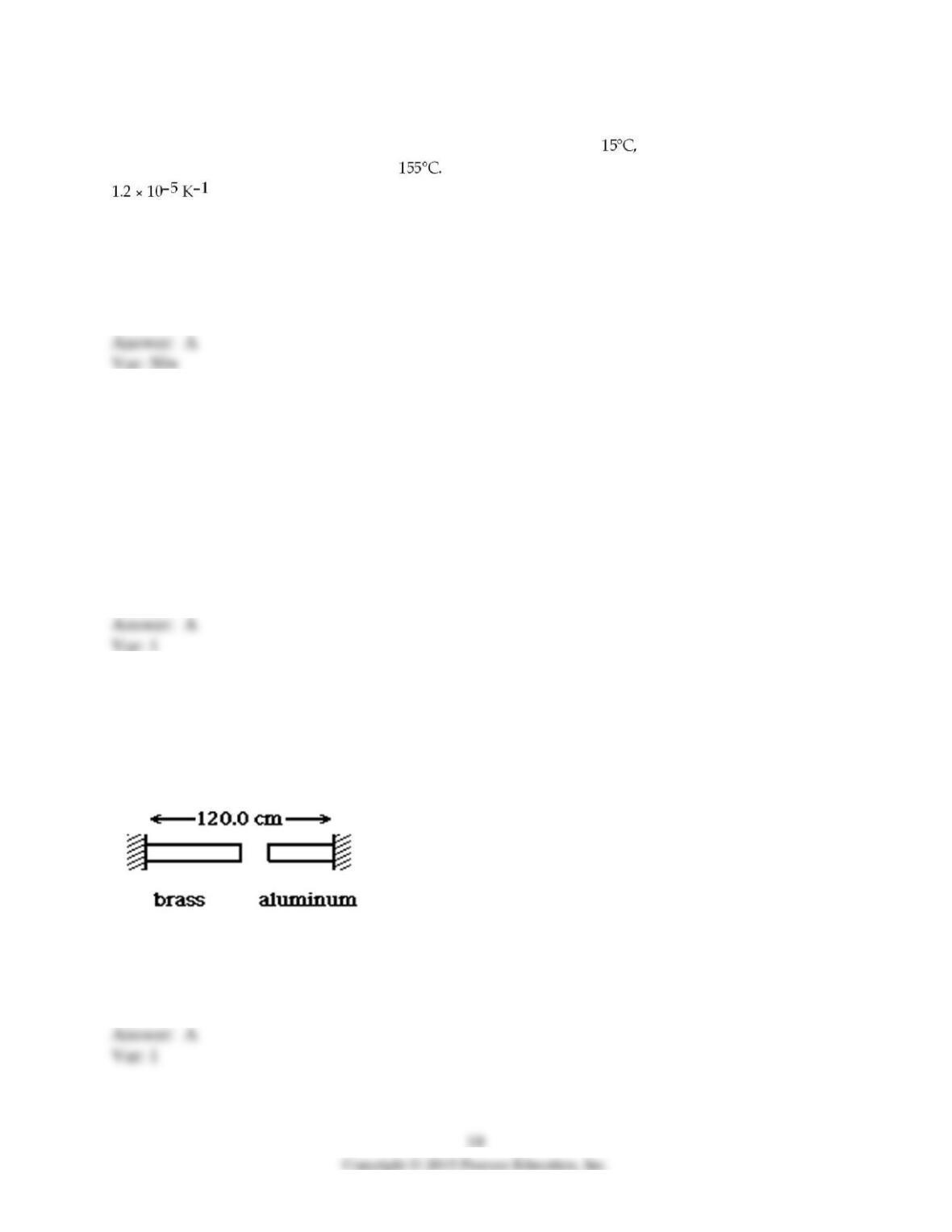
20) A steel pipe 36.0 m long, installed when the temperature was is used to transport
superheated steam at a temperature of Steel’s coefficient of linear expansion is
. The pipe is allowed to expand freely when the steam is transported. What is the
increase in the length of the pipe when it is used with the superheated steam?
A) 60 mm
B) 57 mm
C) 54 mm
D) 64 mm
E) 67 mm
21) An aluminum rod is 10.0 cm long and a steel rod is 80.0 cm long when both rods are at a
temperature of 15°C. Both rods have the same diameter. The rods are now joined end–to-end to
form a rod 90.0 cm long. If the temperature is now raised from 15°C to 90°C, what is the
increase in the length of the joined rod? The coefficient of linear expansion of aluminum is 2.4 ×
10-5 K-1 and that of steel is 1.2 × 10⁻⁵ K-1.
A) 0.90 mm
B) 0.81 mm
C) 0.72 mm
D) 0.63 mm
E) 0.99 mm
22) A brass rod is 69.5 cm long and an aluminum rod is 49.3 cm long when both rods are at an
initial temperature of 0° C. The rods are placed in line with a gap of 1.2 cm between them, as
shown in the figure. The distance between the far ends of the rods is maintained at 120.0 cm
throughout. The temperature of both rods is raised equally until they are barely in contact. At
what temperature does contact occur? The coefficients of linear expansion of brass and
aluminum are 2.0 ×10⁻⁵ K-1 (brass) and 2.4 × 10⁻⁵ K-1 (aluminum).
A) 470°C
B) 440°C
C) 420°C
D) 490°C
E) 510°C

23) A glass flask has a volume of 500 mL at a temperature of 20° C. The flask contains 492 mL
of mercury at an equilibrium temperature of 20°C. The temperature is raised until the mercury
reaches the 500 mL reference mark. At what temperature does this occur? The coefficients of
volume expansion of mercury and glass are 18 ×10-5 K-1 (mercury) and 2.0 ×10⁻⁵ K-1 (glass).
A) 120°C
B) 110°C
C) 100°C
D) 140°C
E) 130°C
24) A solid object has a volume density ρ0 at a temperature of 315 K. The coefficient of volume
expansion for the material of which it is made is 7.00 × 10⁻⁵ K-1. What will be its density (in
terms of ρ0 at a temperature of 425 K, assuming that it does not melt and that its thermal
properties do not change with temperature?
25) How much heat is required to raise the temperature of a 225-g lead ball from 15.0°C to
25.0°C? The specific heat of lead is 128 J/kg ∙ K.
A) 725 J
B) 576 J
C) 145 J
D) 217 J
E) 288 J
26) A 4.0-kg aluminum block is originally at 10°C. If 160 kJ of heat is added to the block, what
is its final temperature? The specific heat capacity of aluminum is 910 J/kg ∙ K.
A) 24°C
B) 34°C
C) 44°C
D) 54°C
27) If 150 kcal of heat raises the temperature of 2.0 kg of a material by 400 F°, what is the
specific heat capacity of the material?
A) 1.35 kcal/kg ∙ C°
B) 0.75 kcal/kg ∙ C°
C) 0.34 kcal/kg ∙ C°
D) 0.19 kcal/kg ∙ C°