Exam
Name___________________________________
MULTIPLE CHOICE. Choose the one alternative that best completes the statement or answers the question.
Use the information for the question(s) below.
Suppose that the risk–free rate is 5% and the market portfolio has an expected return of 13% with a volatility of 18%.
Monsters Inc. has a 24% volatility and a correlation with the market of .60, while California Gold Mining has a 32% volatility
and a correlation with the market of –.7. Assume the CAPM assumptions hold.
1)
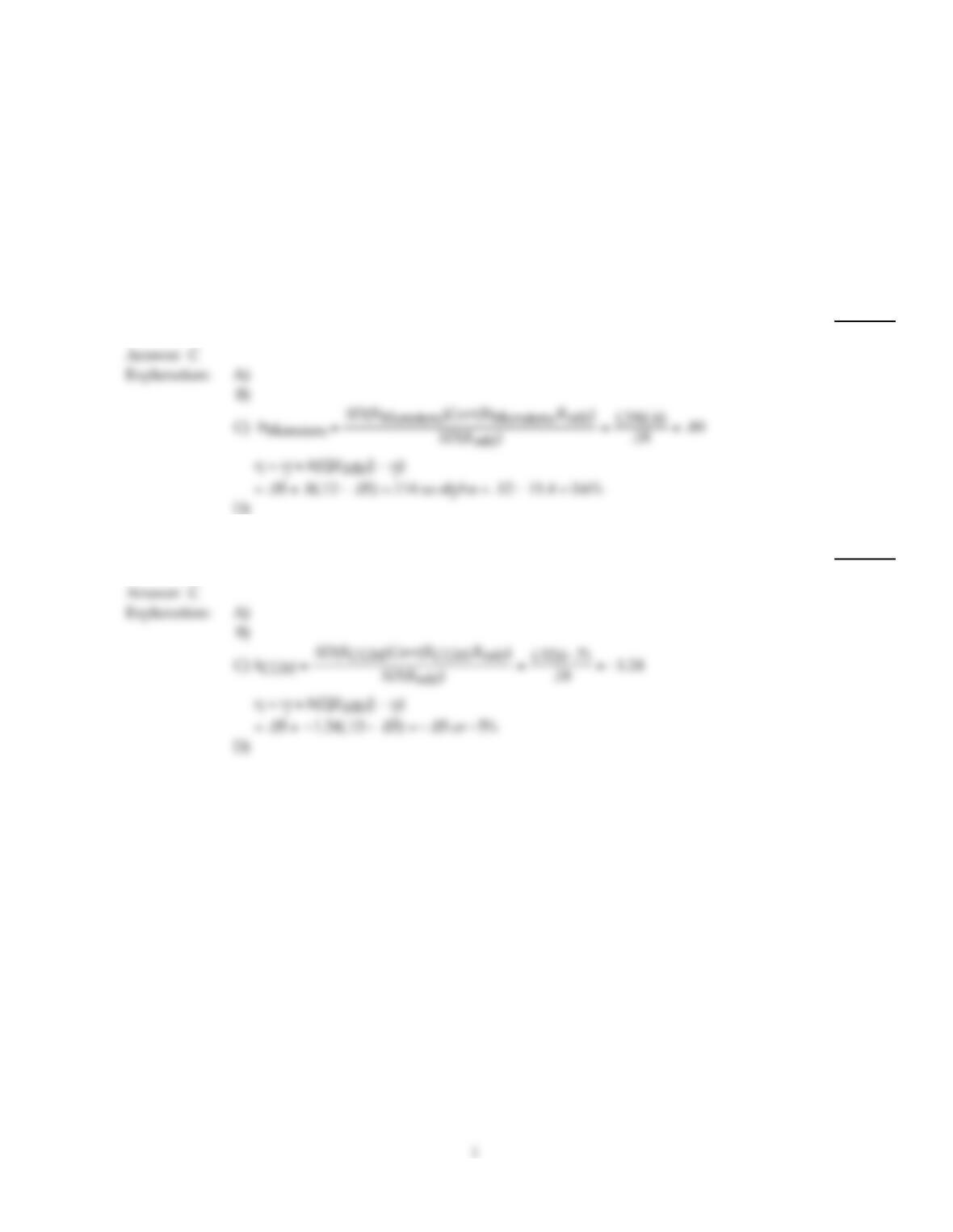
Suppose that Monsters’ expected return is 12%. Then Monsters‘ alpha is closest to:
1)
A)
–2.0%
B)
1.0%
C)
0.5%
D)
–1.0%
2)
California Gold Mining’s required return is closest to:
2)
A)
15%
B)
5%
C)
–5%
D)
13%
Use the table for the question(s) below.
Consider the following three individuals portfolios consisting of investments in four stocks:
Stock Beta
Peter’s
Investment
Paul’s
Investment
Mary’s
Investment
Eenie 1.3 2500 5000 10000
Meenie 1.0 2500 5000 10000
Minie 0.8 2500 5000 –5000
Moe –0.5 2500 –5000 –5000
3)
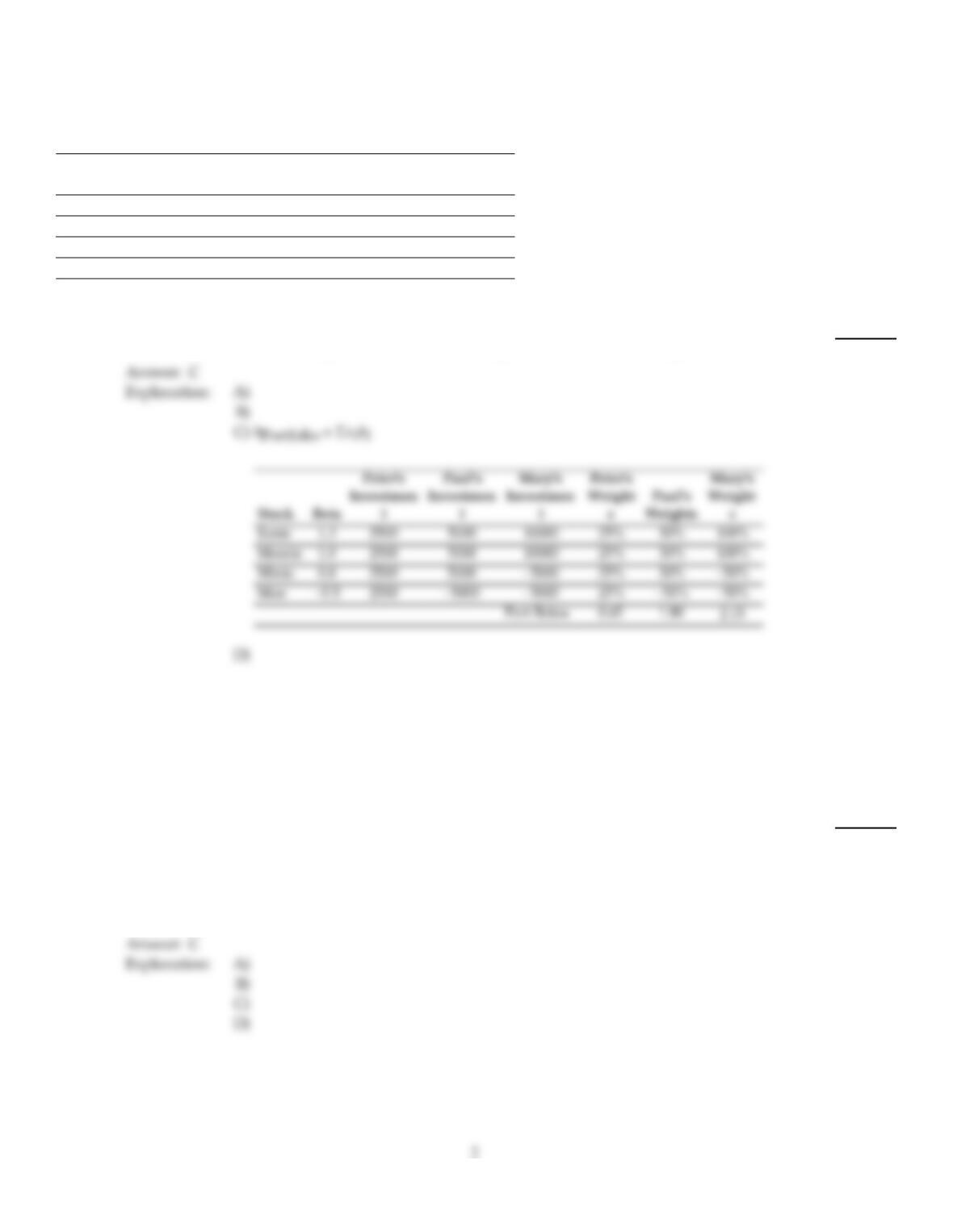
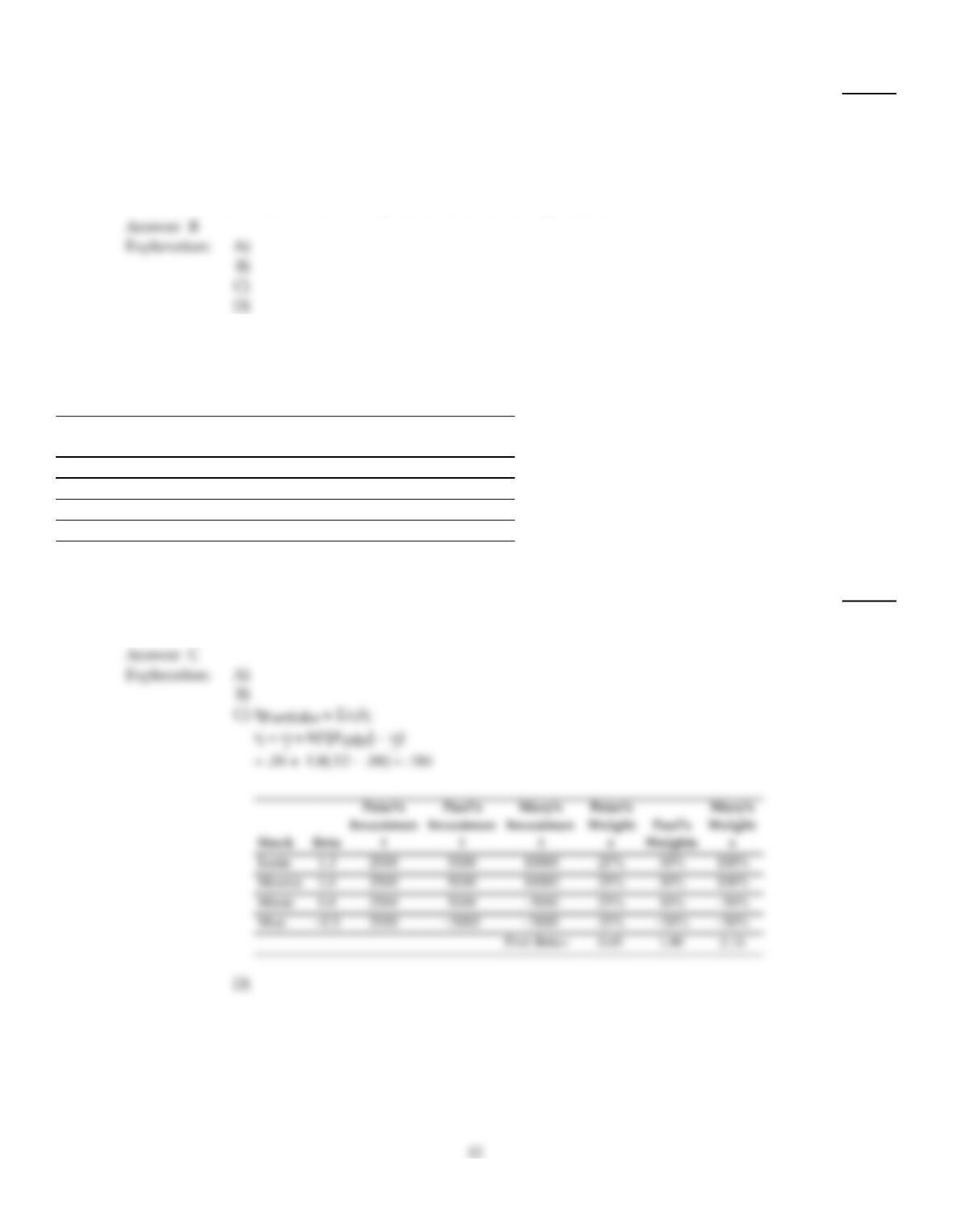
The Beta on Peter’s Portfolio is closest to:
3)
A)
1.0
B)
0.8
C)
0.7
D)
1.8
Use the equation for the question(s) below.
Consider the following linear regression model:
(Ri–rf) =ai+bi(RMkt –rf) +ei
4)
The ei in the regression
4)
A)
measures the historical performance of the security relative to the expected return predicted
by the SML.
B)
measures the sensitivity of the security to market risk.
C)
measures the deviation from the best fitting line and is zero on average.
D)
measures the market risk in returns.
5)
Which of the following statements is false?
5)
A)
There is a linear relationship between a stock’s beta and its expected return.
B)
We refer to the beta of a security with the market portfolio simply as the securities beta.
C)
A security with a negative beta has a negative correlation with the market, which means that
this security tend to perform will when the rest of the market is doing poorly.
D)
The risk premium of a security is equal to the market risk premium (the amount by which the
market’s expected return exceeds the risk–free rate), divided by the amount of market risk
present in the security’s returns measured by its beta with the market.
6)
Which of the following statements is false?
6)
A)
Even though the S&P 500 includes only 500 of the more than 7,000 individual U.S. Stocks in
existence, it represents more than 70% of the U.S. stock market in terms of market
capitalization.
B)
A market index reports the value of a particular portfolio of securities.
C)
The S&P 500 is the standard portfolio used to represent “the market” when using the CAPM in
practice.
D)
The S&P 500 is an equal–weighted portfolio of 500 of the largest U.S. stocks.
7)
Which of the following statements is false?
7)
A)
The SML holds with some rate r* between rs and rb in place of rf, where r* depends on the
proportion of savers and borrowers in the economy.
B)
A combination of portfolios on the efficient frontier of risky investments is also on the
efficient frontier of risky investments.
C)
The conclusion of the CAPM that investors should hold the market portfolio combined with
the risk–free investment depends on the quality of an investor’s information.
D)
In reality, investors have different information and spend varying amounts of effort on
research for assorted stocks.
8)
Which of the following statements is false?
8)
A)
Because very little trading is required to maintain it, an equal–weighted portfolio is called a
passive portfolio.
B)
If the number of shares in a value weighted portfolio does not change, but only the prices
change, the portfolio will remain value weighted.
C)
A price weighted portfolio holds an equal number of shares of each stock, independent of
their size.
D)
The CAPM says that individual investors should hold the market portfolio, a value–weighted
portfolio of all risky securities in the market.
9)
Which of the following statements is false?
9)
A)
A portfolio in which each security is held in proportion to its market capitalization is called a
price–weighted portfolio.
B)
The most familiar stock index in the United States is the Dow Jones Industrial Average (DJIA).
C)
The Dow Jones Industrial Average (DJIA) consists of a portfolio of 30 large industrial stocks.
D)
The Dow Jones Industrial Average (DJIA) is a price–weighted portfolio.
10)
Which of the following is not considered to be an important choice when estimating beta?
10)
A)
The choice of method used to extrapolate beta
B)
The choice of index used as the market portfolio
C)
The choice of the time horizon to use for estimation
D)
The choice between weekly and monthly returns
11)
Which of the following statements is false?
11)
A)
As savvy investors attempt to trade to improve their portfolios, they raise the price and lower
the expected return of the positive alpha stocks, and they depress the price and raise the
expected return of negative alpha stocks, until the stocks are once again on the security
market line and the market portfolio is efficient.
B)
The market portfolio is the efficient portfolio.
C)
If we plot individual securities according to their expected return and beta, the CAPM implies
that they should all fall along the CML.
D)
Many practitioners believe it is sensible to use the CAPM and the security market line as a
practical means to estimate a stock’s required return and therefore a firm’s equity cost of
capital.
12)
The beta for the market portfolio is closest to:
12)
A)
0
B)
1
C)
Unable to answer this question without knowing the markets expected return
D)
Unable to answer this question without knowing the markets volatility
B
Use the equation for the question(s) below.
Consider the following linear regression model:
(Ri–rf) =ai+bi(RMkt –rf) +ei
13)
The bi in the regression
13)
A)
measures the sensitivity of the security to market risk.
B)
measures the diversifiable risk in returns.
C)
measures the deviation from the best fitting line and is zero on average.
D)
measures the historical performance of the security relative to the expected return predicted
by the SML.
A
C

14)
Which of the following statements is false?
14)
A)
Every investor, regardless of how much information he has access to, can guarantee himself
an alpha of zero by holding the market portfolio.
B)
The CAPM requires making the strong assumption of homogeneous expectations.
C)
Investors may have different information regarding expected returns, correlations, and
volatilities, but they correctly interpret that information and the information contained in
market prices and they adjust their estimates of expected returns in a rational way.
D)
Investors may learn different information through their own research and observations, but
as long as they understand the differences in information and learn from other investors by
observing prices, the CAPM conclusions still stand.
15)
Which of the following statements is false?
15)
A)
The SML is still valid when interest rates differ.
B)
In the real world investors have different information and expectations regarding securities.
C)
Short–term margin loans from a broker are often 1% to 2% lower than the rates paid on
short–term Treasury securities.
D)
When borrowing and lending occur at different rates there are different tangent portfolios
identified.
16)
Which of the following statements is false?
16)
A)
If we use very old data to when estimating beta, they data may be unrepresentative of the
current market risk of the security.
B)
Many practitioners use adjusted betas, which are calculated by averaging the estimated beta
with 1.0.
C)
The beta estimated we obtain from linear regression can be very sensitive to outliers, which
are returns of unusually small magnitude.
D)
There may be reasons to exclude certain historical data as anomalous when estimating beta.
Use the information for the question(s) below.
Suppose that the risk–free rate is 5% and the market portfolio has an expected return of 13% with a volatility of 18%.
Monsters Inc. has a 24% volatility and a correlation with the market of .60, while California Gold Mining has a 32% volatility
and a correlation with the market of –.7. Assume the CAPM assumptions hold.
17)
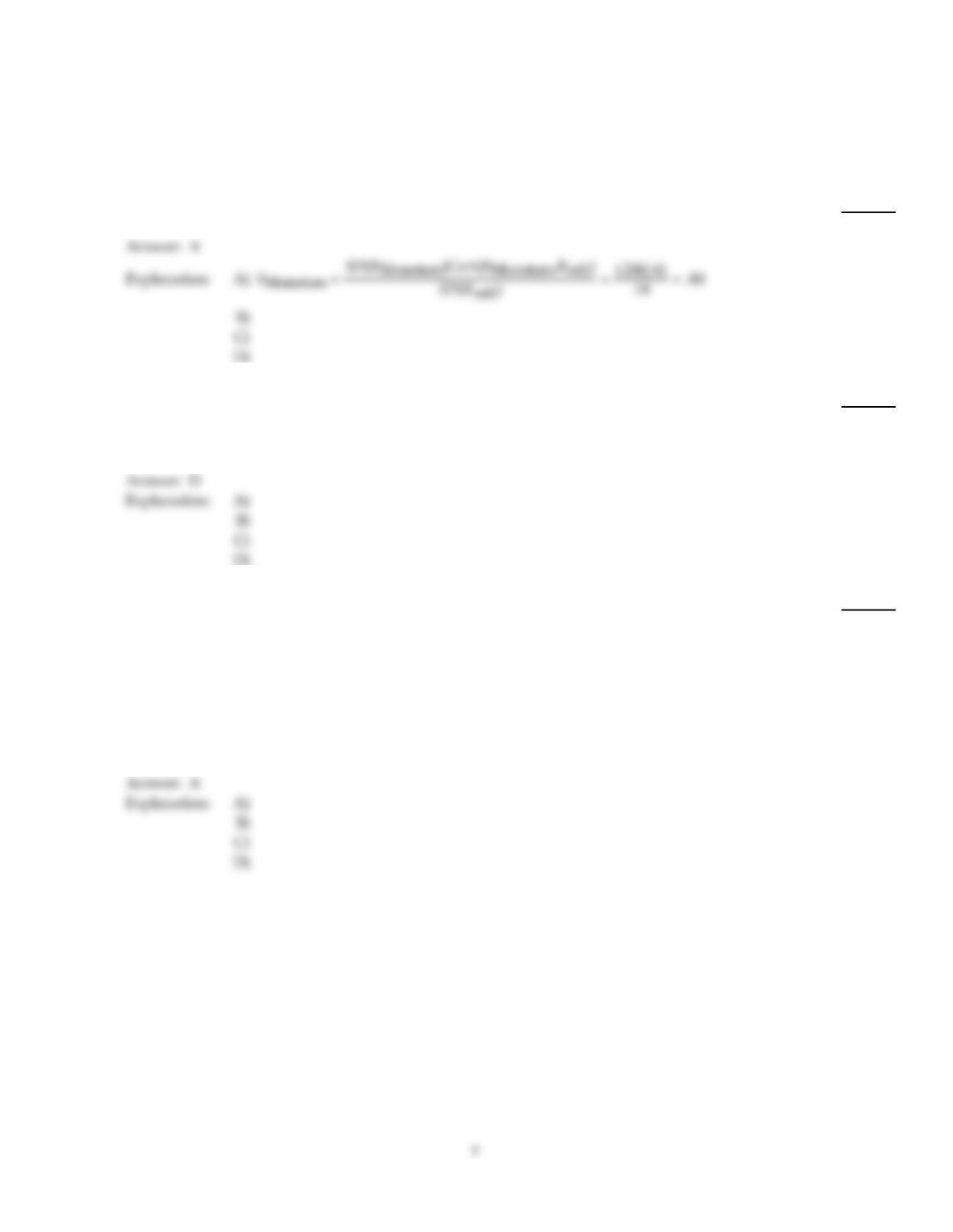
Monsters’ Beta with the market is closest to:
17)
A)
0.8
B)
1.0
C)
1.3
D)
0.6
18)
In practice which market index is most widely used as a proxy for the market portfolio in the
CAPM?
18)
A)
U.S. Treasury Bill
B)
Dow Jones Industrial Average
C)
Wilshire 5000
D)
S&P 500
19)
Which of the following statements is false?
19)
A)
Practitioners commonly use the S&P 500 as the market portfolio in the CAPM with the belief
that this index is the market portfolio.
B)
Standard & Poor’s Depository Receipts (SPDR, nicknamed “spider”) trade on the American
Stock Exchange and represent ownership in the S&P 500.
C)
The S&P 500 was the first widely publicized value weighted index and it has become a
benchmark for professional investors.
D)
The S&P 500 and the Wilshire 5000 indexes are both well–diversified indexes that roughly
correspond to the market of U.S. stocks.
Use the information for the question(s) below.
Suppose that the risk–free rate is 5% and the market portfolio has an expected return of 13% with a volatility of 18%.
Monsters Inc. has a 24% volatility and a correlation with the market of .60, while California Gold Mining has a 32% volatility
and a correlation with the market of –.7. Assume the CAPM assumptions hold.
20)
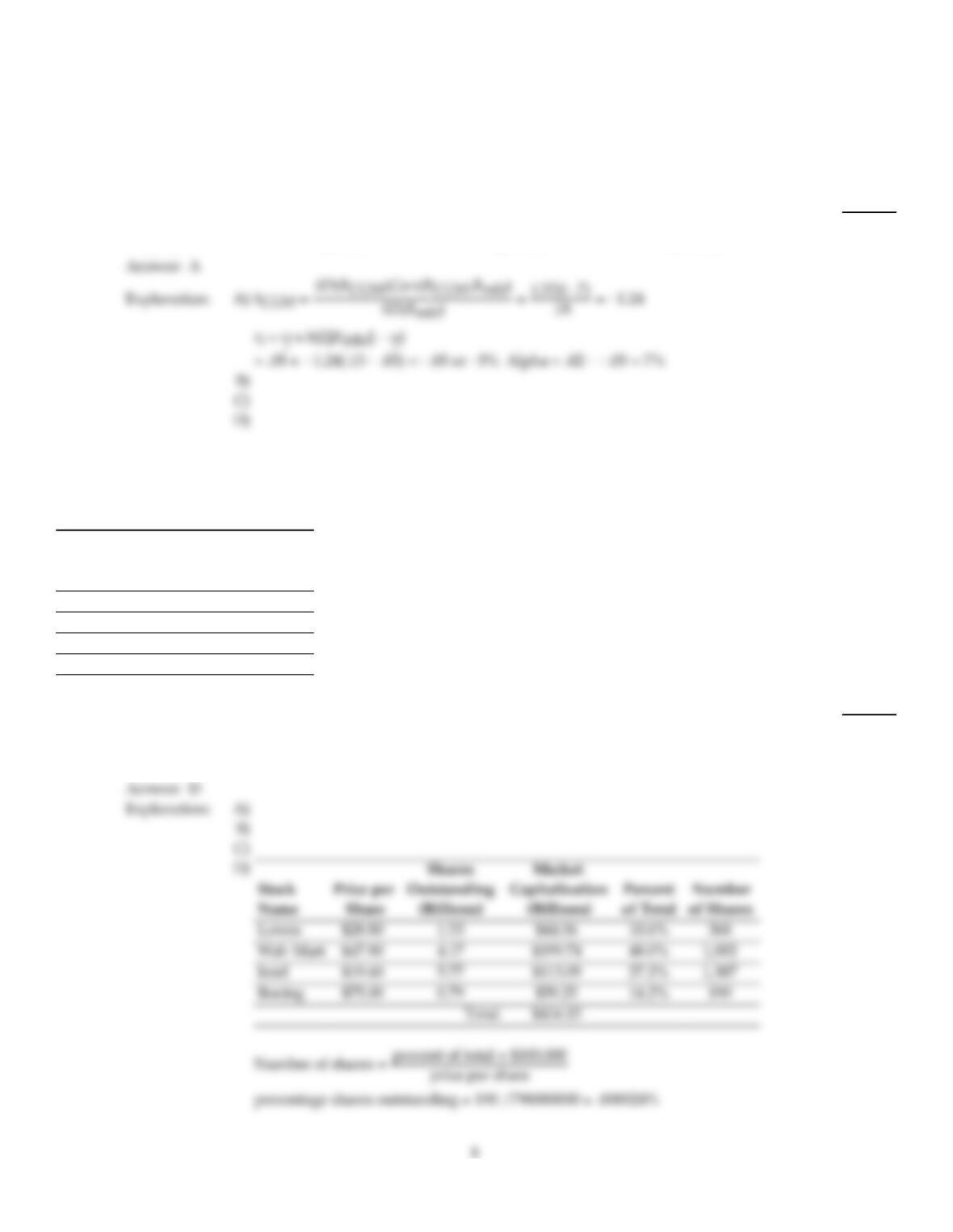
Suppose that California Gold Mining’s expected return is 2%. Then california Gold Mining’s alpha
is closest to:
20)
A)
7%
B)
–3%
C)
–13%
D)
–11%
Use the table for the question(s) below.
Consider the following stock price and shares outstanding data:
Stock
Name
Price per
Share
Shares
Outstanding
(Billions)
Lowes $28.80 1.53
Wal–Mart $47.90 4.17
Intel $19.60 5.77
Boeing $75.00 0.79
21)
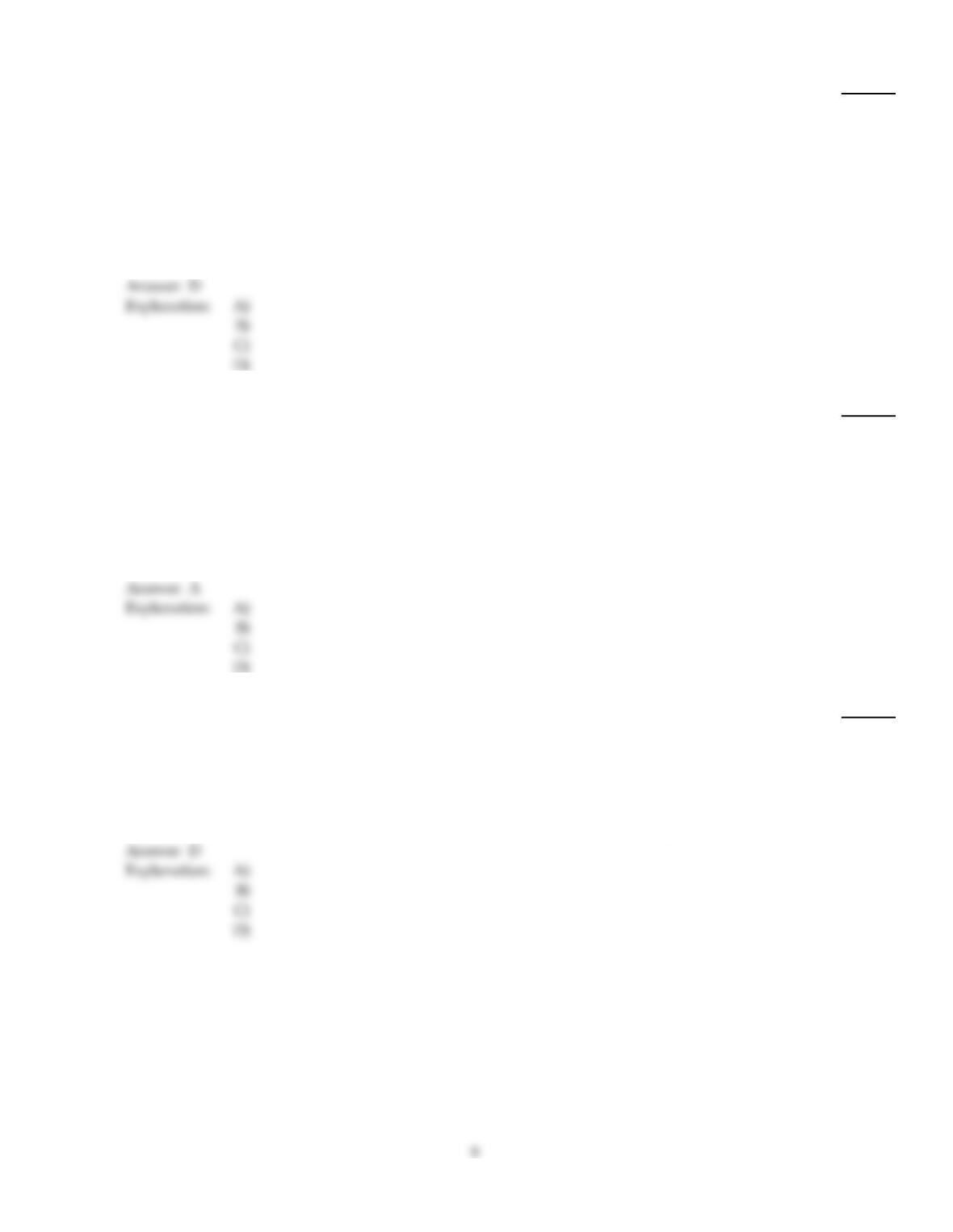
Assume that you have $100,000 to invest and you are interested in creating a value–weighted
portfolio of these four stocks. The percentage of the shares outstanding of Boeing that you would
hold in your portfolio is closest to:
21)
A)
.000020%
B)
.000031%
C)
.000018%
D)
.000024%
22)
Which of the following statements is false?
22)
A)
Given an assessment of an index’s future cash flows, we can estimate the expected return of
the market by solving for the discount rate that is consistent with the current level of the
index.
B)
The highest beta stocks have tended to under perform what the CAPM predicts.
C)
To estimate the expected market risk premium we can look at the historical average excess
return of the market over the risk free interest rate.
D)
The imperfections in the CAPM may be critical in the context of capital budgeting and
corporate finance, where errors in estimating the cost of capital are likely to be far more
important than small discrepancies in the project cash flows.
23)
Which of the following statements is false?
23)
A)
When surveyed, the vast majority of large firms and financial analysts reported using the
yields of Treasury Bills to determine the risk–free rate.
B)
The risk–free interest rate is generally determined using the yields of U.S. Treasury securities,
which are free from default risk.
C)
The CAPM states that we should use the risk–free interest rate corresponding to the
investment horizon of the firm’s investors.
D)
To determine the risk premium for a stock using the security market line, we need an estimate
of the market risk premium.
24)
Which of the following statements is false?
24)
A)
For the market portfolio, the investment in each security is proportional to its market
capitalization.
B)
Because the market portfolio is defined as the total supply of securities, the proportions
should correspond exactly to the proportion of the total market that each security represents.
C)
Market capitalization is the total market value of the outstanding shares of a firm.
D)
The market portfolio contains more of the smallest stocks and less of the larger stocks.

25)
Which of the following statements is false?
25)
A)
If no investor earns a positive alpha, then no investor can earn a negative alpha, and the
market portfolio must be efficient.
B)
Because the average portfolio of all investors is the market portfolio, the average alpha for all
investors is zero.
C)
The market portfolio can be inefficient if a significant number of investors misinterpret
information and believe they are earning a positive alpha when they are actually earning a
negative alpha.
D)
Because of the higher and uncompensated risk involved, no investor should choose a
portfolio with a negative alpha.
26)
Which of the following statements is false?
26)
A)
Even though different investors may research different stocks, their information will not
impact the market portfolio since there is no way to share this information with other
investors.
B)
If the market portfolio is not efficient, savvy investors who recognize that the market portfolio
is not optimal will push prices and expected returns back into balance.
C)
In the real world borrowers pay higher interest rates than savers receive.
D)
When an investor chooses her optimal portfolio, she will do so by finding the tangent line
using the risk–free rate that corresponds to her investment horizon.
27)
Which of the following statements is false?
27)
A)
Low beta stocks have tended to perform somewhat better than the CAPM predicts.
B)
The empirically estimated security market line is somewhat steeper than that predicted by the
CAPM.
C)
Some evidence suggests that the market risk premium has declined over time.
D)
The CAPM remains the predominant model use in practice to determine the equity cost of
capital.
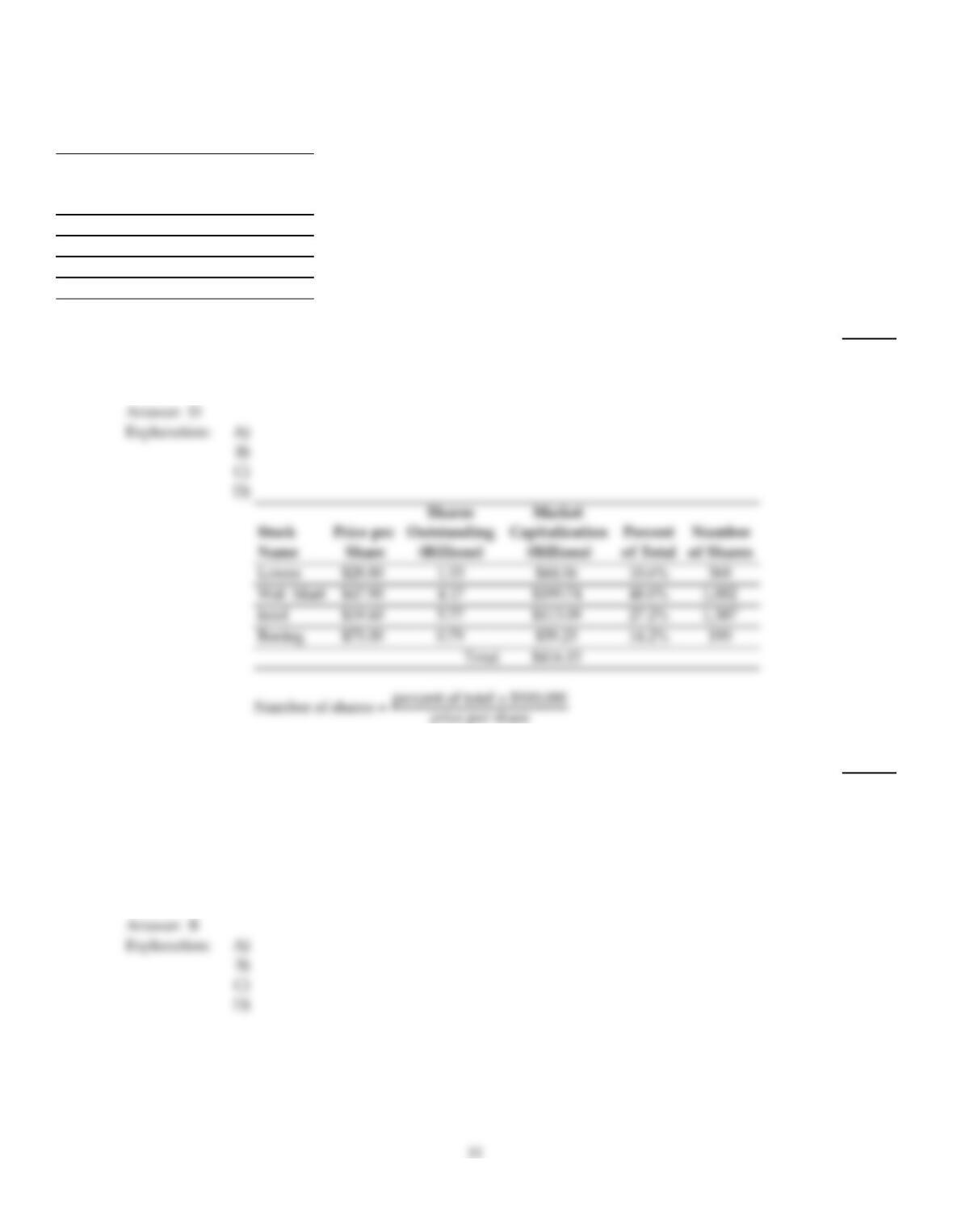
Use the table for the question(s) below.
Consider the following stock price and shares outstanding data:
Stock
Name
Price per
Share
Shares
Outstanding
(Billions)
Lowes $28.80 1.53
Wal–Mart $47.90 4.17
Intel $19.60 5.77
Boeing $75.00 0.79
28)
Assume that you have $100,000 to invest and you are interested in creating a value–weighted
portfolio of these four stocks. The number of shares of Wal–Mart that you would hold in your
portfolio is closest to:
28)
A)
710
B)
1390
C)
870
D)
1000
29)
Which of the following statements is false?
29)
A)
If investors have homogeneous expectations, then each investor will identify the same
portfolio as having the highest Sharpe ratio in the economy.
B)
There are many investors in the world, and each must have identical estimates of the
volatilities, correlations, and expected returns of the available securities.
C)
Homogeneous expectations are when all investors have the same estimates concerning future
investments and returns.
D)
The combined portfolio of risky securities of all investors must equal the efficient portfolio.
30)
Which of the following statements is false?
30)
A)
If investors hold the efficient portfolio, then the cost of capital for any investment project is
equal to its required return calculated using its beta with the efficient portfolio.
B)
The Capital Asset Pricing Model (CAPM) allows corporate executives to identify the efficient
portfolio (of risky assets) by using knowledge of the expected return of each security.
C)
All investors should demand the same efficient portfolio of securities in the same proportions.
D)
The CAPM identifies the market portfolio as the efficient portfolio.
Use the table for the question(s) below.
Consider the following three individuals portfolios consisting of investments in four stocks:
Stock Beta
Peter’s
Investment
Paul’s
Investment
Mary’s
Investment
Eenie 1.3 2500 5000 10000
Meenie 1.0 2500 5000 10000
Minie 0.8 2500 5000 –5000
Moe –0.5 2500 –5000 –5000
31)
Assuming that the risk–free rate is 4% and the expected return on the market is 12%, then required
return on Peter’s Portfolio is closest to:
31)
A)
16%
B)
20%
C)
18%
D)
22%
32)
Which of the following statements is false?
32)
A)
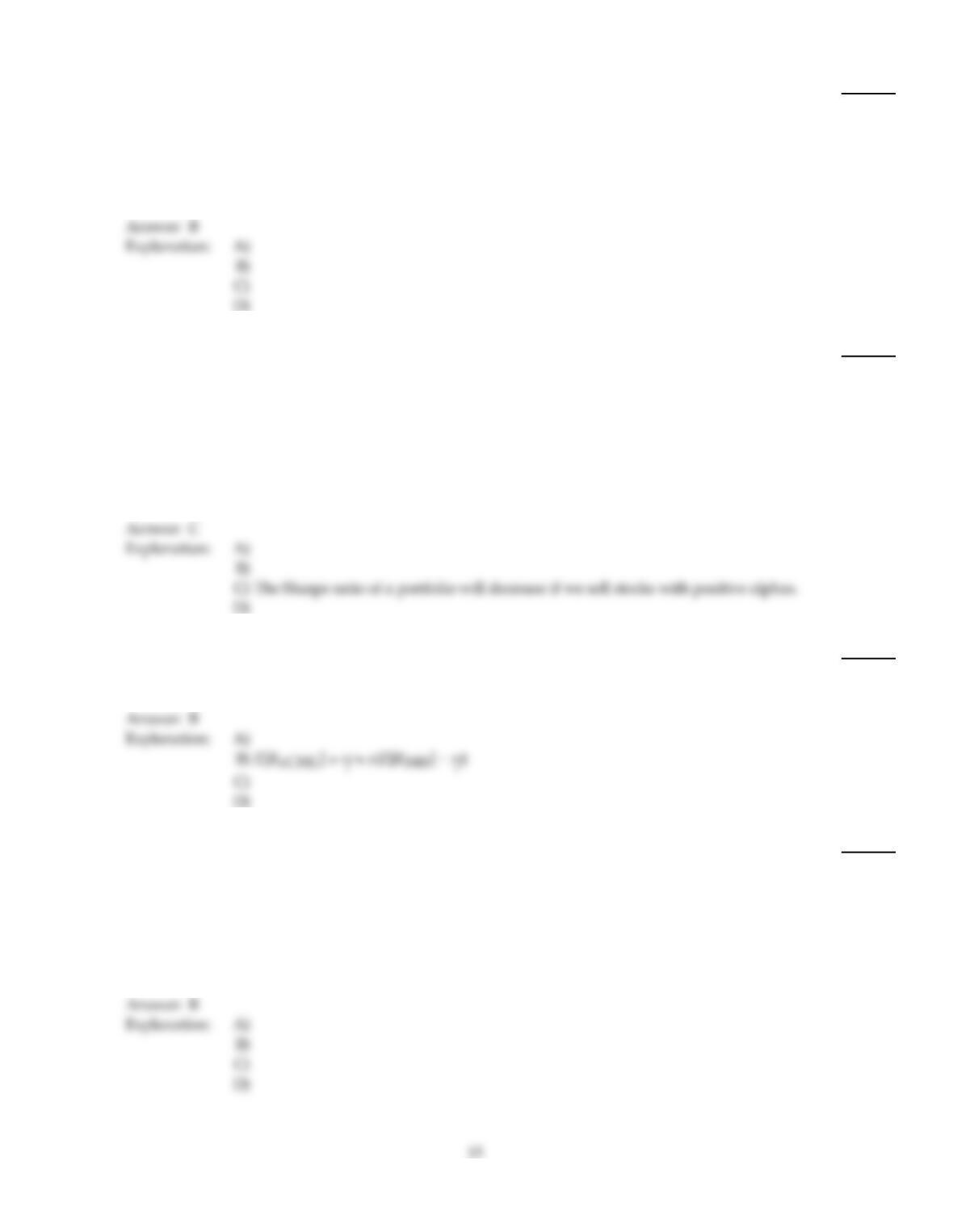
We can improve the performance of our portfolio by selling stocks with negative alphas.
B)
The market portfolio is on the SML, and according to the CAPM, since all other portfolios are
inefficient they will not fall on the SML.
C)
The risk premium for any security is proportional to its beta with the market.
D)
The difference between a stock’s expected return and its required return according to the
security market line is called the stock’s alpha.
33)
Which of the following statements is false?
33)
A)
When the market portfolio is efficient, all stocks are on the security market line and have an
alpha of zero.
B)
When a stock’s alpha is not zero, investors can improve upon the performance of the market
portfolio.
C)
The Sharpe ratio of a portfolio will increase if we sell stocks with positive alphas.
D)
To improve the performance of their portfolios, investors who are holding the market
portfolio will compare the expected return of each security with its required return from the
security market line.
34)
Which of the following equations is incorrect?
34)
A)
SD(RxCML)=xSD(RMkt)
B)
E[RxCML] =rf+x(E[RMkt] + rf)
C)
ri=rf+b(E[RMkt] –rf)
D)
E[RxCML] = (1 –x)rf+xE[RMkt]
E[RxCML] =rf+x(E[RMkt] – rf)
35)
Which of the following statements is false?
35)
A)
Many practitioners prefer to use average industry betas rather than individual stock betas.
B)
When estimating beta by using past returns it is best to use the longest time horizon of returns
available.
C)
If we use too short a time horizon when estimating beta, our estimate of beta will be
unreliable.
D)
The CAPM predicts that a security’s expected return depends on its beta with regard to the
market portfolio of all risky investments available to investors.
Use the information for the question(s) below.
Tom’s portfolio consists solely of an investment in Merck stock. Merck has an expected return of 13% and a volatility of 25%.
The market portfolio has an expected return of 12% and a volatility of 18%. The risk–free rate is 4%. Assume that the CAPM
assumptions hold in the market.
36)
Assuming that Tom wants to maintain the current volatility of his portfolio, then the amount that
Tom should invest in the market portfolio to maximize his expected return is closest to:
36)
A)
110%
B)
72%
C)
92%
D)
140%
Use the table for the question(s) below.
Consider the following stock price and shares outstanding data:
Stock
Name
Price per
Share
Shares
Outstanding
(Billions)
Lowes $28.80 1.53
Wal–Mart $47.90 4.17
Intel $19.60 5.77
Boeing $75.00 0.79
37)
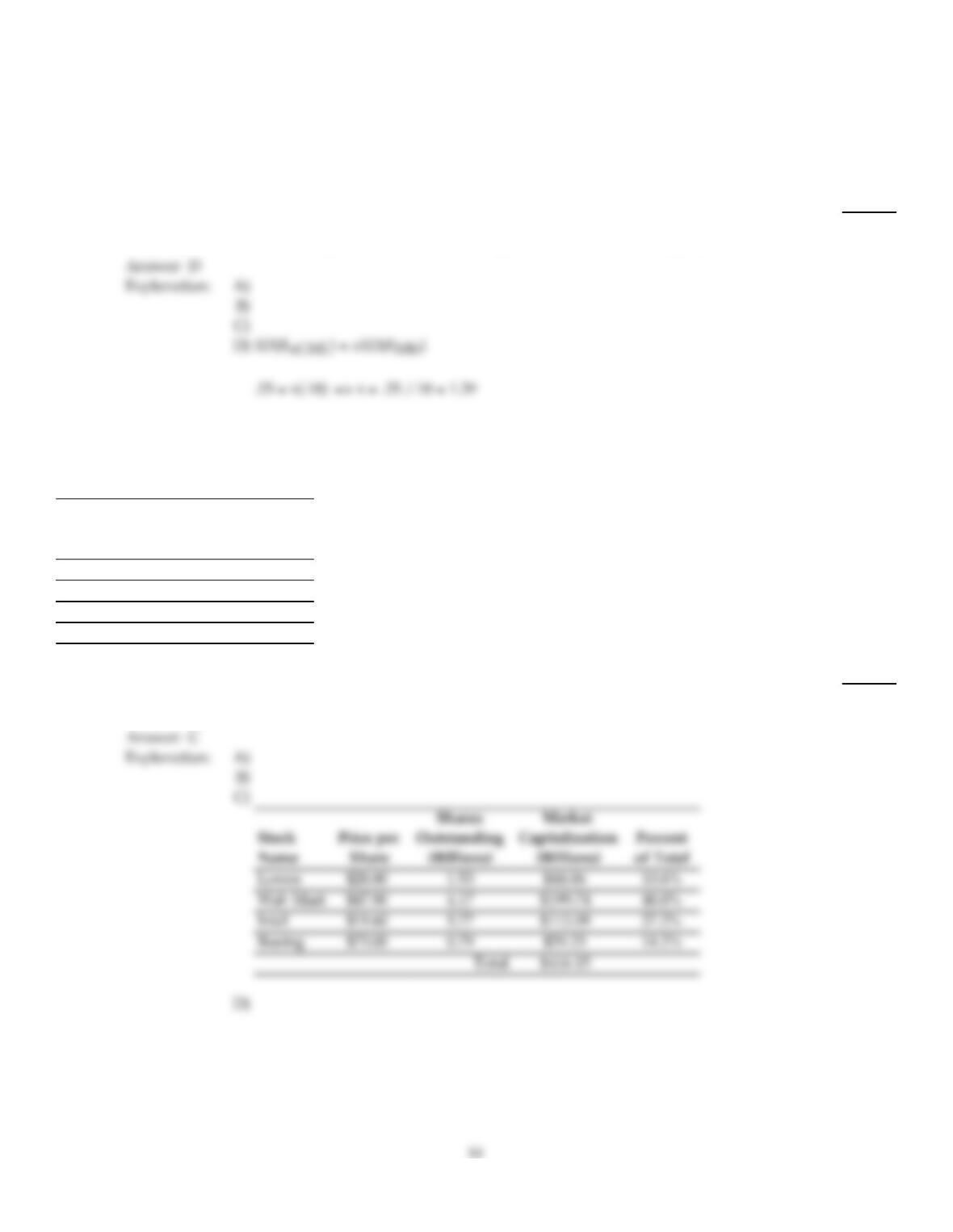
If you are interested in creating a value–weighted portfolio of these four stocks, then the percentage
amount that you would invest in Lowes is closest to:
37)
A)
20.0%
B)
25%
C)
11%
D)
12%
Use the table for the question(s) below.
Consider the following three individuals portfolios consisting of investments in four stocks:
Stock Beta
Peter’s
Investment
Paul’s
Investment
Mary’s
Investment
Eenie 1.3 2500 5000 10000
Meenie 1.0 2500 5000 10000
Minie 0.8 2500 5000 –5000
Moe –0.5 2500 –5000 –5000
38)
The Beta on Paul’s Portfolio is closest to:
38)
A)
1.5
B)
1.0
C)
1.3
D)
1.8
Use the information for the question(s) below.
Suppose that the risk–free rate is 5% and the market portfolio has an expected return of 13% with a volatility of 18%.
Monsters Inc. has a 24% volatility and a correlation with the market of .60, while California Gold Mining has a 32% volatility
and a correlation with the market of –.7. Assume the CAPM assumptions hold.
39)
Monsters’ required return is closest to:
39)
A)
13.0%
B)
10.0%
C)
15.5%
D)
11.5%