Exam
Name___________________________________
MULTIPLE CHOICE. Choose the one alternative that best completes the statement or answers the question.
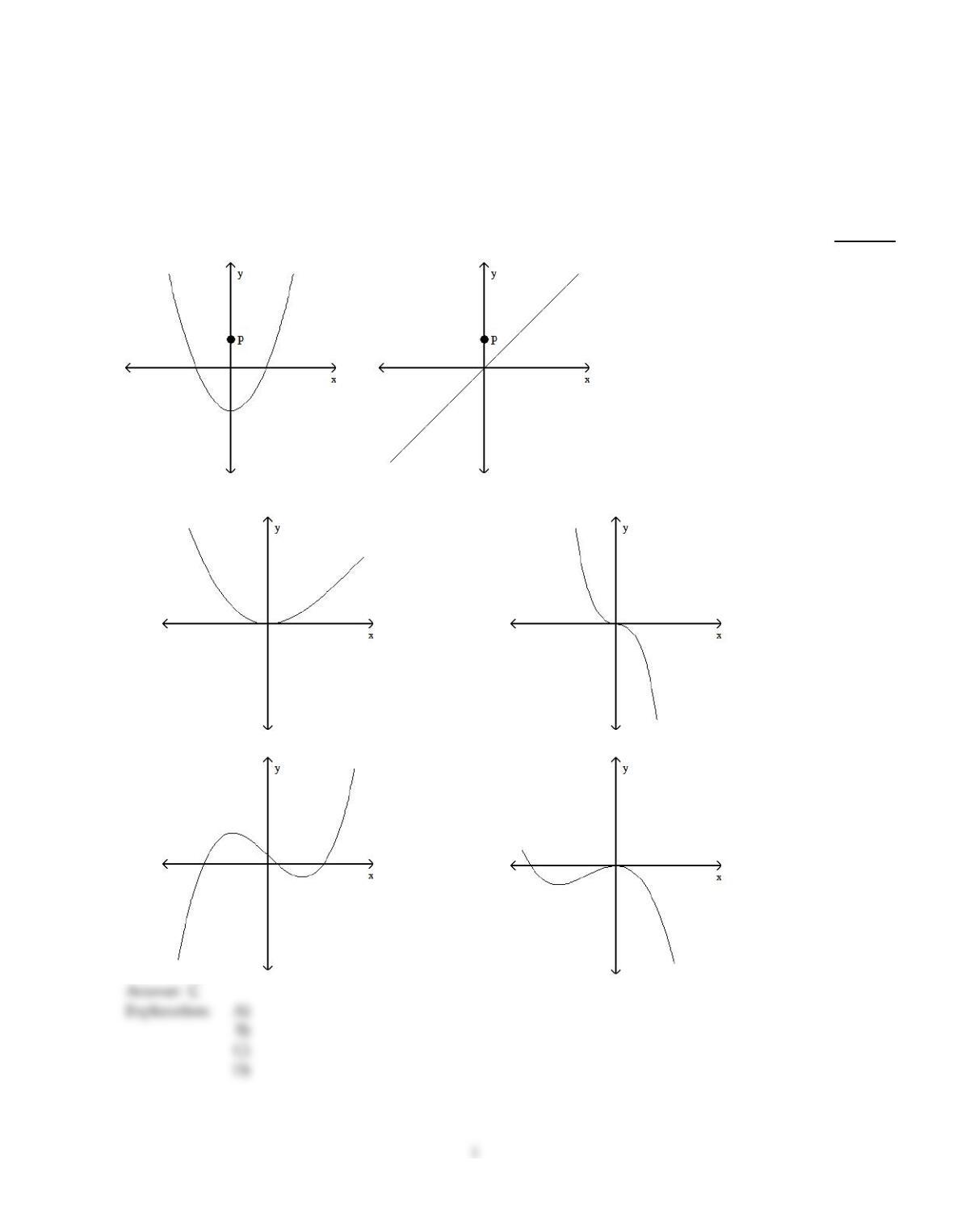
The graphs of the first and second derivatives of a function y = f(x) are given. Select a possible graph of f that passes
through the point P. (NOTE: Vertical scales may vary from graph to graph.)
1)
f’ f”
1)
A)
B)
C)
D)
SHORT ANSWER. Write the word or phrase that best completes each statement or answers the question.
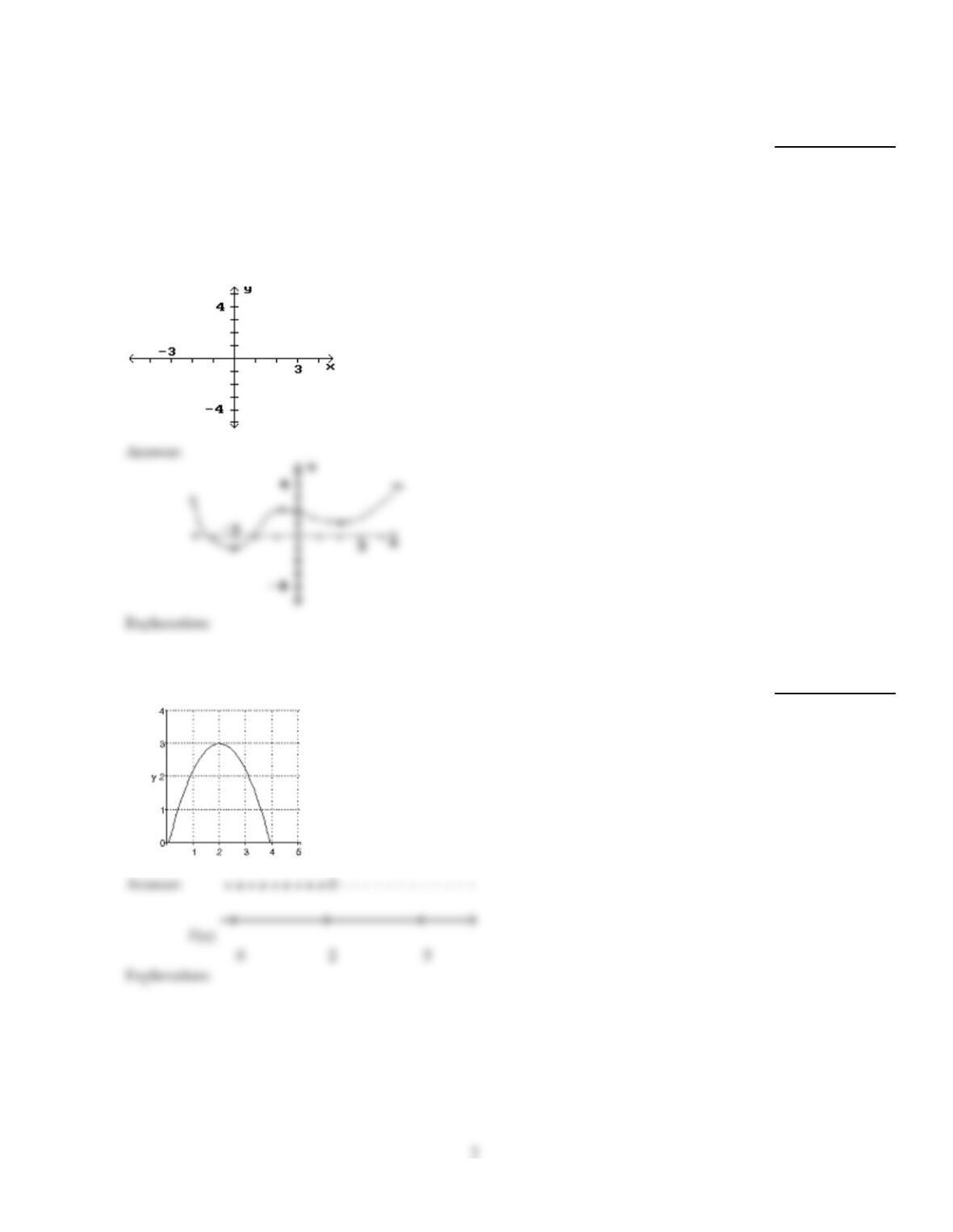
Sketch a graph of a single function that has these properties.
2)
a) Continuous and differentiable for all real numbers
b) f(x) > 0 on (–3 , –1) and ( 2 , )
c) f(x) < 0 on (–, –3) and ( –1 , 2)
d) f(x) > 0 on (– , –2) and ( 1 , )
e) f(x) < 0 on (–2 , 1)
f) f (–3) =f (–1) =f(2) = 0
g) f(x) = 0 at (–2 , 0) and (1, 1)
2)
Provide an appropriate response.
3)
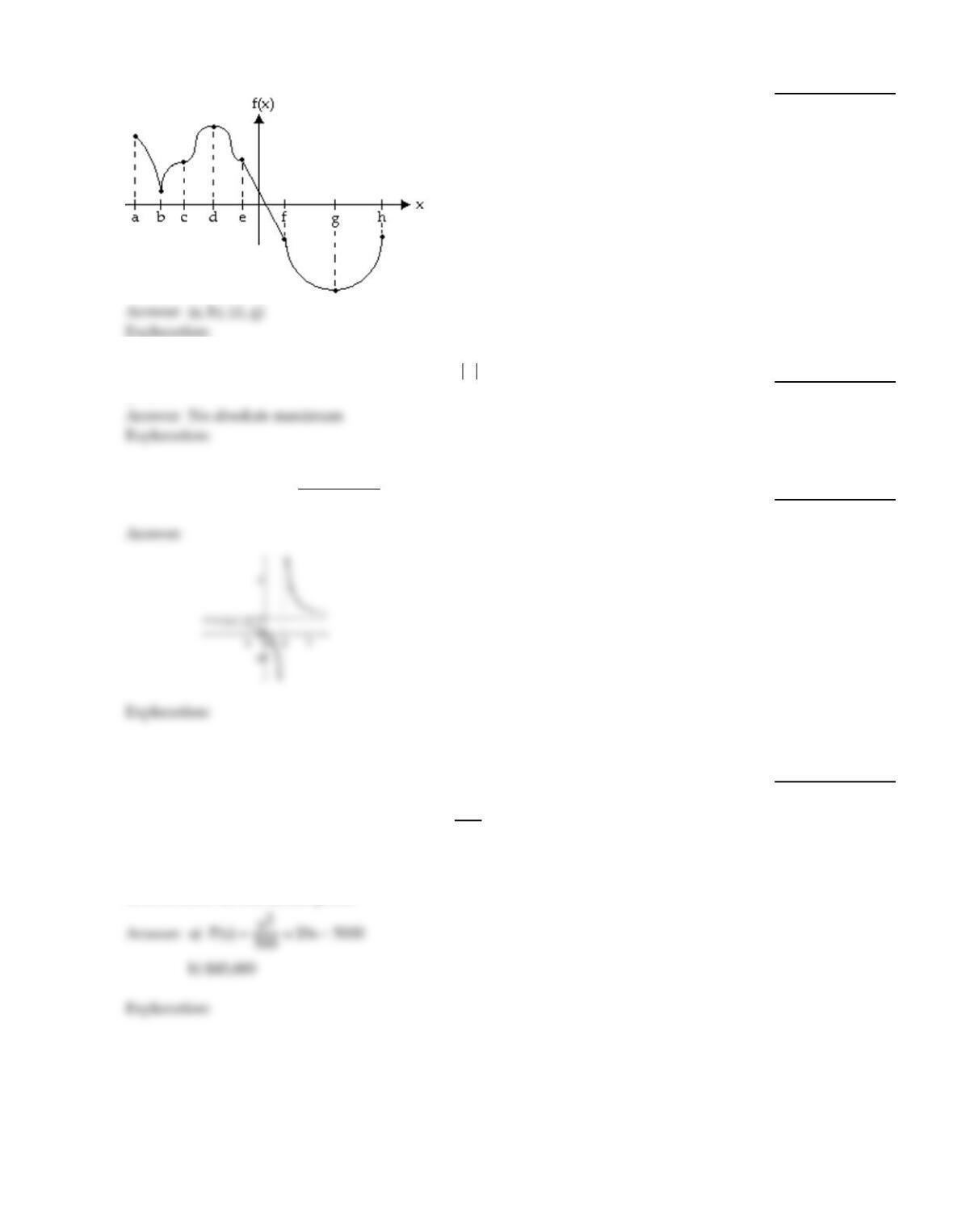
Write the sign chart that corresponds to the following graph of f(x)::
3)
4)
Identify the intervals where f(x) is decreasing.
4)
5)
Find the absolute maximum value of f(x) = 3x – ln x . Round your answer to four decimal
places.
5)
6)
Sketch the graph of f(x) =2x2+ 5x – 3
x2– 9 . Include sketch of all asymptotes.
6)
Solve the problem.
7)
The financial analysis department of a software design company determined that the cost
of producing x palm assistants is C(x) = 5000 + 3x. The department also determined the
associated price–demand equation to be p = 23 –x
500, where p is price in dollars.
a) Obtain the profit function.
b) Determine the maximum profit.
7)
3
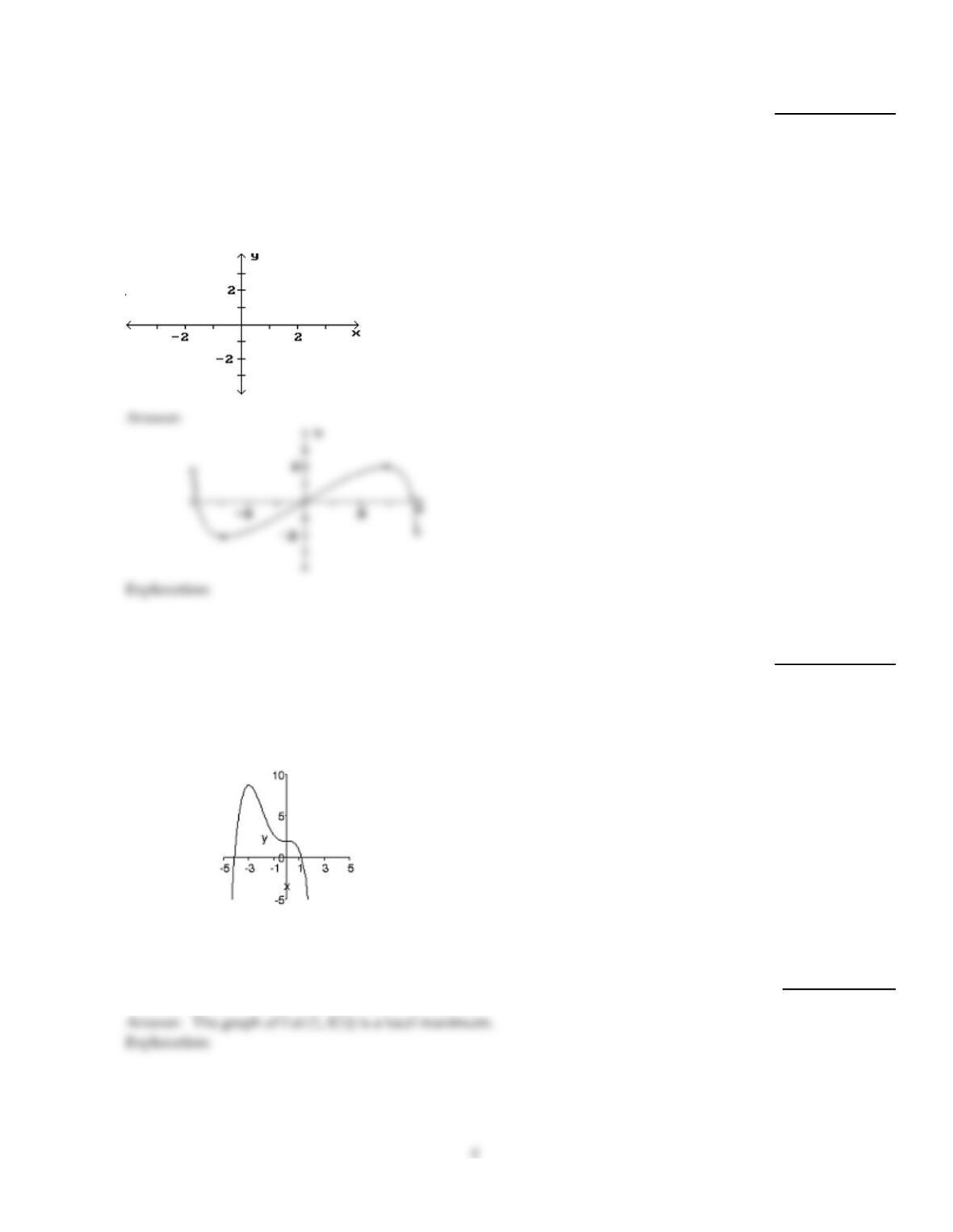
Sketch a graph of a single function that has these properties.
8)
a) Continuous and differentiable for all real numbers
b) f(x) < 0 on (– , –3 ) and ( 3 , )
c) f(x) > 0 on (–3 , 3)
d) f(x) > 0 on (– , 0 )
e) f(x) < 0 on ( 0 , )
f) f (–3) =f(3) = 0
g) An inflection point at (0,0)
8)
Provide an appropriate response.
9)
Consider the function f(x) = – 0.25x4–x3+ 2. Determine the intervals where f(x) is
increasing and decreasing, concave up and concave down and all local extrema. Use that
information to obtain a sketch of the function.
9)
Answer:
f(x) is increasing on (–, –3), decreasing on (–3, 0) (0, ); concave up on (–2, 0),
concave down on (–, –2) (0, ).Local max is at 8.75 at x = – 3.
Explanation:
10)
Suppose f is a continuous function. Describe the graph of f at (1, f(1)) if f'(1) = 0 and
f”(x) < 0.
10)
Answer:
Explanation:
Answer:
Explanation:
11)
Sketch the graph of f(x) =3x2+ 2x + 5
6x2+ 2 . Include sketch of all asymptotes.
11)
Solve the problem.
12)
A logo baseball cap manufacturer has a uniform annual demand of 25,000 caps. It costs $1
to store one baseball cap for 1 year and $500 to set up the plant for production of the logo
baseball caps. How many times a year should the company produce the caps in order to
minimize the total storage and set–up costs? (Assume that there are 250 working days per
year.)
12)
13)
A backpack manufacturer is planning to expand its work force. They estimate that the
number of backpacks produced by hiring new workers is given by
T(x) = – 0.25x4+4x3, 0 x
12. Determine when the rate of backpacks is increasing and
when it is decreasing. Determine the point of diminishing returns and the maximum rate
of change of backpack production.
13)
Provide an appropriate response.
14)
Sketch the graph of f(x) = x +3
x2. Include sketch of all asymptotes.
14)
5
15)
Find the absolute minimum value of f(x) = 4x ln x – 7x. Round your answer to three
decimal places.
15)
16)
Write the sign chart that corresponds to the following graph of f(x):
16)
Sketch a graph of a single function that has these properties.
17)
a) Continuous for all real numbers
b) Differentiable everywhere except x = 0
c) f(x) < 0 on (– , 0)
d) f(x) > 0 on ( 0 , )
e) f(x) < 0 on (– , 0) and (0, )
f) f(–2) = f (2) = 5
g) y–intercept and x–intercept at (0, 0)
17)
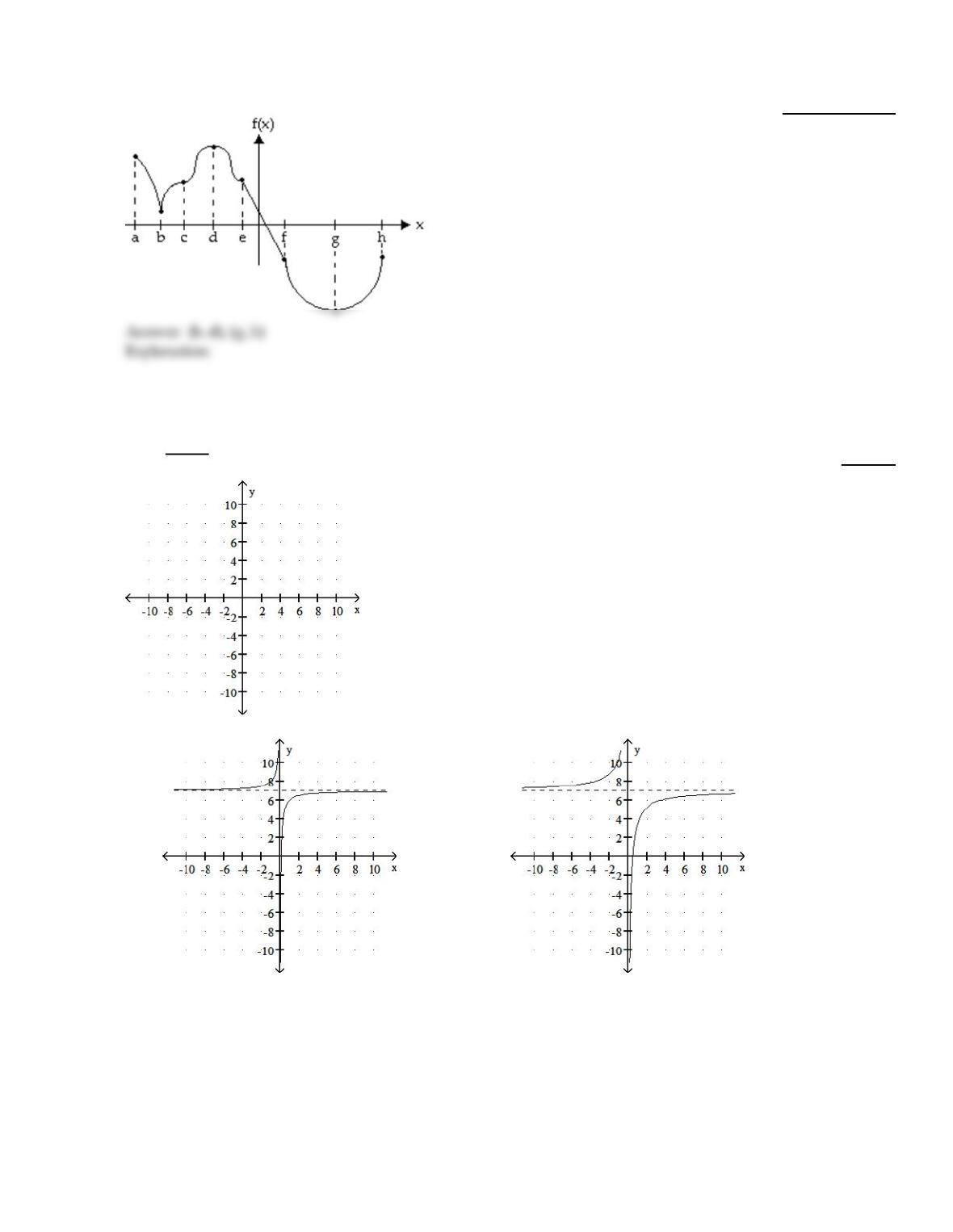
Provide an appropriate response.
18)
Identify the intervals where f(x) > 0.
18)
MULTIPLE CHOICE. Choose the one alternative that best completes the statement or answers the question.
Sketch a graph of the function.
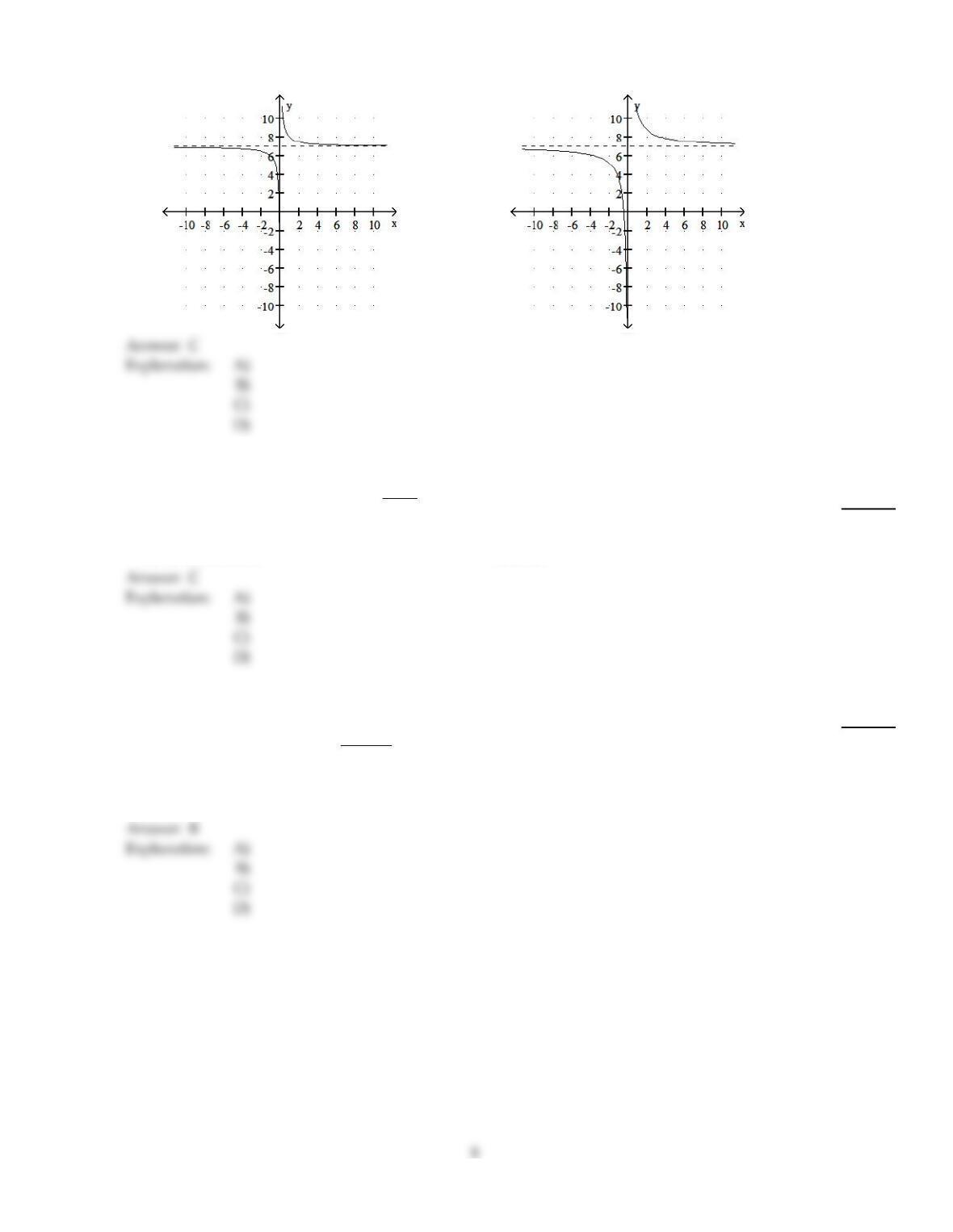
19)
f(x) =7x + 1
x
19)
A)
B)
7
C)
D)
Provide an appropriate response.
20)
Determine the interval(s) where f(x) =x2
x – 3 is decreasing.
20)
A)
(0, 3) and (6, )
B)
( , 0) and (6, )
C)
(0, 3) and (3, 6)
D)
(0, 6)
C
Solve the problem.
21)
The percent of concentration of a certain drug in the bloodstream x hr after the drug is
administered is given by K(x) =3x
x2+ 16 . How long after the drug has been administered is the
concentration a maximum? Round answer to the nearest tenth, if necessary.
21)
A)
3 hr
B)
4 hr
C)
0.8 hr
D)
1.6 hr
B
C
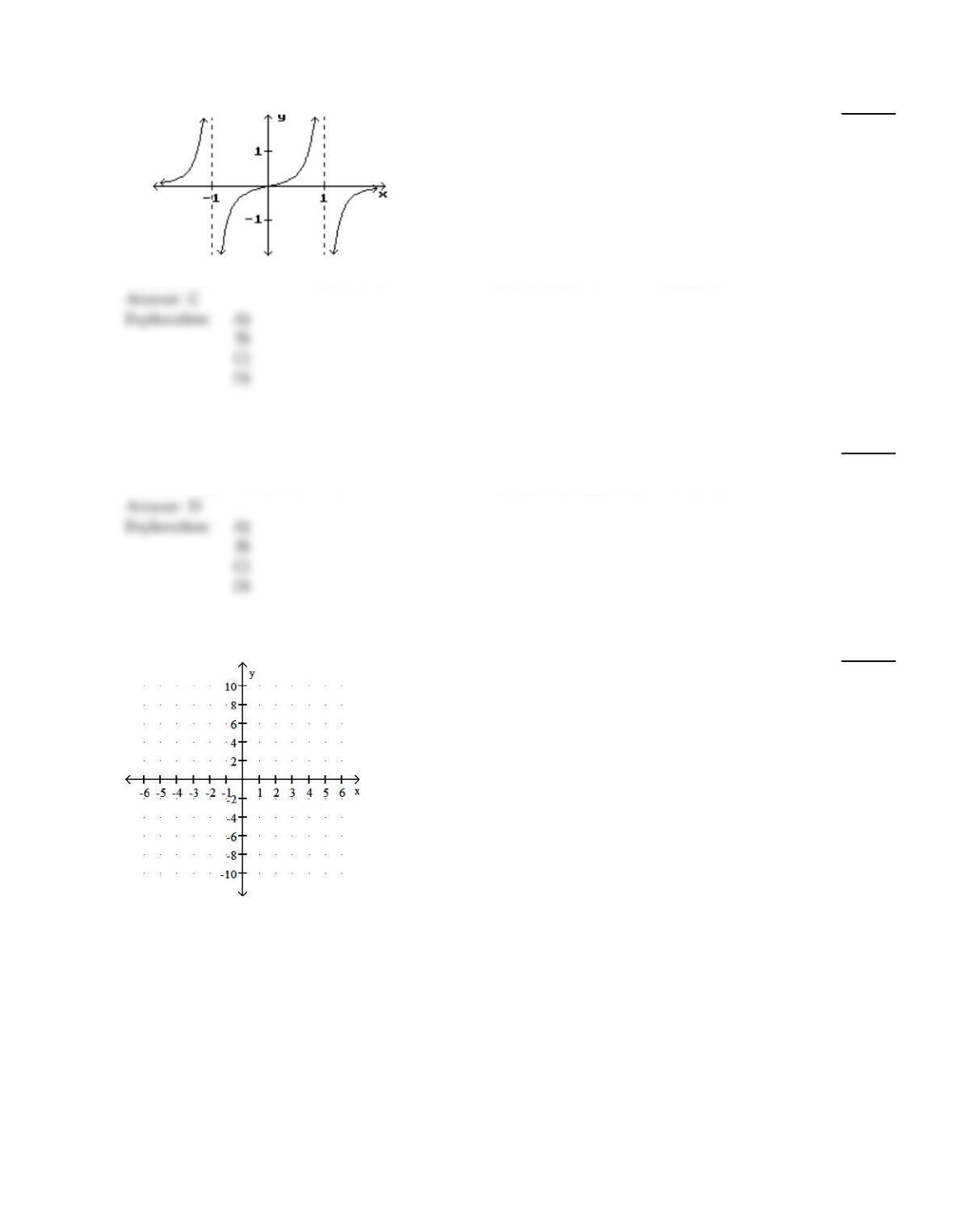
Find the intervals where f”(x) < 0 ir f”(x) > 0 as indicated.
22)
f”(x) < 0
22)
A)
(–1, 0)
B)
(–, –1)
C)
(–1, 0) , (1, )
D)
(1, )
Provide an appropriate response.
23)
Find the absolute minimum value of f(x) = 4x +x2+ 2 on [0, ).
23)
A)
Absolute minimum is 2 at x = 2.
B)
Absolute minimum is 2 at x = 6.
C)
Absolute minimum is 4 at x = 2.
D)
Absolute minimum is 2 at x = 0.
Sketch a graph of the function.
24)
f(x) =x4– 2x2+1
24)
9
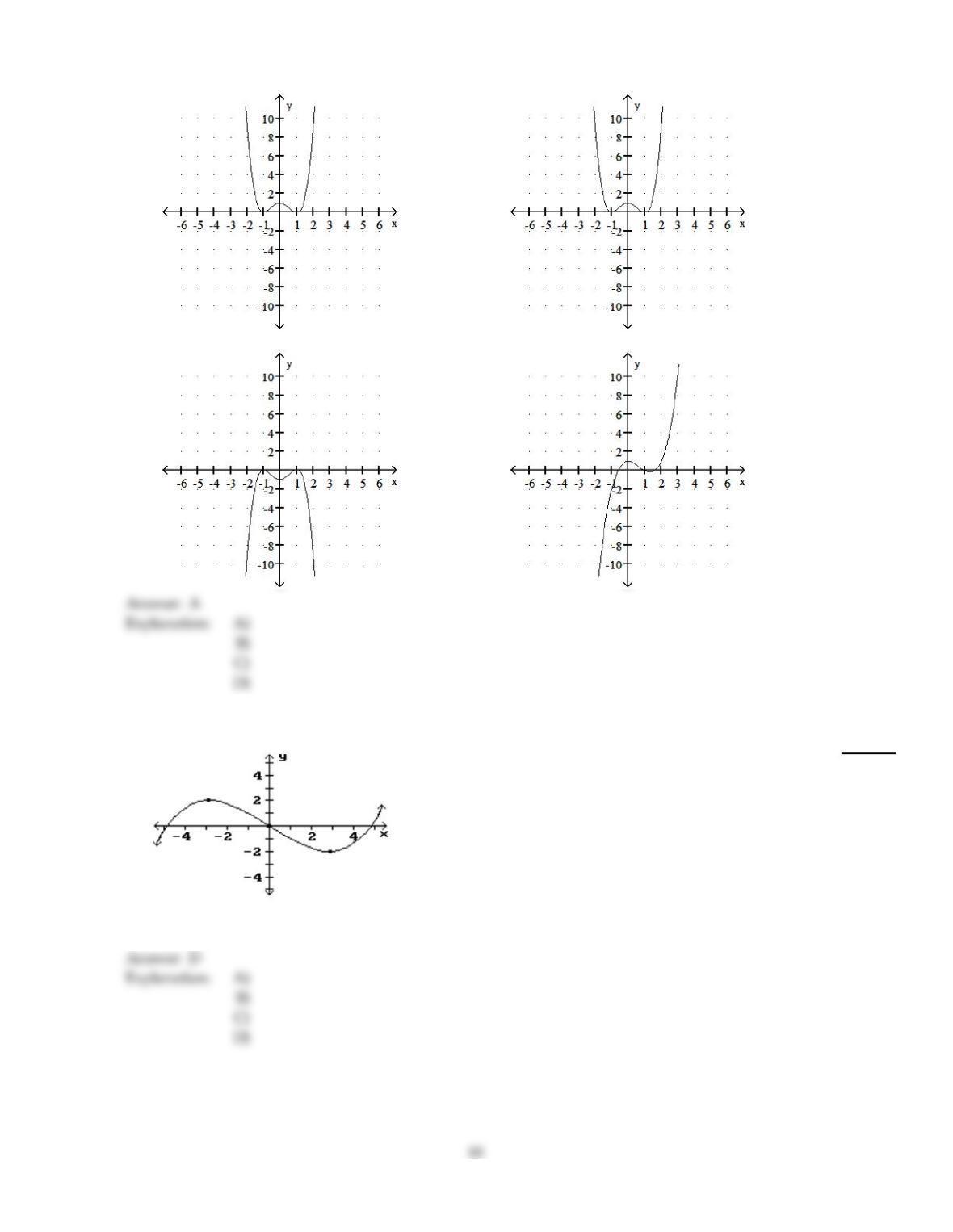
A)
B)
C)
D)
Find the intervals where the function has the indicated concavity. Give the x coordinates of inflection points.
25)
Concave upward
25)
A)
(–3, ); x = 0
B)
(0, ); no inflection points
C)
(–3, 3); x = 0
D)
(0, ); x = 0
D
A
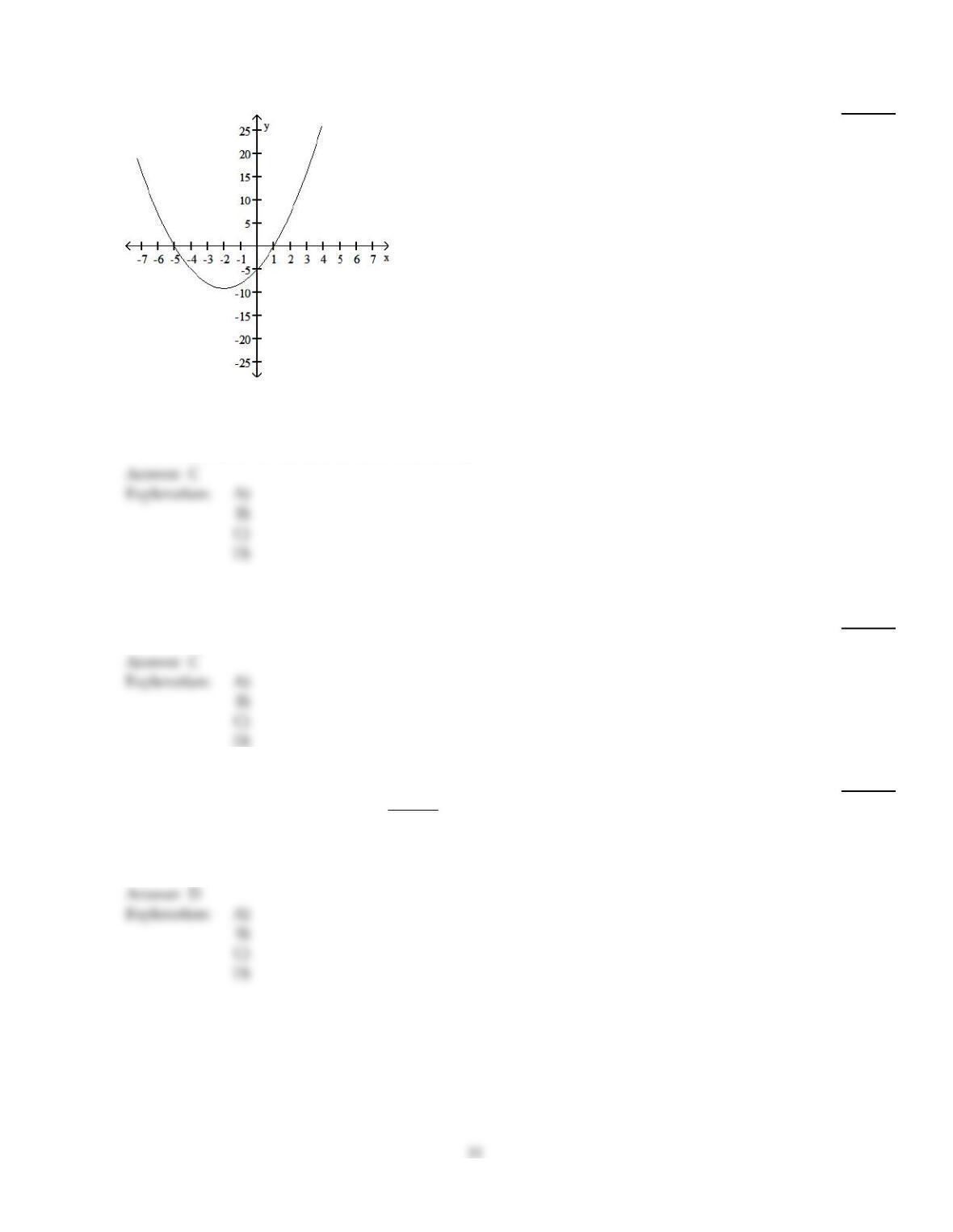
Use the given graph of f(x) to find the intervals on which f(x) > 0.
26)
26)
A)
f(x) < 0 on (–,)
B)
f(x) > 0 on [-5, ), f(x) < 0 on (–, -5]
C)
f(x) > 0 on [-2, ), f(x) < 0 on decreasing on (–, -2]
D)
f(x) > 0 on (–, –5] [1, ), f(x) < 0 on [–5, 1]
Provide an appropriate response.
27)
Determine the interval(s) over which f(x) = (x –4)3 is concave downward.
27)
A)
(4, )
B)
(–, –4)
C)
(–, 4)
D)
(–4, )
28)
The percent of concentration of a acid absorbed in a new manufacturing process after x hr after the
acid has been mixed is given by A(x) =4x
x2+ 49 How long after the acid has been added is the
concentration a maximum? Round answer to the nearest tenth, if necessary.
28)
A)
4.9 hr
B)
4 hr
C)
2.5 hr
D)
7 hr
29)
Find the absolute maximum and absolute minimum values of the function f(x) =x4–6x2 on the
interval [0, 3].
29)
A)
Absolute maximum: f(0) =0; absolute minimum: f(2) = – 8
B)
Absolute maximum: f(3) = 27; absolute minimum: f( 3) = – 9
C)
Absolute maximum: f(3) = – 27; absolute minimum: f( 3) = – 9
D)
This function has no absolute maximum or minimum on the given interval.
30)
Find the relative extrema of the function. List your answer(s) in terms of ordered pair(s).
f(x) = 20x3– 3x5
30)
A)
Relative minimum: (–2 , –64)
Relative maximum: (2 , 64)
B)
Relative minimum: (–2, –64)
Relative maximum: (0, 0)
C)
Relative minimum: (–2 , –64)
Relative minimum: (0, 0)
Relative maximum: (2 , 64)
D)
Relative maximum: (0, 0)
Relative minimum: (2, 64)
Solve the problem.
31)
A computer software company sells 20,000 copies of a certain computer game each year. It costs the
company $1.00 to store each copy of the game for one year. Each time it must produce additional
copies, it costs the company $625 to set up production. How many copies of the game should the
company produce during each production run in order to minimize its total storage and set–up
costs?
31)
A)
20,000 copies in 1 production run
B)
10,000 copies in 2 production runs
C)
4000 copies in 5 production runs
D)
5000 copies in 4 production runs
Provide an appropriate response.
32)
Find f”(x) for f(x) = 5x4– 6x2+ 7.
32)
A)
f”(x) = 60x2– 12x
B)
f”(x) = 20x2– 12
C)
f”(x) = 20x2– 12x
D)
f”(x) = 60x2– 12
12
Solve the problem.
33)
A company wishes to manufacture a box with a volume of 16 cubic feet that is open on top and is
twice as long as it is wide. Find the width of the box that can be produced using the minimum
amount of material. Round to the nearest tenth, if necessary.
33)
A)
4.2 ft
B)
2.1 ft
C)
2.9 ft
D)
5.8 ft
Provide an appropriate response.
34)
Use a graphing utility to approximate the intervals where f(x) is decreasing and intervals where
f(x) is increasing for the function f(x) =x4–3x3–2x2+ 5x. Round your answer to two decimal
places.
34)
A)
decreasing on ( , –0.82); increasing on (–0.82, 0.62)
B)
increasing on ( , –0.82) and (0.62, 2.45); decreasing on (–0.82, 0.62) and (2.45, )
C)
decreasing on ( , –0.82) and (0.62, 2.45); increasing on (–0.82, 0.62) and (2.45, )
D)
increasing on ( , –0.82); decreasing on (–0.82, 0.62)
35)
Find all inflection points for f(x) =x4–10x3+24x2+ 3x + 5.
35)
A)
Inflection points at x = 0, x = 1, x = 4
B)
Inflection points at x = 1, x = 4
C)
Inflection points at x –0.06, x
2.43, x
5.13
D)
This function does not have any inflection points.
36)
The critical values of f(x) = 4x3– 48x + 24 are x = – 2 and x = 2. Use the first derivative test to
determine which of the critical values correspond to a local maximum.
36)
A)
x = 0 and x = 2
B)
x = 2 and x = – 2
C)
x = 2
D)
x = – 2
13
37)
Given f(x) = x +16
x, x < 0, find the values of x corresponding to local maxima and local minima.
37)
A)
no local maximum or minimum
B)
local maximum at x = – 4, local minimum at x = 4
C)
local maximum at x = – 4 (no local minimum)
D)
local minimum at x = – 4 (no local maximum)
Find the domain and intercepts.
38)
f(x) =3x +6
38)
A)
Domain: (–2, ); y intercept: 6; x intercept: –2
B)
Domain: ( , ); y intercept: 6; x intercept: 2
C)
Domain: ( , ); y intercept: –2; x intercept: 6
D)
Domain: ( , ); y intercept: 6; x intercept: –2
Solve the problem.
39)
The cost of manufacturing x electric woks in one day is given by C(x) = 2x3–16x2+ 4x. Find the
average cost per electric wok and the interval where the average cost per electric wok is decreasing.
39)
A)
C(x) = 2x2– 16x + 4; 0 < x < 4
B)
C(x) = 6x2– 32x + 4; 0 < x < 4
C)
C(x) = 2x2– 32x + 4; 0 < x < 4
D)
C(x) = 6x2– 32x + 4; x < 4
Provide an appropriate response.
40)
Find the relative extrema of the function. List your answer(s) in terms of ordered pair(s).
f(x) = 5 –x2
40)
A)
Relative maximum: (0, 5)
B)
Relative minimum: (0, 5)
C)
Relative minima: (–5, 0); ( 5, 0)
D)
Relative maximum: (5, 5)
41)
Find the inflection point(s) for f(x) =1
4x4–x3+ 6.
41)
A)
(0, 0)
B)
(0, 6) and (2, 2)
C)
(0, 0) and (2, 2)
D)
(0, 6) and (2, –4)
42)
Find the absolute minimum value of f(x) = x +9
x on (0, ).
42)
A)
Absolute maximum is 3 at x = 6.
B)
Absolute minimum is 3 at x = 6.
C)
Absolute minimum is 6 at x = 3.
D)
Absolute maximum is 6 at x = 3.
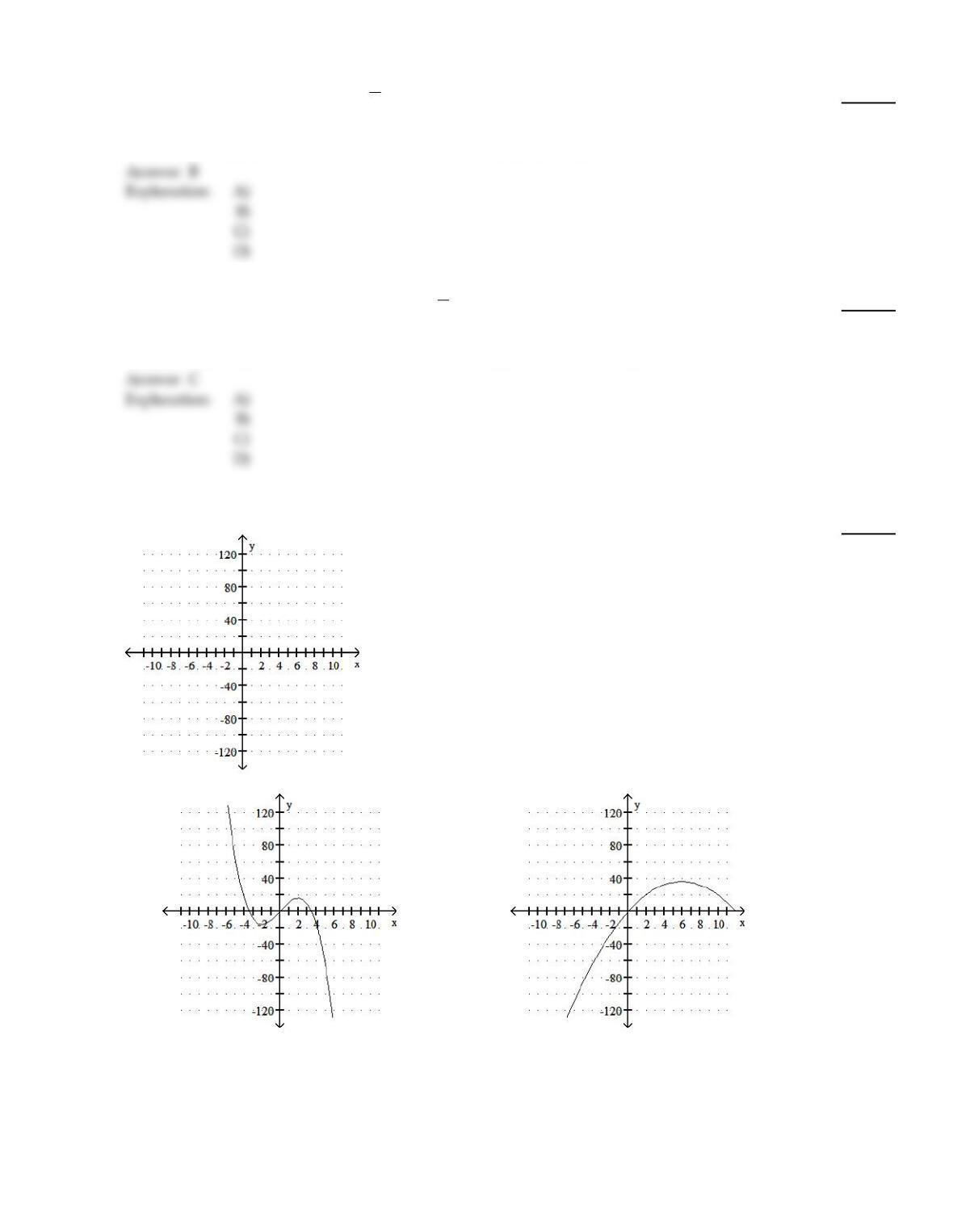
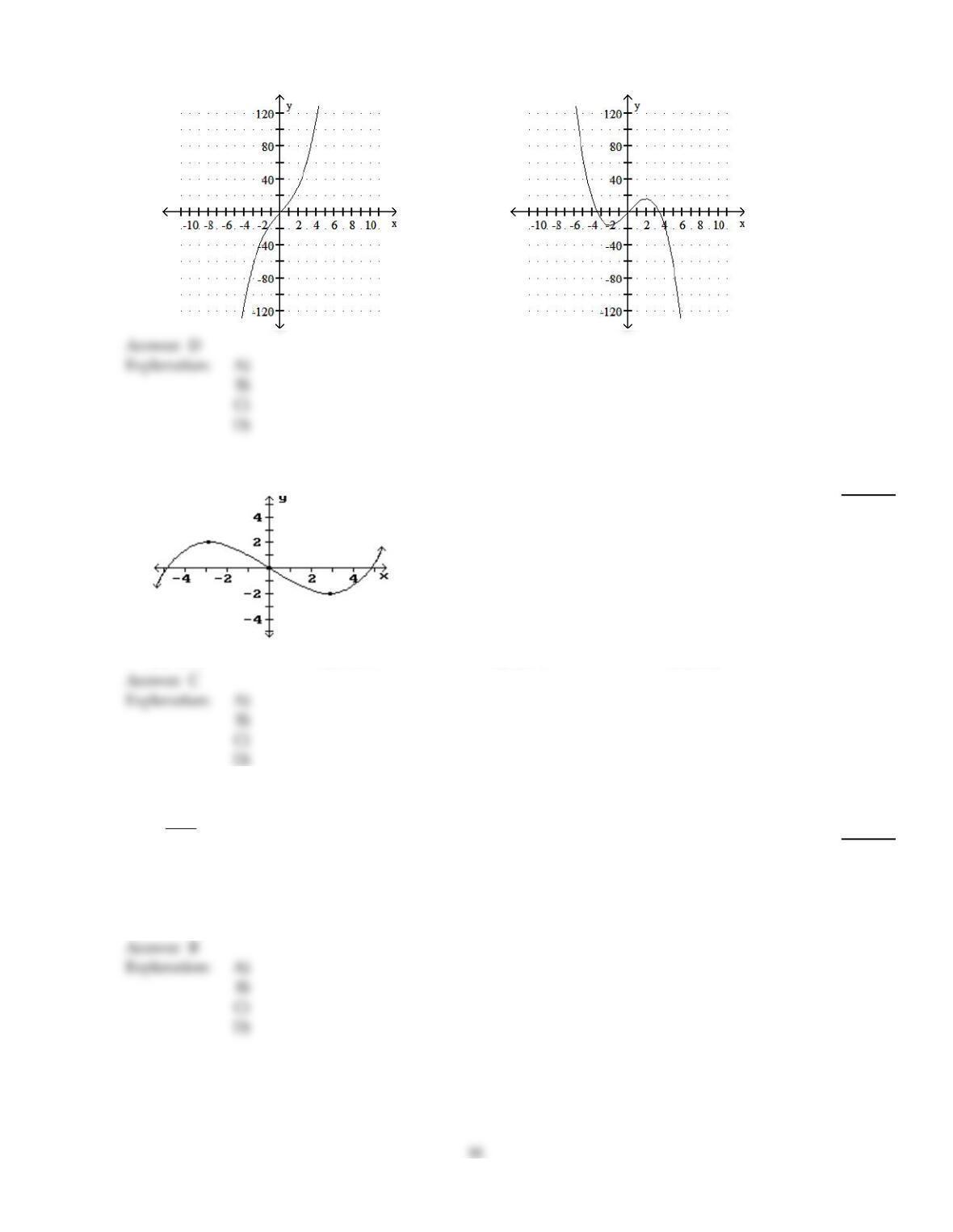
Sketch a graph of the function.
43)
f(x) =12x –x3
43)
A)
B)
15
C)
D)
Find the intervals where f”(x) < 0 ir f”(x) > 0 as indicated.
44)
f”(x) > 0
44)
A)
(–3, 3)
B)
(–3, )
C)
(0, )
D)
(0, 3)
Find the domain and intercepts.
45)
f(x) =6x
x – 3
45)
A)
Domain: ( , 3); y intercept: 0; x intercept: 0
B)
Domain: All real numbers except 3; y intercept: 0; x intercept: 0
C)
Domain: All real numbers except 3; y intercept: 0; no x intercept
D)
Domain: All real numbers except -3; y intercept: 0; x intercept: 0
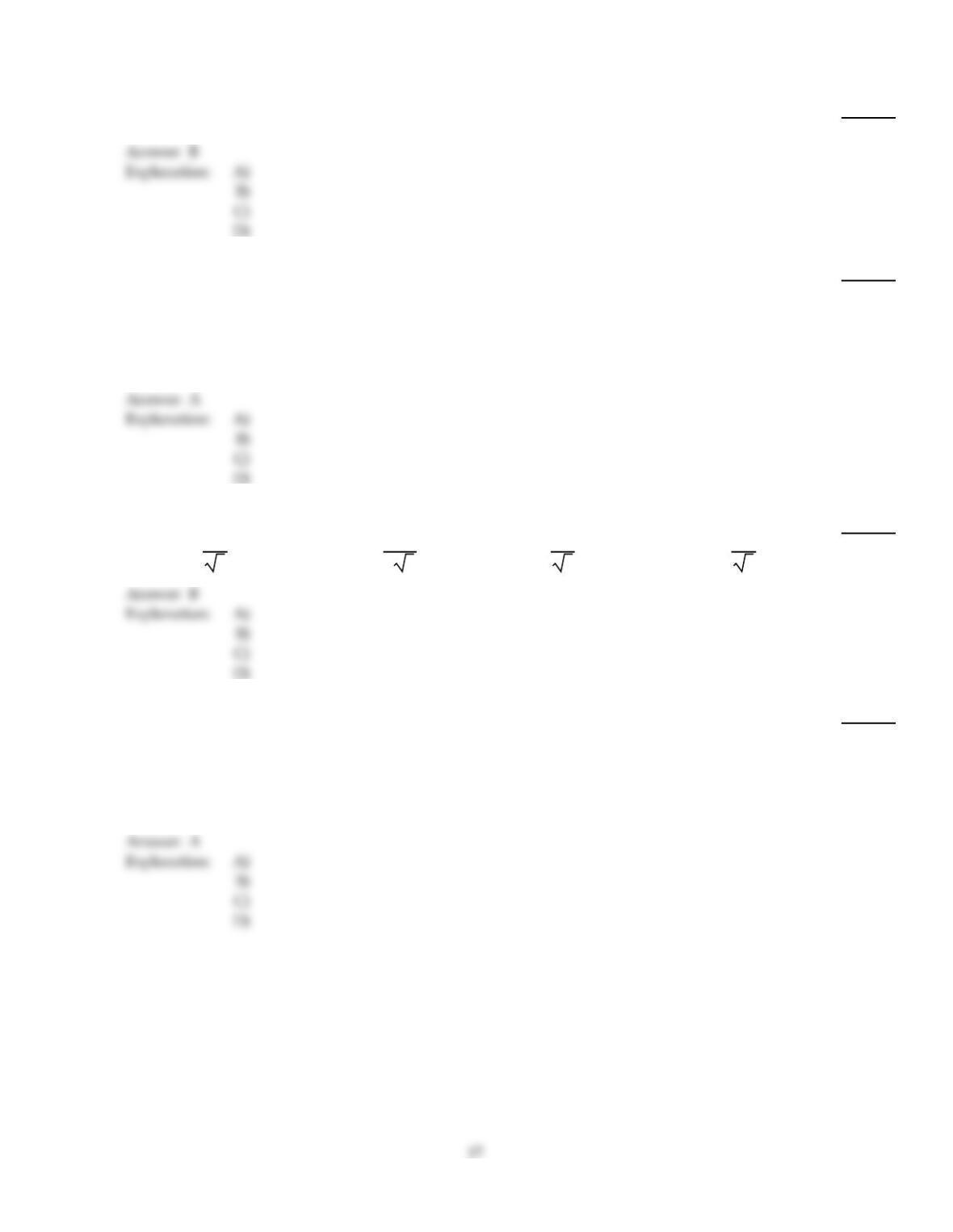
Provide an appropriate response.
46)
Find the inflection point(s) for f(x) =x3– 6x – 1.
46)
A)
(–1, 6)
B)
(0, –1)
C)
(1, –1)
D)
(0, –6)
47)
Use a graphing utility to approximate where the local extrema of the function
f(x) =x4–3x3–2x2+ 5x are to two decimal places.
47)
A)
local max at x
0.62; local min at x –0.82 and x
2.45
B)
local min at x –0.62 and x
2.45
C)
local max at x
0.82
D)
local min at x
0.62; local max at x –0.82 and x
2.45
48)
Find y” for y =x4–8x1/2
48)
A)
4x3–4
x
B)
12x2+2
x x
C)
4x3+4
x
D)
12x2–4
x
49)
Find the critical values and determine the intervals where f(x) is increasing and the intervals where
f(x) is decreasing for the function f(x) =x3+3x2– 24x + 6.
49)
A)
increasing on ( , –4) and (2, ); decreasing on (–4, 2)
B)
increasing on ( , –4); decreasing on (–4, 2)
C)
increasing on ( , –4) and (2, ); decreasing on (–4, )
D)
decreasing on ( , –4) and (2, ); increasing on (–4, 2)
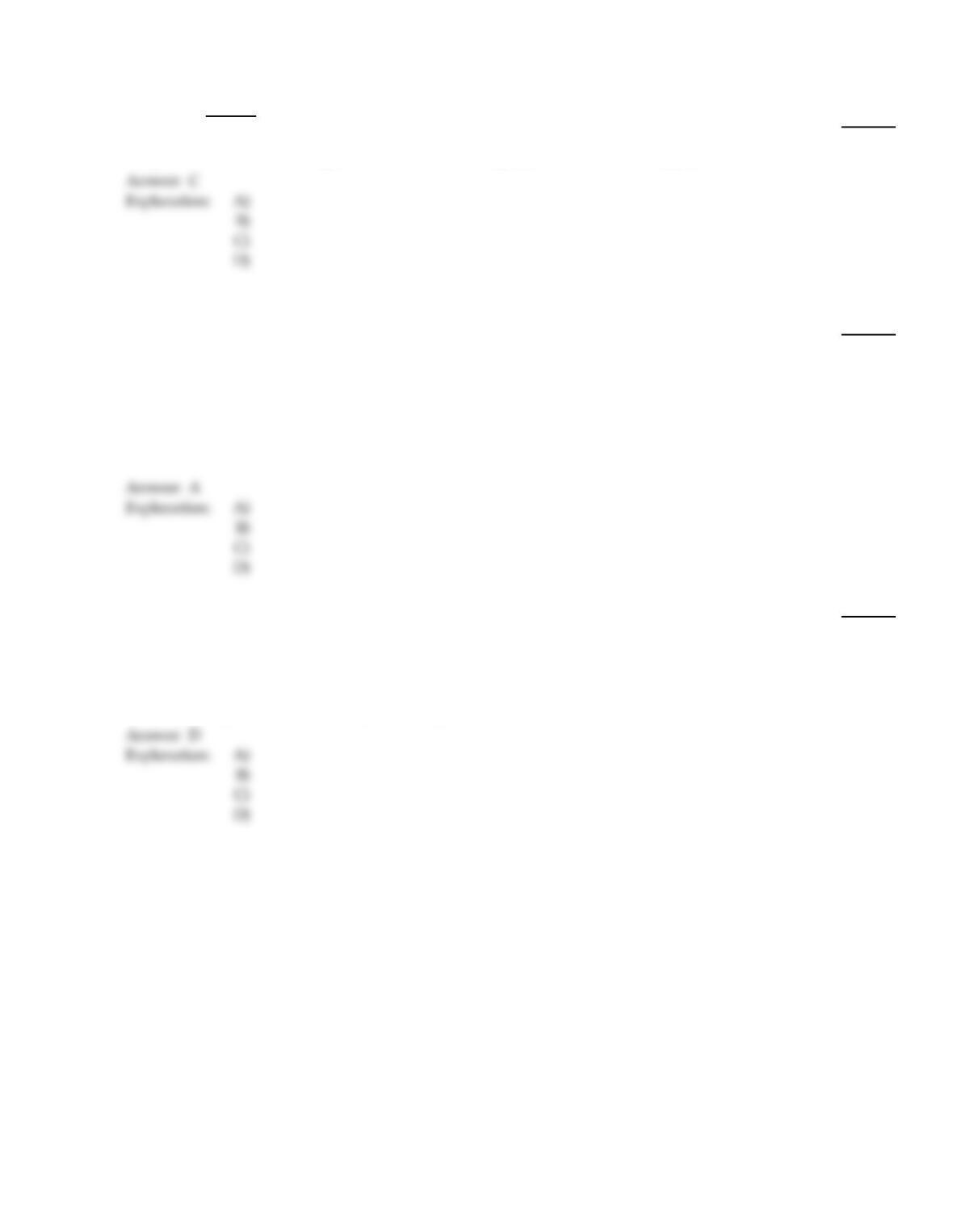
Find the limit, if it exists.
50)
Find lim
x
3
x4– 81
x – 3 .
50)
A)
0
B)
3
C)
108
D)
81
Provide an appropriate response.
51)
Find the absolute maximum and minimum values of f(x) = 9x3– 54x2+ 81x + 13 on the interval
[–6, 2].
51)
A)
max f(x) = f(1) = 49
min f(x) = f(–6) = – 4361
B)
max f(x) = f(1) = 4361
min f(x) = f(–6) = – 49
C)
max f(x) = f(1) = 4361
min f(x) = f(–6) = 49
D)
max f(x) = f(–6) = – 4361
min f(x) = f(1) = 49
52)
Find the critical values and determine the intervals where f(x) is decreasing and the intervals where
f(x) is increasing for f(x) =3x4–6x2+ 7.
52)
A)
decreasing on (–1, 0) and (1, ); increasing on ( , –1) and (0, 1)
B)
increasing on (–1, 0); decreasing on ( , –1) and (0, 1)
C)
decreasing on (–1, 0) and (1, ); increasing on ( , –1)
D)
increasing on (–1, 0) and (1, ); decreasing on ( , –1) and (0, 1)
Sketch the graph and show all local extrema and inflection points.
18
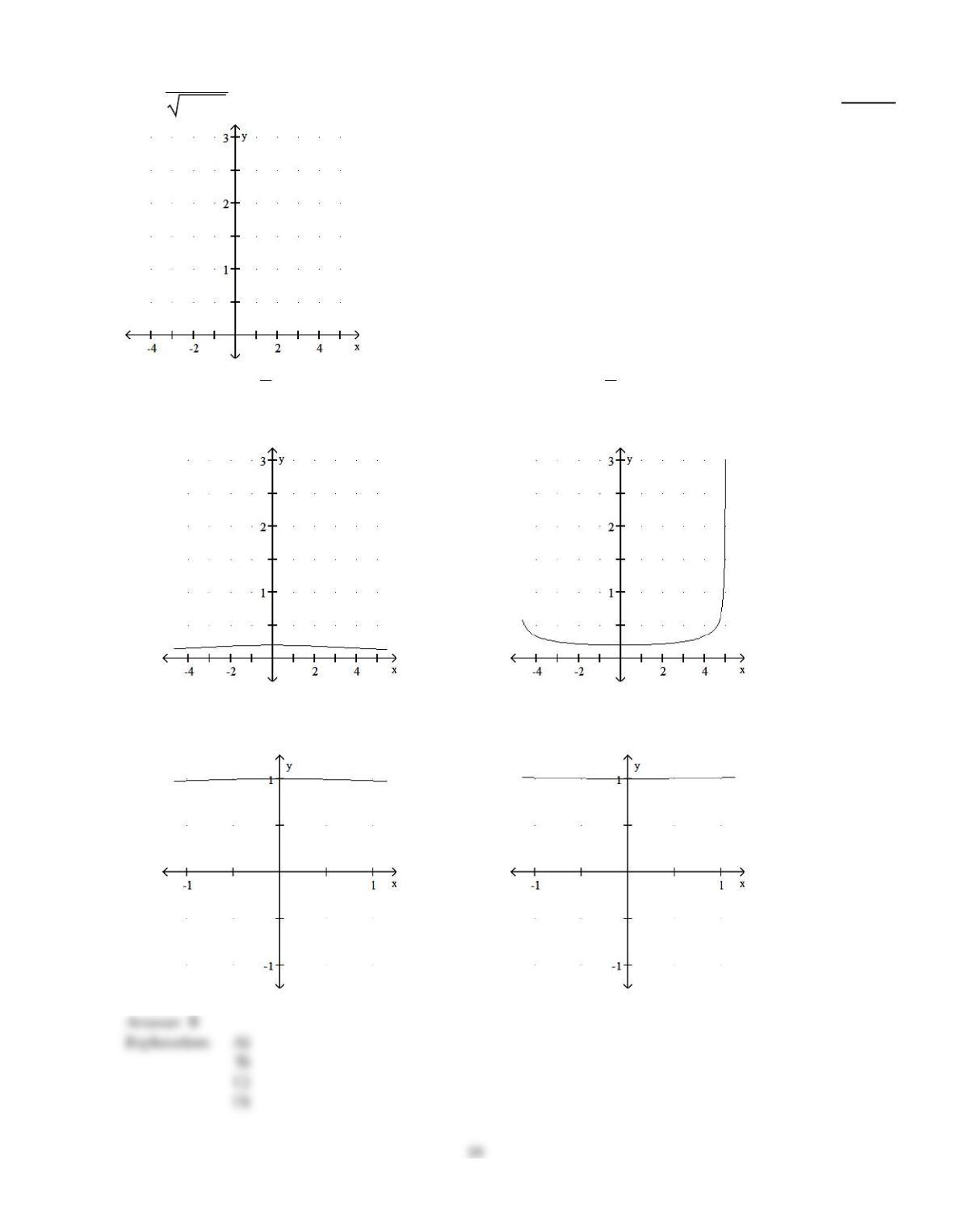
53)
f(x) =1
25 – x2
53)
A)
Local max: (0, 1
5)
No inflection point
B)
Local min: (0, 1
5)
No inflection point
C)
Local max: (0, 1)
No inflection point
D)
Local min: (0, 1)
No inflection point
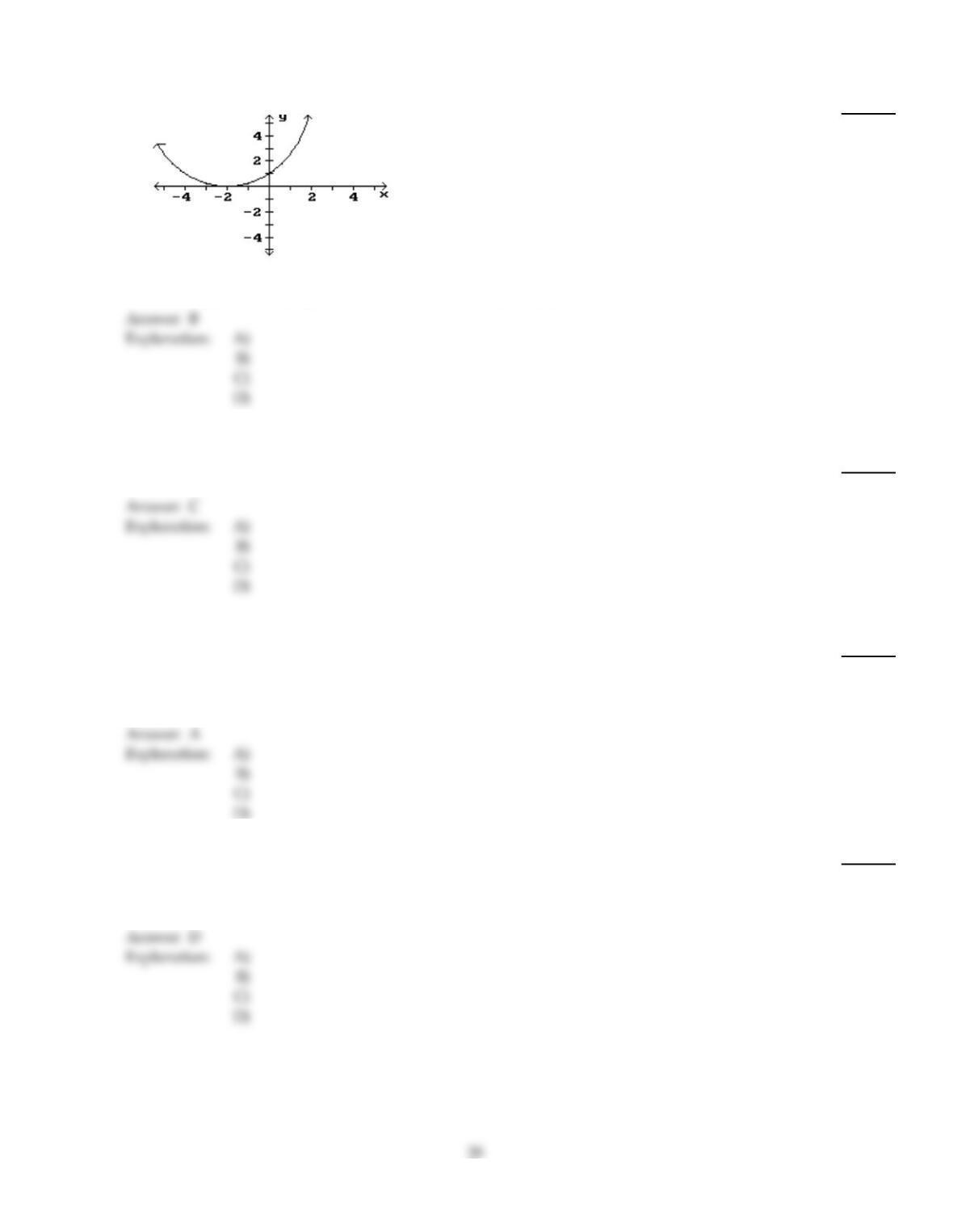
Find the intervals where the function has the indicated concavity. Give the x coordinates of inflection points.
54)
Concave upward
54)
A)
(–2, ); no inflection points
B)
(–, ); no inflection points
C)
(–, –2); no inflection points
D)
(–, ); x = – 2
Provide an appropriate response.
55)
Determine the interval(s) over which f(x) = (x +3)3 is concave upward.
55)
A)
(–, )
B)
(–3, )
C)
(–, –3)
D)
(–, 3)
C
Solve the problem.
56)
The Olympic flame at the 1992 Summer Olympics was lit by a flaming arrow. As the arrow moved
d feet horizontally from the archer, assume that its height h(d), in feet, was approximated by the
function h(d) = – 0.002d2+ 0.7d + 6.9. Find the relative maximum of the function.
56)
A)
(175, 68.15)
B)
(0, 6.9)
C)
(350, 129.4)
D)
(175, 61.25)
A
57)
A bookstore has an annual demand for 104,000 copies of a best–selling book. It costs $0.90 to store
one copy for one year, and it costs $80 to place an order. Find the optimum number of copies per
order.
57)
A)
4532 copies
B)
3870 copies
C)
4416 copies
D)
4300 copies
D
B