17) In a diagram showing the average total cost and average variable cost curves, the minimum
point of the average total cost is
A) at the same level of output as the minimum point of the average variable cost.
B) at a larger level of output than the minimum point of the average variable cost.
C) at a lower level of output than the minimum point of the average variable cost.
D) at the same level of output as the maximum of the total product curve.
18) A firm’s short-run average total cost curve is parallel to its short-run average variable cost
curve.
19) As output increases, the distance between average total cost and average variable cost
increases.
42
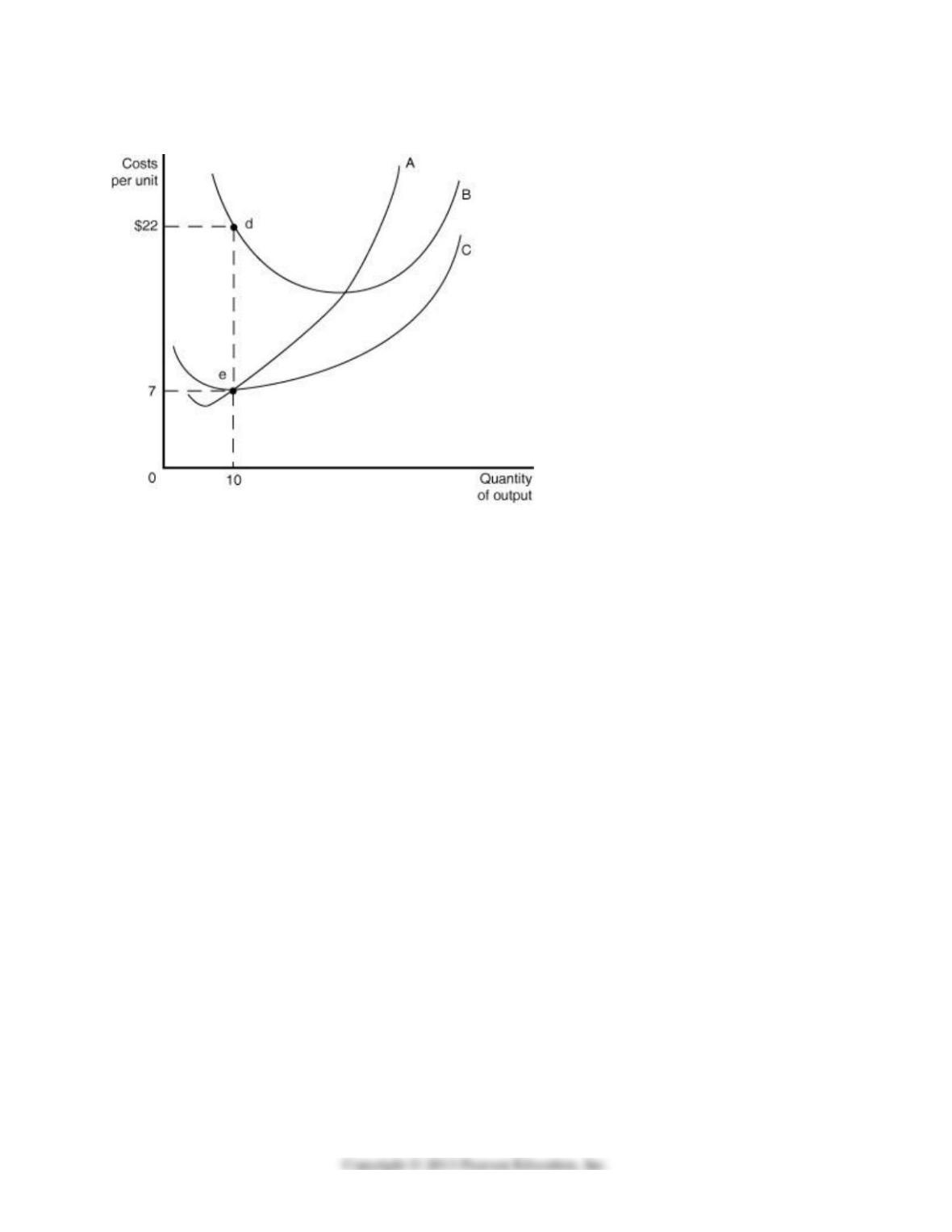
Figure 11-4
20) Refer to Figure 11-4 above to answer the following questions.
a. Identify the curves in the diagram.
A ________________________________________
B ________________________________________
C ________________________________________
b. What is the numerical value of fixed cost when the quantity of output=10?
c. What is the numerical value of variable cost when the quantity of output=10?
d. What is the numerical value of total cost when the quantity of output =10?
e. What is the numerical value of average fixed cost when the quantity of output =10?
f. What is the numerical value of average total cost when the quantity of output =10?
g. On the graph identify the area that represents the total variable cost of production when the
quantity of output =10.
h. On the graph identify the area that represents the fixed cost of production when the quantity
of output =10.
21) Use the general relationship between marginal and average values to explain why a marginal
cost curve must intersect an average total cost curve and an average variable cost curve at their
minimum points.
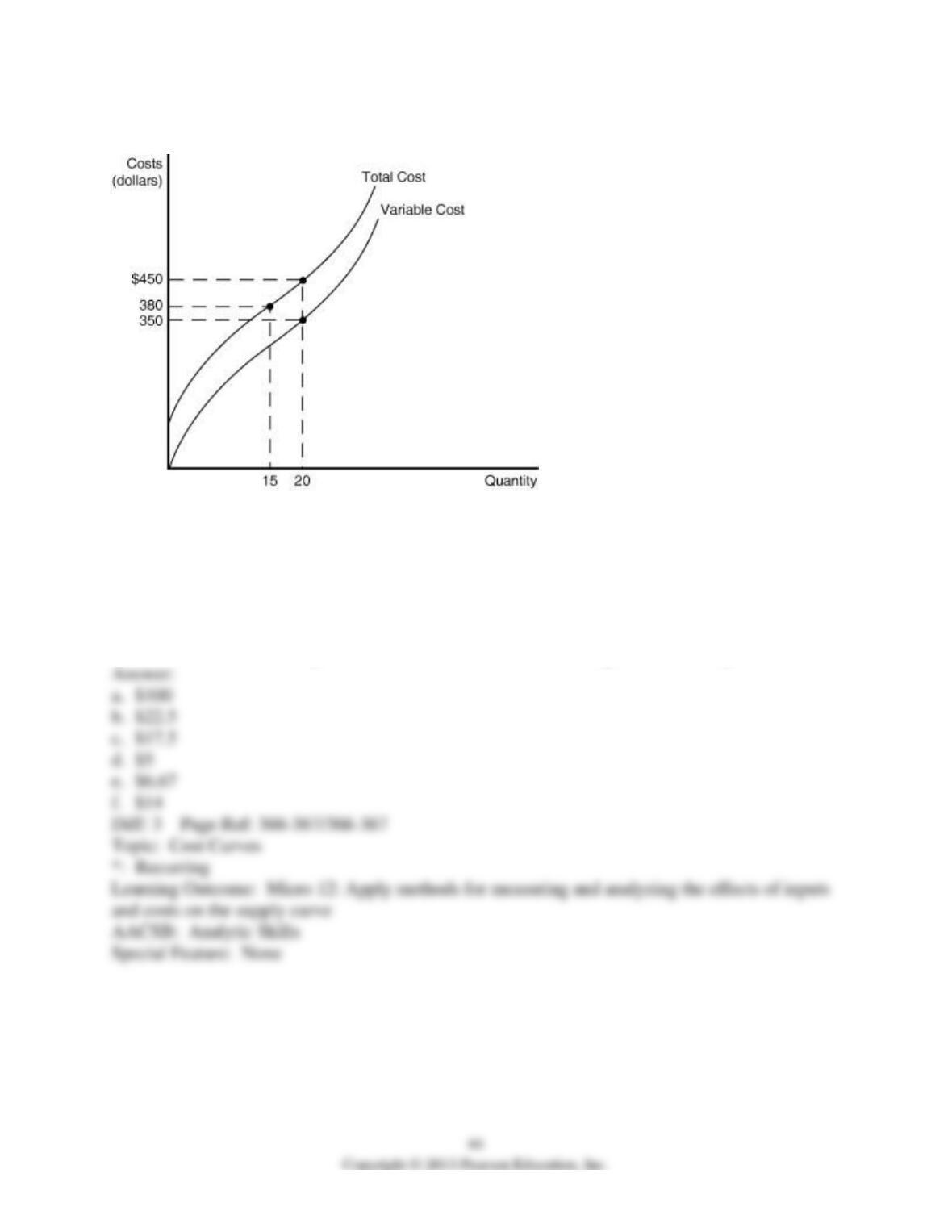
Figure 11-5
22) Refer to Figure 11-5 above to solve the following problems.
a. Calculate the fixed cost of production.
b. Calculate the average total cost of production when the firm produces 20 units of output.
c. Calculate the average variable cost of production when the firm produces 20 units of output.
d. Calculate the average fixed cost of production when the firm produces 20 units of output.
e. Calculate the average fixed cost of production when the firm produces 15 units of output.
f. If the firm increases output from 15 to 20 units what is the marginal cost of output?
11.6 Costs in the Long Run
1) In the long run
A) the firm’s fixed costs are greater than its fixed costs in the short run.
B) all of the firm’s costs are explicit costs; there are no implicit costs of production.
C) the firm is more profitable than it is in the short run.
D) all of the firm’s costs are variable costs.
2) Which of the following statements regarding a firm’s long-run average total cost (LRATC)
curve and its short-run average total cost (SRATC) curve is true?
A) The shape of the LRATC is affected by the law of diminishing returns.
B) The SRATC, but not the LRATC, can be used by a firm’s managers for planning.
C) The LRATC shows the lowest cost at which a firm is able to produce a given level of output
when no inputs are fixed.
D) The contribution of average fixed cost to LRATC is greater than its contribution to SRATC.
3) If a firm’s long-run average total curve shows that it can produce 5,000 DVDs at an average
cost of $2.00 and 15,000 DVDs at an average cost of $1.50 this is evidence of
A) diminishing returns.
B) economies of scale.
C) diseconomies of scale.
D) the law of supply.
4) Economies of scale occur when
A) a firm’s long-run average total costs fall as it increases the quantity of output it produces.
B) the marginal product of labor is greater than the average product of labor.
C) short-run marginal cost falls.
D) the demand for a firm’s output increases.
5) In 1955, the chairman of the Sony corporation offered to sell transistor radios through
department stores in the United States. Sony based its selling price on its average total cost of
production. If a store bought 5,000 radios, Sony would sell them at $29.95 each. For 10,000 there
would be a discount, and for more than 10,000 the price would begin to climb. Based on this
information, Sony began experiencing diseconomies of scale
A) at a quantity of less than 5,000 radios.
B) at a quantity between 5,000 and 10,000 radios.
C) at a quantity of 10,000 radios.
D) at a quantity just greater than 10,000 radios.
6) In 1955, the chairman of the Sony corporation offered to sell transistor radios through
department stores in the United States. Sony based its selling price on its average total cost of
production. If a store bought 5,000 radios, Sony would sell them at $29.95 each. For 10,000 there
would be a discount, and for more than 10,000 the price would begin to climb. Based on this
information, Sony experienced economies of scale
A) only at quantities up to 5,000 radios.
B) only at quantities between 5,000 and 10,000 radios.
C) only at quantities between 0 and 10,000 radios.
D) only at quantities above 10,000 radios.
7) If an airport decides to expand by building an additional passenger terminal, and in doing so it
lowers its average cost per airplane landing, it was previously operating at
A) minimum efficient scale.
B) more than minimum efficient scale.
C) less than minimum efficient scale.
D) minimum capacity.
8) If an airport decides to expand by building an additional passenger terminal, and in doing so it
lowers its average cost per airplane landing, then the expansion would provide ________ to the
airlines.
A) economies of scale
B) diseconomies of scale
C) higher average costs but lower total costs
D) higher marginal costs but lower total costs
9) Which of the following is not a reason why firms experience economies of scale?
A) Technology can make it possible to increase production with a smaller increase in at least one
input.
B) Workers and managers can become more specialized, enabling them to be more productive.
C) Larger firms may be able to purchase inputs at lower costs than smaller competitors.
D) As output increases, the managers can begin to have difficulty coordinating the operations of
their firms.
10) Diseconomies of scale occur when
A) long-run average costs rise as a firm increases its output.
B) long-run average cost fall as a firm expands its plant size.
C) short-run average costs rise as a firm expands its plant size.
D) long-run labor costs rise as a firm increases its output.
11) A curve showing the lowest cost at which a firm is able to produce a given level of output in
the long run is
A) a long-run production function.
B) a long-run marginal cost curve.
C) a minimum efficient scale curve.
D) a long-run average total cost curve.
12) The level of output at which all economies of scale have been exhausted is known as
A) constant returns to scale.
B) minimum efficient scale.
C) the economically efficient output level.
D) optimal economic size.
13) Minimum efficient scale is defined as the level of output at which
A) all economies of scale are exhausted.
B) diminishing returns affect average total cost.
C) the firm’s long-run average total cost starts falling.
D) the maximum output is produced.
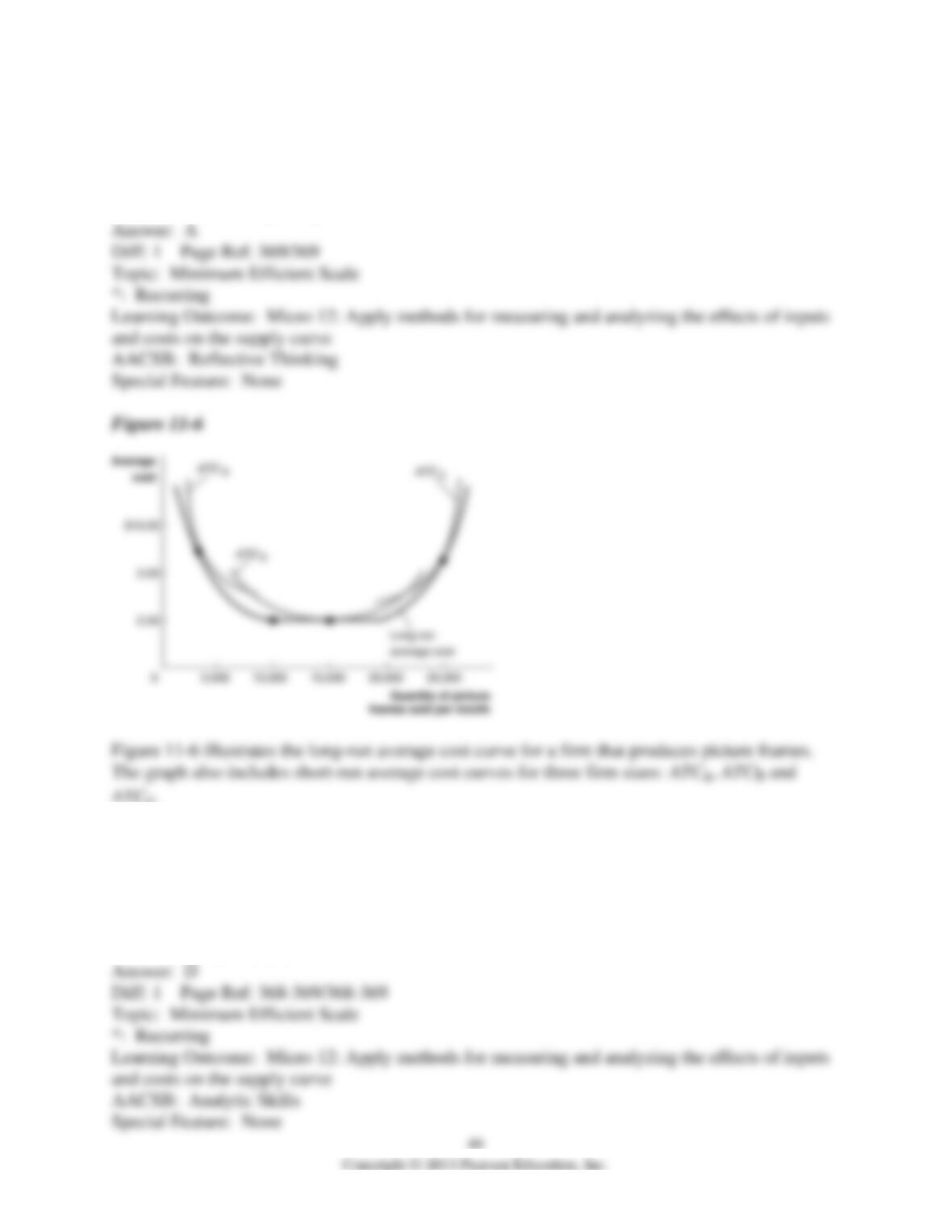
14) Refer to Figure 11-6. The minimum efficient scale of output is reached at what rate of
output?
A) 10,000 workers
B) 5,000 picture frames
C) 20,000 picture frames
D) 10,000 picture frames
15) Refer to Figure 11-6. For output rates greater than 20,000 picture frames per month
A) the firm will not make a profit because the average cost of production will be too high.
B) the firm will experience diseconomies of scale.
C) the firm will experience diminishing returns.
D) the short-run average total cost will equal the long-run average total cost of production.
16) Refer to Figure 11-6. Constant returns to scale
A) occur for output rates greater than 5,000 picture frames.
B) occur between 5,000 and 20,000 picture frames per month.
C) occur between 10,000 and 20,000 pictures frames per month.
D) will shift the long-run average cost curve downward.
17) Refer to Figure 11-6. In the short run, if the firm sells fewer than 5,000 picture frames per
month
A) it should produce with the scale of operation associated with ATCa.
B) it should produce with the scale of operation associated with ATCb.
C) it should produce with the scale of operation associated with ATCc.
D) it will experience constant returns to scale.
18) Refer to Figure 11-6. If the firm chooses to produce and sell 25,000 frames per month by
operating in the short run with a scale operation represented by ATCc
A) the firm will not be operating efficiently.
B) the firm will be operating efficiently.
C) the firm would lower its average costs by reducing its scale of operation.
D) the firm will not be able to earn a profit.
Table 11-5
Quantity
(sets)
Long Run
Average Cost
100
$40
200
35
300
30
400
30
500
35
Elegant Settings manufactures stainless steel cutlery. Table 11-5 shows the company’s cost data.
19) Refer to Table 11-5. Elegant Settings experiences
A) economies of scale up to an output level of 400.
B) diminishing returns up to an output level of 400.
C) increasing returns beyond an output level of 400.
D) economies of scale at an output of 300 or less and diseconomies of scale at an output level
above 400.
20) Refer to Table 11-5. What is the minimum efficient scale of production?
A) 100 units
B) 200 units
C) 300 units
D) 400 units
21) The River Rouge plant was built by the Ford Motor Company in the 1920s to produce the
company’s Model A car. Which of the following is evidence that the River Rouge plant suffered
from diseconomies of scale?
A) Despite an expensive advertising campaign the Model A did not earn the company a profit.
B) Model A cars made at the River Rouge plant failed to earn Ford a profit. Ford eventually
constructed smaller plants to make the Model A at a lower average cost.
C) Model A cars made at the River Rouge plant failed to earn a profit. Ford reduced the average
cost of the Model A by cutting its employees’ wages.
D) Model A cars made at the River Rouge plant failed to earn a profit because the price of steel
used to manufacture the Model A rose when workers in the steel industry went on strike.
22) Which of the following statements explains the difference between diminishing returns and
diseconomies of scale?
A) Diminishing returns are the result of changes in explicit costs. Diseconomies of scale are the
result of changes in explicit costs and implicit costs.
B) Diminishing returns refer to production while diseconomies of scale refer to costs.
C) Diminishing returns cause a firm’s marginal cost curve to rise; diseconomies of scale cause a
firm’s marginal cost curve to fall.
D) Diminishing returns apply only to the short run; diseconomies of scale apply only in the long
run.
23) Two stores – Lazy Guys and Ralph’s Recliners – are located in the same city. Both stores buy
recliner chairs from the same manufacturer at the same price and both stores are about the same
size, so that the fixed costs of production for both stores are the same. Ralph’s Recliners sells
more recliners per month and Ralph’s has a lower average total cost of production. Which of the
following can explain why the average total cost of production is lower for Ralph’s Recliners?
A) Because Ralph’s Recliners sells more output its average fixed costs are lower than Lazy Guy’s
average fixed cost.
B) The rent Lazy Guys pays for its building is greater than the rent paid by Ralph’s Recliners.
C) Ralph’s explicit costs are less because Ralph owns the land on which his building is located.
Lazy Guy must make lease payments for the land on which its store is located.
D) The price of recliners charged by Ralph’s is greater than the price charged by Lazy Guys.
24) Assume that you observe the long-run average cost curve of ACME Bookstores, a national
chain. Starting from the point on the curve where output is zero and moving to the right which of
the following lists the behavior of long-run average costs in the correct sequence (that is, which
will be observed first, second, etc.)?
A) minimum efficient scale; economies of scale; constant returns to scale; diseconomies of scale
B) economies of scale; constant returns to scale; diseconomies of scale; minimum efficient scale
C) constant returns to scale; economies of scale; minimum efficient scale; diseconomies of scale
D) economies of scale; minimum efficient scale; constant returns to scale; diseconomies of scale
25) When solar panels were first introduced to the market, sales numbers were low and
production costs were high. Manufacturers realized the need to produce and sell more solar
panels at a lower average total cost in order to achieve
A) economies of scale.
B) diseconomies of scale.
C) positive technological change.
D) a reduction in total fixed costs.
26) Minimum efficient scale is defined as the level of output at which the short-run average total
cost stops decreasing.
27) If a firm is experiencing diseconomies of scale, its long-run average cost curve is increasing.
28) A U-shaped long run average cost curve implies that a firm experiences economies of scale
at low levels of production and diseconomies of scale at high levels of production.