14) In his book The Wealth of Nations, Adam Smith employed the example of a pin factory in
order to explain what economic concept?
A) the relationship between the marginal and average product of labor
B) the law of diminishing returns
C) why no firm would want to hire so many workers as to experience a negative marginal
product of labor
D) the division of labor
15) The total output produced by a firm divided by the quantity of workers employed by the firm
is the definition of
A) the marginal product of labor.
B) the division of labor.
C) the average product of labor.
D) the average cost of production.
16) After Suzie, owner of Suzie’s Sweet Shop, hires her 8th worker the average product of labor
declines. Which of the following statements must be true?
A) The marginal product of the 8th worker is negative.
B) The marginal product of the 8th worker is less than the average product of labor before the
8th worker was hired.
C) Suzie’s profits would be greater if she did not hire the 8th worker.
D) The average product of labor is negative.
17) Which of the following statements is true?
A) The average product of labor is at its maximum when the average product of labor equals the
marginal product of labor.
B) The average product of labor is at its minimum when the average product of labor equals the
marginal product of labor.
C) The average product of labor tells us how much output changes as the quantity of workers
hired changes.
D) Whenever the marginal product of labor is greater than the average product of labor the
average product of labor must be decreasing.
18) The marginal product of labor is calculated using the formula
A) L/Q.
B) ΔL/ΔQ.
C) ΔQ/ΔL.
D) Q/L.
19) Which of the following describes how output changes in the short run? Because of
specialization and the division of labor, as more workers are hired
A) output will first increase at an increasing rate, then output will increase at a decreasing rate.
B) output will first decrease at an increasing rate, then increase at a decreasing rate.
C) the marginal product of labor will first decrease, then increase at a decreasing rate.
D) the marginal product of labor will first be negative and then will be positive.
20) If 11 workers can produce 53 units of output while 12 workers can produce 56 units of
output, what is the marginal product of the 12th worker?
A) 0.16
B) 3
C) 4.67
D) 36
Table 11-2
Quantity of
Workers
Quantity of
Boxes
Marginal
Product of
Labor
Average
Product of
Labor
0
0
—–
—–
1
50
2
200
3
240
4
264
5
284
21) Refer to Table 11-2. The table above refers to the relationship between the quantity of
workers employed and the number of cardboard boxes produced per day by Manny’s House of
Boxes. The capital used to produce the boxes is fixed. Diminishing returns to labor are first
observed in this example after Manny hires the ________ worker.
A) second
B) third
C) fourth
D) fifth
22) Refer to Table 11-2. The table above refers to the relationship between the quantity of
workers employed and the number of cardboard boxes produced per day by Manny’s House of
Boxes. The capital used to produce the boxes is fixed. The highest value of the average product
is labor is ________ when Manny hires ________ workers.
A) 80; 3
B) 100; 3
C) 100; 2
D) 80; 4
23) Refer to Table 11-2. The table above refers to the relationship between the quantity of
workers employed and the number of cardboard boxes produced per day by Manny’s House of
Boxes. The capital used to produce the boxes is fixed. The average product of labor will equal 60
boxes when Manny hires
A) the second worker.
B) the third worker.
C) the fourth worker.
D) the fifth worker.
24) If marginal product is greater than average product, then
A) average product must be decreasing.
B) marginal product must be decreasing.
C) marginal product must be increasing.
D) marginal product could either be increasing or decreasing.
25) If production displays increasing marginal returns, then
A) total product rises by a constant amount throughout.
B) each new worker hired adds more to output than previous hires.
C) the firm must be adding new capital to keep boosting productivity.
D) total product reaches a maximum sooner than if production displayed decreasing returns.
26) If a firm experiences diminishing returns its marginal product must be negative.
27) The additional output a firm produces by hiring one more worker is called the marginal
product of labor.
28) If marginal product is equal to average product, then total product is at a maximum.
29) What is the marginal product of labor and what is the average product of labor.
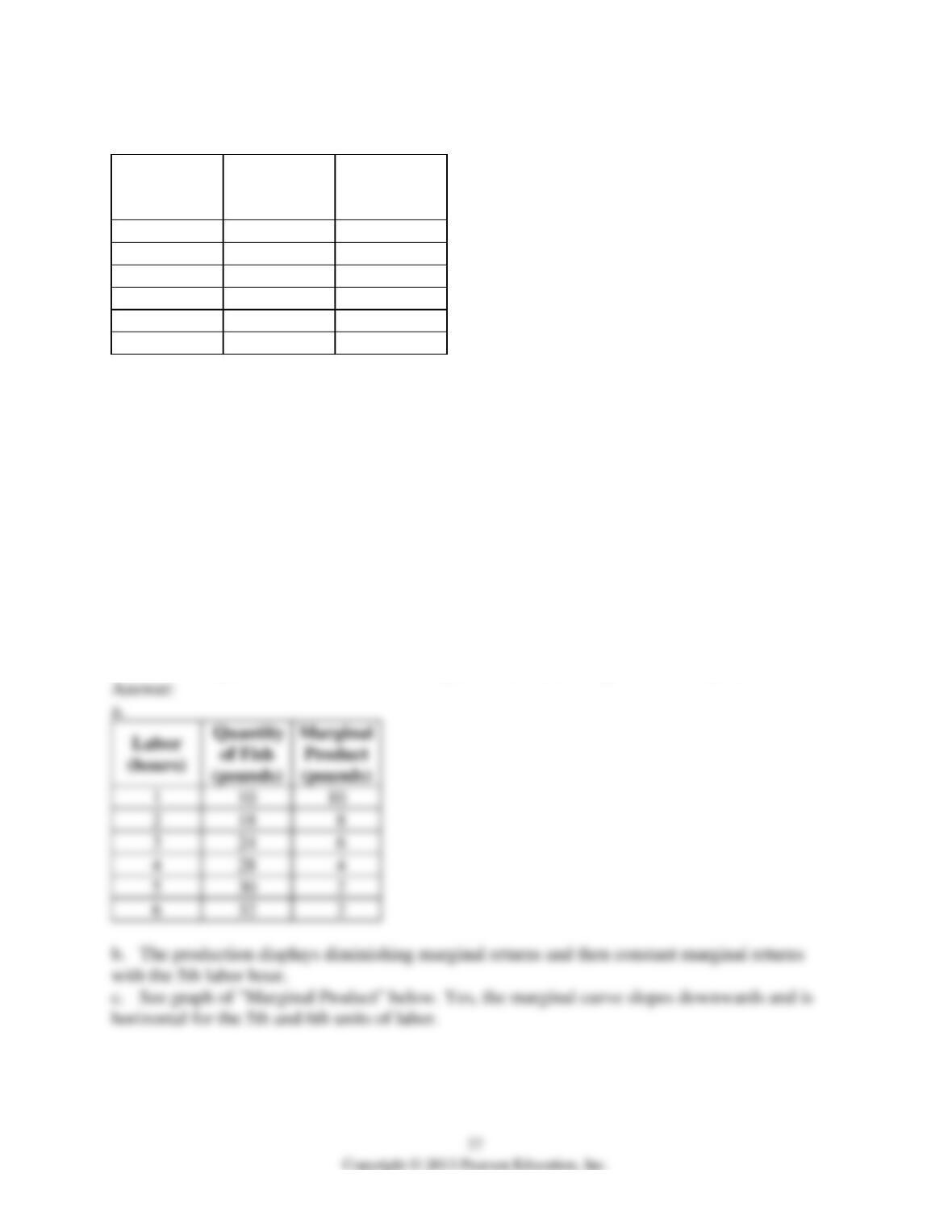
Table 11-3
Labor
(hours)
Quantity of
Fish (pounds)
Marginal
Product
(pounds)
1
10
2
18
3
24
4
28
5
30
6
32
30) Refer to Table 11-3. The table above shows the following relationship between hours spent
fishing and the quantity of fish caught for Juan, a commercial fisherman.
a. Complete the Marginal Product column in Table 10-3.
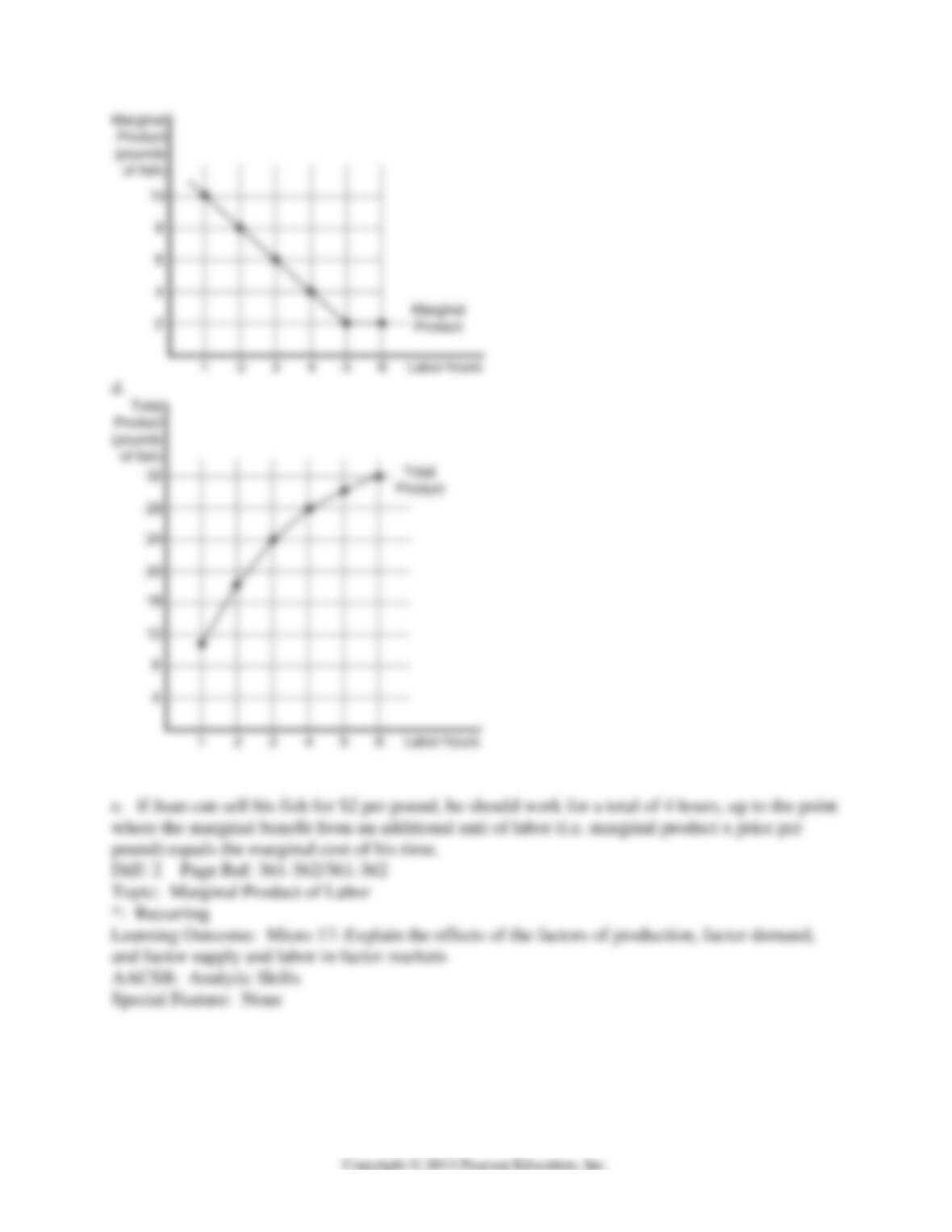
b. Characterize the production function, i.e. does the production function display increasing
marginal returns, diminishing marginal returns, etc.
c. Using the data above, graph Juan’s marginal product curve. Be sure to label the horizontal
and vertical axes. Is your graph consistent with your answer to part (b)? Explain.
d. Juan uses the following inputs for fishing — a small wooden boat (B), a fishing pole (P) and
of course, his labor (L). Treating the boat and the fishing pole as fixed inputs and using the data
above, graph Juan’s Total Product of Labor curve. Be sure to label the horizontal and vertical
axes.
e. (Extra Credit) The opportunity cost of Juan’s time is $8 per hour. If Juan receives $2 per
pound for his fish, what is the optimal number of hours he should spend fishing? Explain how
you arrived at your answer. Hint: Recall marginal benefit and marginal cost analysis.
28
11.4 The Relationship between Short-Run Production and Short-Run Cost
1) The change in a firm’s total cost from producing one more unit of a good or service is the
firm’s
A) explicit cost of production.
B) marginal cost of production.
C) average cost of production.
D) implicit cost of production.
2) Which of the following explains why the marginal cost curve has a U shape?
A) Initially, the marginal product of labor falls, then rises.
B) Initially, the average product of labor rises, then falls.
C) Initially, the marginal product of labor rises, then falls.
D) Initially, the average cost of production rises, then falls.
3) The shape of the average total cost curve is determined by the shape of
A) the marginal cost curve.
B) the average fixed cost curve.
C) the average product curve.
D) the firm’s production function.
4) Jill Johnson owns a pizzeria. She currently produces 10,000 pizzas per month at a total cost of
$500. If she produced one more pizza her total cost rises to $500.11. What does this tell us about
Jill’s marginal cost of producing pizzas?
A) The marginal cost of producing pizzas is constant.
B) The marginal cost of producing pizzas is falling.
C) The marginal cost of producing pizzas cannot be determined without more information.
D) The marginal cost of producing pizzas is rising.
5) Marginal cost is calculated for a particular increase in output by
A) multiplying the total cost by the change in output.
B) multiplying the change in total cost by the change in output.
C) dividing the total cost by the change in output.
D) dividing the change in total cost by the change in output.
6) When the marginal product of labor rises
A) the marginal cost of production will exceed the average total cost.
B) the marginal cost of production also rises.
C) the marginal cost of production falls.
D) the average total cost of production also rises.
7) Akio Morita, chairman of Sony, used a curve to determine the price of radios his company
sold. This curve was
A) a demand curve.
B) an average total cost curve.
C) a marginal cost curve.
D) a production function.
8) Which of the following statements is false?
A) Marginal cost will equal average total cost when marginal cost is at its lowest point.
B) When marginal cost is less than average total cost, average total cost will fall.
C) When marginal cost is greater than average total cost, average total cost will rise.
D) Marginal cost will equal average total cost when average total cost is at its lowest point.
9) The change in a firm’s total cost from producing one more unit of a good or service is
A) the result of economies of scale.
B) the definition of marginal product
C) the definition of marginal cost.
D) impossible to observe in large firms with many manufacturing plants.
10) The marginal cost curve is U-shaped because of the law of increasing opportunity costs.
11) If average total cost is falling marginal cost must also be falling.
12) In the short run, if average product is at its maximum, then average variable cost is at its
minimum.
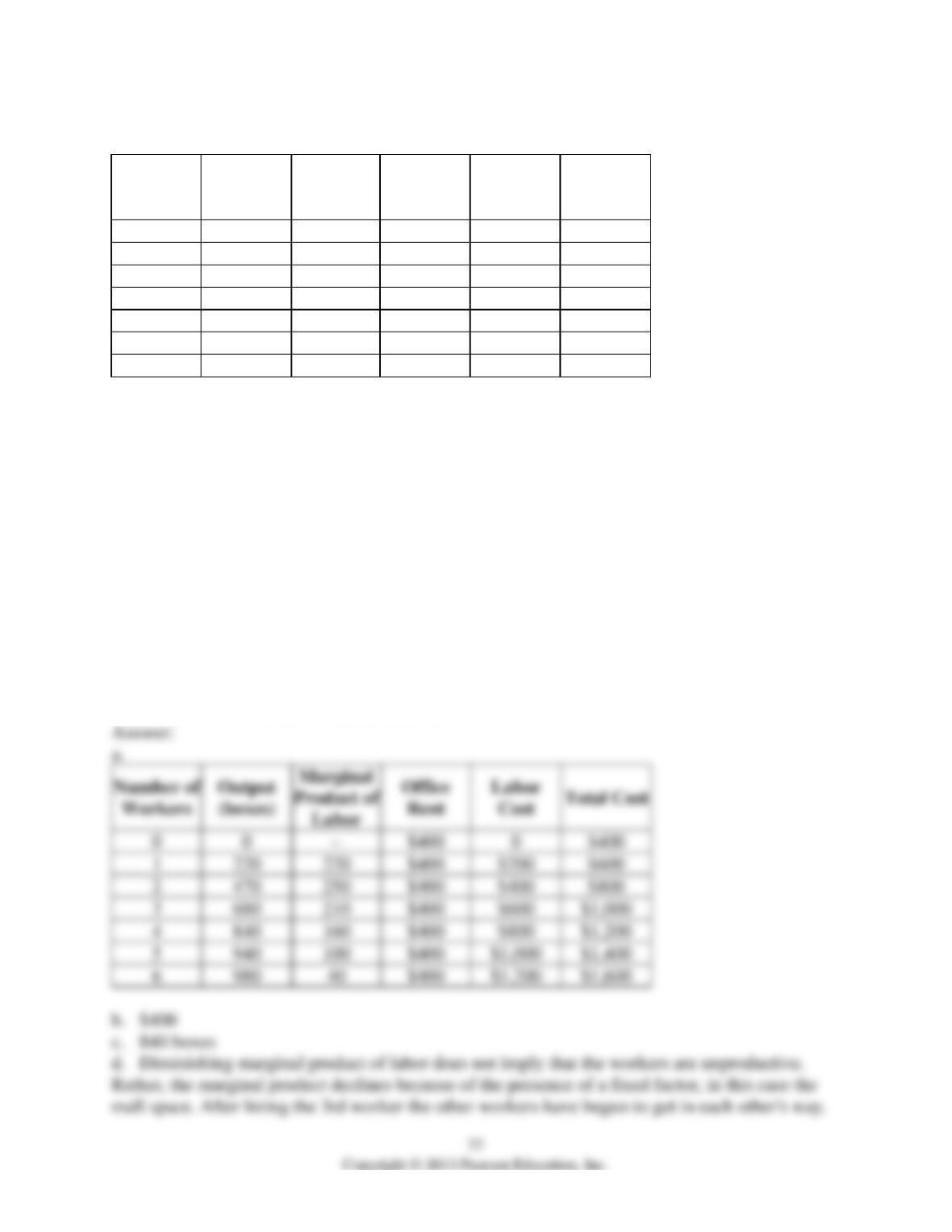
Table 11-4
Number of
Workers
Output
(boxes)
Marginal
Product of
Labor
Office
Rent
(dollars)
Labor
Cost
(dollars)
Total Cost
(dollars)
0
0
—
1
220
400
200
2
250
800
3
680
4
160
1,200
5
940
1,000
6
980
1,600
13) Refer to Table 11-4. Suzette’s Fancy Packaging subcontracts with Sunshineland Pecans to
box dried fruit and nuts for Suzette’s mail order business. Suzette rents space for her factory for
$400 a week in a nearby strip mall. She can hire temporary workers for $200 a week. Table 11-4
above shows her output and cost data. Use the table to answer questions a-e.
a. Complete the table.
b. In the last week of summer Suzette closes her business to go on a family vacation. What are
her costs during that week?
c. In one week Suzette exactly breaks even. If her revenue for the week is $1,200, how many
boxes of fruit and nuts did she produce?
d. Judging from the marginal product of labor data, would you say that Suzette had to settle for
increasingly unproductive workers? Explain your answer.
e. Suzette has received an order for 1,500 boxes of nuts per week for the next 3 months. If she
expects the trend in the marginal product of labor will continue in the same direction, what do
you think she should do? Should she not commit until she can move to a larger space or should
she just hire more workers? Explain your answer.
Number of
Workers
Output
(boxes)
Marginal
Product of
Labor
0
0
—
$400
0
$400
1
220
220
$400
$200
$600
2
470
250
$400
$400
$800
3
680
210
$400
$600
4
840
160
$400
$800
5
940
100
$400
6
980
$400
14) Explain why the marginal cost of production must increase if the marginal product of a
variable resource is decreasing.
11.5 Graphing Cost Curves
1) Which of the following equations is incorrect?
A) ATC – AFC = AVC
B) AVC + AFC = ATC
C) AFC = ATC – AVC
D) ATC = AVC – AFC
2) Average total cost is equal to
A) average fixed cost minus average variable cost.
B) total cost divided by the level of output.
C) marginal cost plus variable cost.
D) total cost divided by the number of workers.
3) Average fixed cost is equal to
A) the amount of total cost that does not change as output changes in the short run.
B) fixed cost divided by the quantity of output produced.
C) fixed cost multiplied by the quantity of output produced.
D) average total cost plus average variable cost.
4) Which of the following statements is true?
A) As output increases, average fixed cost becomes smaller and smaller.
B) Average fixed cost does not change as output increases.
C) The marginal cost curve intersects the average fixed cost curve at its minimum point.
D) When marginal cost is greater than average fixed cost, average fixed cost increases.
5) As output increases
A) average variable cost becomes smaller and smaller.
B) the difference between average total cost and average variable cost decreases.
C) marginal cost increases continuously.
D) the difference between average total cost and average variable cost becomes greater and
greater.
6) Which of the following statements is false?
A) When marginal cost equals average total cost, average total cost is at its highest value.
B) The marginal cost curve intersects the average variable cost curve and the average total cost
curve at their minimum points.
C) The difference between average total cost and average fixed cost is average variable cost.
D) Firms often refer to the process of lowering average fixed cost as “spreading the overhead.”
7) Average fixed cost can be calculated using any of the formulas below except
A) TFC/Q.
B) (TC – VC)/Q.
C) Δ(TC – VC)/ΔQ.
D) (TC/Q) – AVC.
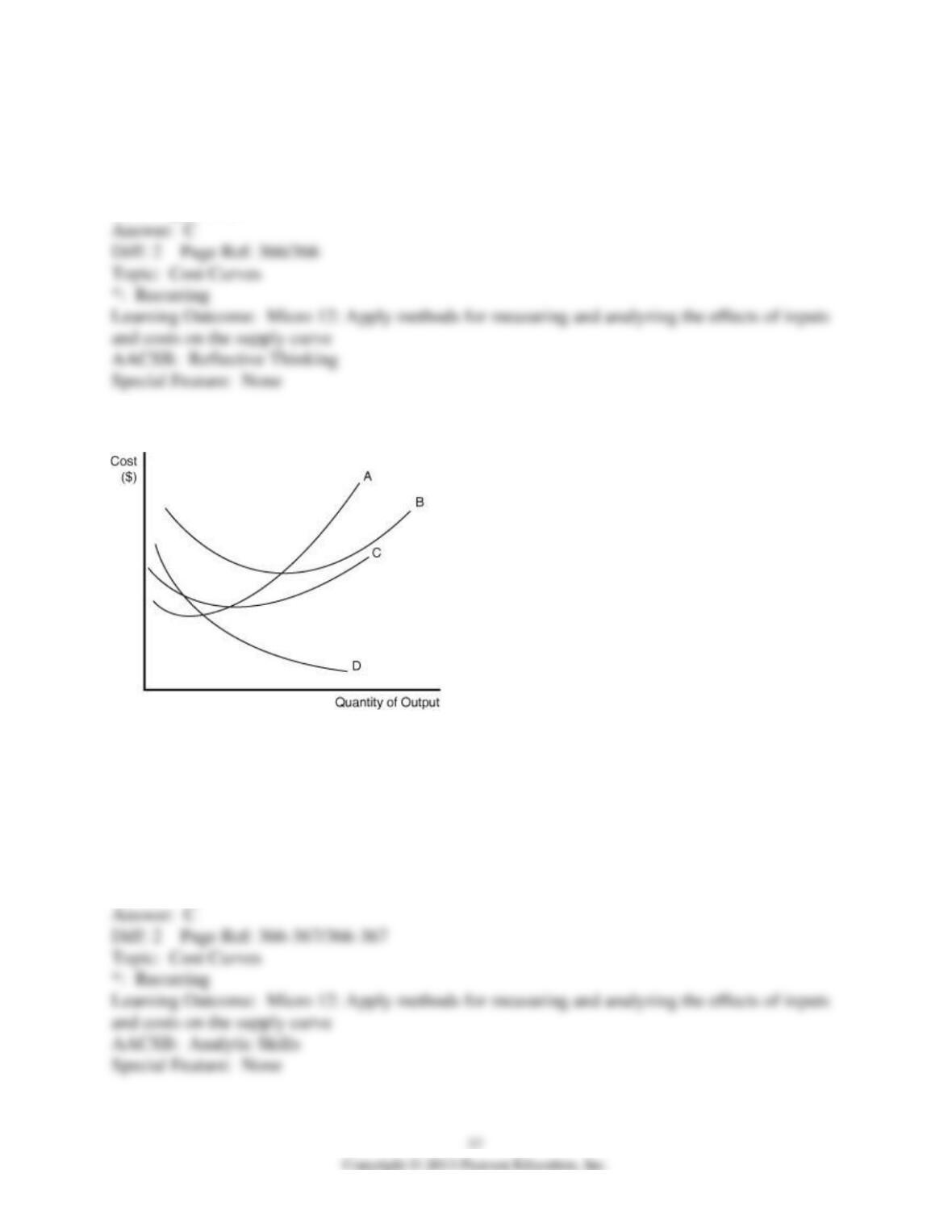
Figure 11-2
Figure 11-2 contains information about the short run cost structure of a firm.
8) Refer to Figure 11-2. In the figure above which letter represents the average variable cost
curve?
A) A
B) B
C) C
D) D
9) Refer to Figure 11-2. In the figure above which letter represents the average fixed cost curve?
A) A
B) B
C) C
D) D
10) Refer to Figure 11-2. In the figure above which letter represents the average total cost
curve?
A) A
B) B
C) C
D) D
11) Refer to Figure 11-2. In the figure above which letter represents the marginal cost curve?
A) A
B) B
C) C
D) D
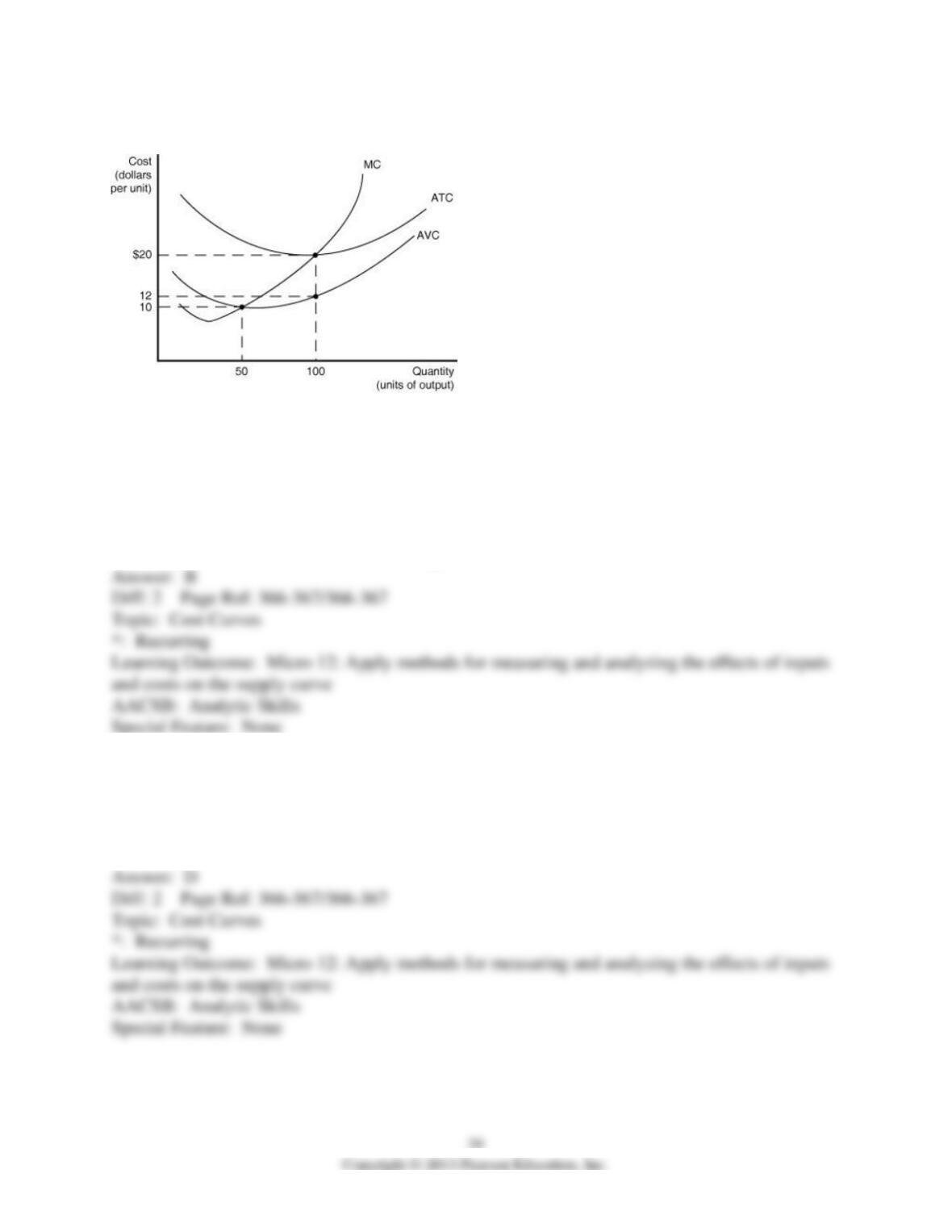
Figure 11-3
Figure 11-3 shows the cost structure for a firm.
12) Refer to Figure 11-3. When the output level is 100 units average fixed cost is
A) $10.
B) $8.
C) $5.
D) This cannot be determined from the diagram.
13) Refer to Figure 11-3. When output level is 100, what is the total cost of production?
A) $20
B) $1,000
C) $1,200
D) $2,000
14) Refer to Figure 11-3. If output is 100 units what is the fixed cost of production?
A) $8
B) $800
C) $1,000
D) This cannot be determined from the diagram.
15) Which of the following is true at the output level where average total cost is at its minimum?
A) Marginal cost equals average total cost.
B) Average variable cost equals fixed cost.
C) Marginal cost equals average variable cost.
D) Average total cost equals average fixed cost.
16) All of the following cost curves are U-shaped except one. Which curve is not U-shaped?
A) the marginal cost curve
B) the average fixed cost curve
C) the average total cost curve
D) the average variable cost curve