Microeconomics, 4e – Testbank 2 (Hubbard)
Chapter 11 Technology, Production, and Costs
11.1 Technology: An Economic Definition
1) Improvements in technology used to produce solar panels allow manufacturers such as 1366
Technologies to produce
A) more output using the same inputs, thereby reducing average total cost.
B) the same output using more inputs, thereby reducing average total cost.
C) more output using more inputs, thereby reducing total fixed cost.
D) the same output using fewer inputs, thereby reducing total fixed cost.
2) The basic activity of a firm is
A) to set the prices of its products as high as possible.
B) to compete with other firms that produce similar products.
C) to provide jobs for its employees.
D) to use inputs to produce outputs of goods and services.
3) The processes a firm uses to turn inputs into outputs of goods and services is called
A) technology.
B) technological change.
C) marginal analysis.
D) positive economic analysis.
4) When a firm produces more output using the same inputs or the same output using fewer
inputs we say that the firm
A) experiences an increase in demand.
B) experiences positive technological change.
C) will hire more workers in order to produce more output.
D) is operating in the short run.
5) When a firm experiences a positive technological change
A) the price of a share of the firm’s stock rises.
B) the firm is able to produce more output using the same inputs, or the same output using fewer
inputs.
C) the value of the firm’s assets rises.
D) the firm will hire additional workers in order to increase production.
6) A “stockout” occurs when
A) brokers run out of shares of stock to sell of a particular company.
B) a disruption due to a power outage, etc., causes a temporary production shutdown.
C) a company holds too many goods in inventories.
D) a firm loses sales because goods consumers want are not available.
7) Technological change is a key reason why Wal-Mart has become one of the largest firms in
the world. Which of the following is a change in technology implemented by Wal-Mart?
A) Wal-Mart developed a supply chain that allows it to manage inventories efficiently.
B) Instead of buying goods it sells from other companies, Wal-Mart makes many of these goods
in its own factories.
C) Wal-Mart employs hundreds of scientists and engineers who develop new cost-saving
techniques.
D) Wal-Mart hires managers from many of the top business schools in the United States.
8) Which of the following statements correctly describes the distinction between technology and
technological change?
A) Technology refers to the processes used by a firm to transform inputs into output of goods
and services while technological change is a change in a firm’s ability to produce a given level of
output with a given quantity of inputs.
B) Technology refers to the ability of a firm to increase its maximum output from a given
quantity of inputs and technological change is the process by which the firm achieves this
productivity gain.
C) Technology is product-centered; its refers to developing new products with limited resources
while technological change is process-centered in that it focuses on developing new production
techniques.
D) Technology involves research and development while technological change involves the use
of more efficient machinery.
9) When a firm experiences negative technological change it can produce the same output with
fewer inputs.
10) In economics, technology only refers to the development of new products.
11) Describe the difference between technology and positive technological change.
12) Which of the following are examples of a firm experiencing a positive technological change?
a. A firm is able to reduce its inputs by 15 percent and still produce the same level of output.
b. A seminar attended by the firm’s workers makes them more productive.
c. A firm adds 5 percent to its workforce and is able to maintain its initial level of output.
d. A firm restructures its distribution system and is able to save on its shipping times.
e. A firm rearranges its warehouse and finds that it can use fewer workers to maintain its
productivity level.
11.2 The Short Run and the Long Run in Economics
1) Which of the following statements best describes the economic short run?
A) It is a period of one year or less.
B) It is a period during which firms are free to vary all of their inputs.
C) It is a period during which at least one of the firm’s inputs is fixed.
D) It is a period during which fixed inputs become variable inputs because of depreciation.
2) When firms analyze the relationship between their level of production and their costs they
separate the time period involved into
A) morning and evening.
B) 6 months or less; 6 months to 1 year; more than 1 year.
C) a fixed period and a variable period.
D) the short run and the long run.
3) The long run refers to a time period
A) during which a firm is able to purchase all of its inputs, including its plant and equipment.
B) long enough for a firm to vary all of its inputs, to adopt new technology and change the size
of its physical plant.
C) long enough for a firm to pay all of its creditors in full.
D) long enough for a firm to change the use of its variable inputs.
4) Which of the following can a firm do in the long run but not in the short run?
A) decrease the size of its physical plant
B) reduce its rate of output by laying off workers
C) increase its variable costs
D) increase its use of raw materials
5) Which of the following statements is false?
A) An explicit cost is a nonmonetary opportunity cost.
B) In the short run: total cost = fixed cost + variable cost.
C) Variable costs are costs that change as output changes.
D) In the long run there are no fixed costs.
6) In the long run which of the following is true?
A) Total cost = fixed cost + variable cost.
B) The size of a firm’s physical plant can be changed but the firm cannot adopt new technology.
C) There are no fixed costs.
D) The firm can vary its explicit costs but not its implicit costs.
7) Which of the following are implicit costs for a typical firm?
A) the cost of labor
B) the opportunity cost of capital owned and used by the firm
C) the cost of energy used in production
D) a business licensing fee
8) Which of the following is typically considered a fixed cost by academic book publishers but a
variable cost by companies that print books?
A) postage and supplies
B) travel
C) rent
D) wages and salaries
9) Which of the following statements is false?
A) An implicit cost is a nonmonetary opportunity cost.
B) Economic costs include both accounting costs and implicit costs.
C) An explicit cost is a cost that involves spending money.
D) Economists consider all costs to be implicit costs.
10) An explicit cost is defined as
A) a cost that does not change as output changes.
B) a nonmonetary opportunity cost.
C) a cost that involves spending money.
D) a nonmonetary accounting cost.
11) Which of the following statements is true?
A) An explicit cost is an actual cost; an implicit cost is a theoretical cost.
B) Economic costs include both explicit costs and implicit costs.
C) An explicit cost is more important, dollar for dollar, than an implicit cost.
D) Explicit costs are accounting costs, not economic costs; implicit costs are economic costs, not
accounting costs.
12) Jennifer Borts moves her office from the premises she rents at a local mall to her home. As a
result of this move
A) Jennifer’s explicit costs fall and her implicit costs rise.
B) Jennifer’s total costs fall.
C) Jennifer’s implicit costs fall.
D) Jennifer’s opportunity costs fall.
13) The relationship between the inputs employed by a firm and the maximum output that it can
produce with those inputs is the firm’s
A) production function.
B) supply curve, or supply schedule.
C) marginal product of labor.
D) average product of labor.
14) The Santa Fe Spark Plug Company supplies spark plugs to automotive parts dealers. An
increase in the demand for its product led Santa Fe to hire 150 new workers. Santa Fe also plans
to expand the capacity of its plant but this project will take 2 years to complete. Which of the
following statements is true?
A) The wages and benefits paid to the new workers are implicit costs.
B) The long run for Santa Fe is longer than 1 year.
C) The short run for Santa Fe is 1 year.
D) In the short run Santa Fe’s variable costs increase but its fixed costs decrease.
15) Which of the following statements is true?
A) Opportunity cost = explicit cost – implicit cost.
B) Total cost = fixed cost + implicit cost.
C) Total cost = fixed cost + variable cost.
D) Variable cost = wages + salaries + benefits.
16) The rules of accounting generally require that ________ costs be used for purposes of
keeping a company’s financial records and for paying taxes. These costs are sometimes called
________ costs.
A) economic; legal
B) real; explicit
C) total; economic
D) explicit; accounting
17) Stan owns a software design business. He does not have time to expand his office space or
redesign the layout of his office. He can increase the amount of work he does by working more
hours, asking his current employees to work more hours, or hiring more employees. The
relationship between Stan’s inputs and the maximum output his firm can produce is called his
A) long-run production function.
B) production possibilities frontier.
C) short-run production function.
D) cost function.
18) Stan owns a software design business. He obtained a bank loan to buy computer equipment
for his business. He pays $1,000 per month for interest on the loan. He has 10 employees, each
of whom is paid $4,000 per month. Because his business has been successful, next month he will
increase employee wages to $5,000. If the revenue from his business remains at its current level,
Stan is considering an addition to his office. Which of the following statements regarding Stan’s
business is false?
A) The payments Stan makes to his employees are variable costs and explicit costs.
B) The monthly payment Stan makes for his bank loan is an implicit cost.
C) The monthly payment Stan makes for his bank loan is a fixed cost.
D) The time and effort Stan spends on his software design business is an implicit cost.
19) Average total cost is
A) total cost divided by the quantity of output produced.
B) total explicit costs divided by the quantity of output produced.
C) variable cost divided by the quantity of output produced.
D) the change in fixed plus variable cost divided by the quantity of output produced.
20) Bill owns “Bill’s Home of Blues” a store that specializes in selling CDs and DVDs of blues
musicians of the 1960s and 1970s. Bill took out a loan from his bank to pay for his store and its
initial inventory. Bill pays the bank $900 per week for his loan. The $900 bank payment
A) is a long-run implicit cost.
B) is a fixed cost.
C) is a short-run implicit cost.
D) is a variable cost.
21) In the short-run, changes in output can only be brought about by a change in the quantity of
variable inputs.
22) In the long run, all of a firm’s inputs are variable.
23) Costs that change as output changes are called incremental costs.
24) Economic costs include implicit costs but not explicit costs.
25) The total cost schedule shows the relationship between different amounts of inputs and the
resulting level of output.
26) What is the difference between between total costs, variable costs, and fixed costs?
27) Are the costs of utilities always fixed, always variable, or can they be both? Briefly explain.
28) Sally quit her job as an auto mechanic earning $50,000 per year to start her own business. To
save money she operates her business out of a small building she owns which, until she started
her own business, she had rented out for $10,000 per year. She also invested her $20,000 savings
(which earned a market interest rate of 5% per year) in her business. You are given the following
information about the first year of her operations.
Total revenue $120,000
Cost of labor 40,000
Cost of materials 15,000
Equipment rental 5,000
a. Calculate her economic costs.
b. Calculate her accounting costs.
c. Calculate her implicit costs.
d. Sally tells you that she would really like to move to a location closer to town but she decided
against it because “right now I don’t pay any rent and it will cost me $10,000 a year to rent near
town.” Do you agree with her reasoning?
1) The marginal product of labor is defined as
A) the change in total revenue that results when an additional unit of a labor is hired.
B) the additional labor required to produce one more unit of output.
C) the additional labor cost of producing one more unit of output.
D) the change in output that a firm produces as a result of hiring one more worker.
2) Diminishing marginal product of labor occurs when adding another unit of labor
A) decreases output.
B) changes output by an amount smaller than the output added by the previous unit of labor.
C) increases output by an amount larger than the output added by the previous unit of labor.
D) decreases output by an amount smaller than the output added by the previous unit of labor.
3) Increases in the marginal product of labor result from
A) the use of new technology.
B) hiring more efficient workers.
C) the division of labor and specialization.
D) increasing the usage of all inputs.
4) Gertrude Stork’s Chocolate Shoppe normally employs 4 workers. When the Chocolate Shoppe
hired a 5th worker the Shoppe’s total output decreased. Therefore,
A) the marginal product of the 5th worker is negative.
B) the total output of Gertrude Stork’s Chocolate Shoppe is negative.
C) the average product of the 5th worker is negative.
D) the 5th worker should be hired only if he is willing to accept a wage lower than the wage paid
to the other 4 workers.
5) An avocado orchard employs five full-time workers. Currently, the average product of labor is
120 pounds of avocados per day. The orchard hires a 6th full-time worker and his marginal
product is 150 pounds of avocados. The average product of the six workers will now be
A) more than 120 pounds.
B) less than 120 pounds.
C) equal to 120 pounds.
D) less than the marginal product of labor.
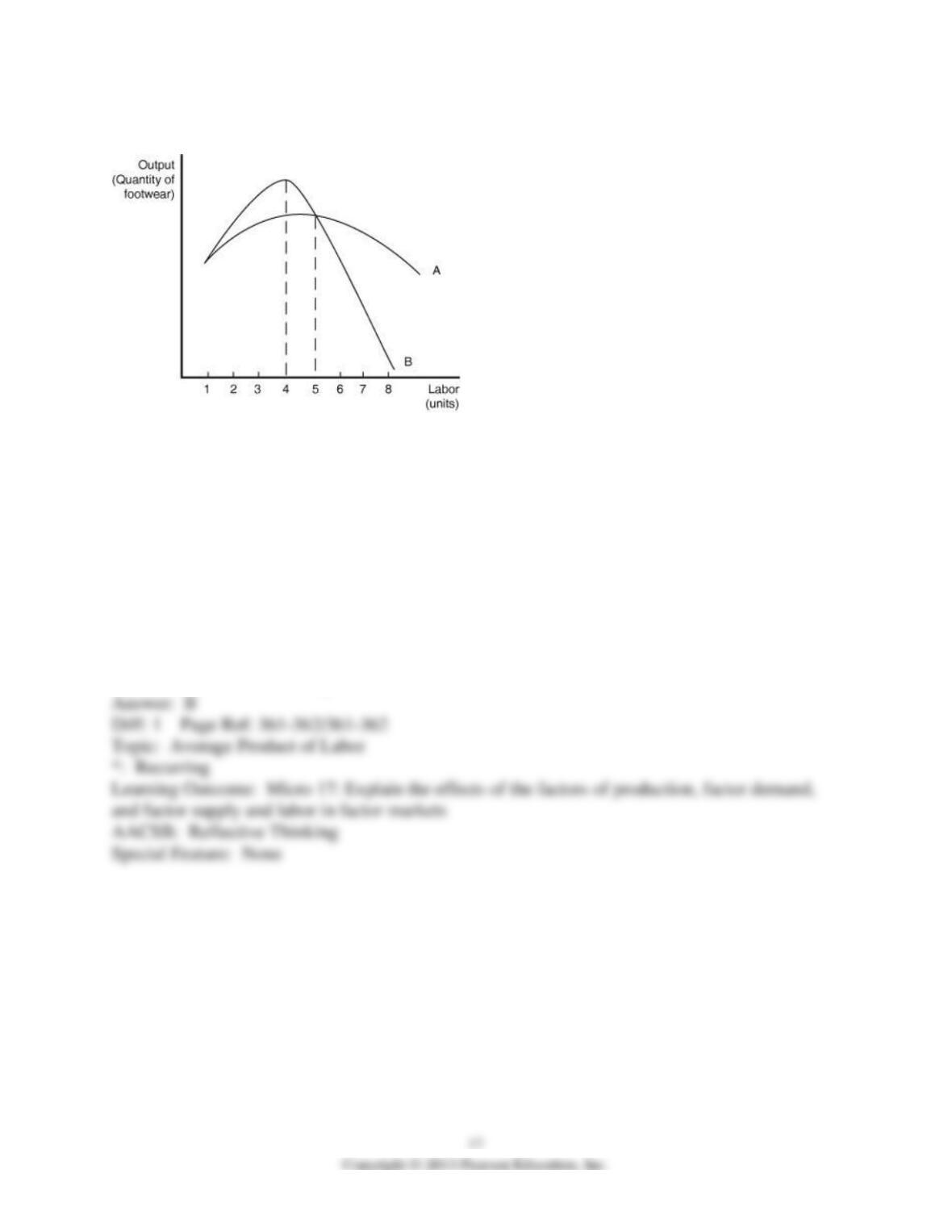
Figure 11-1
Fancy Footwear manufactures shoes. Figure 11-1 shows Fancy Footwear’s marginal product of
labor and average product of labor curves in the short run.
6) Refer to Figure 11-1. Which of the following statements correctly describes the curves in the
figure?
A) The marginal product of labor curve is represented by curve A and the average product of
labor curve is represented by curve B.
B) The marginal product of labor curve is represented by curve B and the average product of
labor curve is represented by curve A.
C) Curve A could represent either the average product curve or the marginal product and curve.
Curve B represents the total product curve.
D) Curve B could represent either the average product curve or the marginal product curve.
Curve A represents the total product curve.
7) Refer to Figure 11-1. For what quantity of labor does production display diminishing returns?
A) for more than 1 units of labor
B) for more than 4 unit of labor
C) for more than 5 units of labor
D) for more than 8 units of labor
8) The law of diminishing marginal returns
A) sets in because not all workers are equally productive.
B) applies only in the short run.
C) holds even when there are no fixed factors.
D) ultimately explains why production displays diseconomies of scale.
9) In the short run, why does a production function eventually display diminishing returns to
labor?
A) As the number of workers increases it becomes difficult to monitor them.
B) As a firm hires more workers the skills and the work ethic of the additional workers will
eventually decline.
C) As the number of workers increases eventually the gains from the division of labor and
specialization are used up.
D) The opportunity cost of hiring additional workers must eventually rise.
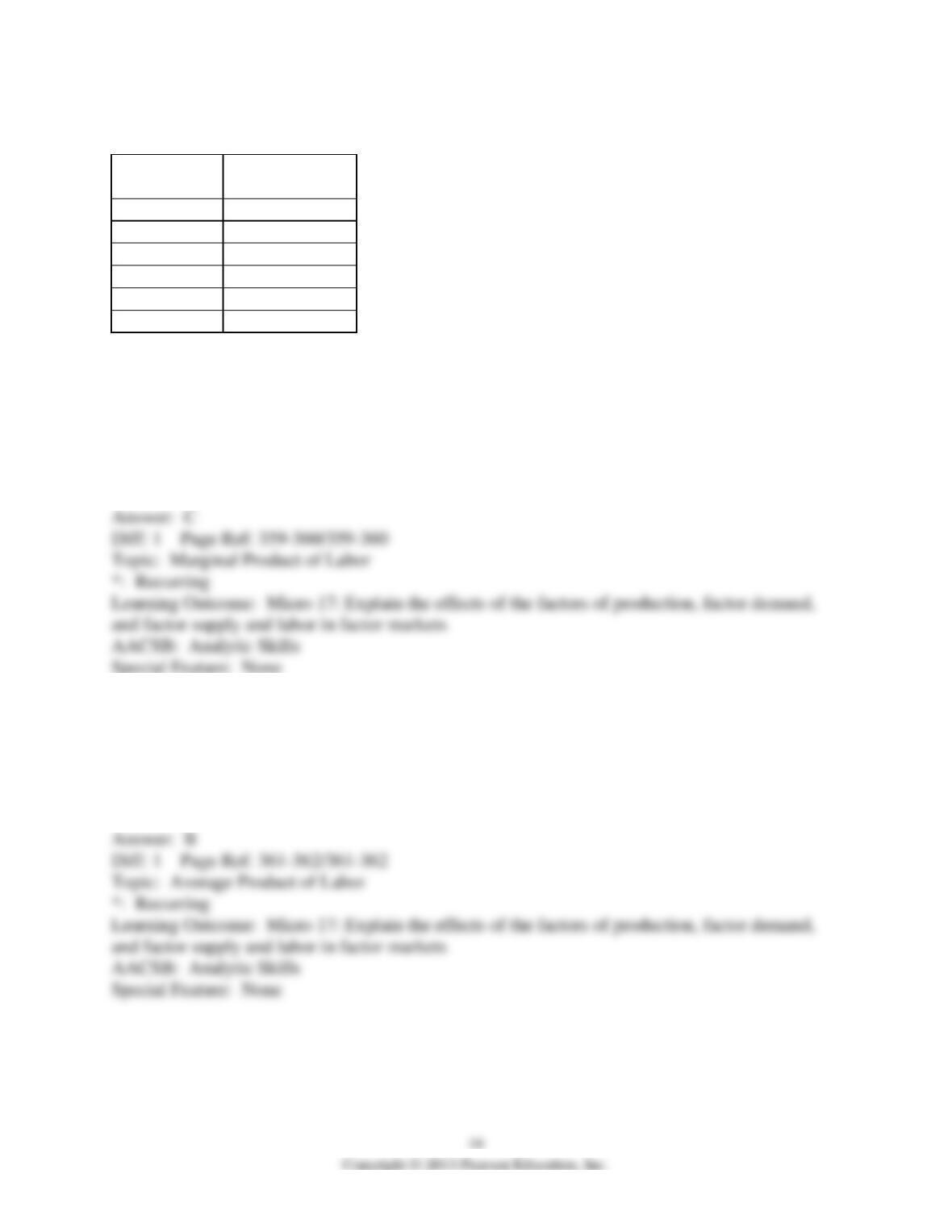
Table 11-1
Number of
Workers
Apples per Day
(bushels)
1
50
2
120
3
180
4
230
5
270
6
300
Table 11-1 summarizes production at the Crunchy Apple Orchard for the month of April 2005.
10) Refer to Table 11-1. What is the marginal product of the 4th worker?
A) 230 bushels
B) 57.4 bushels
C) 50 bushels
D) 12.4 bushels
11) Refer to Table 11-1. What is the average product of labor when the orchard employs 5
workers?
A) 270 bushels
B) 54 bushels
C) 40 bushels
D) 8 bushels
12) The division of labor and specialization explain
A) why, when the marginal product of labor increases, so does the average product of labor.
B) why the average product of labor falls when firms use more capital or change the layout of
their businesses.
C) why the marginal product of labor rises as a firm hires its first units of labor.
D) why firms may find it profitable to use more workers when the marginal product of labor is
negative.
13) Sam Lewis owns a firm in New York City’s garment district. If Sam keeps adding workers to
use the same number of sewing machines, eventually the workplace will become so crowded that
workers will get in each other’s way. At this point
A) the marginal product of labor in Sam’s business would be negative and his total output would
decrease.
B) Sam should encourage his workers to share their sewing machines.
C) Sam’s business will be in violation of safety rules that have been established by the New York
City government.
D) Sam should begin using a division of labor in his business.