Chapter 11 – Appendix A Transfer Pricing
11-4
Chapter 11 Appendix A Transfer Pricing Answer Key
True / False Questions
1. When a division is operating at full capacity, the transfer price to other divisions should
include opportunity costs.
2. When an intermediate market price for a transferred item exists, it represents a lower limit
on the charge that should be made on transfers between divisions.
3. A transfer price is the price charged when one segment of a company provides goods or
services to another segment of the company.
Multiple Choice Questions
Chapter 11 – Appendix A Transfer Pricing
11-5
4. When the selling division in an internal transfer has unsatisfied demand from outside
customers for the product that is being transferred, then the lowest acceptable transfer price as
far as the selling division is concerned is:
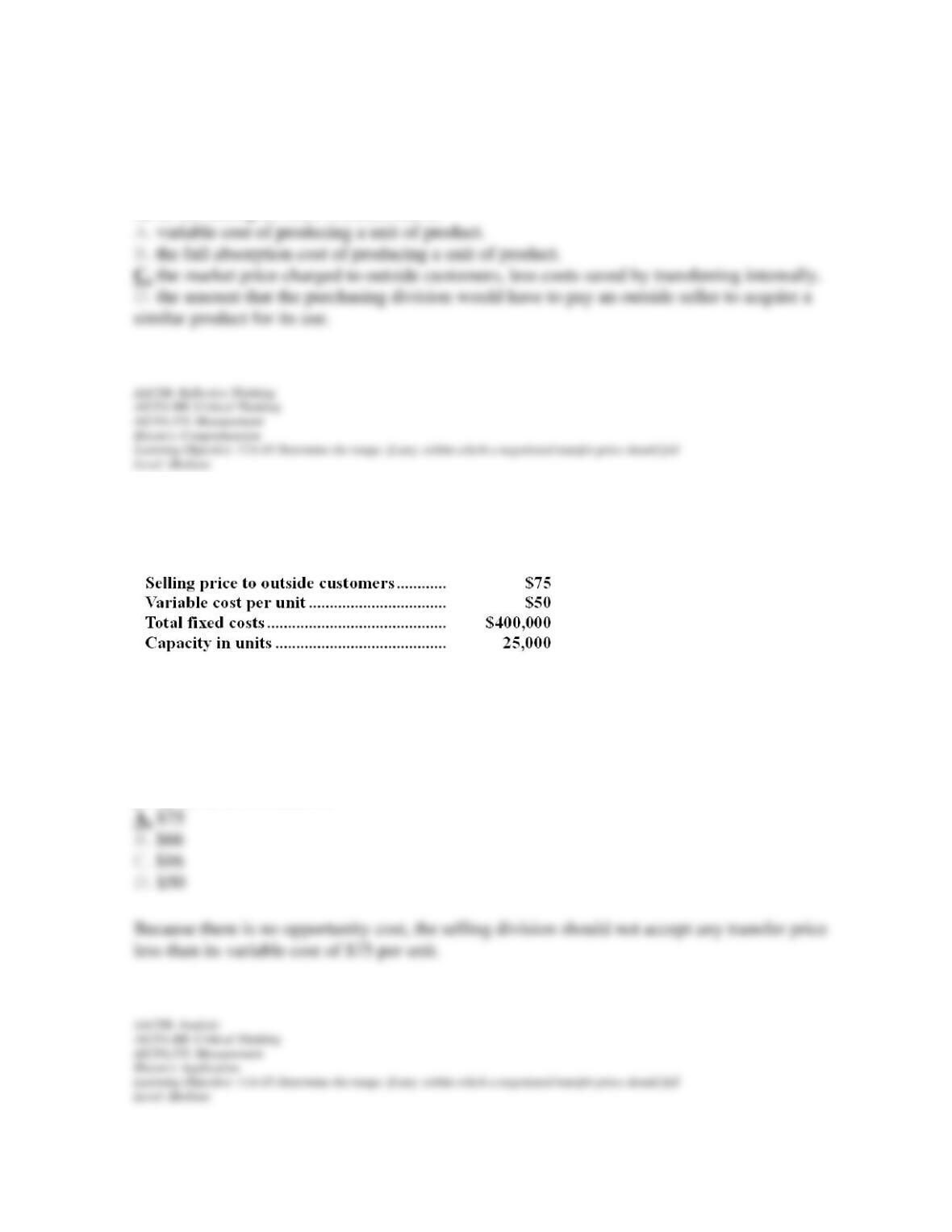
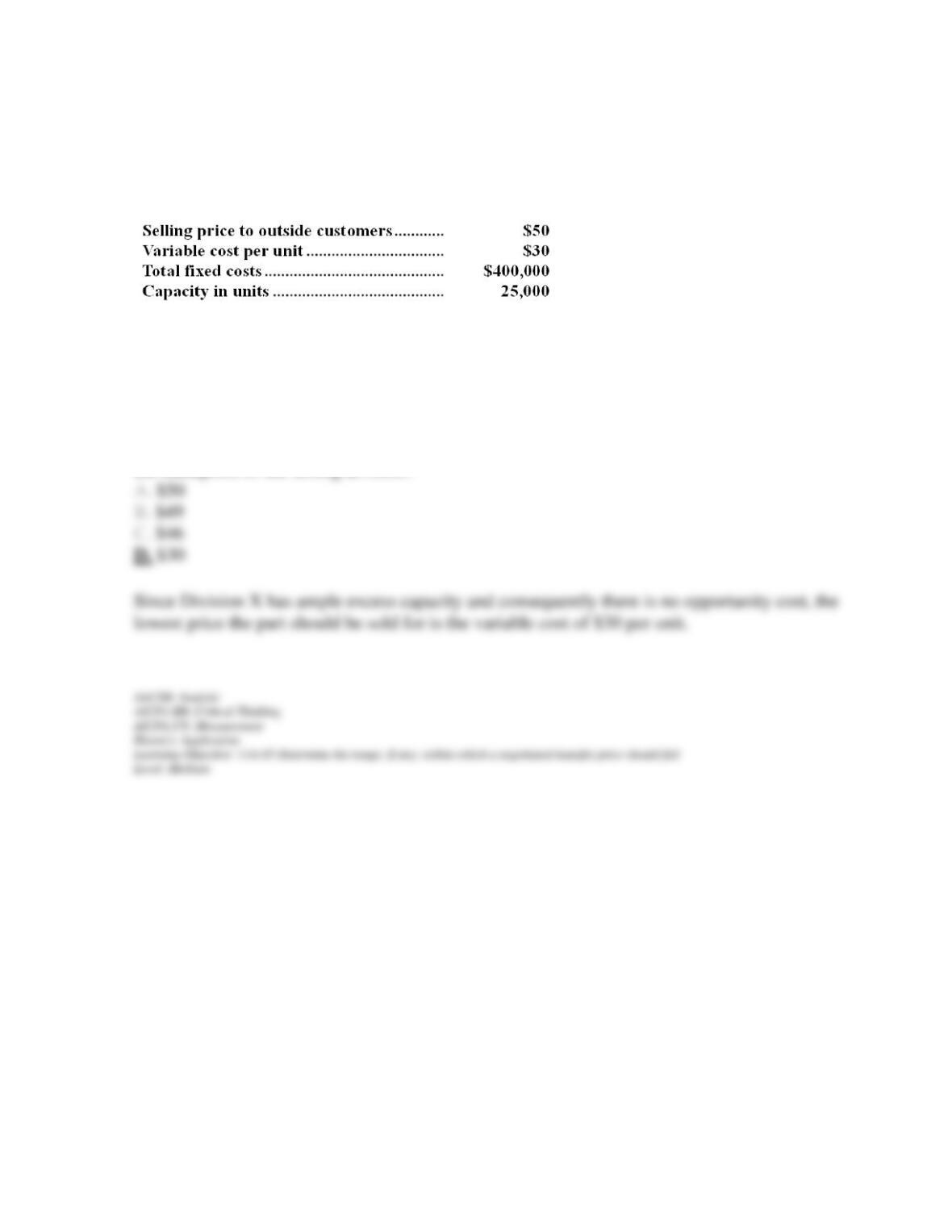
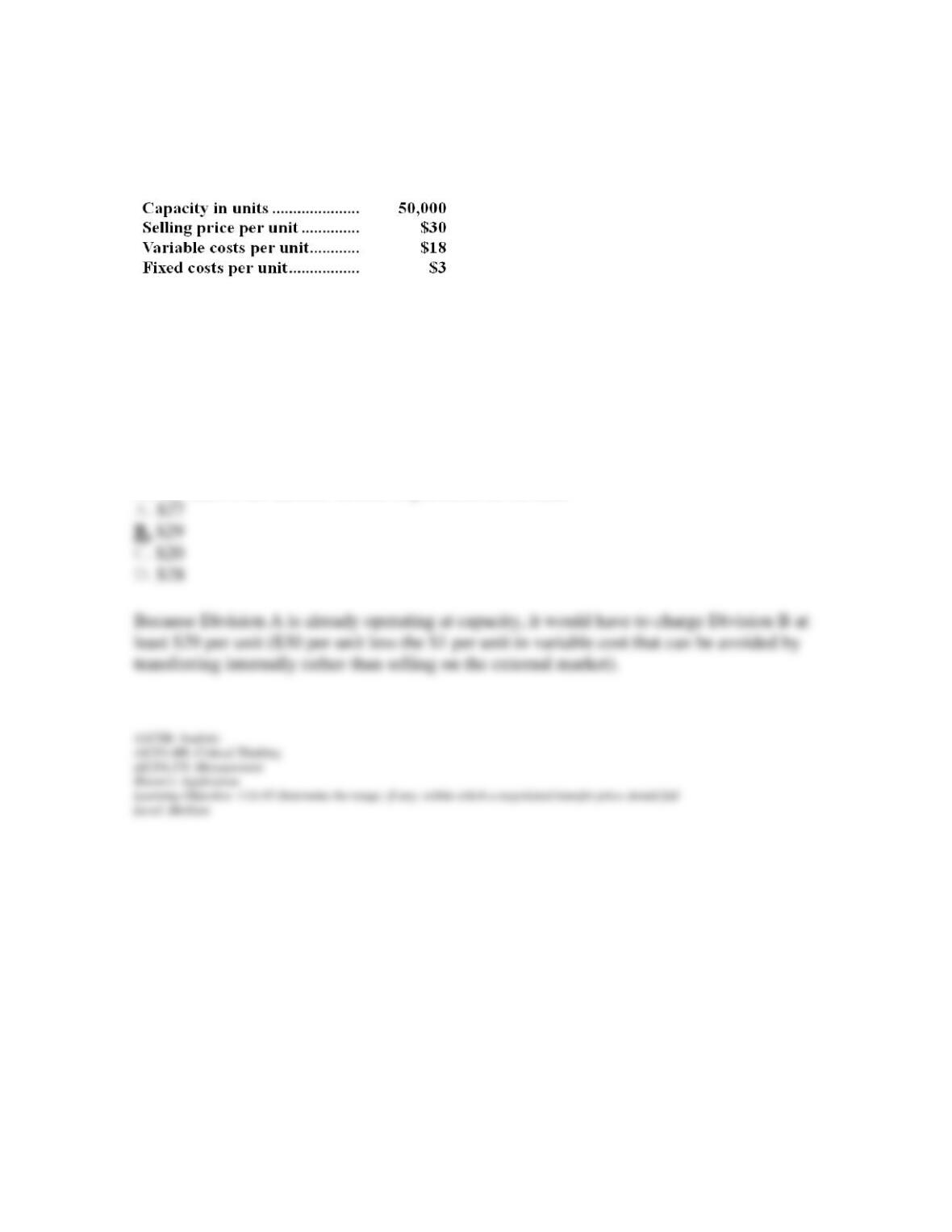
5. Division X makes a part that it sells to customers outside of the company. Data concerning
this part appear below:
Division Y of the same company would like to use the part manufactured by Division X in
one of its products. Division Y currently purchases a similar part made by an outside
company for $70 per unit and would substitute the part made by Division X. Division Y
requires 5,000 units of the part each period. Division X can already sell all of the units it can
produce on the outside market. What should be the lowest acceptable transfer price from the
perspective of Division X?
Chapter 11 – Appendix A Transfer Pricing
11-6
6. Part WY4 costs the Eastern Division of Tyble Corporation $26 to make-direct materials are
$10, direct labor is $4, variable manufacturing overhead is $9, and fixed manufacturing
overhead is $3. Eastern Division sells Part WY4 to other companies for $30. The Western
Division of Tyble Corporation can use Part WY4 in one of its products. The Eastern Division
has enough idle capacity to produce all of the units of Part WY4 that the Western Division
would require. What is the lowest transfer price at which the Eastern Division should be
willing to sell Part WY4 to the Central Division?
Chapter 11 – Appendix A Transfer Pricing
11-7
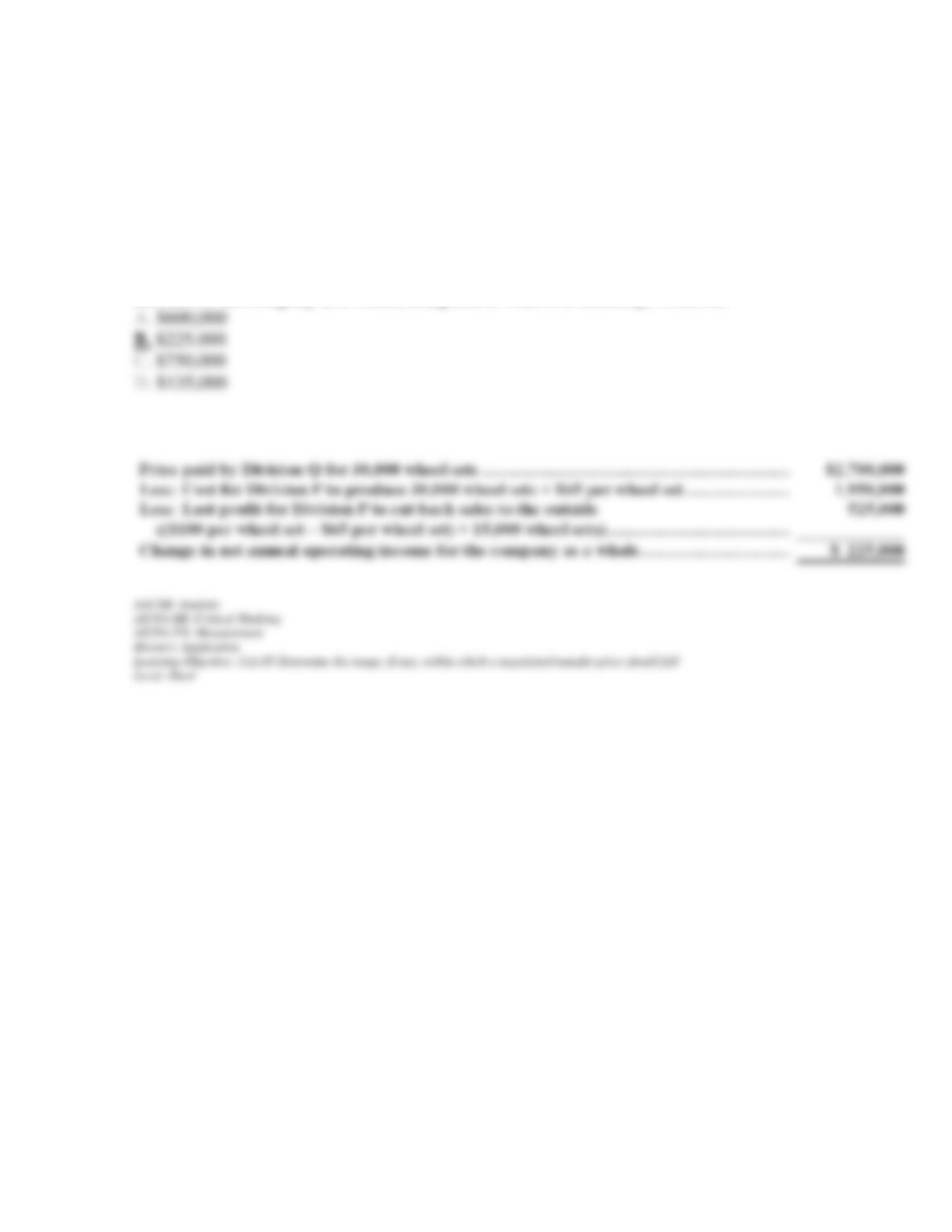
7. Division P of Turbo Corporation has the capacity for making 75,000 wheel sets per year
and regularly sells 60,000 each year on the outside market. The regular sales price is $100 per
wheel set, and the variable production cost per unit is $65. Division Q of Turbo Corporation
currently buys 30,000 wheel sets (of the kind made by Division P) yearly from an outside
supplier at a price of $90 per wheel set. If Division Q were to buy the 30,000 wheel sets it
needs annually from Division P at $87 per wheel set, the change in annual net operating
income for the company as a whole, compared to what it is currently, would be:
Chapter 11 – Appendix A Transfer Pricing
11-8
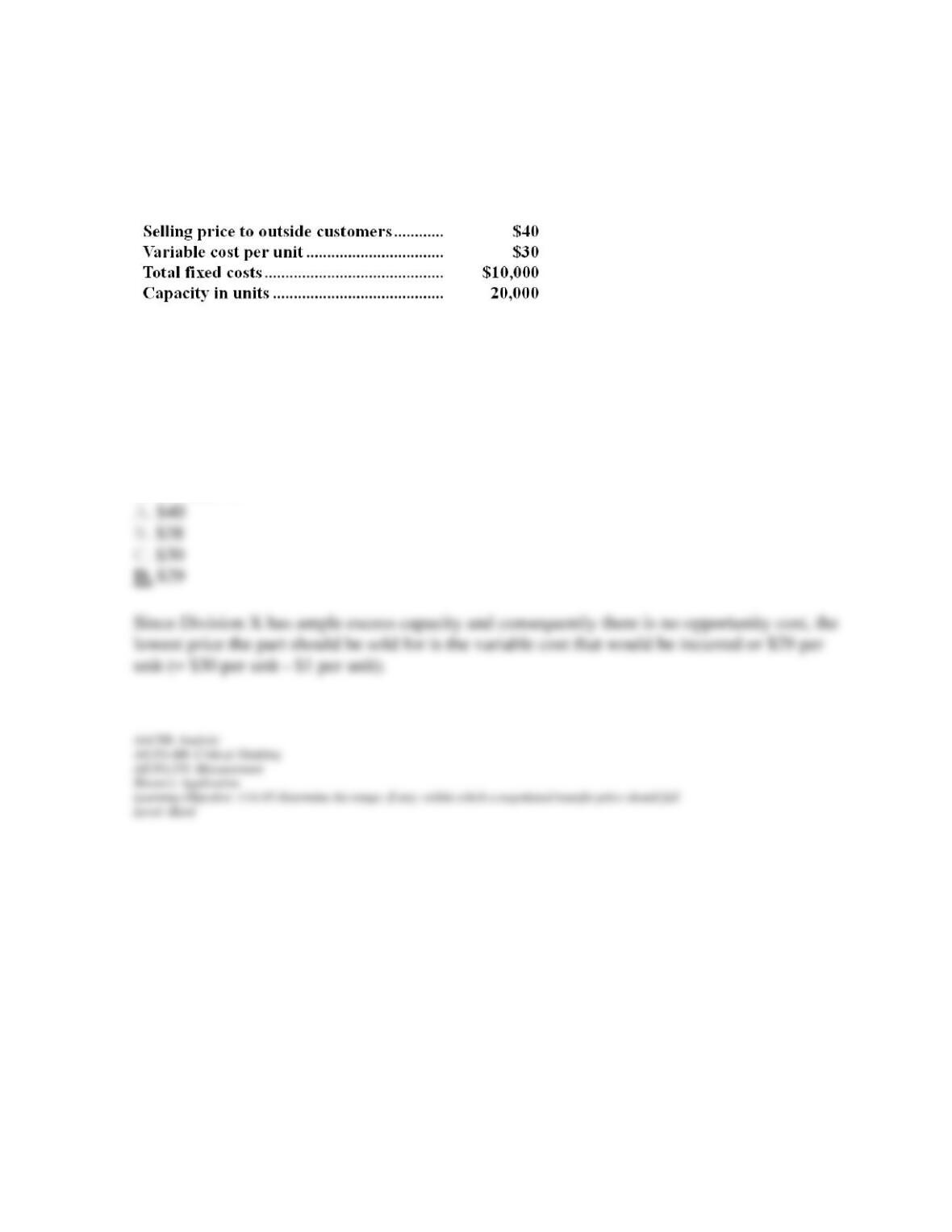
8. Division X makes a part that it sells to customers outside of the company. Data concerning
this part appear below:
Division Y of the same company would like to use the part manufactured by Division X in
one of its products. Division Y currently purchases a similar part made by an outside
company for $49 per unit and would substitute the part made by Division X. Division Y
requires 5,000 units of the part each period. Division X has ample excess capacity to handle
all of Division Y’s needs without any increase in fixed costs and without cutting into outside
sales. According to the formula in the text, what is the lowest acceptable transfer price from
the standpoint of the selling division?
Chapter 11 – Appendix A Transfer Pricing
11-9
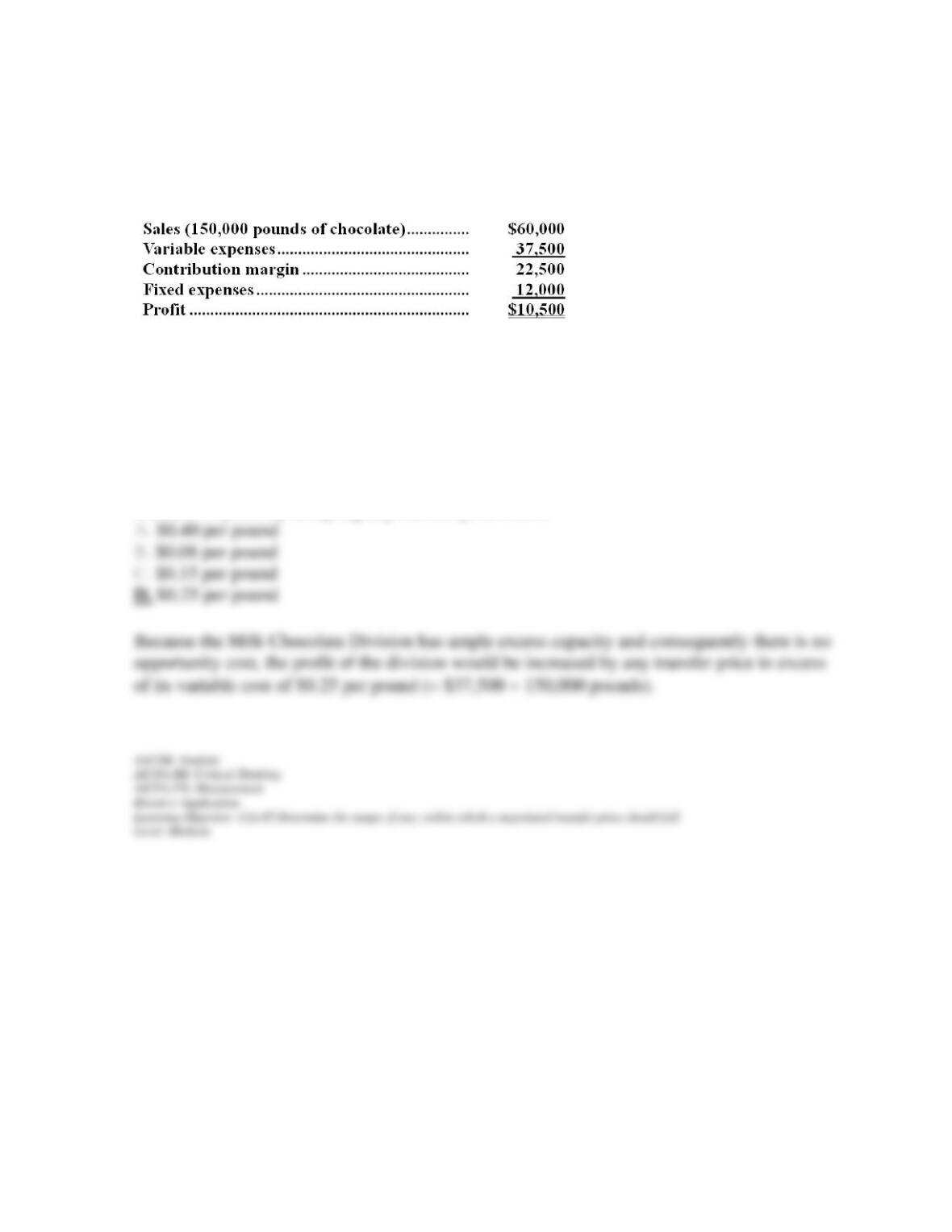
9. Division A makes a part that it sells to customers outside of the company. Data concerning
this part appear below:
Division B of the same company would like to use the part manufactured by Division A in
one of its products. Division B currently purchases a similar part made by an outside company
for $38 per unit and would substitute the part made by Division A. Division B requires 5,000
units of the part each period. Division A has ample capacity to produce the units for Division
B without any increase in fixed costs and without cutting into sales to outside customers. If
Division A sells to Division B rather than to outside customers, the variable cost be unit
would be $1 lower. What should be the lowest acceptable transfer price from the perspective
of Division A?
Chapter 11 – Appendix A Transfer Pricing
11–10
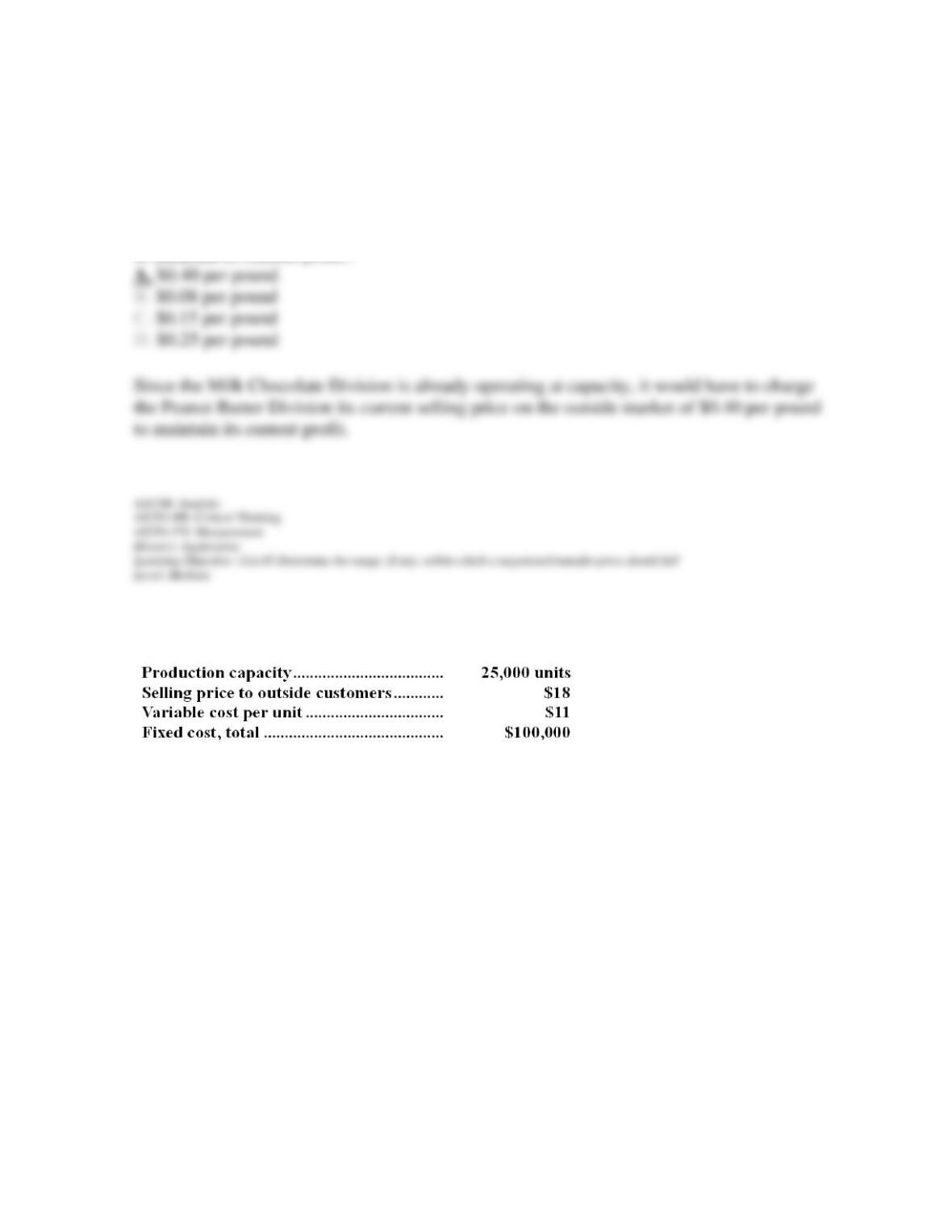
The Milk Chocolate Division of Mmmm Foods, Inc. had the following operating results last
year:
Milk Chocolate expects identical operating results this year. The Milk Chocolate Division has
the ability to produce and sell 200,000 pounds of chocolate annually.
10. Assume that the Peanut Butter Division of Mmmm Foods wants to purchase an additional
20,000 pounds of chocolate from the Milk Chocolate Division. Milk Chocolate will be able to
increase its profit by accepting any transfer price above:
Chapter 11 – Appendix A Transfer Pricing
11–11
11. Assume that the Milk Chocolate Division is currently operating at its capacity of 200,000
pounds of chocolate. Also assume again that the Peanut Butter Division wants to purchase an
additional 20,000 pounds of chocolate from Milk Chocolate. Under these conditions, what
amount per pound of chocolate would Milk Chocolate have to charge Peanut Butter in order
to maintain its current profit?
Division X makes a part with the following characteristics:
Division Y of the same company would like to purchase 10,000 units each period from
Division X. Division Y now purchases the part from an outside supplier at a price of $17
each.
Chapter 11 – Appendix A Transfer Pricing
11–12
12. Suppose Division X has ample excess capacity to handle all of Division Y’s needs without
any increase in fixed costs and without cutting into sales to outside customers. If Division X
refuses to accept the $17 price internally and Division Y continues to buy from the outside
supplier, the company as a whole will be:
13. Suppose that Division X is operating at capacity and can sell all of its output to outside
customers. If Division X sells the parts to Division Y at $17 per unit, the company as a whole
will be:
Chapter 11 – Appendix A Transfer Pricing
11–13
Division A produces a part with the following characteristics:
Division B, another division in the company, would like to buy this part from Division A.
Division B is presently purchasing the part from an outside source at $28 per unit. If Division
A sells to Division B, $1 in variable costs can be avoided.
14. Suppose Division A is currently operating at capacity and can sell all of the units it
produces on the outside market for its usual selling price. From the point of view of Division
A, any sales to Division B should be priced no lower than:
Chapter 11 – Appendix A Transfer Pricing
11–14
15. Suppose that Division A has ample idle capacity to handle all of Division B’s needs
without any increase in fixed costs and without cutting into its sales to outside customers.
From the point of view of Division A, any sales to Division B should be priced no lower
than:
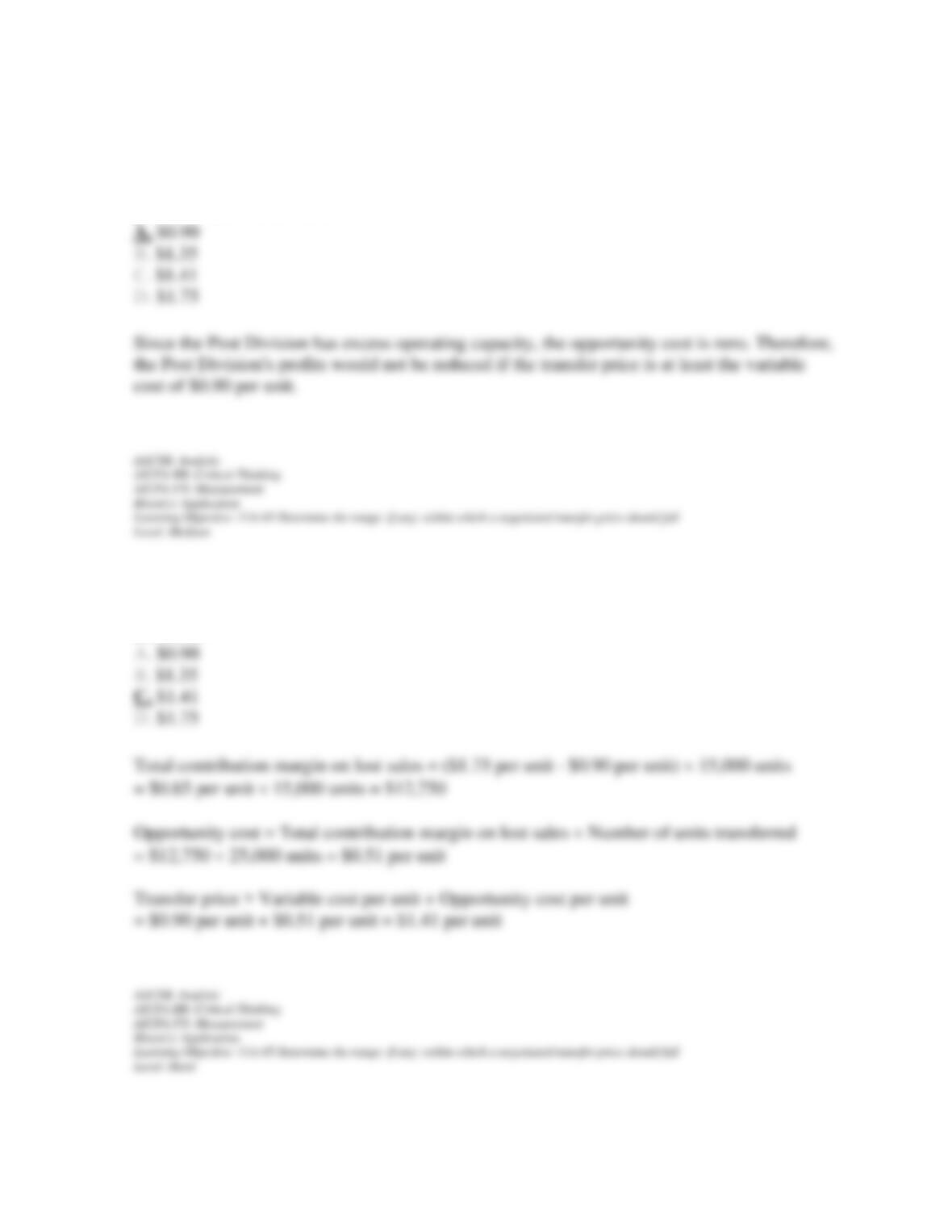
The Post Division of the M.T. Woodhead Company produces basic posts which can be sold
to outside customers or sold to the Lamp Division of the M.T. Woodhead Company. Last year
the Lamp Division bought all of its 25,000 posts from Post at $1.50 each. The following data
are available for last year’s activities of the Post Division:
The total fixed costs would be the same for all the alternatives considered below.
Chapter 11 – Appendix A Transfer Pricing
11–15
16. Suppose there is ample capacity so that transfers of the posts to the Lamp Division do not
cut into sales to outside customers. What is the lowest transfer price that would not reduce the
profits of the Post Division?
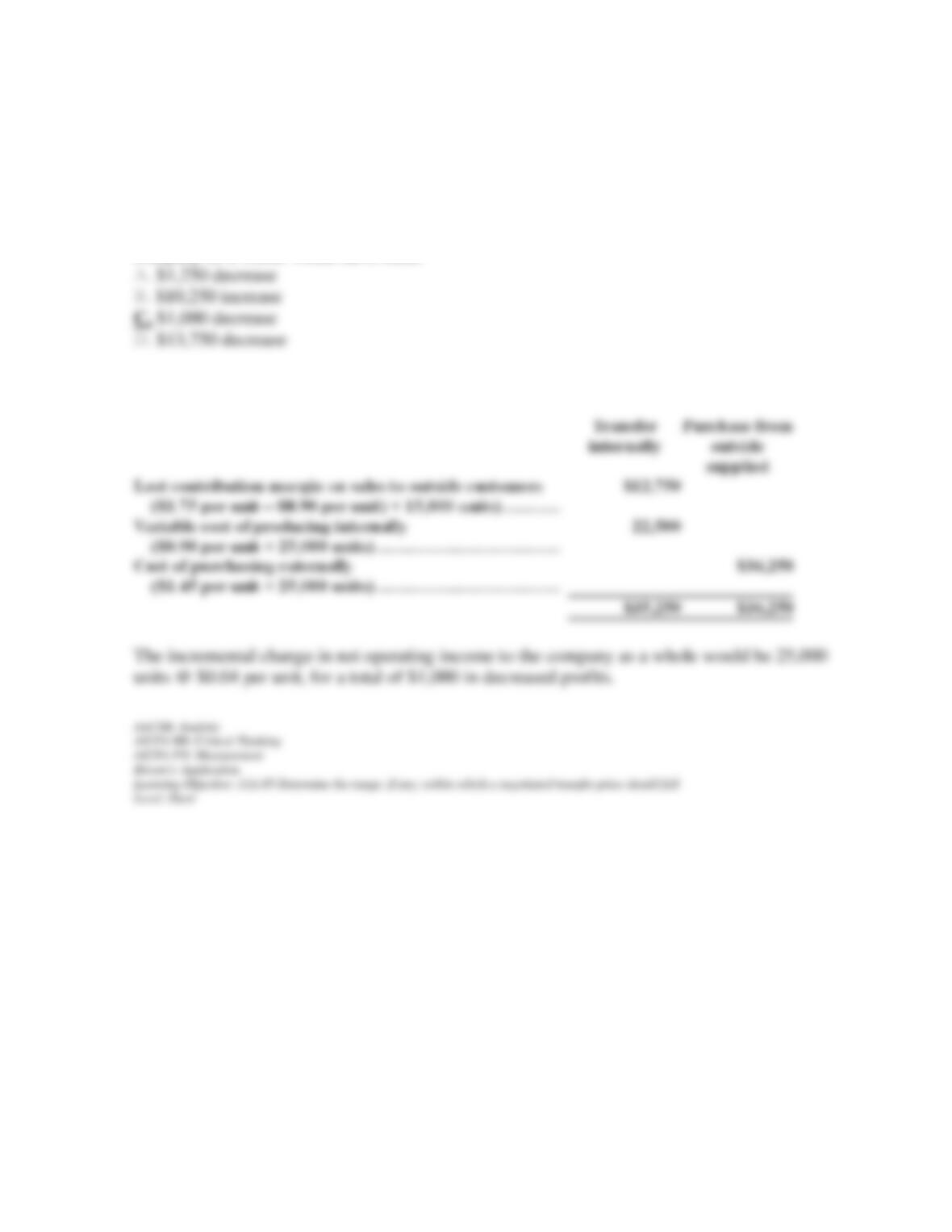
17. Suppose the transfers of posts to the Lamp Division cut into sales to outside customers by
15,000 units. What is the lowest transfer price that would not reduce the profits of the Post
Division?
Chapter 11 – Appendix A Transfer Pricing
11–16
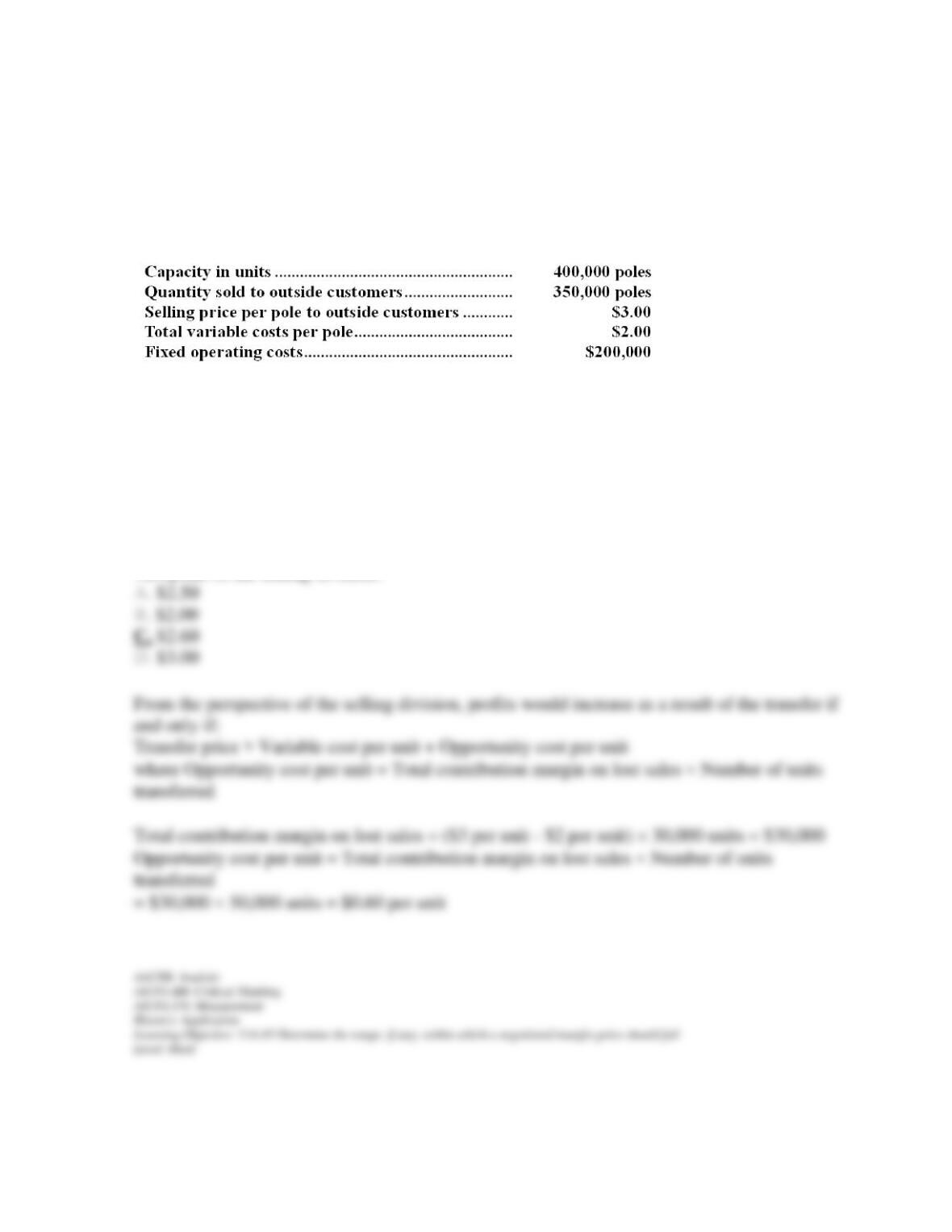
18. Suppose the transfers of posts to the Lamp Division cut into sales to outside customers by
15,000 units. Further suppose that an outside supplier is willing to provide the Lamp Division
with basic posts at $1.45 each. If the Lamp Division had chosen to buy all of its posts from
the outside supplier instead of the Post Division, the change in net operating income for the
company as a whole would have been:
Chapter 11 – Appendix A Transfer Pricing
11–17
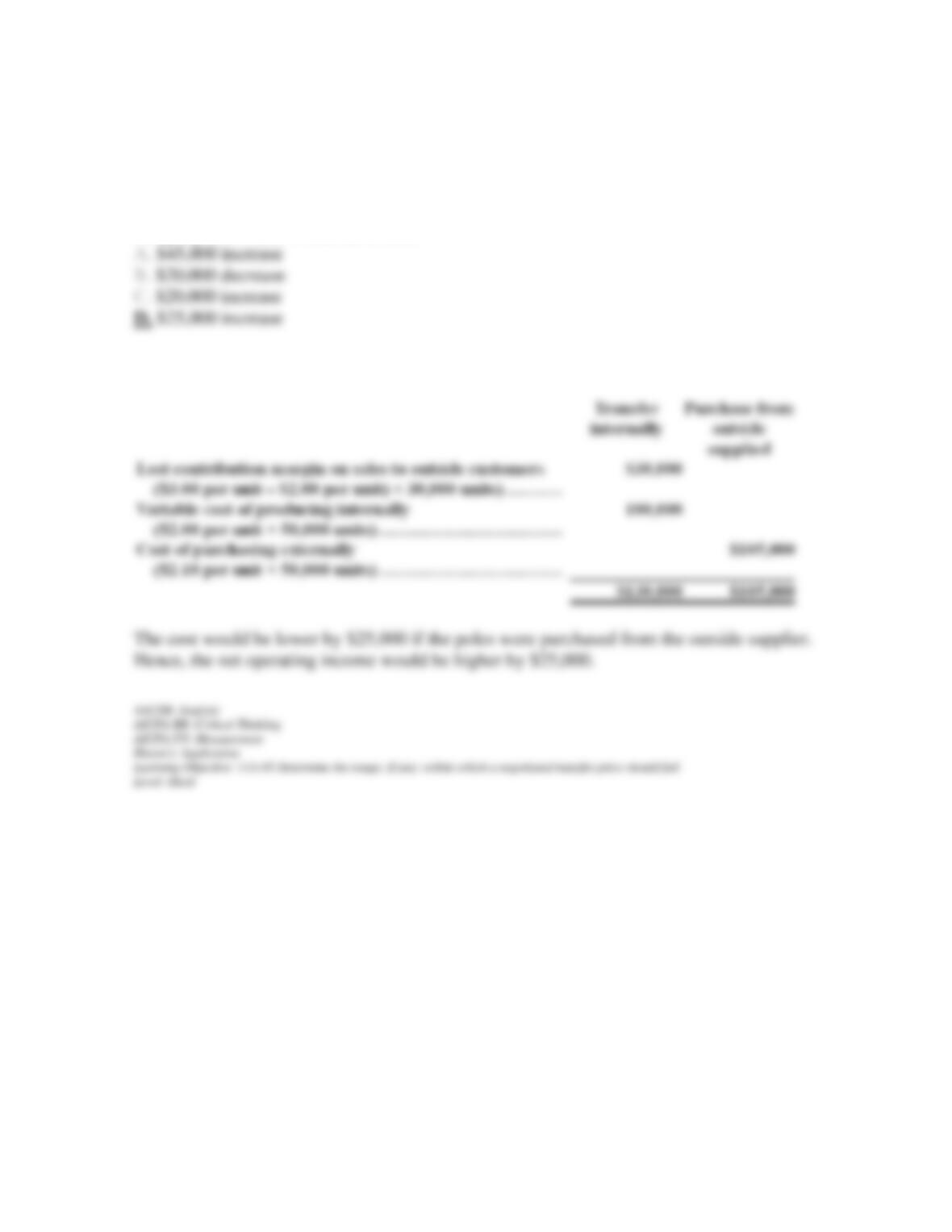
The Pole Division of Hillyard Company produces poles which can be sold to outside
customers or transferred to the Flag Division of Hillyard Company. Last year the Flag
Division bought 50,000 poles from Pole at $2.50 each. The following data are available for
last year’s activities in the Pole Division:
In order to sell 50,000 poles to the Flag Division, the Pole Division must give up sales of
30,000 poles to outside customers. That is, the Pole Division could sell 380,000 poles each
year to outside customers (rather than only 350,000 poles as shown above) if it were not
making sales to the Flag Division.
19. According to the formula in the text, what is the lowest acceptable transfer price from the
viewpoint of the selling division?
Chapter 11 – Appendix A Transfer Pricing
11–18
20. Suppose that last year an outside supplier would have been willing to provide the Flag
Division with the basic poles at $2.10 each. If Flag had chosen to buy all of its poles from the
outside supplier instead of the Pole Division, the change in net operating income for the
company as a whole would have been:
Essay Questions
Chapter 11 – Appendix A Transfer Pricing
11–19
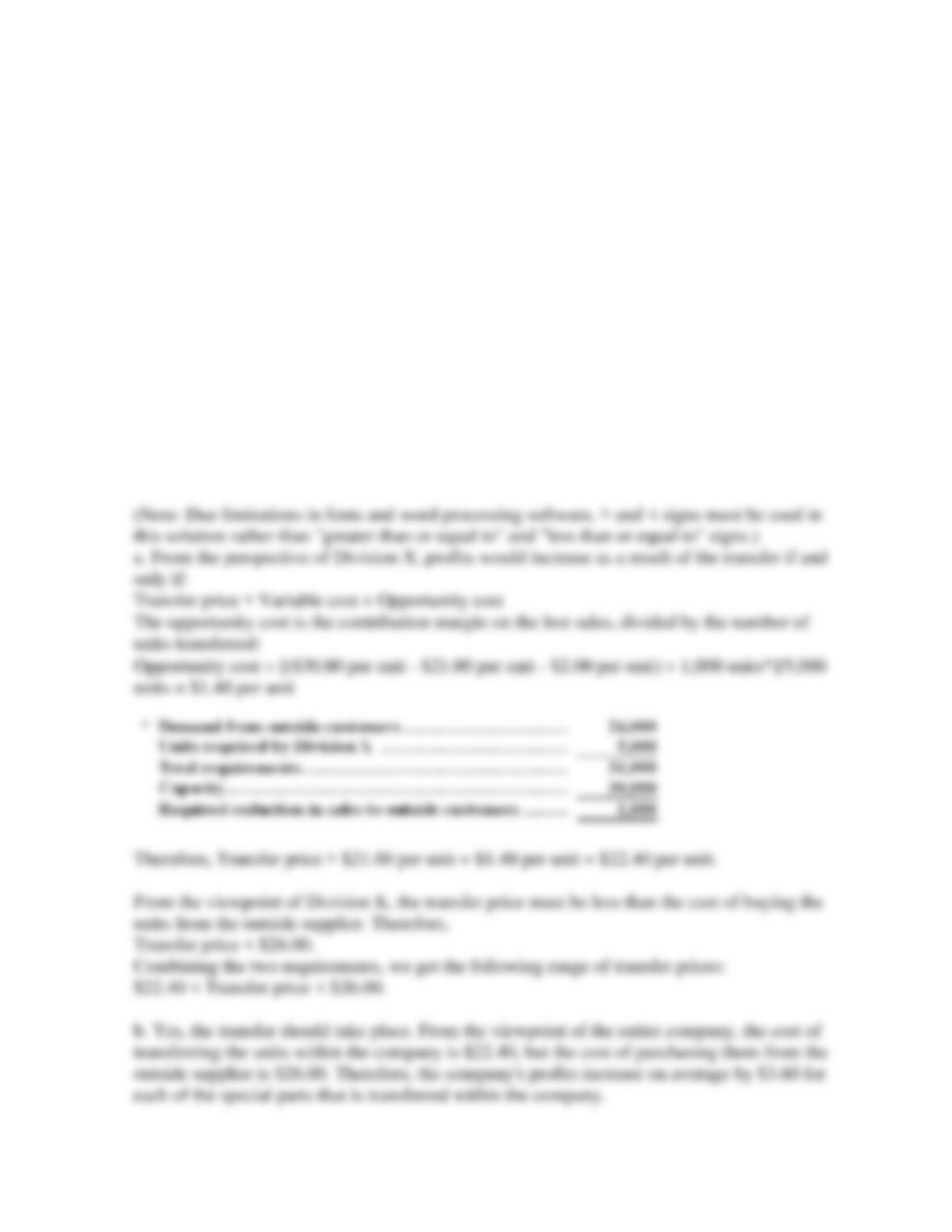
21. Division X has asked Division K of the same company to supply it with 5,000 units of
part L433 this year to use in one of its products. Division X has received a bid from an outside
supplier for the parts at a price of $26.00 per unit. Division K has the capacity to produce
30,000 units of part L433 per year. Division K expects to sell 26,000 units of part L433 to
outside customers this year at a price of $30.00 per unit. To fill the order from Division X,
Division K would have to cut back its sales to outside customers. Division K produces part
L433 at a variable cost of $21.00 per unit. The cost of packing and shipping the parts for
outside customers is $2.00 per unit. These packing and shipping costs would not have to be
incurred on sales of the parts to Division X.
Required:
a. What is the range of transfer prices within which both the Divisions’ profits would increase
as a result of agreeing to the transfer of 5,000 parts this year from Division X to Division K?
b. Is it in the best interests of the overall company for this transfer to take place? Explain.

Chapter 11 – Appendix A Transfer Pricing
11–20
Chapter 11 – Appendix A Transfer Pricing
11–21
22. Leontif Corporation has a Parts Division that does work for other Divisions in the
company as well as for outside customers. The company’s Equipment Division has asked the
Parts Division to provide it with 2,000 special parts each year. The special parts would require
$17.00 per unit in variable production costs.
The Equipment Division has a bid from an outside supplier for the special parts at $28.00 per
unit. In order to have time and space to produce the special part, the Parts Division would
have to cut back production of another part-the J789 that it presently is producing. The J789
sells for $34.00 per unit, and requires $22.00 per unit in variable production costs. Packaging
and shipping costs of the J789 are $4.00 per unit. Packaging and shipping costs for the new
special part would be only $0.50 per unit. The Parts Division is now producing and selling
10,000 units of the J789 each year. Production and sales of the J789 would drop by 10% if the
new special part is produced for the Equipment Division.
Required:
a. What is the range of transfer prices within which both the Divisions’ profits would increase
as a result of agreeing to the transfer of 2,000 special parts per year from the Parts Division to
the Equipment Division?
b. Is it in the best interests of Leontif Corporation for this transfer to take place? Explain.

Chapter 11 – Appendix A Transfer Pricing
11–22