56. Arsenic is released into drinking water
a.
from inorganic fertilizers
b.
from sewage and animal wastes
c.
from food processing facilities
d.
when any well is drilled down to the water table
e.
from mining refuse
57. Which of the following statements about underground contaminants is false?
a.
Degradable organic wastes do not decompose as rapidly underground as on the surface.
b.
There is little dissolved oxygen to aid in degradation of wastes.
c.
Waste products are diluted and dispersed quickly in underground aquifers.
d.
It can take hundreds to thousands of years for contaminated groundwater to cleanse itself
of degradable wastes.
e.
In some coastal areas, groundwater has been contaminated by saltwater intrusion.
58. Which of the following aquatic ecosystems receives the vast majority of the global inputs of pollution?
a.
estuary
b.
swiftly flowing stream
c.
deep-water ocean
d.
coastal parts of the ocean
e.
slow-moving river
59. Which of the following aquatic ecosystems is most capable of diluting, dispersing, and degrading large
amounts of sewage, sludge, and oil?
a.
estuary
b.
swiftly flowing stream
c.
deep-water ocean
d.
coastal parts of the ocean
e.
slow-moving river
60. The majority of the oil pollution of the ocean comes from
a.
blowouts (rupture of a borehole of an oil rig in the ocean)
b.
tanker accidents
c.
environmental terrorism
d.
runoff from land
e.
normal operation of offshore wells
61. All of the following are true about the discharge trading policy except
a.
is sponsored by the EPA
b.
uses market forces to reduce water pollution
c.
allows polluters to pollute at higher levels than they have permits for under certain
circumstances
d.
purchasing of unused polluting credits from permit holders who are polluting below their
allowed levels
e.
polluters who pollute at higher levels than they have permits for are immediately closed
down
62. Which of the following types of sewage treatment are properly matched?
a.
primary—removal of pollutants particular to a given area
b.
secondary—removal of oxygen-demanding wastes
c.
advanced—removal of suspended solids
d.
primary – removal of oxygen-demanding wastes
e.
primary and secondary both – removal of pollutants particular to a given area
63. The shift to pollution prevention will most likely be the result of
a.
bottom-up political pressure
b.
elected officials recognizing the benefits of sustainable living
c.
financial benefits of pollution prevention inspiring business leaders
d.
community cooperatives promoting the idea
e.
top-down politics starting at the White House
64. The main sources of lead, mercury and arsenic water pollutants are
a.
electric power plants
b.
inclined landfills, household chemicals, mining refuse and industrial discharges
c.
sewage and inorganic fertilizers
d.
runoff from streets and parking lots
e.
land erosion from farms that have used chemical insecticides
65. Which of the following statements about drinking bottled water is NOT true?
a.
Americans are the world’s largest consumers of bottled water.
b.
The movement to boycott bottled water consumption is called back-to-the-tap
c.
86% of the bottles containing bottled water are recycled
d.
Some of the bottled water that Americans drink comes from as much as 5,500 miles away.
e.
BPA is a chemical in the plastic of water bottles that can leach into the water, especially if
the bottle is exposed to the sun.
TRUE/FALSE
1. Most aquifers are rapidly recharged through precipitation that percolates downward through soil and
rock.
2. A large amount of the world’s drinking water comes from desalination.
3. We are using freshwater unsustainably by wasting it, polluting it and not charging enough for it.
4. Some water resources are best categorized as nonrenewable.
5. Drinking is the biggest use of water worldwide.
6. Flooding increases with economic and urban development.
7. Eutrophication is a condition of natural nutrient enrichment of a shallow lake, estuary or slow-moving
stream.
8. Global reduction of grain-fed beef consumption would help to reduce water shortages.
9. One potential problem associated with global warming is that rising sea levels will cause salt
contamination of coastal area soils.
10. The creation of dams and reservoirs has decreased the annual reliable runoff available for human use.
11. Salt from the region of the Aral Sea is being blown onto the alpine glaciers of the Himalayas, and is
causing them to melt at faster than normal rates.
12. Federal subsidies are provided to U.S. farmers who reduce water use in irrigation.
13. Drip irrigation systems can increase crop yields by 20–90%.
14. An oligotrophic lake tends to have relatively high levels of dissolved oxygen.
15. If we protect more wetlands, that will actually increase the threat of flooding.
16. Use of dams, reservoirs and water transfer projects has disrupted ecosystems.
17. The shrinkage of the Aral Sea has actually altered the climate of the area around it.
18. Heat is a type of water pollutant.
19. Atmospheric warming will increase water pollution in areas with increased rainfall and areas with
prolonged drought.
20. Cruise ships are a significant source of pollution of ocean water.
21. The United States is the world’s largest user of water, and wastes about 50% of all water drawn from
surface and groundwater sources.
22. Land erosion causes water pollution.
23. Preventing contamination is the least expensive and most effective way to protect groundwater
resources.
24. Water in a tap in Palm Springs, California, could have originated in northwestern Colorado.
COMPLETION
1. ____________________ are deep underground sources of freshwater found between the porous
geological layers of sand, gravel, or bedrock.
2. When a lot of water is pumped from an aquifer, or when there is a dry spell, the
____________________ sinks lower.
3. ____________________ involves removing dissolved salts from ocean water or from to increase
supplies of freshwater.
4. A flood happens when water in a stream overflows its normal channel and spills into the adjacent area,
called a(n) ____________________.
5. One of the most serious overdrafts of groundwater is in the United States in the lower half of the
________________aquifer.
6. ____________________ is the name given to the natural nutrient enrichment of a shallow lake.
7. Withdrawing massive amounts of groundwater can cause a condition called____________
______________
8. ____________________ keep the price of water so low that users do not worry about wasting water.
9. About ____________% of the freshwater used in the United States is unnecessarily wasted.
10. Human activities can greatly accelerate the rate at which nutrients and organic substances enter aquatic
ecosystems from their surrounding watersheds in a process called ______________
_______________.
11. Spaces in rock and soil called the ____________________ are completely filled with water.
12. The LifeStraw is a portable ____________________that eliminates many bacteria and viruses that are
drawn into it.
13. The country with the highest percentage of agricultural land irrigated with drip irrigation is
____________________.
14. In the United States and most other developed countries, there has been an increase in the number and
quality of _______________ treatment plants since the 1970’s.
15. ________________is slower to cleanse itself of contaminants than ____________________
_______________ ________________is.
16. Drip irrigation is used on ____________________%of irrigated crop fields in the United States, and
____________________% of irrigated crop fields worldwide.
17. About _________% of the garbage in the huge rotating masses of plastic and other trash in the Pacific
Ocean comes from land.
MATCHING
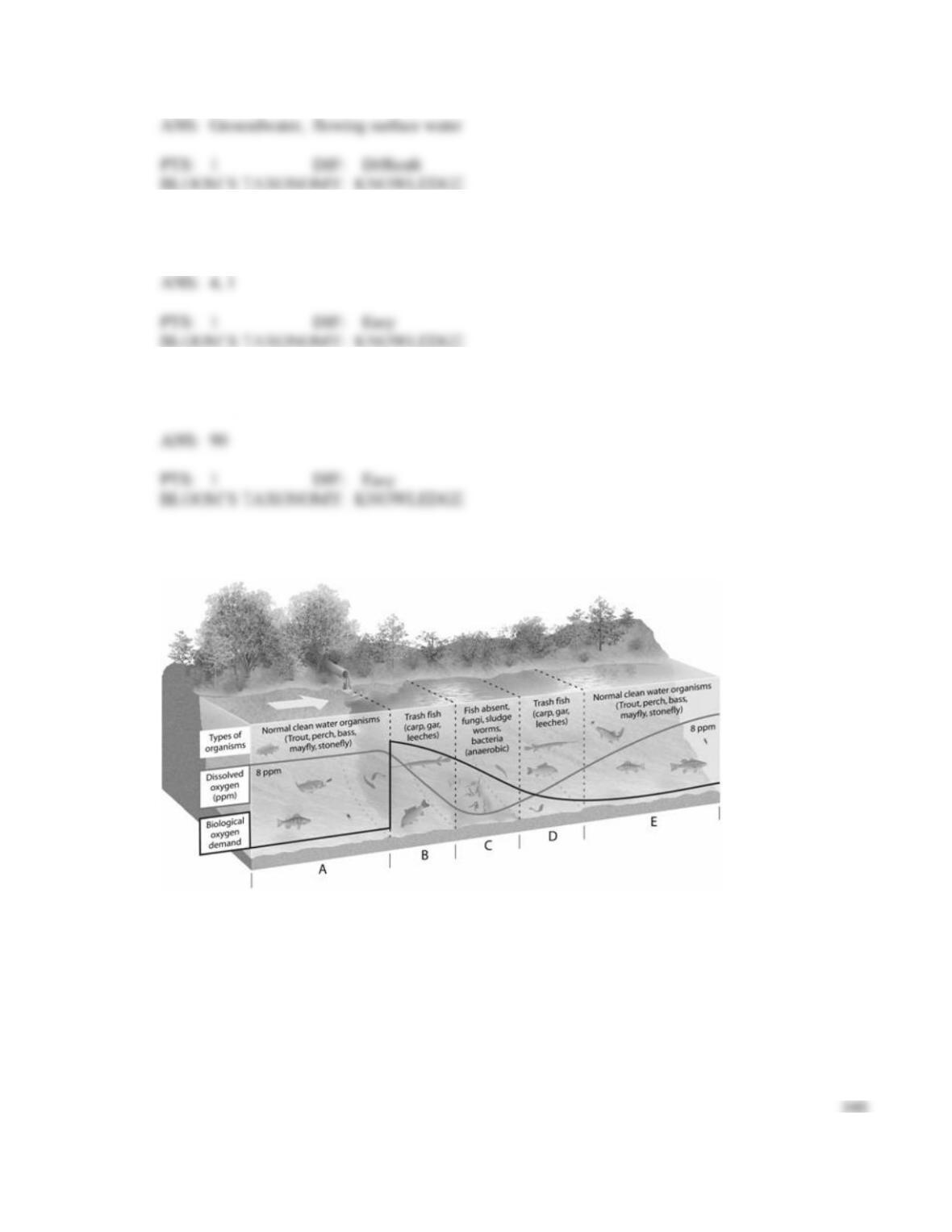
1. On the dilution and decay of degradable wastes figure, choose the zone in which populations of
organisms with high oxygen requirements will most likely be eliminated.
2. On the dilution and decay of degradable wastes figure, choose the zone in which the breakdown of
degradable wastes by bacteria starts to deplete the dissolved oxygen.
3. On the dilution and decay of degradable wastes figure, choose the zone in which the water has
recovered from oxygen-demanding wastes and heat.
4. On the dilution and decay of degradable wastes figure, choose the zone in which the water needs time
and must have an adequate flow rate.
5. On the dilution and decay of degradable wastes figure, choose the zone in which the bacteria have not
started the decay of degradable, oxygen-demanding wastes.
Match the items listed below with the appropriate choice
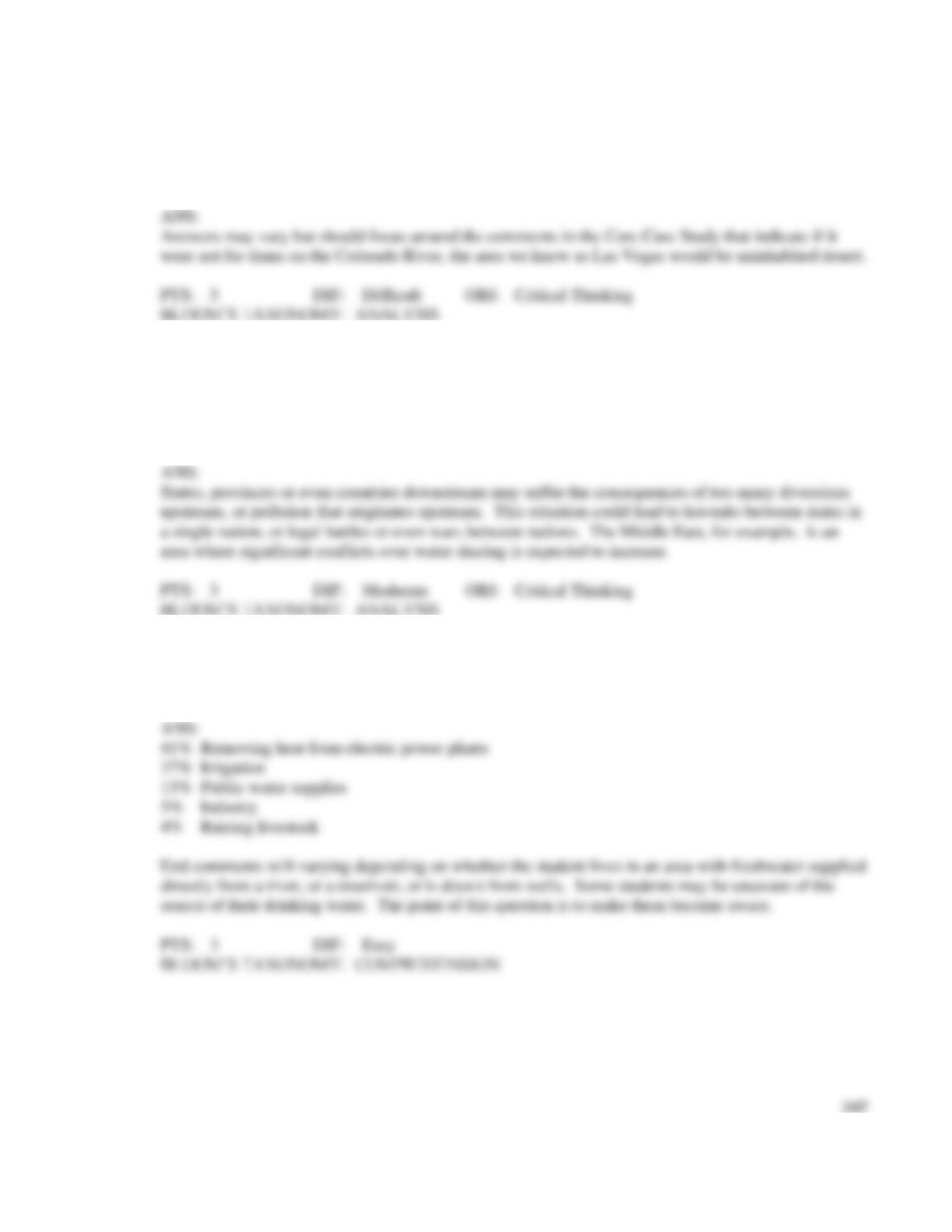
6. On the primary and secondary sewage treatment figure, choose the letter that represents where bacteria
are killed and the water is clean.
7. On the primary and secondary sewage treatment figure, choose the letter that represents where sludge
is dried before being disposed of.
8. On the primary and secondary sewage treatment figure, choose the letter that represents where the
water is aerated.
9. On the primary and secondary sewage treatment figure, choose the letter that represents where large
floating objects and solids are removed.
10. On the primary and secondary sewage treatment figure, choose the letter that represents where
activated sludge settles out in the biological process of sewage treatment.
11. On the primary and secondary sewage treatment figure, choose the letter that represents where
suspended solids settle out as sludge in the physical process of sewage treatment.
12. On the primary and secondary sewage treatment figure, choose the letter that represents where all the
sludge is combined before drying.
SHORT ANSWER
1. Writer Jacques Leslie, in his Harper’s Magazine article of July 2000, made this statement: “Las Vegas
is America’s city of fantasy, and water, not wealth, is its greatest fantasy of all. Comment on this
statement using information from this chapter.
2. Many of the world’s large rivers flow from one state or province to another, or even through several
others. The Colorado River and Mississippi River are examples of this. In many instances, they flow
from one country to another. Discuss the potential problems that arise from this simple geographical
fact. For example, what potential problem arises if the irrigation water used in Nebraska was polluted
or contaminated as the water moved through South Dakota?
3. List in order, from largest to smallest, the uses of water drawn from groundwater and surface water in
the United States. Also state what the percentages of use are. Include at the end how the drinking
water that is used in your city or town is acquired.
4. Hoover Dam was built in the 1930’s on the Colorado River, and at that time was extremely important
as an employment project. The United States was just coming out of the Great Depression and it was
viewed as a life-saver by thousands of people across the country. Now this dam is 80 years old.
Drawing from information in this chapter about aging dams, what is a severe problem that could be
expected?
ESSAY
1. In a freshwater river or stream, clearly explain what causes an oxygen sag curve and how this can
impact natural populations in that ecosystem.
2. Clearly explain how soil erosion, associated with poor agricultural practices, can lead to a decrease in
dissolved oxygen in bodies of water.
3. Explain the advantages and disadvantages of large dams and reservoirs.
4. List at least five things you are willing to do to help eliminate water waste. As part of your answer
explain why these things are important.
5. Using statistics presented in this chapter, discuss the problem with groundwater contamination in the
United States.
6. A recent Time magazine article discussed the profession of farming in the United States. The theme of
this article was the affluence of some farmers, and the fact that it is a very profitable career to have.
Discuss this fact, now that you are informed on some of the subsidies that traditional agriculture
receive. Keep in mind, also, the value of crop production and farming to our country. Weigh also the
profitability of such careers as being a professional athlete, an actor or actress, a celebrity, a Wall
Street CEO, and include comments on this as part of your answer.