55) NAFTA’s only primate city is
A) Montreal (pop. 4 million).
B) Toronto (pop 5.5 million).
C) New York (pop 8.4 million).
D) Los Angeles (4 million).
E) Mexico City (9 million).
56) World cities
A) did not exist until the twentieth century.
B) were initially intimately involved with imperialism and colonialism.
C) typically do not change in influence over time.
D) would not include small cities like Brussels.
57) The most important functions of world cities have to do with
A) economic functions.
B) dissemination of global culture.
C) international politics and diplomacy.
D) the influential media they host.
E) the nongovernmental organizations headquartered in them.
58) Which of the following is NOT a top-tier world city?
A) Los Angeles
B) New York
C) London
D) Tokyo
59) Counterurbanization
A) results in a much slower increase in population growth for cities.
B) is due in part to agglomeration economies.
C) is due in part to the increased accessibility of smaller towns and rural areas.
D) has been successful at shrinking the size of the world’s megacities.
60) Urban growth in peripheral countries
A) often occurs at a rapid rate.
B) can lead to overurbanization.
C) usually is far in advance of industrial development in urban areas.
D) often occurs at a rapid pace, can lead to overurbanization, and is usually far in advance of
industrial development in urban areas.
61) By A.D. 1000, a city-based world empire had NOT yet occurred in
A) Europe.
B) North America.
C) the Middle East.
D) China.
62) Of the following regions, which is least urbanized?
A) Africa
B) Middle East
C) Latin America
D) Europe
E) North America
63) In 2025 it is projected that the largest city will be in
A) North America.
B) Europe.
C) Latin America.
D) Africa.
E) Asia.
64) The Pearl River Delta is an extended metropolitan region of nearly 50 million people,
encouraged by the Chinese government as an engine of economic growth and built around the
already established economic success of
A) Hong Kong.
B) Beijing.
C) Shanghai.
D) Tokyo.
65) Cities in the world’s core have the potential to contribute significantly to the mitigation of
pollution and climate change because core cities
A) produce such huge amounts of greenhouse gas emissions that small changes can have
comparatively big results.
B) are already the greenest cities.
C) have growing amounts of brownfield sites.
D) are reurbanizing.
66) The transportation technology that first opened up agrarian interiors and intensified intercity
trade was the
A) wagon train/telegraph system.
B) interlinked canal and river systems.
C) railroad system.
D) expressway system.
67) The rise of instant slums is the consequence of
A) overurbanization.
B) counterurbanization.
C) decentralization.
D) reurbanization.
68) Which of the following is NOT among the reasons why world cities are typically targets of
terrorism?
A) The perpetrators and their groups are not from urban areas
B) The symbolic value — prestige is associated with penetrating sites of power.
C) The impact value — targeting urban infrastructure has the potential to be much more
destructive.
D) The political and social reverberations are greatest and have the potential to spread the most
fear.
69) Cities like Rio de Janeiro, Accra, Buenos Aires, Kolkata and other colonial cities emerged
and grew due to
A) trade.
B) industrialization.
C) tourism.
D) war.
E) the rank-size rule.
70) ________ gave us a new kind of city, and many of them. These cities were based on
assembling and processing raw materials and producing and distributing manufactured goods.
A) The Industrial Revolution
B) The Green Revolution
C) Central place theory
D) Overurbanization
E) Counterurbanization
71) Dubai, of the United Arab Emirates, embodies surprising and disturbing changes in
economic, social, and cultural life. Thus, it is a good example of a
A) shock city.
B) post-industrial city.
C) world city.
D) central city.
E) polycentric city.
1) According to the text, technological and industrial innovations now make the urbanization
process reversible.
2) The Gross Domestic Product of some cities is so big that they exceed the GDP of the countries
in which they are located.
3) While the urban system of medieval and feudal Europe was struggling to avoid collapse,
Baghdad was known as the intellectual center of the world.
4) The new phase of urbanization (14th century) that emerged with the regional trade networks
of Northern Italy and the Hanseatic League was based on merchant capitalism.
5) Gateway cities are thus named because of their function as centers of computer and
technology production.
6) Pure colonial cities are located where colonial administrators can easily keep colonizers
separate from the local population.
7) A basic assumption of central place theory is that people are spread evenly over space.
8) Primate cities are only found in the core.
9) The original urban hearths are today’s world cities.
10) The majority of urban population growth in peripheral countries is due to natural increase.
11) According to the World Bank’s “agglomeration index,” roughly half of the world is
urbanized.
12) A country can be highly urbanized and have a low rate of urbanization.

13) According to our text, the continued growth of urban populations is essentially irreversible.
14) For the urban geographer, urban areas are part of both an economy and a society.
15) After the 11th century, towns grew in size and importance in part because landlords raised
taxes on peasants.
16) Long-distance trading did not become significant until the late 18th century.
17) By definition, a gateway city is located in a core country.

18) Most urbanization has taken place during the last hundred years.
19) For the purpose of gathering comparable data, the United Nations has imposed a precise
definition of the meaning of urban upon the world’s states.
20) Typically, peripheral countries have a more rapid rate of urbanization than do core countries.
21) The most urbanized continent in the world is Asia—over 85%.
22) The rank-size rule worked well for 19th century towns and cities, but it has limited
applicability to modern towns and cities.

23) New York City is a primate city.
24) Many world cities appeared at the same time that imperialism and colonialism became
significant.
25) World cities attract businesses in part because of agglomeration effects.
26) Chicago is a top-tier world city.
27) An increase in the production of basic functions of a city will typically lead to growth in the
city’s population.
28) Most migrants to urban centers in the periphery are drawn by plentiful job opportunities and
adequate housing.
29) Poor migrants make up the bulk of the population growth of frontier towns in the periphery.
30) Urbanization has made the plight of poor children worse in less-developed countries.
31) Urbanization first occurred in the Middle East, which triggered urbanization in the other
hearth areas of the world.
32) Urbanization is commonly found in areas where subsistence agriculture is the primary source
of food.
33) Although its economic importance increased during the course of the nineteenth century,
Manchester’s population size remained relatively constant.
34) In 1950, 2/3 of the world’s 30 largest cities were located in core countries.
35) By 2030, all but two or three of the world’s 30 largest cities will not be located in the core.
36) Though Hong Kong is now part of China, its northern border is separated from the rest of the
country by an electrified fence to control the movement of goods and people.
37) China has more top 25 global world cities than all of Europe.

38) Agglomeration diseconomies have slowed the growth of urbanization in the core but not in
the periphery.
39) Latin America had cities before the Columbian Exchange.
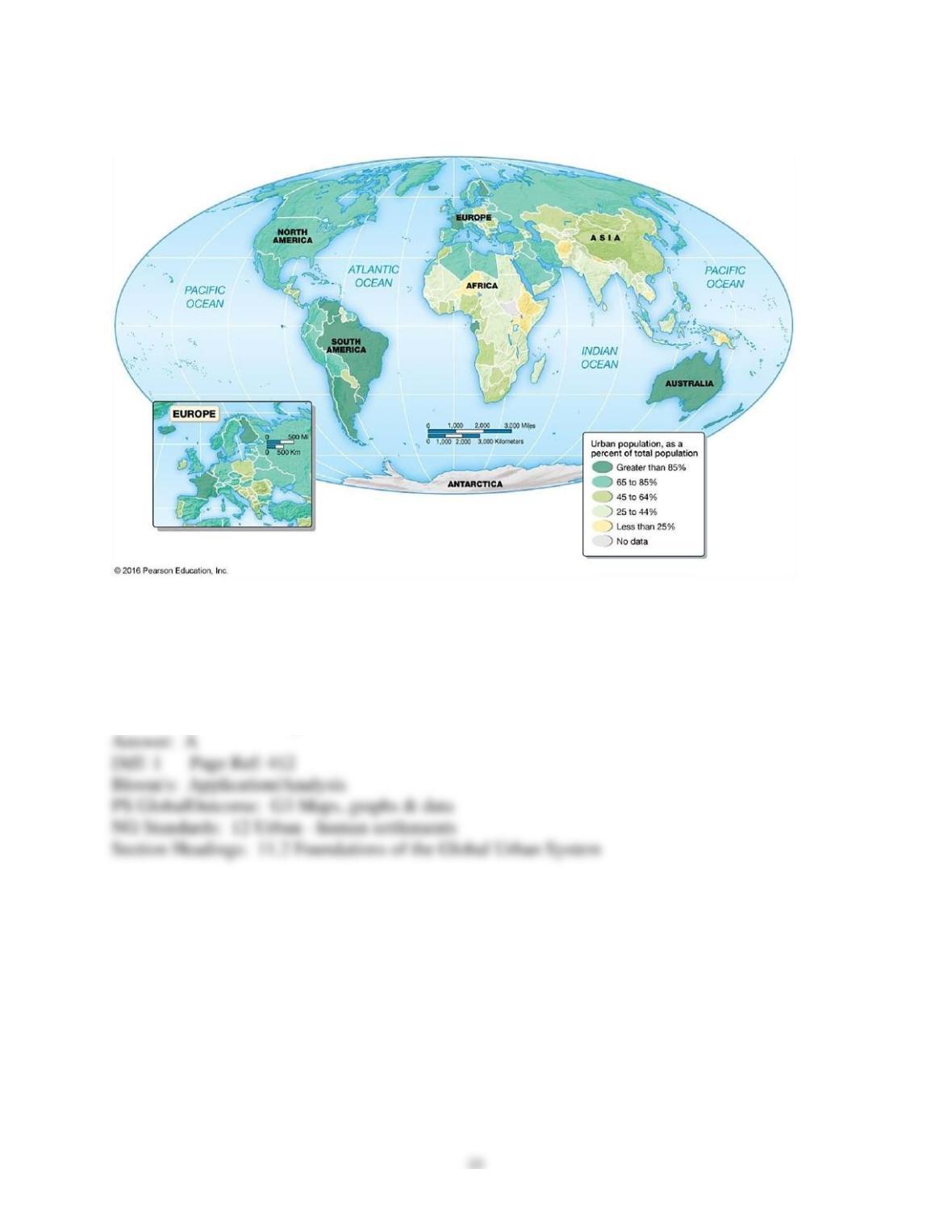
11.3 Questions with Images
1) The above map shows the percentage of each country’s
A) population that lives in urban settlements.
B) population that lives in the primate city.
C) area that is urban.
D) likelihood that cities are shock cities.
E) cities that are central places.
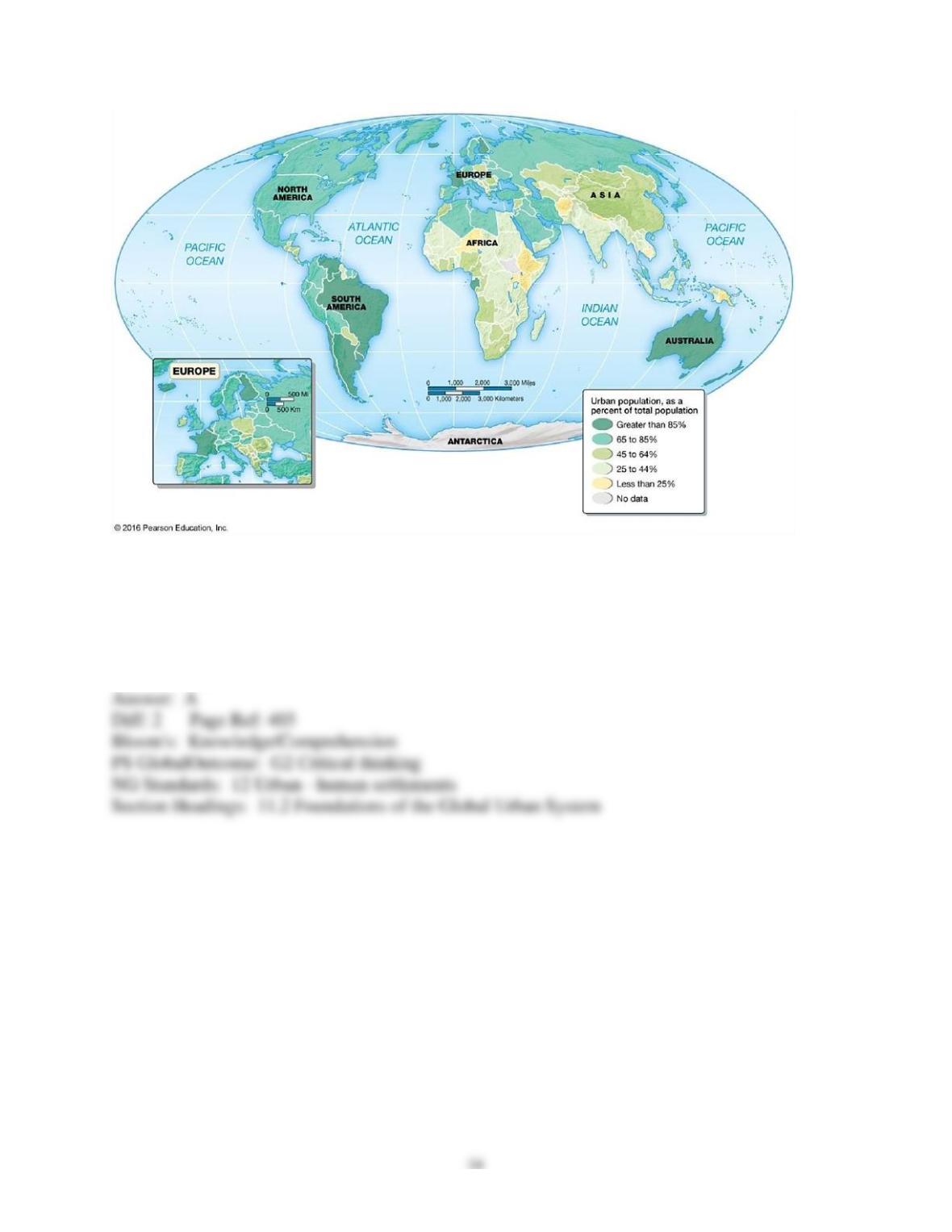
2) The cities shown on the world map above all have this in common — they are
A) gateway cities.
B) shock cities.
C) primate cities.
D) peripheral cities.
E) world cities.
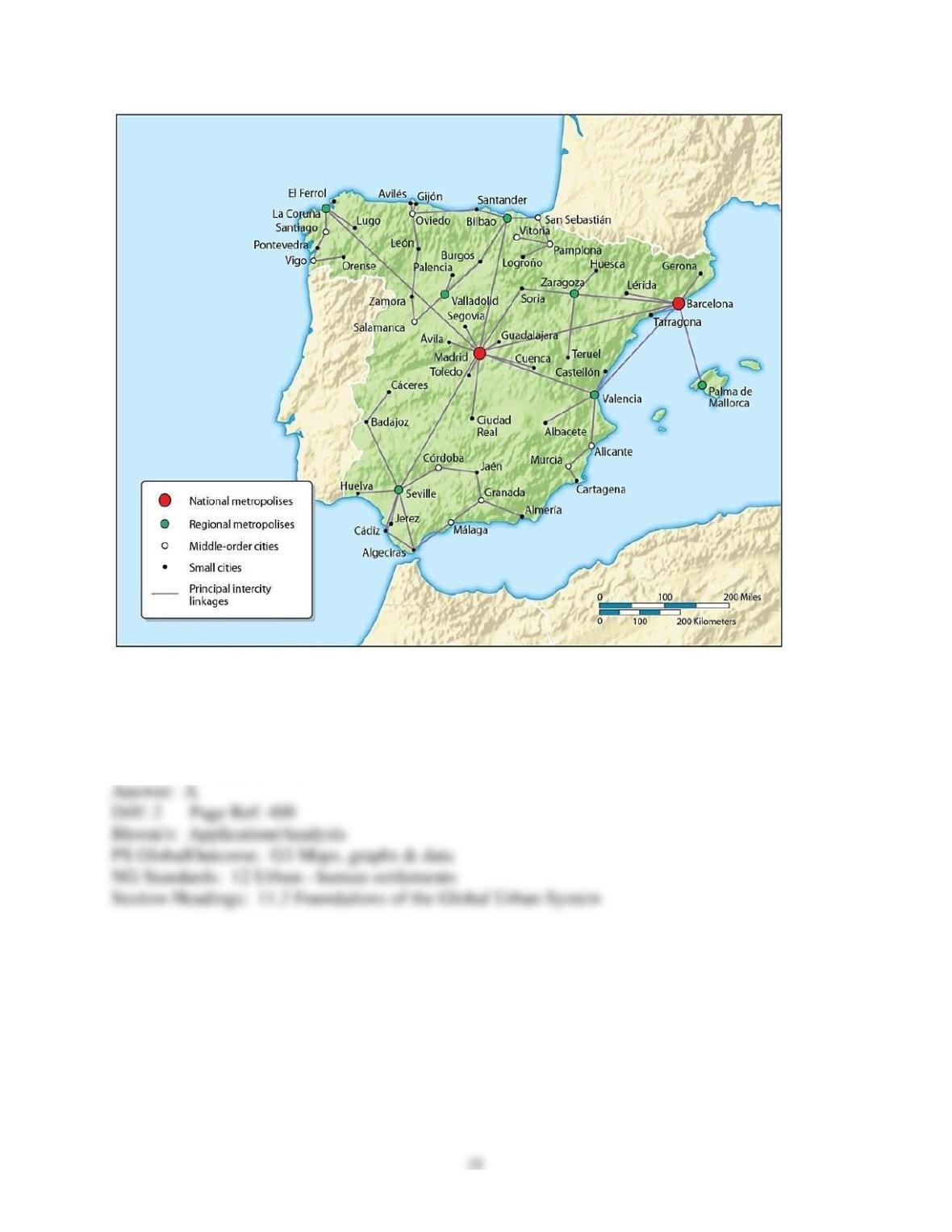
3) The above map of Spain visually demonstrates the
A) hierarchical nature of central place theory.
B) overurbanization.
C) the rank size rule.
D) the world city network.