
62. Exhibit 11-1
Pelletier Corporation has the following stock outstanding:
Preferred Stock (6 percent, $10 par, 45,000 shares authorized, 10,000
shares issued and outstanding)
$100,000
Common Stock ($7 par, 250,000 shares authorized, 120,000 shares issued
and outstanding)
840,000
Refer to Exhibit 11-1. Given the information above, if Pelletier pays a $9,000 cash dividend, and if the preferred stock is noncumulative, common
stockholders will receive
63. Exhibit 11-1
Pelletier Corporation has the following stock outstanding:
Preferred Stock (6 percent, $10 par, 45,000 shares authorized, 10,000
shares issued and outstanding)
$100,000
Common Stock ($7 par, 250,000 shares authorized, 120,000 shares issued
and outstanding)
840,000
Refer to Exhibit 11-1. Given the information above, if Pelletier pays a $64,000 dividend, and if the preferred stock is cumulative and two years’
dividends are in arrears, common stockholders will receive
64. Exhibit 11-1
Pelletier Corporation has the following stock outstanding:
Preferred Stock (6 percent, $10 par, 45,000 shares authorized, 10,000
shares issued and outstanding)
$100,000
Common Stock ($7 par, 250,000 shares authorized, 120,000 shares issued
and outstanding)
840,000
Refer to Exhibit 11-1. Given the information above, if Pelletier pays a $64,000 dividend, and if the preferred stock is noncumulative and the two
previous years’ dividends have not been paid, common stockholders will receive
65. Exhibit 11-1
Pelletier Corporation has the following stock outstanding:
Preferred Stock (6 percent, $10 par, 45,000 shares authorized, 10,000
shares issued and outstanding)
$100,000
Common Stock ($7 par, 250,000 shares authorized, 120,000 shares issued
and outstanding)
840,000
Refer to Exhibit 11-1. Given the information above, if Pelletier pays a $108,000 dividend, and if the preferred stock is cumulative and three years’
dividends are in arrears, preferred stock will receive
66. The following information is available for Snipes Company:
2012
2011
Current assets
$24,000
$23,600
Current liabilities
8,400
7,400
Long-term assets
18,400
15,000
Long-term liabilities
12,000
11,200
Stockholders’ equity
22,000
20,000
Net sales
88,000
76,000
Net income
3,200
2,800
Dividends paid
1,800
1,600
The dividend payout ratio for 2012 is
67. The term used to describe the equity section of the balance sheet that reports the effect on equity that results
from market-related gains and losses that are NOT included in the computation of net income is
68. The purpose of a statement of stockholders’ equity is to
69. The foreign currency translation adjustment is reported in the
70. Unrealized gains and losses on available-for-sale securities are reported in the
71. Which of the following is NOT a component of comprehensive income?
72. Which of the following would NOT appear on a statement of stockholders’ equity?
73. Which of the following arises because of the change in the equity of foreign subsidiaries that occurs as a
result of changes in foreign currency exchange rates?
74. The following information is available for Janeway Corporation for the year 2012:
Net income
$37,500
Foreign currency translation adjustment
3,750
Net unrealized gain (loss) on available-for-sale securities
(1,800)
Dividends paid
18,000
Given this information, what is Janeway’s comprehensive income for 2012?
75. The following information is available for Pluto Company for the year 2012:
Comprehensive income
$50,000
Foreign currency translation adjustment
12,500
Net unrealized gain (loss) on available-for-sale securities
4,000
Dividends paid
7,000
Given this information, what is Pluto’s net income for 2012?
76. Identify the three types of organizations and list the characteristics of each one.
Proprietorship:
·
Owned by one person
·
Formed with few legal formalities
·
Easily terminated
·
Unlimited liability
·
Owned by two or more persons
·
Formed with few legal formalities
·
Easily terminated
·
Unlimited liability
·
Limited liability
·
Easy transferability of owners
·
Double taxation
·
Close government regulation

77. Identify the two types of stock that are sold by a corporation and list the characteristics of each one.
Common Stock:
78. The stockholders’ equity section of the balance sheet for Beryl Corporation as of December 31, 2012, is as
follows:
Stockholders’ Equity
Preferred stock (6 percent, $24 par, cumulative, 100,000 shares
authorized)
$1,200,000
Common stock (no par, $10 stated value, 200,000 shares authorized)
1,600,000
Paid-in capital in excess of stated value, common stock
900,000
Total contributed capital
$3,700,000
Retained earnings:
Retained earnings, unrestricted
$1,200,000
Retained earnings, restricted
400,000
1,600,000
Total contributed capital and retained earnings
$5,300,000
Less: Treasury stock, common (5,000 shares at $30 per share)
(150,000)
Total stockholders’ equity
$5,150,000
a.
How many shares of preferred stock have been issued?
b.
How many shares of common stock have been issued?
c.
How many shares of preferred stock are outstanding?
d.
How many shares of common stock are outstanding?
a.
$1,200,000 ¸ $24 par = 50,000 shares
b.
$1,600,000 ¸ $10 stated value = 160,000 shares
c.
50,000 shares (no preferred treasury stock)
d.
160,000 shares issued – 5,000 treasury shares = 155,000 shares
·
Confers the right to vote in corporate matters
·
Confers the right to maintain proportionate ownership
·
Confers the right to receive cash dividends
·
Confers the ownership of all excess corporate assets upon liquidation of the corporation
·
Confers preferential claims to dividends
·
Confers preferential claims to liquidation privileges
·
Has no voting rights
79. On January 1, 2012, Dkembe Corporation was authorized to issue 100,000 shares of common stock, par
value $5 per share, and 20,000 shares of 5 percent cumulative preferred stock, par value $40 per share.
Prepare journal entries to record the following 2012 transactions:
a.
Issued 60,000 shares of common stock at $12 per share.
b.
Issued 12,000 shares of preferred stock at $56 per share.
c.
Reacquired 1,000 shares of common stock at $12 per share.
d.
Reissued 200 of the treasury shares for $2,600.
e.
Declared a cash dividend sufficient to meet the current-dividend preference on preferred stock and pay common stockholders $1 per share.
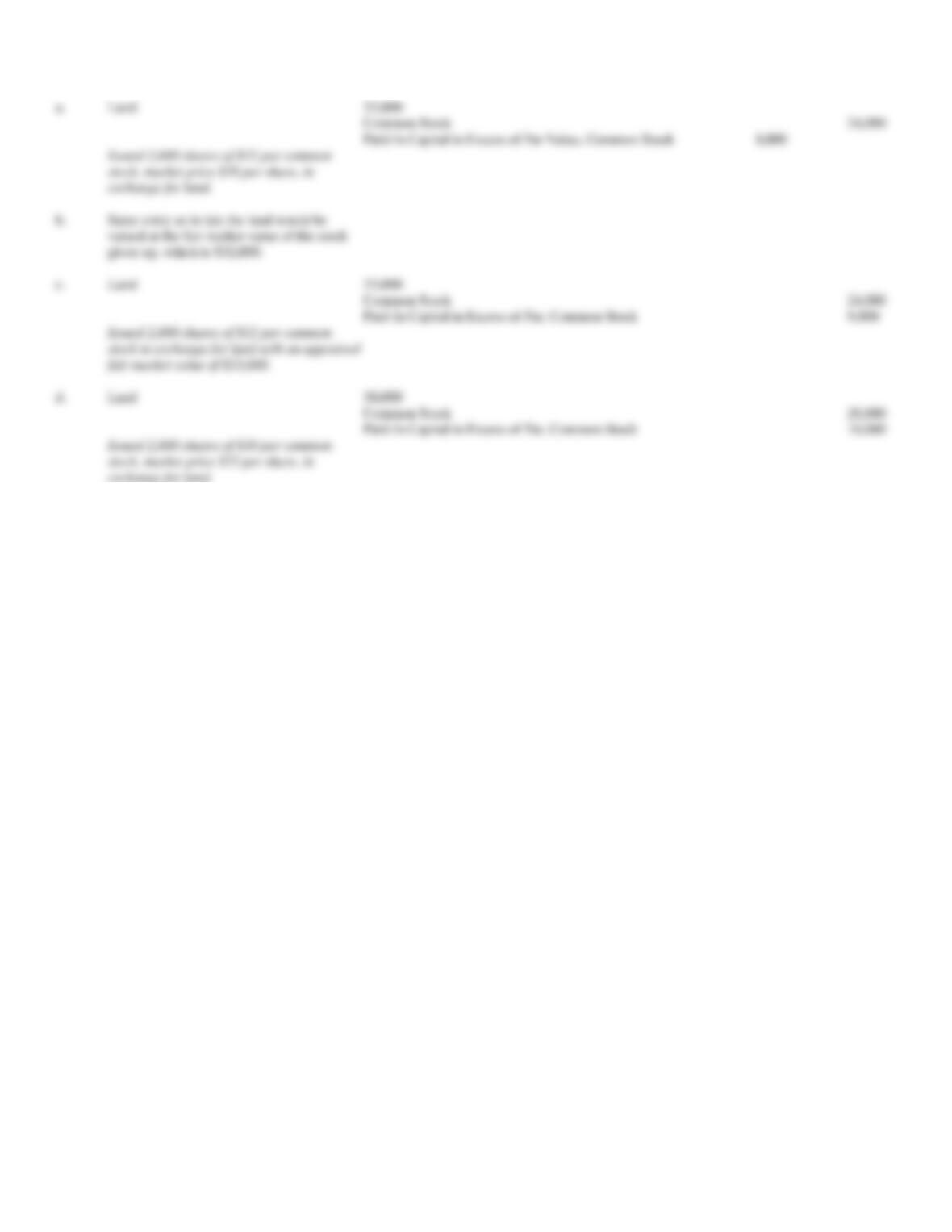
80. Assume that 2,000 shares of common stock with a par value of $12 and a market price of $16 per share are
issued in exchange for land with a fair market value of $32,000.
a.
Prepare the journal entry to record the transaction.
b.
If the land’s appraised fair market value were $33,000, what would be the correct entry to record the transaction?
c.
Prepare the necessary journal entry, assuming the same facts as in (b), except that the stock is not actively traded and therefore its market
price is unknown.
d.
Prepare the necessary journal entry, assuming the stock has a par value of $10 and a market price of $15 per share.
a.
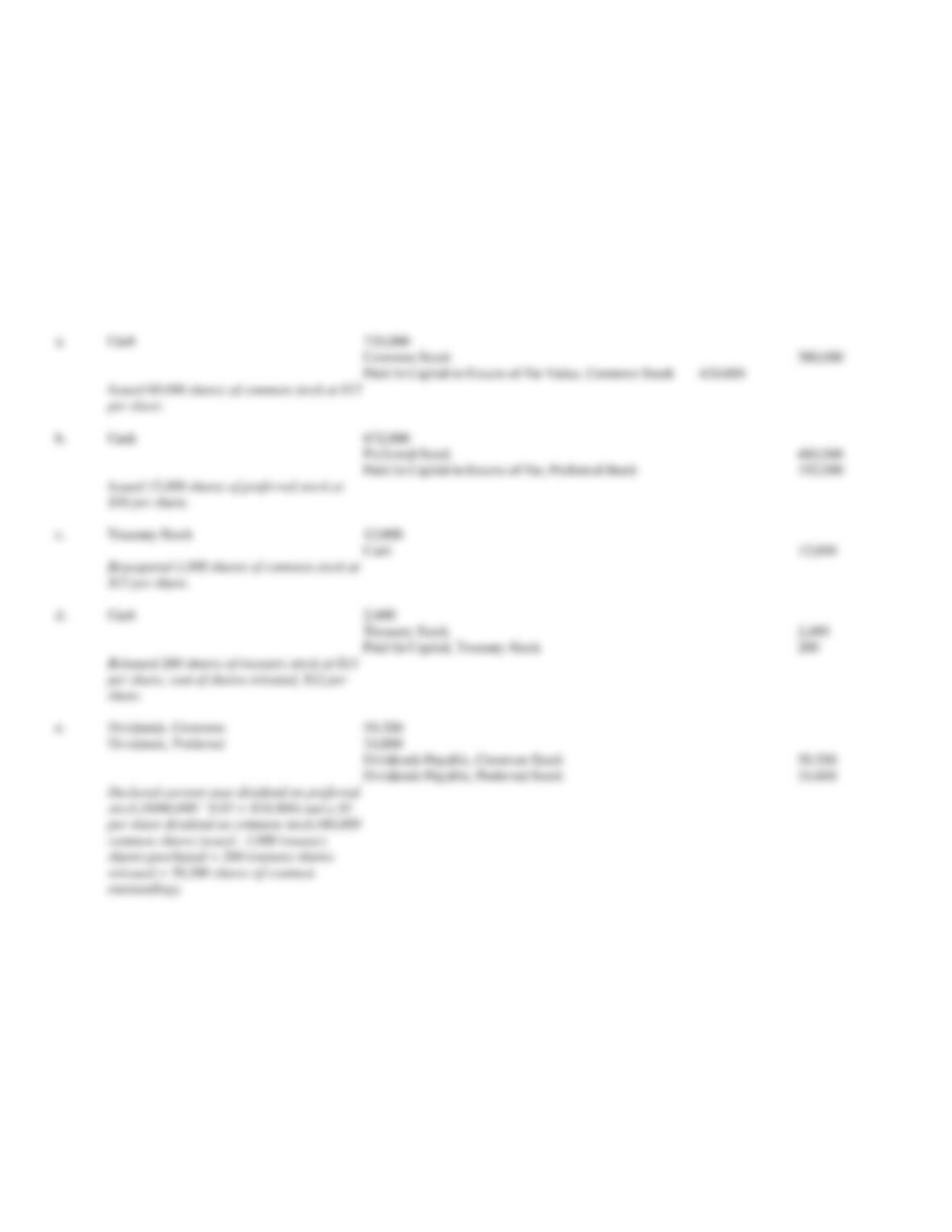
Cash
720,000
Common Stock
300,000
Paid-In Capital in Excess of Par Value, Common Stock
420,000
b.
Cash
672,000
Preferred Stock
480,000
Paid-In Capital in Excess of Par, Preferred Stock
192,000
c.
Treasury Stock
12,000
Cash
12,000
d.
Cash
2,600
Treasury Stock
2,400
e.
Dividends, Common
59,200
Dividends, Preferred
24,000
Dividends Payable, Common Stock
59,200
Dividends Payable, Preferred Stock
24,000
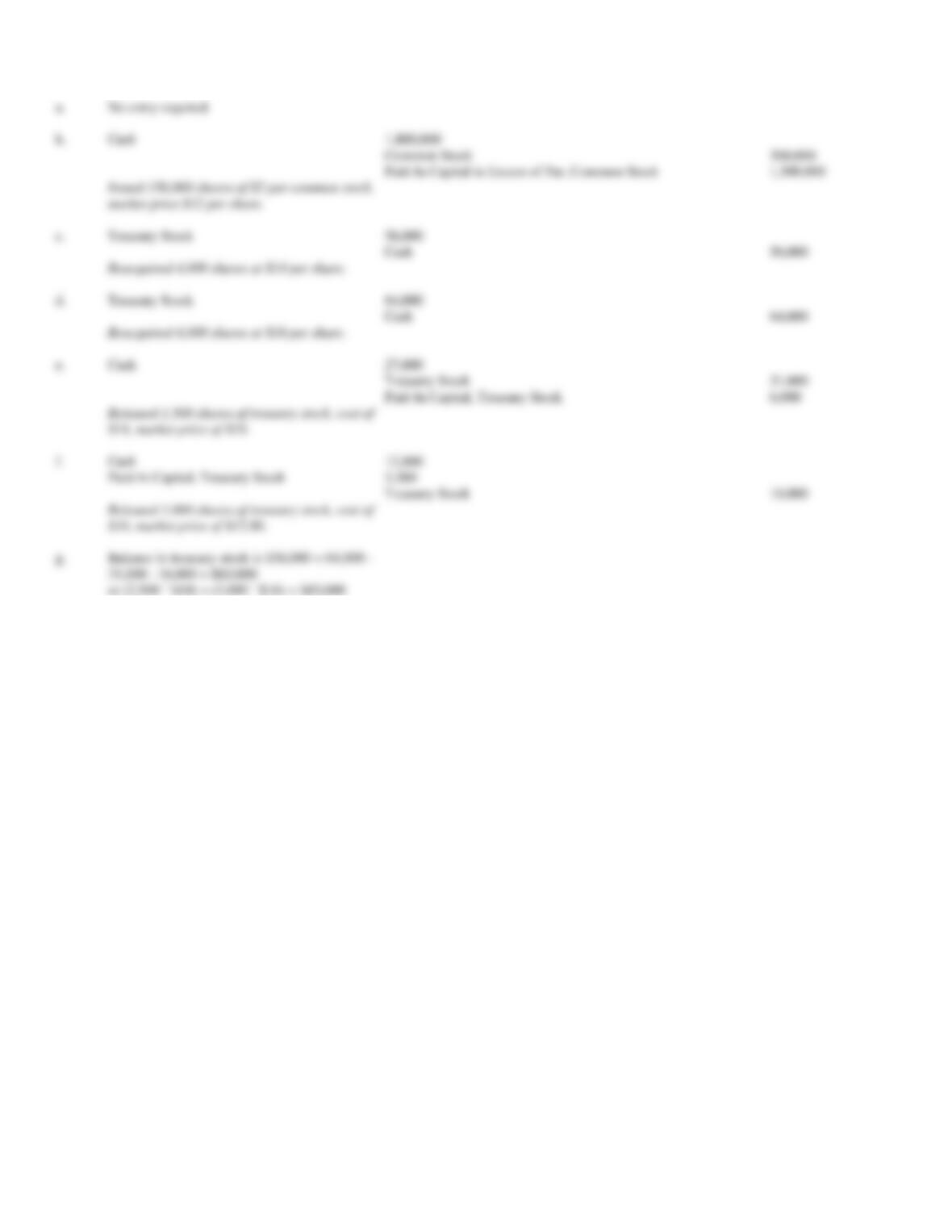
81. Provide the necessary journal entries to record the following:
a.
Delta Corporation was granted a charter authorizing the issuance of 600,000 shares of $2 par value common stock.
b.
The company issued 150,000 shares of common stock at a price of $12 per share.
c.
The company reacquired 4,000 shares of its own stock at $14 per share, to be held in treasury.
d.
Another 4,000 shares were reacquired at $16 per share.
e.
Of the shares reacquired in (c), 1,500 were reissued for $18 per share.
f.
Of the shares reacquired in (d), 1,000 were reissued at $12.80 per share.
g.
Given the preceding transactions, what is the balance in the treasury stock account?
a.
Land
32,000
Paid-In Capital in Excess of Par Value, Common Stock
8,000
c.
Land
33,000
Common Stock
Paid-In Capital in Excess of Par, Common Stock
d.
Land
30,000
Common Stock
Paid-In Capital in Excess of Par, Common Stock
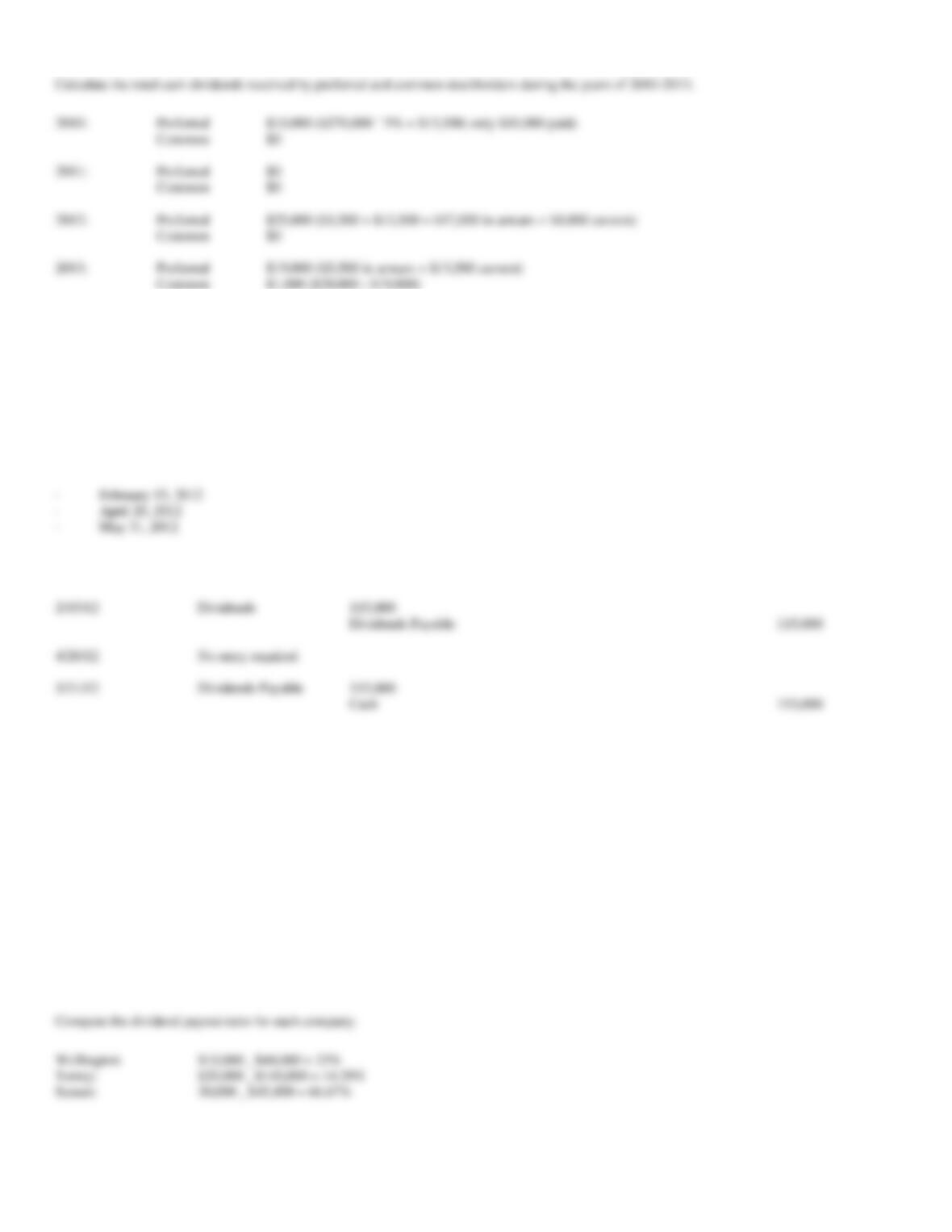
82. Halsey Corporation first issued stock on January 1, 2010. Halsey has the following stock outstanding on
December 31, 2013:
Preferred Stock (5 percent cumulative, $45 par, 10,000 shares authorized,
6,000 shares issued and outstanding)
$270,000
Common Stock ($5 par, 100,000 shares authorized, 75,000 shares issued
and outstanding)
375,000
Halsey Corporation paid cash dividends as follows:
2010:
$10,000
2011:
$ 0
2012:
$25,000
2013:
$20,000
No entry required
Cash
1,800,000
Common Stock
300,000
Paid-In Capital in Excess of Par, Common Stock
1,500,000
Treasury Stock
56,000
Cash
56,000
Treasury Stock
64,000
Cash
64,000
Cash
27,000
Treasury Stock
21,000
Paid-In Capital, Treasury Stock
6,000
Cash
12,800
Paid-In Capital, Treasury Stock
3,200
Treasury Stock
16,000
or (2,500 ´ $14) + (3,000 ´ $16) = $83,000
83. On February 15, 2012, Portage Company declared a dividend of $115,000. Portage Company decided that
the dividend would be paid on May 31, 2012, to all shareholders of record on April 20, 2012.
Prepare the appropriate journal entries to record the transactions on the following dates:
·
February 15, 2012
·
April 20, 2012
·
May 31, 2012
2/15/12
Dividends
115,000
Dividends Payable
115,000
4/20/12
No entry required
5/31/12
Dividends Payable
115,000
Cash
115,000
84. The following information is given for Wellington Company, Torrey Company, and Sunset Company.
Wellington
Torrey
Sunset
Accounts receivable
$ 30,000
$ 100,000
$ 35,000
Retained earnings
90,000
200,000
205,000
Cash dividends
10,000
20,000
30,000
Capital stock
320,000
400,000
125,000
Total assets
200,000
300,000
150,000
Sales
800,000
1,200,000
350,000
Net income
40,000
140,000
45,000
Wellington:
$10,000 ¸ $40,000 = 25%
Common
2011:
Preferred
Common
2012:
Preferred
$25,000 ($3,500 + $13,500 = $17,000 in arrears + $8,000 current)
Common
2013:
Preferred
$19,000 ($5,500 in arrears + $13,500 current)
Common
$1,000 ($20,000 – $19,000)
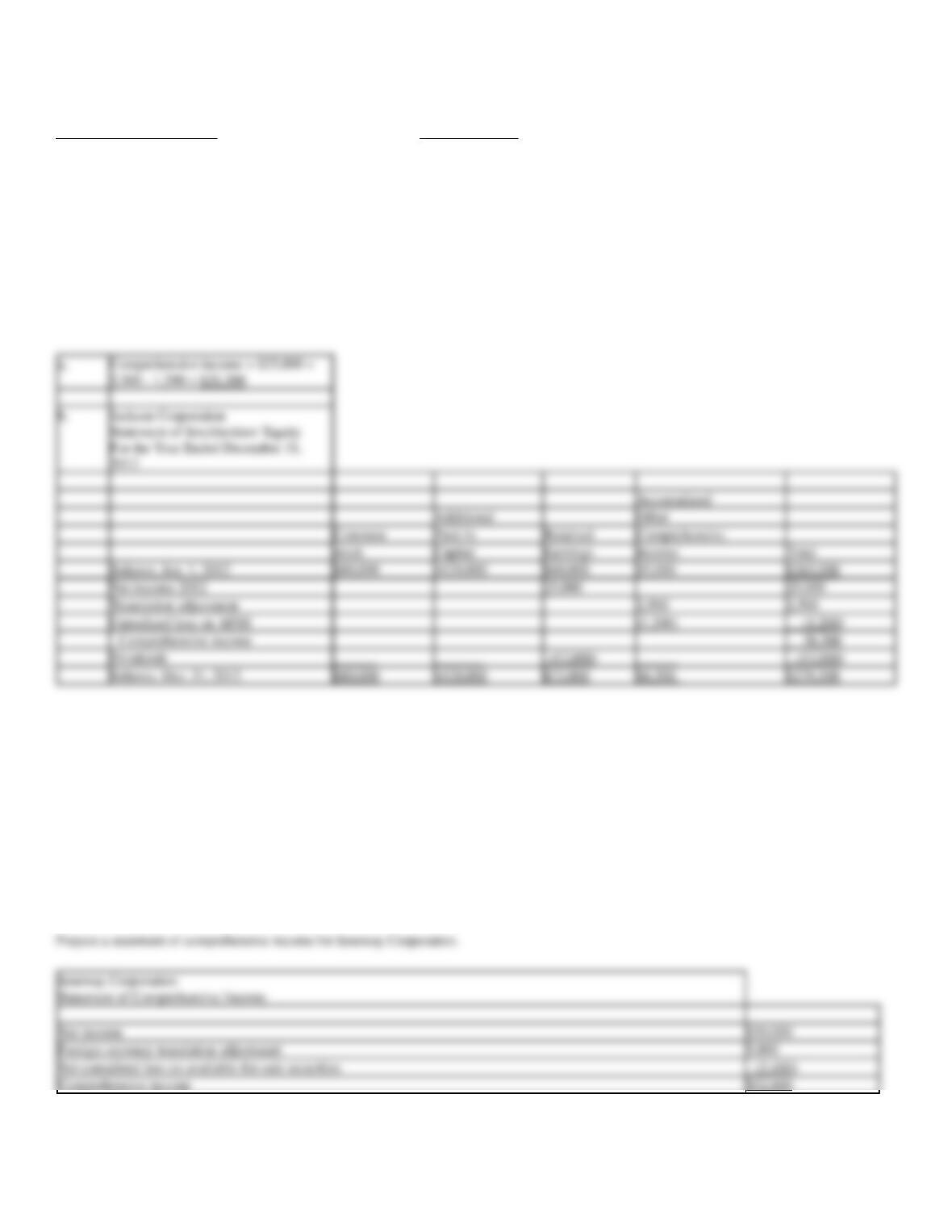
85. The accounting records of Jackson Corporation reveal the following data:
December 31, 2011 balances
2012 transactions
Common stock
$ 80,000
Net income
$25,000
Additional paid-in capital
120,000
Translation adjustment
2,500
Retained earnings
60,000
Unrealized loss on available-
Accumulated other
for-sale securities
(1,200)
comprehensive income
5,000
Dividends paid
12,000
a.
Compute the comprehensive income for 2012.
b.
Prepare the statement of stockholders’ equity for 2012.
86. The accounting records of Janeway Corporation reveal the following data:
Net income
$ 50,000
Foreign currency translation adjustment
5,000
Net unrealized loss on available-for-sale securities
(2,400)
Cost of goods sold
175,000
Interest expense
4,000
Dividends paid
24,000
Net income
$50,000
Foreign currency translation adjustment
5,000
Net unrealized loss on available-for-sale securities
(2,400)
Accumulated
Additional
Other
Common
Retained
Comprehensive
stock
Capital
Earnings
Income
Total
Balance, Jan. 1, 2012
$80,000
$120,000
$60,000
$5,000
$265,000
Net income 2012
25,000
25,000
Translation adjustment
2,500
2,500
Unrealized loss on AFSS
(1,200)
(1,200)
Comprehensive income
26,300
Dividends
______
_______
(12,000)
(12,000)
Balance, Dec. 31, 2012
$80,000
$120,000
$73,000
$6,300
$279,300