Chapter 11 – Liabilities: Bonds Payable
116. When the market rate of interest was 12%, Halprin Corporation issued $1,000,000, 11%, 10-year bonds that pay
interest annually. The selling price of this bond issue was
a.
$321,970
b.
$1,000,000
c.
$943,494
d.
$621,524
117. The Designer Company issued 10-year bonds on January 1. The 6% bonds have a face value of $800,000 and pay
interest every January 1 and July 1. The bonds were sold for $690,960 based on the market interest rate of 8%. Designer
uses the effective interest method to amortize bond discounts and premiums. On July 1 of the first year, Designer should
record interest expense (round to the nearest dollar) of
a.
$27,638
b.
$24,000
c.
$48,000
d.
$55,277
Chapter 11 – Liabilities: Bonds Payable
118. The Merchant Company issued 10-year bonds on January 1. The 15% bonds have a face value of $100,000 and pay
interest every January 1 and July 1. The bonds were sold for $117,205 based on the market interest rate of
12%. Merchant uses the effective interest method to amortize bond discounts and premiums. On July 1 of the first year,
Merchant should record interest expense (round to the nearest dollar) of
a.
$7,032
b.
$7,500
c.
$8,790
d.
$14,065
119. When the effective interest method is used, the amortization of the bond premium
a.
increases interest expense each period
b.
decreases interest expense each period
c.
increases interest expense in some periods and decreases interest expense in other periods
d.
has no effect on the interest expense in any period
Bloom’s: Remembering
BUSPROG: Analytic
Match each description below to the appropriate term (a-g).
a.
contract rate
b.
effective rate
c.
bond discount
d.
bond premium
e.
bond
f.
bond indenture
g.
principal
DIFFICULTY:
Bloom’s: Remembering
Moderate
Chapter 11 – Liabilities: Bonds Payable
LEARNING OBJECTIVES:
FNMN.WARD.17.11-01 – LO: 11–01
ACCREDITING STANDARDS:
ACCT.ACBSP.APC.09 – Financial Statements
ACCT.ACBSP.APC.22 – Long–Term Liabilities Reporting
ACCT.AICPA.FN.03 – Measurement
ACCT.AICPA.FN.04 – Reporting
BUSPROG: Reflective Thinking
120. The face amount of each bond
121. A form of an interest-bearing note
122. The return required by the market on the day of issuance
123. If the contract rate exceeds the effective rate
124. The rate printed on the bond certificate
125. If the contract rate is less than the effective rate
126. The contract between bond issuer and bond purchaser
Match each description below to the appropriate term (a-g).
a.
carrying amount
b.
face value
c.
callable bond
d.
indenture
e.
term bond
f.
convertible bond
g.
serial bond
DIFFICULTY:
Moderate
Bloom’s: Remembering
LEARNING OBJECTIVES:
FNMN.WARD.17.11-01 – LO: 11–01
FNMN.WARD.17.11-02 – LO: 11–02
ACCREDITING STANDARDS:
ACCT.ACBSP.APC.22 – Long–Term Liabilities Reporting
ACCT.AICPA.FN.03 – Measurement
ACCT.AICPA.FN.04 – Reporting
BUSPROG: Reflective Thinking
127. The book value of bonds payable
Chapter 11 – Liabilities: Bonds Payable
128. The entire principal of the bond is paid back on maturity date
129. The value of a bond stated on the bond certificate
130. The legal contract between issuer and bond holder
131. Allows the issuer to redeem bonds before maturity date
132. The principal of the bond issue is paid back in installments
133. Allows the bond holder to exchange bond for shares of stock
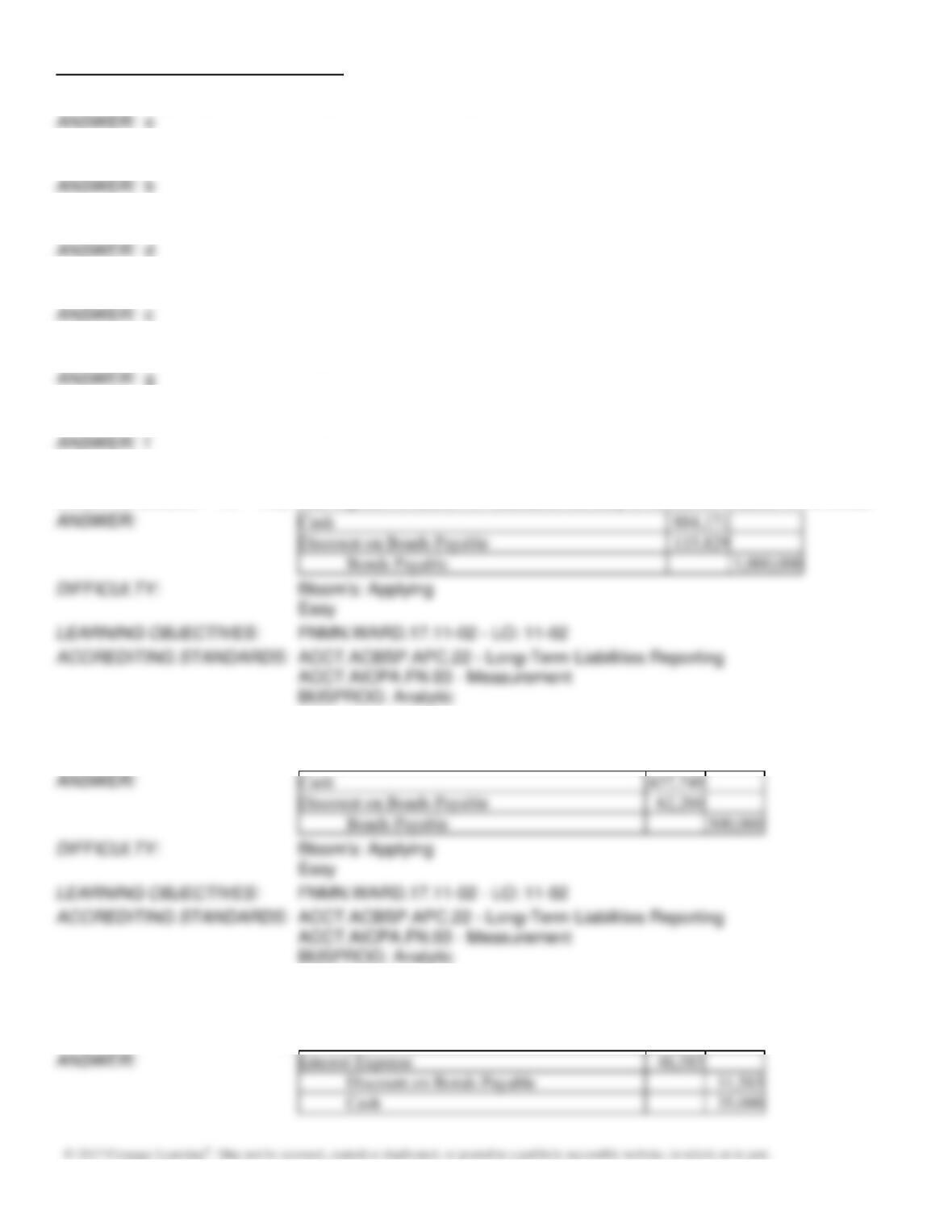
134. On the first day of the fiscal year, a company issues a $1,000,000, 7%, 5-year bond that pays semiannual interest of
$35,000 ($1,000,000 × 7% × 1/2), receiving cash of $884,171. Journalize the entry to record the issuance of the bonds.
135. On the first day of the fiscal year, a company issues a $500,000, 8%, 10-year bond that pays semiannual interest of
$20,000 ($500,000 × 8% × 1/2), receiving cash of $437,740. Journalize the entry to record the issuance of the bonds.
136. On the first day of the fiscal year, a company issues a $1,000,000, 7%, 5-year bond that pays semiannual interest of
$35,000 ($1,000,000 × 7% × 1/2), receiving cash of $884,171. Journalize the first interest payment and the amortization
of the related bond discount using the straight-line method. Round answers to the nearest dollar.
Chapter 11 – Liabilities: Bonds Payable
137. On the first day of the fiscal year, a company issues an $800,000, 6%, 5-year bond that pays semiannual interest of
$24,000 ($800,000 × 6% × 1/2), receiving cash of $690,960. Journalize the entry to record the first interest payment and
the amortization of the related bond discount using the straight-line method.
138. On the first day of the fiscal year, a company issues a $500,000, 8%, 10-year bond that pays semiannual interest of
$20,000 ($500,000 × 8% × 1/2), receiving cash of $530,000. Journalize the entry to record the issuance of the bonds.
139. On the first day of the fiscal year, a company issues a $500,000, 8%, 10-year bond that pays semiannual interest of
$20,000 ($500,000 × 8% × 1/2), receiving cash of $520,000. Journalize the entry to record the first interest payment and
amortization of premium using the straight-line method.
Chapter 11 – Liabilities: Bonds Payable
140. A $375,000 bond issue on which there is an unamortized discount of $40,000 is redeemed for $320,000. Journalize
the redemption of the bonds.
Bonds Payable
141. A $500,000 bond issue on which there is an unamortized discount of $35,000 is redeemed for $475,000. Journalize
the redemption of the bonds.
Bonds Payable
Loss on Redemption of Bonds
142. A $500,000 bond issue on which there is an unamortized discount of $20,000 is redeemed for $475,000. Journalize
the redemption of the bonds.
Bonds Payable
143.
(a)
Prepare the journal entry to issue $500,000 bonds that sold for $490,000.
(b)
Prepare the journal entry to issue $500,000 bonds that sold for $515,000.
Cash
Discount on Bonds Payable
Chapter 11 – Liabilities: Bonds Payable
Cash
144. Brubeck Co. issued $10,000,000 of 30-year, 8% callable bonds on May 1 of Year 1, with interest payable on May 1
and November 1. The fiscal year of the company is the calendar year. Journalize the entries to record the following
selected transactions:
(a) Issued the bonds for cash at their face amount.
(b) Paid the interest on the bonds on November 1 of Year 3.
(c) Called one-fourth of the bonds at 104, the rate provided in the bond indenture, on May 1 of Year 10. (Omit entry for
payment of interest.)
(a)
Cash
Bonds Payable
(b)
Interest Expense
(c)
Bonds Payable
Loss on Redemption of Bonds
Cash
145. On the first day of the current fiscal year, $1,500,000 of 10-year, 8% bonds, with interest payable semiannually, were
sold for $1,225,000. Present entries to record the following transactions for the current fiscal year:
(a)
Issuance of the bonds.
(b)
First semiannual interest payment (record as separate entry from discount amortization).
(c)
Amortization of bond discount for the year, using the straight-line method of amortization.
Cash
Discount on Bonds Payable
Interest Expense
Interest Expense
Chapter 11 – Liabilities: Bonds Payable
146. On the first day of the current fiscal year, $2,000,000 of 10-year, 7% bonds, with interest payable annually, were sold
for $2,125,000. Present entries to record the following transactions for the current fiscal year.
(a)
Issuance of the bonds.
(b)
First annual interest payment (record as separate entry from premium amortization).
(c)
Amortization of bond premium for the year, using the straight-line method of amortization.
Cash
Interest Expense
Premium on Bonds Payable
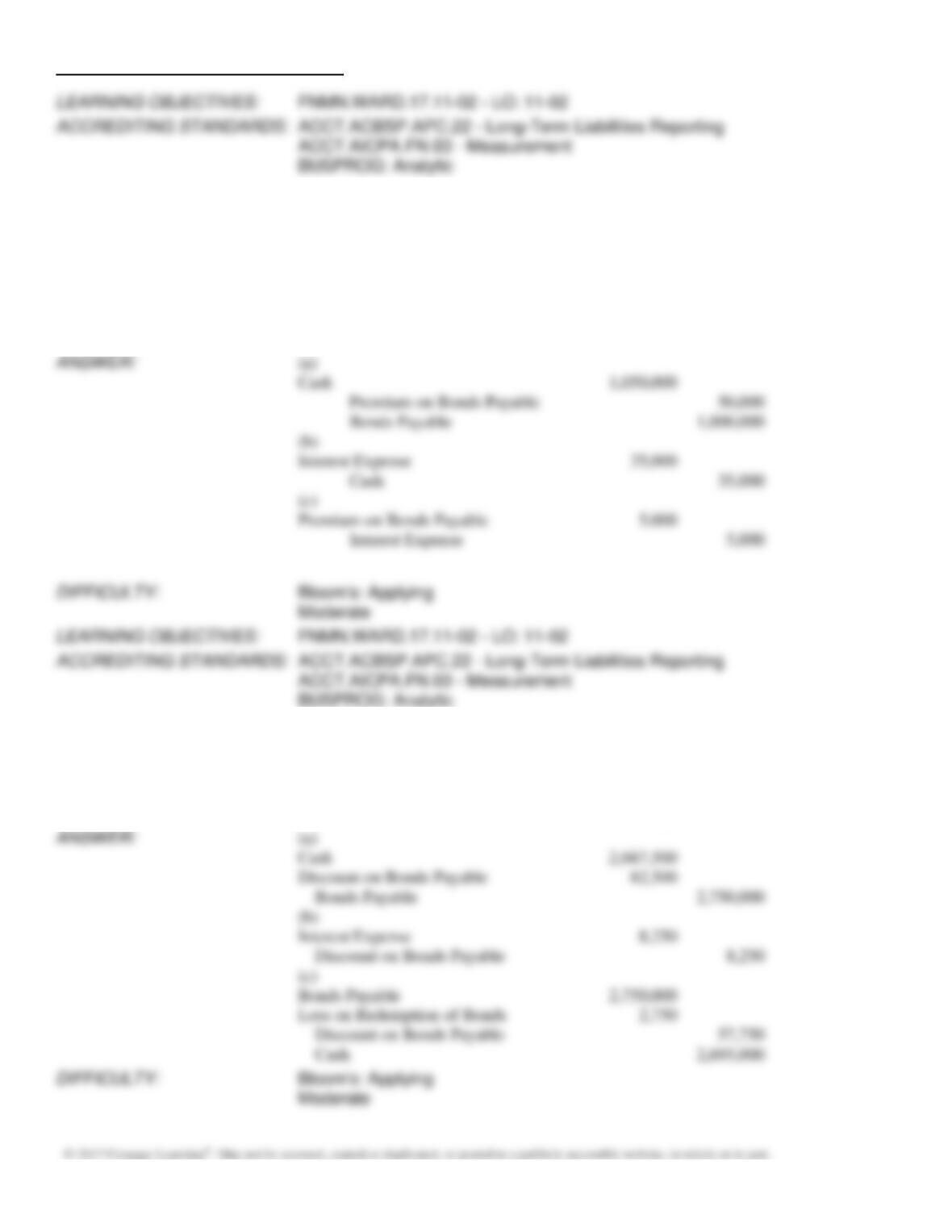
147. On February 1, Clayton Co. issued $1,300,000 of 20-year, 9% bonds for $1,225,000. Interest is payable semiannually
on February 1 and August 1. Present the entries to record the following transactions.
(a)
Issuance of the bonds.
(b)
First semiannual interest payment (record as separate entry from premium amortization).
(c)
Amortization of bond premium for the year, using the straight-line method of amortization.
(Round to the nearest dollar when necessary.)
Cash
Discount on Bonds Payable
Interest Expense
(c)
Interest Expense
Chapter 11 – Liabilities: Bonds Payable
148. On the first day of the fiscal year, Lisbon Co. issued $1,000,000 of 10-year, 7% bonds for $1,050,000, with interest
payable semiannually. Orange Inc. purchased the bonds on the issue date for the issue price. Prepare entries to record the
following transactions for the current fiscal year.
(a)
Issuance of the bonds.
(b)
Second semiannual interest payment.
(c)
Amortization of bond premium for the first year, using the straight-line method of
amortization.
Cash
Interest Expense
Premium on Bonds Payable
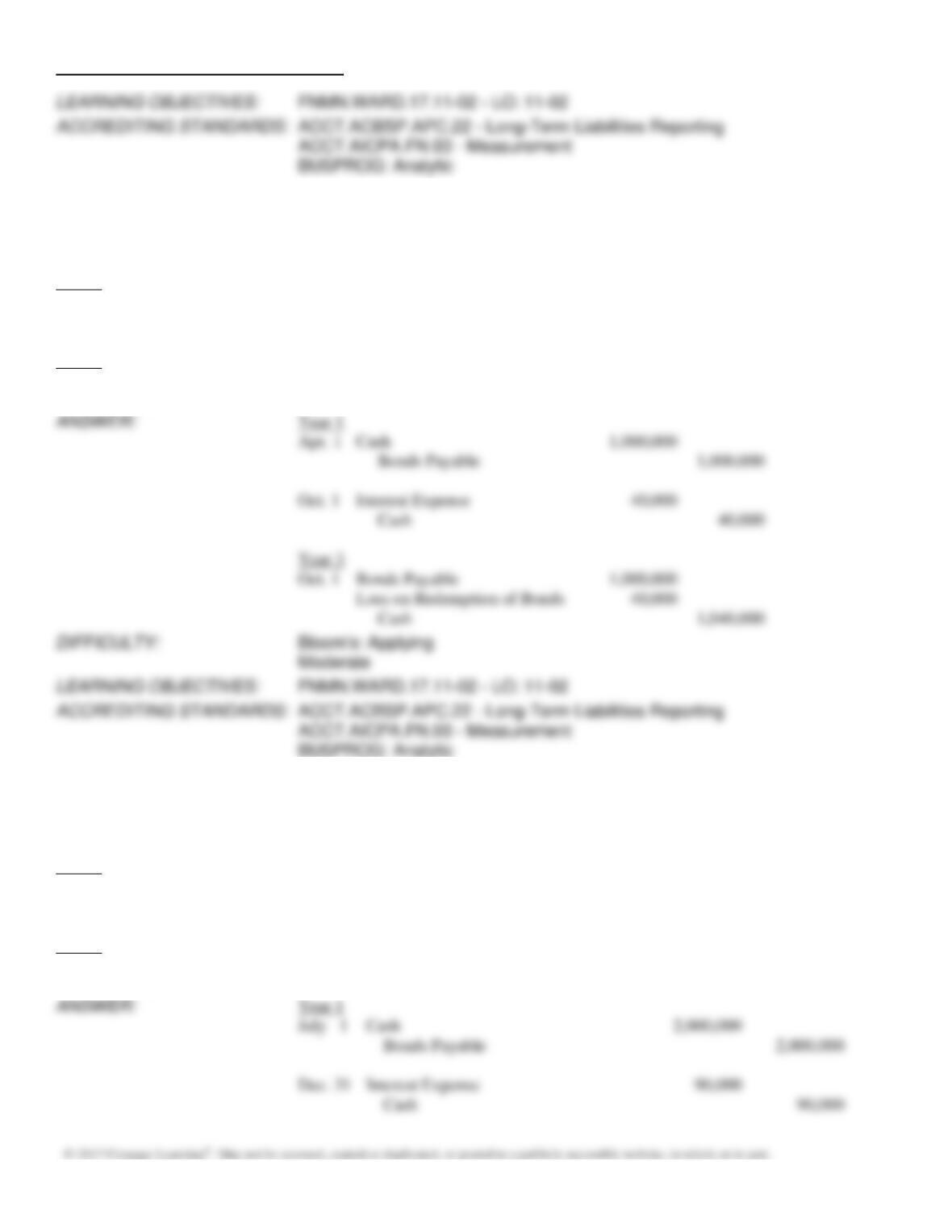
149. Present entries to record the selected transactions described below:
(a)
Issued $2,750,000 of 10-year, 8% bonds at 97.
(b)
Amortized bond discount for a full year, using the straight-line method.
(c)
Called bonds at 98. The bonds were carried at $2,692,250 at the time of the redemption.
Cash
Discount on Bonds Payable
Interest Expense
Bonds Payable
Loss on Redemption of Bonds
Chapter 11 – Liabilities: Bonds Payable
150. A company issued $1,000,000 of 30-year, 8% callable bonds on April 1, with interest payable on April 1 and October
1. The fiscal year of the company is the calendar year. Journalize the entries to record the following selected
transactions:
Year 1
Apr. 1
Issued the bonds for cash at their face amount.
Oct. 1
Paid the interest on the bonds.
Year 3
Oct. 1
Called the bond issue at 104, the rate provided in the bond indenture. (Omit entry for
payment of interest.)
Year 1
Apr. 1
Cash
Oct. 1
Interest Expense
Year 3
Oct. 1
Bonds Payable
Loss on Redemption of Bonds
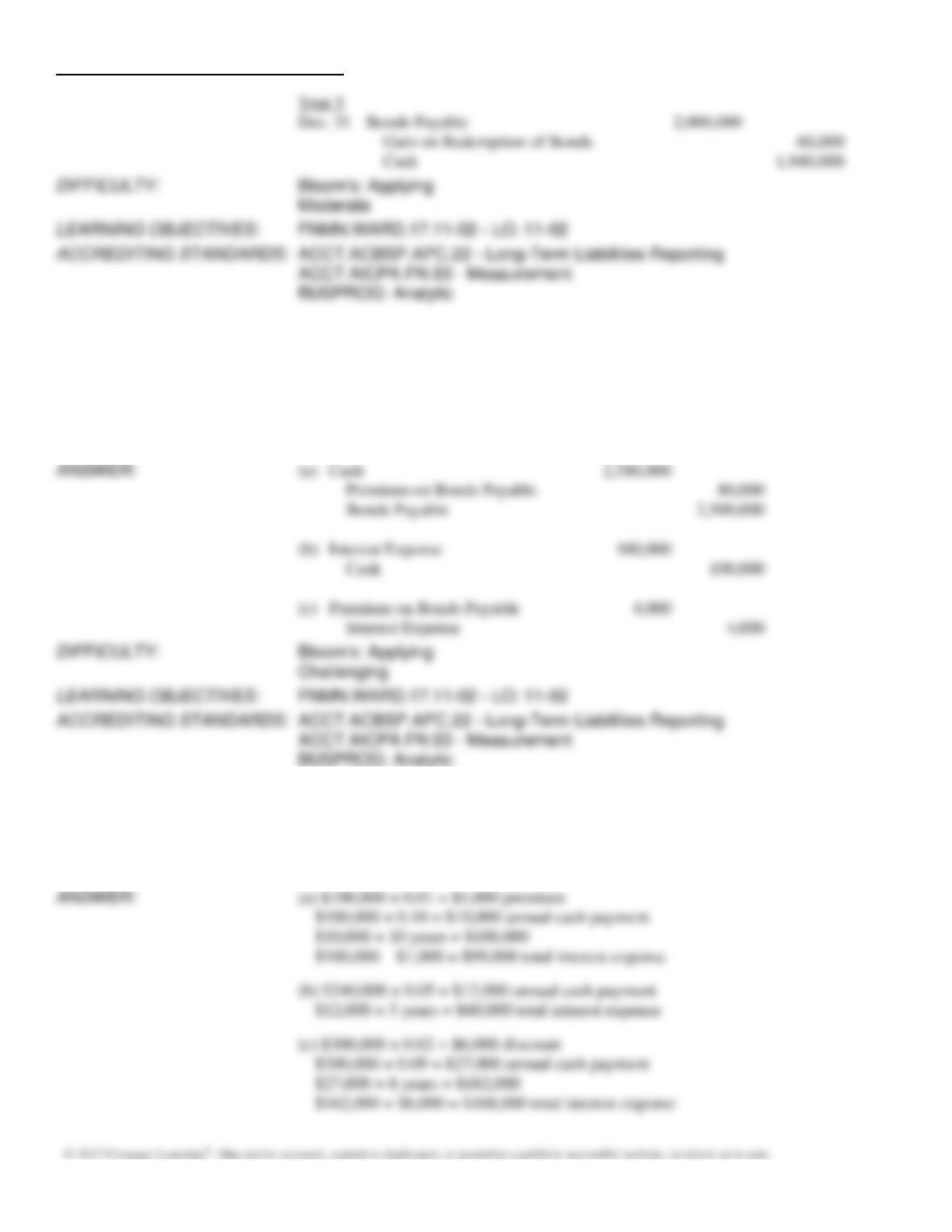
151. Luke Corp. issued $2,000,000 of 20-year, 9% callable bonds on July 1, Year 1, with interest payable on June 30 and
December 31. The fiscal year of the company is the calendar year. Journalize the entries to record the following selected
transactions:
Year 1
July 1
Issued the bonds for cash at their face amount.
Dec. 31
Paid the interest on the bonds.
Year 5
Dec. 31
Called the bond issue at 97, the rate provided in the bond indenture. (Omit entry for
payment of interest.)
Year 1
July 1
Cash
Dec. 31
Interest Expense
Chapter 11 – Liabilities: Bonds Payable
152. On June 30, Jamison Company issued $2,500,000 of 10-year, 8% bonds, dated June 30, for $2,580,000. Present
entries to record the following transactions.
(a)
Issuance of bonds.
(b)
Payment of first semiannual interest on December 31 (record separate entry from premium
amortization).
(c)
Amortization by straight-line method of bond premium on December 31.
(a)
Cash
(b)
Interest Expense
(c)
Premium on Bonds Payable
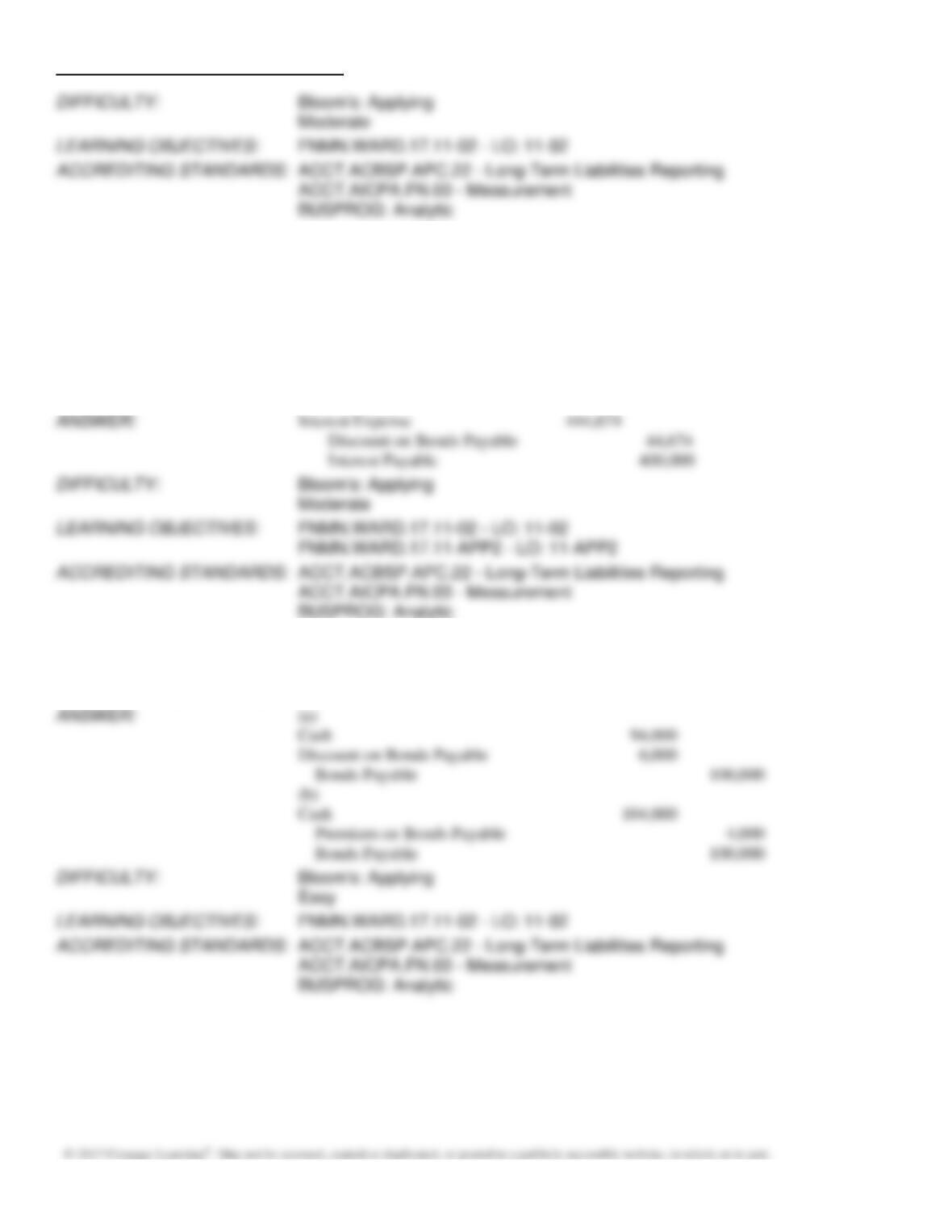
153. Calculate the total amount of interest expense over the life of the bonds for the following independent situations.
(a) $100,000 face value, 10%, 10-year bonds issued at 101.
(b) $240,000 face value, 5%, 5-year bonds issued at 100.
(c) $300,000 face value, 9%, 6-year bonds issued at 98.
Bonds Payable
Chapter 11 – Liabilities: Bonds Payable
154. Given the following data, prepare the journal entry to record interest expense and any related amortization on
December 31 of the first year using the effective interest rate method. Assume interest is paid annually on January 1. The
bonds were issued on January 1 for $7,411,233.
Bonds payable, maturing in 10 years = $8,000,000
Contract interest rate = 5%
Market (effective) interest rate = 6%
Round answers to nearest dollar.
155.
(a)
Prepare the journal entry to issue $100,000 bonds that sold for $94,000.
(b)
Prepare the journal entry to issue $100,000 bonds that sold for $104,000.
Cash
Discount on Bonds Payable
Cash
Chapter 11 – Liabilities: Bonds Payable
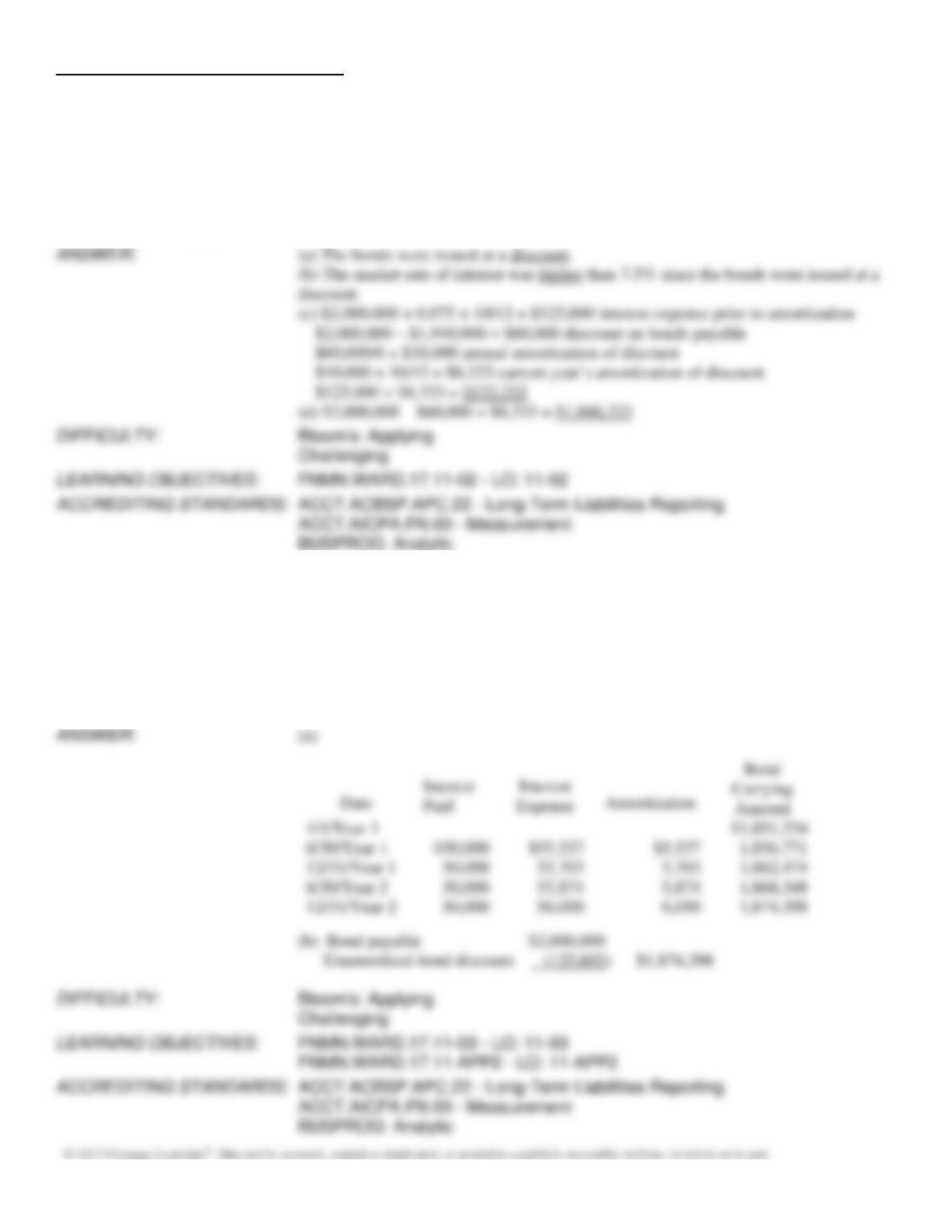
156. Glover Corporation issued $2,000,000 of 7.5%, 6-year bonds dated March 1, with semiannual interest payments on
September 1 and March 1. The bonds were issued on March 1, at 97. Glover’s year-end is December 31.
(a) Were the bonds issued at a premium, a discount, or at par?
(b) Was the market rate of interest higher, lower, or the same as the contract rate of interest?
(c) If the company uses the straight-line method of amortization, what is the amount of interest expense Glover
Corporation will show for the year ended December 31?
(d) What is the carrying value of the bonds on December 31?
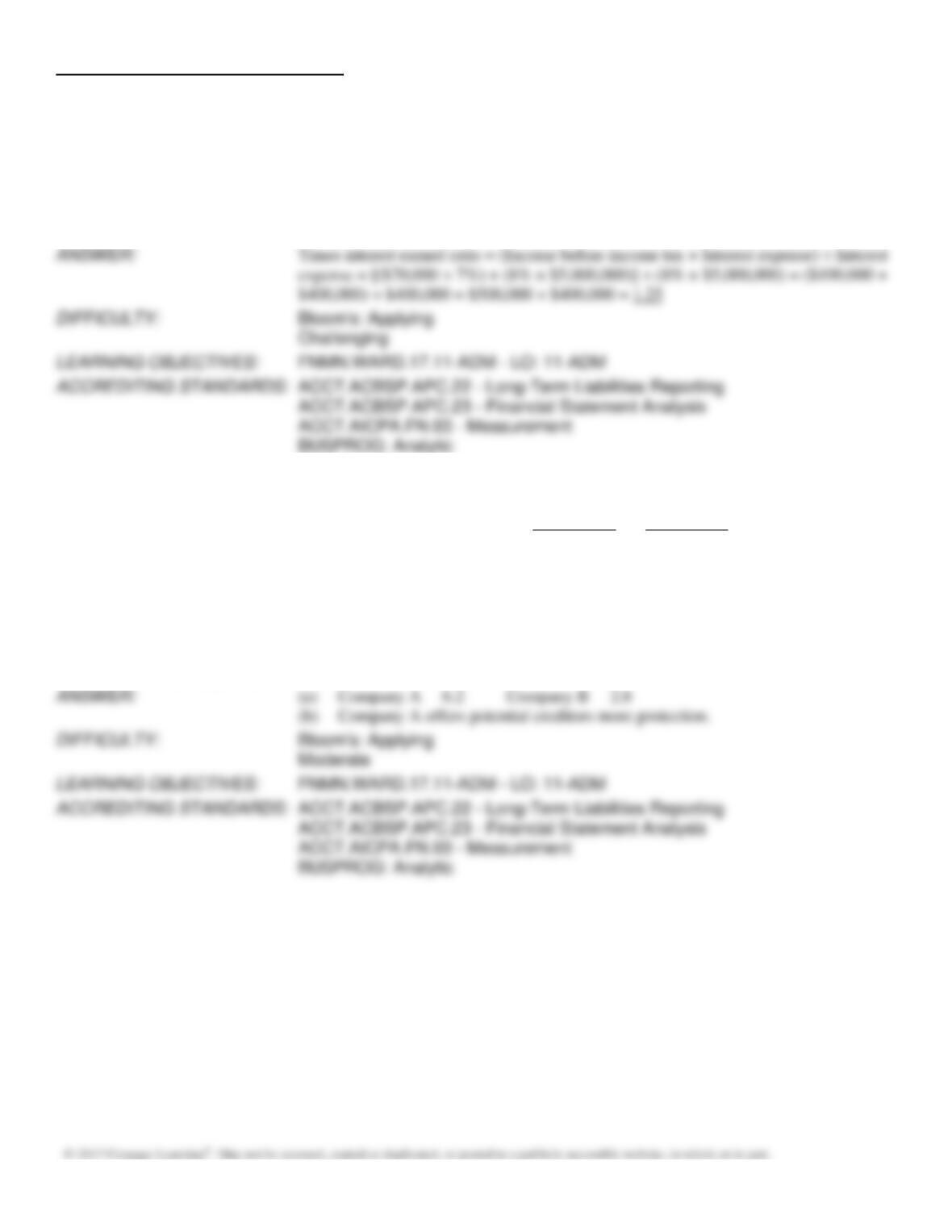
157. On January 1, Year 1, Kennard Co. issued $2,000,000, 5%, 10-year bonds, with interest payable on June 30
and December 31 to yield 6%. Use the following format and round figures to nearest dollar. The bonds were issued for
$1,851,234.
(a) Prepare an amortization schedule for Year 1 and Year 2 using the effective interest rate method.
Date Interest Paid Interest Expense Amortization Bond Carrying Amount
(b) Show how this bond would be reported on the balance sheet at December 31, Year 2.
Chapter 11 – Liabilities: Bonds Payable
158. Given the following data, determine the times interest earned ratio.
Net income, $70,000
Bonds payable, issued at face value, 8%, $5,000,000
Tax rate is 30%
Interest payable, $6,000
Interest receivable, $1,700
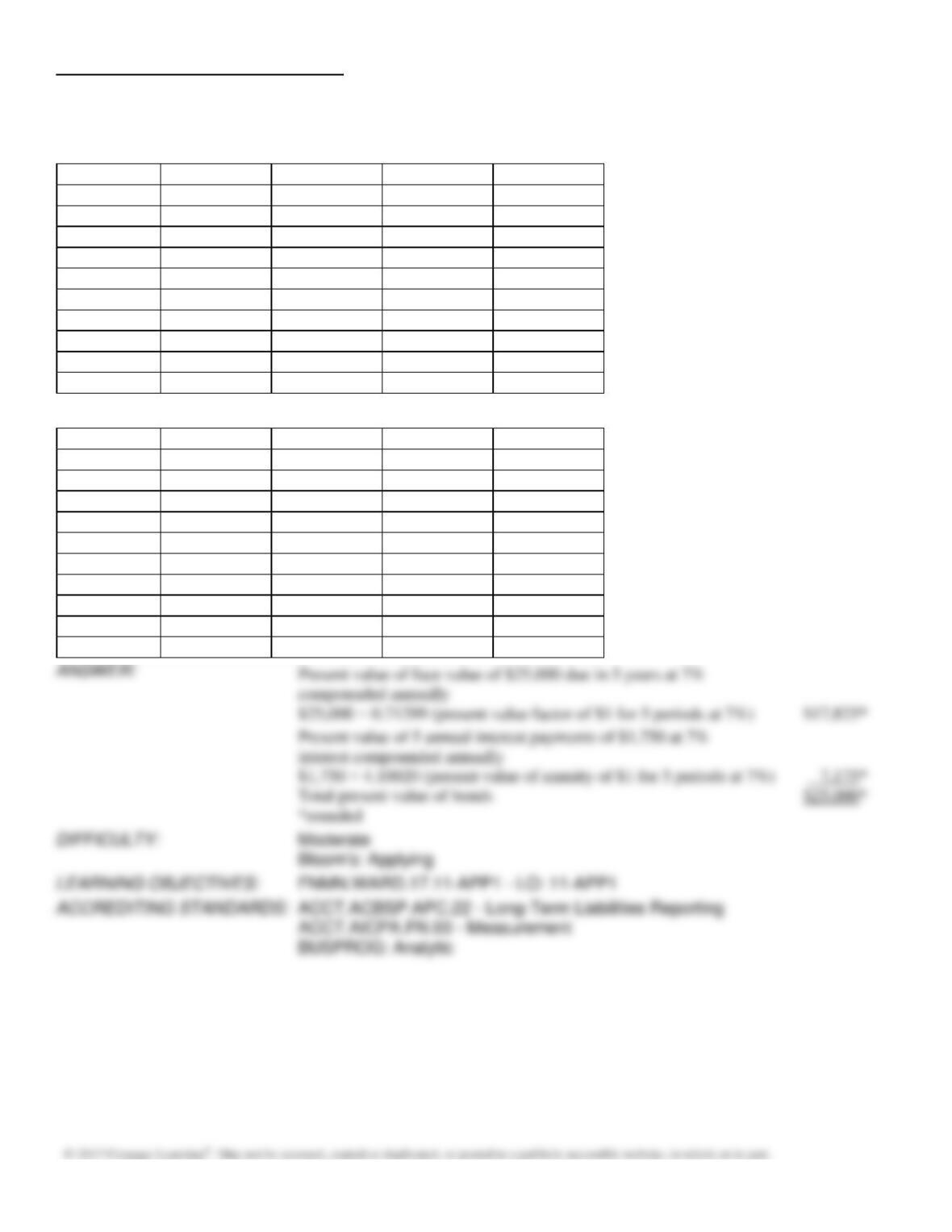
159. Balance sheet and income statement data indicate the following:
Company A
Company B
Bonds payable, 8%, 24-year bonds
$1,200,000
$900,000
Income before income tax for year
495,000
130,000
Income tax for year
75,000
12,000
Interest payable
50,000
0
Interest receivable
21,000
28,000
(a)
For each company, what is the times interest earned ratio? (Round to one decimal place.)
(b)
Which company gives potential creditors more protection?
(a)
Company A 6.2 Company B 2.8
(b)
Company A offers potential creditors more protection.
Chapter 11 – Liabilities: Bonds Payable
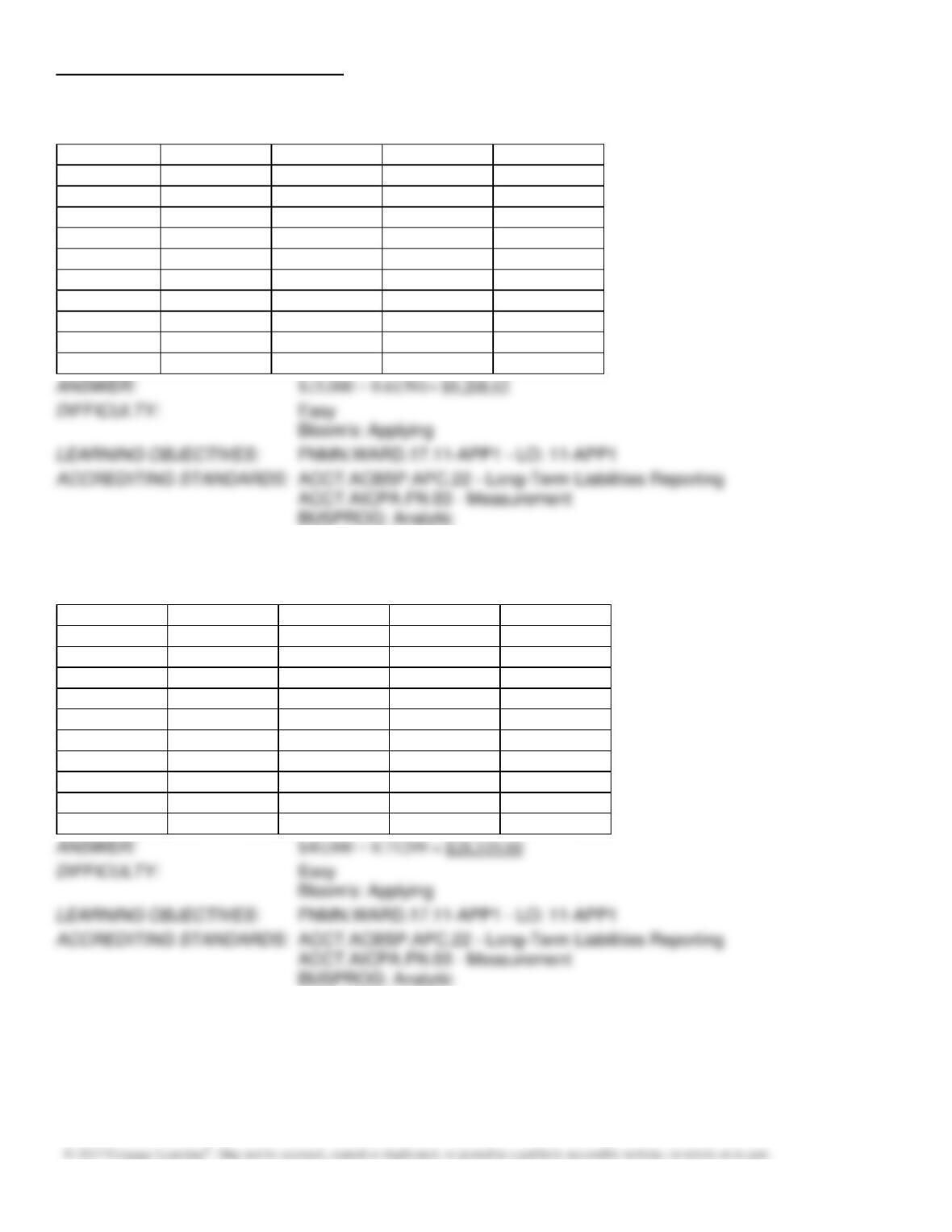
160. Use the following tables to calculate the present value of a $25,000, 7%, 5-year bond that pays $1,750 ($25,000 ×
7%) interest annually, if the market rate of interest is 7%
Present Value of $1 at Compound Interest
Periods
5%
6%
7%
10%
1
0.95238
0.94340
0.93458
0.90909
2
0.90703
0.89000
0.87344
0.82645
3
0.86384
0.83962
0.81630
0.75132
4
0.82270
0.79209
0.76290
0.68301
5
0.78353
0.74726
0.71299
0.62092
6
0.74622
0.70496
0.66634
0.56447
7
0.71068
0.66506
0.62275
0.51316
8
0.67684
0.62741
0.58201
0.46651
9
0.64461
0.59190
0.54393
0.42410
10
0.61391
0.55840
0.50835
0.38554
Present Value of Annuity of $1 at Compound Interest
Periods
5%
6%
7%
10%
1
0.95238
0.94340
0.93458
0.90909
2
1.85941
1.83339
1.80802
1.73554
3
2.72325
2.67301
2.62432
2.48685
4
3.54595
3.46511
3.38721
3.16987
5
4.32948
4.21236
4.10020
3.79079
6
5.07569
4.91732
4.76654
4.35526
7
5.78637
5.58238
5.38929
4.86842
8
6.46321
6.20979
5.97130
5.33493
9
7.10782
6.80169
6.51523
5.75902
10
7.72174
7.36009
7.02358
6.14457
*rounded
Chapter 11 – Liabilities: Bonds Payable
161. Using the following table, what is the present value of $15,000 to be received in 10 years, if the market rate is 5%
compounded annually?
Periods
5%
6%
7%
10%
1
0.95238
0.94340
0.93458
0.90909
2
0.90703
0.89000
0.87344
0.82645
3
0.86384
0.83962
0.81630
0.75132
4
0.82270
0.79209
0.76290
0.68301
5
0.78353
0.74726
0.71299
0.62092
6
0.74622
0.70496
0.66634
0.56447
7
0.71068
0.66506
0.62275
0.51316
8
0.67684
0.62741
0.58201
0.46651
9
0.64461
0.59190
0.54393
0.42410
10
0.61391
0.55840
0.50835
0.38554
162. Using the following table, what is the present value of $40,000 to be received in 5 years, if the market rate is 7%
compounded annually?
Periods
5%
6%
7%
10%
1
0.95238
0.94340
0.93458
0.90909
2
0.90703
0.89000
0.87344
0.82645
3
0.86384
0.83962
0.81630
0.75132
4
0.82270
0.79209
0.76290
0.68301
5
0.78353
0.74726
0.71299
0.62092
6
0.74622
0.70496
0.66634
0.56447
7
0.71068
0.66506
0.62275
0.51316
8
0.67684
0.62741
0.58201
0.46651
9
0.64461
0.59190
0.54393
0.42410
10
0.61391
0.55840
0.50835
0.38554