71) In contrast to Fordist production, Post-Fordist production is more likely to
A) introduce more flexible work rules.
B) place more importance on site factors.
C) assign each worker one task.
D) include repetitive tasks.
E) require larger inventories of parts and components.
72) Prior to the Industrial Revolution, cottage industries were most common.
73) The dominant industrial power in the nineteenth century was Great Britain.
74) Wood became the main energy source during the Industrial Revolution due to overuse and
depletion of coal reserves.
75) The invention of the steam engine in 1769 by James Watt is considered the most important
invention for the development of factories at the beginning of the Industrial Revolution.
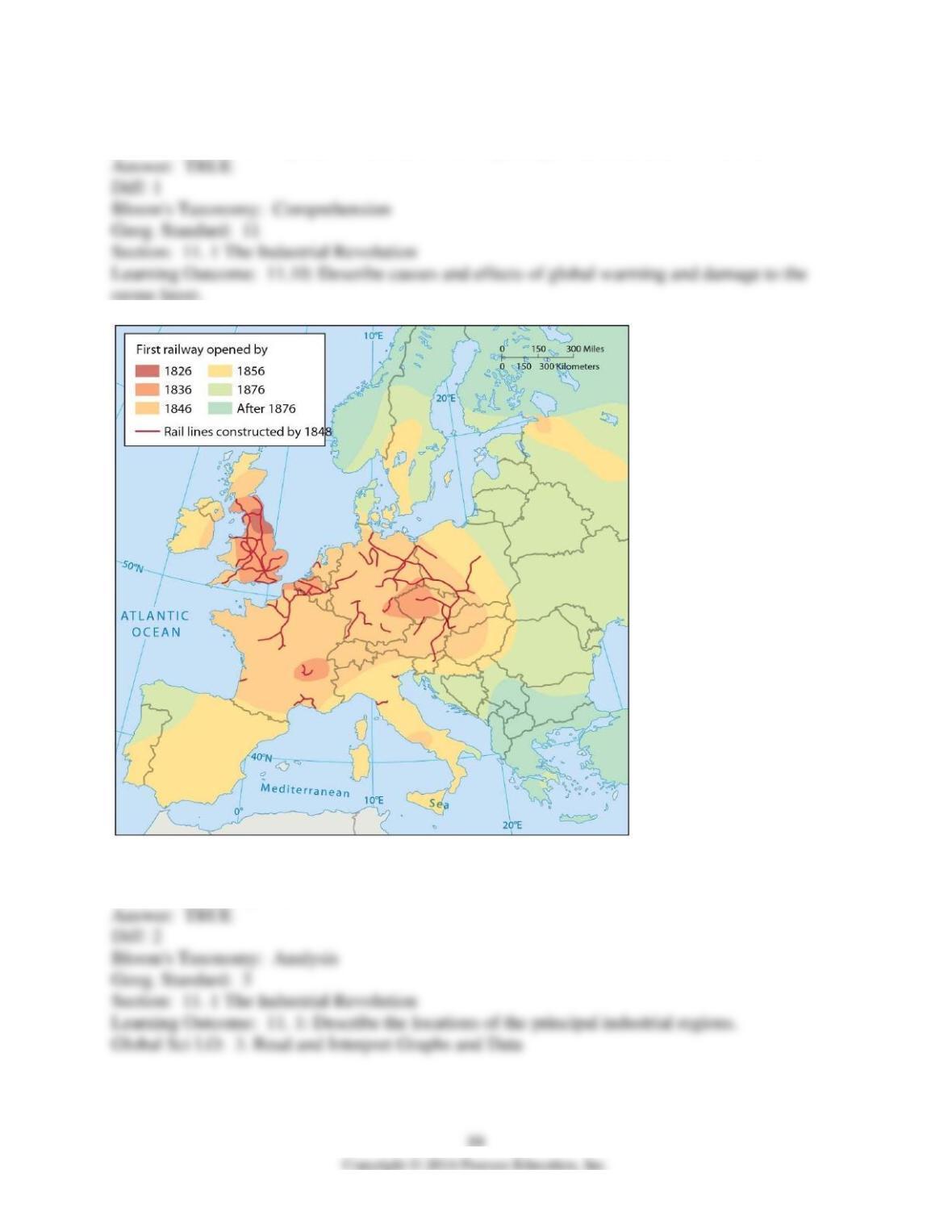
76) This map of rail diffusion in the Industrial Revolution indicates that Germany was served by
several rail lines by 1848.
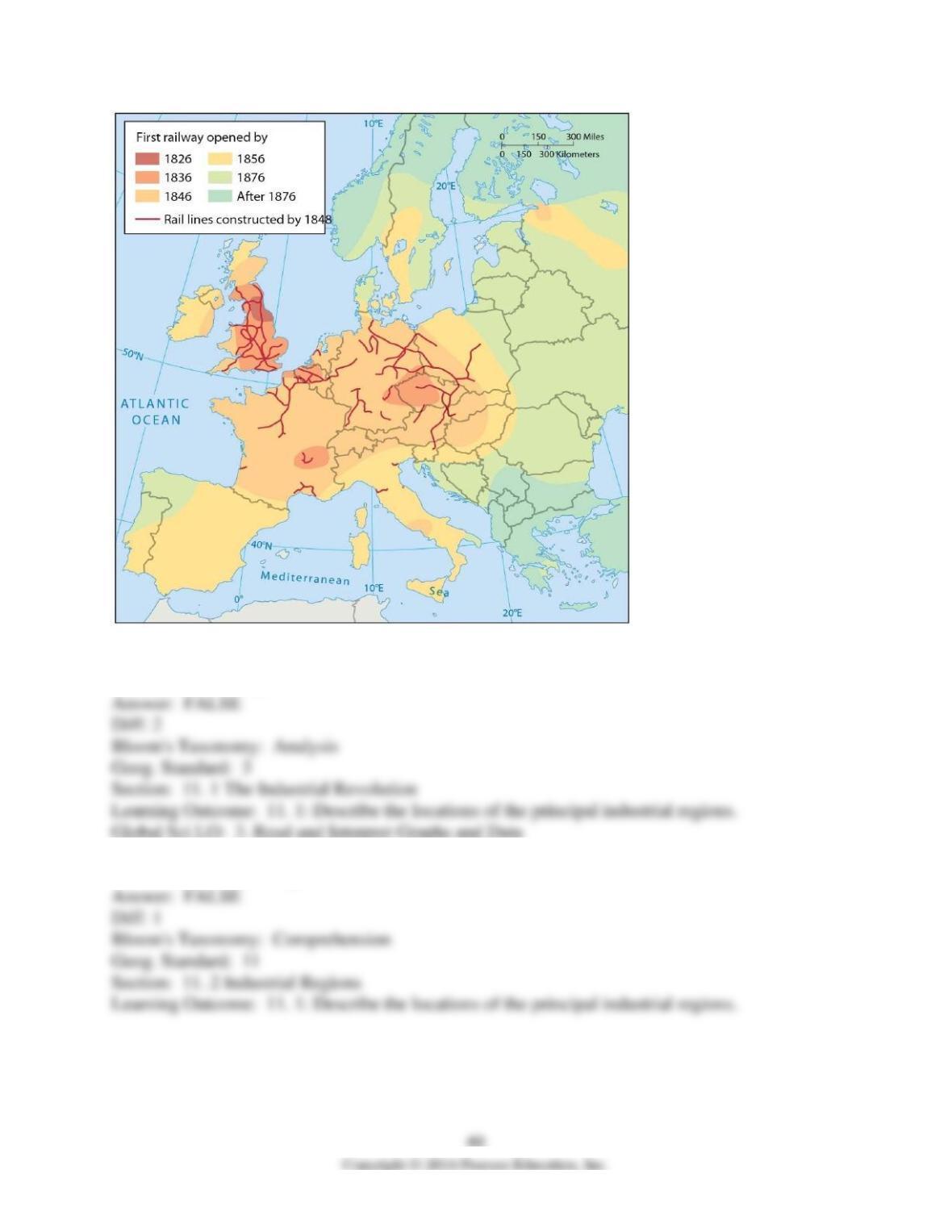
77) This map of rail diffusion in the Industrial Revolution indicates that Greece obtained
railways before Italy.
78) Industry is uniformly distributed across Earth.
79) About three-fourths of world industrial production is clustered in three regions.
80) The Rhine-Ruhr River valley in Europe is near large deposits of coal.
81) If the cost of transporting the inputs exceeds the cost of transporting the product, then the
optimal plant location is as close as possible to the customer.
82) The optimal location for a factory manufacturing a bulk-gaining product is likely to be one
that minimizes the cost of transporting the product to the market.
83) Of the four common shipping modes of transportation, air claims the lowest cost per
kilometer across all distances.

84) Communications-oriented industries, like newspapers, tend to locate near their markets.
85) Because of the invention of high-tech pulleys and chutes, multi-story buildings in major
cities are the most suitable land locations for contemporary factories.
86) China has the largest labor force employed in manufacturing.
87) The site factor most affecting the relocation of industry in the twenty-first century is labor.
88) Newly constructed factories in more developed countries are more likely to be in suburban or
rural areas than in urban centers.
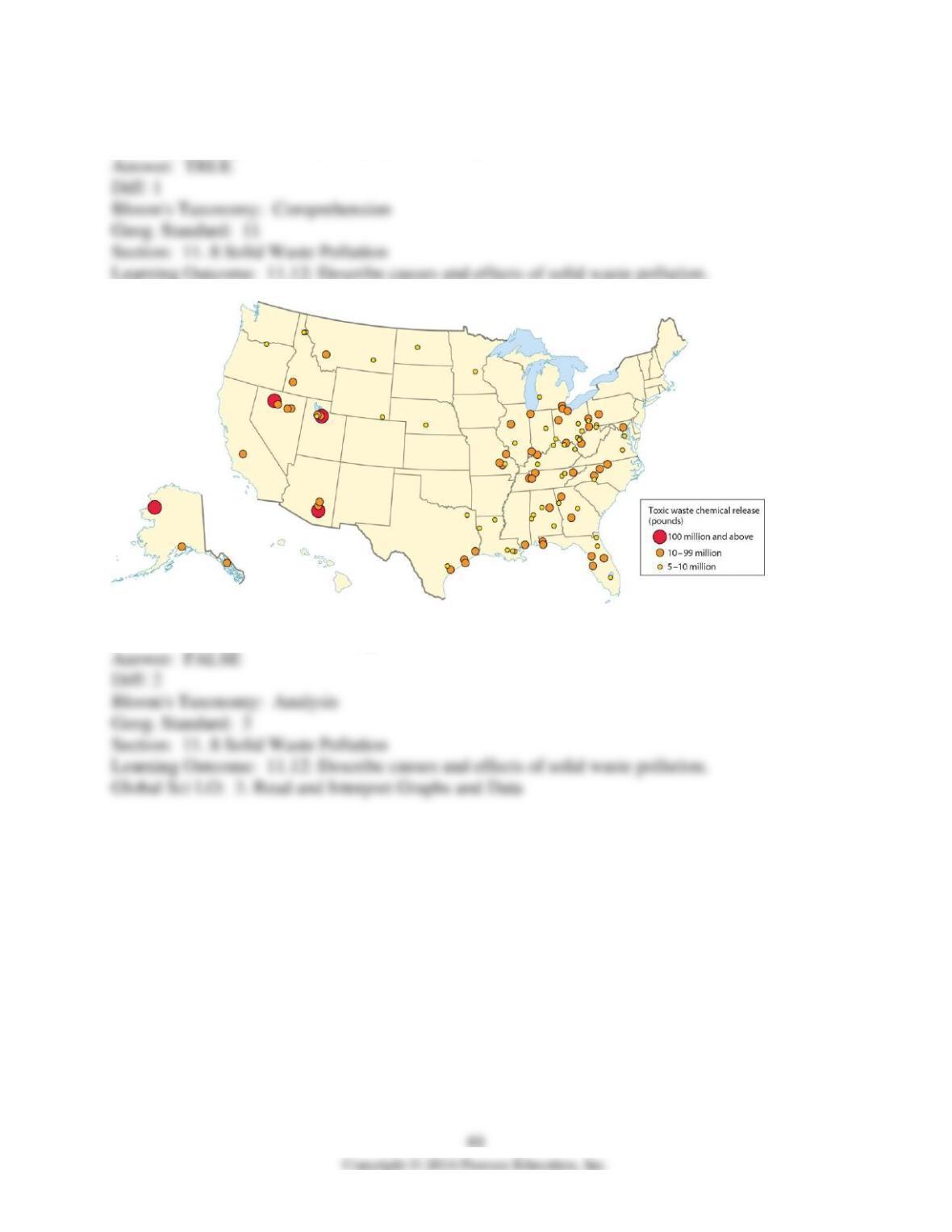
89) About 2 kilograms (4 pounds) of solid waste per person is generated daily in the United
States, about 60 percent from residences and 40 percent from businesses.
90) This map indicates that the largest chemical release sites are in Ohio and other eastern states.
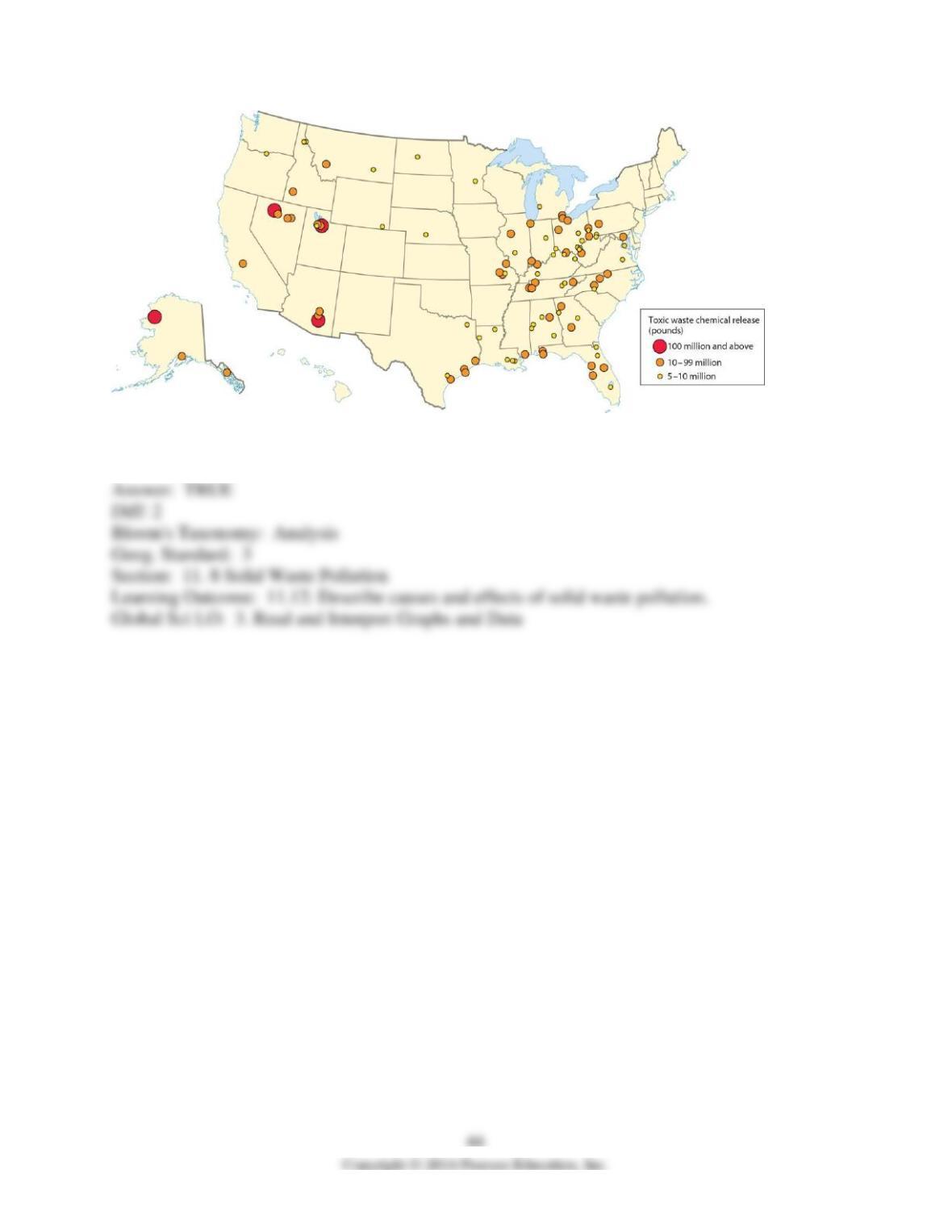
91) This map indicates that Arizona and Nevada together have at least seven toxic chemical
release sites.
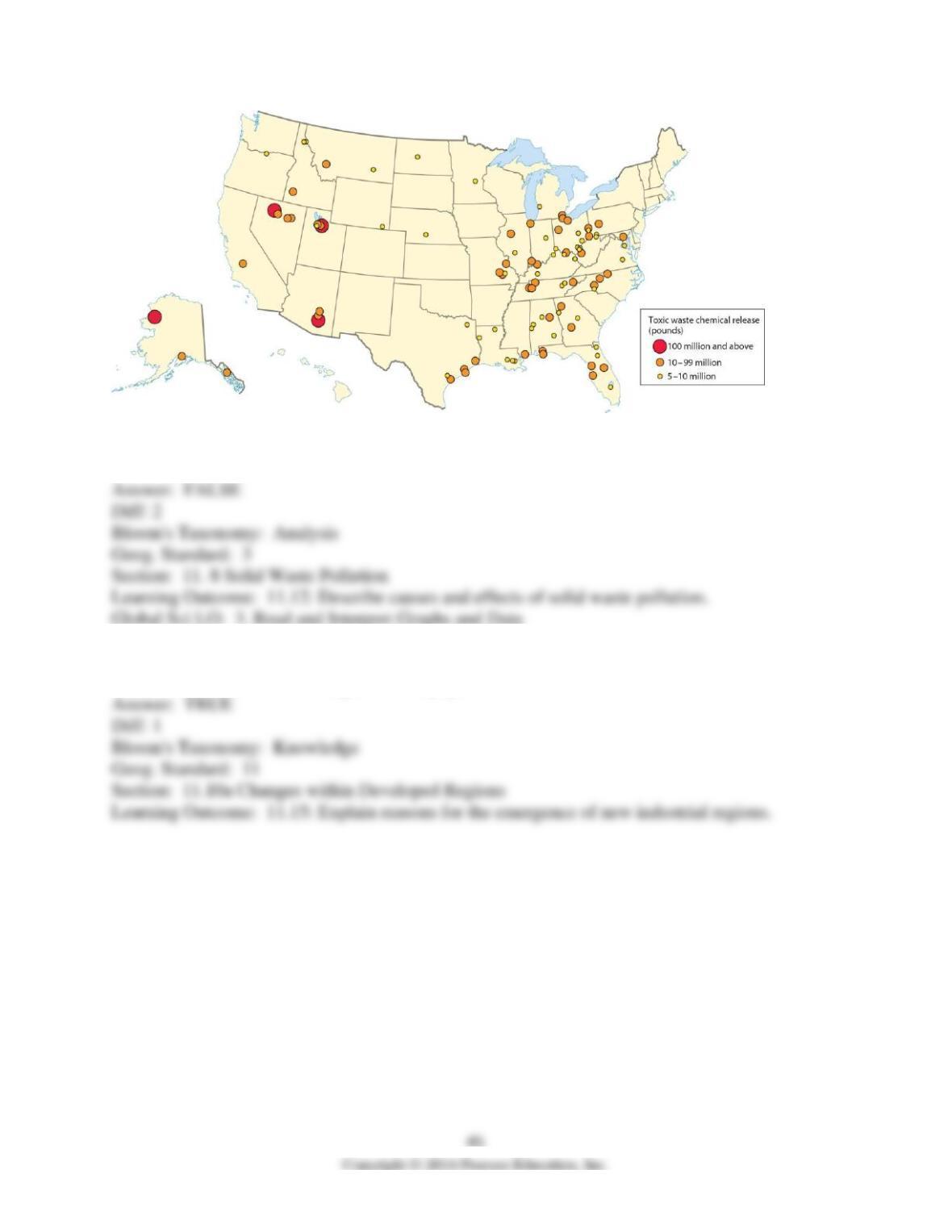
92) This map of toxic chemical release sites indicates that Louisiana has more challenges with
toxic chemicals than does Texas.
93) As the global economy has changed, the United States lost 6 million manufacturing jobs
between 1950 and 2009 although the U.S. population continued to increase.
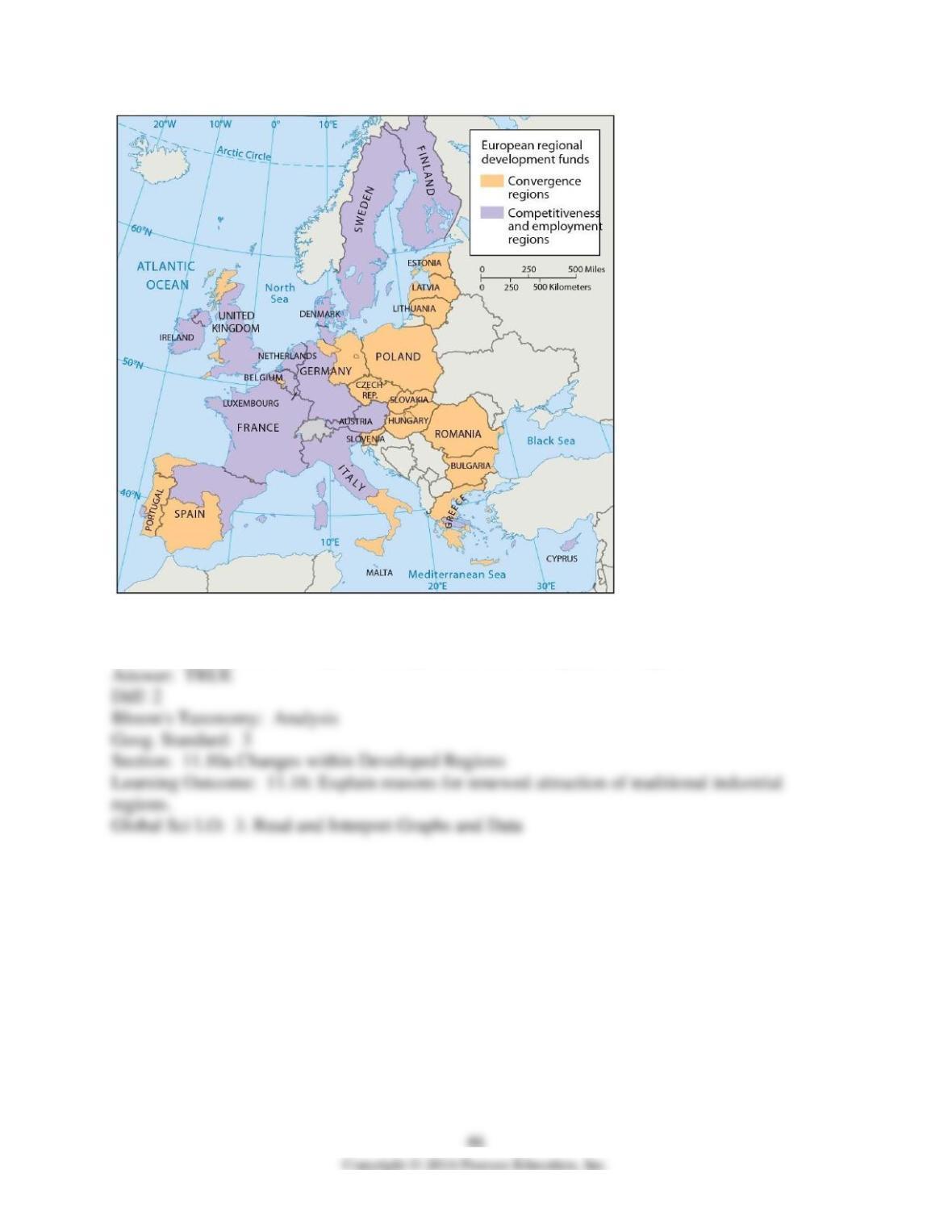
94) According to this map of the European Union, southern Italy is identified as a “convergence
region” whereas northern Italy is a “competitiveness and employment region.”
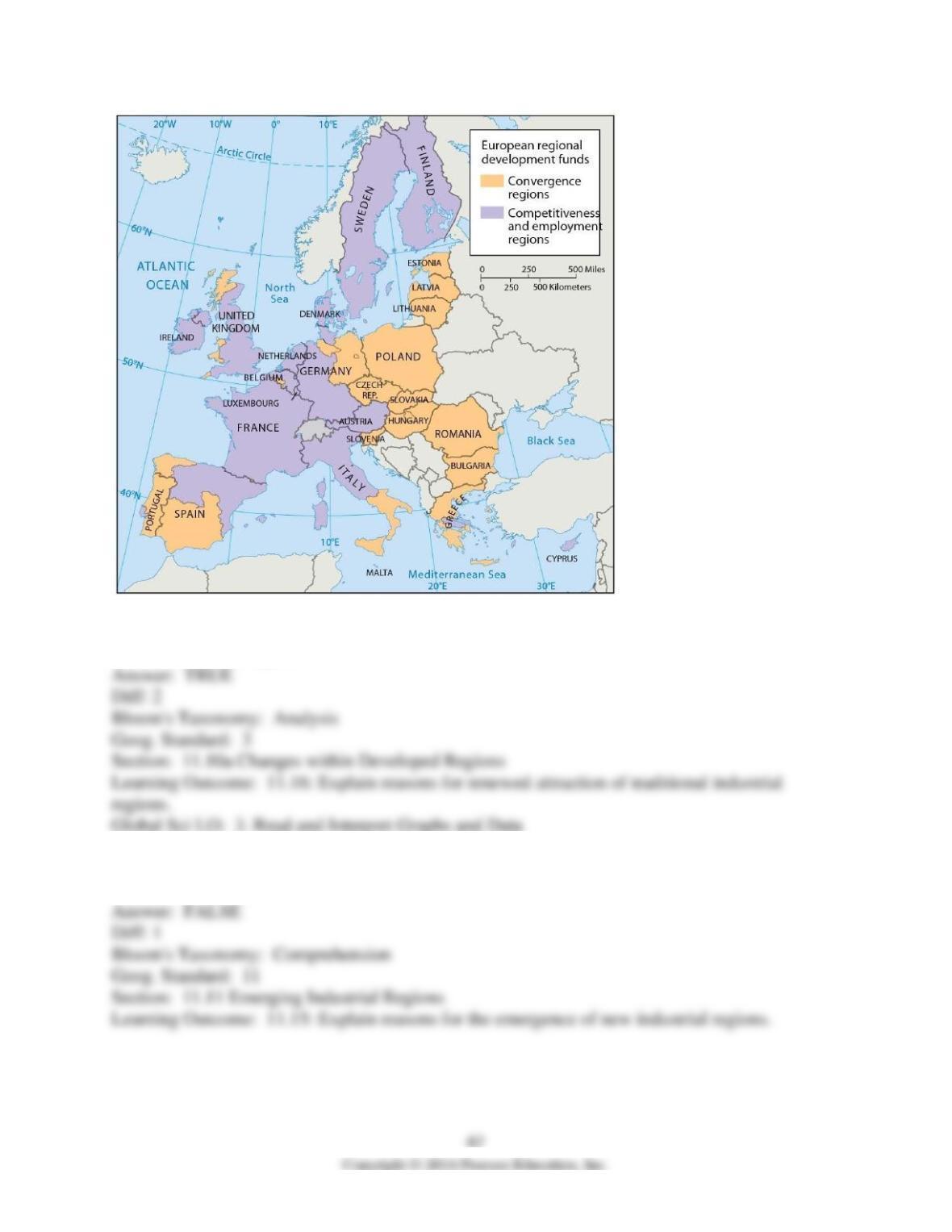
95) This map of the European Union indicates that the northernmost part of the United Kingdom
is a “convergence region.”
96) It is projected that by 2050, the United States would have the second largest economy in the
world.
97) India is expected to pass the United States as the world’s largest economy around 2020.
98) A financial analysis firm coined the acronym BRIC to indicate the projected economic power
of Brazil, Russia, India, and China in the near future.
99) Imagine that you are the leader of a new country being constructed on an artificial island in
the Atlantic Ocean. Assuming that your citizens want to have a self-sustaining economy that is
not highly dependent on global trade, how would you attempt to design and develop the nation’s
industrial sector?
100) Imagine that you will design and build a new, sovereign island-state in the Caribbean Sea,
based on investments made by multimillionaires. The lack of space means that only one or two
manufacturing facilities can be built on the new island, however. What types of factories would
you recommend building and why?

101) As with many economists, geographers often work on logistical issues for industry and
other challenges inherent in the global capitalist economy. Imagine for a moment, however, that
you had the ability to change the global economic system into another form. What major changes
would you institute, how, and why? Refer to various data in this chapter to reinforce your
argument.
102) Discuss an example of a bulk-reducing (or weight-reducing) industry that you believe will
face severe economic or environmental difficulties in the near future. What could be done to
improve the outlook for that industry? How and why?
103) If you manage a computer manufacturer with assembly plants in Southeast Asia and are
faced with a sudden increase in transportation costs, what changes could you institute to help to
ameliorate the situation?
104) Compare the transportation and manufacturing regimes of water bottlers that ship water
from the southern Pacific Ocean to water bottlers that use locally available sources.
105) How are just-in-time delivery methods more subject to disruptions?
106) Outline the major site and situation factors which affect industrial development.
107) If transportation costs were almost nonexistent—that is, if industries did not have to pay
money to transport inputs and finished goods over long distances—what are the major changes
that could occur in the automobile manufacturing industry?
108) If transportation costs were not a factor—that is, if industries did not have to pay money to
transport inputs and finished goods over long distances—what major changes could occur in
information industries such as publishing? In addition, what changes would be the least likely to
occur, given the major types of site factors?

109) If a multinational corporation in your city proposes outsourcing a local factory to China in
order to save a few cents per product manufactured, what counter-arguments could you offer to
dissuade them from closing the local factory? Use data from this chapter to reinforce your
argument.
110) What economic advantages would break-of-bulk points offer to local populations?
111) Analyze the economy of the university or college environment around you, and compare
this service-oriented environment to the manufacturing sector. In your opinion, does your
university or college more closely resemble Fordist or post-Fordist lean production methods?
Why? Use data from this chapter to back up your analysis.
112) Henry Ford was famous for paying his workers higher wages than other manufacturers of
his time. Compare Ford’s strategy to the wage-lowering strategies of car manufacturers in the
U.S. today. Which approach would you favor, and why? Refer to specific data or examples from
this chapter as either evidence for or against your opinion.
113) Imagine that you will build a new factory to produce parts for all of the major U.S.-based
automobile assembly plants today. Assume that you will build only one factory. Taking into
account the locations of the assembly plants on this map and your knowledge of other factors
described in this chapter, where would you locate your new factory, and why?
114) Why is China one of the world’s most important industrial producers?
115) Imagine that you wished to manufacture clothing in the United States to sell in Asian
markets. What challenges would you have to overcome in order to do this, and how?
116) Considering the site and situation of the city or region in which you live, what future
industries could you envision arising locally, that would help to reduce or reverse the trend of
global warming? Why would you promote these industries over others in order to improve the
environment? In your answer, use the information in this chapter to show that you understand the
causes and challenges presented by global warming.

117) Many changes to industries are possible owing to global warming. If you assume, for the
purposes of this question, that transportation costs will rise drastically in the next 20 years,
discuss the impact of global warming on the current distribution of manufacturing in East Asia,
given that many of these manufacturers are currently destined for U.S. markets.
118) Imagine that a multinational corporation is considering closing a shoe factory in Malaysia
in order to begin manufacturing in your city. What arguments could you make in favor of this
change, considering factors of site, situation, labor, and environmental issues? Attempt to
incorporate your knowledge of the city in your answer.