Chapter 11 The Cost of Capital 271
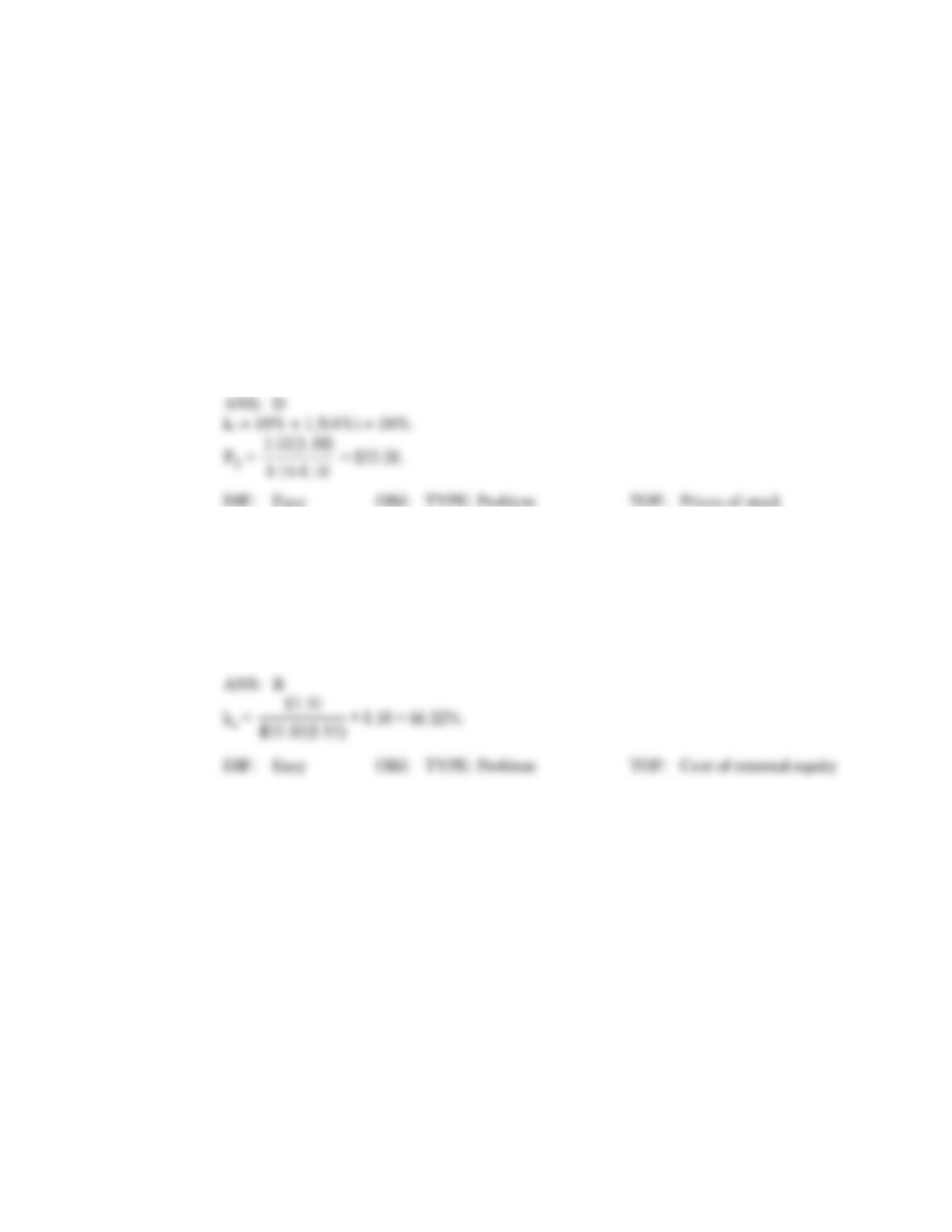
33. SW Ink’s preferred stock, which pays a $5 dividend each year, currently sells for $62.50. The
company’s marginal tax rate is 40 percent. What is the cost of preferred stock, kps, that should be
included in the computation of the SW Ink’s weighted average cost of capital (WACC)?
a.
8.0%
b.
4.8%
c.
3.2%
d.
The dividend growth rate is needed to compute kps; so not enough information is given to
answer this question.
e.
None of the above is correct.
34. Tapley Inc.’s current (target) capital structure has a target debt ratio (D/TA) of 60 percent. The
firm can raise up to $5 million in new debt at a before-tax cost of 8 percent. If more debt is
required, the initial cost will be 8.5 percent, and if more than $10 million of debt is required, the
cost will be 9 percent. Net income for the previous year was $10 million, and it is expected to
increase by 10 percent this year. The firm expects to maintain its dividend payout ratio of 40
percent on the 1 million shares of common stock outstanding. If it must sell new common stock,
it would encounter a 10 percent flotation cost on the first $2 million, a 15 percent cost if more
than $2 million but less than $4 million is needed, and a 20 percent cost if more than $4 million
of new outside equity is required. Tapley’s tax rate is 30 percent, and its current stock price is $88
per share. If the firm has an unlimited number of projects which will earn a 10.25 percent return,
what is the maximum capital budget that can be adopted without adversely affecting stockholder
wealth?
a.
$32.0 million
b.
$15.9 million
c.
$23.0 million
d.
$10.6 million
e.
$26.5 million
272 Chapter 11 The Cost of Capital
Chapter 11 The Cost of Capital 273
35. Anderson Company has four investment opportunities with the following costs (all costs are paid
at t = 0) and estimated internal rates of return (IRR):
Project
Cost
IRR
A
$2,000
16.0%
B
3,000
14.5
C
5,000
11.5
D
3,000
9.5
The company has a target capital structure which consists of 40 percent common equity, 40
percent debt, and 20 percent preferred stock. The company has $1,000 in retained earnings. The
company expects its year-end dividend to be $3.00 per share (i.e., = $3.00). The dividend is
expected to grow at a constant rate of 5 percent a year. The company’s stock price is currently
$42.75. If the company issues new common stock, the company will pay its investment bankers a
10 percent flotation cost. The company can issue corporate bonds with a yield to maturity of 10
percent. The company is in the 35 percent tax bracket. How large can the cost of preferred stock
be (including flotation costs) and it still be profitable for the company to invest in all four
projects?
a.
7.75%
b.
8.90%
c.
10.46%
d.
11.54%
e.
12.68%
274 Chapter 11 The Cost of Capital
Gulf Electric Company
Gulf Electric Company (GEC) uses only debt and equity in its capital structure. It can borrow
unlimited amounts at an interest rate of 10 percent so long as it finances at its target capital
structure, which calls for 55 percent debt and 45 percent common equity. Its last dividend was
$2.20; its expected constant growth rate is 6 percent; its stock sells on the NYSE at a price of $35;
and new stock would net the company $30 per share after flotation costs. GEC‘s tax rate is 40
percent, and it expects to have $100 million of retained earnings this year. GEC has two projects
available: Project A has a cost of $200 million and a rate of return of 13 percent, while Project B
has a cost of $125 million and a rate of return of 10 percent. All of the company’s potential
projects are equally risky.
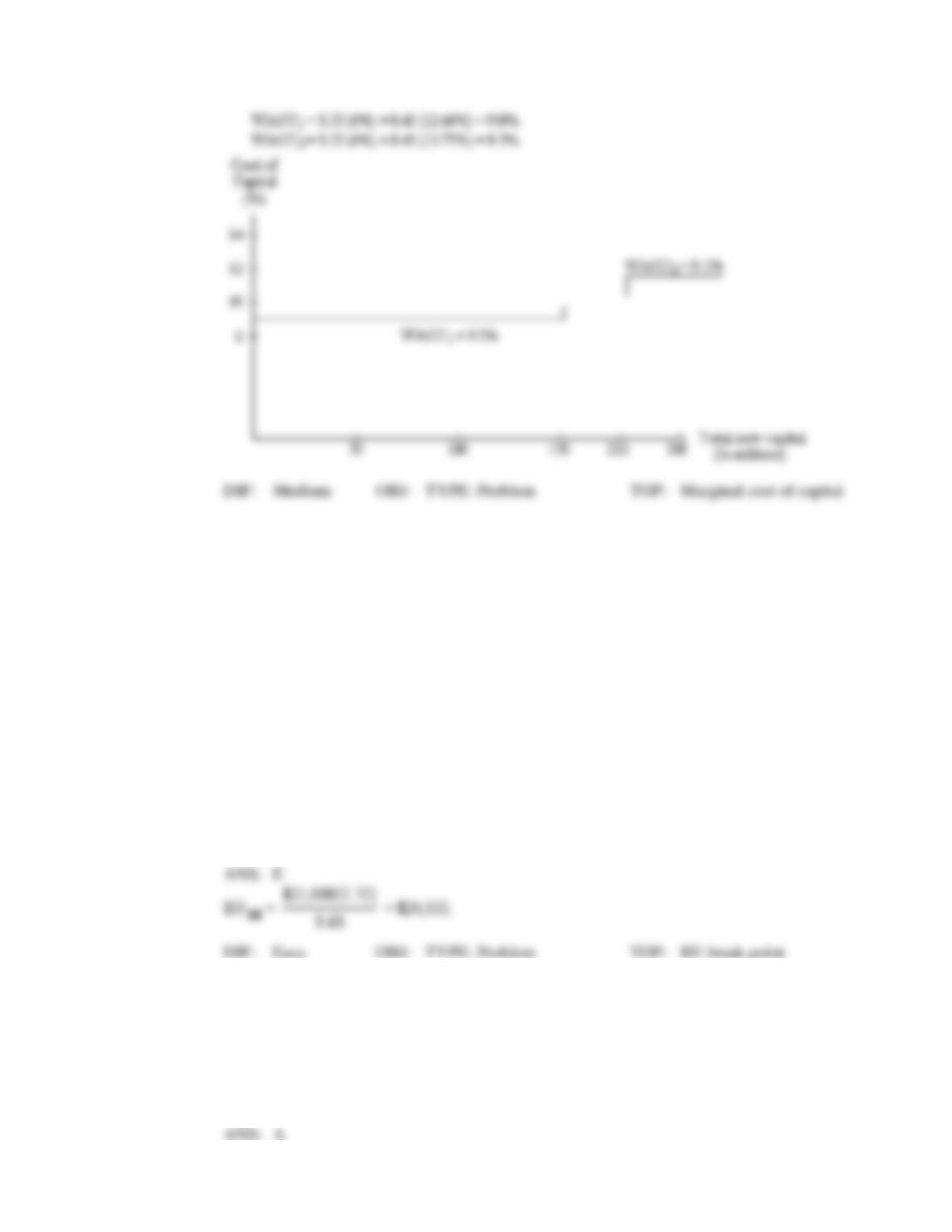
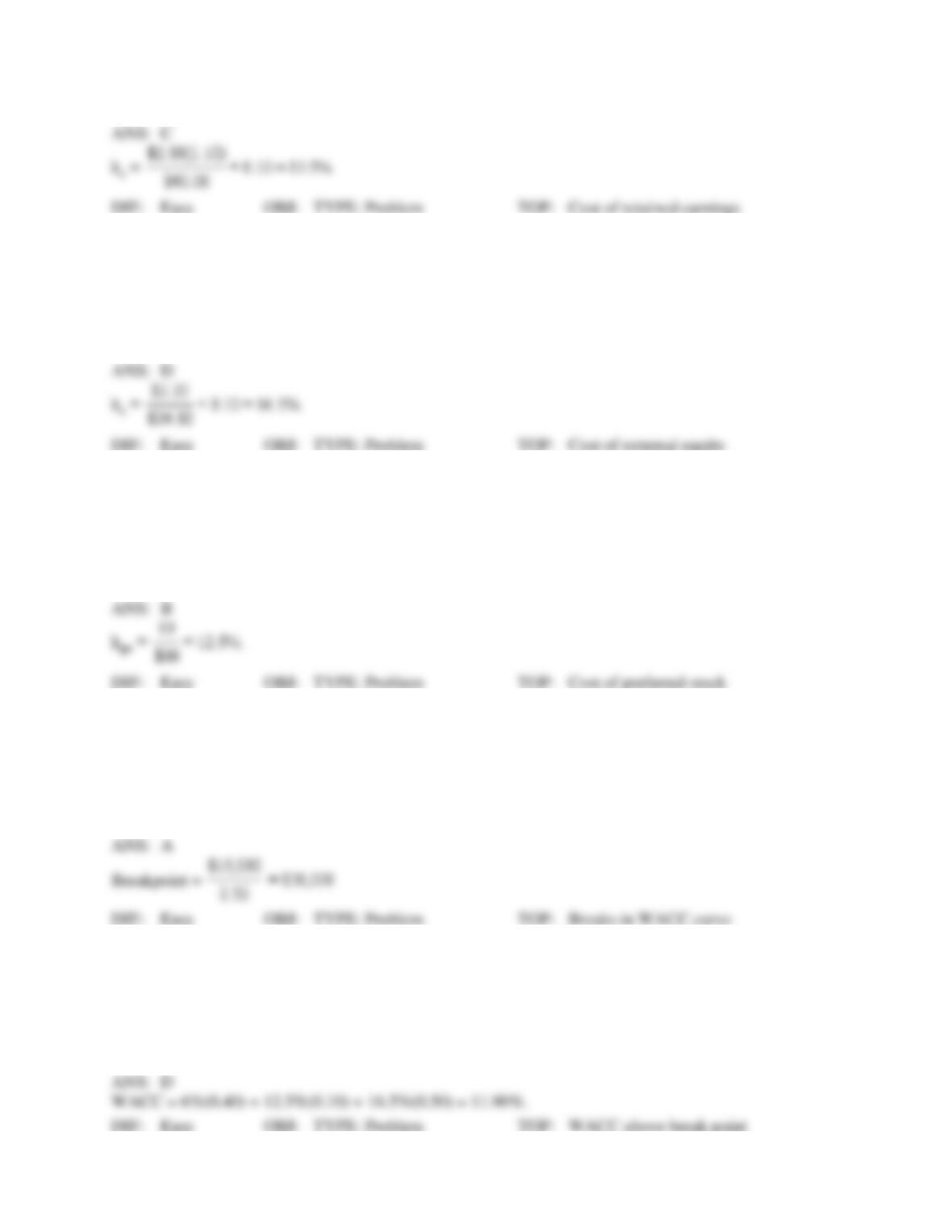
36. Refer to Gulf Electric Company. What is GEC’s cost of equity from newly issued stock?
a.
13.77%
b.
12.66%
c.
13.33%
d.
12.29%
e.
10.00%
37. Refer to Gulf Electric Company. Assume now that GEC needs to raise $300 million in new
capital. What is GEC‘s marginal cost of capital for evaluating the $300 million in capital projects
and any others that might arise during the year?
a.
6.00%
b.
13.77%
c.
12.66%
d.
9.50%
e.
9.00%
Chapter 11 The Cost of Capital 275
Byron Corporation
Byron Corporation’s present capital structure, which is also its target capital structure, is 40
percent debt and 60 percent common equity. Next year’s net income is projected to be $21,000,
and Byron’s payout ratio is 30 percent. The company’s earnings and dividends are growing at a
constant rate of 5 percent; the last dividend (D0) was $2.00; and the current equilibrium stock
price is $21.88. Byron can raise all the debt financing it needs at 14.0 percent. If Byron issues
new common stock, a 20 percent flotation cost will be incurred. The firm’s marginal tax rate is 40
percent.
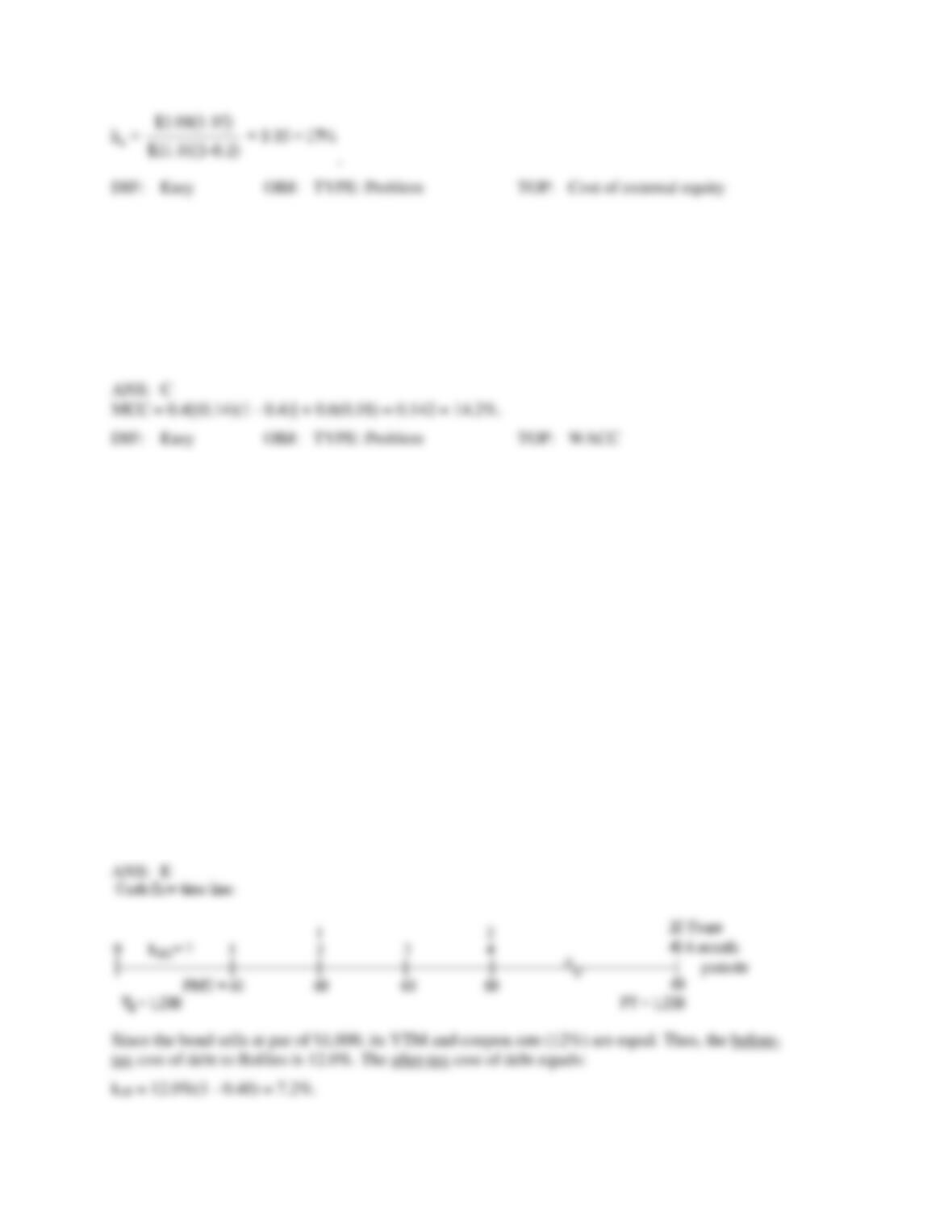
38. Refer to Byron Corporation. What is the maximum amount of new capital that can be raised at
the lowest component cost of equity? (In other words, what is the retained earnings break point?)
a.
$12,600
b.
$14,700
c.
$17,400
d.
$21,000
e.
$24,500
39. Refer to Byron Corporation. What is the component cost of the equity raised by selling new
common stock?
a.
17.0%
b.
16.4%
c.
15.0%
d.
14.6%
e.
12.0%
276 Chapter 11 The Cost of Capital
40. Refer to Byron Corporation. Assume that at one point along the marginal cost of capital
schedule the component cost of equity is 18.0 percent. What is the weighted average cost of
capital at that point?
a.
10.8%
b.
13.6%
c.
14.2%
d.
16.4%
e.
18.0%
Rollins Corporation
Rollins Corporation is constructing its MCC schedule. Its target capital structure is 20 percent
debt, 20 percent preferred stock, and 60 percent common equity. Its bonds have a 12 percent
coupon, paid semiannually, a current maturity of 20 years, and sell for $1,000. The firm could
sell, at par, $100 preferred stock which pays a 12 percent annual dividend, but flotation costs of 5
percent would be incurred. Rollins’ beta is 1.2, the risk-free rate is 10 percent, and the market risk
premium is 5 percent. Rollins is a constant growth firm which just paid a dividend of $2.00, sells
for $27.00 per share, and has a growth rate of 8 percent. The firm’s policy is to use a risk
premium of 4 percentage points when using the bond-yield-plus-risk-premium method to find ks.
The firm’s net income is expected to be $1 million, and its dividend payout ratio is 40 percent.
Flotation costs on new common stock total 10 percent, and the firm’s marginal tax rate is 40
percent.
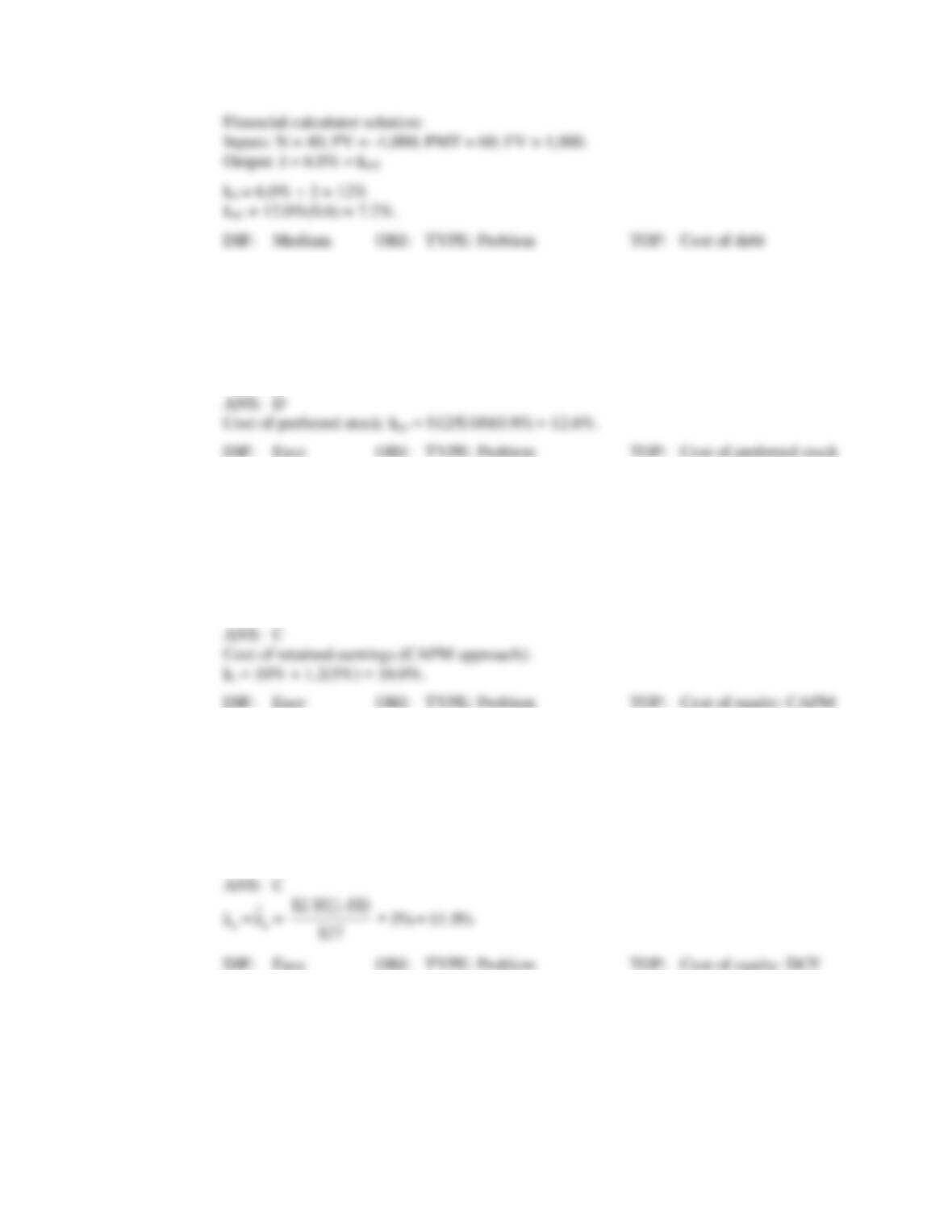
41. Refer to Rollins Corporation. What is Rollins’ component cost of debt?
a.
10.0%
b.
9.1%
c.
8.6%
d.
8.0%
e.
7.2%
Chapter 11 The Cost of Capital 277
42. Refer to Rollins Corporation. What is Rollins’ cost of preferred stock?
a.
10.0%
b.
11.0%
c.
12.0%
d.
12.6%
e.
13.2%
43. Refer to Rollins Corporation. What is Rollins’ cost of retained earnings using the CAPM
approach?
a.
13.6%
b.
14.1%
c.
16.0%
d.
16.6%
e.
16.9%
44. Refer to Rollins Corporation. What is the firm’s cost of retained earnings using the DCF
approach?
a.
13.6%
b.
14.1%
c.
16.0%
d.
16.6%
e.
16.9%
45. Refer to Rollins Corporation. What is Rollins’ cost of retained earnings using the bond-yield-
plus-risk-premium approach?
a.
13.6%
b.
14.1%
c.
16.0%
d.
16.6%
e.
16.9%
278 Chapter 11 The Cost of Capital
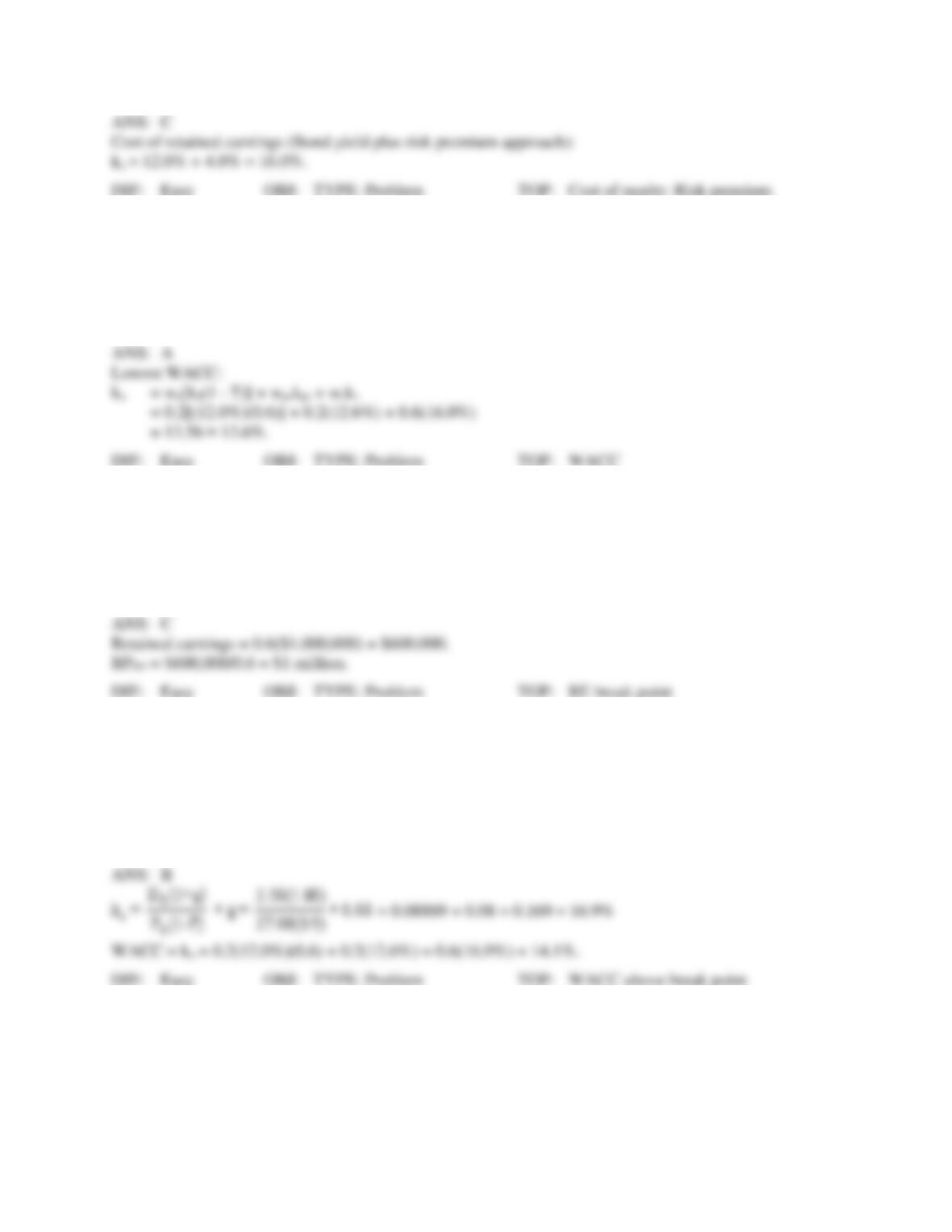
46. Refer to Rollins Corporation. What is Rollins’ lowest WACC?
a.
13.6%
b.
14.1%
c.
16.0%
d.
16.6%
e.
16.9%
47. Refer to Rollins Corporation. What is Rollins’ retained earnings break point?
a.
$600,000
b.
$800,000
c.
$1,000,000
d.
$1,200,000
e.
$1,400,000
48. Refer to Rollins Corporation. What is Rollins’ WACC once it starts using new common stock
financing?
a.
13.6%
b.
14.1%
c.
16.0%
d.
16.6%
e.
16.9%
Chapter 11 The Cost of Capital 279
Jackson Company
The Jackson Company has just paid a dividend of $3.00 per share on its common stock, and it
expects this dividend to grow by 10 percent per year, indefinitely. The firm has a beta of 1.50; the
risk-free rate is 10 percent; and the expected return on the market is 14 percent. The firm’s
investment bankers believe that new issues of common stock would have a flotation cost equal to
5 percent of the current market price.
49. Refer to Jackson Company. How much should an investor be willing to pay for this stock today?
a.
$62.81
b.
$70.00
c.
$43.75
d.
$55.00
e.
$30.00
50. Refer to Jackson Company. What will be Jackson’s cost of new common stock if it issues new
stock in the marketplace today?
a.
15.25%
b.
16.32%
c.
17.00%
d.
12.47%
e.
9.85%
J. Ross and Sons Inc.
J. Ross and Sons Inc. has a target capital structure that calls for 40 percent debt, 10 percent
preferred stock, and 50 percent common equity. The firm’s current after-tax cost of debt is 6
percent, and it can sell as much debt as it wishes at this rate. The firm’s preferred stock currently
sells for $90 a share and pays a dividend of $10 per share; however, the firm will net only $80 per
share from the sale of new preferred stock. Ross expects to retain $15,000 in earnings over the
next year. Ross’ common stock currently sells for $40 per share, but the firm will net only $34 per
share from the sale of new common stock. The firm recently paid a dividend of $2 per share on its
common stock, and investors expect the dividend to grow indefinitely at a constant rate of 10
percent per year.
51. Refer to J. Ross and Sons Inc. What is the firm’s cost of retained earnings?
a.
10.0%
b.
12.5%
c.
15.5%
d.
16.5%
e.
18.0%
280 Chapter 11 The Cost of Capital
52. Refer to J. Ross and Sons Inc. What is the firm’s cost of newly issued common stock?
a.
10.0%
b.
12.5%
c.
15.5%
d.
16.5%
e.
18.0%
53. Refer to J. Ross and Sons Inc. What is the firm’s cost of newly issued preferred stock?
a.
10.0%
b.
12.5%
c.
15.5%
d.
16.5%
e.
18.0%
54. Refer to J. Ross and Sons Inc. Where will a break in the WACC curve occur?
a.
$30,000
b.
$20,000
c.
$10,000
d.
$42,000
e.
There will be no breaks in the WACC curve.
55. Refer to J. Ross and Sons Inc. What will be the WACC above this break point?
a.
12.5%
b.
8.3%
c.
10.6%
d.
11.9%
e.
14.1%
Chapter 11 The Cost of Capital 281
Financial Calculator Section
The following question(s) may require the use of a financial calculator.
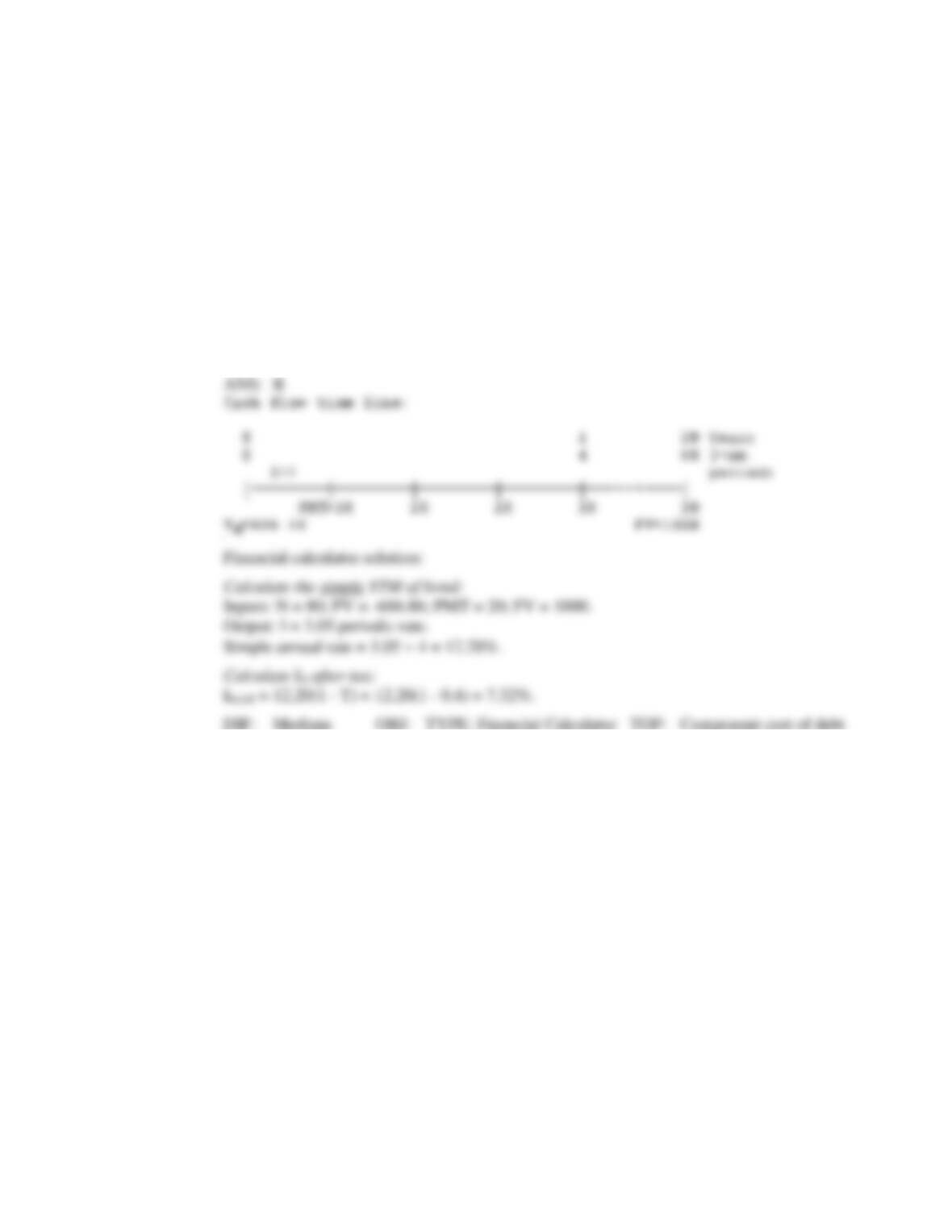
56. Hamilton Company’s 8 percent coupon rate, quarterly payment, $1,000 par value bond, which
matures in 20 years, currently sells at a price of $686.86. The company’s tax rate is 40 percent.
Based on the simple interest rate, not the EAR, what is the firm’s component cost of debt for
purposes of calculating the WACC?
a.
3.05%
b.
7.32%
c.
7.36%
d.
12.20%
e.
12.26%