Introduction to General, Organic & Biological Chemistry, 12e (Timberlake)
Chapter 11 Introduction to Organic Chemistry: Hydrocarbons
11.1 Multiple-Choice Questions
1) Which of the following is true of nonane, , which has a density of 0.79 g/mL, melts at –
51 °C, and boils at 151 °C?
A) Nonane is soluble in water.
B) Nonane is a gas at room temperature.
C) Nonane is a solid at room temperature.
D) Nonane does not undergo combustion.
E) Nonane floats on the surface of water.
2) A formula that shows the arrangement of all bonds in a molecule is called a(n) ________.
A) molecular formula
B) expanded structural formula
C) condensed structural formula
D) condensed molecular formula
E) isomeric formula
3) In the three-dimensional structure of methane, , the hydrogen atoms attached to a carbon
atom are aligned ________.
A) in a straight line
B) at the corners of a square
C) at the corners of a tetrahedron
D) at the corners of a rectangle
E) at the corners of a cube
4) A hydrocarbon contains only the elements ________.
A) hydrogen and oxygen
B) carbon and oxygen
C) carbon and hydrogen
D) carbon, hydrogen, and oxygen
E) carbon, hydrogen, and nitrogen
5) Which of the following is not typical of most hydrocarbons?
A) high melting point
B) poor solubility in water
C) low boiling point
D) covalent bonding
E) high flammability
6) Organic chemistry is the study of the chemistry of compounds of ________.
A) oxygen
B) hydrogen
C) living things
D) polymers
E) carbon
7) How many valence electrons does carbon have?
A) one
B) two
C) three
D) four
E) five
8) Carbon atoms always have how many covalent bonds?
A) one
B) two
C) three
D) four
E) five
9) The carbon atoms in saturated hydrocarbons ________.
A) have only single bonds
B) contain at least one double bond
C) contain at least one triple bond
D) contain a benzene ring
E) contain both a double and a triple bond
10) An organic compound composed of carbon and hydrogen connected only by single bonds is
an ________.
A) alkane
B) alkene
C) alkyne
D) aromatic compound
E) alcohol
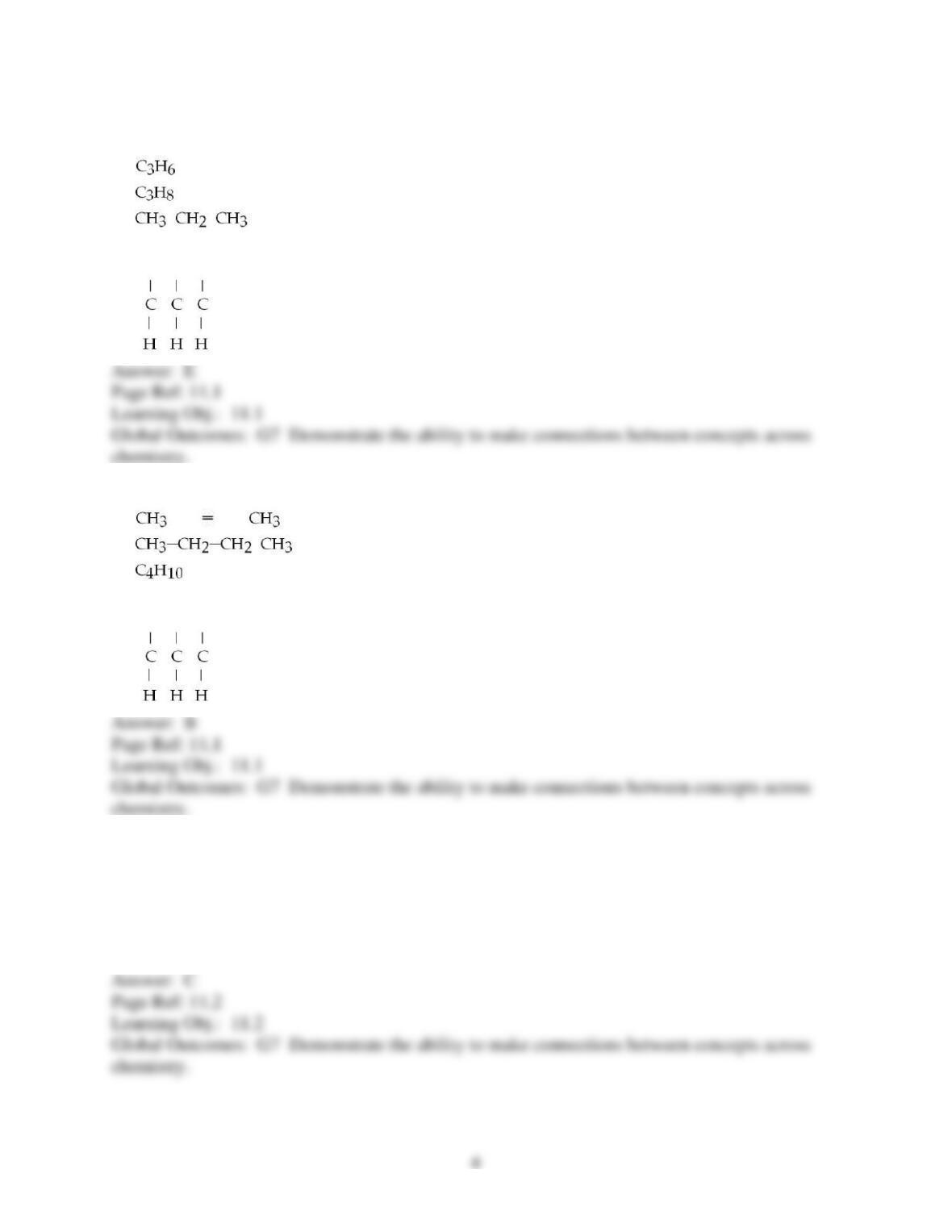
11) Which of these formulas is the expanded structural formula for an alkane with three carbon
atoms?
A)
B)
C) ––
D) C– C– C
E) H H H
H – – – – H
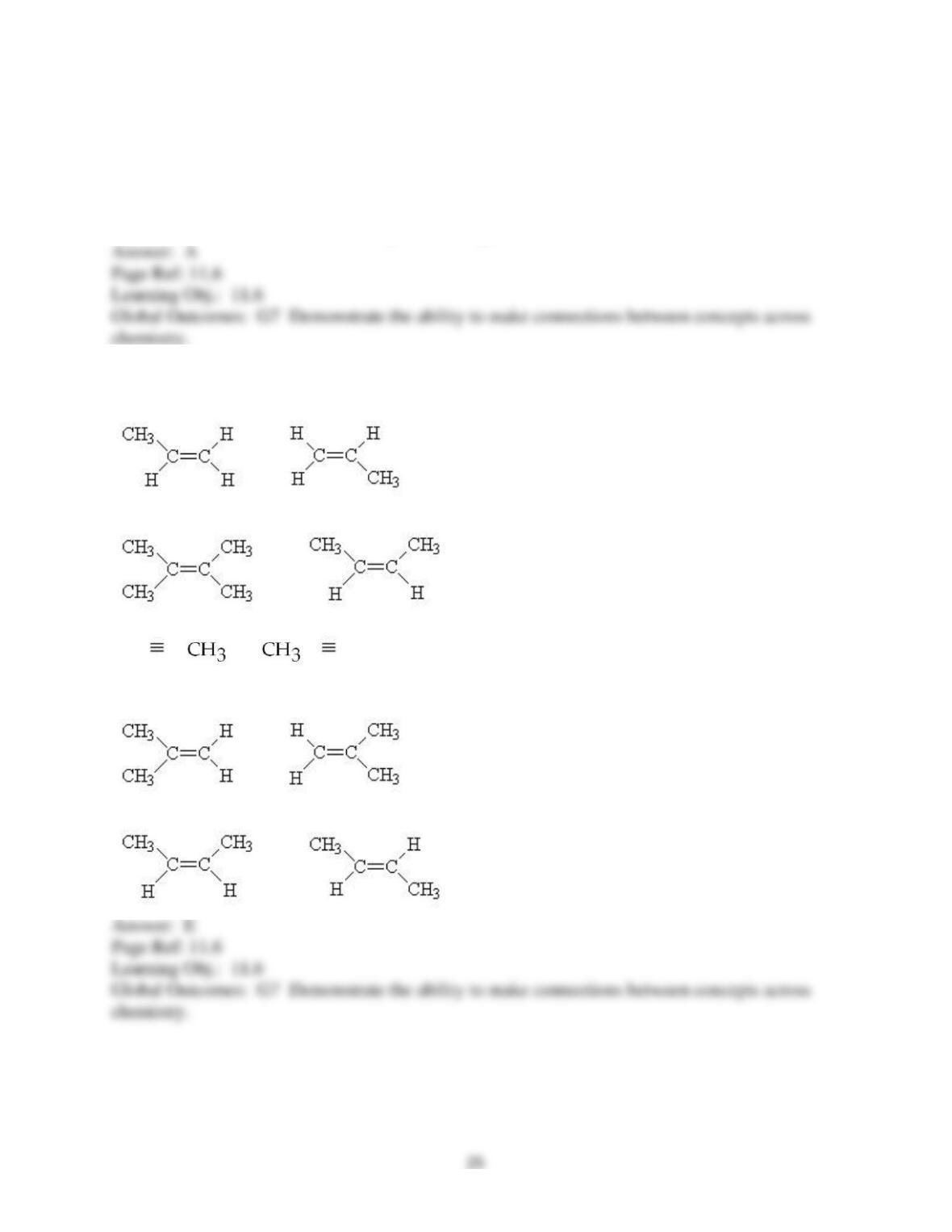
12) What is the condensed structural formula for an alkane with four carbon atoms?
A) –CH CH–
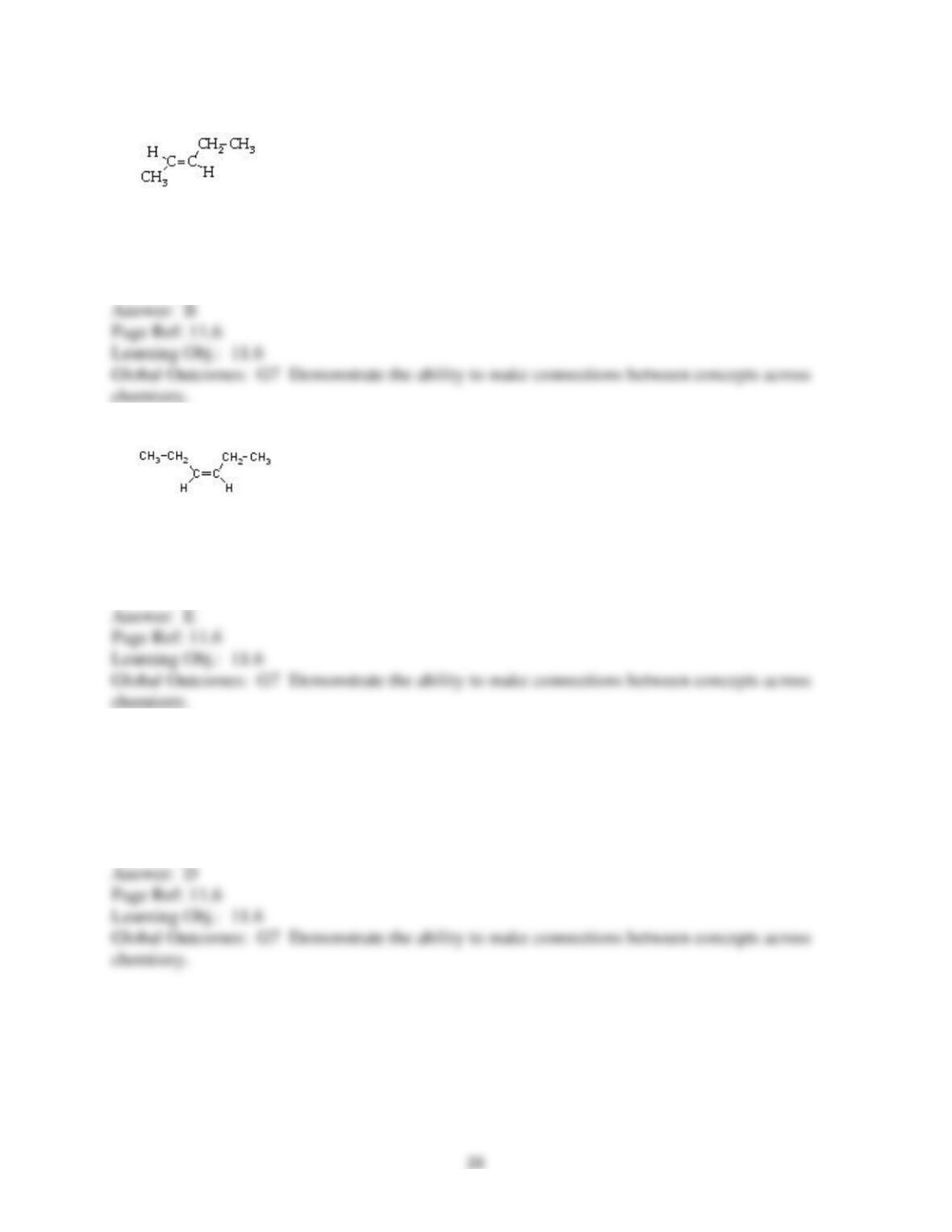
B) –
C)
D) C–C–C–C
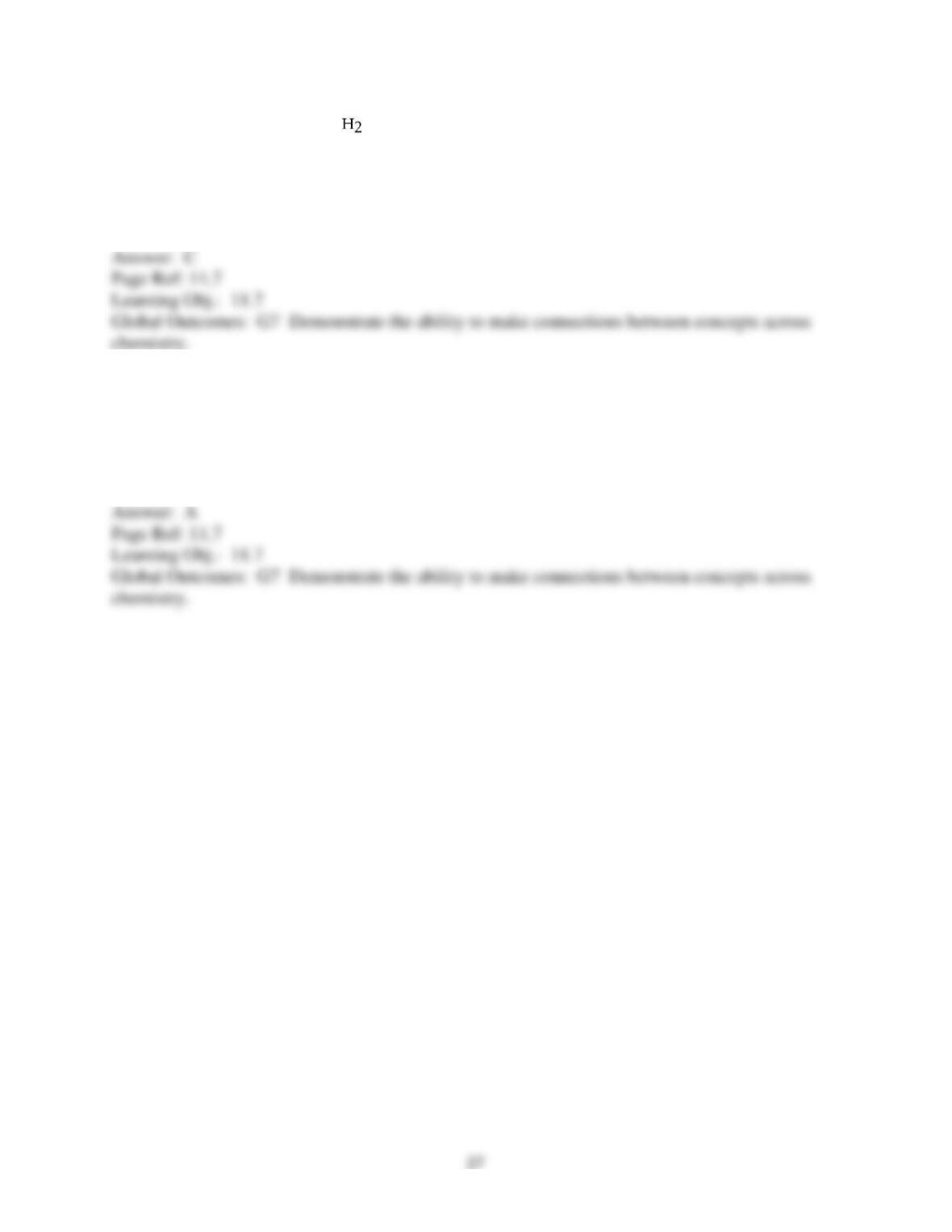
E) H H H
H – – – – H
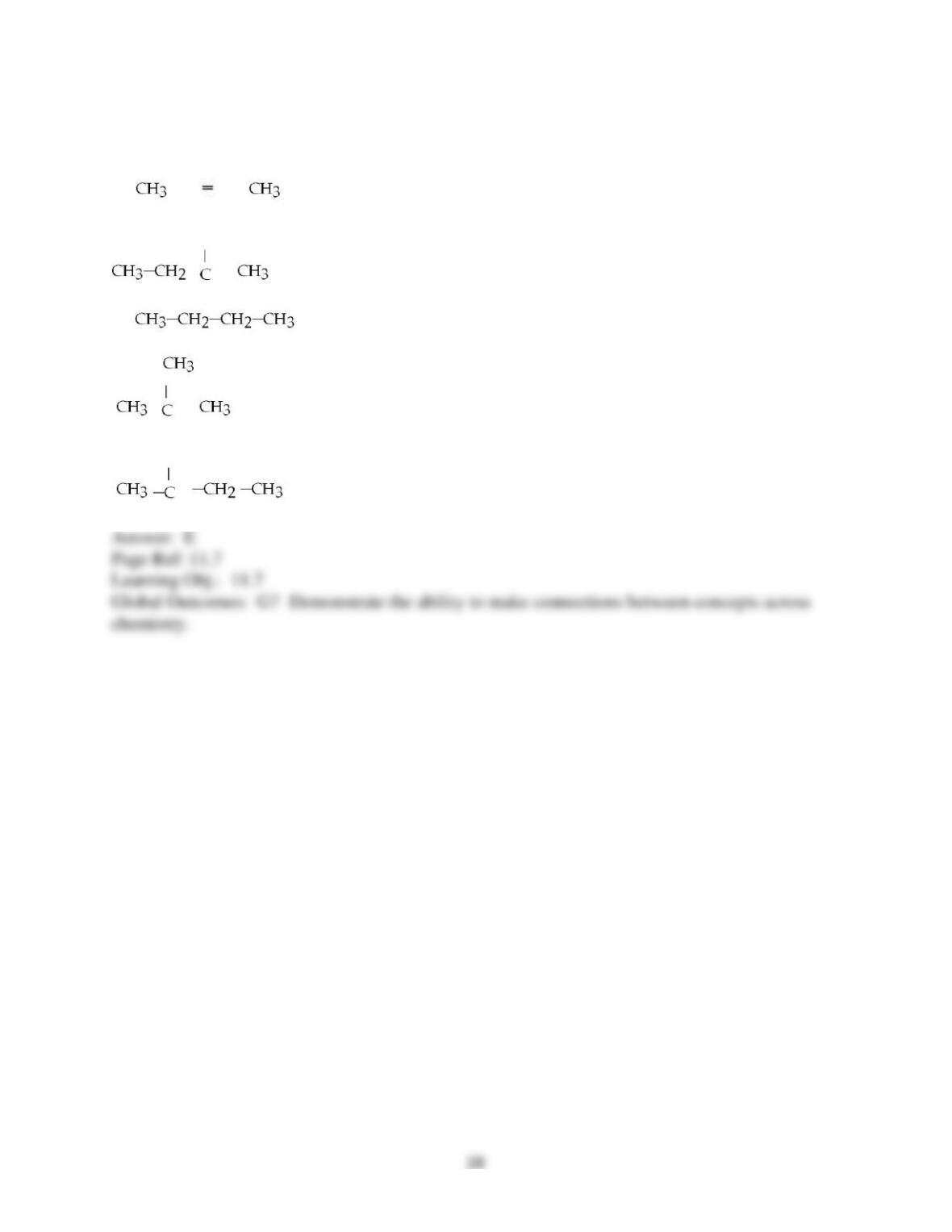
13) What is the IUPAC name of the continuous chain alkane with six carbon atoms?
A) butane
B) pentane
C) hexane
D) heptane
E) octane
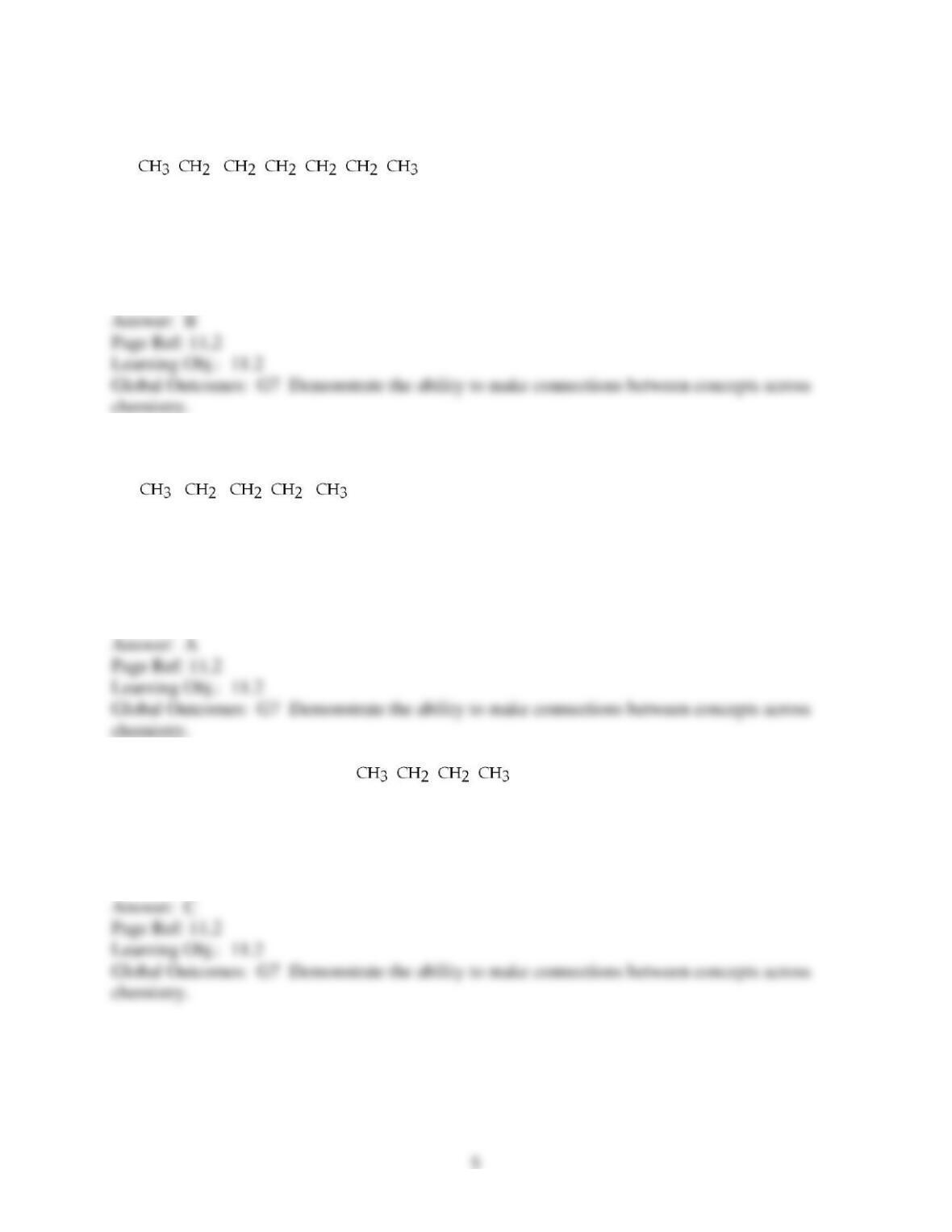
14) What is the IUPAC name of this compound?
– – ––––
A) hexane
B) heptane
C) octane
D) butane
E) pentane
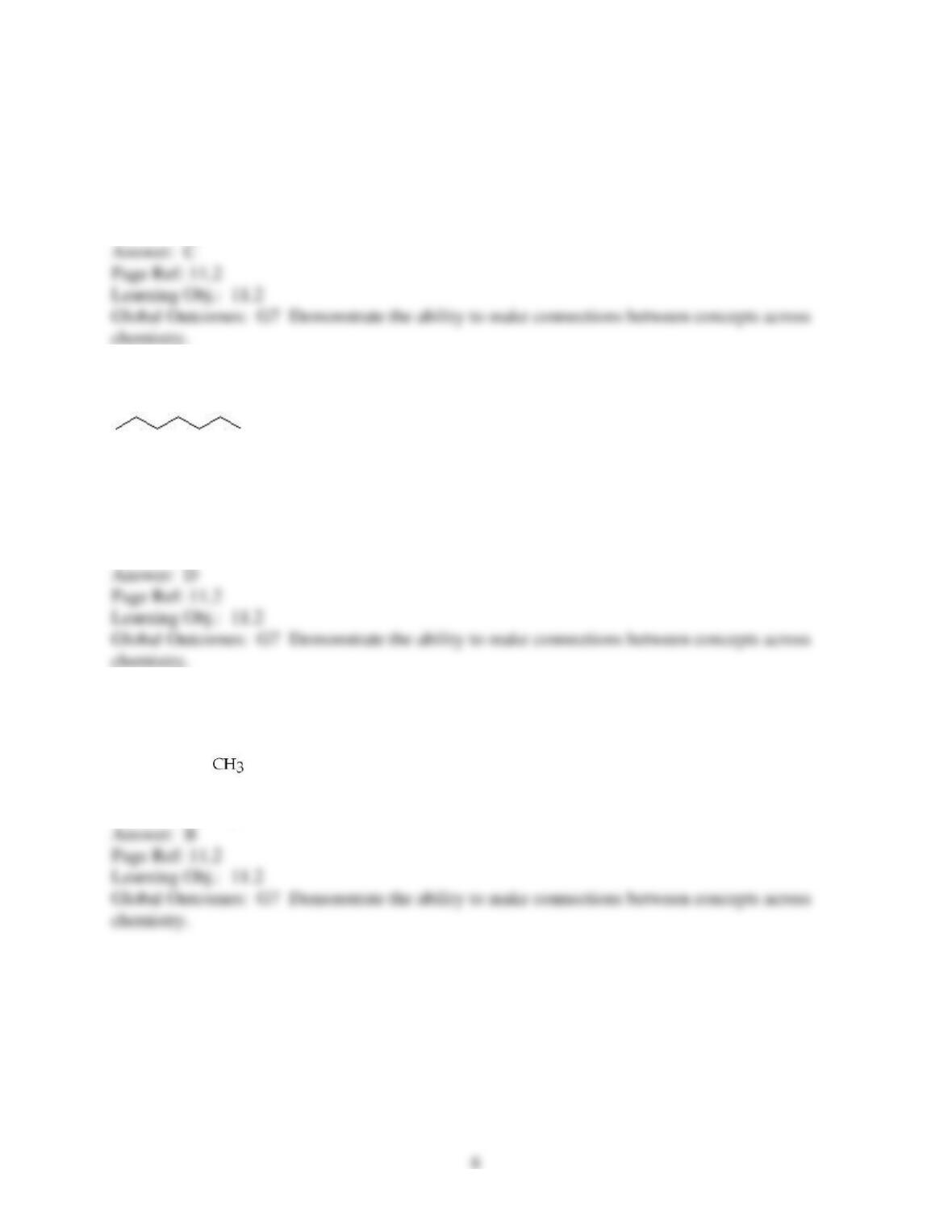
15) What is the IUPAC name of this compound?
– – – –
A) pentane
B) hexane
C) heptane
D) octane
E) methylbutane
16) What is the IUPAC name of –––?
A) ethane
B) propane
C) butane
D) pentane
E) hexane
17) Hydrocarbons are the primary constituents of ________.
A) drugs
B) food flavors
C) fuels
D) fruit juices
E) disinfectants
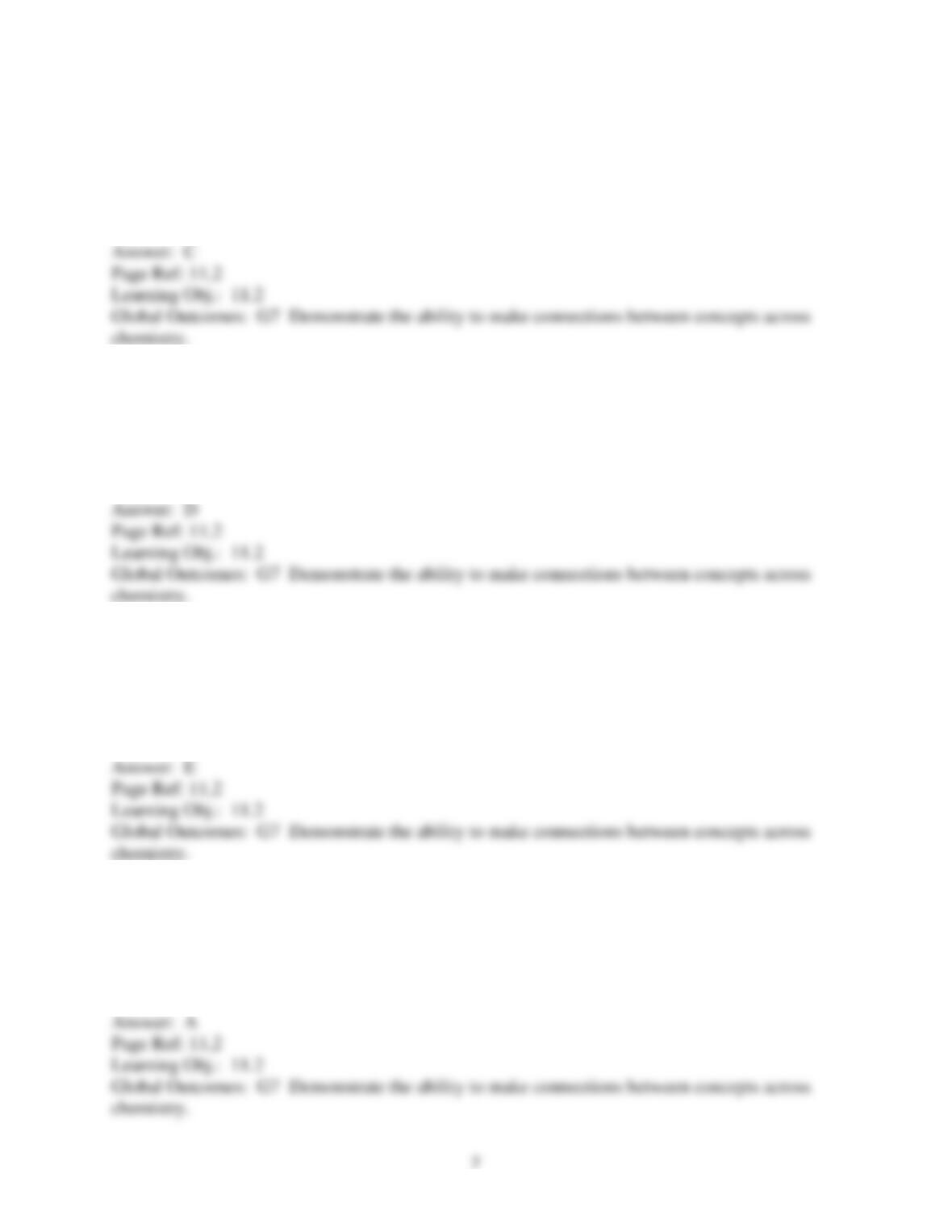
18) The skeletal formula shown is that of ________.
A) butane
B) pentane
C) hexane
D) heptane
E) octane
19) A cycloalkane ________.
A) has two fewer carbon atoms than the corresponding alkane
B) has two fewer hydrogen atoms than the corresponding alkane
C) contains – groups joined by single bonds
D) always contains a three carbon ring
E) has no hydrogen atoms
20) The simplest cycloalkane has ________.
A) one carbon atom
B) two carbon atoms
C) three carbon atoms
D) four carbon atoms
E) five carbon atoms
21) What is the IUPAC name for a four-carbon continuous-chain alkane?
A) methane
B) ethane
C) propane
D) butane
E) pentane
22) What is the IUPAC name for a five-carbon continuous-chain alkane?
A) methane
B) ethane
C) propane
D) butane
E) pentane
23) What is the mame for a six-carbon continuous-chain alkane?
A) hexane
B) heptane
C) octane
D) nonane
E) decane
24) What is the IUPAC name for a seven-carbon continuous-chain alkane?
A) hexane
B) heptane
C) octane
D) nonane
E) decane
25) What is the IUPAC name for an eight-carbon continuous-chain alkane?
A) hexane
B) heptane
C) octane
D) nonane
E) decane
26) What is the IUPAC name of the nine-carbon continuous-chain alkane?
A) hexane
B) heptane
C) octane
D) nonane
E) decane
27) What is the IUPAC name for a ten-carbon continuous-chain alkane?
A) hexane
B) heptane
C) octane
D) nonane
E) decane
28) In a condensed structural formula, each carbon atom is ________.
A) shown with all individual atoms and bonds drawn
B) shown with only the other carbon atoms
C) grouped with its bonded hydrogen atoms
D) not explicitly shown
E) written in lowercase letters
29) What type of compound is –?
A) alkane
B) branched alkane
C) cycloalkane
D) haloalkane
E) isomer
30) According to the IUPAC convention for chemical naming, which part of a hydrocarbon is
selected as the main chain for a hydrocarbon chain?
A) the most highly branched chain
B) the shortest chain
C) the longest chain drawn in a straight line
D) the longest continuous chain, regardless of bends
E) the chain with the most substituted carbons in it
31) According to the IUPAC convention, alkyl group names should be located ________ of the
name of the main chain.
A) in front
B) at the end
C) in the middle
32) According to the IUPAC convention, alkyl substituents on a hydrocarbon chain should be
listed in which order?
A) alphabetical including prefixes
B) alphabetical without considering prefixes
C) in order with the substituent having the largest number of carbons first
D) in order with the substituent having the smallest number of carbons first
E) in order with the substituent having the largest total number of carbons first
33) When drawing a structural formula, the first step is to draw ________.
A) the substituents
B) the most highly substituted carbons
C) the saturated carbons
D) the main carbon chain
E) the functional group
34) What is the IUPAC name of the following compound?
CH3
∣
CH3–CH2–CH2–CH2–CH–CH3
A) heptane
B) methylhexane
C) 5-methylhexane
D) 2-methylhexane
E) 2-methylpentane
35) Compounds that have the same molecular formula but different arrangements of atoms are
called ________.
A) isomers
B) isotopes
C) indicators
D) isozymes
E) isometrics
36) Isomers are molecules that share the same formula and have ________.
A) a different shape to the molecule
B) the same arrangement of atoms within the molecule
C) a different arrangement of atoms within the molecule
D) identical boiling points
E) the same shape in each molecule
37) What is the IUPAC name of this compound?
Cl
–H – – – Cl
A) 1,1-dichlorobutane
B) 1,2,-dichlorobutane
C) 1,3-dichlorobutane
D) 1,4-dichlorobutane
E) dichlorobutane
38) What is the IUPAC name of this compound?
A) 2,2-dimethylpentane
B) 2,4-dimethylpentane
C) heptane
D) 2-methylhexane
E) 1,1,3-trimethylbutane
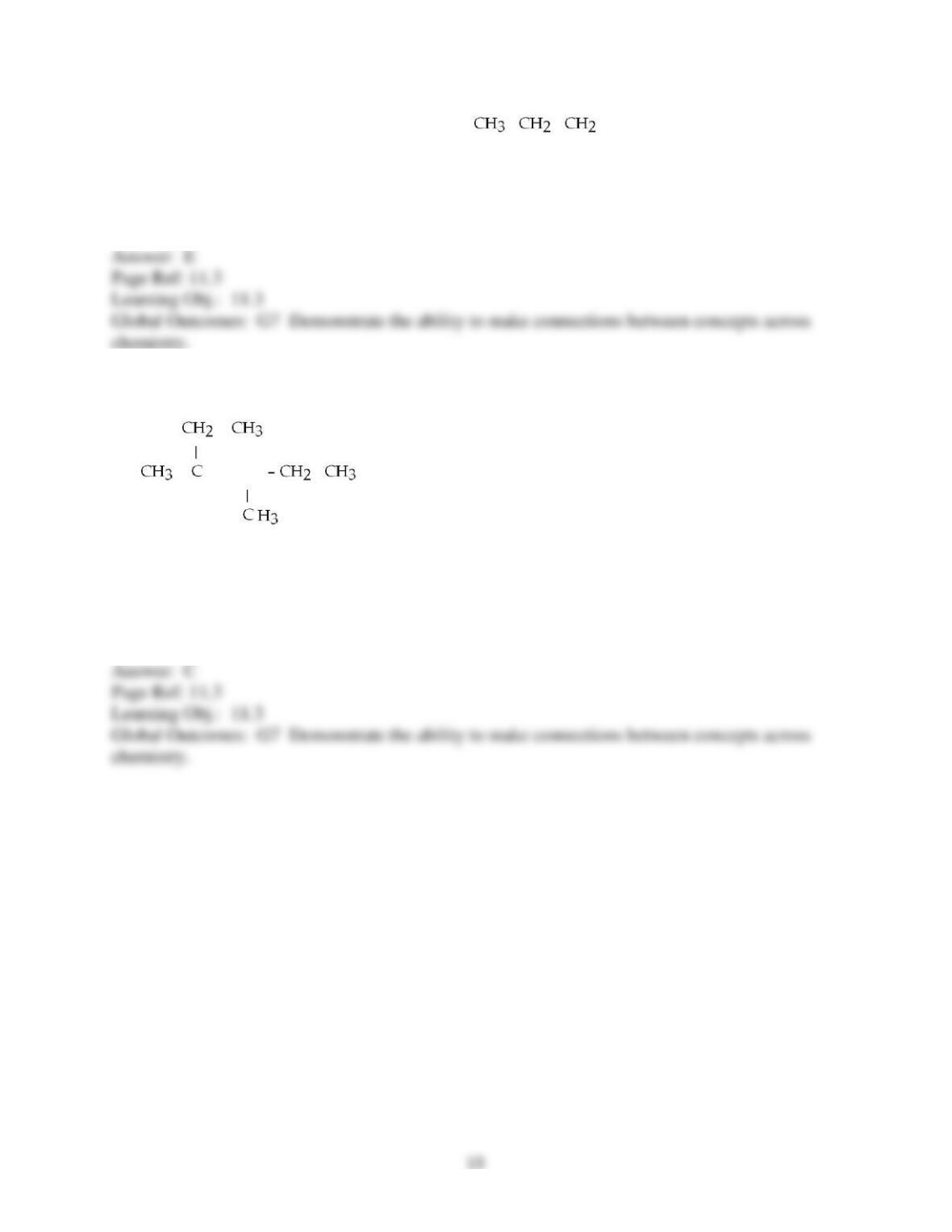
39) What is the IUPAC name of the alkyl group – – –?
A) propane
B) methyl
C) ethane
D) ethyl
E) propyl
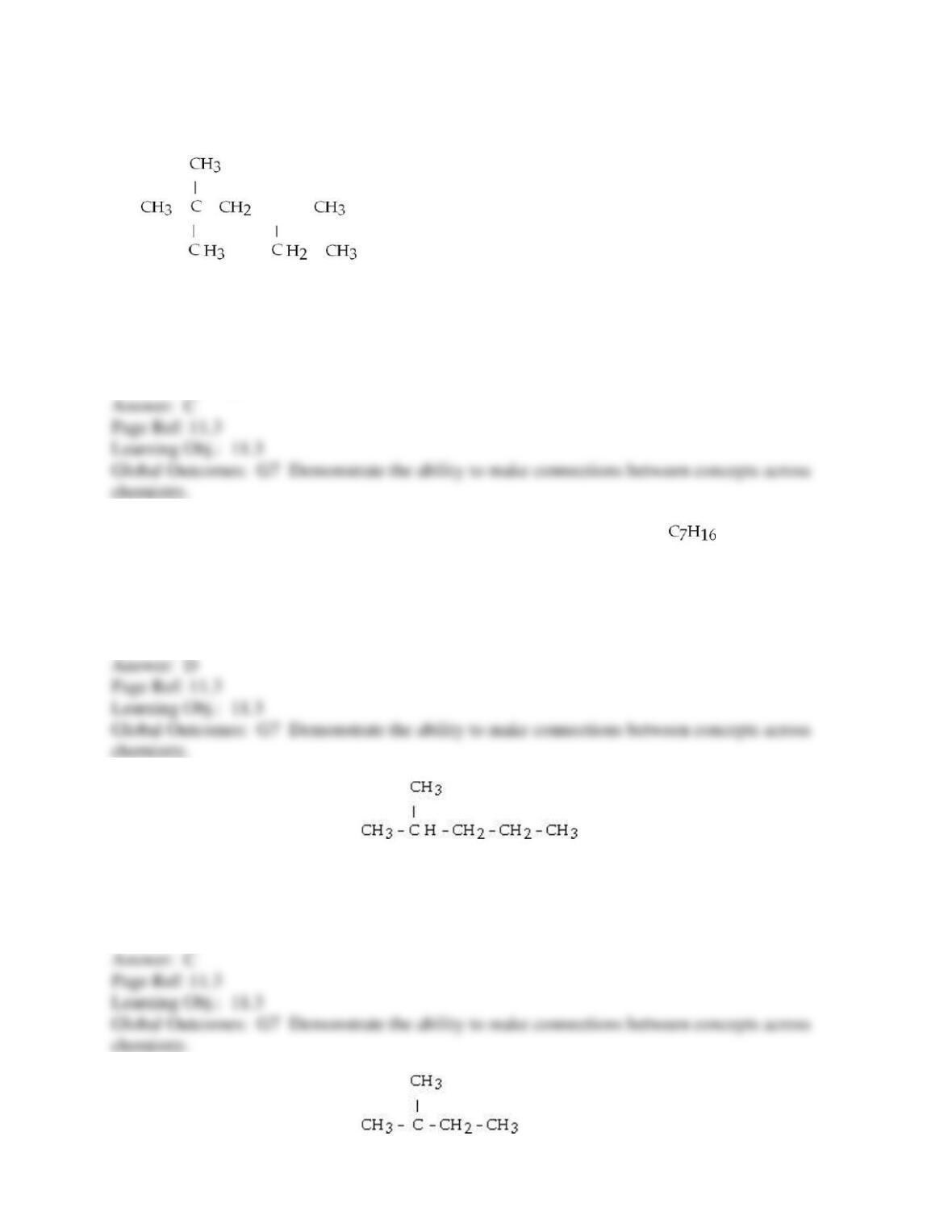
40) What is the IUPAC name for this alkane?
–
–H – CH –
A) 2-ethyl-3-methylpentane
B) 4-ethyl-3-methylpentane
C) 3, 4-dimethylhexane
D) 2, 3-diethylbutane
E) octane
14
41) What is the IUPAC name of this alkane?
– – – CH –
–
A) 4-ethyl-2,2-dimethylpentane
B) 2-ethyl-4,4-dimethylpentane
C) 2,2,4-trimethylhexane
D) 2-ethyl-2,2-dimethylpentane
E) 3,5,5-trimethylhexane
42) Which of the following compounds could have the molecular formula ?
A) hexane
B) pentane
C) 2-methylheptane
D) 2,3-dimethylpentane
E) 3-ethylhexane
43) What is the IUPAC name of ?
A) pentane
B) methylpentane
C) 2-methylpentane
D) 4-methylpentane
E) hexane
44) What is the IUPAC name of ?
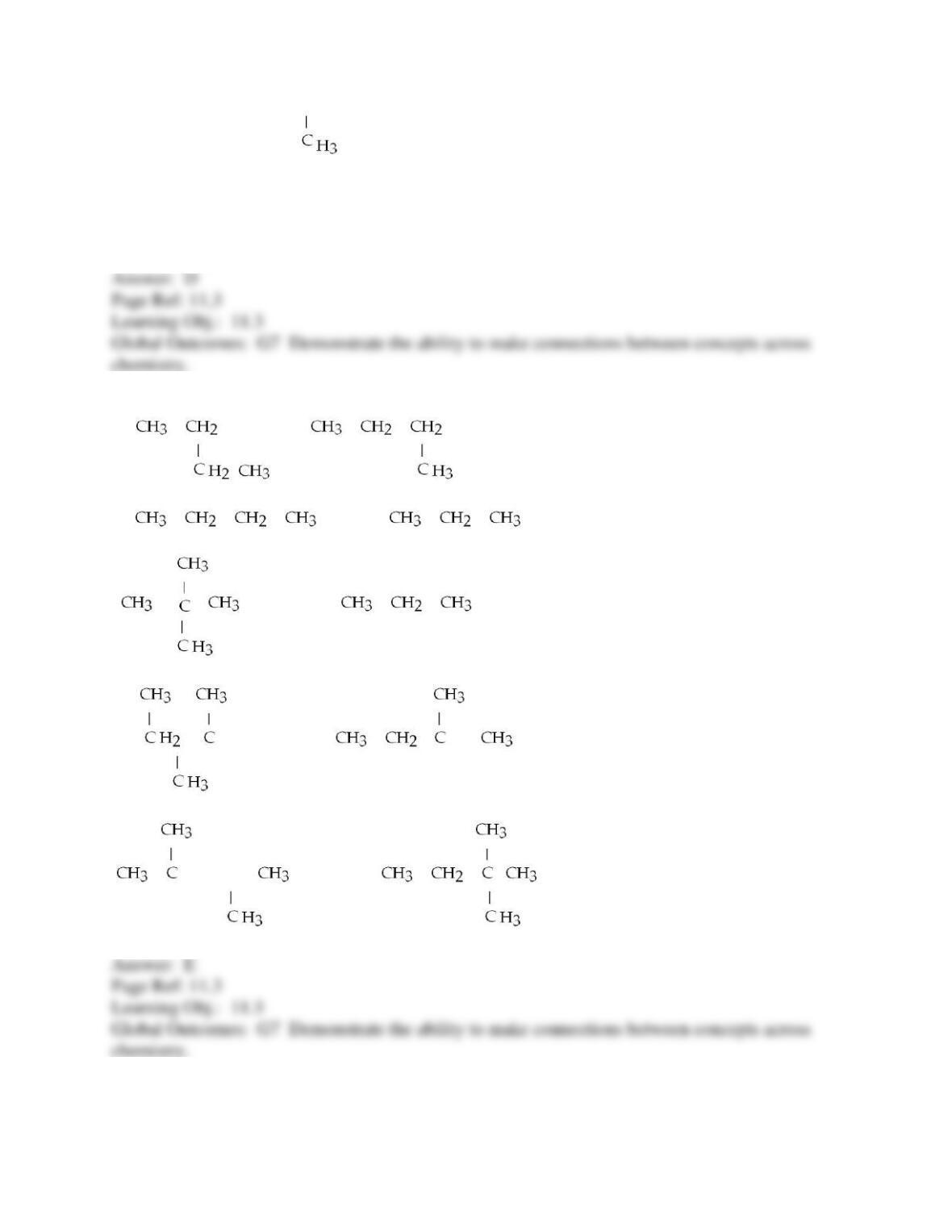
15
A) hexane
B) dimethylbutane
C) 3,3-dimethylbutane
D) 2,2-dimethylbutane
E) 2-dimethylbutane
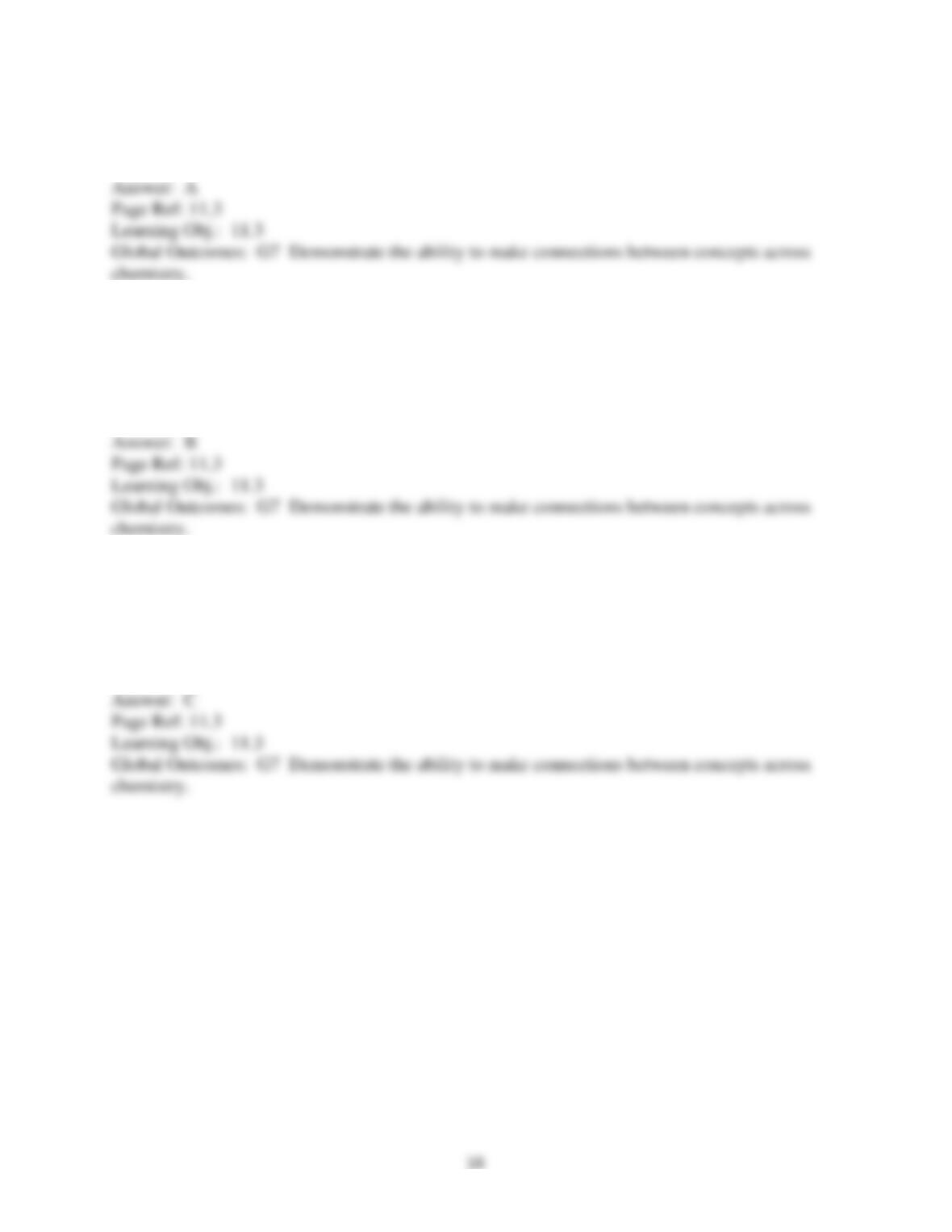
45) Which of the following pairs of formulas represent isomers?
A) – and – –
–
B) – – – and – –
C)
– – and – –
D)
– H and – –H –
E)
–H – CH – and – – –
46) What is the name for a one-carbon alkyl substituent?
A) methyl
B) ethyl
C) propyl
D) butyl
E) pentyl
47) What is the name for a two-carbon saturated alkyl group?
A) methyl
B) ethyl
C) propyl
D) butyl
E) pentyl
48) What is the name for a three-carbon saturated alkyl group?
A) methyl
B) ethyl
C) propyl
D) butyl
E) pentyl
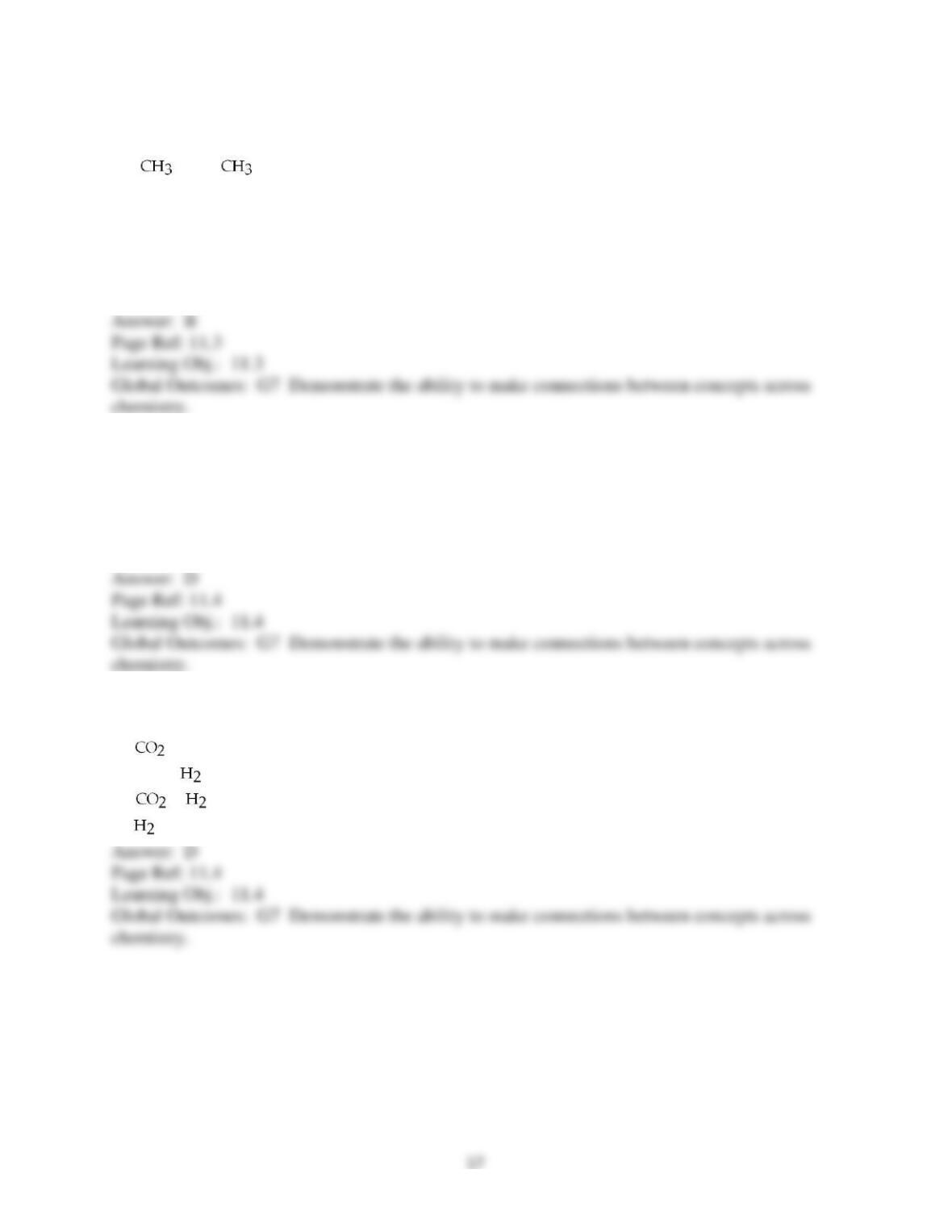
49) What is the name for this three-carbon alkyl group?
–CH–
A) propyl
B) isopropyl
C) butyl
D) methyl
E) ethyl
50) The reaction of butane with oxygen is called ________.
A) substitution
B) addition
C) neutralization
D) combustion
E) titration
51) What is(are) the product(s) of the complete combustion of any hydrocarbon?
A) CO only
B) only
C) CO + O
D) + O
E) O only
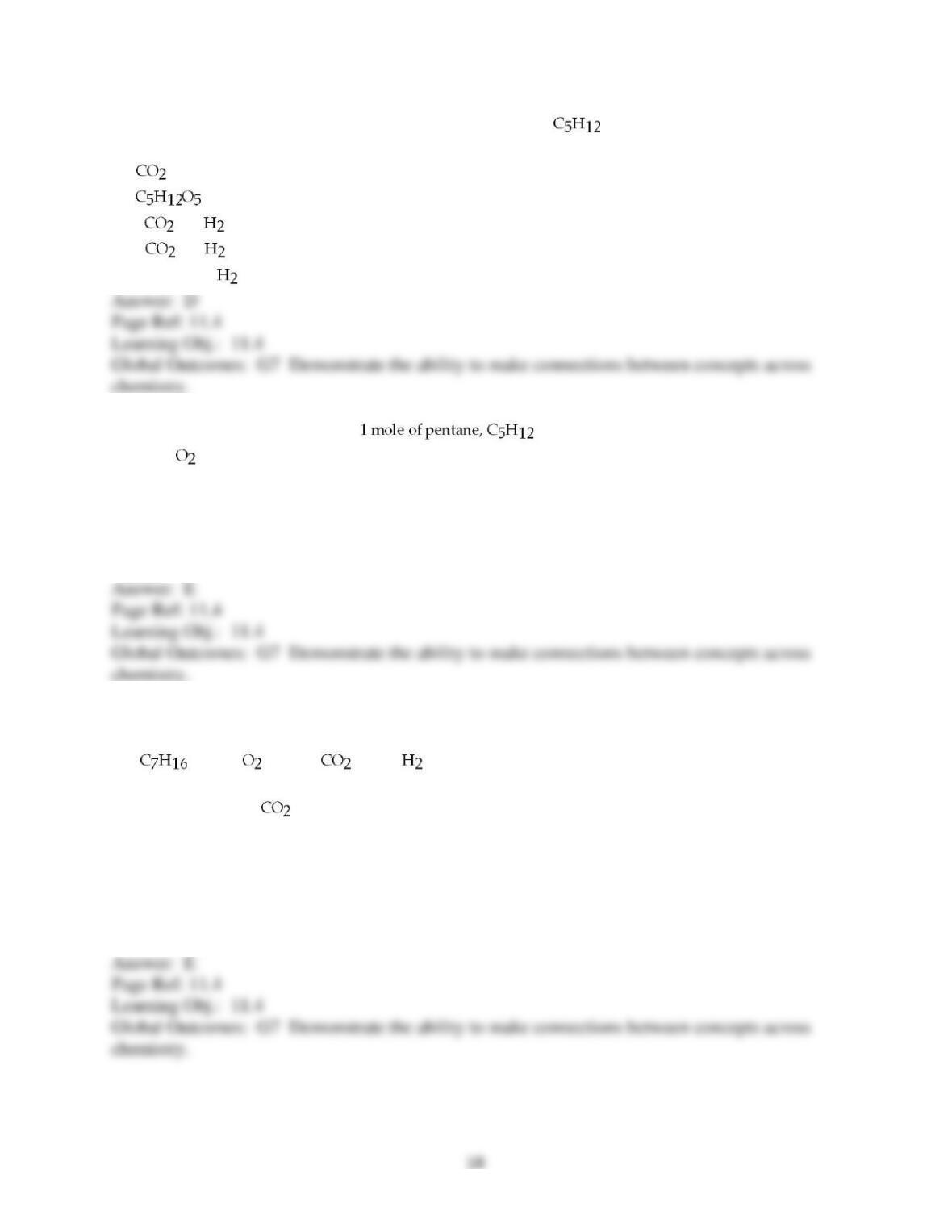
52) The balanced equation for the complete combustion of will give which of these
product(s)?
A) only
B) only
C) 5 + 5 O
D) 5 + 6 O
E) 10CO + 12 O
53) The complete combustion of , will require how many moles of
oxygen, ?
A) 1 mole
B) 2 moles
C) 5 moles
D) 6 moles
E) 8 moles
54) The reaction for the combustion of heptane is
(l) + 11 (g) → 7 (g) + 8 O(g).
How many liters of at STP are produced from the complete combustion of 2.00 moles of
heptane?
A) 44.8 L
B) 22.4 L
C) 157 L
D) 246 L
E) 314 L
55) An alkene is an organic compound that contains a ________ bond.
A) single
B) double
C) triple
D) aromatic
E) hydrogen
56) An alkyne is an organic compound that contains a ________ bond.
A) single
B) double
C) triple
D) aromatic
E) hydrogen
57) A hydrocarbon with a double bond is a(n) ________.
A) alkane
B) alkene
C) alkyne
D) alcohol
E) saturated compound
58) Alkenes and alkynes are called unsaturated compounds because ________.
A) they have the maximum number of hydrogen atoms attached to each carbon in the compound
B) they have fewer hydrogen atoms attached to the carbon chain than alkanes
C) they have more hydrogen atoms attached to the carbon chain than alkanes
D) they have more carbon atoms than alkanes
E) they have fewer carbon atoms than alkanes
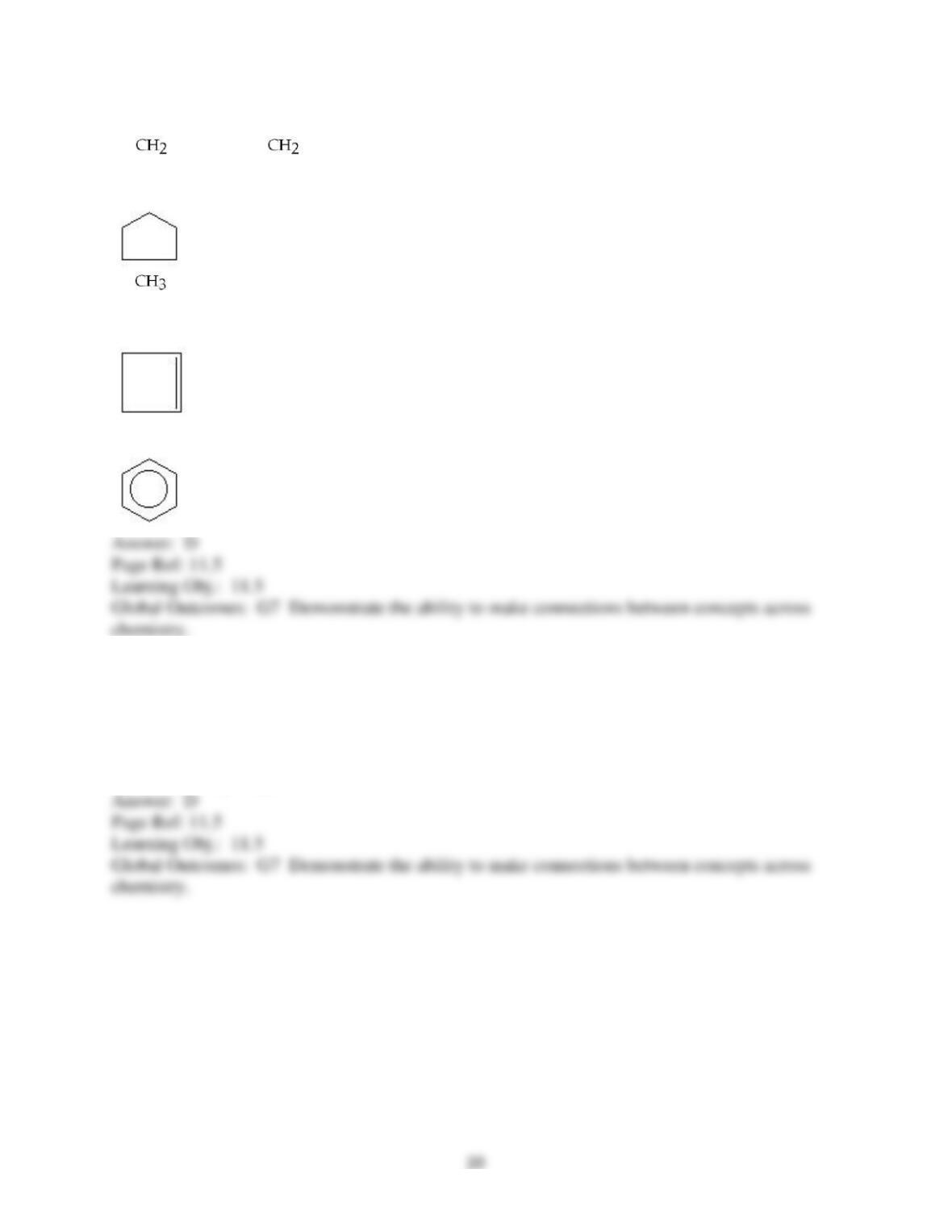
59) Which of the compounds is a cycloalkene?
A) = CH–CH =
B)
C) –CH = CH2
D)
E)
60) An unsaturated compound always ________.
A) is a cycloalkane
B) contains a double bond
C) contains a triple bond
D) contains at least one double or triple bond
E) contains only single bonds
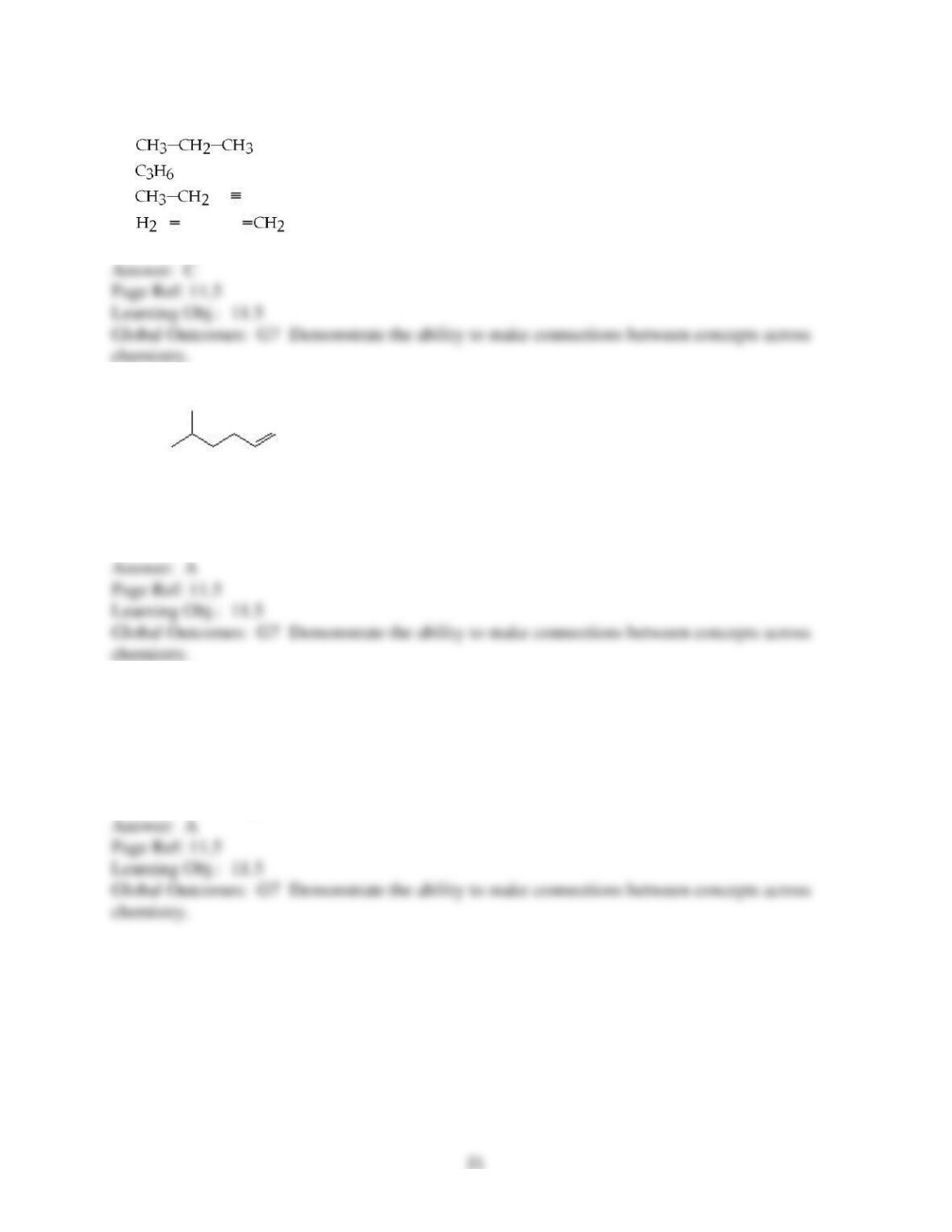
61) Which of the following compounds is an alkyne?
A)
B)
C) –CCH
D) C CH–CH
E) 2-pentene
62) What is the IUPAC name of the following compound?
A) 5-methyl-1-hexene
B) 2-methyl-1-hexene
C) 2-methyl-5-hexene
D) 5-methyl-2-hexene
E) 1-hexene
63) Organic compounds with carbon-carbon double or triple bonds are classified as ________.
A) unsaturated compounds
B) saturated compounds
C) dilute solutions
D) concentrated solutions
E) substituted compounds
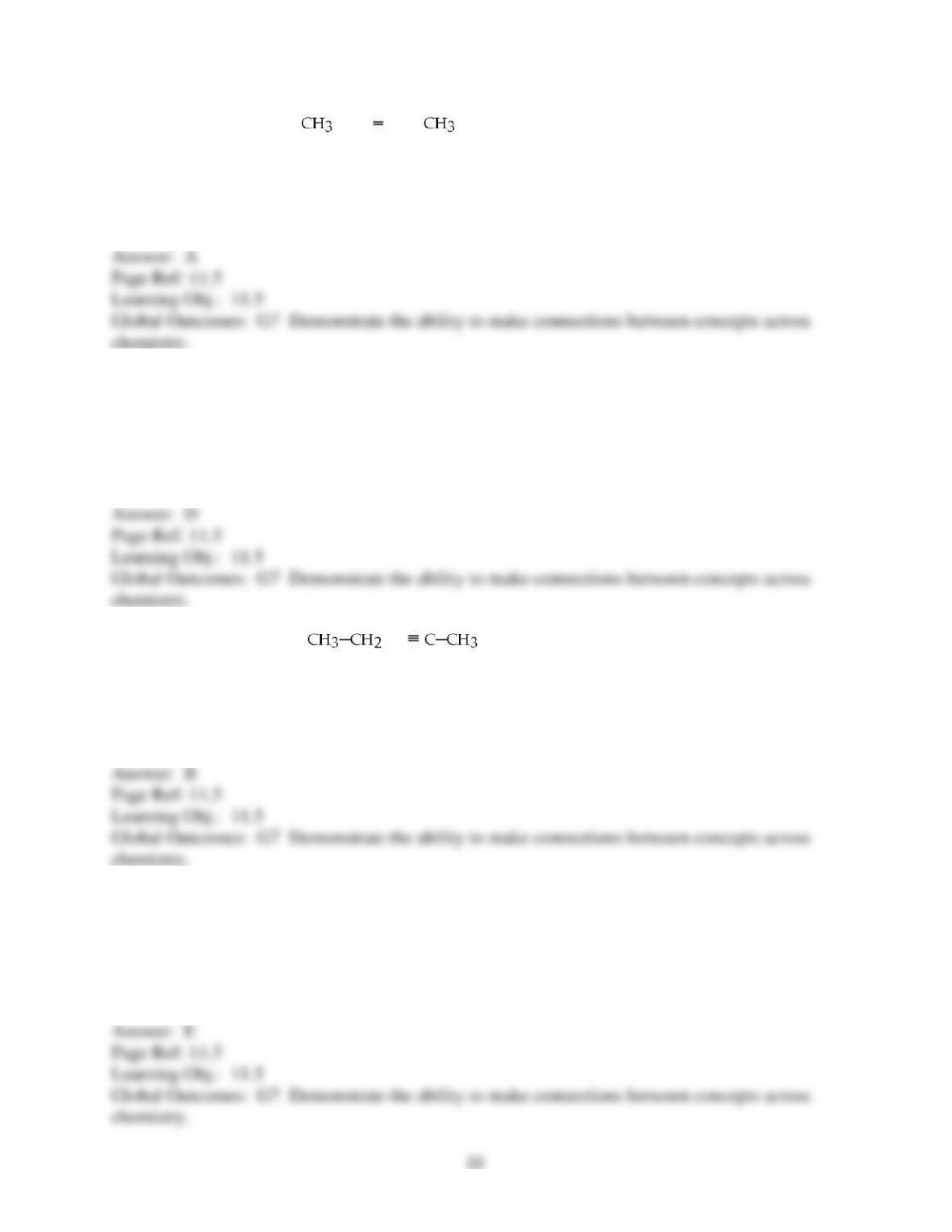
64) The IUPAC name of –CH CH– is ________.
A) 2-butene
B) 2-butane
C) 1-butene
D) butene
E) 2-butyne
65) When naming an alkene, the parent chain is the longest carbon chain ________.
A) that does not contain the double bond
B) regardless of whether or not it contains the double bond
C) that contains at least one of the carbon atoms of the double bond
D) that contains both atoms of the double bond
E) that contains a branch
66) The IUPAC name for –C is ________.
A) 3-pentyne
B) 2-pentyne
C) pentyne
D) 1-methylbutyne
E) 2-propene
67) The IUPAC name for ethylene is ________.
A) ethane
B) cycloethane
C) ethyne
D) ethanene
E) ethene
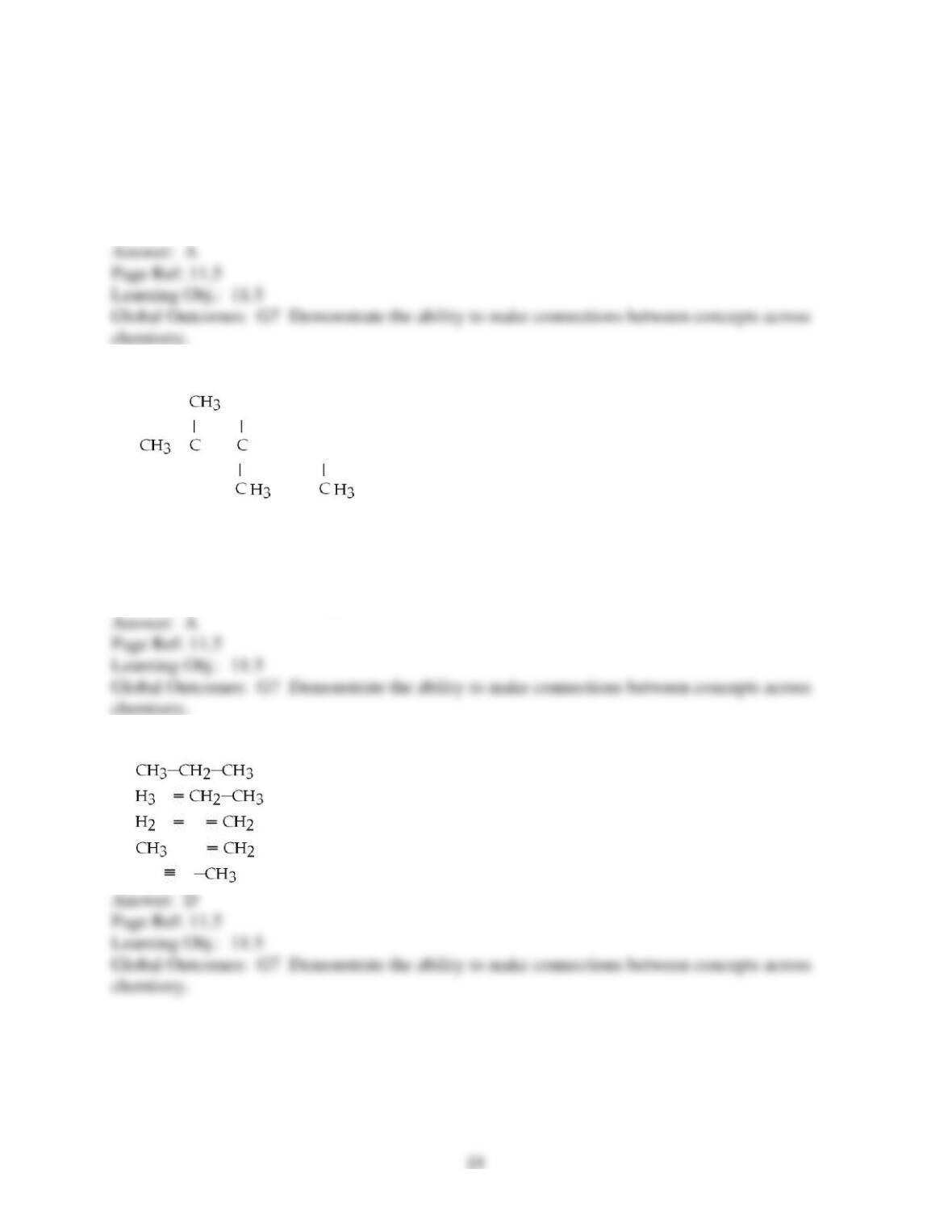
68) Which one of the following compounds has the smallest number of hydrogen atoms?
A) butyne
B) 2-methylpropane
C) butene
D) 2-methybutane
E) butane
69) What is the IUPAC name for the following compound?
Cl
–H – – CH = CH
A) 4-chloro-4,5-dimethyl-2-hexene
B) 3-chloro-1,3,4-trimethyl-1-pentene
C) 3-chloro-2,3-dimethyl-4-hexene
D) 3-chloro-2,3,5-trimethyl-4-pentene
E) 3-chloro-1,3,4,4-tetramethyl-1-butene
70) What is the condensed structural formula of the compound propene?
A)
B) C
C) C C
D) –CH
E) HC C
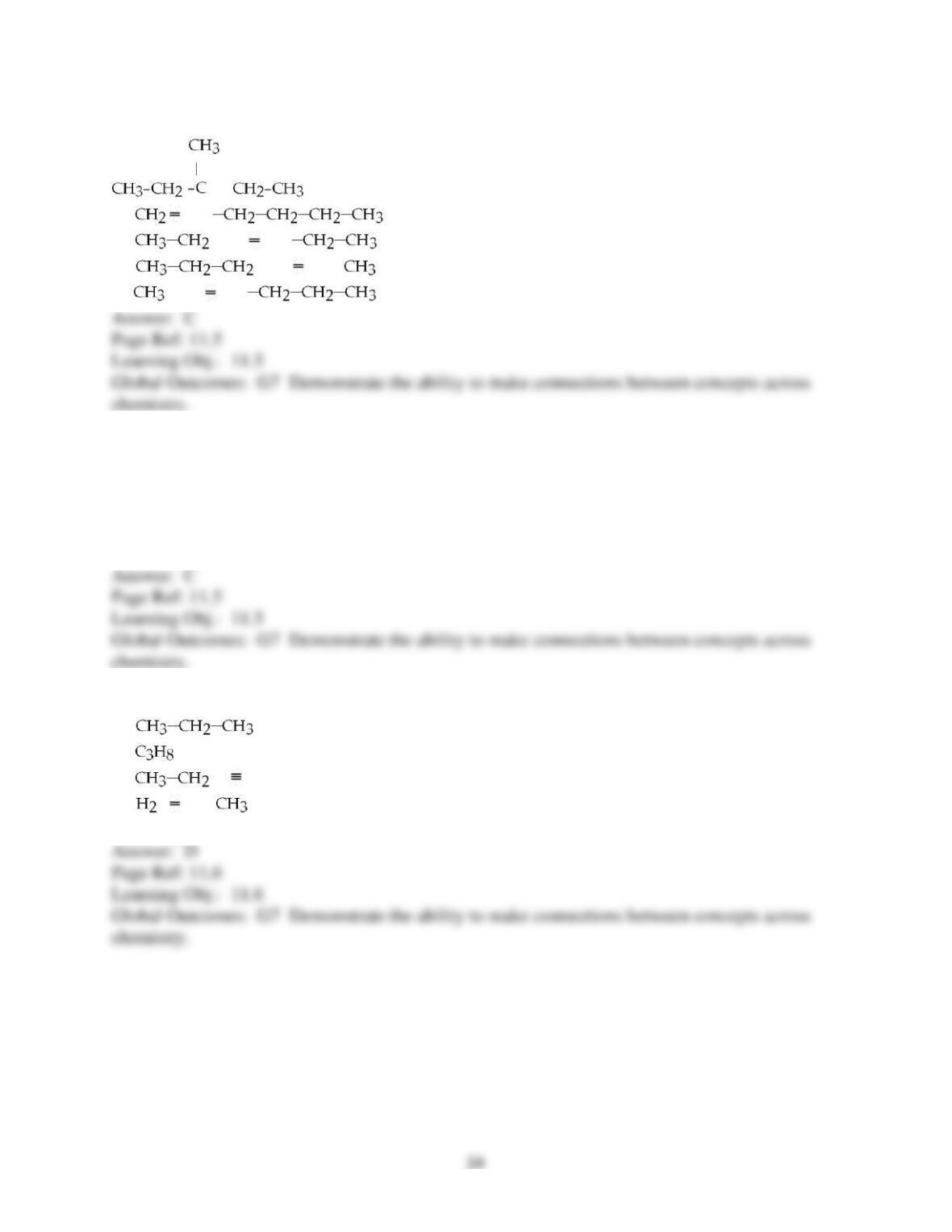
71) What is the condensed structural formula for the compound 3-hexene?
A)
H–
B) CH
C) –CH CH
D) –CH CH–
E) –CH CH
72) The compound 1-butyne contains ________.
A) all single bonds
B) a double bond
C) a triple bond
D) a ring structure
E) a bromine atom
73) Which of the following compounds is an alkene?
A)
B)
C) –CCH
D) C CH–
E) cyclopentane
74) Some alkenes have geometric (cis-trans) isomers because ________.
A) the carbon atoms in the double bond cannot rotate
B) each of the carbon atoms in the double bond has four different groups attached to it
C) one of the carbon atoms in the double bond has two identical groups attached to it
D) the carbon atoms in the double bond are free to rotate
E) all of the carbon atoms in the compound are rigid and cannot rotate
75) Which of the following pairs of compounds are cis-trans isomers?
A)
and
B)
and
C)
HC C– and –CCH
D)
and
E)
and
76) What is the IUPAC name of the compound shown below?
A) 2-pentene
B) trans-2-pentene
C) trans-3-pentene
D) cis-2-pentene
E) cis-3-pentene
77) What is the IUPAC name of the compound shown below?
A) 3-hexene
B) 3-hexyne
C) trans-3-hexene
D) cis-2-hexene
E) cis-3-hexene
78) Insects communicate with chemicals called ________.
A) markers
B) isomers
C) signals
D) pheromones
E) scents
79) The reaction of hydrogen ( ) and propene using a platinum catalyst is called ________.
A) combustion
B) substitution
C) addition
D) neutralization
E) condensation
80) The hydrogenation of an alkene gives a(n) ________.
A) alkane
B) alkene
C) alkyne
D) benzene
E) isomer
81) What is the condensed structural formula for the product of the reaction of 2-butene with
water and a strong acid catalyst?
A) –CH CH–
B) Cl
–H–
C)
D)
–H–
E) OH
H
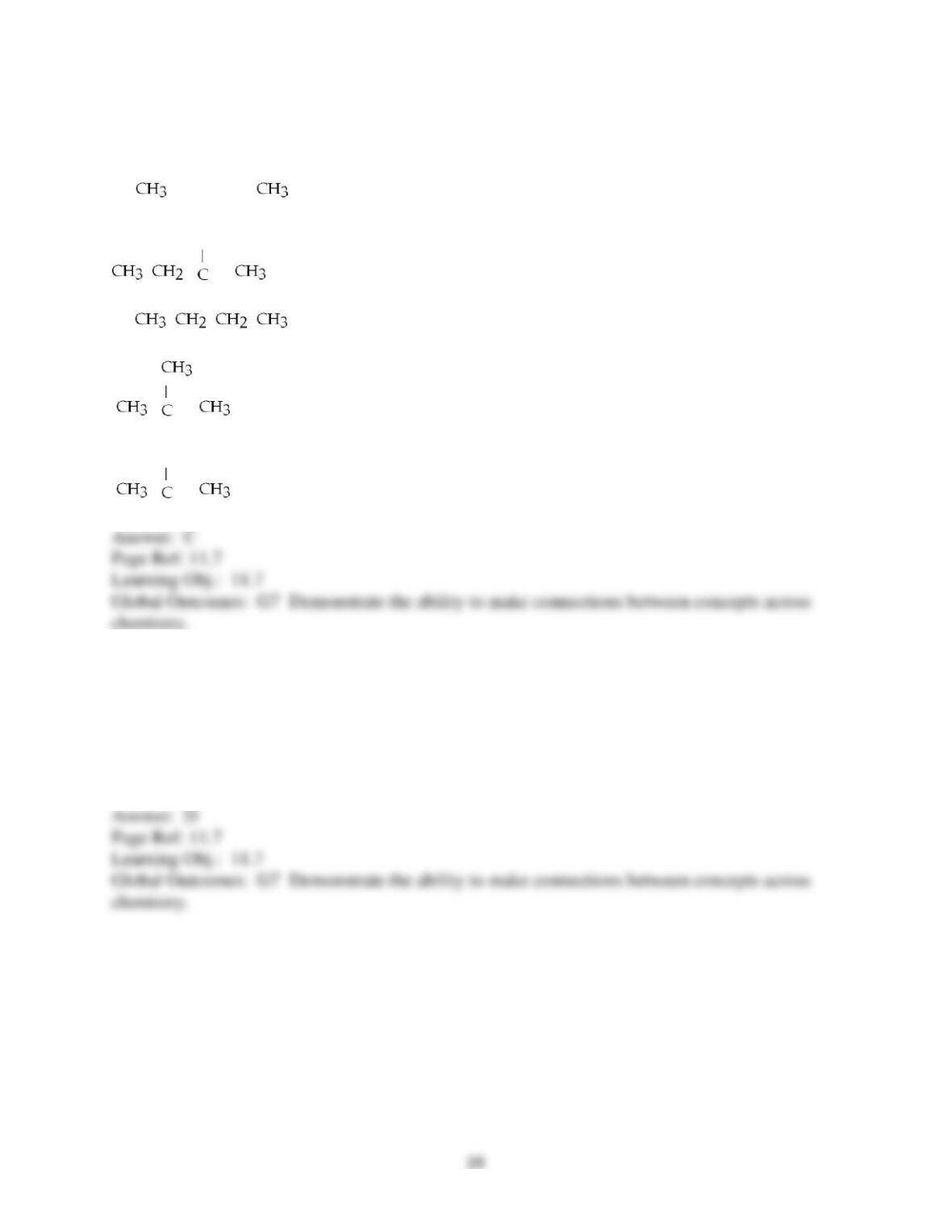
82) What is the condensed structural formula for the product of the hydrogenation of 2-butene
using a platinum catalyst?
A) –CH = CH–
B) Cl
– – H–
C) –––
D)
–H–
E) OH
–H–
83) The reaction of an alkene and water in the presence of an acid catalyst to produce an alcohol
is called ________.
A) hydrolysis
B) alkoholysis
C) halogenation
D) hydration
E) hydrohydration
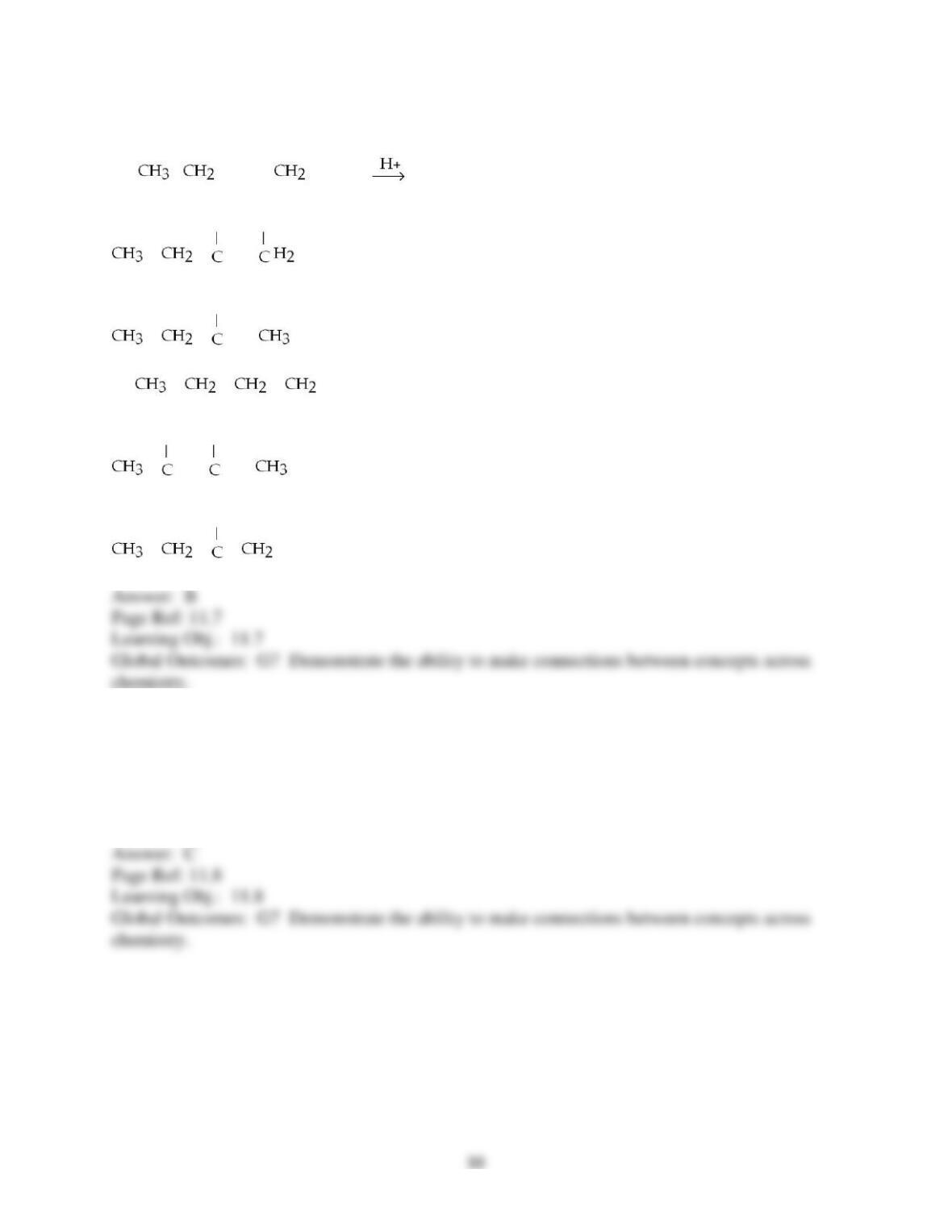
84) What is the product of the reaction shown below?
– – CH = + HOH
A) OH OH
– –H –
B) OH
– –H –
C) – – – OH
D) OH OH
–H –H –
E) OH
– –=
85) The structural formula of benzene is often represented as a ________.
A) ring of five carbon atoms
B) ring of six carbon atoms with six double bonds
C) ring of six carbon atoms with a circle in the center
D) cycloalkane
E) cycloalkyne
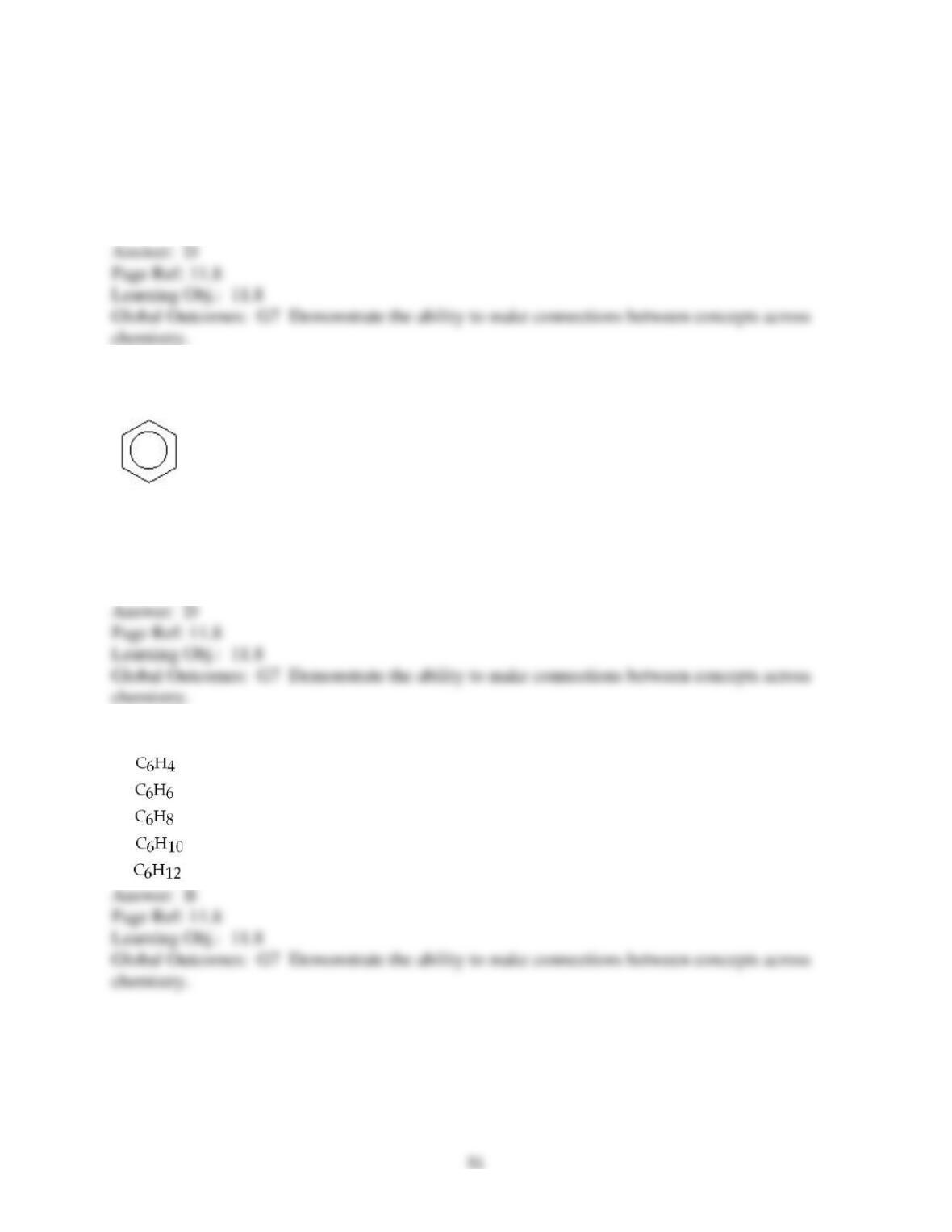
86) A compound that contains the ring structure of benzene is called a(n) ________.
A) alkane
B) cycloalkane
C) alkyl group
D) aromatic compound
E) hydrocarbon
87) The compound below is named ________.
A) cyclohexane
B) cyclohexene
C) cyclohexyne
D) benzene
E) cyclobenzene
88) What is the molecular formula of benzene?
A)
B)
C)
D)
E)
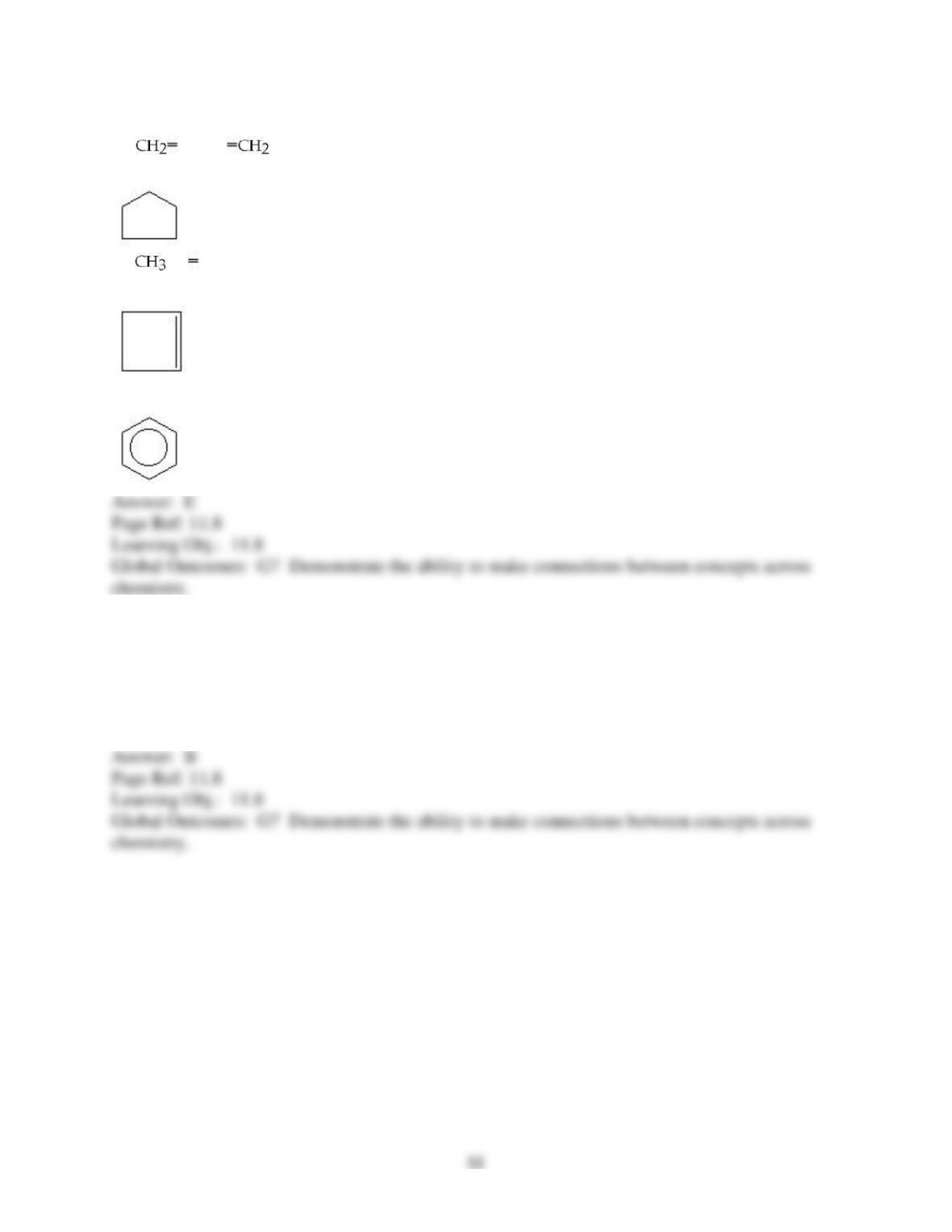
89) Which of the compounds below is aromatic?
A) CH–C
B)
C) –CCH2
D)
E)
90) All of the carbon-carbon bonds in benzene are ________.
A) composed of only two types, single and double
B) identical
C) double bonds
D) single bonds
E) circular bonds
11.2 True/False Questions
1) Organic chemistry is the study of the chemistry of compounds that contain primarily carbon
and hydrogen.
2) Shampoos, perfumes, and plastics are organic compounds.
3) There are vast numbers of organic compounds.
4) Carbon has six valence electrons.
5) Methane has a tetrahedral structure.
6) Organic compounds are always highly water soluble.
7) Most organic compounds are flammable.
8) Organic compounds usually have low melting and boiling points.
9) Organic liquids are usually less dense than water.
10) Organic compounds usually contain carbon, hydrogen and metal atoms.
11) Most medicines are organic molecules.
12) Organic compounds can only be made by living things because a “vital force” is needed for
their production.
13) Octane is a seven carbon linear alkane.
14) Hexane has six carbon atoms.
15) When naming an alkane, the main chain is the longest continuous carbon chain regardless of
bends.
16) Isomers have the same molecular formula.
17) The first four linear alkyl substituent groups are named methyl, ethyl, propyl, and butyl.
18) Mineral oil is a liquid hydrocarbon used as a laxative.
19) Solid alkanes are found on the surface of many fruits and vegetables.
20) Light-induced cis-trans isomerization is an important step in vision.
21) Propylene is used to induce ripening in fruits.
22) In a cis alkene, the groups are on the same side of the double bond.
23) In a trans alkene, the groups are on the same side of the double bond.
24) All alkenes show cis-trans isomerism.
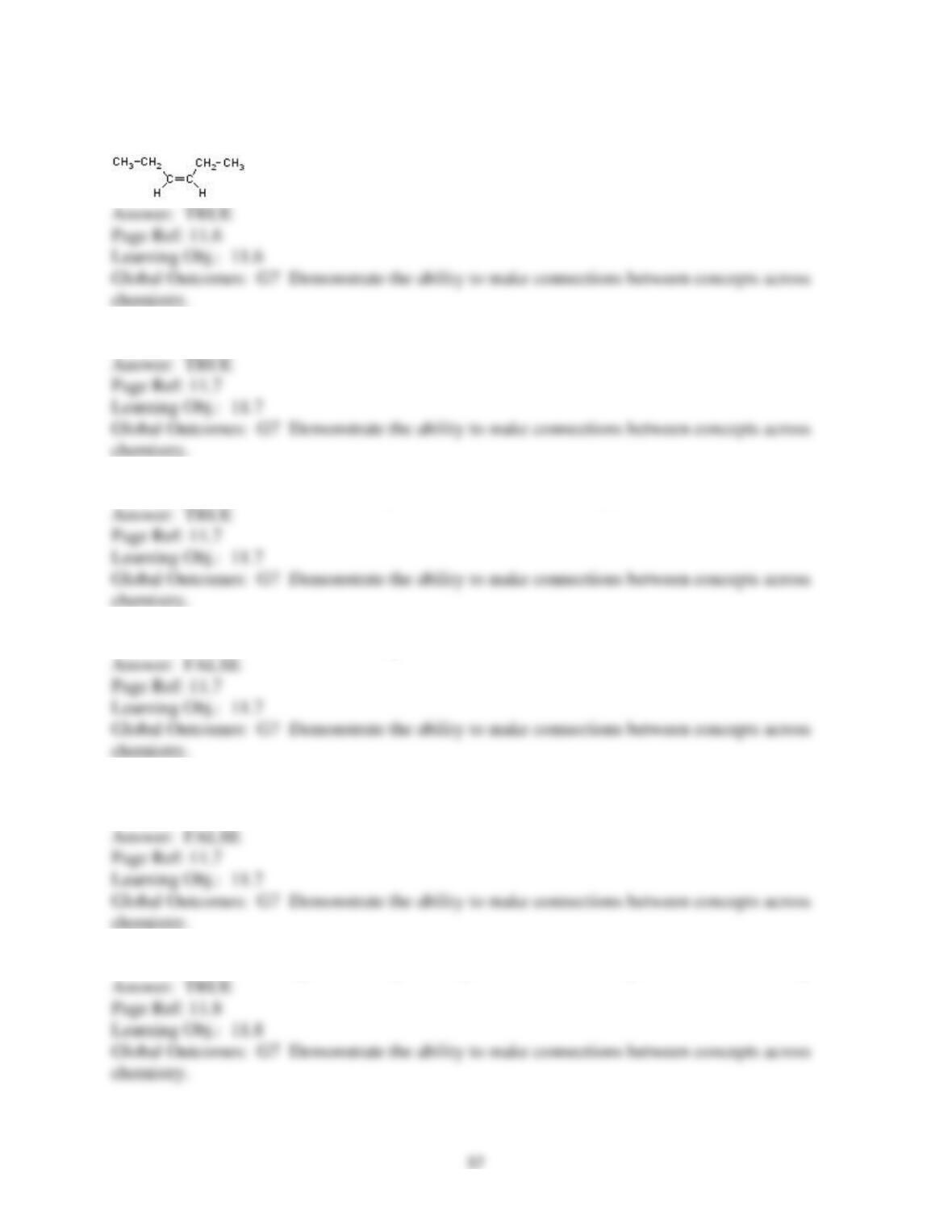
25) The compound shown below is cis-3-hexene.
26) Hydrogenation is used to convert alkenes to alkanes.
27) Hydrogenation of unsaturated vegetable oils raises the melting point.
28) Water can be added to alkenes to produce acids.
29) When hydrogen is added to 1-pentene in the presence of a platinum catalyst, the product is 1-
pentyne.
30) One essential building block of aspirin, ibuprofen, and acetaminophen is the benzene ring.
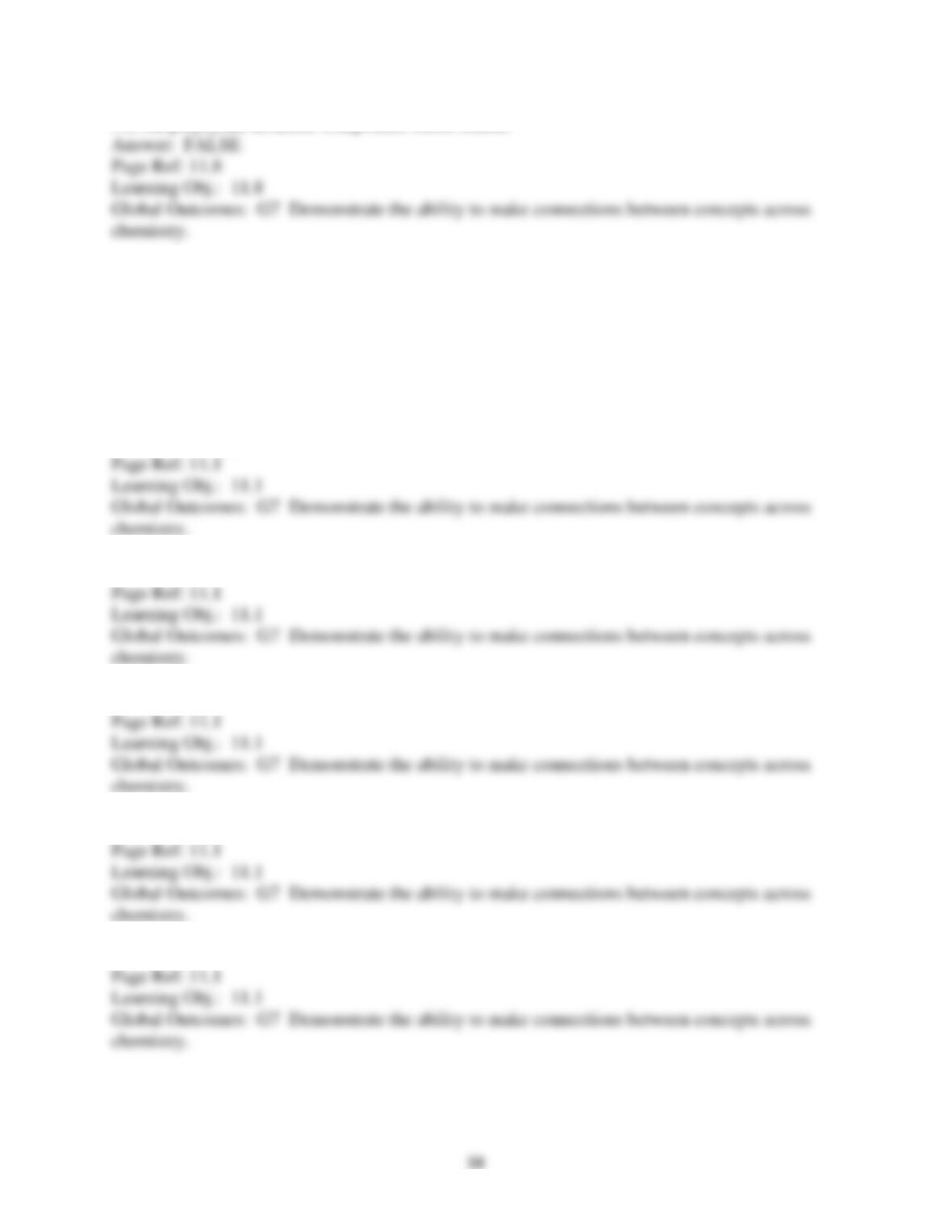
31) All polycyclic aromatic compounds cause cancer.
11.3 Matching Questions
Identify the following as more characteristic of an organic compound or an inorganic
compound.
A) inorganic
B) organic
1) high melting point
2) flammable
3) covalent bonds
4) contains metal atoms
5) insoluble in water
39
6) ionic bonds
Page Ref: 11.1
Learning Obj.: 11.1
Global Outcomes: G7 Demonstrate the ability to make connections between concepts across
chemistry.
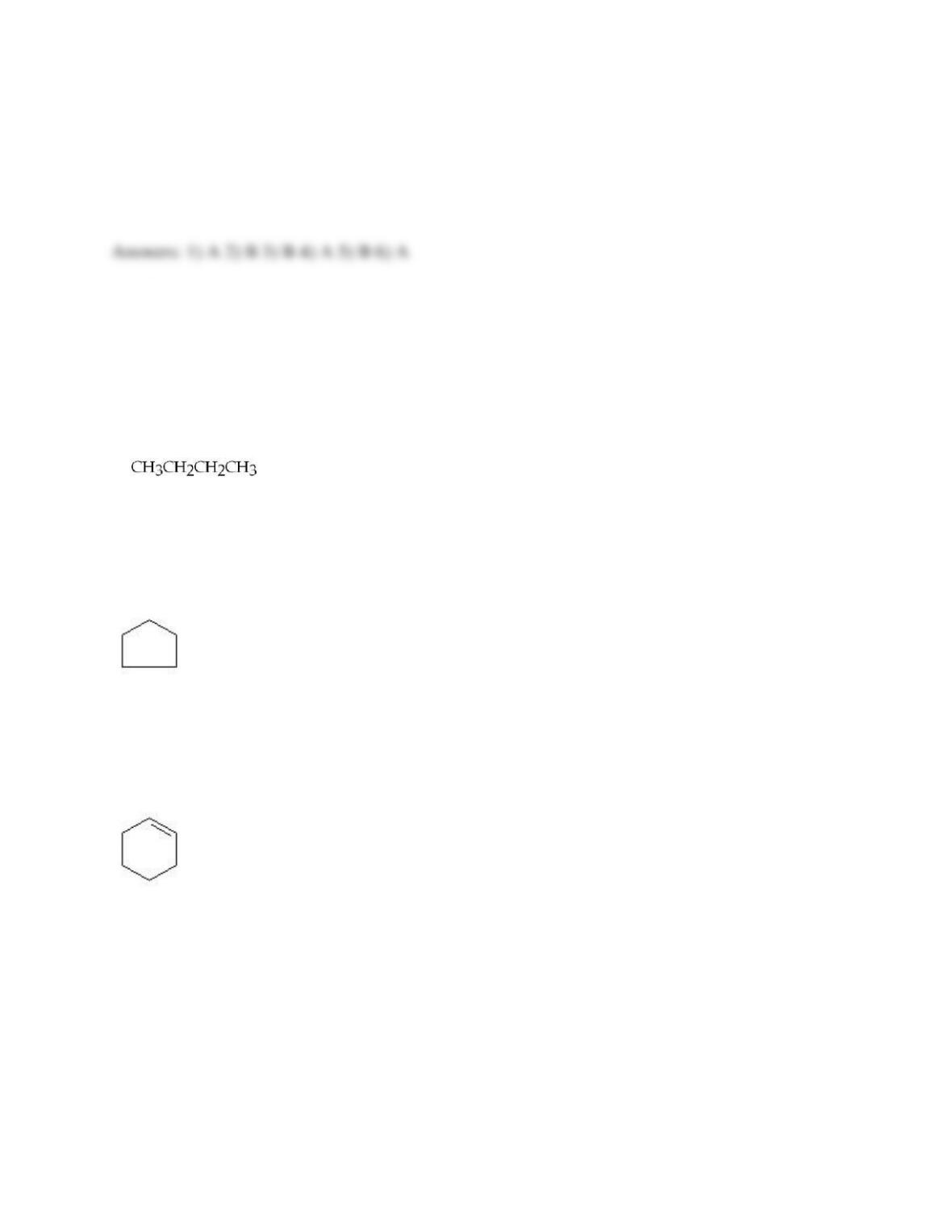
Match the following organic structures with the appropriate family name.
A) alkene aromatic
B) cycloalkane
C) cycloalkene
D) aromatic compound
E) alkane
7)
Page Ref: 11.2
Learning Obj.: 11.2
Global Outcomes: G7 Demonstrate the ability to make connections between concepts across
chemistry.
8)
Page Ref: 11.2
Learning Obj.: 11.2
Global Outcomes: G7 Demonstrate the ability to make connections between concepts across
chemistry.
9)
Page Ref: 11.5
Learning Obj.: 11.5
Global Outcomes: G7 Demonstrate the ability to make connections between concepts across
chemistry.
40
10)
Page Ref: 11.8
Learning Obj.: 11.8
Global Outcomes: G7 Demonstrate the ability to make connections between concepts across
chemistry.
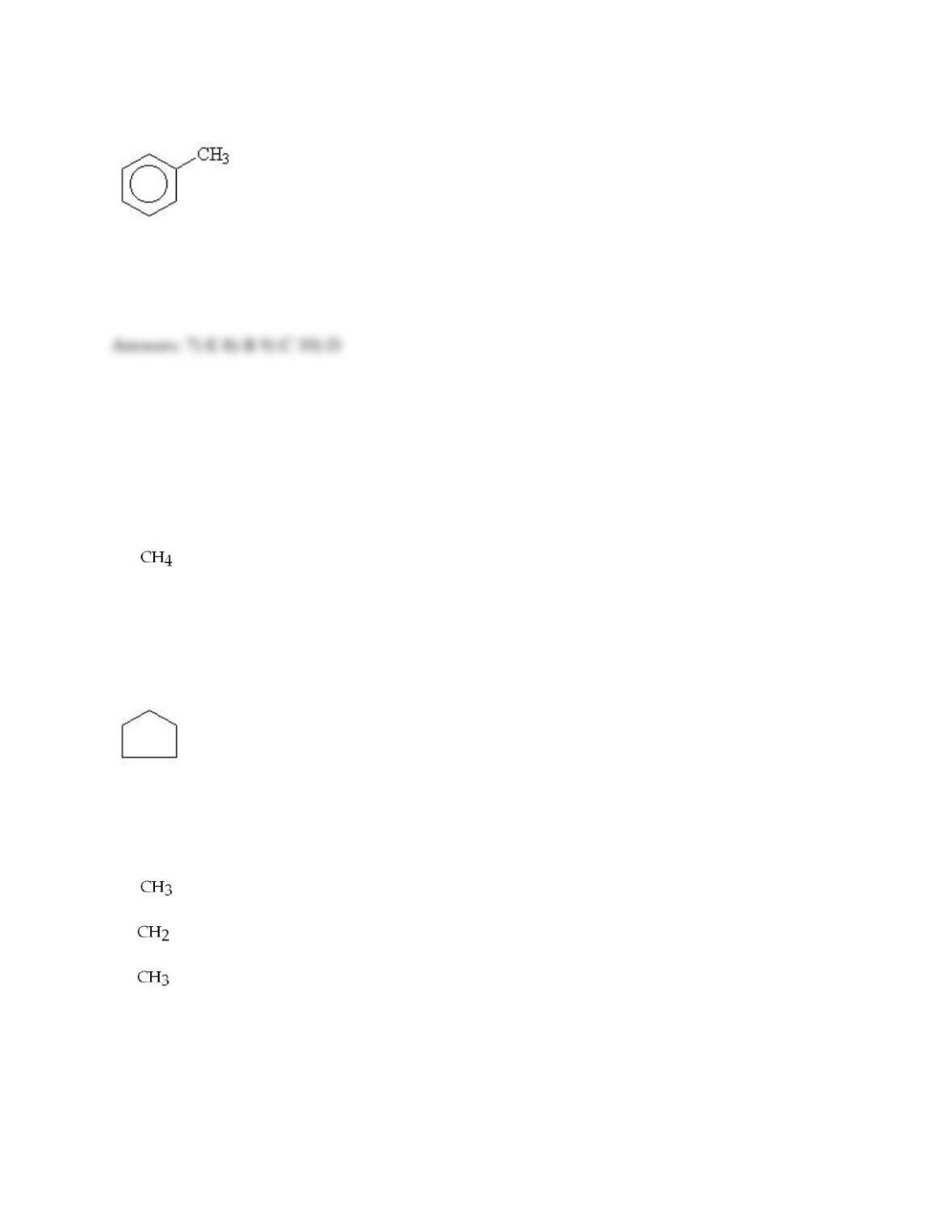
Choose the type of compound from Column 2 that best matches each item in Column 1.
A) cycloalkene
B) cycloalkane
C) alkene
D) alkane
E) alkyne
11)
Page Ref: 11.2
Learning Obj.: 11.2
Global Outcomes: G7 Demonstrate the ability to make connections between concepts across
chemistry.
12)
Page Ref: 11.2
Learning Obj.: 11.2
Global Outcomes: G7 Demonstrate the ability to make connections between concepts across
chemistry.
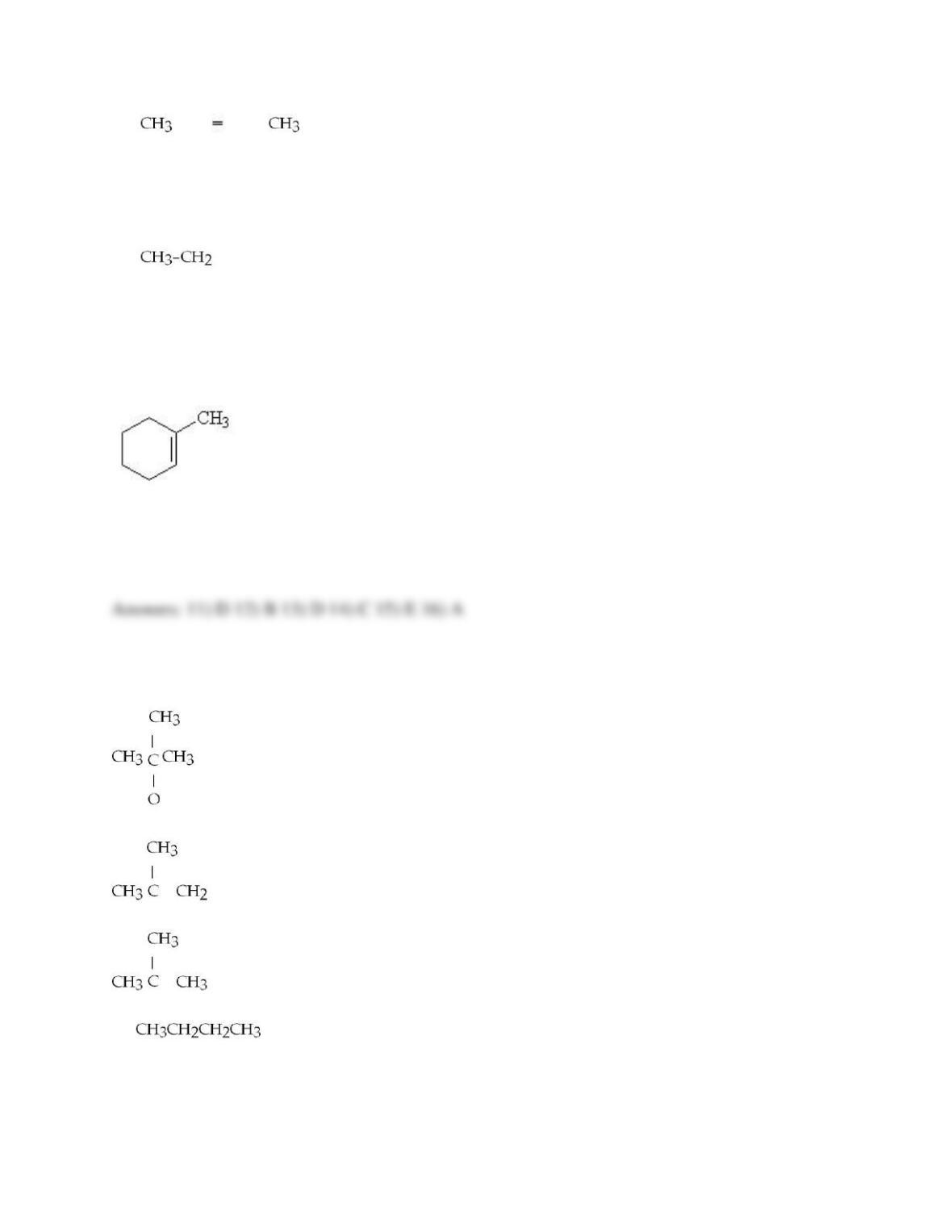
13)
∣
∣
Page Ref: 11.2
Learning Obj.: 11.2
Global Outcomes: G7 Demonstrate the ability to make connections between concepts across
chemistry.
41
14) –CH CH–
Page Ref: 11.5
Learning Obj.: 11.5
Global Outcomes: G7 Demonstrate the ability to make connections between concepts across
chemistry.
15) –C ≡ CH
Page Ref: 11.5
Learning Obj.: 11.5
Global Outcomes: G7 Demonstrate the ability to make connections between concepts across
chemistry.
16)
Page Ref: 11.5
Learning Obj.: 11.5
Global Outcomes: G7 Demonstrate the ability to make connections between concepts across
chemistry.
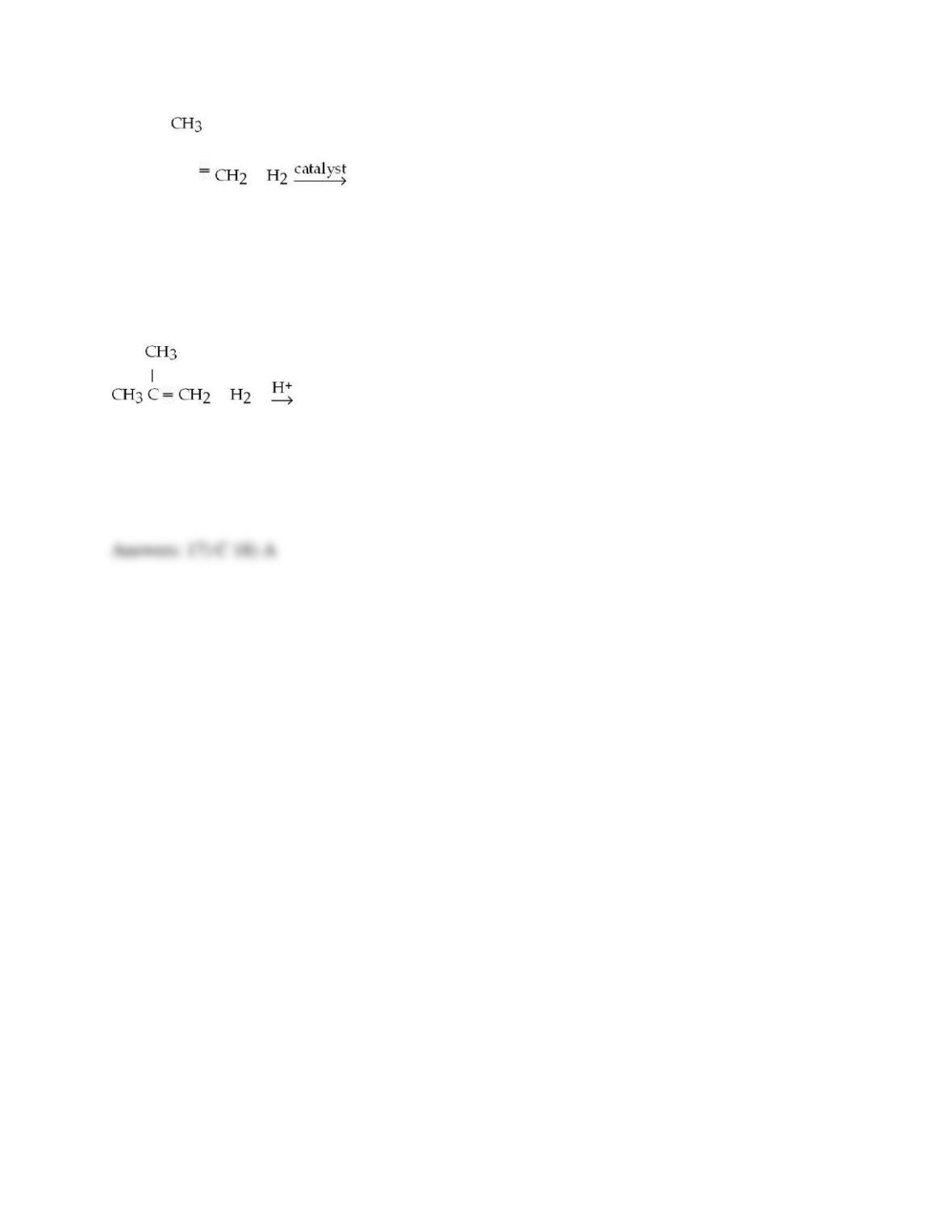
Match each of the following reactions with its product. Assume any necessary catalysts are
present.
A)
H
B)
HOH
C)
H
D)
42
17)
∣
CH3C +
Page Ref: 11.7
Learning Obj.: 11.7
Global Outcomes: G7 Demonstrate the ability to make connections between concepts across
chemistry.
18)
+ O
Page Ref: 11.7
Learning Obj.: 11.7
Global Outcomes: G7 Demonstrate the ability to make connections between concepts across
chemistry.