
Exam
Name___________________________________
MULTIPLE CHOICE. Choose the one alternative that best completes the statement or answers the question.
1)
Which portions of a slope overlap substantially?
1)
A)
Waxing slope and waning slope
B)
Debris slope and waning slope
C)
Waxing slope and free face
D)
Free face and debris slope
2)
Hydrolysis, hydration, oxidation, and carbonation are all examples of ________ weathering
processes.
2)
A)
chemical
B)
physical
C)
biological
D)
physical and biological
3)
Continuing dissolution and collapse may lead the the coalescing of sinkholes to form a
3)
A)
karst valley.
B)
disappearing stream.
C)
rise.
D)
doline.
4)
Many of the Native American dwellings at Mesa Verde and elsewhere in the western United States
are located under overhangs that form along the contact between permeable and impermeable rock
layers. These overhangs (niches) were primarily created by what process?
4)
A)
Carbonic acid solution
B)
Hydrolysis
C)
Salt–crystal growth
D)
Frost wedging
E)
Exfoliation
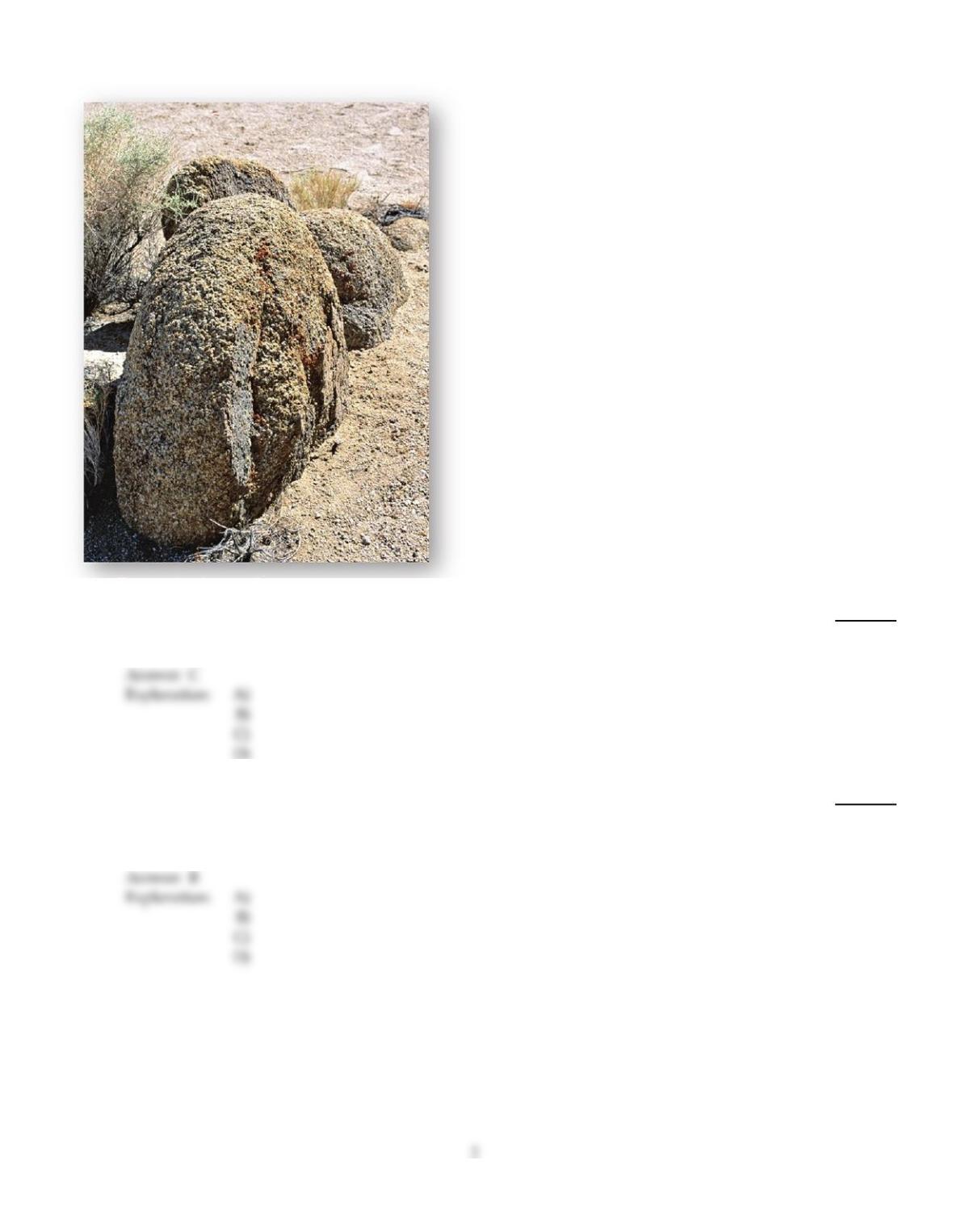
5)
These rounded granite outcrops are the result of which weathering process?
5)
A)
Hydration
B)
Oxidation
C)
Spheroidal weathering
D)
Carbonation
6)
A slope is ________ if its strength exceed denudation processes and ________ if its materials are
weaker than denudation processes.
6)
A)
in equilibrium; in disequilibrium
B)
stable; unstable
C)
in disequilibrium; in equilibrium
D)
unstable; stable

7)
Exfoliation occurs because
7)
A)
evaporated water leaves behind previously dissolved mineral to form crystals, which
accumulate and grow over time, exerting pressure on the rock.
B)
water combines with minerals and increases their size, thereby causing surrounding minerals
to expand.
C)
water freezes in joints and expands.
D)
overlying rock is removed, thereby allowing the underlying rock mass to expand and
fracture.
8)
Which of the following can lead to the slope failure that causes mass movement?
8)
A)
Volcanic eruptions
B)
Oversteepening of the slope
C)
Saturation from rainfall
D)
Earthquakes
E)
Saturation, oversteepening of slopes, earthquakes, and volcanic eruptions
E
Explanation:
9)
________ may form at the bottom of cockpits and may even be an important cause of cockpit karst
topography.
9)
A)
Sinkholes
B)
River floodplains
C)
Stalactites
D)
Grabens
A
Explanation:
10)
Which of the following is CORRECT regarding joints?
10)
A)
Joints are small, localized fault planes along which movement occurs.
B)
Joints are fractures in rock that occur without displacement on either side.
C)
Joints decrease the amount of exposed surface area of rocks.
D)
Joint impede both physical and chemical weathering.
B
Explanation:
D
Explanation:

11)
Plants are important to the development of karst primarily because
11)
A)
the decay of large roots below the surface produces cavities which eventually enlarge to form
caves.
B)
openings adjacent to their roots serve as microchannels that allow water to enter the rock.
C)
they supply organic acids that enhance the dissolution process.
D)
None of the aboveplants play no role in the development of karst.
12)
Inclined surfaces forming the sides of hills and mountains are known as
12)
A)
catchments.
B)
free faces.
C)
slopes.
D)
regoliths.
13)
In the spring of 1925 in Jackson Hole, WY, about 37 million m3 of moisture–laden soil and rock
moved down one side of the canyon and surge up the other side. This is an example of a(n)
13)
A)
rockfall.
B)
rotational slide.
C)
earthflow.
D)
slump.
14)
A slow persistent mass movement of surface soil is called
14)
A)
a soil slide.
B)
a debris avalanche.
C)
a rockfall.
D)
soil creep.
15)
A translational slide involves
15)
A)
mudflow.
B)
rotational movement of surface material.
C)
movement of surface material along a planar surface.
D)
unconsolidated flow of material.

16)
The science that specifically studies the origin, evolution, form, and spatial distribution of
landforms is
16)
A)
environmental chemistry.
B)
geography.
C)
geomorphology.
D)
geology.
17)
Salt–crystal growth (salt weathering) is an example of ________ weathering processes.
17)
A)
both biological and physical
B)
biological
C)
chemical
D)
physical
18)
Other than the rock itself, the most important chemical substance needed for the majority of
weathering processes is
18)
A)
nitrogen.
B)
carbon dioxide.
C)
oxygen.
D)
water.
19)
Weathering that softens and rounds the sharp edges and corners of jointed rock is known as
19)
A)
hydration.
B)
hydrolysis.
C)
exfoliation.
D)
spheroidal weathering.
20)
Frost wedging is an example of ________ weathering processes.
20)
A)
biological
B)
chemical
C)
both biological and chemical
D)
physical
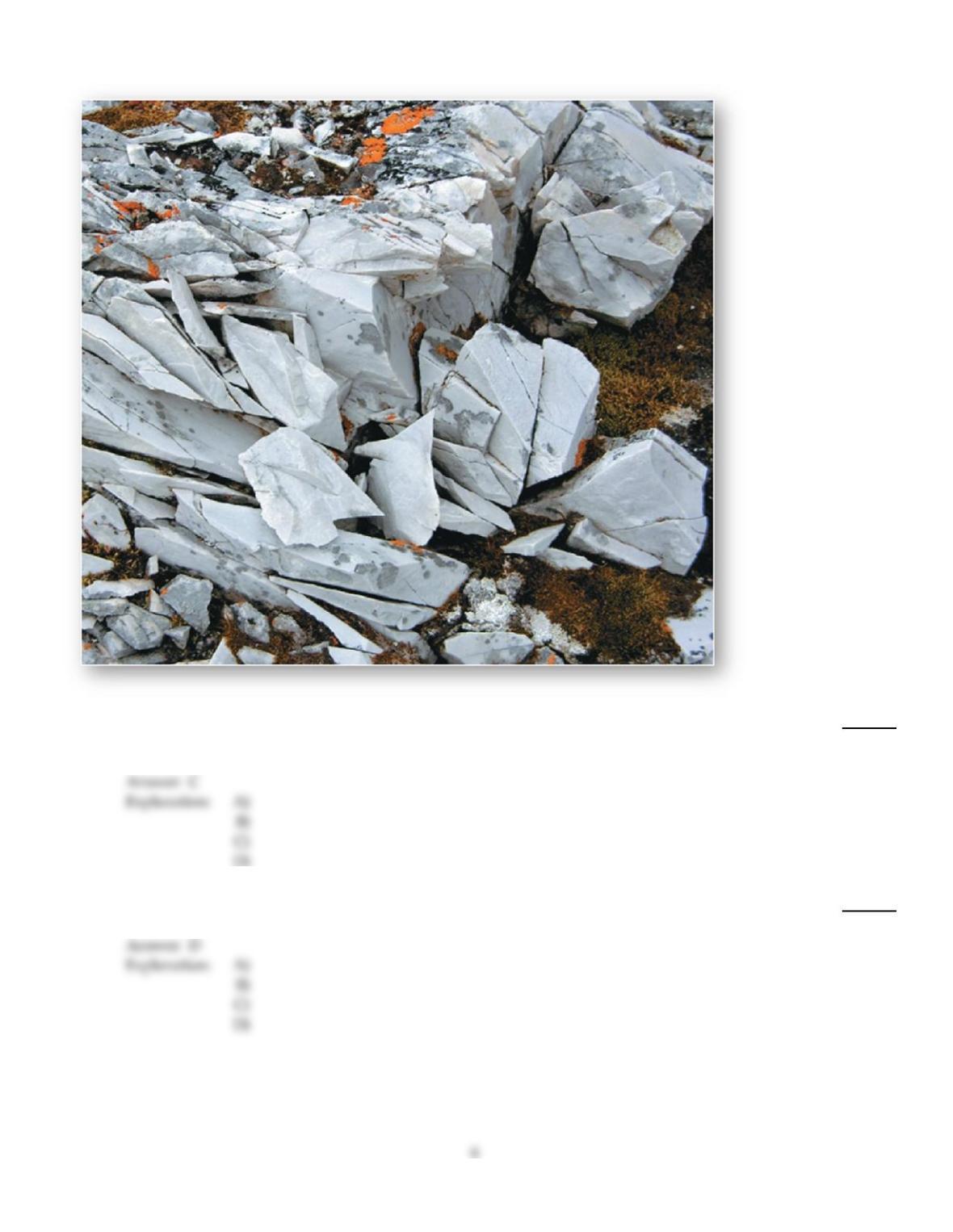
21)
The weathering process responsible for breaking this marble is likely
21)
A)
exfoliation.
B)
salt–crystal growth.
C)
frost wedging.
D)
carbonation.
22)
The weathering of limestone can create circular depressions known as
22)
A)
stalactites.
B)
caverns.
C)
uvalas.
D)
sinkholes.

23)
Chemical weathering is greatest under conditions of
23)
A)
lower rainfall, but higher temperatures.
B)
higher rainfall, but lower temperatures.
C)
lower rainfall and temperatures.
D)
higher rainfall and temperatures.
24)
A sinkhole that develops over a period of hours or days and forms from a collapse through the roof
of an underground cavern is known as a
24)
A)
karst valley.
B)
collapse sinkhole.
C)
solution sinkhole.
D)
doline.
25)
The concave lower portion of a typical slope is called a
25)
A)
debris slope.
B)
free face.
C)
pediment.
D)
waning slope.
26)
Extensive landscapes formed by the dissolution of limestone and other carbonate rock and
characterized by pitted, bumpy surface topography, poor surface drainage, and well developed
solutions channels are known as
26)
A)
basins.
B)
high tablelands.
C)
karst topography.
D)
plains.
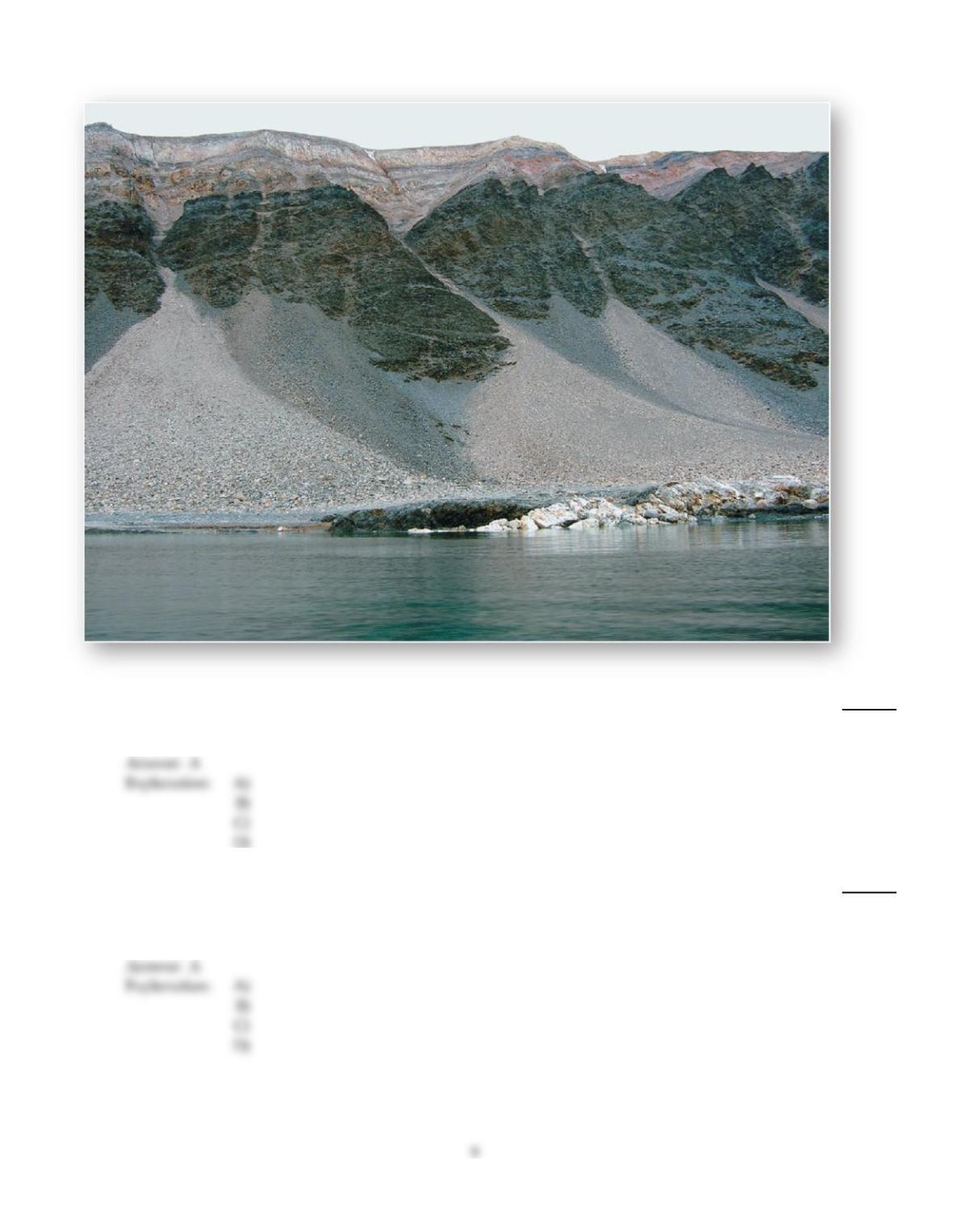
27)
The talus cones in this photograph are the result of
27)
A)
mudflows.
B)
planar slides.
C)
creep.
D)
rockfall.
E)
slumps.

28)
The maximum angle at which soil, sediment, and rock will remain on a slope without moving
downslope is the
28)
A)
height of the slope.
B)
angle of repose.
C)
the speed of the particles.
D)
mass movement gradient.
29)
The sudden rapid movement of an unsaturated cohesive mass of regolith or bedrock is a
29)
A)
mudflow.
B)
rockfall.
C)
landslide.
D)
debris avalanche.
30)
The uplift of mountains is caused by
30)
A)
endogenic processes.
B)
exogenic forces.
C)
aggradation.
D)
denudation.
31)
All processes that cause reduction and rearrangement of landforms are included in the term
31)
A)
weathering.
B)
erosion.
C)
mass movement.
D)
denudation.
32)
Factors influencing the weathering process include
32)
A)
rock composition and structure
B)
the amount of vegetation in an area.
C)
the climate of an area.
D)
rock composition and structure, climate, and vegetation.
E)
only the climate of an area and rock composition.
33)
The photograph is an example of a
33)
A)
talus slope.
B)
debris avalanche.
C)
landslide.
D)
mudflow.
34)
The principle that landscape formation is balance between endogenic and exogenic processes is
called
34)
A)
the dynamic equilibrium model.
B)
catastrophism.
C)
steady state theory.
D)
uniformitarianism.

35)
Karst topography is formed primarily by
35)
A)
mass wasting processes.
B)
oxidation and hydrolysis.
C)
carbonation and solution.
D)
exfoliation and hydration.
36)
The downslope movement of a body of material made up of soil, sediment, or rock propelled by
the force of gravity is known as
36)
A)
slide.
B)
lahar.
C)
downslope flow.
D)
mass movement.
D
37)
________ is a steep scarp or cliff whose presence indicates an outcrop of resistant rock.
37)
A)
Debris slope
B)
Waxing slope
C)
Free face
D)
Waning slope
C
38)
When rainwater attacks formations of limestone, the minerals dissolve and wash away with the
mildly acid rainwater. This is an example of
38)
A)
carbonation.
B)
oxidation.
C)
crystallization.
D)
frost action.
A
39)
Hydrolysis involves
39)
A)
salt crystal growth from evaporation.
B)
the addition of water with little chemical change.
C)
the chemical reaction of water.
D)
frost action.
C
C

40)
The dynamic equilibrium model refers to
40)
A)
an important concept first stated by William Morris Davis.
B)
a sequential development of landforms.
C)
a balancing act between tectonic uplift and rates of denudation by weathering and erosion in
a given landscape.
D)
a theory involving the cyclic or evolutionary development of a landscape.
41)
Which of the following is NOT necessary for well–developed karst to develop?
41)
A)
Vegetation
B)
High proportion of calcium carbonate in the rock
C)
Arid conditions
D)
Joints in rock of otherwise low permeability
42)
In the Andes Mountains of South America, entire towns of thousands of people have been buried
suddenly when water and loose materials traveled downhill as a viscous fluid. This type of
catastrophic event is known as a
42)
A)
slump.
B)
rock fall.
C)
debris avalanche.
D)
slide.
E)
lahar.
43)
Rust, formed by the reaction of iron and oxygen in the presence of water, is an example of
43)
A)
hydration.
B)
frost wedging.
C)
oxidation.
D)
carbonation.

44)
The fact that water expands as much as 9% of its volume as it freezes is the basis of
44)
A)
salt crystal growth.
B)
frost wedging.
C)
exfoliation.
D)
oxidization.
45)
Any large cave formed by chemical processes is a
45)
A)
karst valley.
B)
collapse sinkhole.
C)
cavern.
D)
doline.
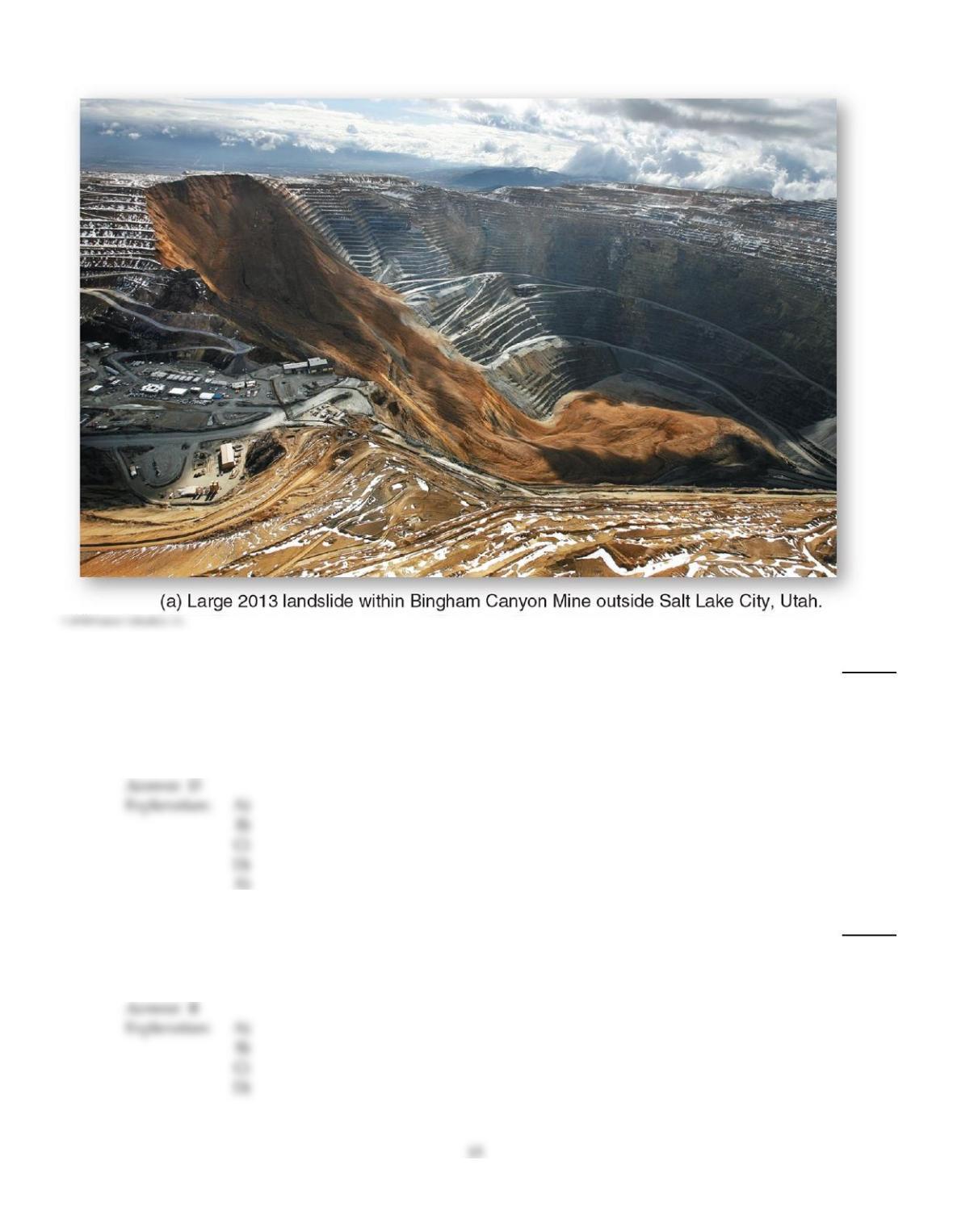
46)
The photograph shows an example of which mass movement process?
46)
A)
Debris flows
B)
Landslide
C)
Scarification
D)
Both scarification and landslide
E)
Both debris flow and landslide
47)
When the upper surface of consolidated rock undergoes constant weathering, it creates broken–up
rock called
47)
A)
bedrock.
B)
regolith.
C)
parent material.
D)
outcrop.
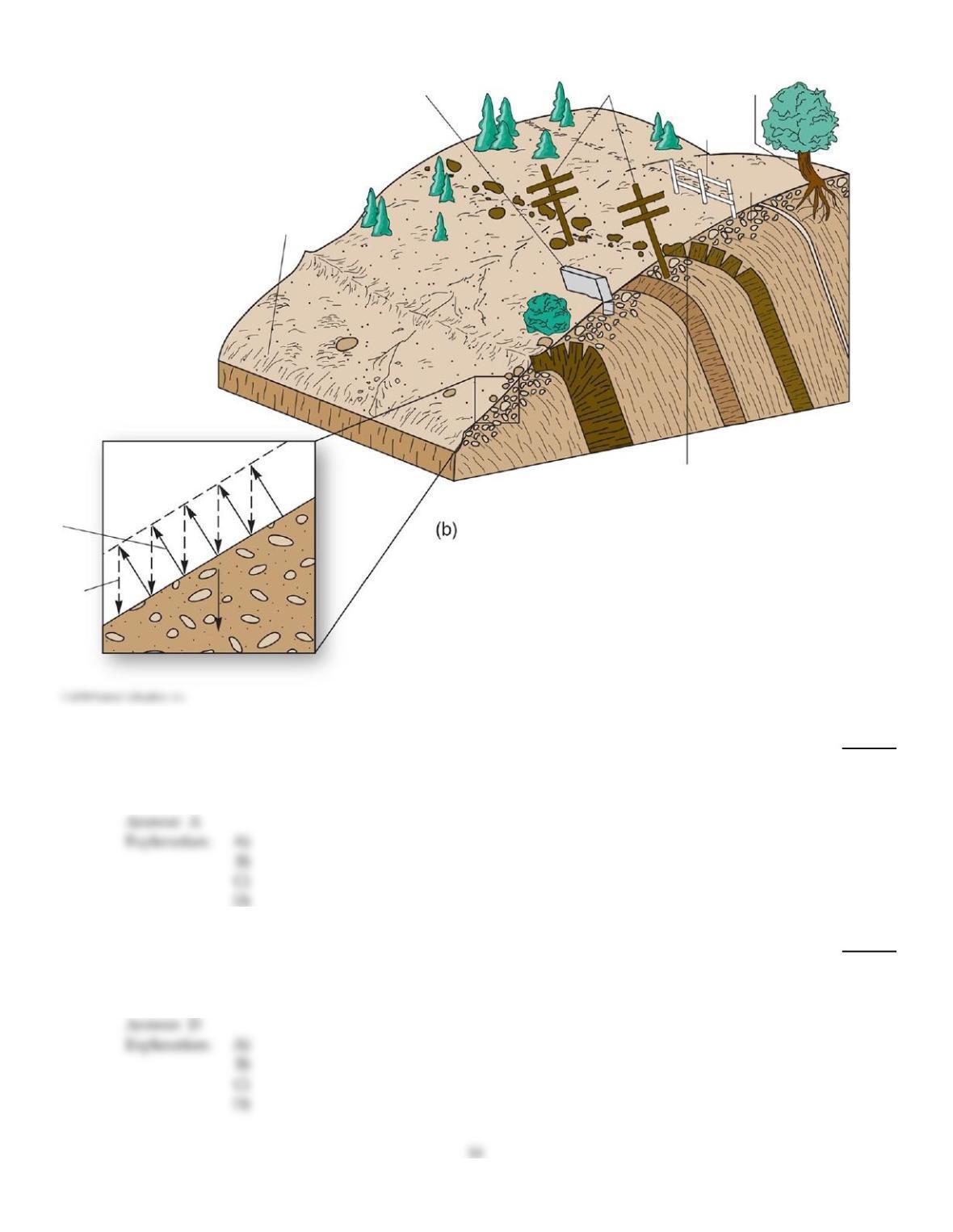
48)
The bent trees, leaning utility posts, and fences in this diagram indicate which type of mass
movement?
48)
A)
soil creep.
B)
landslide.
C)
rockfall.
D)
debris avalanche.
49)
When rock is broken down and disintegrated without any chemical alterations, the process in
operation is
49)
A)
chemical weathering.
B)
hydrolysis.
C)
carbonation.
D)
physical weathering.

50)
Because the climate of a region slowly changes and tectonic adjustments slowly occur, the
landscape
50)
A)
is continuously adjusting to new conditions that develop.
B)
is usually in a state of dynamic equilibrium.
C)
is continuously adjusting, and in a state of dynamic equilibrium, but not constantly at a
threshold.
D)
is constantly at a threshold, continuously adjusting, and in a state of dynamic equilibrium,.
E)
is constantly at a threshold condition.
51)
A watery mix of falling and tumbling rock, debris, and soil is a
51)
A)
debris avalanche.
B)
mudflow.
C)
landslide.
D)
rockfall.
52)
Which of the following are examples of dripstones?
52)
A)
Stalactites
B)
Disappearing streams
C)
Caverns
D)
Sink holes
53)
Which of the following is NOT a class of mass movement?
53)
A)
Creep
B)
Flow
C)
Slip
D)
Slide
E)
Fall
54)
Chemical weathering processes are particularly effective on limestone landscapes, forming
54)
A)
exfoliation domes and arch–like forms.
B)
pressure–release jointing.
C)
karst topography.
D)
hydrolysis plains.

55)
After a threshold is crossed, the landscape
55)
A)
remains unstable thereafter.
B)
returns to the conditions that existed prior to the crossing the threshold.
C)
adjusts to a new equilibrium condition.
D)
looks identical to the landscape that existed prior to the crossing of the threshold.
56)
The angle of repose represent a balance between the driving force and resisting force. Which of the
following is the driving force?
56)
A)
Inertia
B)
Friction
C)
Shear
D)
Gravity
57)
Which of the following human activities can contribute to mass movement?
57)
A)
Residential and commercial development
B)
Surface mining
C)
A roadcut
D)
Any human disturbance of a slope, including road cuts, surface mining, and residential and
commercial development.
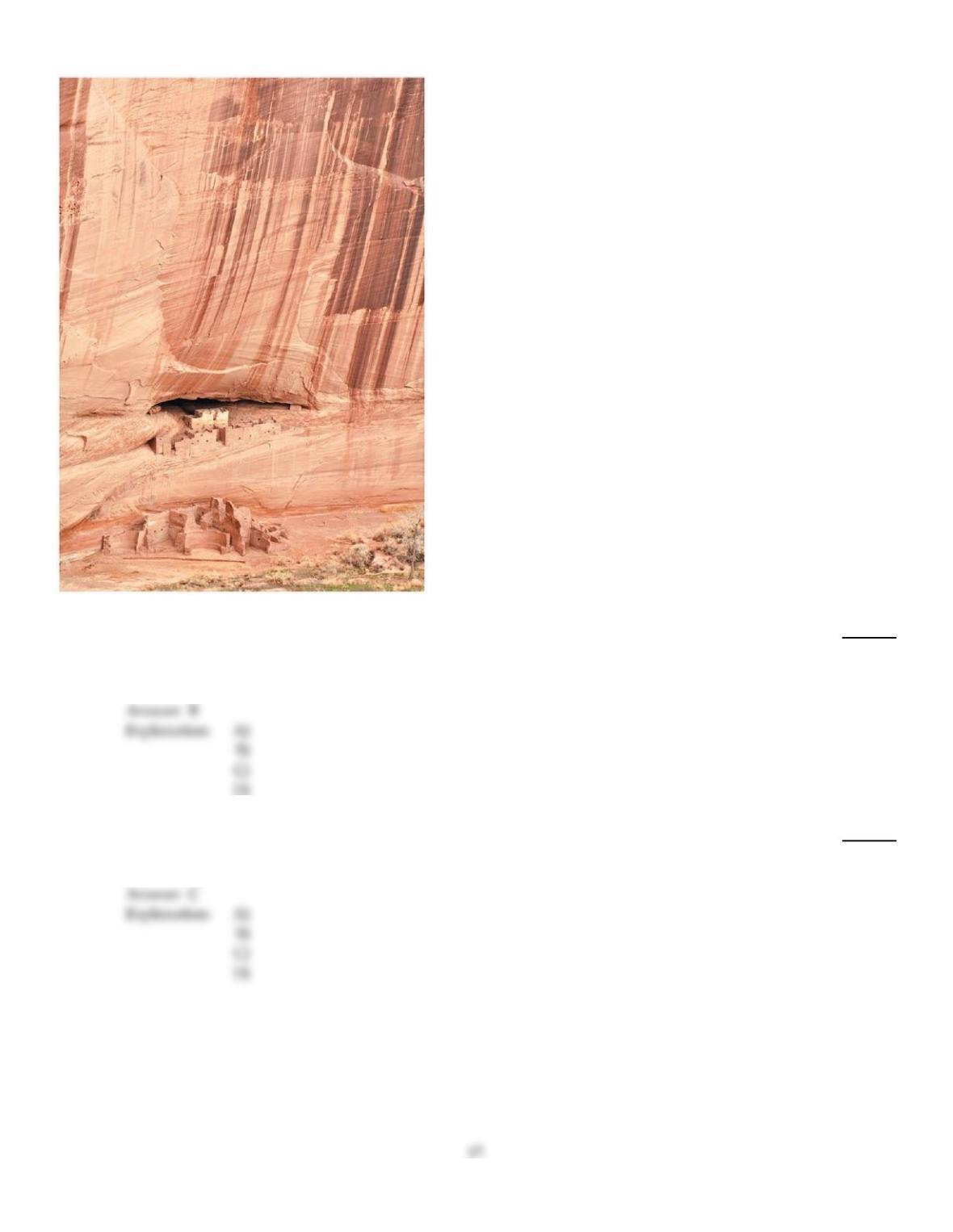
58)
A niche in sandstone, such as that in Arizona’s Canyon de Chelly, is indicative of which weathering
process?
58)
A)
Carbonation
B)
Salt–crystal growth
C)
Exfoliation
D)
Frost wedging
59)
The consolidated or unconsolidated materials from which soils develop is known as
59)
A)
bedrock.
B)
regolith.
C)
parent material.
D)
outcrop.

60)
Exfoliation and pressure–release jointing are examples of ________ weathering processes.
60)
A)
physical
B)
biological
C)
chemical
D)
both biological and physical
61)
Human–induced mass movements produce a category of processes known as
61)
A)
debris flows.
B)
scarification.
C)
translational slides.
D)
denudation.
62)
The convex upper portion of a typical slope is called a
62)
A)
free face.
B)
pediment.
C)
debris slope.
D)
waxing slope.
63)
The process that breaks down rock at Earth’s surface through disintegration of rocks into mineral
particles or dissolving it into water is known as
63)
A)
erosion.
B)
landmass denudation.
C)
mass movement.
D)
weathering.
64)
Hydration involves
64)
A)
the chemical reaction of water.
B)
salt crystal growth from evaporation.
C)
frost action.
D)
the addition of water with little chemical change.

65)
The scientific study of caves is known as
65)
A)
ciselure.
B)
soda straw.
C)
speleology.
D)
areology.
66)
Which of the following weathering processes does NOT involve water?
66)
A)
Crystallization
B)
Pressure–release jointing
C)
Carbonation
D)
Hydration
E)
Hydrolysis
B
67)
On a typical hillside, the consolidated rock overlain by loose surface material is known as
67)
A)
bedrock.
B)
regolith.
C)
parent material.
D)
outcrop.
A
68)
In polar and alpine regions, the thawing and saturation of the upper layer of soil results in a slow
downslope movement called
68)
A)
mudflow.
B)
solifluction lobe.
C)
lahar.
D)
transitional slide.
B
69)
Cones and cockpit karst develop in
69)
A)
arid regions.
B)
cold, midlatitude climates.
C)
wet tropical areas.
D)
polar regions.
C
C

70)
In most areas, the upper surface of bedrock is partially weathered to broken–up rock called
70)
A)
parent rock.
B)
regolith.
C)
sediment.
D)
bedrock.
71)
In which climates would rocks experience the highest amounts of chemical decomposition and
decay?
71)
A)
Hot and wet
B)
Cold and dry
C)
Hot and dry
D)
Cold and wet
72)
The yellow–red stains that occur on some rock surfaces are the result of ________ which is a form of
________ weathering.
72)
A)
oxidation; physical
B)
oxidation; chemical
C)
hydration; physical
D)
solution; chemical
E)
hydration; chemical
73)
Salt–crystal growth (salt weathering) is prevalent in which climate type?
73)
A)
Arid
B)
Mesothermal
C)
Tropical
D)
Polar
74)
Which of the following is NOT a type of physical weathering process?
74)
A)
Salt crystal growth
B)
Exfoliation
C)
Frost wedging
D)
Hydrolysis

75)
Which of the following is NOT exogenic in nature?
75)
A)
Weathering
B)
Mass wasting
C)
Denudation
D)
Tectonic uplift
E)
Erosion
76)
If material is to move downslope, it must overcome the force of
76)
A)
the cohesion of particles to each other.
B)
friction.
C)
inertial resistance of the material.
D)
friction, cohesion of particles, and inertial resistance.
77)
Which of the following are the principal active agents involved in chemical weathering?
77)
A)
Oxygen, silicon, aluminum
B)
Nitrogen, oxygen, argon
C)
Magnesium, water, limestone
D)
Water, oxygen, carbon dioxide
78)
Which of the following is NOT a denudation process?
78)
A)
Mass movement
B)
Orogeny
C)
Weathering
D)
Erosion
79)
When pressure is removed from overlying rock, the pressure of deep burial is relieved, initiating
pressure–release jointing. The joints then separate into curved slabs. This is known as
79)
A)
exfoliation.
B)
spheroidal weathering.
C)
salt crystal growth.
D)
frost wedging.

80)
When rock is broken down and disintegrated in the presence of water and with chemical
alterations to the rock, the process in operation is
80)
A)
hydrolysis.
B)
physical weathering.
C)
carbonation.
D)
chemical weathering.
TRUE/FALSE. Write ‘T’ if the statement is true and ‘F’ if the statement is false.
81)
Weathering refers specifically to the physical (mechanical) processes that break down rocks and
doesn’t include the chemical processes that breakdown rocks.
81)
82)
The driving force of mass movement is gravity.
82)
83)
A landslide requires substantial amounts of water to saturate a mass of materials.
83)
84)
A talus slope is indicative of soil creep.
84)
85)
Stalactites and stalagmites are examples of dripstones.
85)
86)
Solution sinkholes develop rapidly, typically over periods of hours or a few days.
86)
87)
Debris slopes tend to be steeper in arid climates than humid climates.
87)
88)
Vegetation is necessary for the development of karst topography.
88)
89)
Hydration does not result in the formation of new chemical compounds, whereas hydrolysis
produces a different mineral through a chemical reaction.
89)

90)
Physical weathering dominates in warm, wet climates.
90)
91)
Scarification is an example of anthropogenic mass movement.
91)
92)
The dynamic equilibrium model considers the balance between endogenic and exogenic processes.
92)
93)
Fence posts and utility poles leaning downslope is indicative of slump.
93)
94)
Salt crystal growth is most prevalent in humid regions.
94)
95)
In order for a limestone landscape to develop into karst topography, the limestone formation must
contain at least 30% of calcium carbonate.
95)
96)
Frost wedging is the result of repeated freeze/thaw cycles.
96)
97)
Landscapes in a dynamic equilibrium show ongoing adaptations to ongoing changes occurring in a
landscape.
97)
98)
The angle of repose typically ranges from 15° to 30° from horizontal.
98)
99)
A landscape in a state of dynamic equilibrium experiences no change.
99)
100)
Weathering is not influenced by vegetation.
100)
101)
The movement of unsaturated regolith and bedrock downslope is called earthflow.
101)

102)
Freeze/thaw cycles contribute to soil creep.
102)
103)
Landscapes return to equilibrium quickly after dramatic events, such as a major landslide.
103)
104)
Exfoliation is an example of a chemical weathering process.
104)
105)
When a landform system reaches a geomorphic threshold, it returns to the old system state.
105)
106)
Karst topography involves the chemical weathering of granite landscapes.
106)
107)
Chemical weathering always occurs in the presence of water.
107)
108)
Karst topography is an example of chemical weathering occurring over entire landscapes.
108)
109)
Physical and chemical weathering processes often operate in concert to decompose and dissolve
rock.
109)
110)
Major karst regions occur on every continent on Earth.
110)
111)
The angle of repose represents a balance between gravity, friction, and shear.
111)
112)
Physical weathering changes the chemical composition of the rock.
112)
ESSAY. Write your answer in the space provided or on a separate sheet of paper.
113)
Discuss the formation and characteristics of karst and examine the various types of karst topography and
associated landforms.
114)
List and describe anthropogenic mass movement.
115)
Briefly describe chemical weathering, providing examples of several chemical weathering processes.
116)
Describe the processes of denudation.
117)
As weathering mechanisms, how does hydration differ from hydrolysis?
118)
Describe the factors influencing the weathering process.
119)
Describe the forces acting on a slope and the various physical aspects of a slope, such as waxing slope and
debris slope.
120)
Discuss the dynamic equilibrium model and the concept of geomorphic threshold.
121)
Briefly describe physical weathering, providing examples of several physical weathering processes.
122)
In what ways can water be involved in physical and chemical weathering processes?
123)
List and describe the various classes of mass movement.

Answer Key
Testname: C11

Answer Key
Testname: C11
28
Answer Key
Testname: C11
29