
Fundamentals of Corporate Finance 3e Test Bank
57.
Windy Burgers is trying to determine when to harvest a herd of cows that it currently owns. If it
harvests the herd in year 1, the NPV of the project would increase over an immediate harvest by
25 percent. A year 2 harvest would create an NPV increase of 15 percent over that of year 1 and
year 3 would create an NPV increase of 7 percent over that of year 2. If the cost of capital is 12
percent for Windy, then which harvest year would maximize the NPV for the firm? Assume
that all NPVs are calculated from the perspective of today.
A)
Harvest immediately.
B)
Harvest in year 1.
C)
Harvest in year 2.
D)
Harvest in year 3.
Ans:
C
AICPA: Industry/Sector Perspective
58.
Stillwater Drinks is trying to determine when to harvest the water from the fountain of youth
that it currently owns. If it harvests the water in year 1, the NPV of the project would increase
over an immediate harvest by 18 percent. A year 2 harvest would create an NPV increase of 12
percent over that of year 1 and year 3 would create an NPV increase of 8 percent over that of
year 2. If the cost of capital is 17 percent for Stillwater, then which harvest year would
maximize the NPV for the firm? Assume that all NPVs are calculated from the perspective of
today.
A)
Harvest immediately.
B)
Harvest in year 1.
C)
Harvest in year 2.
D)
Harvest in year 3.
Ans:
B
Fundamentals of Corporate Finance 3e Test Bank
59.
The proper time to harvest an asset is when:
A)
the percentage NPV increase of harvesting a project at a future point in time is at the last
date where the increase is greater than the cost of capital.
B)
the percentage NPV increase of harvesting a project at a future point in time is at the first
date where the increase is less than the cost of capital.
C)
the percentage NPV increase of harvesting a project at a future point in time is at the first
date where the increase is greater than the cost of capital.
D)
None of the above.
Ans:
A
60.
Norman, Inc., is considering two mutually exclusive projects. Project A is a six-year project
with a NPV of $3,000 and Project B is a four-year project with an NPV of $2,278. Project A
has an equivalent annual cash flow of $730 and Project B has an equivalent annual cash flow of
$750. Which project should the firm select?
A)
Choose Project A because it has the higher NPV.
B)
Choose Project B because it has the lower NPV.
C)
Choose Project B because it has the higher equivalent annual cash flow.
D)
Choose Project A because it has the lower equivalent annual cash flow.
Ans:
C
Fundamentals of Corporate Finance 3e Test Bank
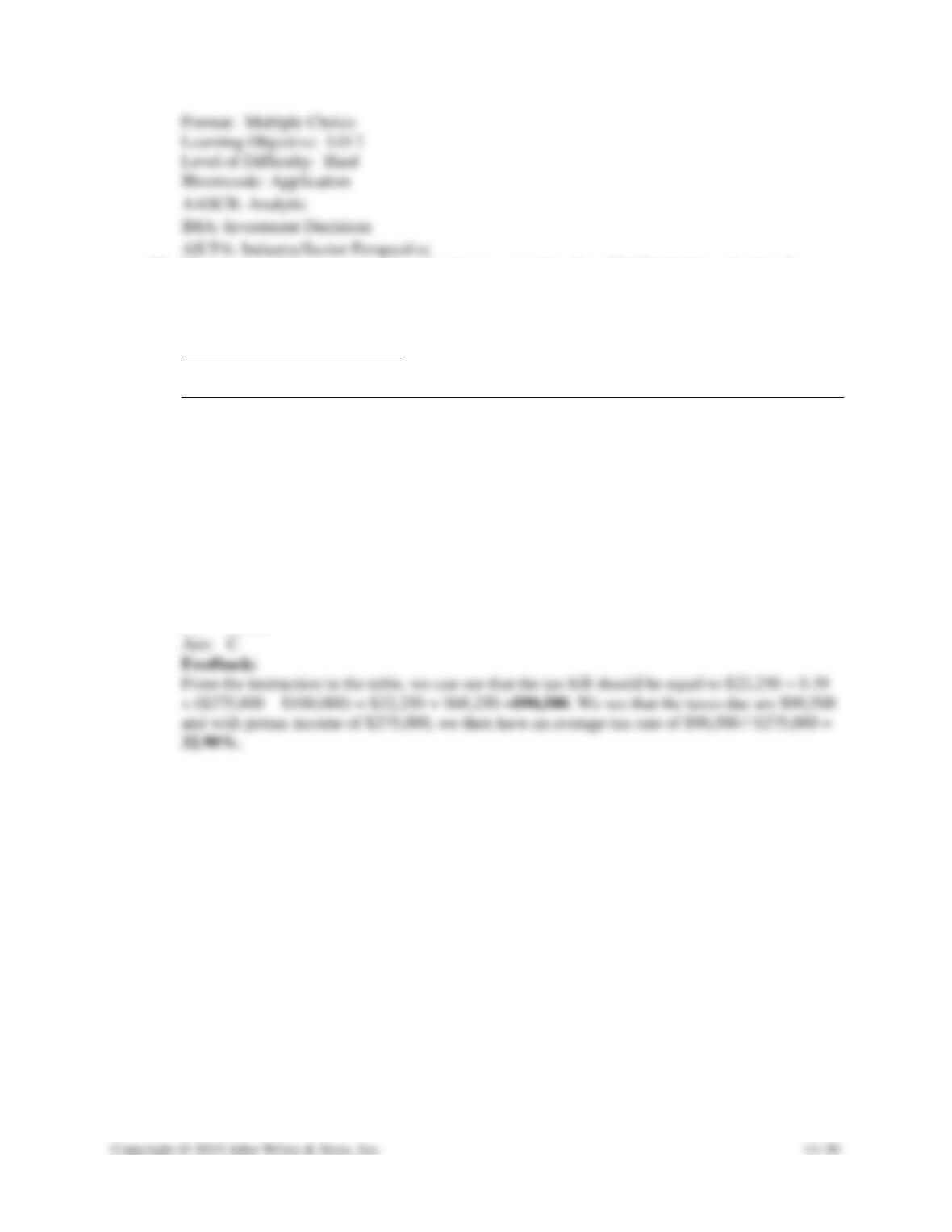
61.
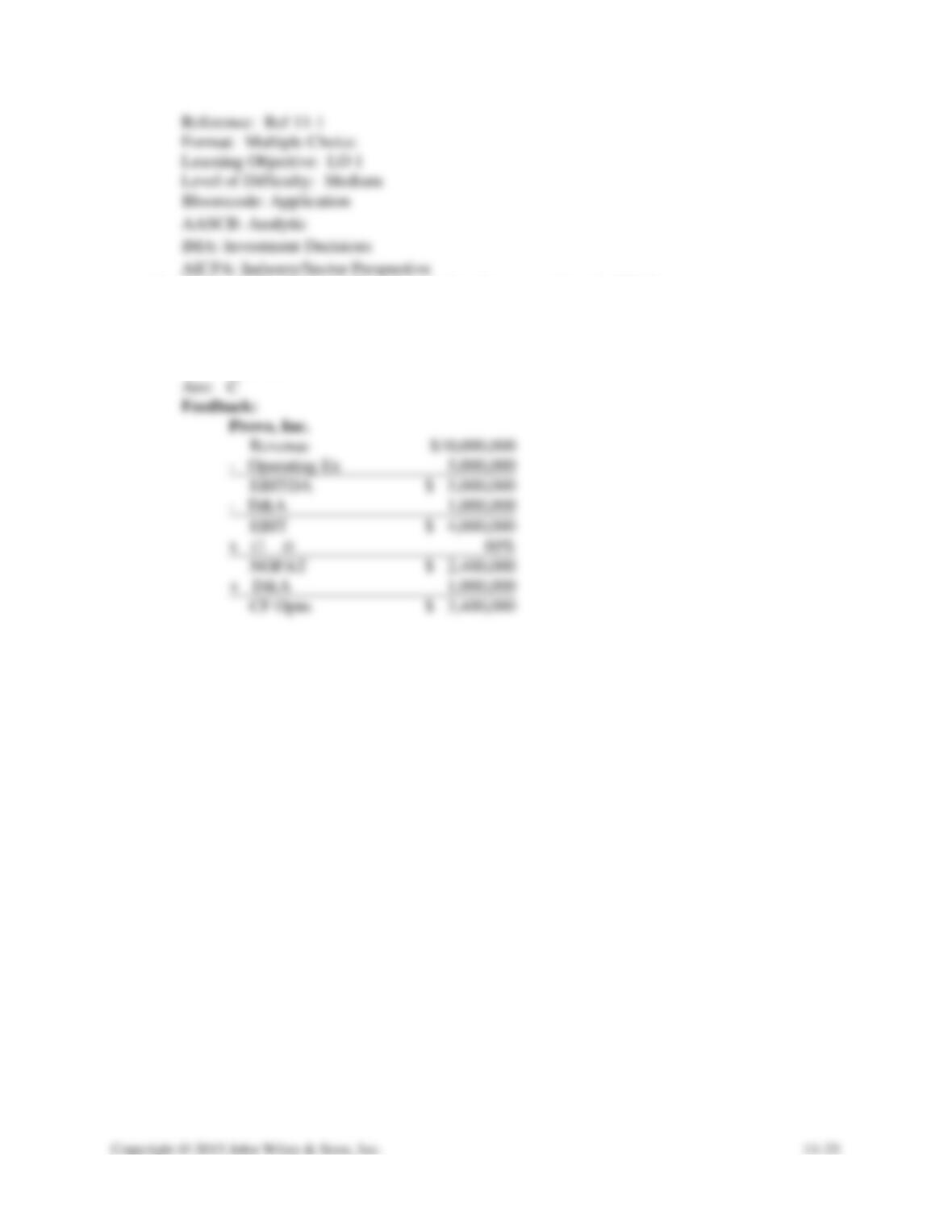
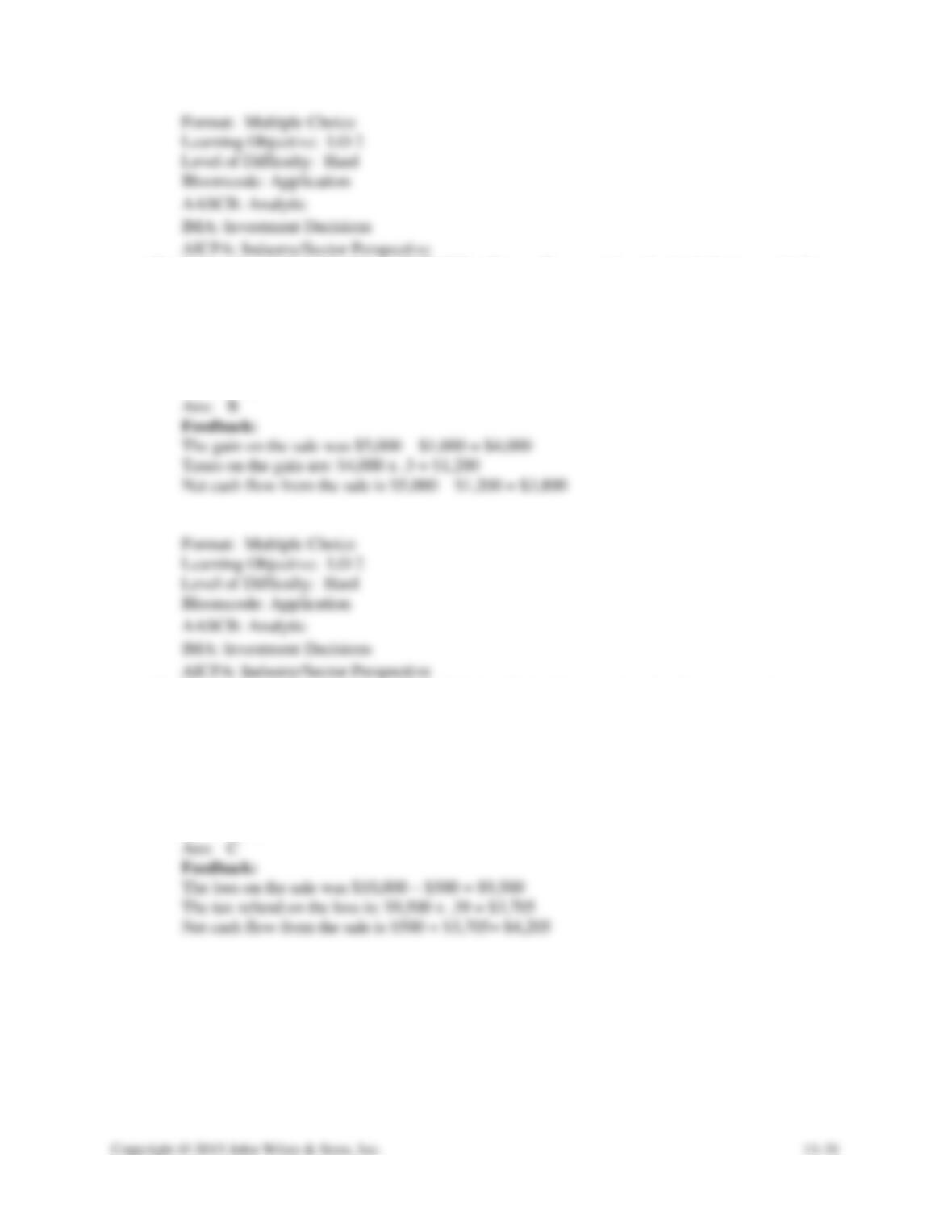
Free cash flow: What is Provo’s cash flow from operations for 2008?
A)
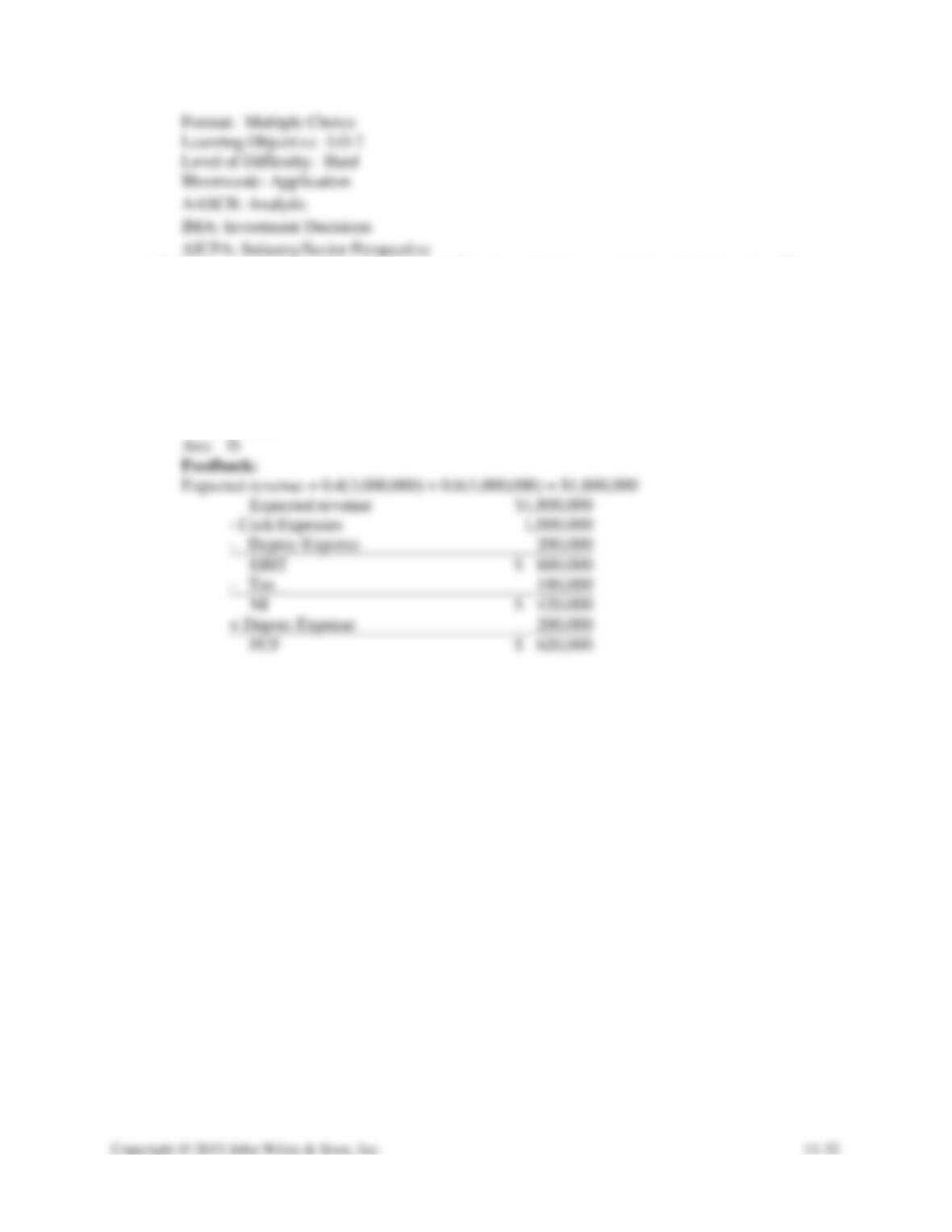
$2,400,000
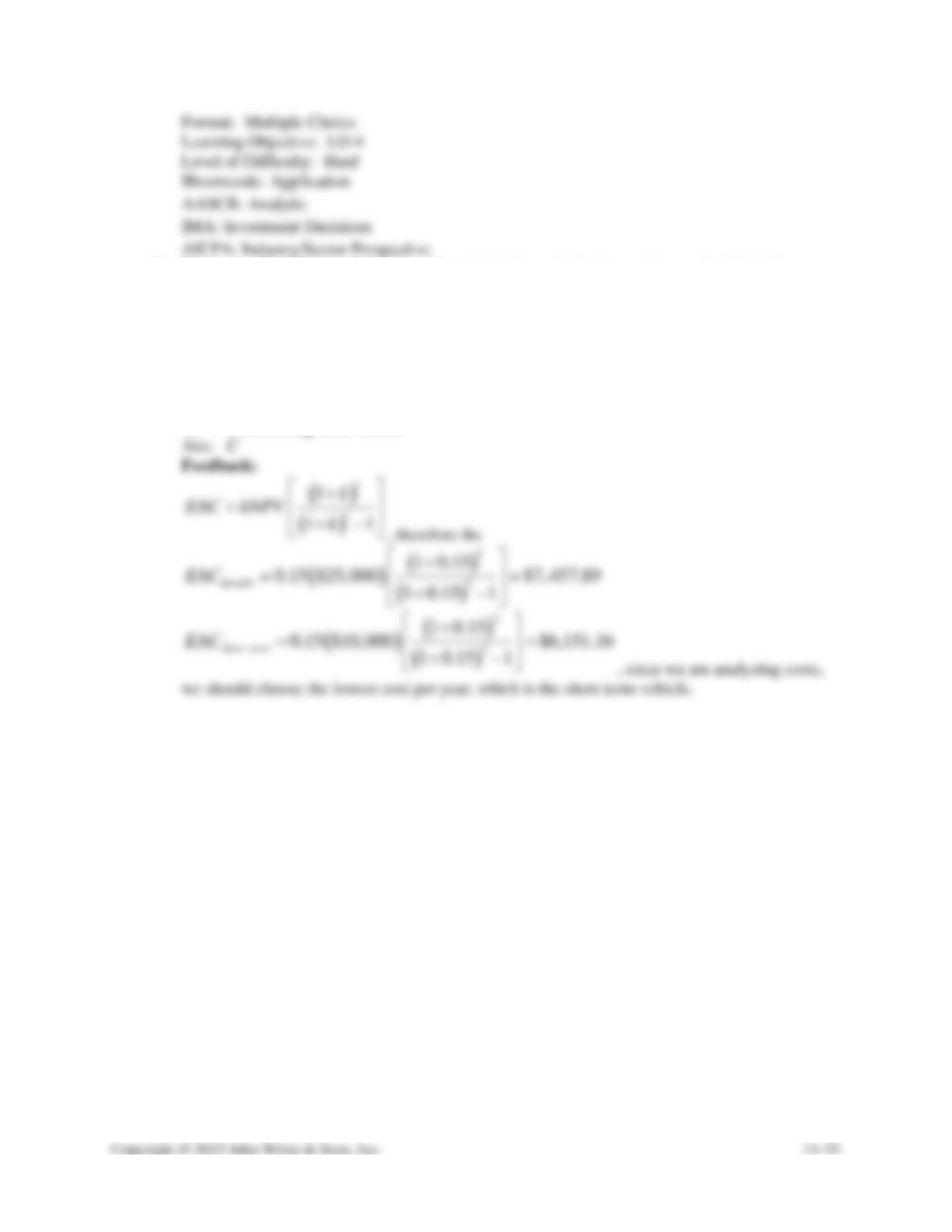
B)
$2,600,000
C)
$3,400,000
D)
$4,000,000
Ans:
C
Fundamentals of Corporate Finance 3e Test Bank
62.
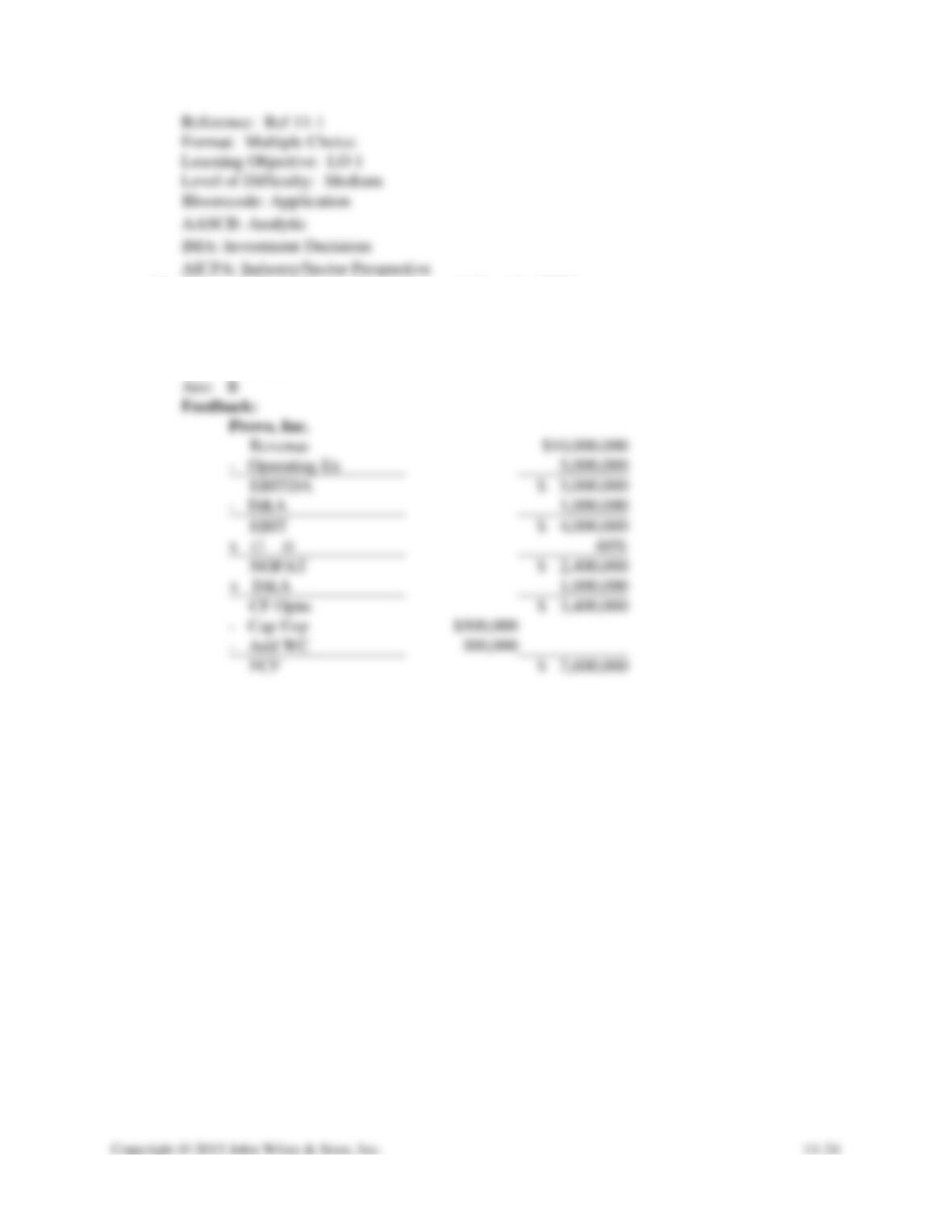
Free cash flow: What is Provo’s free cash flow for 2008?
A)
$2,400,000
B)
$2,600,000
C)
$3,400,000
D)
$4,000,000
Ans:
B
Fundamentals of Corporate Finance 3e Test Bank
63.
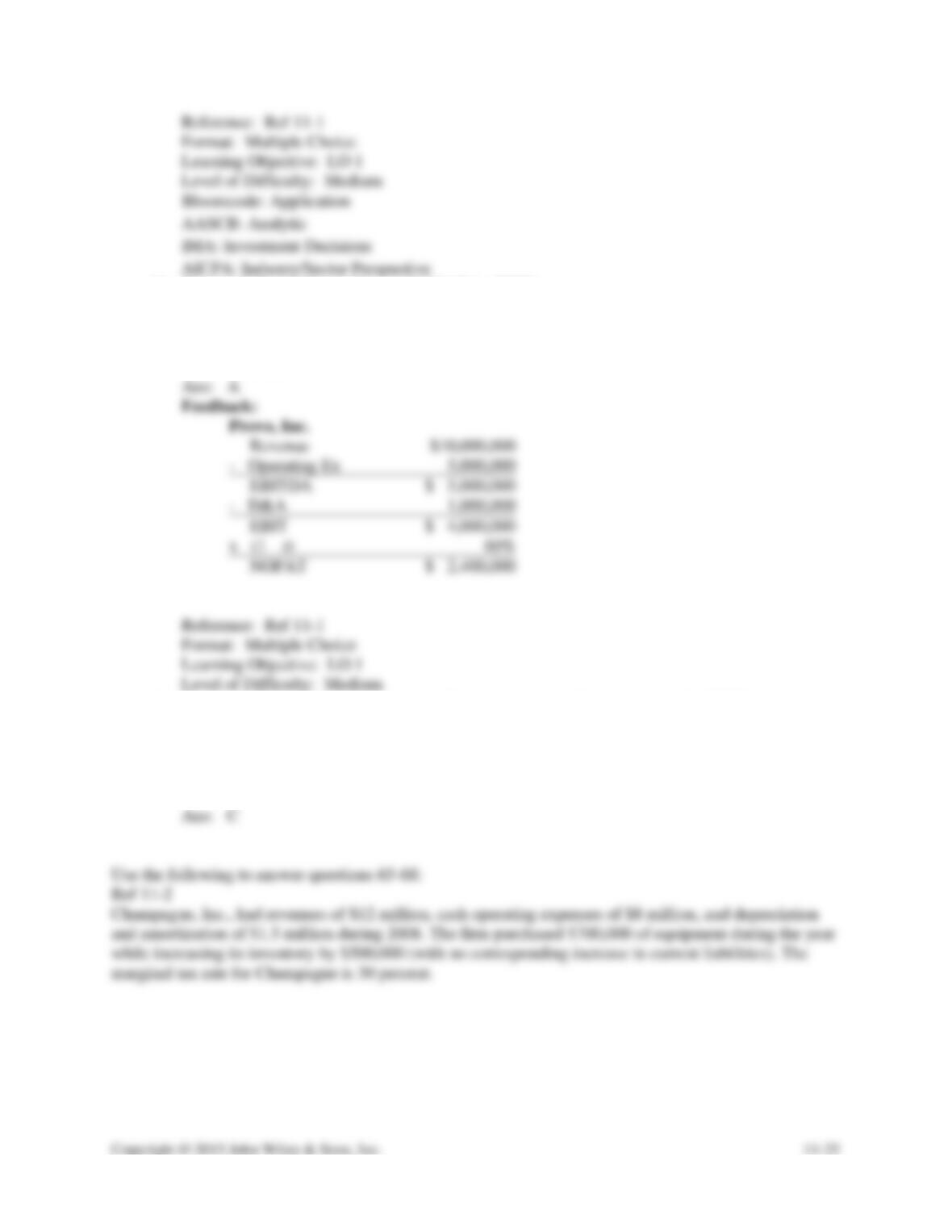
Free cash flow: What is Provo’s NOPAT for 2008?
A)
$2,400,000
B)
$2,600,000
C)
$3,400,000
D)
$4,000,000
Ans:
A
64.
Free cash flow: What is Provo’s cash flows associated with investments for 2008?
A)
$300,000
B)
$500,000
C)
$800,000
D)
None of the above.
Ans:
C
Fundamentals of Corporate Finance 3e Test Bank
65.
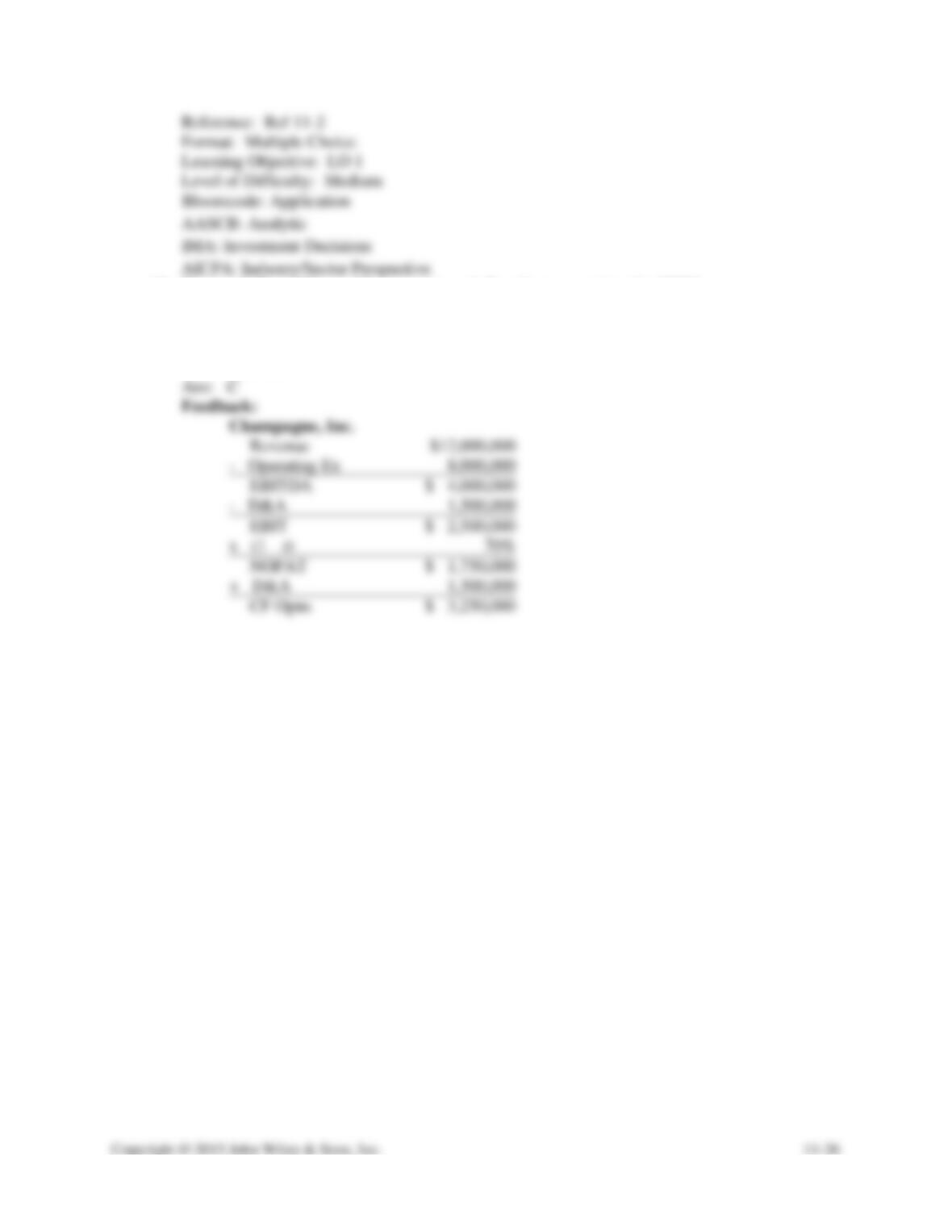
Free cash flow: What is Champagne’s cash flow from operations for 2008?
A)
$2,050,000
B)
$2,500,000
C)
$3,250,000
D)
$4,000,000
Ans:
C
Fundamentals of Corporate Finance 3e Test Bank
66.
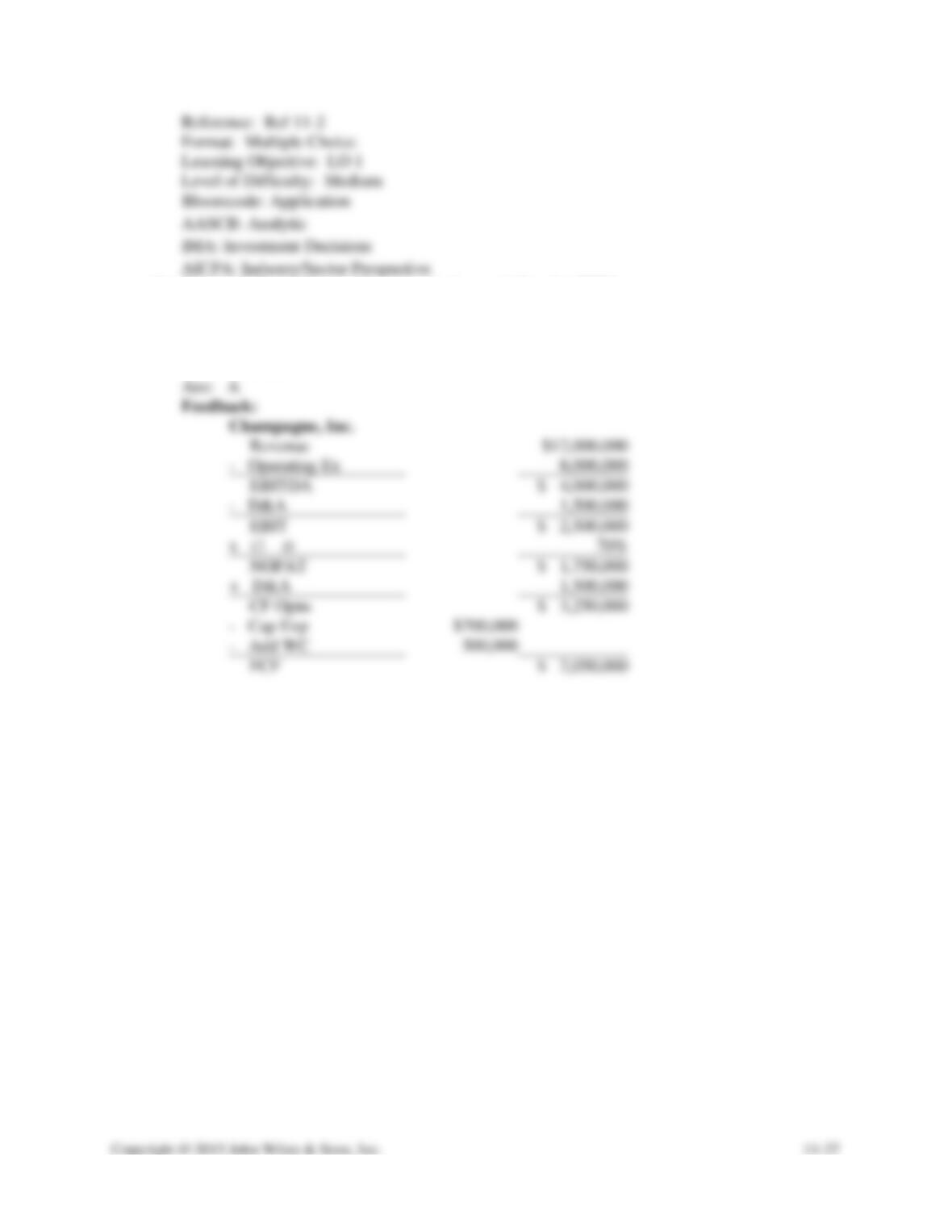
Free cash flow: What is Champagne’s free cash flow for 2008?
A)
$2,050,000
B)
$2,500,000
C)
$3,250,000
D)
$4,000,000
Ans:
A
Fundamentals of Corporate Finance 3e Test Bank
67.
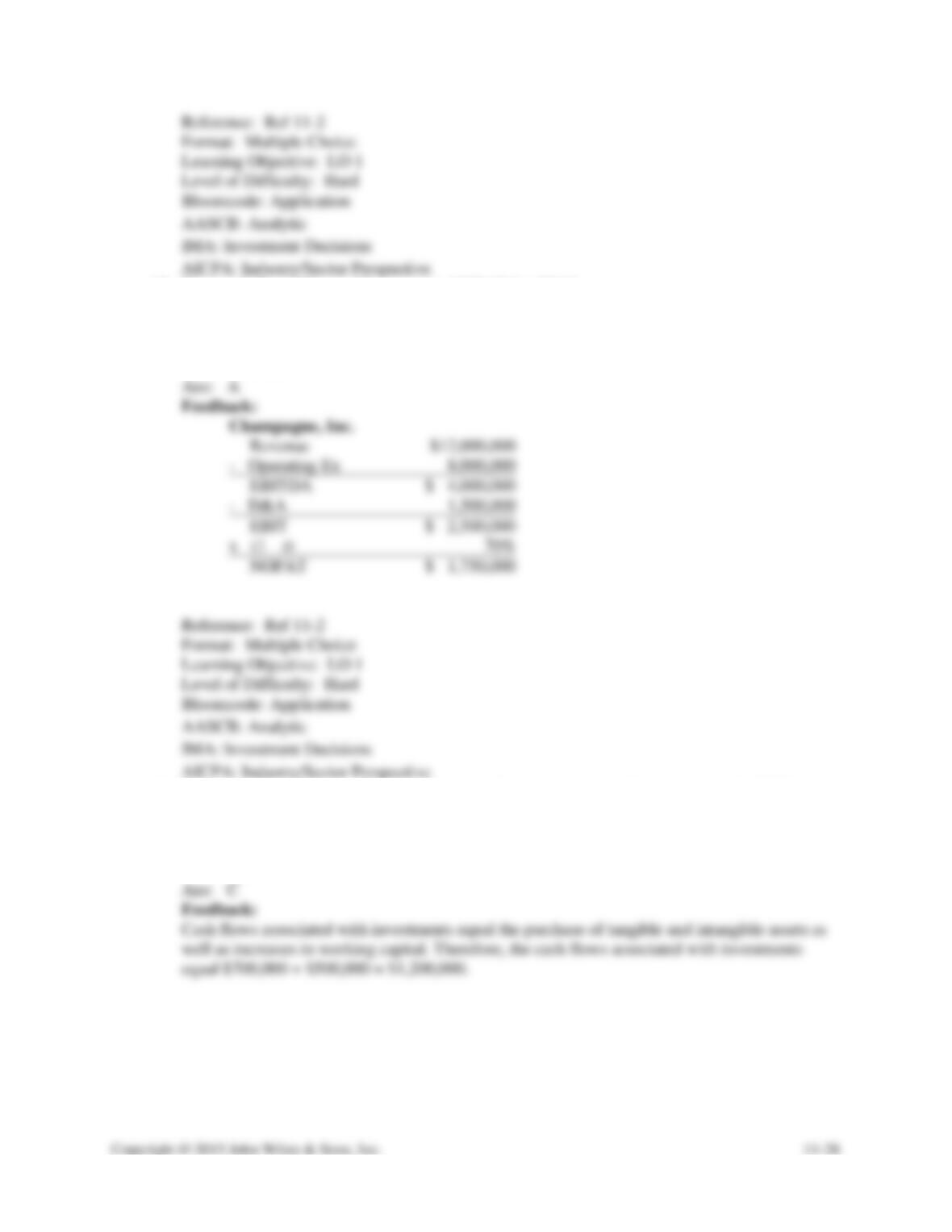
Free cash flow: What is Champagne’s NOPAT for 2008?
A)
$1,750,000
B)
$2,500,000
C)
$3,250,000
D)
$4,000,000
Ans:
A
68.
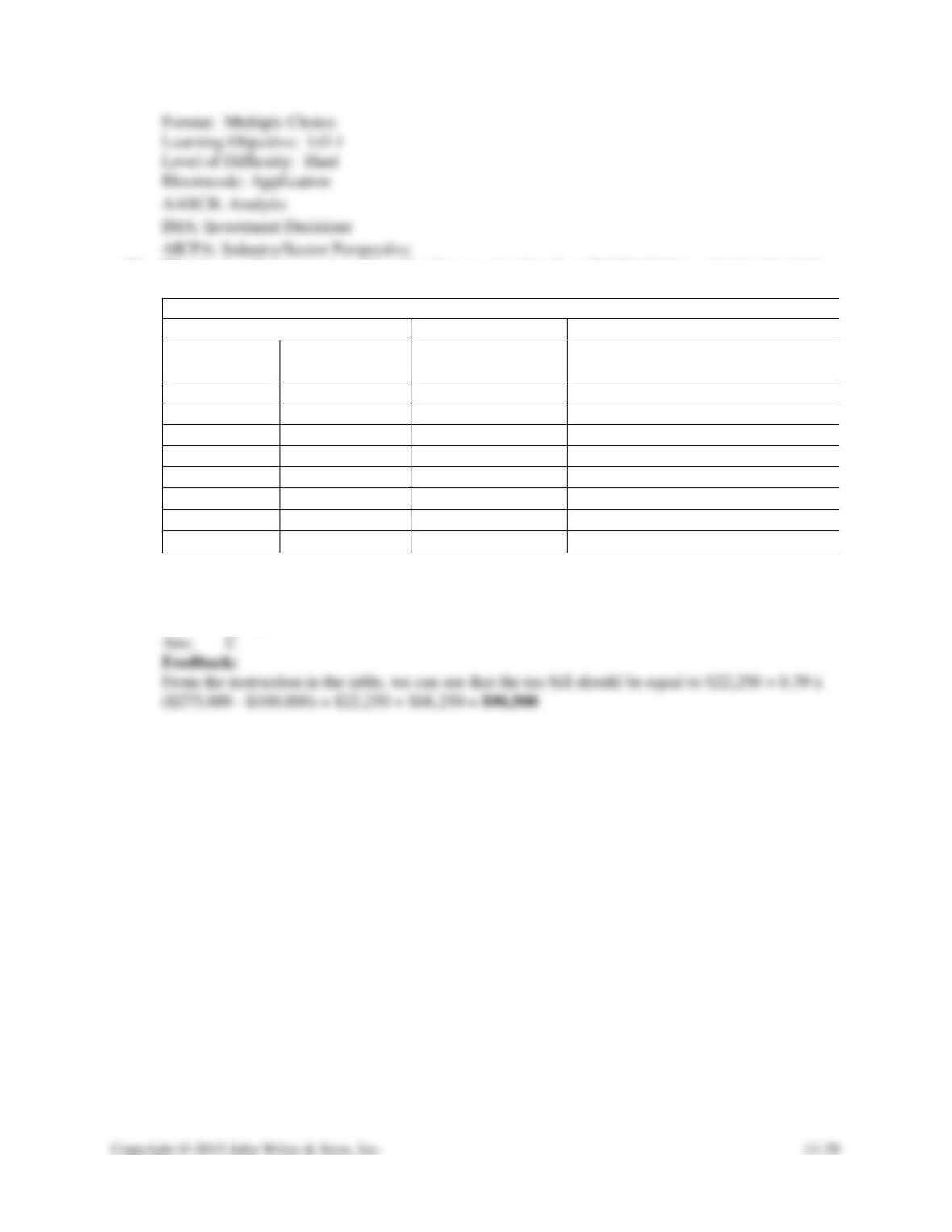
Free cash flow: What are Champagne’s cash flows associated with investments for 2008?
A)
$500,000
B)
$700,000
C)
$1,200,000
D)
None of the above.
Ans:
C
equal $700,000 + $500,000 = $1,200,000.
Fundamentals of Corporate Finance 3e Test Bank
69.
Marginal and average tax rates: Use the tax rate taken from Exhibit 11.6 to calculate the total
taxes paid for Lansing, Inc., this year. Lansing’s pretax income was $275,000.
Exhibit 11.6 U.S. Corporate Tax Rate Schedule in 2007
Taxable Income
More
Than
But Not More
Than
Tax Owed
$0
$50,000
15% of amount beyond $0
$50,000
$75,000
$7,500 +
25% of amount beyond $50,000
$75,000
$100,000
$13,750 +
34% of amount beyond $75,000
$100,000
$335,000
$22,250 +
39% of amount beyond $100,000
$335,000
$10,000,000
$113,900 +
34% of amount beyond $335,000
$10,000,000
$15,000,000
$3,400,000 +
35% of amount beyond $10,000,000
$15,000,000
$18,333,333
$5,150,000 +
38% of amount beyond $15,000,000
$18,333,333
——-
35% on all income
A)
$22,500
B)
$68,250
C)
$90,500
D)
$107,250
Fundamentals of Corporate Finance 3e Test Bank
70.
Marginal and average tax rates: Use the tax rate taken from Exhibit 11.6 to calculate the
average tax rate for Lansing, Inc., this year. Lansing’s pretax income was $275,000.
(Round final answer to nearest whole percent.)
Exhibit 11.6 U.S. Corporate Tax Rate Schedule in 2007
Taxable Income
More
Than
But Not More
Than
Tax Owed
$0
$50,000
15% of amount beyond $0
$50,000
$75,000
$7,500 +
25% of amount beyond $50,000
$75,000
$100,000
$13,750 +
34% of amount beyond $75,000
$100,000
$335,000
$22,250 +
39% of amount beyond $100,000
$335,000
$10,000,000
$113,900 +
34% of amount beyond $335,000
$10,000,000
$15,000,000
$3,400,000 +
35% of amount beyond $10,000,000
$15,000,000
$18,333,333
$5,150,000 +
38% of amount beyond $15,000,000
$18,333,333
——-
35% on all income
A)
8.0%
B)
25.0%
C)
32.9%
D)
39.0%
Fundamentals of Corporate Finance 3e Test Bank
71.
Computing the terminal-year FCF: Miles Cyprus Corp. purchased a truck that currently has a
book value of $1,000. If the firm sells the truck for $5,000 today, then what is the amount of
cash that it will net after taxes if the firm is subject to a 30 percent marginal tax rate?
A)
$1,200
B)
$3,800
C)
$4,000
D)
$5,000
Ans:
B
72.
Computing the terminal-year FCF: Babaloo Nightclubs, purchased a disco mirror that
currently has a book value of $10,000. If Babaloo sells the disco mirror for $500 today, then
what is the amount of cash that it will net after taxes if the firm is subject to a 39 percent
marginal tax rate?
A)
$500
B)
$3,705
C)
$4,205
D)
$9,500
Ans:
C
Net cash flow from the sale is $500 + $3,705= $4,205
Fundamentals of Corporate Finance 3e Test Bank
73.
Expected cash flows: FireRock Wheel Corp is evaluating a project in which there is a 40
percent probability of revenues totaling $3 million and a 60 percent probability of revenues
totaling $1 million per year. Its cash expenses will be $1.0 million while depreciation expense
will be $200,000; then what is the expected free cash flow from taking the project if the
marginal tax rate for the firm is 30 percent?
A)
$200,000
B)
$420,000
C)
$600,000
D)
$620,000
Ans:
D
Fundamentals of Corporate Finance 3e Test Bank
74.
Projects with different lives: Your firm is deciding whether to purchase a durable delivery
vehicle or a short-term vehicle. The durable vehicle costs $25,000 and should last five years.
The short-term vehicle costs $10,000 and should last two years. If the cost of capital for the
firm is 15 percent, then what is the equivalent annual cost for the best choice for the firm?
(Round final answer to nearest whole dollar.)
A)
$5,000, either vehicle
B)
$5,000, short-term vehicle
C)
$6,151, short-term vehicle
D)
$7,458, long-term vehicle
Ans:
C
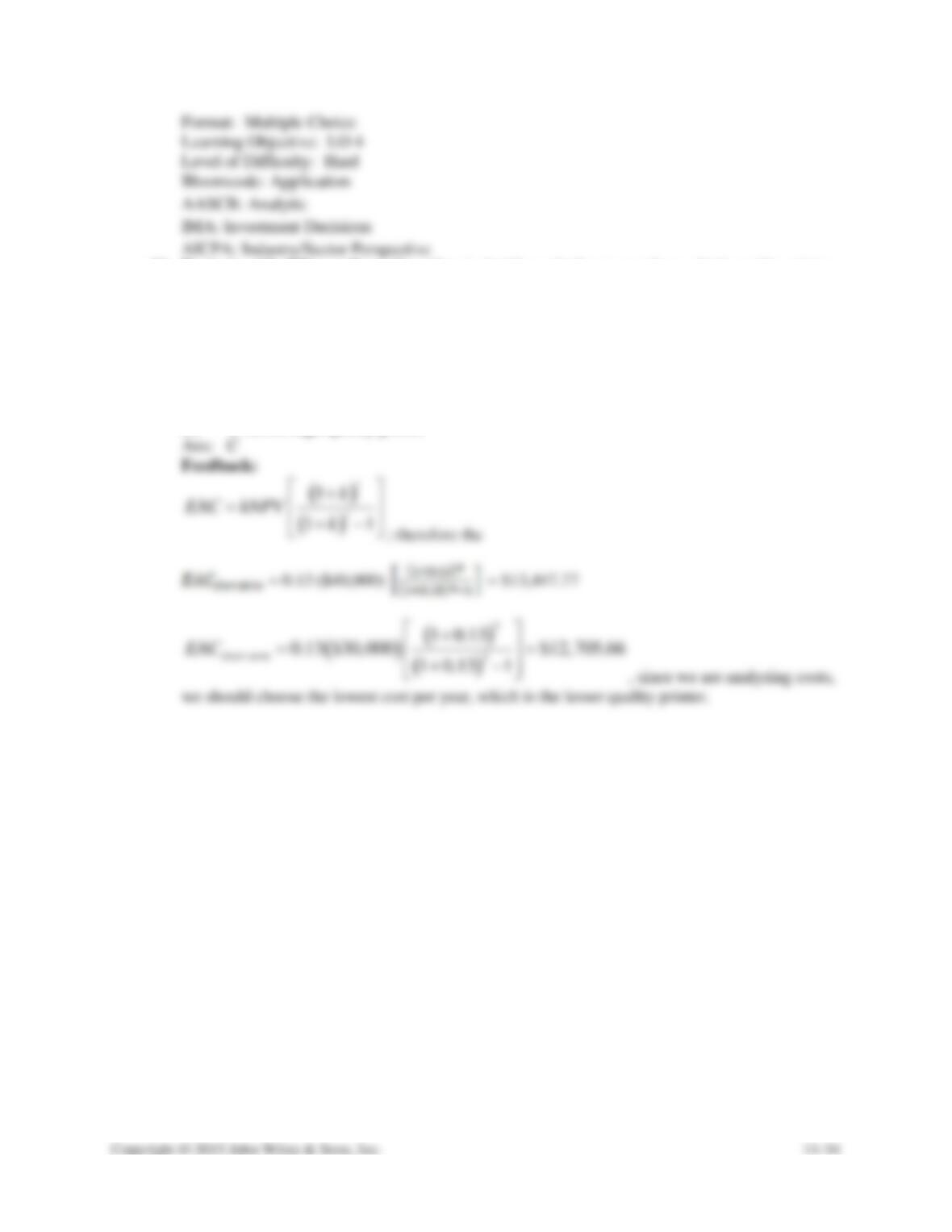
we should choose the lowest cost per year, which is the short-term vehicle.
Fundamentals of Corporate Finance 3e Test Bank
75.
Projects with different lives: Your firm is deciding whether to purchase a high-quality printer
for your office or one of lesser quality. The high-quality printer costs $40,000 and should last
four years. The lesser quality printer costs $30,000 and should last three years. If the cost of
capital for the firm is 13 percent, then what is the equivalent annual cost for the best choice for
the firm? Round to the nearest dollar.
A)
$10,000, either printer
B)
$10,000, lesser quality printer
C)
$12,706, lesser quality printer
D)
$13,448, high-quality printer
Ans:
C
we should choose the lowest cost per year, which is the lesser quality printer.