
Exam
Name___________________________________
MULTIPLE CHOICE. Choose the one alternative that best completes the statement or answers the question.
1)
What observations characterize solar maximum?
1)
A)
The Sun emits light of longer average wavelength.
B)
There are many sunspots visible on the surface of the Sun.
C)
The Sun becomes much brighter.
D)
The Sun rotates faster at its poles.
E)
all of the above
2)
The core of the Sun is
2)
A)
at the same temperature and density as its surface.
B)
composed of iron.
C)
at the same temperature but much denser than its surface.
D)
constantly rising to the surface through convection.
E)
much hotter and much denser than its surface.
E
3)
The overall result of the proton–proton chain is ________.
3)
A)
p + p becomes 2H + energy
B)
4 H becomes 1 He + energy
C)
6 H becomes 1 He + energy
D)
individual protons are joined into long chains of protons
B
B

4)
When is/was gravitational contraction an important energy generation mechanism for the Sun?
4)
A)
It is the primary energy generation mechanism in the Sun today.
B)
It is important during periods when the Sun is going from solar maximum to solar minimum.
C)
It has played a role throughout the Sun’s history, but it was most important right after nuclear
fusion began in the Sun’s core.
D)
It was important when the Sun was forming from a shrinking interstellar cloud of gas.
5)
To estimate the central temperature of the Sun, scientists ________.
5)
A)
monitor changes in Earth’s atmosphere
B)
use computer models to predict interior conditions
C)
use hot gas to create a small Sun in a laboratory
D)
send probes to measure the temperature
6)
What is the solution to the solar neutrino problem?
6)
A)
The Sun is generating energy other than by nuclear fusion.
B)
We did not know how to detect neutrinos.
C)
Not all fusion reactions create neutrinos.
D)
The electron neutrinos created in the Sun’s core change into another type of neutrino that we
did not detect.
E)
The Sun is generating much less energy than we think it is.
7)
The star Alpha Centauri A is the same type of star as the Sun, but its luminosity is about 1.6 times
that of the Sun. What can we conclude?
7)
A)
Alpha Centauri A has a much higher surface temperature than the Sun.
B)
Alpha Centauri A fuses hydrogen into helium in its core at a higher rate than our Sun.
C)
Alpha Centauri A is much farther from Earth than the Sun.
D)
Alpha Centauri A must have a vastly different interior structure than the Sun.

8)
How does the Sun’s mass compare to Earth’s mass?
8)
A)
The Sun‘s mass is about 300 times the mass of the Earth.
B)
The Sun’s mass is about 300,000 times the mass of the Earth.
C)
The Sun’s mass is about 30 times the mass of the Earth.
D)
Both have approximately the same mass.
9)
Sunspots are cooler than the surrounding gas in the photosphere because
9)
A)
magnetic fields trap ionized gases that absorb light.
B)
they are regions where convection carries cooler material downward.
C)
strong magnetic fields slow convection and prevent hot plasma from entering the region.
D)
there is less fusion occurring there.
E)
magnetic fields lift material from the sunspot and quickly cool the material.
C
10)
The source of energy that keeps the Sun shining today is ________.
10)
A)
nuclear fission
B)
chemical reactions
C)
nuclear fusion
D)
gravitational contraction
C
11)
What is the Sun made of (by mass)?
11)
A)
100% hydrogen and helium
B)
50% hydrogen, 25% helium, 25% other elements
C)
90% dark matter, 10% ordinary matter
D)
70% hydrogen, 28% helium, 2% other elements
D
B

12)
What two physical processes balance each other to create the condition known as gravitational
equilibrium in stars?
12)
A)
the strong force and the electromagnetic force
B)
the strong force and the weak force
C)
gravitational force and surface tension
D)
gravitational force and outward pressure
13)
Which of the following is the phase of matter in the Sun?
13)
A)
plasma
B)
liquid
C)
gas
D)
solid
E)
a mixture of all of the above
Explanation:
14)
Which of the following statements is an inference from a model (rather than an observation)?
14)
A)
The photosphere emits visible light.
B)
The photosphere is made out of mainly hydrogen and helium.
C)
The corona is hotter than the photosphere.
D)
The Sun emits neutrinos.
E)
The Sun’s core is gradually turning hydrogen into helium.
Explanation:
15)
What is the only force that can overcome the repulsion between two positively charged nuclei to
bind them into an atomic nucleus?
15)
A)
the strong force
B)
the weak force
C)
the Coriolis force
D)
the gravitational force
E)
the electromagnetic force
Explanation:
Explanation:

16)
What do we mean when we say that the Sun is in gravitational equilibrium?
16)
A)
The hydrogen gas in the Sun is balanced so that it never rises upward or falls downward.
B)
There is a balance within the Sun between the outward push of pressure and the inward pull
of gravity.
C)
The Sun maintains a steady temperature.
D)
The Sun always has the same amount of mass, creating the same gravitational force.
17)
All but one of the following statements describe why scientists doubt the solar sunspot cycle affects
global climate. Identify which statement is irrelevant to the explanation.
17)
A)
Variations in solar activity affect the Sun’s luminosity by a very tiny amount.
B)
Solar winds can affect satellite communications.
C)
The variations in solar particle winds do not change the temperature of the Earth’s ocean or
ground.
D)
The solar cycle varies every 11 years; average Earth temperatures do not show an 11 year
variation.
18)
The light radiated from the Sun’s surface reaches Earth in about 8 minutes, but the energy of that
light was released by fusion in the solar core about ________.
18)
A)
a few hundred thousand years ago
B)
one thousand years ago
C)
one hundred years ago
D)
three days ago
19)
The Sun will exhaust its nuclear fuel in about ________.
19)
A)
5000 AD
B)
5 billion years
C)
50 billion years
D)
5 million years

20)
Why do sunspots appear dark in pictures of the Sun?
20)
A)
They are holes in the solar surface through which we can see through to deeper, darker layers
of the Sun.
B)
They actually are fairly bright, but appear dark against the even brighter background of the
surrounding photosphere.
C)
They are extremely hot and emit all their radiation as X–rays rather than visible light.
D)
They are too cold to emit any visible light.
21)
Which of the following statements about the Sun is an inference from a model, not an observation?
21)
A)
The Sun emits neutrinos.
B)
The corona is hotter than the photosphere.
C)
The convection zone is cooler than the radiation zone.
D)
The photosphere emits visible light.
C
Explanation:
22)
Which of the following correctly describes how the process of gravitational contraction can make a
star hot?
22)
A)
Gravitational contraction involves the generation of heat by chemical reactions, much like the
burning of coal.
B)
Heat is generated when gravity contracts because gravity is an inverse square law force.
C)
Gravitational contraction involves nuclear fusion, which generates a lot of heat.
D)
When a star contracts in size, gravitational potential energy is converted to thermal energy.
D
Explanation:
23)
What would happen in the Sun if the temperature of the core decreased?
23)
A)
The fusion rate increases, then the core expands and cools.
B)
The fusion rate increases, then the core shrinks and heats.
C)
The fusion rate decreases, then the core shrinks and heats.
D)
The fusion rate decreases, then the core expands and heats.
C
Explanation:
B
Explanation:

24)
The Sun’s average surface (photosphere) temperature is about ________.
24)
A)
5,800 K
B)
1,000 K
C)
1,000,000 K
D)
37,000 K
25)
A computer accessory salesman attempts to convince you to purchase a “solar neutrino” shield for
your new computer. (It’s even “on sale”!) Why do you turn down this excellent offer?
25)
A)
There’s no such thing as a solar neutrino.
B)
The Earth’s natural magnetic field already offers excellent protection against the onslaught of
solar neutrinos.
C)
Neutrinos rarely, if ever, interact with your computer.
D)
Solar neutrinos are generated by solar winds, but we’re in a solar minimum now, so the risk
of damage is very low.
26)
Which of the following is the best answer to the question, “Why does the Sun shine?”
26)
A)
The Sun initially began making energy through chemical reactions. These heated the interior
enough to allow gravitational contraction and nuclear fusion to occur.
B)
The Sun initially began generating energy through nuclear fusion as it formed, but today it
generates energy primarily through the sunspot cycle.
C)
As the Sun was forming, nuclear fusion reactions in the shrinking clouds of gas slowly
became stronger and stronger, until the Sun reached its current luminosity.
D)
As the Sun was forming, gravitational contraction increased the Sun’s temperature until the
core became hot enough for nuclear fusion, which ever since has generated the heat that
makes the Sun shine.
27)
At the center of the Sun, nuclear fusion converts hydrogen into
27)
A)
hydrogen compounds such as methane.
B)
radiation and elements such as carbon and nitrogen.
C)
radioactive elements such as uranium and plutonium.
D)
helium, gamma rays, and neutrinos.
E)
molecular hydrogen.

28)
Which of the following processes is involved in the sunspot cycle?
28)
A)
small variations in the rate of nuclear energy generation in the solar interior
B)
a large change in the amount of visible light emitted by the Sun
C)
an imbalance in the operation of the solar thermostat
D)
the winding of magnetic field lines due to the Sun’s rotation
E)
a slight gravitational contraction of the Sun
29)
How do we test our computer models for the interior of the Sun?
29)
A)
sending a probe to the Sun to plunge into its interior
B)
comparing model predictions to how the Sun actually vibrates
C)
taking movies of the solar prominences and flares
D)
monitoring the helium content of the surface of the Sun
30)
Which of the following quantities is equal to the energy per second generated by the Sun’s nuclear
reactions?
30)
A)
the luminosity of the Sun’s photosphere
B)
the temperature at the Sun’s photosphere
C)
the force of gravity holding the Sun together
D)
the temperature of the Sun’s core
31)
Why are neutrinos so difficult to detect?
31)
A)
They have a tendency to pass through just about any material without any interactions.
B)
They have no mass.
C)
They are extremely rare.
D)
No one knows; this is the essence of the “solar neutrino problem.”

32)
Which is closest to the temperature of the Sun’s core?
32)
A)
100 million K
B)
1 million K
C)
10,000 K
D)
10 million K
E)
100,000 K
33)
Why isn’t the Sun shrinking or expanding?
33)
A)
Because the Sun is spinning so fast, the centrifugal forces keep the surface of the Sun
supported against collapse.
B)
because gas pressure balances gravity in the Sun
C)
because the Sun has lived for billions of years
D)
because the Sun is solid
34)
What happens to energy in the Sun‘s convection zone?
34)
A)
Energy is transported outward by the rising of hot plasma.
B)
Energy is produced in the convection zone by thermal radiation.
C)
Energy is produced in the convection zone by nuclear fusion.
D)
Energy slowly leaks outward through the radiative diffusion of photons that repeatedly
bounce off ions and electrons.
35)
Studies of solar vibrations have revealed that
35)
A)
neutrinos from the solar core reach the solar surface easily.
B)
they are caused by processes similar to those that create earthquakes.
C)
the Sun generates energy by nuclear fusion.
D)
our mathematical models of the solar interior are fairly accurate.
E)
the Sun vibrates only on the surface.

36)
When we say that the Sun is a ball of plasma, we mean that ________.
36)
A)
the Sun consists of gas in which many or most of the atoms are ionized (missing electrons)
B)
the Sun is roughly the same color as blood
C)
the Sun is made of material that acts like a liquid acts on Earth
D)
the Sun is made of atoms and molecules
37)
The intricate patterns visible in an X–ray image of the Sun generally show ________.
37)
A)
structure within sunspots
B)
extremely hot plasma flowing along magnetic field lines
C)
helioseismological fluctuations
D)
a bubbling pattern on the photosphere
38)
Which of the following correctly compares the Sun’s energy generation process to the energy
generation process in human–built nuclear power plants?
38)
A)
The Sun generates energy by fusing small nuclei into larger ones, while our power plants
generate energy by the fission (splitting) of large nuclei.
B)
The Sun generates energy through nuclear reactions while nuclear power plants generate
energy through chemical reactions.
C)
The Sun generates energy through fission while nuclear power plants generate energy
through fusion.
D)
Both processes involve nuclear fusion, but the Sun fuses hydrogen while nuclear power
plants fuse uranium.
39)
How is the sunspot cycle directly relevant to us here on Earth?
39)
A)
The Sun’s magnetic field, which plays a major role in the sunspot cycle, affects compass
needles that we use on Earth.
B)
The brightening and darkening of the Sun that occurs during the sunspot cycle affects plant
photosynthesis here on Earth.
C)
The sunspot cycle is the cause of global warming.
D)
Coronal mass ejections and other activity associated with the sunspot cycle can disrupt radio
communications and knock out sensitive electronic equipment.
E)
The sunspot cycle strongly influences Earth’s weather.
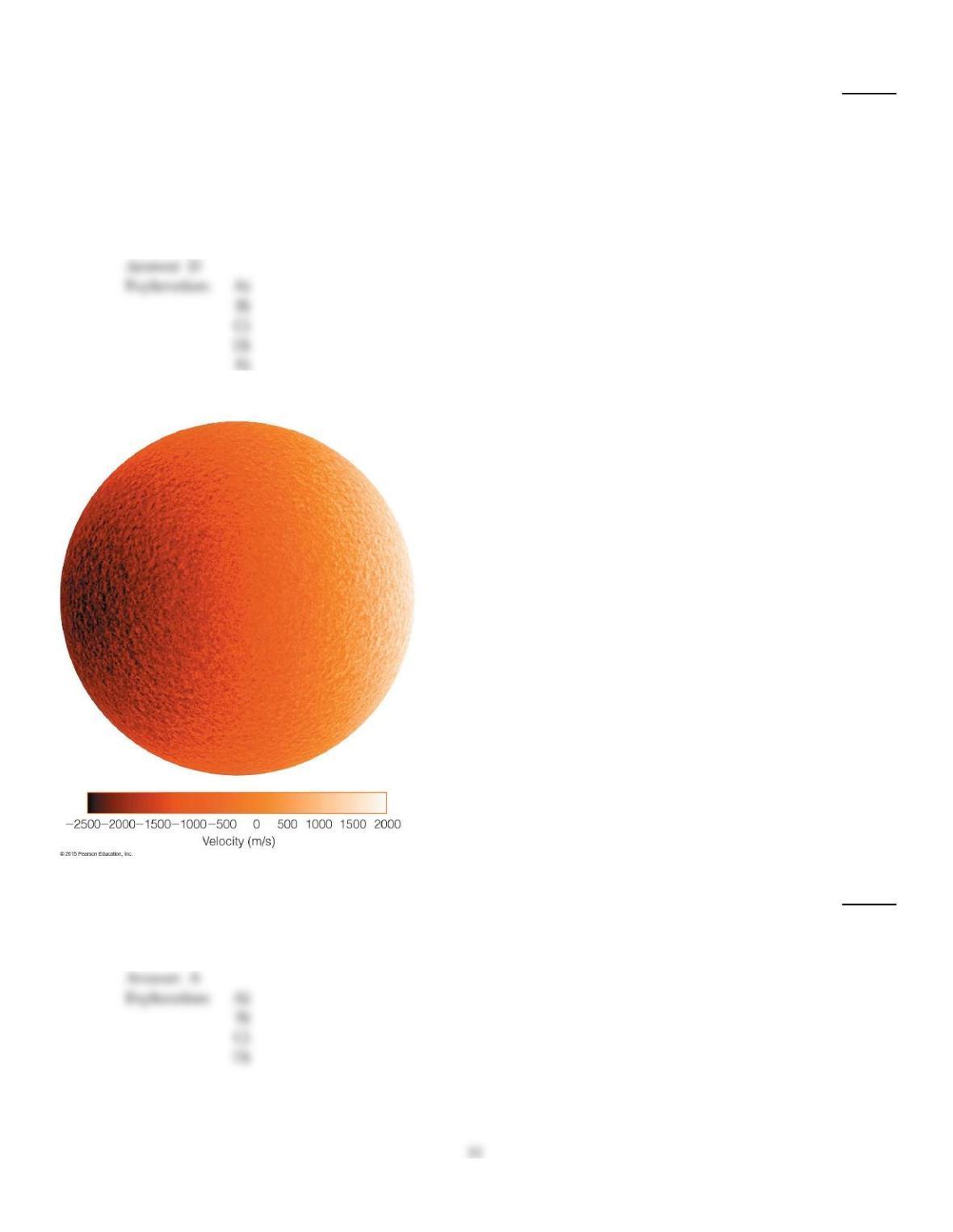
40)
According to this Doppler map of the sun’s surface, about how fast is the sun rotating around at its
equator?
40)
A)
about 2000 m/s
B)
about 200 m/s
C)
about 20,000 m/s
D)
It is not rotating.

41)
Why does the Sun emit neutrinos?
41)
A)
The Sun was born with a supply of neutrinos that it gradually emits into space.
B)
Fusion in the Sun’s core creates neutrinos.
C)
Solar flares create neutrinos with magnetic fields.
D)
Convection releases neutrinos, which random walk through the radiation zone.
E)
The Sun does not emit neutrinos.
42)
By what process do nuclear power plants on the Earth generate energy?
42)
A)
converting kinetic energy into electricity
B)
chemical reactions
C)
converting gravitational potential energy into electricity
D)
nuclear fission
E)
nuclear fusion
D
43)
According to modern science, approximately how old is the Sun?
43)
A)
400 million years
B)
10,000 years
C)
4.5 billion years
D)
25 million years
C
44)
How can we measure the strength of magnetic fields on the Sun?
44)
A)
by observing the sizes of sunspots: Bigger sunspots mean a stronger field
B)
by looking for the splitting of spectral lines in the Sun’s spectrum
C)
by observing auroras here on Earth
D)
only by using sophisticated computer models because there are no observational ways of
measuring magnetic field strength
B
B

45)
If the sun’s surface cooled, how would its appearance change?
45)
A)
It would appear more blue.
B)
It would stay the same.
C)
It would appear more red.
D)
It would become bright white.
46)
When the temperature of the Sun’s core goes down, what happens next?
46)
A)
Fusion reactions slow down; the core expands and heats.
B)
Fusion reactions speed up; the core shrinks and cools.
C)
Fusion reactions slow down; the core shrinks and heats.
D)
Fusion reactions speed up; the core expands and cools.
C
47)
In the late 1800s, Kelvin and Helmholtz suggested that the Sun stayed hot due to gravitational
contraction. What was the major drawback to this idea?
47)
A)
It is physically impossible to generate heat simply by making a star shrink in size.
B)
It predicted that the Sun would shrink noticeably as we watched it, but the Sun appears to be
stable in size.
C)
It predicted that Earth would also shrink in size with time, which would make it impossible
to have stable geology on our planet.
D)
It predicted that the Sun could shine for about 25 million years, but geologists had already
found that Earth is much older than this.
D
48)
The Sun’s surface seethes and churns with a bubbling pattern. Why?
48)
A)
We are seeing hot gas rising and cool gas falling due to the convection that occurs beneath the
surface.
B)
The churning is an illusion created by varying radiation, as the gas on the Sun’s surface is
actually quite still.
C)
The churning gas is being stirred up by the strong solar wind.
D)
The Sun’s surface is boiling.
A
C

49)
If the Sun suddenly stopped emitting neutrinos, what might we infer (after checking that our
neutrino detectors were still operational)?
49)
A)
Fission reactions in the Sun have ceased.
B)
The Sun has exhausted its supply of neutrinos.
C)
Fusion reactions in the Sun have ceased.
D)
Fusion reactions in the Sun ceased a few hundred thousand years ago.
50)
Which has a greater mass?
50)
A)
two neutrons and two protons in a helium nucleus
B)
four protons
C)
A and B both have exactly the same mass.
51)
What would happen if the fusion rate in the core increased but the core could not expand?
51)
A)
The Sun’s core would cool and the rate of fusion would decrease.
B)
The Sun’s core would reach a new equilibrium, but at a cooler temperature.
C)
The Sun’s core would heat and the rate of fusion would increase further.
D)
The Sun’s core would reach a new equilibrium, but at a higher temperature.
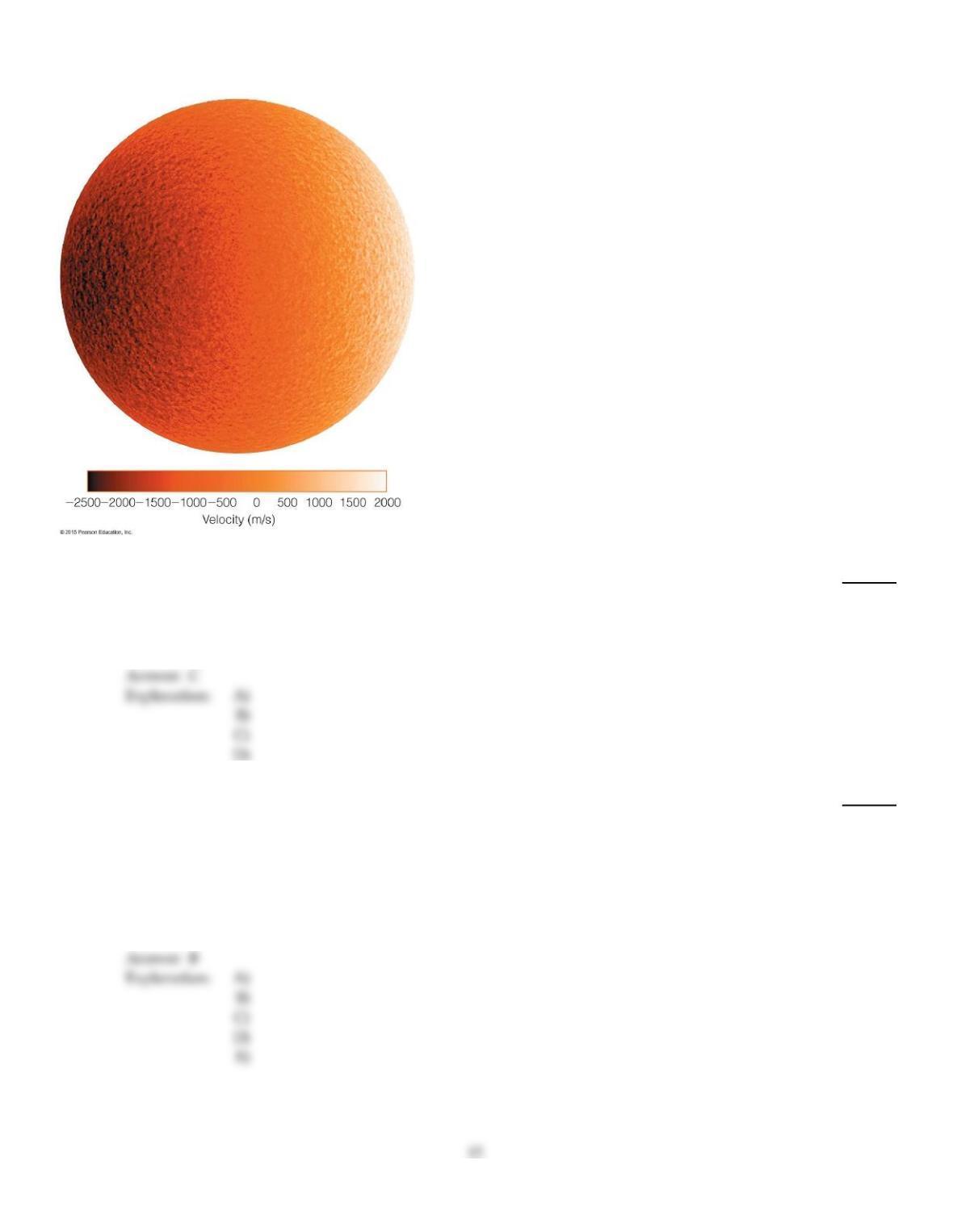
52)
What is shown by the small–scale changes in the shading in the figure above?
52)
A)
variations in the height of the solar surface
B)
variations in the temperature of the photosphere
C)
vibrations seen at the solar surface
D)
Nothing; this is an artist’s rendering of the sun.
53)
What are coronal holes?
53)
A)
tunnels in the outer layers of the Sun that allow photons to escape and form the solar wind
B)
areas of the corona where magnetic field lines project out into space, allowing charged
particles to escape and form the solar wind
C)
regions in the photosphere where magnetic lines gather, creating cooler areas with much less
plasma
D)
areas in the corona that allow us to see through to the photosphere
E)
all of the above

54)
The Sun’s surface, as we see it with our eyes, is called the ________.
54)
A)
chromosphere
B)
corona
C)
core
D)
photosphere
55)
What is the solar wind?
55)
A)
the strong wind that blows sunspots around on the surface of the Sun
B)
a stream of charged particles flowing outward from the surface of the Sun
C)
the uppermost layer of the Sun, lying just above the corona
D)
the wind that causes huge arcs of gas to rise above the Sun’s surface
56)
Imagine that you are trying to stop neutrinos with a lead shield. How thick would you need to
make this shield to ensure that it can stop a neutrino?
56)
A)
about 150 million kilometers (the size of an astronomical unit)
B)
about 14 billion light years (the size of the observable universe)
C)
about 700,000 kilometers (the radius of the Sun)
D)
about one meter
E)
about one light year
57)
By what process does the Sun generate energy?
57)
A)
gravitational contraction
B)
chemical reactions
C)
nuclear fission
D)
gradual expansion
E)
nuclear fusion

58)
How do we know how old the Sun is?
58)
A)
from calculating its fuel supply and how fast it is using it up
B)
from Newton’s version of Kepler’s third law and the orbits of the planets
C)
from its speed and distance from us
D)
from ages of solar system meteorites, based on radioactive elements
59)
Energy balance in the Sun refers to a balance between ________.
59)
A)
the amount of energy the Sun radiates into space and the amount of energy that reaches Earth
B)
the mass that the Sun loses each second and the amount of mass converted into energy each
second
C)
the force of gravity pulling inward and the force due to pressure pushing outward
D)
the rate at which fusion generates energy in the Sun’s core and the rate at which the Sun’s
surface radiates energy into space
60)
Which of the following statements about the sunspot cycle is not true?
60)
A)
At solar minimum, the first sunspots form at mid–latitudes on the Sun.
B)
The magnetic polarity of the Sun reverses approximately every 11 years.
C)
The number of solar flares peaks about every 11 years.
D)
The number of sunspots peaks approximately every 11 years.
E)
The rate of nuclear fusion in the Sun peaks about every 11 years.
61)
Suppose you try to bring two protons close together. Because of the electromagnetic force, the two
protons will
61)
A)
repel one another.
B)
attract one another.
C)
remain stationary.
D)
collide.
E)
join together to form a deuterium nucleus.

62)
Order the interior layers of the Sun from the hottest to the coldest.
62)
A)
photosphere, convection zone, radiation zone, core
B)
core, radiation zone, convection zone, photosphere
C)
radiation zone, core, convection zone, photosphere
D)
photosphere, convection zone, core, radiation zone
63)
If the Sun’s core suddenly shrank a little bit, what would happen in the Sun?
63)
A)
The core would heat up, fusion rates would increase, the core would re–expand.
B)
The density of the core would decrease, causing the core to cool off and expand.
C)
The core would cool off and continue to shrink as its density increased.
D)
The core would heat up, causing it to radiate so much energy that it would shrink even more.
A
64)
How can we best observe the Sun’s chromosphere and corona?
64)
A)
The chromosphere and corona are both best studied with visible light.
B)
The chromosphere is best observed with infrared telescopes and the corona is best observed
with ultraviolet telescopes.
C)
The chromosphere is best observed with ultraviolet telescopes and the corona is best observed
with X–ray telescopes.
D)
The chromosphere and corona are both best studied with radio telescopes.
C
65)
Which of the following best explains why nuclear fusion requires bringing nuclei extremely close
together?
65)
A)
Fusion can proceed only by the proton–proton chain, and therefore requires that protons
come close enough together to be linked up into a chain.
B)
Nuclei normally repel because they are all positively charged and can be made to stick only
when brought close enough for the strong force to take hold.
C)
Nuclei have to be very hot in order to fuse, and the only way to get them hot is to bring them
close together.
D)
Nuclei are attracted to each other by the electromagnetic force, but this force is only strong
enough to make nuclei stick when they are very close together.
B
B

66)
The fundamental nuclear reaction occurring in the core of the Sun is ________.
66)
A)
nuclear fission
B)
radioactive decay
C)
nuclear fusion of helium into carbon
D)
nuclear fusion of hydrogen into helium
67)
Which of the following choices is not a way by which we can study the inside of the Sun?
67)
A)
We can study solar neutrinos.
B)
We can make a computer model of the Sun’s interior that allows us to predict the observable
properties of the Sun.
C)
We can probe the interior of the Sun by studying the vibrations in its photosphere.
D)
We can send a space probe into the Sun’s photosphere.
D
68)
Which of the following best describes why the Sun emits most of its energy in the form of visible
light?
68)
A)
The visible light comes from energy level transitions as electrons in the Sun’s hydrogen atoms
jump between level 1 and level 2.
B)
Like all objects, the Sun emits thermal radiation with a spectrum that depends on its
temperature, and the Sun’s surface temperature is just right for emitting mostly visible light.
C)
Nuclear fusion in the Sun’s core produces visible light photons.
D)
The Sun’s gas is on fire like flames from wood or coal, and these flames emit visible light.
B
69)
Every second, the Sun converts about 600 million tons of hydrogen into 596 million tons of helium.
The remaining 4 million tons of mass is ________.
69)
A)
ejected into space in a solar wind
B)
ejected into space by solar flares
C)
reabsorbed as molecular hydrogen
D)
converted to an amount of energy equal to 4 million tons times the speed of light squared
D
D

70)
At the time the hypothesis was suggested, what major problem was identified with the idea that
the Sun was powered by gravitational contraction?
70)
A)
This process could not possibly lead to the observed power output of the Sun.
B)
Contracting objects cool down rather than heat up.
C)
This process would power the Sun for only about 25 million years, but geologists already had
evidence the Earth was much older than that.
D)
19th century astronomers should have been able to measure the required change in the Sun’s
size.
71)
What are the appropriate units for the Sun’s luminosity?
71)
A)
Newtons
B)
Watts
C)
Joules
D)
Kilograms
72)
How much mass does the Sun lose through nuclear fusion per second?
72)
A)
4 tons
B)
600 million tons
C)
4 million tons
D)
600 tons
E)
Nothing; mass–energy is conserved.
73)
From center outward, which of the following lists the “layers” of the Sun in the correct order?
73)
A)
core, radiation zone, convection zone, photosphere, chromosphere, corona
B)
core, radiation zone, convection zone, corona, chromosphere, photosphere
C)
core, corona, radiation zone, convection zone, photosphere, chromosphere
D)
core, convection zone, radiation zone, corona, chromosphere, photosphere

74)
The proton–proton chain is ________.
74)
A)
the specific set of nuclear reactions through which the Sun fuses hydrogen into helium
B)
another name for the force that holds protons together in atomic nuclei
C)
the linkage of numerous protons into long chains
D)
an alternative way of generating energy that is different from the fusion of hydrogen into
helium
75)
Satellites in low–Earth orbits are more likely to crash to Earth when the sunspot cycle is near solar
maximum because ________.
75)
A)
they are more likely to have their electronics “fried” by a solar flare during solar maximum
B)
of increased magnetic interference
C)
it is too dangerous to send the Space Shuttle to service satellites during solar maximum
D)
Earth’s upper atmosphere tends to expand during solar maximum, exerting drag on satellites
in low orbits
D
76)
Which of the following is not a method astronomers use to determine the physical conditions inside
the Sun?
76)
A)
detecting solar neutrinos generated in the Sun’s core
B)
observing X–ray images of the solar interior using satellites
C)
building mathematical models that use the laws of physics
D)
measuring Doppler shifts to observe solar vibrations
E)
both C and D
B
A
77)
What would happen to the core of the sun if its temperature rose slightly?
77)
A)
The rate at which fusion occurs would increase, leading to an expansion of the core, which
would in turn cause the temperature to drop back down.
B)
The rate at which fusion occurs would decrease, leading to a contraction of the core, which
would in turn cause a further temperature rise.
C)
The rate at which fusion occurs would decrease, leading to an expansion of the core, which
would in turn cause the temperature to drop back down.
D)
The rate at which fusion occurs would increase, leading to a contraction of the core, which
would in turn cause the temperature to rise even further.
78)
Based on its surface temperature of 6,000 K, most photons that leave the Sun’s surface lie in which
region of the electromagnetic spectrum?
78)
A)
microwave
B)
ultraviolet
C)
visible
D)
X–ray
E)
infrared
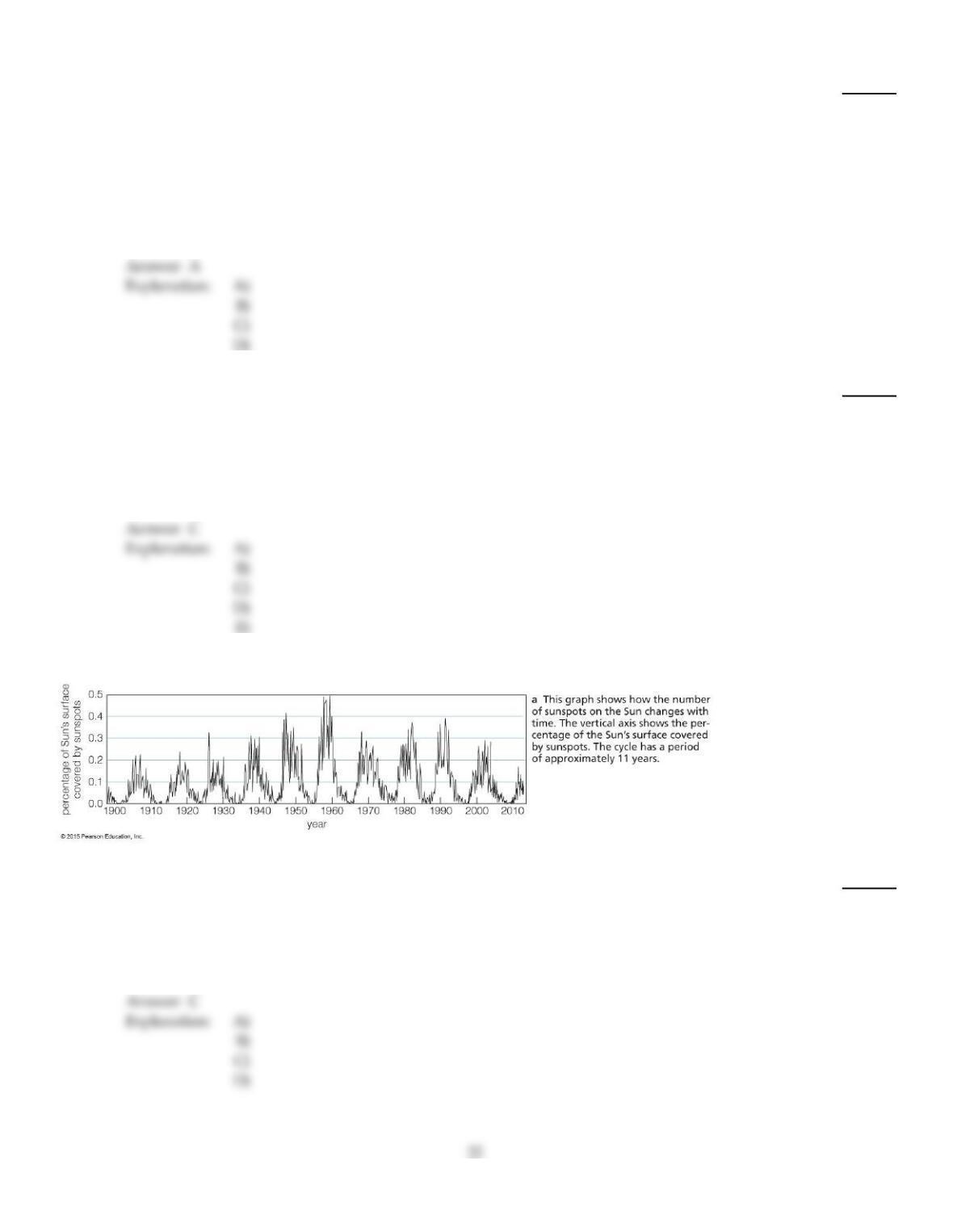
79)
It takes ________ years for the sun to progress through one sunspot cycle from a maximum area
covered with sunspots, to a minimum, and back to a maximum. Refer to the graph above.
79)
A)
about 110 years
B)
about 1 year
C)
about 10 years
D)
This figure cannot be used to answer this question.
80)
What keeps the Sun’s outer layers from continuing to fall inward in a gravitational collapse?
80)
A)
the strong force between protons
B)
outward pressure due to super–heated gas
C)
electromagnetic repulsion between protons
D)
neutrinos produced by nuclear fusion drag gas outward
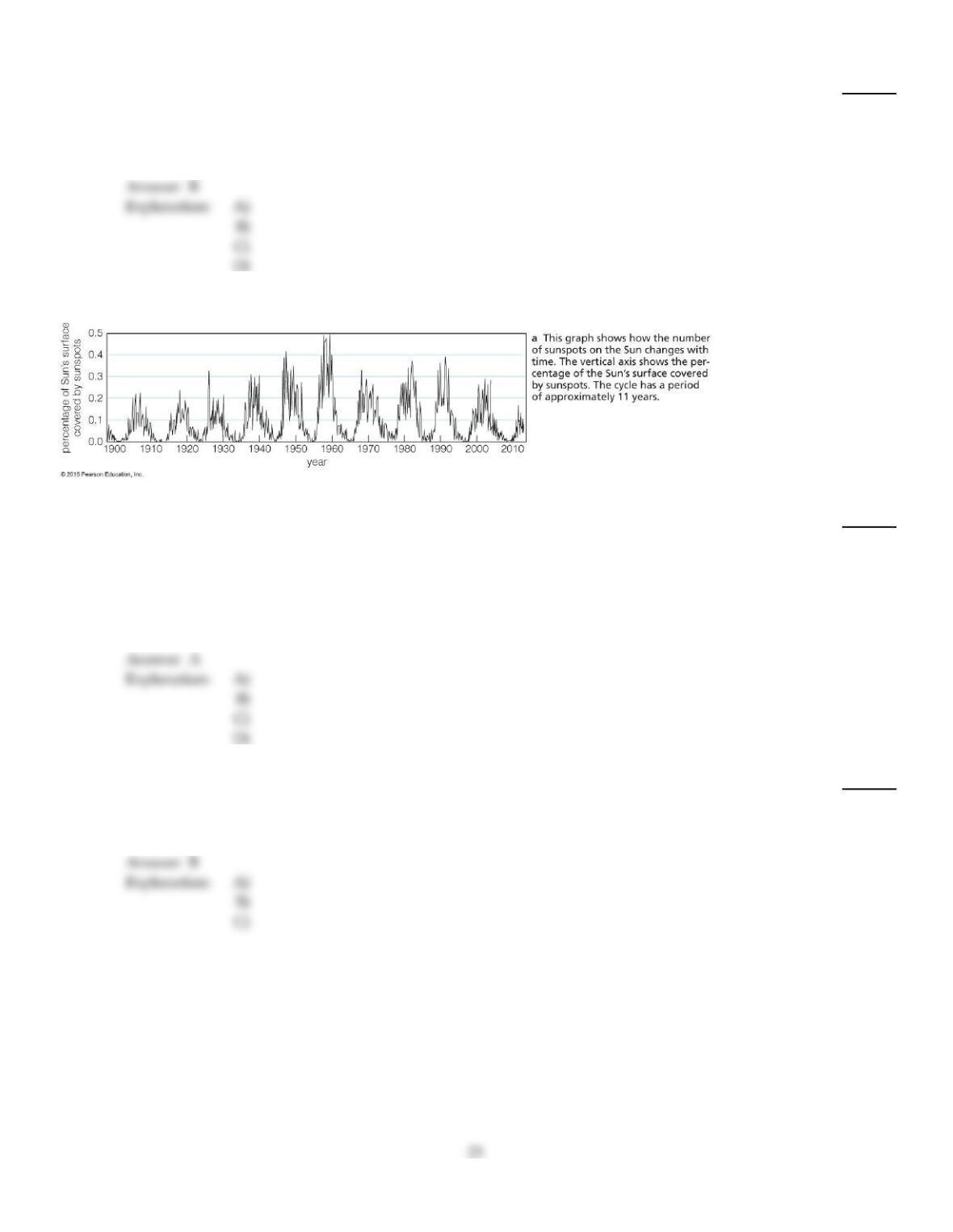
81)
It takes ________ years for the sun to progress through one sunspot cycle, wherein sunspots appear
at high latitudes, shift to lower and lower latitude, then return to high latitudes. Refer to the graph
above.
81)
A)
about 10 years
B)
about 1 year
C)
about 110 years
D)
This figure cannot be used to answer this question.
82)
Where in the Sun do fusion reactions happen?
82)
A)
everywhere inside the Sun
B)
only the core
C)
core and radiation zone

83)
Approximately how many neutrinos pass through your body each second?
83)
A)
about one thousand
B)
about a thousand trillion
C)
about 1023
D)
None; they are blocked by the Earth’s atmosphere.
84)
The light radiated from the Sun’s surface reaches Earth in about 8 minutes. However, the energy of
this light was released by fusion in the Sun’s core about
84)
A)
8 minutes ago.
B)
several hundred thousand years ago.
C)
several hundred years ago.
D)
several thousand years ago.
E)
11 years ago.
85)
Which of the following is not a characteristic of the 11–year sunspot cycle?
85)
A)
The Sun’s entire magnetic field flip–flops with each cycle, so that the overall magnetic cycle
averages 22 years.
B)
The sunspot cycle is very steady, so that each 11–year cycle is nearly identical to every other
11–year cycle.
C)
The likelihood of seeing solar prominences or solar flares is higher when sunspots are more
common and lower when they are less common.
D)
The number of sunspots on the Sun at any one time gradually rises and falls, with an average
of 11 years between the times when sunspots are most numerous.
86)
What do sunspots, solar prominences, and solar flares all have in common?
86)
A)
They all have about the same temperature.
B)
They are all shaped by the solar wind.
C)
They all occur only in the Sun’s photosphere.
D)
They are all strongly influenced by magnetic fields on the Sun.
87)
Why do sunspots appear dark?
87)
A)
They are regions nearly devoid of gas.
B)
They are thick clouds on the sun, blocking its light.
C)
They are regions that are significantly cooler than the rest of the photosphere.
D)
They are composed of different elements than the rest of the sun.
88)
Hydrogen fusion in the Sun requires a temperature (in Kelvin) of
88)
A)
any temperature, as long as gravity is strong enough.
B)
millions of degrees.
C)
billions of degrees.
D)
trillions of degrees.
E)
thousands of degrees.
B
SHORT ANSWER. Write the word or phrase that best completes each statement or answers the question.
89)
Describe two general ways we learn about the Sun’s interior.
89)
C
90)
Imagine you are plunging into the Sun, starting from Earth. Briefly describe what you will
experience on your journey.
90)
91)
Imagine nuclear fusion suddenly ceases in the Sun’s core. How long would it take for us to
discover the problem, and how could we discover it? How long would it take for us
experience the negative consequences of this change, and why?
91)
92)
What is the solar thermostat?
92)
93)
Briefly describe the Sun’s 22 year activity cycle.
93)
94)
Describe some of the early theories for the Sun’s energy source and why they are no longer
accepted as viable.
94)
95)
Briefly describe why the detection of neutrinos coming from the Sun supports the theory
that the Sun generates energy by nuclear fusion.
95)
96)
Briefly explain why sunspots are cooler than surrounding regions of the Sun, and why they
look dark in photos.
96)
97)
Briefly explain how the Sun became hot enough for nuclear fusion.
97)
98)
List at least two ways the sunspot cycle affects us on the Earth.
98)

99)
What was the solar neutrino problem?
99)
TRUE/FALSE. Write ‘T’ if the statement is true and ‘F’ if the statement is false.
100)
Sunspots are cooler than the surrounding region of the Sun’s surface.
100)
101)
The sun rotates more quickly at the equator than at the poles.
101)
102)
Although the Sun does not generate energy by gravitational contraction today, this
energy–generation mechanism was important when the Sun was forming.
102)
103)
The sun’s X–ray and ultraviolet light output is greater than what we would expect based on the
photosphere’s temperature.
103)
104)
Gravitational equilibrium means that the surface and the core of the Sun are at the same pressure.
104)
105)
Nuclear power plants on Earth create energy in the same way as the Sun.
105)
106)
The temperature of the Sun’s core is about 20,000 K.
106)
107)
The corona and chromosphere are hotter than the photosphere.
107)
108)
The chromosphere is the layer of the Sun that we see as its visible surface.
108)
109)
The Sun generates energy primarily by nuclear fission.
109)
110)
Energy from the core of the Sun first travels slowly through a convection zone and then much faster
through the outer radiation zone.
110)
111)
The proton–proton chain converts four hydrogen nuclei into one helium nucleus plus energy.
111)
ESSAY. Write your answer in the space provided or on a separate sheet of paper.
112)
Basis for Fundamental Solar Data: Table 11.1 in your text lists all of the basic fundamental data for the Sun: its
mass, radius, luminosity, rotation rate, surface temperature, and composition. Taking each of the quantities in
turn, outline the basic observations and physical principles used to infer the values. When done, consider one
final fact about the Sun: its core temperature is about 15 million degrees (Kelvin). What observations support
this value? Do you consider the Sun’s core temperature to be more or less well established than the basic data of
Table 11.1? Explain.
113)
Nuclear Fusion Power Plants: The public often reacts with fear to any energy source involving the word “nuclear.”
Imagine that you are discussing the problem of energy generation with a friend, and you mention that nuclear
fusion power plants should be investigated. Your friend expresses worry about all of the nuclear waste that
would be produced. How would you explain to your friend that this fear is misplaced?
114)
Studying the chromosphere and corona: Consider observations of the solar chromosphere and corona. What are the
principle difficulties in observing them in X–ray, ultraviolet, and in visible light? What could be done to
circumvent those difficulties?
115)
Interdisciplinary Science: Significant advancements in science often occur when several separate and distinct
scientific disciplines come together to address a single question. Use the search for the Sun’s energy source as a
case study. Outline how astronomy and physics were driven to consider new possibilities for the Sun’s energy
by the fields of geology and biology.

Answer Key
Testname: C11

Answer Key
Testname: C11
31
Answer Key
Testname: C11

Answer Key
Testname: C11