D) –22.1%, 66.3%
56) McCoy paid a one–time special dividend of $3.20 on October 18, 2010. Suppose you bought McCoy stock for
$47.00 on July 18, 2010, and sold it immediately after the dividend was paid for $63.32. What was your
realized return from holding McCoy?
A) 4.15%
B) 6.8%
C) 34.7%
D) 41.5%
57) McCoy paid a one–time special dividend of $3.20 on October 18, 2010. Suppose you bought McCoy stock for
$47.00 on July 18, 2010, and sold it immediately after the dividend was paid for $63.32. What was your
capital gain yield from holding McCoy?
A) 4.15%
B) 6.8%
C) 34.7%
D) 41.5%
SHORT ANSWER. Write the word or phrase that best completes each statement or answers the question.
58) What are the two components of realized return from a stock investment?
59) Which type of investment has historically had the highest volatility?
60) Which type of investment has historically had the lowest volatility?
61) When looking at investment portfolios historically, was there a pattern between returns and volatility?
TRUE/FALSE. Write ‘T’ if the statement is true and ‘F’ if the statement is false.
62) Rational investors may be willing to choose an investment that has additional risk but does not offer
additional reward.
63) Historical evidence on the returns of large portfolios of stock and bonds shows that investments with higher
volatility have rewarded investors with higher returns.
64) There is a clear link between the volatility of returns for individual stocks and the returns for individual
stocks.
MULTIPLE CHOICE. Choose the one alternative that best completes the statement or answers the question.
65) While ________ seems to be a reasonable measure of risk when evaluating a large portfolio, the ________ of
an individual security does not explain the size of its average return.
A) volatility, volatility
B) the mean return, standard deviation
C) mode, volatility
D) none of the above
66) There is an overall relationship between ________ and ________ larger stocks have a lower volatility overall.
A) size, risk
B) mean, standard deviation
C) risk aversion, size
D) volatility, mean
67) The excess return is the difference between the average return on a security and the average return for
A) Treasury bonds.
B) a portfolio of securities with similar risk.
C) a broad–based market portfolio like the S&P 500 index.
D) Treasury bills.
68) Which of the following statements is FALSE?
A) Expected return should rise proportionately with volatility.
B) Investors would not choose to hold a portfolio that is more volatile unless they expected to earn a
higher return.
C) Smaller stocks have lower volatility than larger stocks.
D) The largest stocks are typically more volatile than a portfolio of large stocks.
69) Which of the following statements is FALSE?
A) Investments with higher volatility have rewarded investors with higher average returns.
B) Investments with higher volatility should have a higher risk premium and, therefore, higher returns.
C) Volatility seems to be a reasonable measure of risk when evaluating returns on large portfolios and the
returns of individual securities.
D) Riskier investments must offer investors higher average returns to compensate them for the extra risk
they are taking on.
Use the table for the question(s) below.
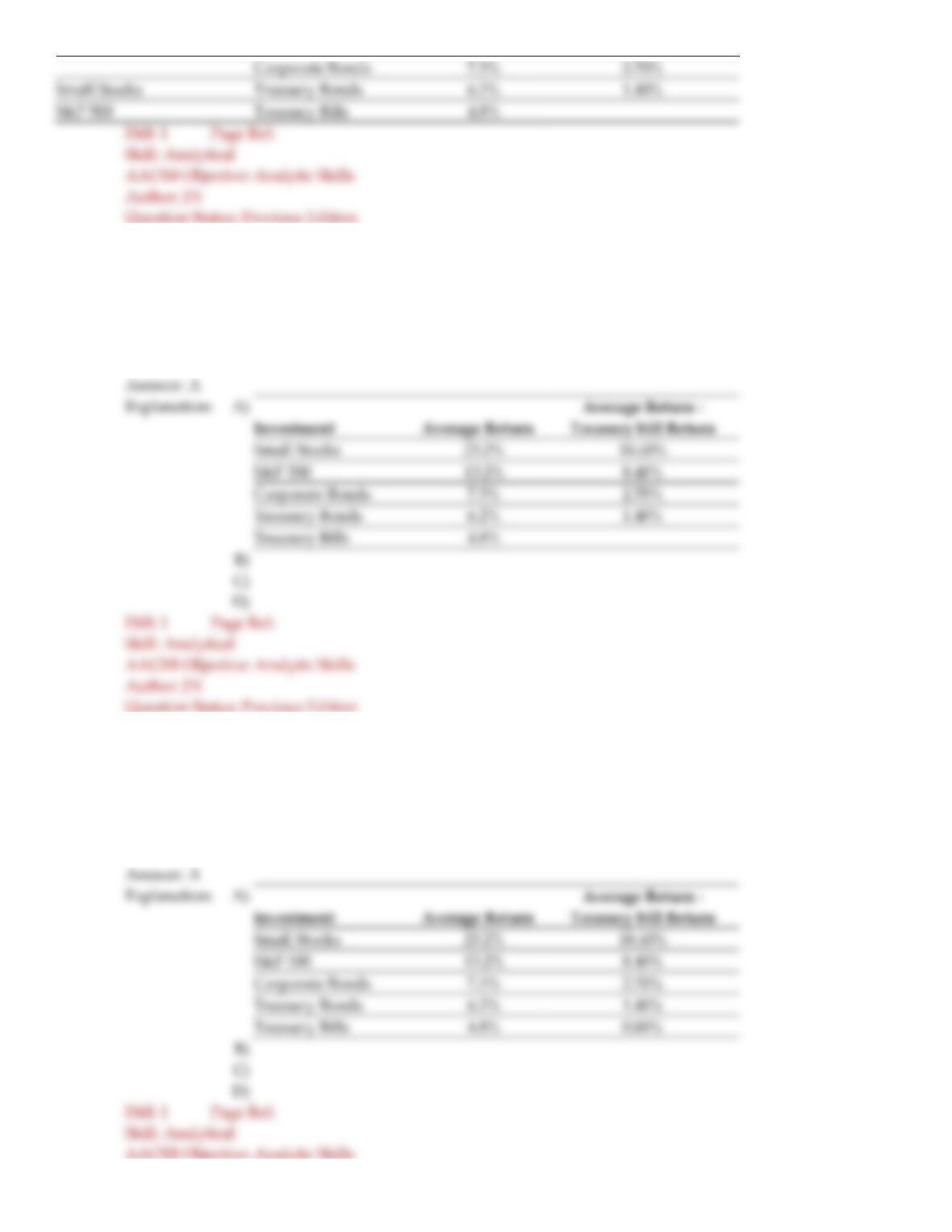
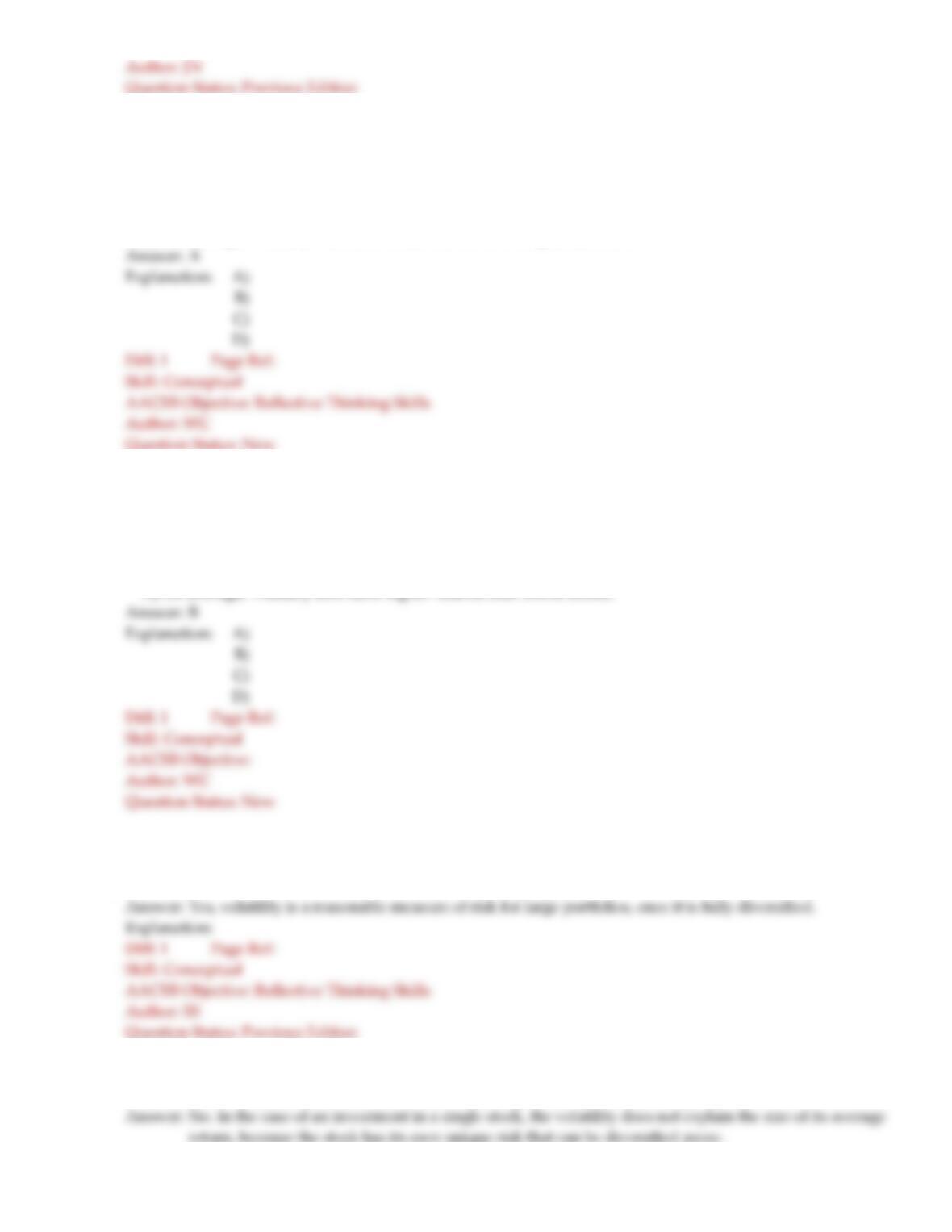
Consider the following average annual returns:
Investment
Average Return
Small Stocks
23.2%
S&P 500
13.2%
Corporate Bonds
7.5%
Treasury Bonds
6.2%
Treasury Bills
4.8%
70) What is the excess return for the portfolio of small stocks?
A) 10.0%
B) 15.7%
C) 18.4%
D) 17.0%
Investment
Average Return
Small Stocks
S&P 500
Corporate Bonds
Treasury Bonds
Treasury Bills
71) What is the excess return for the S&P 500?
A) 5.7%
B) 7.0%
C) 0%
D) 8.4%
Investment
Average Return
72) What is the excess return for corporate bonds?
A) 2.7%
B) 1.3%
C) –5.7%
D) 0%
73) What is the excess return for Treasury bills?
A) 0%
B) –8.4%
C) –2.7%
D) –1.4%
74) Which of the following statements is FALSE?
A) On average, larger stocks have higher volatility than smaller stocks.
B) Portfolios of large stocks are typically less volatile than individual large stocks.
C) On average, smaller stocks have higher returns than larger stocks.
D) On average, Treasury Bills have lower returns than corporate bonds.
75) Which of the following statements is TRUE?
A) On average, smaller stocks have lower volatility than Treasury bills.
B) Portfolios of smaller stocks are typically less volatile than individual small stocks.
C) On average, smaller stocks have lower returns than larger stocks.
D) On average, Treasury bills have higher returns than world stocks.
SHORT ANSWER. Write the word or phrase that best completes each statement or answers the question.
76) Is volatility a reasonable measure of risk when evaluating large portfolios?
77) Is volatility a reasonable measure of risk when evaluating the investment in a single stock?
TRUE/FALSE. Write ‘T’ if the statement is true and ‘F’ if the statement is false.
78) The risk that inflation rates are likely to increase in the next year is an example of common risk.
79) A portfolio of stocks where each stock has a large component of independent risk benefits when such stocks
are held in a portfolio, because the independent risks are averaged out. This is also referred to as
diversification of risks.
MULTIPLE CHOICE. Choose the one alternative that best completes the statement or answers the question.
80) A portfolio of stocks can achieve diversification benefits if the stocks that comprise the portfolio are
A) not perfectly correlated.
B) perfectly correlated.
C) susceptible to common risks only.
D) both B and C
81) Two slot machines offer to double your money 3 times out of 5. Machine A takes $10 bets and Machine B
takes $100 bets on each occasion. A risk–averse investor prefers to bet on:
A) machine A
B) machine B
C) does not matter
D) none of the above
82) Common risk is also called
A) diversifiable risk.
B) correlated risk.
C) uncorrelated risk.
D) independent risk.
Use the information for the question(s) below.
Big Cure and Little Cure are both pharmaceutical companies. Big Cure presently has a potential “blockbuster” drug
before the Food and Drug Administration (FDA) waiting for approval. If approved, Big Cure’s blockbuster drug will
produce $1 billion in net income for Big Cure. Little Cure has ten separate, less important drugs before the FDA waiting
for approval. If approved, each of Little Cure’s drugs would produce $100 million in net income for Little Cure. The
probability of the FDA approving a drug is 50%.
83) What is the expected payoff for Big Cure’s Blockbuster drug?
A) $100 million
B) $0
C) $1 billion
D) $500 million
84) What is the expected payoff for Little Cure’s ten drugs?
A) $500 million
B) $100 million
C) $1 billion
D) $0
SHORT ANSWER. Write the word or phrase that best completes each statement or answers the question.
85) What is the diversification achieved by an investor if he invests in Dell, IBM, and Microsoft?
86) What is the diversification achieved by an investor if he invests in Exxon Mobil, Dell, and Bank of America?
TRUE/FALSE. Write ‘T’ if the statement is true and ‘F’ if the statement is false.
87) Independent risks can be diversified by holding a large number of uncorrelated assets with independent
risks.
88) A stock whose return does not depend on overall economic conditions has a low systematic risk.
89) Investors should earn a risk premium for bearing unsystematic risk.
MULTIPLE CHOICE. Choose the one alternative that best completes the statement or answers the question.
90) In general, it is possible to eliminate ________ risk by holding a large portfolio of assets.
A) unsystematic
B) systematic
C) unsystematic and systematic
D) none of the above
91) Apple computer’s stock price jumped when it announced that its revenue had increased because of the
successful launch of iPad and the increased sales of Macbook computers. This is an example of
A) market risk.
B) unsystematic risk.
C) systematic risk.
D) both A and C
92) As we increase the number of stocks in a portfolio, the standard deviation of returns of the portfolio
A) increases.
B) remains unchanged.
C) decreases.
D) none of the above
93) Because investors can eliminate unsystematic risk “for free” by diversifying their portfolios, they ________ a
risk premium for bearing it.
A) do not require
B) require
C) are indifferent about
D) none of the above
94) The risk premium of a security is determined by its ________ risk and does not depend on its ________ risk.
A) systematic, undiversifiable
B) systematic, unsystematic
C) diversifiable, diversifiable