Elements of Ecology, 9e (Smith)
Chapter 11 Intraspecific Population Regulation
11.1 Short Answer Questions
1) The ________ model of population growth assumes that essential resources are unlimited and
that the environment is constant.
2) The maximum sustainable population size for the prevailing environment is called the
________ capacity.
3) The factors that influence the growth rate of a population in proportion to the size of the
population are called density-________ factors.
4) Competition among individuals of the same species is referred to as ________ competition.
5) ________ competition occurs when some competing individuals obtain enough resources for
themselves while denying resources to others.
6) Density-________ growth is the inverse relationship between population density and
individual growth.
7) The progressive decline in density and increase in biomass of remaining individuals in a
population is known as ________-thinning.
8) A plant grown at high density will produce ________ seeds than the same plant grown at low
density.
9) One hypothesis of population regulation in animals is that increased crowding and social
contact cause ________.
10) Instead of coping with stress, some animals ________ by leaving the population to seek
vacant habitats.
11) Within a social group, the ________ individual is dominant over all other members.
12) The part of an animal’s home range that is defended against intruders is its ________.
13) The presence of a uniform distribution among plants is often used as an indication that
________ is occurring.
14) Factors that influence population growth but do not change systematically with the density of
the population are called density-________ factors.
11.2 Multiple-Choice Questions
1) As population size (N) increases, the per capita
A) birthrate and death rate increase.
B) birthrate increases and death rate decreases.
C) birthrate decreases and death rate increases.
D) birthrate and death rate decrease.
2) The carrying capacity refers to the
A) minimum amount of resources needed to sustain a finite population with zero population
growth.
B) maximum sustainable population size for the prevailing environment.
C) minimum number of individuals in a population required to assure reproductive success.
D) maximum growth rate of a population in which resources are unlimited.
3) In logistic growth, the point at which population growth ceases is referred to as the
A) threshold of security.
B) Malthusian parameter.
C) saturation point.
D) carrying capacity.
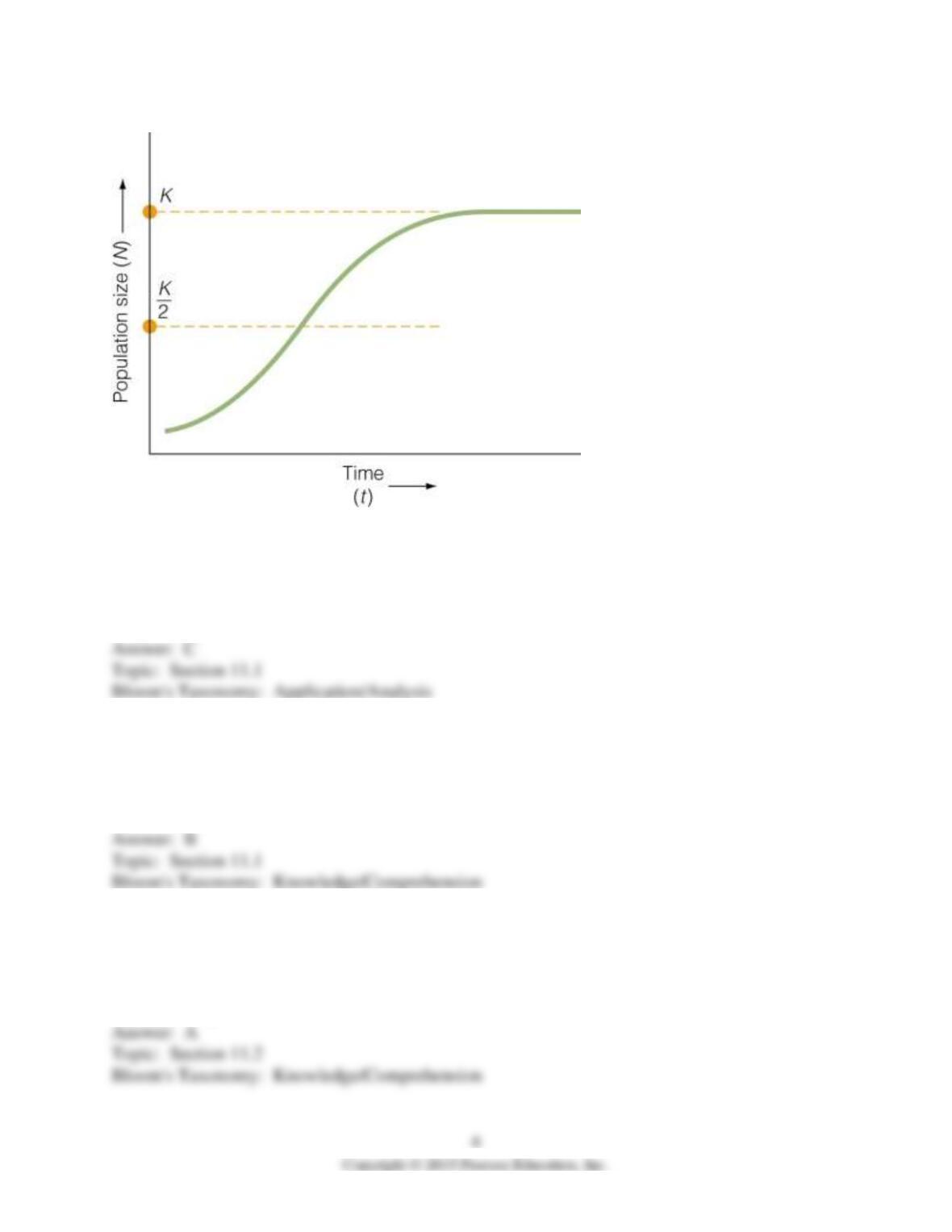
4)
The figure depicts which type of population growth?
A) exponential
B) normal
C) logistic
D) geometric
5) Under the logistic growth model, the rate of population growth is highest when
A) N = K
B) N = K/2
C) N = r
D) N = (1 – N/K)
6) Which of the following is a density-independent factor?
A) weather event
B) food availability
C) shelter availability
D) availability of mates
7) Density-independent population regulation
A) is usually catastrophic.
B) primarily affects large populations.
C) may involve disease transmission among individuals of the population.
D) results from competition among individuals for available resources.
8) The form of competition in which growth and reproduction are depressed equally across
individuals in a population as the intensity of competition increases is called
A) scramble competition.
B) contest competition.
C) exploitation competition.
D) interference competition.
9) When extreme contest competition occurs within a population,
A) all individuals receive insufficient resources for survival and reproduction.
B) local extinction may occur.
C) only a portion of the population suffers.
D) the growth rate of the population increases.
10) As the density of a population increases, the
A) survival rate increases.
B) reproductive rate increases.
C) intensity of intraspecific competition decreases.
D) individual growth rate decreases.
11) When experimental plants (e.g., Atriplex prostrata) were grown at high densities,
A) individual growth rates increased.
B) the proportion of resources allocated to leaf production increased.
C) individual plant weight increased.
D) net photosynthetic rate increased.
12) You see two squirrels fighting over a food resource. This most likely represents
A) scramble competition.
B) carrying capacity.
C) contest competition.
D) interspecific competition.
13) You see a plot of plants that is very dense and small and another plot of the same species
with fewer individuals but larger individual plants. What might be the cause of this pattern?
A) herbivory
B) contest competition
C) water availability
D) intraspecific competition
14) Self-thinning
A) is found only in populations of mobile organisms.
B) occurs at high population densities.
C) functions to increase the survival rate of all individuals in the population.
D) is a type of scramble competition.
15) Which of the following organisms would be most likely to present evidence of self-thinning?
A) frogs
B) barnacles
C) lions
D) birds
16) What might be an unforeseen outcome of planting soybean plants at high densities in a field?
A) reduced seed production per plant
B) increased plant size
C) increased seed size
D) decreased plant mortality
17) As population density increases in harp seals (Phoca groenlandica), females
A) become sexually mature at a smaller body size.
B) refuse to mate with males.
C) begin reproduction at a later age.
D) often cannibalize their own offspring.
18) Which statement about stress is incorrect?
A) Stress increases as population density increases.
B) Stress may trigger the release of specific chemical signals or pheromones.
C) Stress can stimulate growth and increase the rate of reproduction.
D) Stress may result in increased vulnerability to disease.
19) What is one mechanism through which increased density may cause infant mortality in
mammals?
A) reduced social contact causes stress
B) reduced seed bank causes a decrease of feed for infants
C) increased stress increases infant size
D) high stress environments may reduce lactation
20) One way to reduce density dependence is
A) dispersal.
B) via reduced resources.
C) via increased density.
D) via increased stress.
21) The individuals that disperse as a response to high population density are
A) mostly the younger members of the population.
B) more likely to survive.
C) mostly females.
D) usually superior competitors.
22) By organizing socially into a group, individual animals may benefit by
A) coexisting peacefully instead of fighting with group members for dominance.
B) reducing intraspecific competition for food.
C) increasing access to a common food supply.
D) equalizing the number of offspring produced by each group member.
23) In a wolf pack, the beta male
A) mates with all the females of the pack.
B) is subordinate to the alpha female.
C) is dominant over all members of the pack.
D) is usually closely related to the alpha male.
24) Social dominance can serve to
A) increase competition.
B) increase the number of mating pairs.
C) limit population size.
D) decrease the survival rate of a pack.
25) Which of the following is negatively correlated with territory size?
A) bird size
B) bird density
C) number of offspring
D) number of mates
26) Among mammals, the home range is usually larger for
A) carnivorous species than for herbivorous species of the same body size.
B) females than males of the same species.
C) immatures than for adults of the same species.
D) smaller species than for larger species.
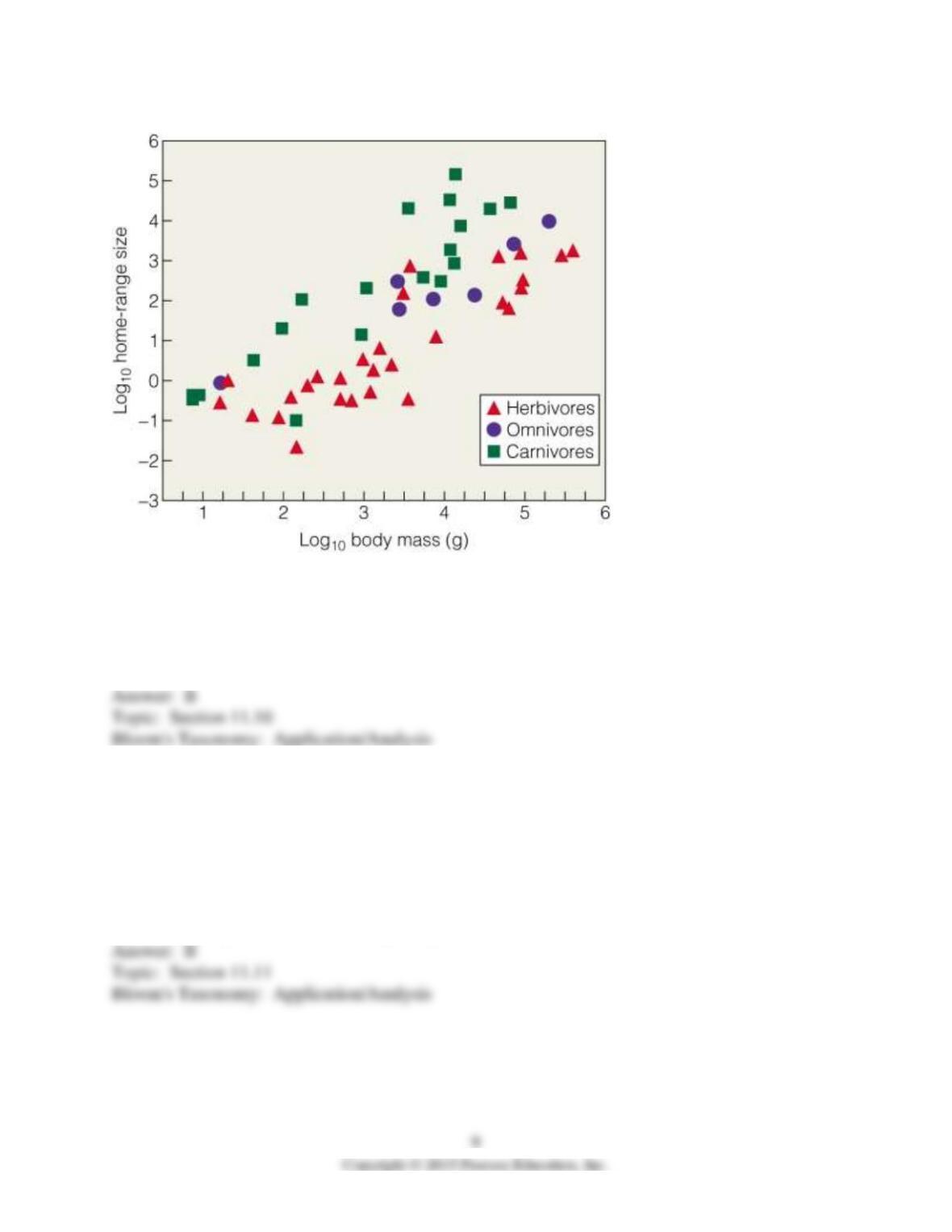
27)
This figures illustrates that territory size is positively correlated with
A) density.
B) body size.
C) feeding type.
D) rainfall.
28) Root competition among neighboring plants was studied by growing plants with their roots
inside tubes of PVC pipes. Some tubes had holes of varying sizes, allowing their neighbors’ roots
to enter the tubes of a target plant. As the percentage of a target plant’s tube open to neighbors’
roots increased,
A) both target plant biomass and neighbor plant root biomass decreased.
B) target plant biomass decreased and neighbor plant root biomass increased.
C) target plant biomass increased and neighbor plant root biomass decreased.
D) both target plant biomass and neighbor plant root biomass increased.
29) Plants can preempt both space and
A) time.
B) resources.
C) mates.
D) territory.
30) When individuals in a small population have difficulty finding a mate, this is referred to as
A) density dependence.
B) promiscuity.
C) the Allee effect.
D) self thinning.
31) A small population size of flowers can pose problems for the plant as a result of
A) poor quality soil.
B) lack of space.
C) lack of resources.
D) lack of pollinator visitation.
32) Which of the following factors is most likely to be a density-independent regulator of
population growth?
A) drought
B) disease
C) starvation
D) parasites
33) Which of the following represents an example of density-independent growth?
A) increased amphibian reproduction following a wet season
B) exponential population growth
C) logistic population growth
D) increase in predator population following increase in prey abundance
34) The fewest number of individuals necessary to ensure the long term survival of a population
is known as the
A) carrying capacity.
B) resource population.
C) lowest common denominator.
D) minimum viable population.
35) What is the minimum dynamic area?
A) the number of individuals necessary to ensure the long term survival of a population
B) the average area of an individual’s territory
C) the space needed for reproduction and raising of offspring
D) the area necessary for maintaining an MVP
36) The carrying capacity is the population size at which dN/dt
A) is positive.
B) is negative.
C) is equal to 0.
D) is equal to N.
37) Which of the following is equal to (1 – N/K)?
A) (N – K)/K
B) (K – N)/K
C) (K – N)/N
D) (N – K)/N
11.3 True/False Questions
1) No population continues to grow in size indefinitely.
2) The carrying capacity (K) of a population can vary depending on the supply of resources.
3) Density-dependent population regulation occurs only at high population densities.
4) Competition for resources is a density-independent factor affecting a population.
5) The influence of density-independent factors on populations is generally less predictable than
the influence of density-dependent factors.
6) Scramble competition results in some individuals in the population getting more resources
than others.
7) As intraspecific competition increases, growth and development are affected first, followed by
individual survival and reproduction.
8) High-density conditions caused no noticeable change in the behavior of experimental wood
frog (Rana sylvatica) tadpoles.
9) Increasing density does not affect the body mass of individual organisms.
10) Population density can affect the age at which an animal matures.
11) The rate of aggressive interactions among individuals increases as population density
increases.
12) As the density of a population increases, dispersal usually decreases.
13) Dispersal is not a population regulatory mechanism.
14) Social organization occurs only among invertebrate animals such as ants, bees, and termites.
15) The home range of an animal is always defended.
16) Territorial behavior includes some form of advertisement, threat, and combat.
17) When a given area is saturated with territories, excluded individuals who lack a territory
soon die of starvation.
18) Plants can capture and defend space.
19) Fire is an example of a density-independent factor that affects the size of a population.
11.4 Essay Questions
1) What is the difference between exponential growth and logistic growth? Under what
ecological conditions does each occur?
2) Define density-dependent and density-independent mechanisms of population regulation and
give three examples of each.
3) Define competition. Compare and contrast scramble and contest competition.
4) Pick either a plant or an animal and discuss how the individuals in either category would be
affected by high population density.
5) Explain why high population density might stress an organism. Provide several examples of
some of the negative impacts of stress on an organism.
6) Explain why the timing of dispersal during low or high population density states can have
very different impacts on the population.
7) Discuss the organization of a typical social group and explain how the organization is
maintained.
8) What is the difference between a home range and a territory? What factors may affect the size
of a home range?
9) Give a specific example of how a density-independent factor affects a population. Explain
why density-independent factors are less predictable in their effects than density-dependent
factors.