47. The primary reason for government regulation of business is
a. hypercompetition.
b. central planning of the
economy.
c. market
failure.
d. lobbying efforts by business.
48. Which of the following is not a major reason given for governmental regulation?
a. controlling natural monopolies
b. controlling negative externalities
c. achieving social goals
d. maintaining a trade surplus with foreign countries
49. A market in which the economies of scale are so great that the largest firm has the lowest costs and is able to
drive
out competitors is called
a(n)
a. natural monopoly.
b. market
failure.
c. externality.
d. deregulated industry.
50. Government intervention in monopolistic industries is often brought about
by
a. requests from smaller
competitors.
b. class-action
lawsuits.
c. anticompetitive practices.
d. frequent bankruptcies within the industries.
51. Negative externalities are often referred to as
a. full absorption costs.
b. social
costs.
c. allocated
costs.
d. envirornnental costs.
52. Government regulation of business through the control of economic or market variables is a form
of
a. negative externality.
b. social
cost.
c. economic regulation.
d. indirect
cost.
53. Governmental regulations that seek to further societal objectives are examples
of
a. social regulation.
b. economic regulation.
c. envirornnental control.
d. central planning.
54. Social regulation’s focus on people encompasses their roles as all of the following
except
a. employees.
b. consumers.
c. citizens.
d. business
owners.
55. The newest type of social regulations is concerned primarily with
a. envirornnental protection.
b. corporate
welfare.
c.
security.
d. educational reform.
56. The dilemma of regulation is the tradeoff
between
a. cost and
efficiency.
b. effective control and the burden placed on
firms.
c. private gain and public good.
d.
individualistic
and collectivistic goals.
57. Which of the following is not considered a part of the induced costs of
regulation?
a. the effect on
innovation
b. the effect on investments in plant and
equipment
c. the effect on small
business
d. the effect on
consumers
58. The primary purpose of deregulation is to
a. decrease competition in the affected
industries.
b. remove certain industries from old-line economic regulations.
c. protect the natural envirornnent.
d. allow natural monopolies to
form.
59. The dilemma of deregulation is
a. to enhance competition within the industry without harming workers’
status.
b. to enhance competition within the industry without sacrificing applicable social regulations.
c. to prevent monopolies without allowing hypercompetition.
d. to provide business more freedom without completely abandoning goverrnnental authority.
60. Which of the following industries has not been affected by
deregulation?
a. fmancial
services.
b. trucking
c. computer
software
d. airline
61. Which of the following is not a role increasing goverrnnent’s complex relationship with business?
a. government is a major
purchaser.
b. goverrnnent can elevate some businesses while devaluing others.
c. goverrnnent cannot have buying
power
d. goverrnnent can create new businesses through
subsidization.
62. Which of the following is not a concern expressed by executives about government involvement in
business?
a. it is difficult to determine the best way to work productively with
government.
b.
regulators and policy makers do not understand the economics of their
industry
c. government blames business for society’s problems
d. U.S adults said government should do
more
63. The newer form of industrial policy is exemplified by:
a. a focus on enabling industrialization.
b. Karl Aiginer’s book, “Industrial Policy: A Dying Breed or a Re-emerging
Phoenix?”
c. policy that does not conflict with widely held view on the role of government in the
economy.
d. Robert Reich’s book, “American
Frontier.”
64. Arguments against privatization include all of these
except:
a. social goals.
b. service provisions.
c. public backlash.
d. safety
concerns.
65. Which of the following is not an effect of induced
costs?
a. small businesses may be adversely
affected.
b. new agencies may be
created.
c. new investments in plant and equipment may be
affected.
d. innovation may be affected.
Provide
a short answer to each of these
questions.
Be sure to fully explain your
answer.
66. Why is it incumbent upon goverrnnent to promote social goals such as safe working envirornnents, clean air, and
safe
products?
67. Discuss the ability of the public or its goverrnnent to establish social priorities.
68. Who determines the public
interest?
69. Discuss the likelihood that the United States can develop a planned, successful industrial policy.
70. Distinguish between producing a service and providing a service. Why is this distinction important in the debate over
privatization?
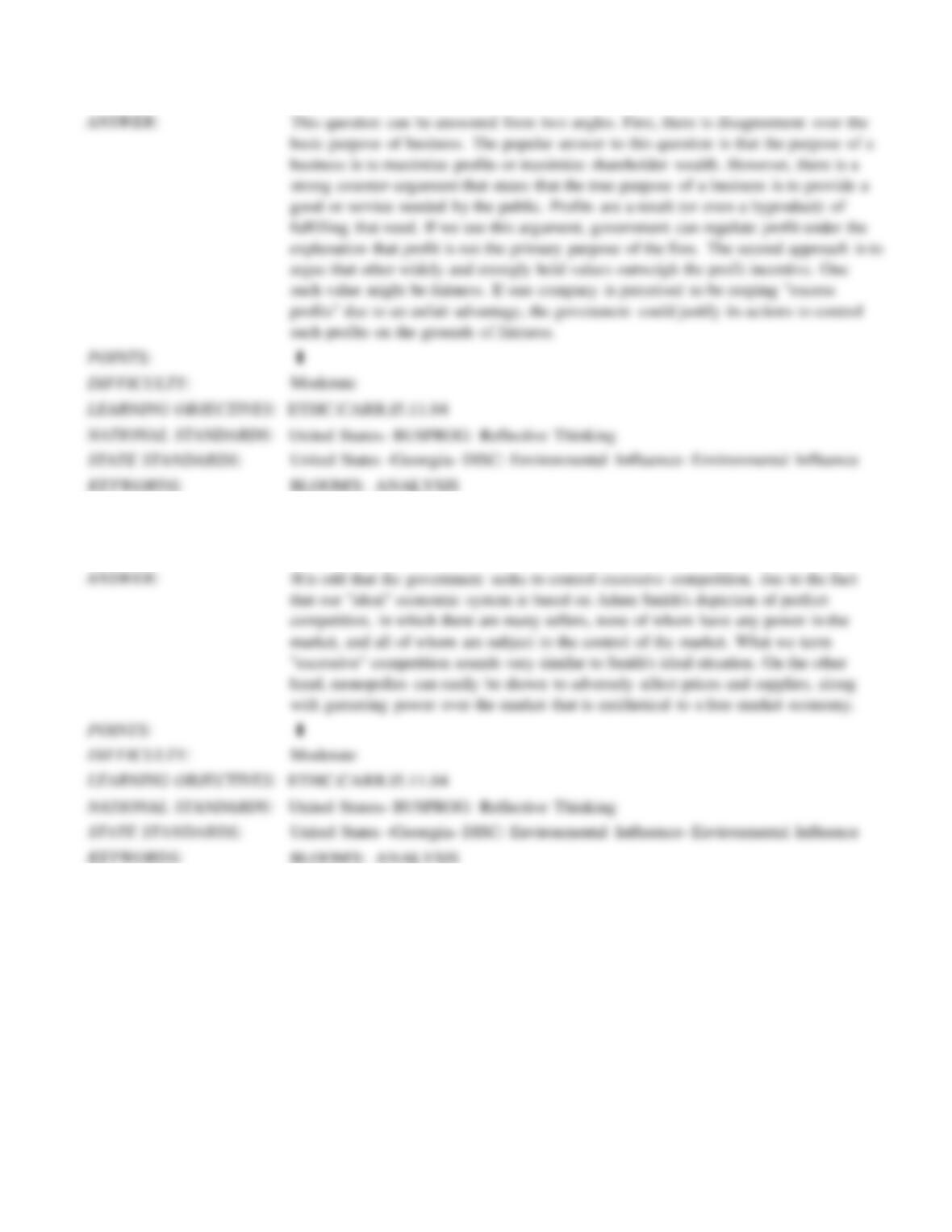
71. In an economy that says it seeks to maximize profits for the individual finn, how can the United States
govenunent
justify regulating business to control excess profits?
72. One reason that government might regulate business is to control excessive competition. Govenunent also regulates
business to control natural monopolies. Which situation is worse—monopoly or excessive competition?
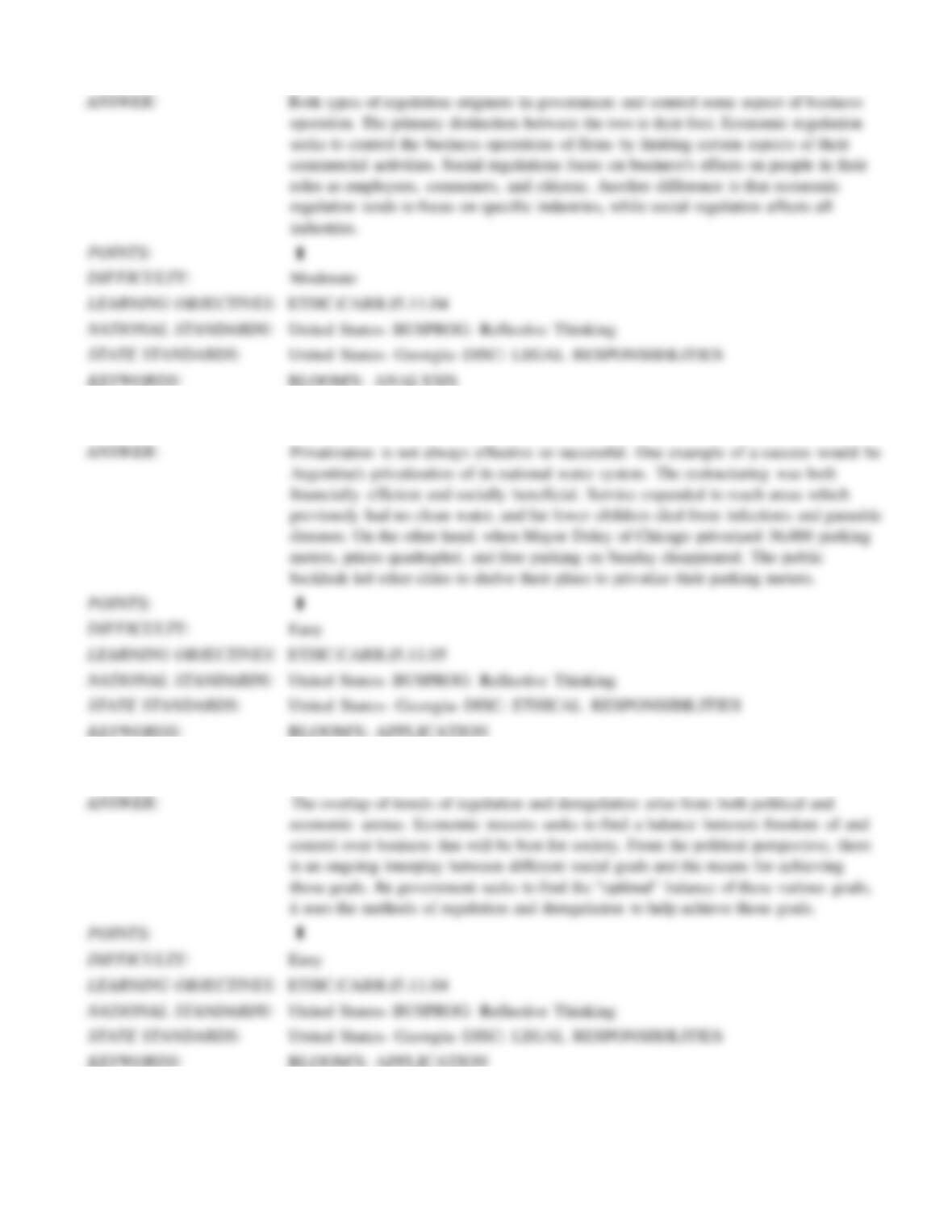
73. Compare and contrast economic regulation and social regulation.
74. Is privatization always effective or successful? Give examples of a success and a
failure.
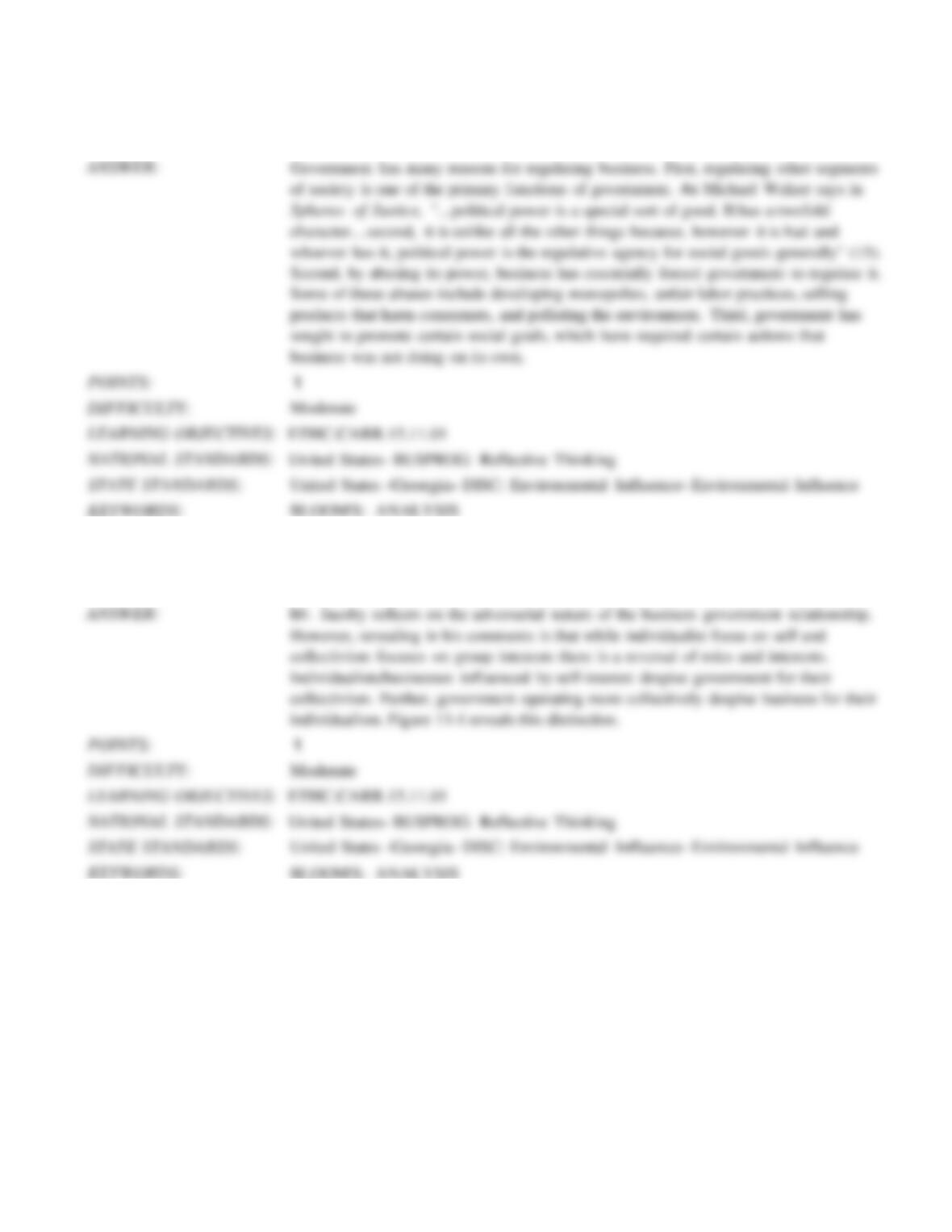
75. Discuss the reasons for the overlapping trends of regulation and
deregulation.
Utilize the
knowledge
you have gained to
respond
to the
following
essay
questions. Your answers should
state
your position and use logical
arguments
and
content
from this and
other chapters
in the
textbook to
support it.
76. Why does government regulate
business?
77. According to the authors, the tension between business and govermnent is “a clash of ethical systems.” If it is,
compare such a viewpoint with Neil Jacoby’s comments provided in the
text.
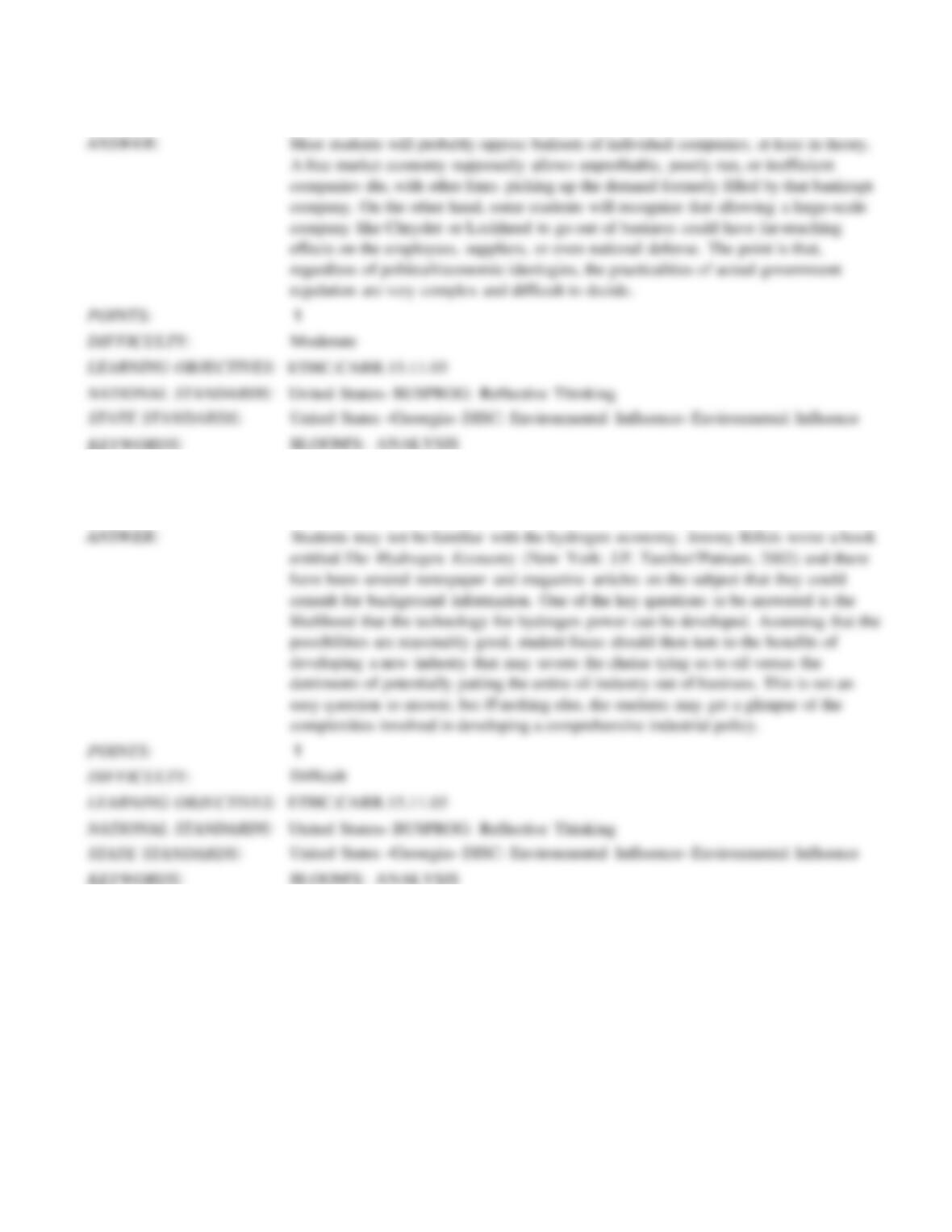
78. Industrial policy sometimes allows, or requires, government fmancial assistance to certain industries (e.g., the
airline
industry or the railroad industry). In addition to industry-wide assistance, the goverrnnent has on occasion provided
bailouts for individual fmns. Is bailing out a specific company an appropriate use of goverrnnent regulation?
79. Using the arguments for and against industrial policy, discuss the benefits and detriments of goverrnnent support
for
the hydrogen economy (i.e., using hydrogen as a primary source of fuel to replace oil
).
80. Regulation imposes new costs on business, including direct, indirect, and induced costs. Which type of additional
cost
is most important to consider in the regulation process?
81. Given information from this chapter, can goverrnnents manage more ethically than
capitalism?
82. Articulate a brief history of government’s role in
business.
83. Describe the history of the U.S. government as to industries in
distress.