Chapter 11: Current Liabilities and Payroll
117.
The journal entry a company uses to record accrued vacation privileges for its employees at the end of the year is
a.
debit Vacation Pay Expense; credit Vacation Pay Payable
b.
debit Vacation Pay Payable; credit Vacation Pay Expense
c.
debit Salary Expense; credit Cash
d.
debit Salary Expense; credit Salaries Payable
118.
The journal entry a company uses to record fully funded pension rights for its salaried employees at the end of
the
year is
a.
debit Salary Expense; credit Cash
b.
debit Pension Expense; credit Unfunded Pension Liability
c.
debit Pension Expense; credit Unfunded Pension Liability and Cash
d.
debit Pension Expense; credit Cash
119.
The journal entry a company uses to record partially funded pension rights for its salaried employees at the end
of
the year is
a.
debit Salary Expense; credit Cash
b.
debit Pension Expense; credit Unfunded Pension Liability
c.
debit Pension Expense; credit Unfunded Pension Liability and Cash
d.
debit Pension Expense; credit Cash
Chapter 11: Current Liabilities and Payroll
120.
The journal entry a company uses to record pension rights that have not been funded for its salaried employees
at
the end of the year is
a.
debit Salary Expense; credit Cash
b.
debit Pension Expense; credit Unfunded Pension Liability
c.
debit Pension Expense; credit Unfunded Pension Liability and Cash
d.
debit Pension Expense; credit Cash
121.
Zennia Company provides its employees with varying amounts of vacation per year, depending on the length
of
employment. The estimated amount of the current year’s vacation cost is $135,000. The journal entry to
record
the adjusting entry required on December 31, the end of the current year, to record the current month’s
accrued
vacation pay is
a. $135,000
b. $67,500
c.
$0
d. $11,250
122.
Hall Company sells merchandise with a one-year warranty. In the current year, sales consisted of 4,500 units. It
is estimated that warranty repairs will average $10 per unit sold, and 30% of the repairs will be made in the
current
year and 70% in the next year. In the current year’s income statement, Hall should show warranty
expense of
a. $45,000
b. $13,500
c. $31,500
d.
$0
Chapter 11: Current Liabilities and Payroll
123.
During September, Excom sold 100 radios for $50 each and provided a two-year warranty with each unit. Each
radio cost Excom $30 to produce. If 5% of the goods sold typically need to be replaced over the warranty
period
and one is actually replaced during September, for what amount in September would Excom debit
Product
Warranty Expense?
a. $50
b. $150
c. $30
d. $120
124.
Wright Company sells merchandise with a one-year warranty. This year, sales consisted of 2,000 units. It is
estimated that warranty repairs will average $15 per unit sold, and 30% of the repairs will be made this year
and
70% next year. In this year’s income statement, Wright should show warranty expense of
a. $9,000.
b. $21,000.
c. $30,000.
d. $0.
125.
Scott Company sells merchandise with a one-year warranty. Sales consisted of 2,500 units in Year 1 and 2,000
units in Year 2. It is estimated that warranty repairs will average $10 per unit sold, and 30% of the repairs will be
made in Year 1 and 70% in Year 2 for the Year 1 sales. Similarly, 30% of repairs will be made in Year 2 and
70%
in Year 3 for the Year 2 sales. In the Year 3 income statement, how much of the warranty expense shown
will be
due to Year 1 sales?
a. $6,000.
b. $14,000.
c. $20,000.
d. $0.
Chapter 11: Current Liabilities and Payroll
126.
The cost of a product warranty should be included as an expense in the
a.
period the cash is collected for a product sold on account
b.
future period when the cost of repairing the product is paid
c.
period of the sale of the product
d.
future period when the product is repaired or replaced
127.
McKay Company sells merchandise with a one-year warranty. In Year 1, sales consisted of 1,200 units. It is
estimated that warranty repairs will average $10 per unit sold, and 30% of the repairs will be made in Year 1
and
70% in Year 2. In the Year 1 income statement, McKay should show warranty expense of
a. $3,600
b. $8,400
c. $12,000
d. $0
128.
During May, Blast sold 650 portable CD players for $50 each and provided a one-year warranty with each unit.
Each CD player cost Blast $25 to produce. If 10% of the goods sold typically need to be replaced over the
warranty period, for what amount should Blast debit Product Warranty Expense in May?
a. $3,250
b. $1,625
c. $650
d. $1,300
Chapter 11: Current Liabilities and Payroll
129.
Estimating and recording product warranty expense in the period of the sale best follows the
a.
cost concept
b.
business entity concept
c.
matching concept
d.
materiality concept
130.
The journal entry a company uses to record the estimated product warranty liability expense is
a.
debit Product Warranty Expense; credit Product Warranty Payable
b.
debit Product Warranty Payable; credit Cash
c.
debit Product Warranty Expense; credit Cash
d.
debit Product Warranty Payable; credit Product Warranty Expense
131.
Which of the following is the most desirable quick ratio?
a. 2.20
b. 1.80
c. 1.95
d. 1.50
Chapter 11: Current Liabilities and Payroll
132.
The Crafter Company has the following assets and liabilities:
ASSETS
Cash
$28,000
Accounts receivable
15,000
Inventory
20,000
Equipment
50,000
LIABILITIES
Current portion of long-term debt
10,000
Accounts payable
2,000
Long-term debt
25,000
Determine the quick ratio (rounded to one decimal point).
a. 5.3
b. 3.6
c. 3.3
d. 2.3
Chapter 11: Current Liabilities and Payroll
133.
Based on the following data, what is the quick ratio, rounded to one decimal point?
Accounts payable $ 30,000
Accounts receivable 60,000
Accrued liabilities 5,000
Cash 30,000
Intangible assets 50,000
Inventory 69,000
Long-term investments 80,000
Long-term liabilities 100,000
Marketable securities 30,000
Fixed assets 670,000
Prepaid expenses 1,000
a. 3.4
b. 3.0
c. 2.2
d. 1.8
134.
Quick assets include
a.
cash, cash equivalents, receivables, prepaid expenses, and inventory
b.
cash, cash equivalents, receivables, and prepaid expenses
c.
cash, cash equivalents, receivables, and inventory
d.
cash, cash equivalents, and receivables
Chapter 11: Current Liabilities and Payroll
135.
The Young Company has the following assets and liabilities:
ASSETS
Cash
$35,000
Accounts receivable
15,000
Inventory
30,000
Equipment
50,000
LIABILITIES
Current portion of long-term debt
10,000
Accounts payable
2,000
Long-term debt
25,000
Determine the quick ratio (rounded to one decimal point).
a. 6.7
b. 13.0
c. 4.2
d. 3.5
136.
Which of the following is the most desirable quick ratio?
a. 1.20
b. 1.00
c. 0.95
d. 0.50
Chapter 11: Current Liabilities and Payroll
137.
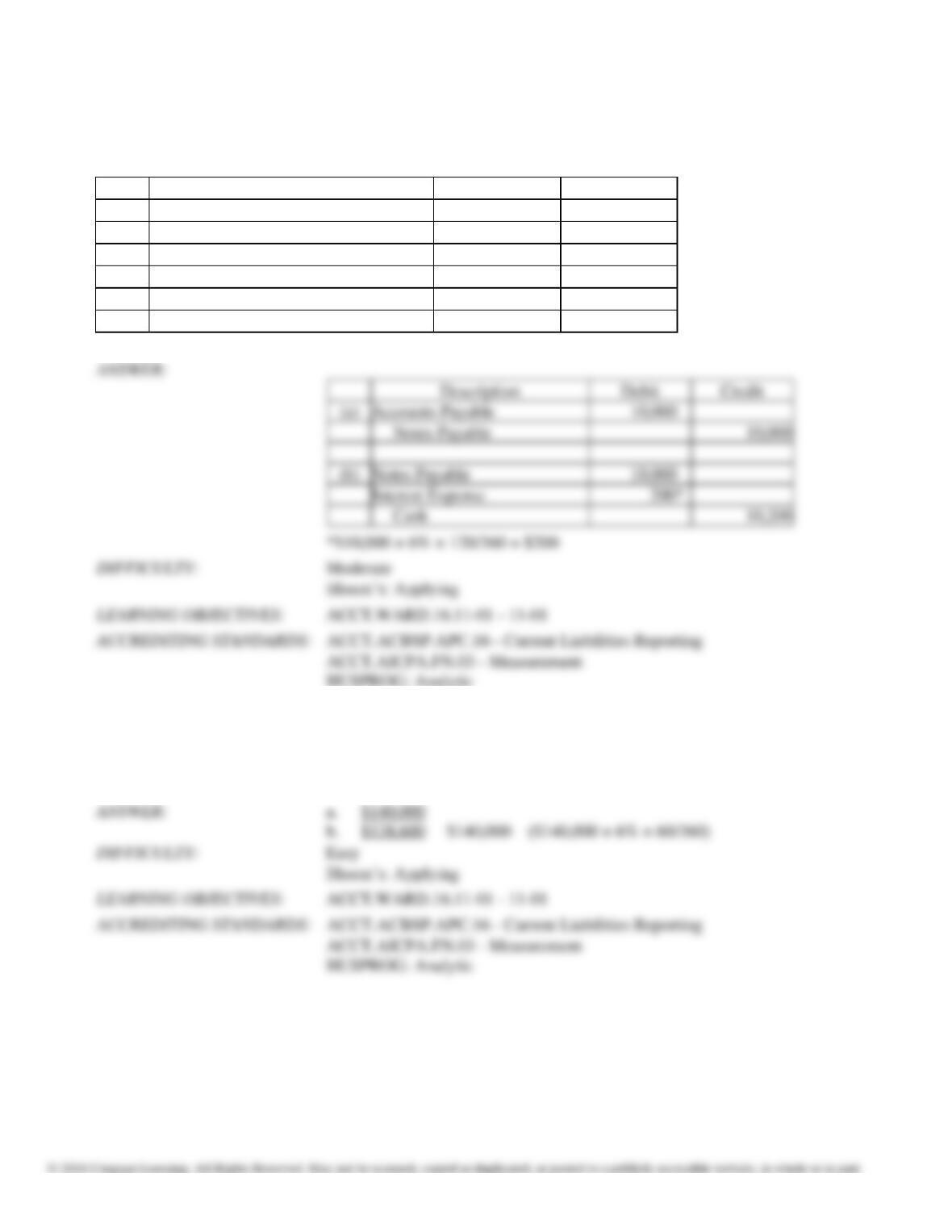
A business issued a 120-day, 6% note for $10,000 to a creditor on account. The company uses a 360-day year for
interest calculations. Journalize the entries to record (a) the issuance of the note and (b) the payment of the note at
maturity, including interest.
Description
Debit
Credit
(a)
(b)
138.
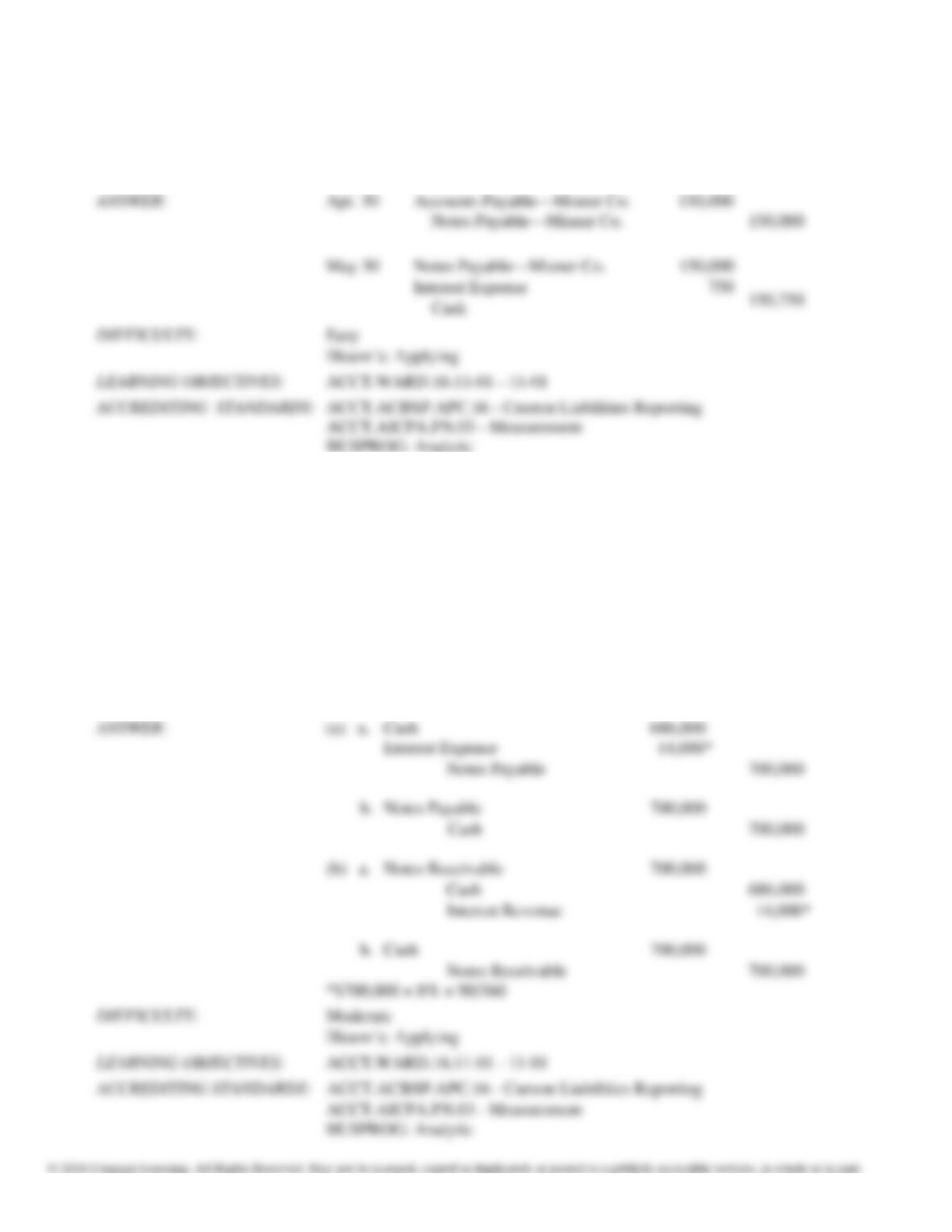
On August 1, Batson Company issued a 60-day note with a face amount of $140,000 to Jergens Company
for
merchandise inventory. (Assume a 360-day year is used for interest calculations.)
a.
Determine the proceeds of the note assuming the note carries an interest rate of 6%.
b.
Determine the proceeds of the note assuming the note is discounted at 6%.
Chapter 11: Current Liabilities and Payroll
139.
Journalize the following, assuming a 360-day year is used for interest calculations:
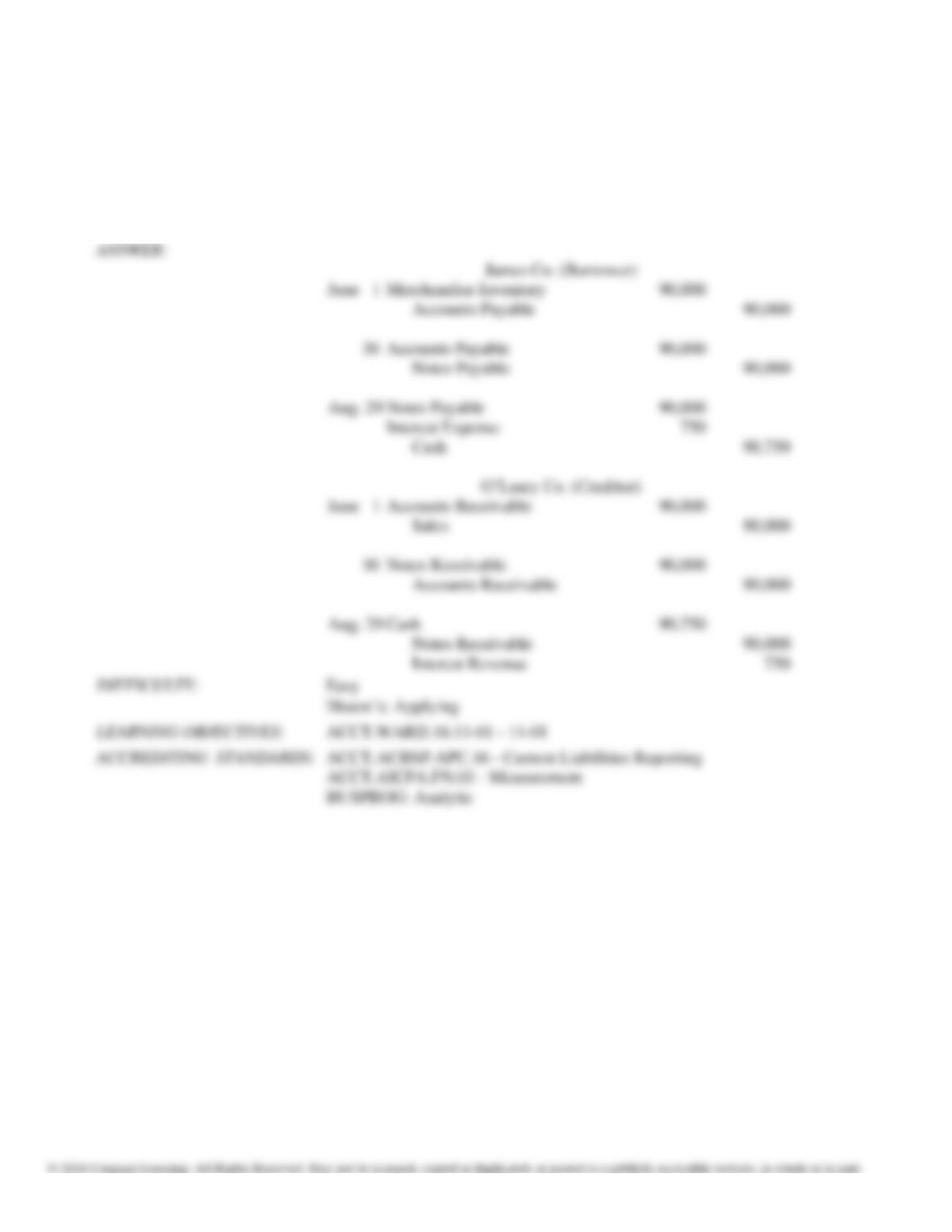
Apr. 30 Issued a $150,000, 30-day, 6% note dated April 30 to Misner Co. on account.
May 30 Paid Misner Co. the amount owed on the note dated April 30.
140.
Roseland Design borrowed $700,000 on a 90-day note from CorpOne Funding Company. CorpOne discounts
the
note at 8%. (Assume a 360-day year is used for interest calculations.)
(a)
Journalize Roseland’s entries to record:
a.
The issuance of the note.
b.
The payment of the note at maturity.
(b)
Journalize CorpOne’s entries to record:
a.
The receipt of the note.
b.
The receipt of the payment of the note at maturity.
Chapter 11: Current Liabilities and Payroll
141.
Journalize the following entries on the books of the borrower and creditor. Label accordingly. (Assume a 360–
day
year is used for interest calculations.)
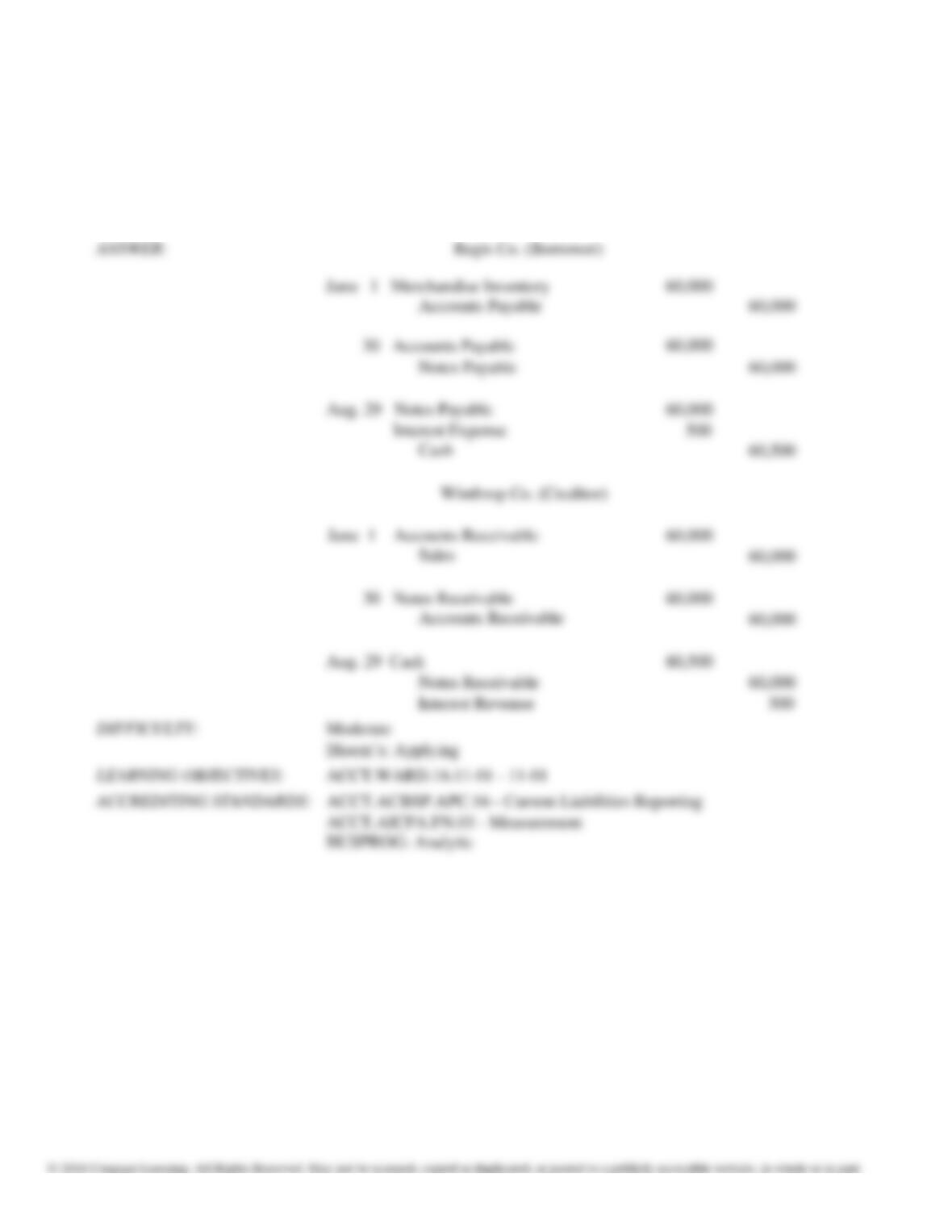
Jun. 1 James Co. purchased merchandise on account from O’Leary Co., $90,000, terms n/30.
Jun. 30 James Co. issued a 60-day, 5% note for $90,000 on account.
Aug. 29 James Co. paid the amount due.
Chapter 11: Current Liabilities and Payroll
142.
Journalize the following entries on the books of the borrower and creditor. Label accordingly. (Assume a 360–
day
year is used for interest calculations.)
Jun. 1 Regis Co. purchased merchandise on account from Winthrop Co., $60,000, terms n/30.
Jun. 30 Regis Co. issued a 60-day, 5% note for $60,000 on account.
Aug. 29 Regis Co. paid the amount due.
Chapter 11: Current Liabilities and Payroll
143.
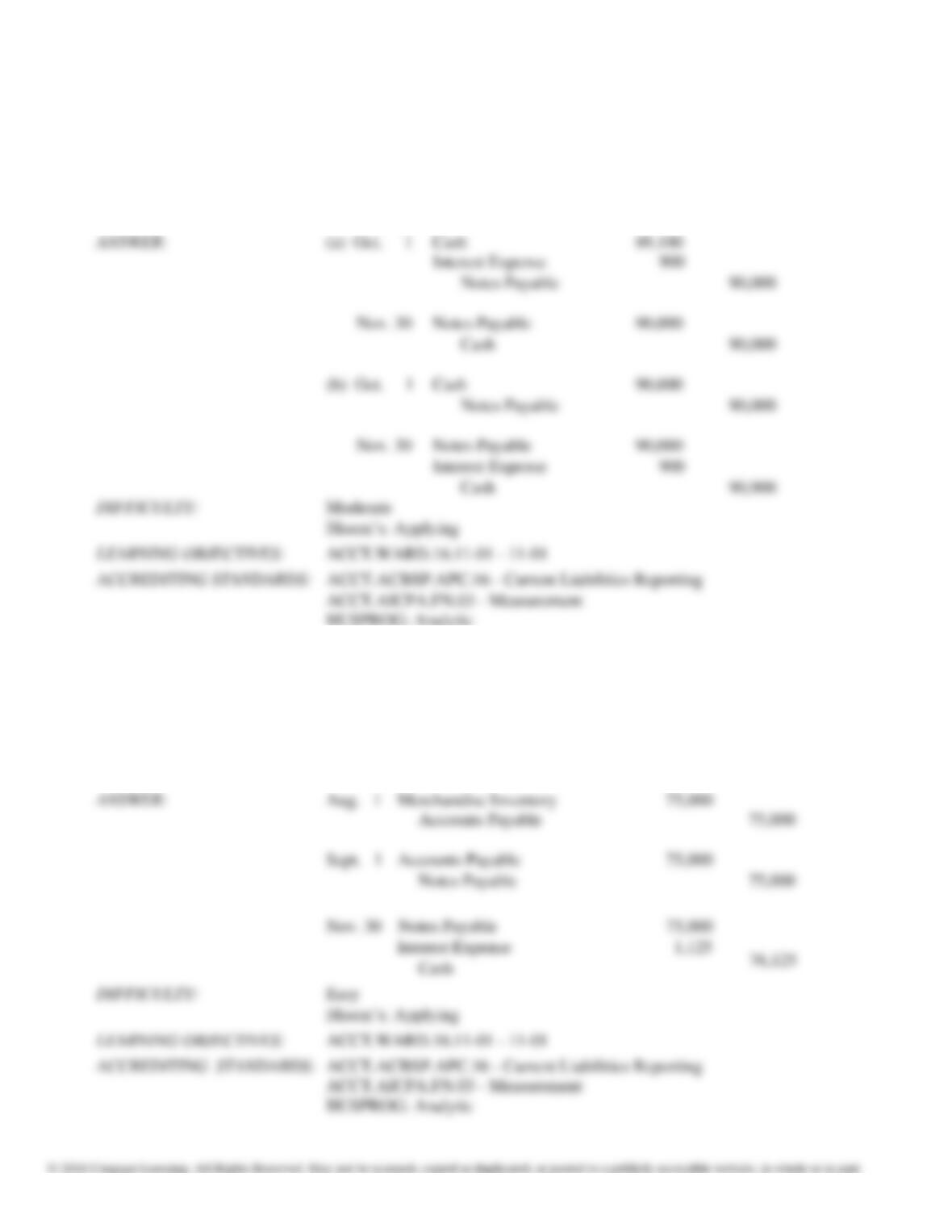
On October 1, Ramos Co. signed a $90,000, 60-day discounted note at the bank. The discount rate was 6%, and
the note was paid on November 30. (Assume a 360-day year is used for interest calculations.)
(a)
Journalize the entries for October 1 and November 30.
(b)
Assume that Ramos Co. signed a 6% note. Journalize the entries for October 1 and
November 30.
144.
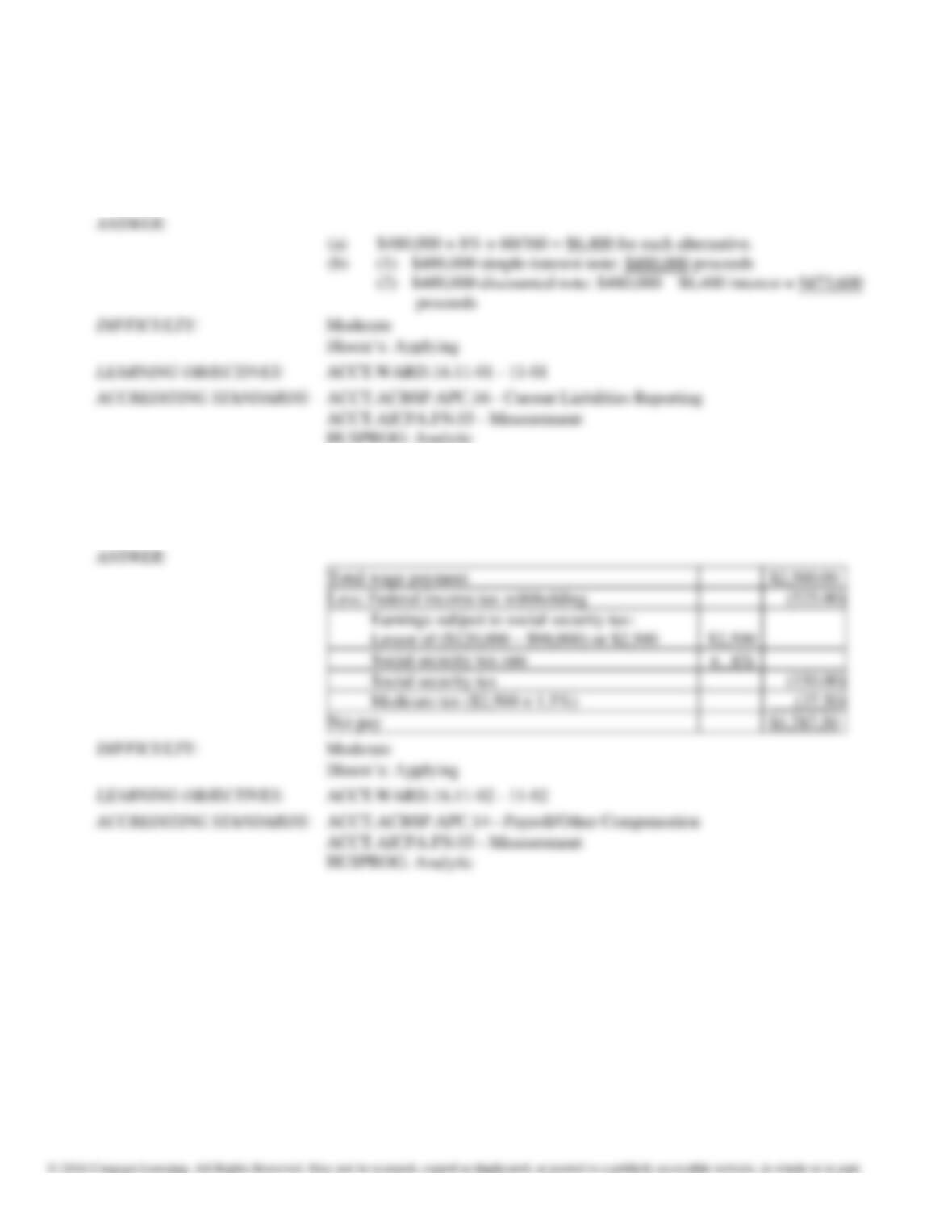
Journalize the following entries on the books of Winston Co. for August 1, September 1, and November
30.
(Assume a 360-day year is used for interest calculations.)
Aug. 1 Winston Co. purchased merchandise for $75,000 on account from Bagley Co., terms n/30.
Sept. 1 Winston Co. issued a 90-day, 6% note for $75,000 on account.
Nov. 30 Winston Co. paid the amount due.
Chapter 11: Current Liabilities and Payroll
145.
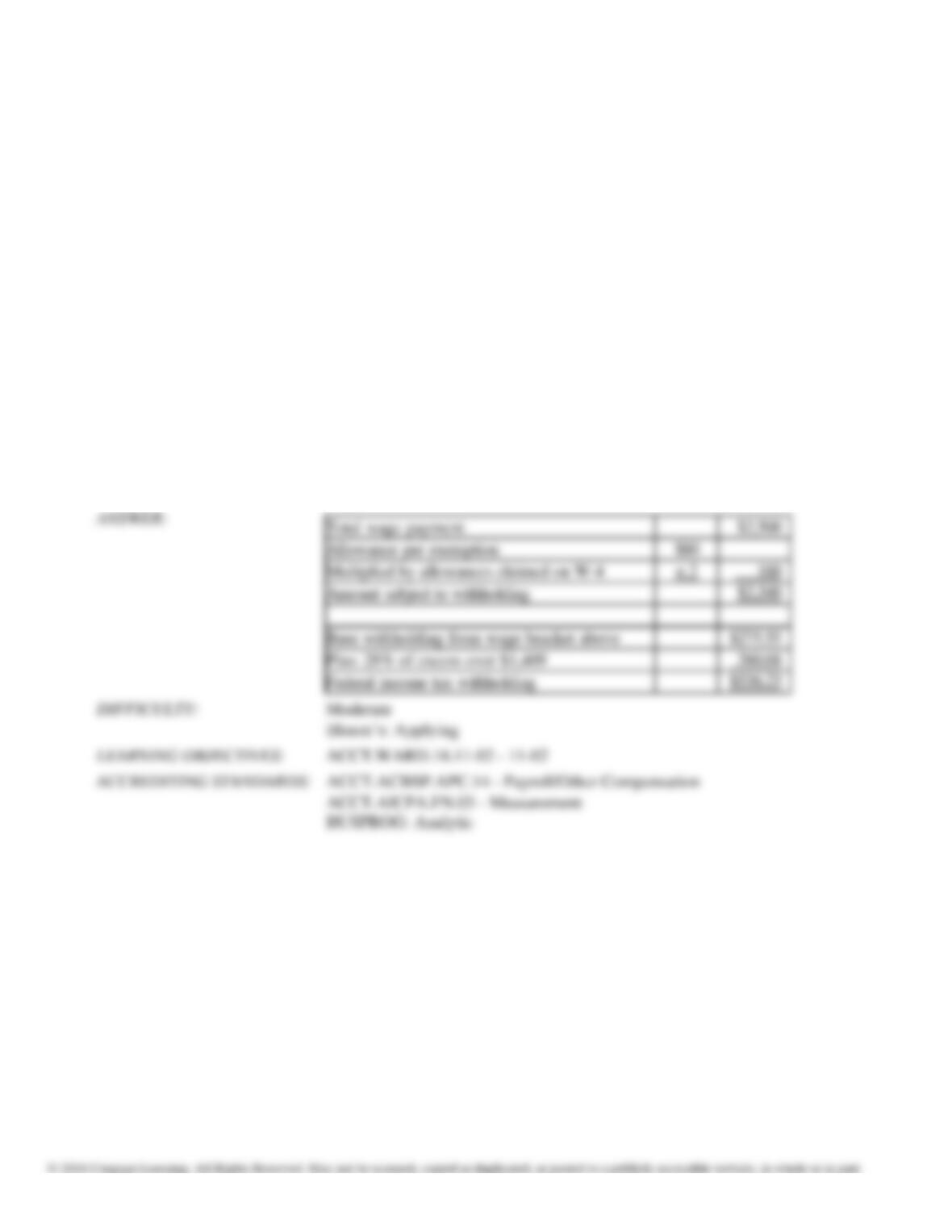
A borrower has two alternatives for a loan: (a) issue a $480,000, 60-day, 8% note or (2) issue a $480,000, 60–
day
note that the creditor discounts at 8%. (Assume a 360-day year is used for interest calculations.)
(a)
Calculate the amount of the interest expense for each option.
(b)
Determine the proceeds received by the borrower in each situation.
146.
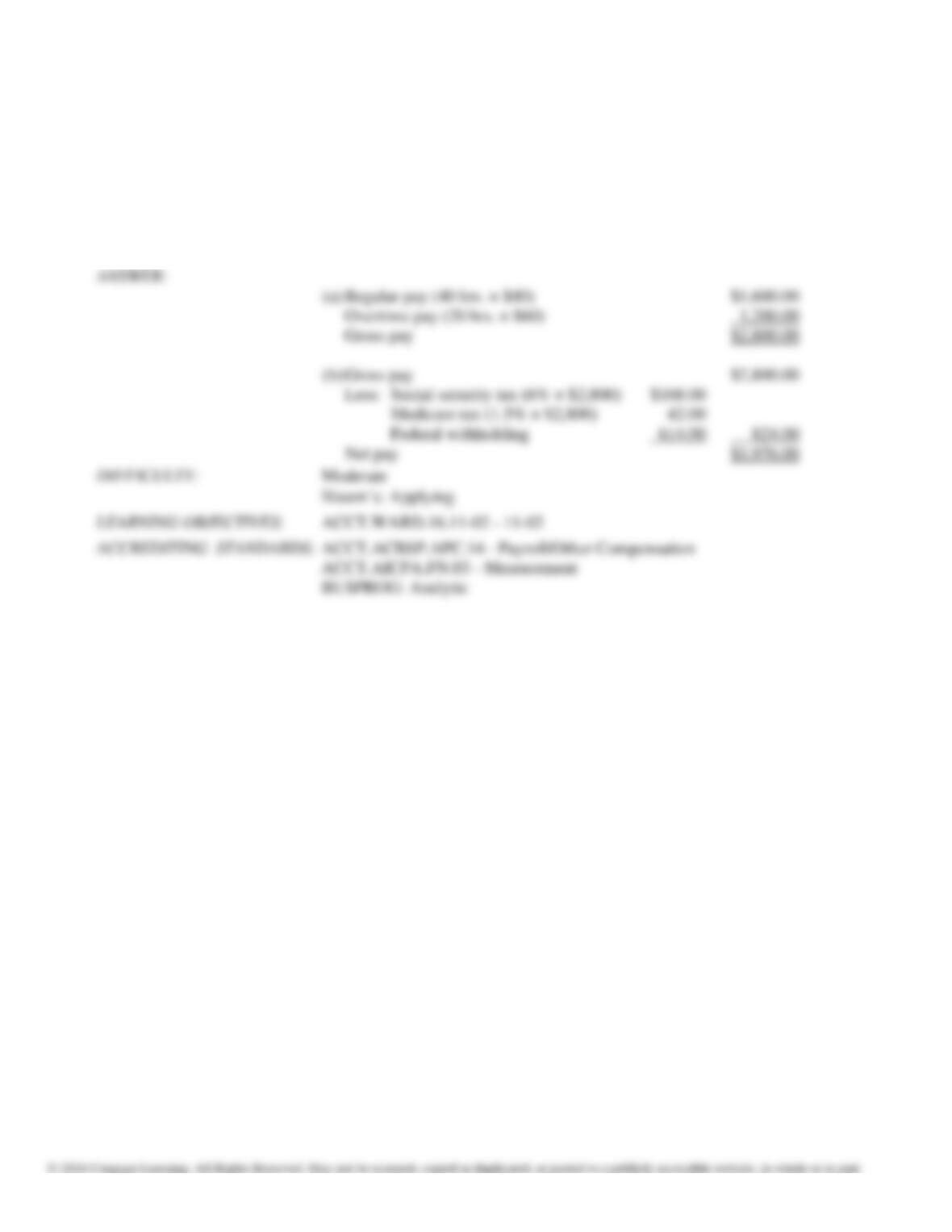
Baker Green’s weekly gross earnings for the week ending December 7 were $2,500, and her federal income tax
withholding was $525. Prior to this week Green had earned $98,000 for the year. Assuming the social security
rate is 6% and Medicare is 1.5%, what is Green’s net pay?
Chapter 11: Current Liabilities and Payroll
147.
John Woods’ weekly gross earnings for the present week were $2,500. Woods has two exemptions. Using $80
value for each exemption and the tax rate schedule below, what is Woods’ federal income tax withholding?
Single person (including head of household)
If amount of wages
(after subtracting
withholding
allowance) is:
The amount of income tax
withholding is:
of excess over:
Not over $51
$0
Over-
$51
But not over-
-$192…….10%
of excess over –
–$51
$192
-$620…….$14.10 plus 15%
–$192
$620
-$1,409….$78.30 plus 25%
–$620
$1,409
-$3,013….$275.55 plus 28%
-$1,409
$3,013
-$6,508….$724.67 plus 33%
-$3,013
$6,508
……………..$1,878.02 plus 35%
-$6,508
Chapter 11: Current Liabilities and Payroll
148.
An employee earns $40 per hour and 1.5 times that rate for all hours in excess of 40 hours per week. Assume
that
the employee worked 60 hours during the week, and that the gross pay prior to the current week totaled
$58,000. Assume further that the social security tax rate was 6.0%, the Medicare tax rate was 1.5%, and the
federal income tax to be withheld was $614.
(a)
Determine the gross pay for the week.
(b)
Determine the net pay for the week.
Chapter 11: Current Liabilities and Payroll
149.
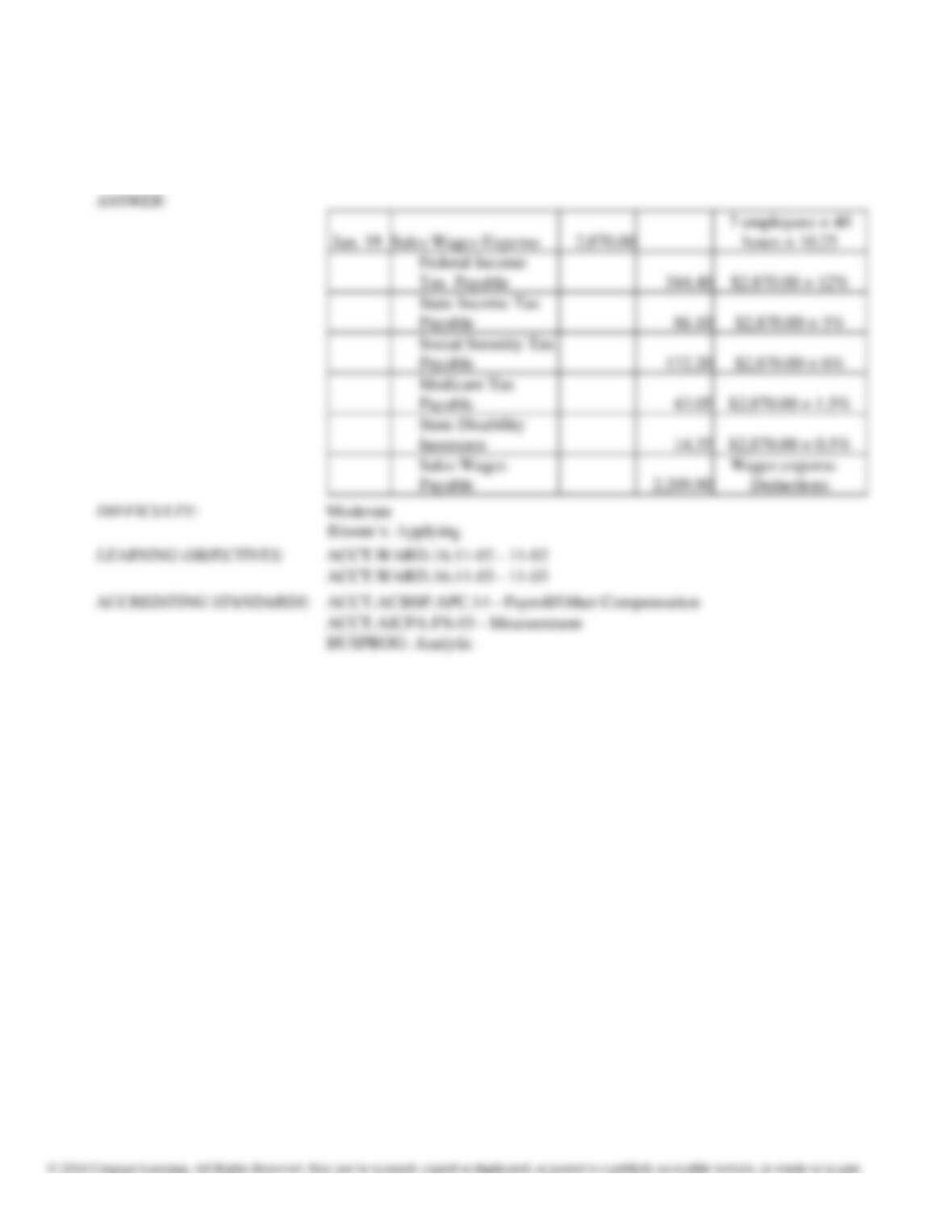
Dixon Sales has seven sales employees that receive weekly paychecks. Each earns $10.25 per hour and each has
worked 40 hours in the pay period. Each employee pays 12% of gross in federal income tax, 3% in state income
tax, 6% of gross in social security tax, 1.5% of gross in Medicare tax, and 0.5% in state disability insurance.
Journalize the recognition of the pay period ending January 19 which will be paid to the employees January 26.
Chapter 11: Current Liabilities and Payroll
150.
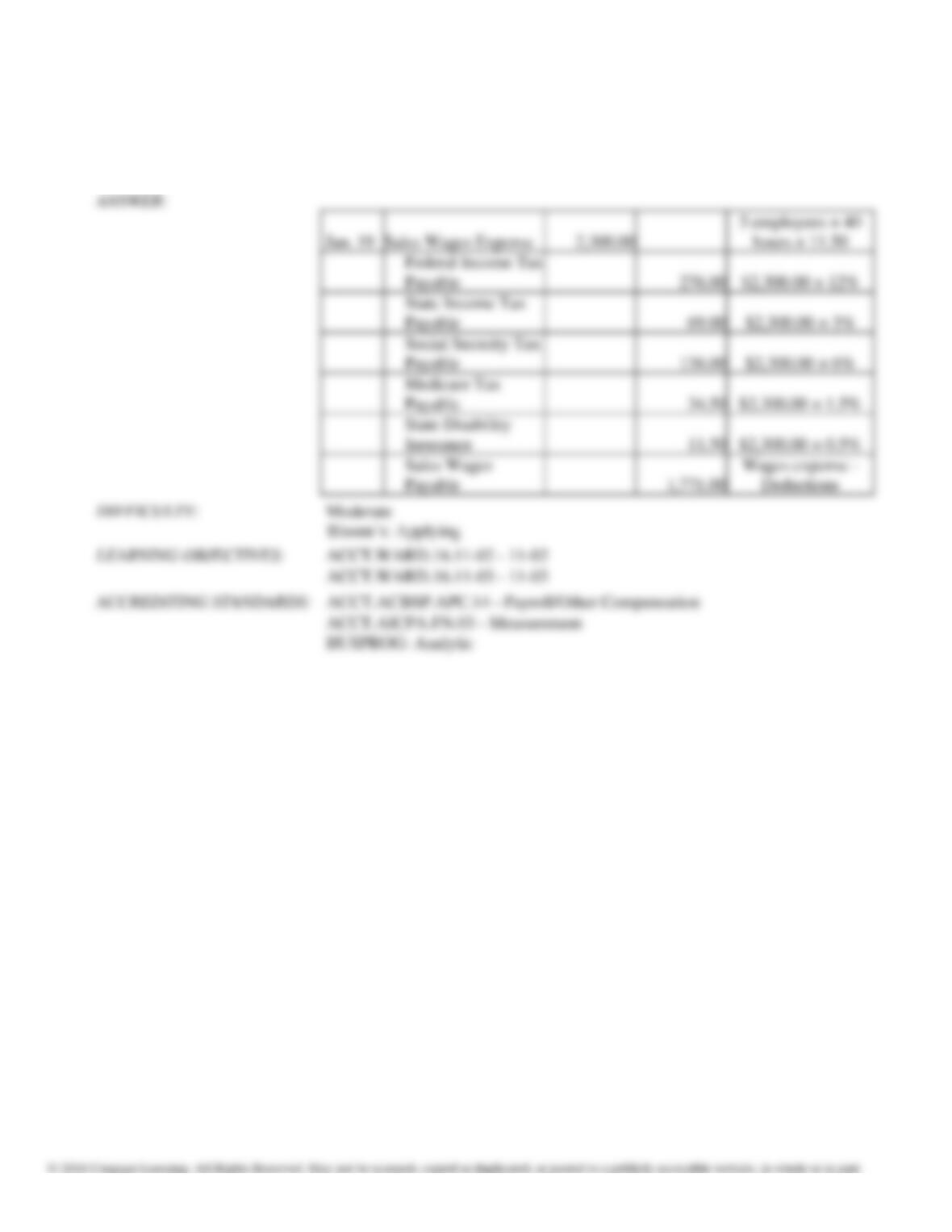
Mobile Sales has five sales employees which receive weekly paychecks. Each earns $11.50 per hour and each has
worked 40 hours in the pay period. Each employee pays 12% of gross in federal income tax, 3% in state income
tax, 6% of gross in social security tax, 1.5% of gross in Medicare tax, and 0.5% in state disability insurance.
Journalize the pay period ending January 19 which will be paid to the employees January 26.
Chapter 11: Current Liabilities and Payroll
151.
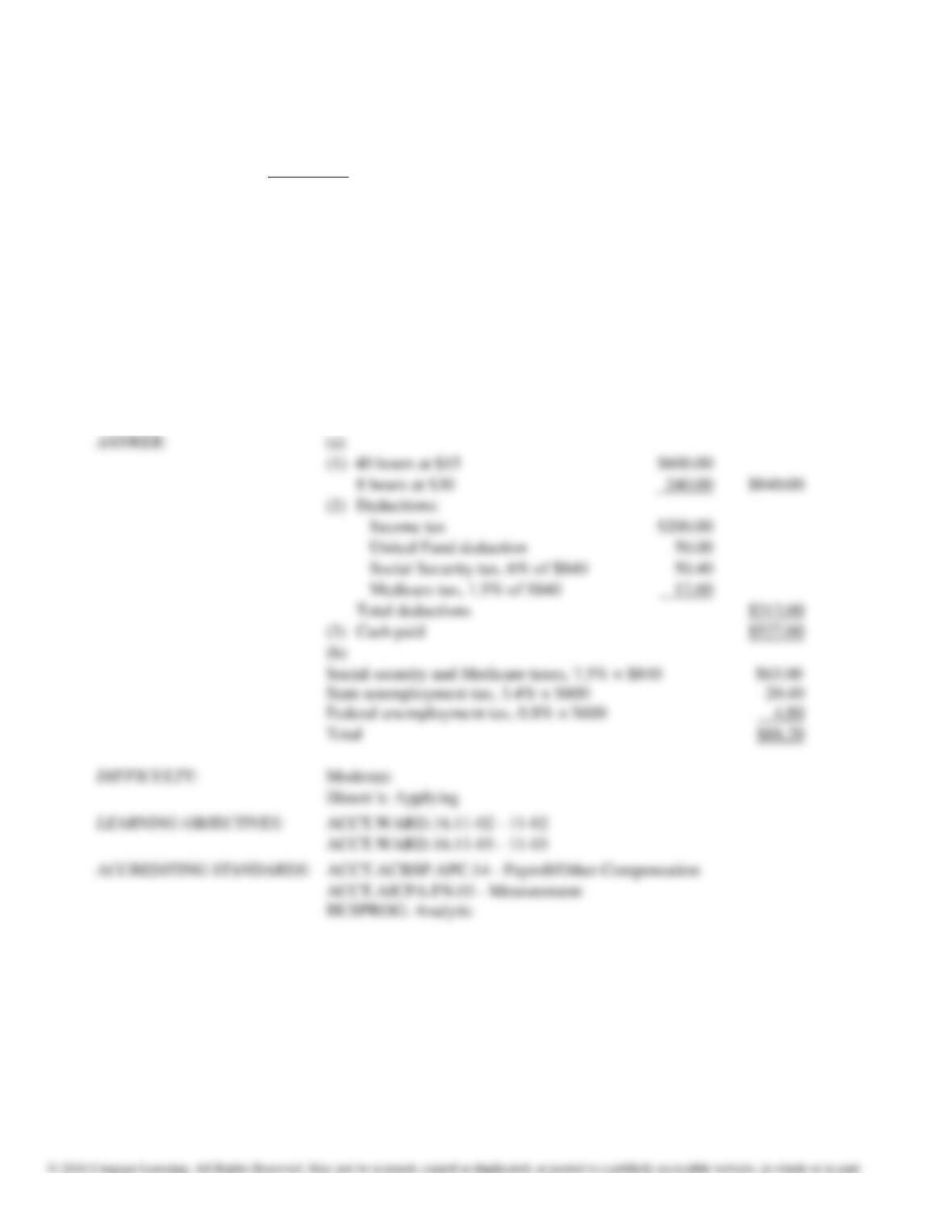
The following information is for employee Ella Dodd for the week ended March 15.
Total hours worked: 48
Rate: $15 per hour, with double time for all hours in excess of 40
Federal income tax withheld: $200
United Fund deduction: $50
Cumulative earnings prior to current week: $6,400
Tax rates:
Social security: 6% on maximum earnings of $120,000.
Medicare tax: 1.5% on all earnings.
State unemployment: 3.4% on maximum earnings of $7,000; on employer
Federal unemployment: 0.8% on maximum earnings of $7,000; on employer
(a)
Determine (1) total earnings, (2) total deductions, and (3) cash paid.
(b)
Determine each of the employer’s payroll taxes related to the earnings of Ella Dodd for
the
week ended March 15.
Chapter 11: Current Liabilities and Payroll
152.
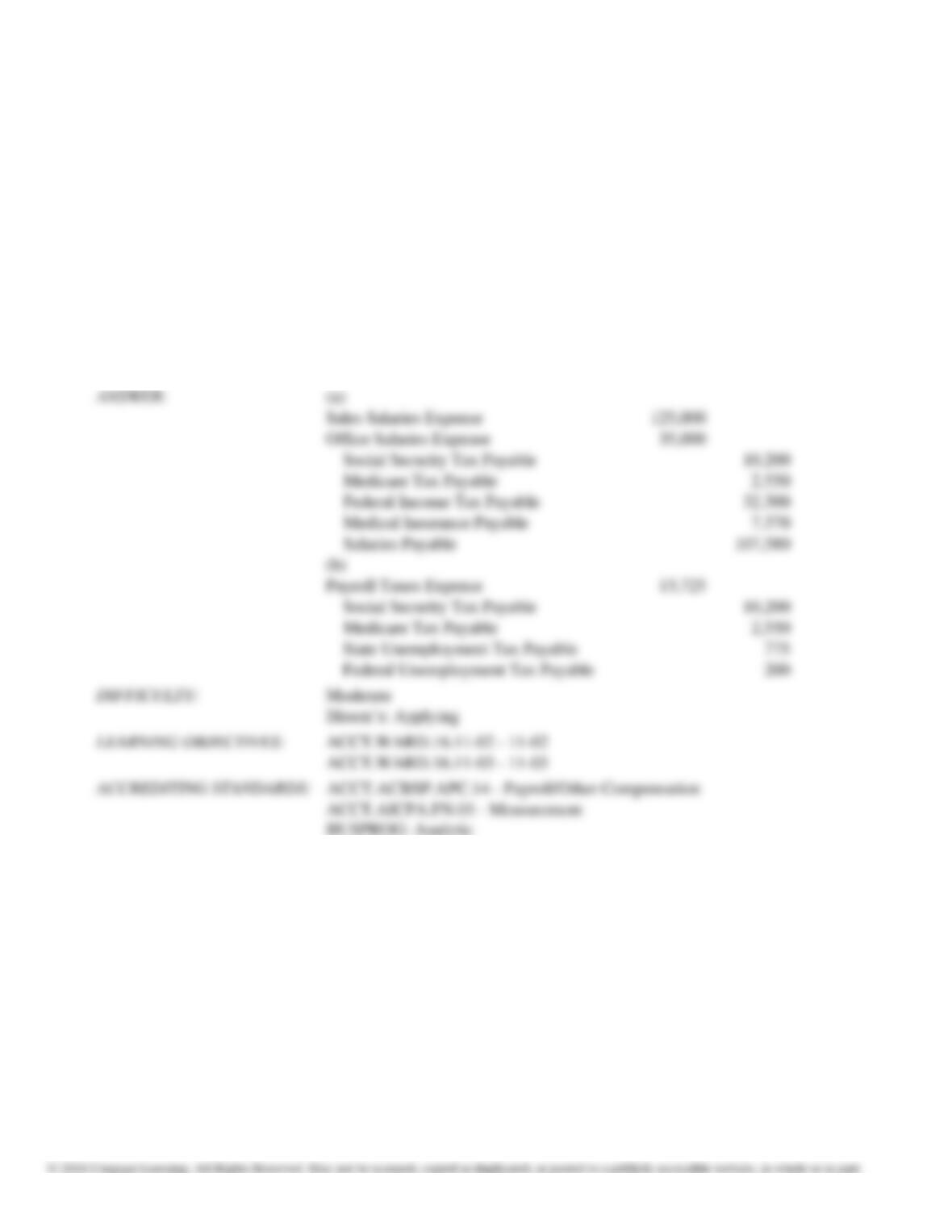
The summary of the payroll for the monthly pay period ending July 15 indicated the following:
Sales salaries
$125,000
Federal income tax withheld
32,300
Office salaries
35,000
Medical insurance withheld
7,370
Social security tax withheld
10,200
Medicare tax withheld
2,550
Journalize the entries to record (a) the payroll and (b) the employer’s payroll tax expense for the month. The
state
unemployment tax rate is 3.1%, and the federal unemployment tax rate is 0.8%. Only $25,000 of salaries
are
subject to unemployment taxes.