Chapter 11 – The Blood
LEARNING OBJECTIVES:
HUPH.SHER.16.11.1.2 – List three important functions of plasma proteins
46. Hemoglobin is found only in leukocytes.
a.
True
b.
False
False
11.2 Erythrocytes
47. In severe loss of RBCs, the rate of erythropoiesis can be increased to more than six times the normal level.
a.
True
b.
False
True
11.2 Erythrocytes
LEARNING OBJECTIVES:
HUPH.SHER.16.11.2.2 – Outline the five steps involved in the control of erythropoiesis
48. Nutritional anemia is caused by an inability to absorb enough ingested vitamin B12 from the digestive tract.
a.
True
b.
False
False
11.2 Erythrocytes
LEARNING OBJECTIVES:
HUPH.SHER.16.11.2.3 – Distinguish between the six causes of anemia
49. Pernicious anemia is caused by the bone marrow failing to produce enough RBCs, even though all ingredients needed
for erythropoiesis are available.
a.
True
b.
False
False
11.2 Erythrocytes
LEARNING OBJECTIVES:
HUPH.SHER.16.11.2.3 – Distinguish between the six causes of anemia
50. Secondary polycythemia is an appropriate erythropoietin-induced adaptive mechanism to improve the blood’s O2–
carrying capacity in response to a prolonged reduction in O2 delivery to the tissues.
a.
True
b.
False
True
11.2 Erythrocytes
LEARNING OBJECTIVES:
HUPH.SHER.16.11.2.4 – Contrast primary and secondary polycythemia
51. The surface membranes of human erythrocytes contain inherited antigens that vary depending on blood type.
Chapter 11 – The Blood
a.
True
b.
False
True
52. Type AB individuals are called universal recipients — lacking both anti-A and anti-B antibodies, they can accept donor
blood of any type.
a.
True
b.
False
True
53. Like the ABO system, naturally occurring antibodies develop against the Rh factor.
a.
True
b.
False
False
54. There are two types of lymphocytes, B and T lymphocytes (B and T cells).
a.
True
b.
False
True
55. Monocytes, like neutrophils, become professional phagocytes.
a.
True
b.
False
True
56. All leukocytes ultimately originate from common precursor undifferentiated pluripotent stem cells in the spleen.
a.
True
b.
False
False
57. One of the major consequences of leukemia, a cancerous condition involving reduced WBCs, is inadequate defense
capabilities against foreign invasion.
a.
True
b.
False
False
58. The hormone thrombopoietin increases the number of megakaryocytes in bone marrow and stimulates each
megakaryocyte to produce more platelets as needed.
a.
True
b.
False
True
59. Bleeding from a severed vein is more profuse and therefore more dangerous than arterial bleeding.
a.
True
b.
False
False
60. Factor X converts prothrombin to thrombin.
a.
True
b.
False
True
61. Platelets normally do not adhere to the smooth endothelial lining of blood vessels, but they do stick to damaged
vessels.
a.
True
b.
False
True
62. Activated platelets release several important chemicals from their storage granules, such as adenosine triphosphate
(ATP).
a.
True
b.
False
False
63. Plasmin is a plasma protein produced by the spleen and present in the blood in an inactive precursor form,
protoplasmin.
a.
True
b.
False
False
64. Widespread clotting can occur in septicemic shock, in which bacteria or their toxins initiate the clotting cascade.
a.
True
b.
False
True
65. Vitamin B12 deficiency can cause a bleeding tendency because of incomplete activation of vitamin B–dependent
clotting factors.
a.
True
b.
False
False
66. Erythrocytes and __________ are both whole cells, whereas __________ are cell fragments.
67. Plasma, being a liquid, consists of about __________% water.
90; ninety
68. The most abundant electrolytes (ions) in the plasma are __________ and __________.
69. The three groups of plasma proteins are albumins, __________, and __________.
70. The protein that enables RBCs to transport O2 is __________.
71. A hemoglobin molecule has two parts: the __________ portion and four __________ groups.
72. The bone __________ normally generates new red blood cells, a process known as __________.
73. Red marrow not only produces RBCs, but also is the ultimate source for __________ and __________.
74. The main cause of nutritional anemia is lack of dietary __________.
75. Pernicious anemia is caused by an inability to absorb enough __________ from the digestive tract.
76. When a normal number of erythrocytes are simply concentrated in a smaller plasma volume, the condition is
sometimes termed __________.
77. The erythrocytes of people with type A blood contain __________ antigens and their plasma contains __________
antibodies.
78. Neutrophils, eosinophils, and basophils are categorized as polymorphonuclear __________.
79. __________, the smallest of the leukocytes, characteristically have a large spherical nucleus that occupies most of the
cell.
80. Neutrophils are __________ specialists; they engulf and destroy bacteria intracellularly.
81. __________ are quite similar structurally and functionally to mast cells.
82. Granulocytes and monocytes are produced only in __________.
83. Platelets are small cell fragments shed from the outer edges of extraordinarily large bone marrow–bound cells known
as __________.
84. Because platelets are cell fragments, they lack __________.
85. __________ is the arrest of bleeding from a broken blood vessel.
86. A cut or torn blood vessel immediately __________, which is called vascular __________.
87. Formation of a platelet plug involves the three successive, closely integrated events of adhesion, __________, and
aggregation.
88. __________ is the most stretchy natural protein that scientists have ever studied.
89. Thrombin exists in the __________ in the form of an inactive precursor called __________.
90. Fibrin is quickly disposed of by plasmin activated by __________ or tPA.
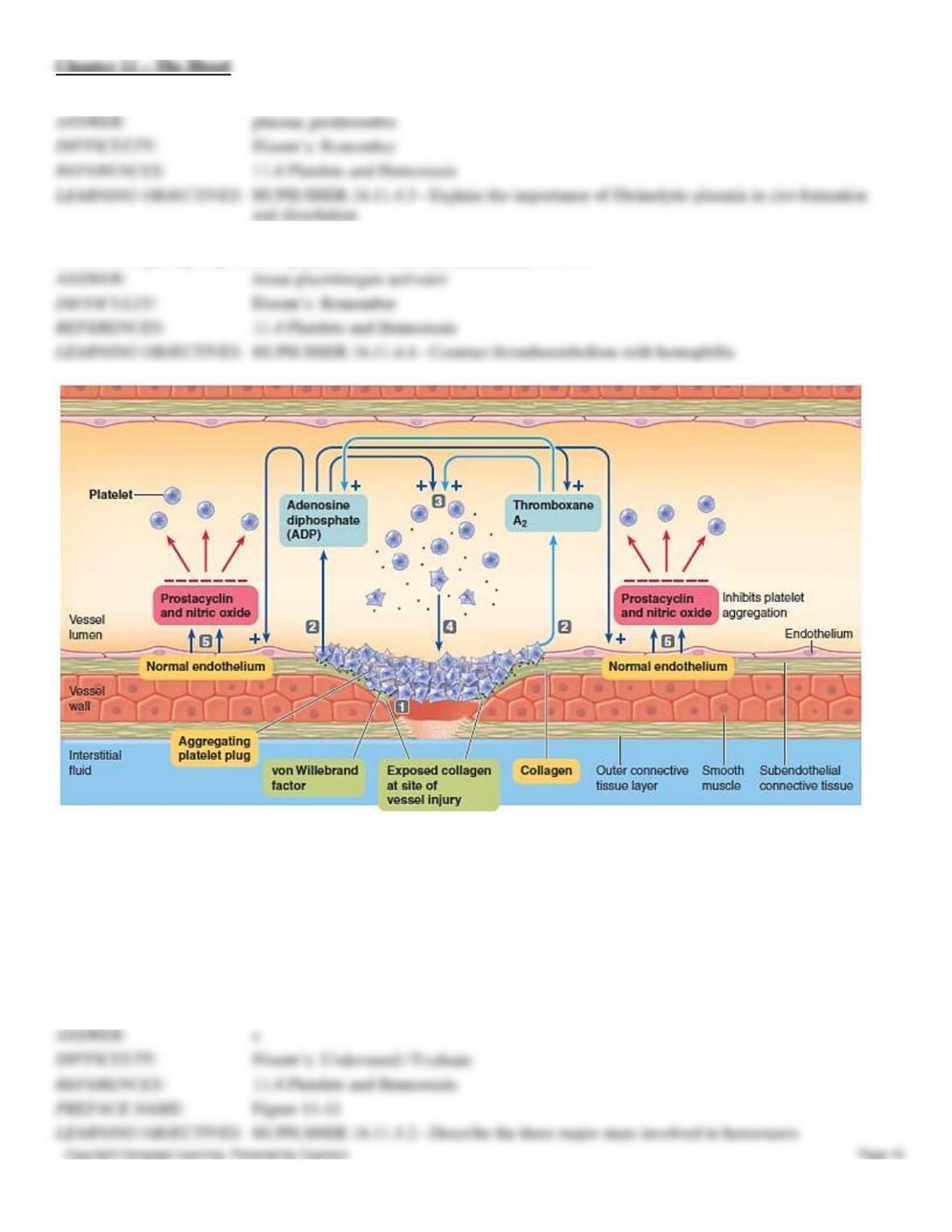
Use the figure above (Figure 11–11) to answer the corresponding questions.
91. Which number in the figure represents chemical messengers working together to activate other platelets that are
passing by?
a.
1
b.
2
c.
3
d.
4
e.
5
92. Which number in the figure represents newly activated platelets aggregating onto the growing platelet plug?
a.
1
b.
2
c.
3
d.
4
e.
5
d
93. Which number in the figure represents circulating platelets adhering to and activated by exposed collagen?
a.
1
b.
2
c.
3
d.
4
e.
5
94. Which number in the figure represents activated platelets releasing ADP and thromboxane A2?
a.
1
b.
2
c.
3
d.
4
e.
5
b
95. Which number in the figure represents uninjured endothelium releasing prostacyclin and nitric oxide, so the platelet
plug is confined to the site of injury?
a.
1
b.
2
c.
3
d.
4
e.
5
96. Describe albumins.
97. Discuss malaria as a cause of anemia.
98. Discuss the conditions that require blood transfusions.
99. Summarize the role of the immune system.
100. Discuss the role of “blood thinners”.