The Cultural Landscape, 11e (Rubenstein)
Chapter 11 Industry and Manufacturing
1) The cottage industry system involved manufacturing
A) of hand-made luxury goods.
B) in the home.
C) of steam engines and other cottage-sized machines.
D) in small factories.
E) cheeses and pastries.
2) In the 1700s, water pollution increased significantly when the chemical industry began to
contribute to the textile industry through methods of
A) bleaching and processing.
B) dyeing and purification.
C) food processing and purification.
D) bleaching and dyeing.
E) dyeing and the creation of synthetic fabrics.
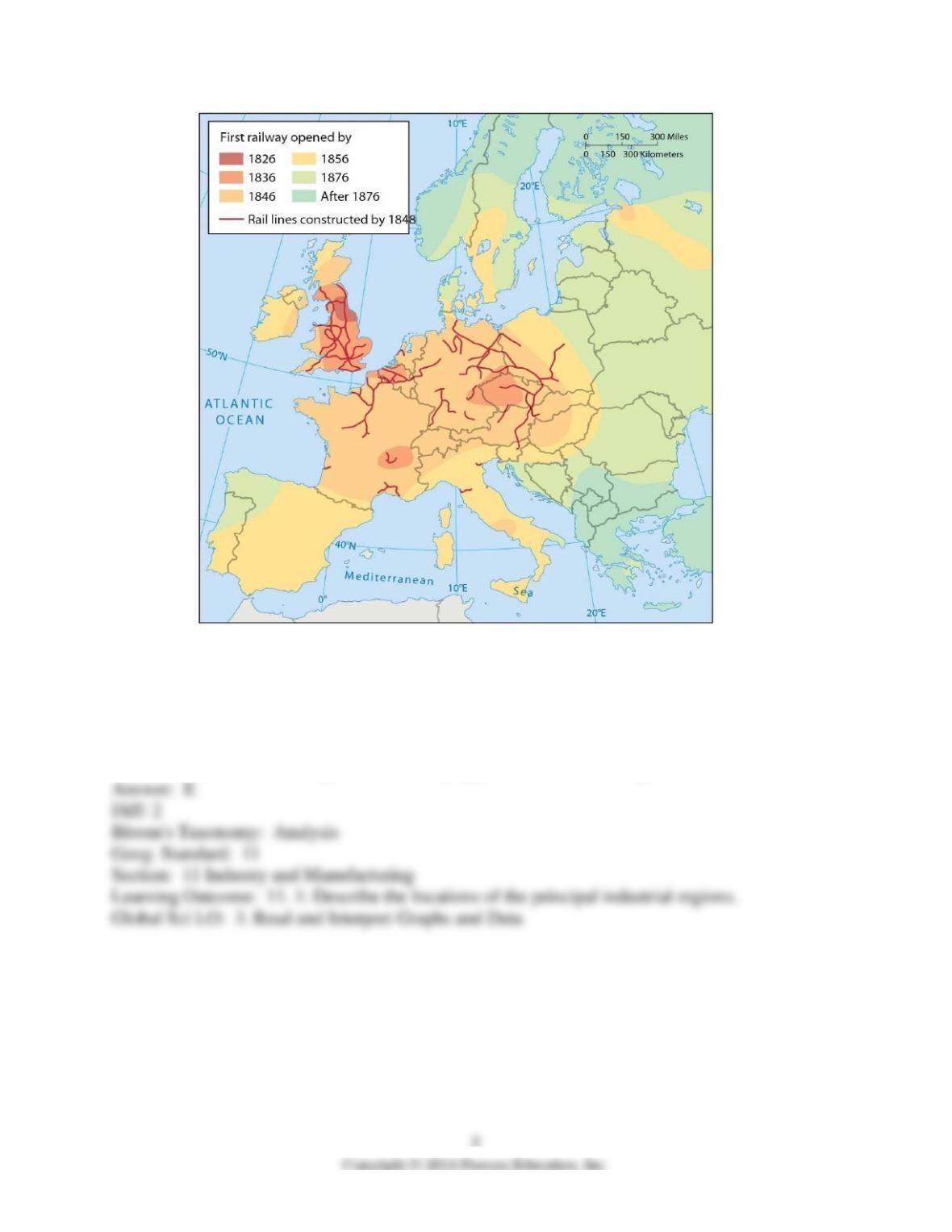
3) An analysis of this map of Europe indicates that railways
A) were more concentrated in France and Germany before they appeared in the United Kingdom.
B) tended to be built first in Eastern Europe before spreading westward.
C) were built in France before they were built in the United Kingdom.
D) in the United Kingdom first appeared near London and were later built in northern England.
E) were built in northern England before they appeared in southern England.
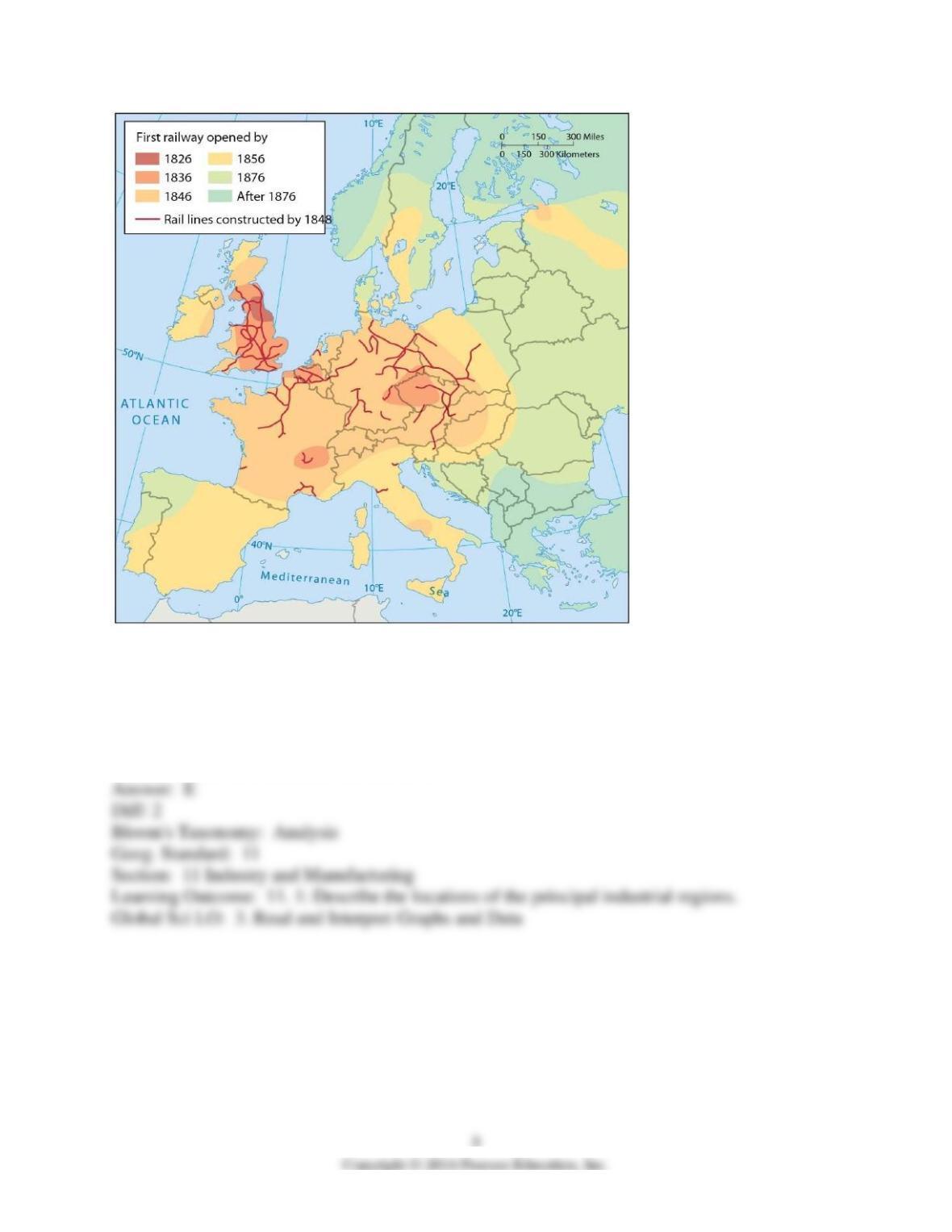
4) An analysis of this map indicates that railways
A) were not built in Russia until 1836.
B) were not built in France until 1826.
C) were not built in Russia until after 1876.
D) were built in Russia, France, and Serbia by 1856.
E) were not built in Greece until after 1876.
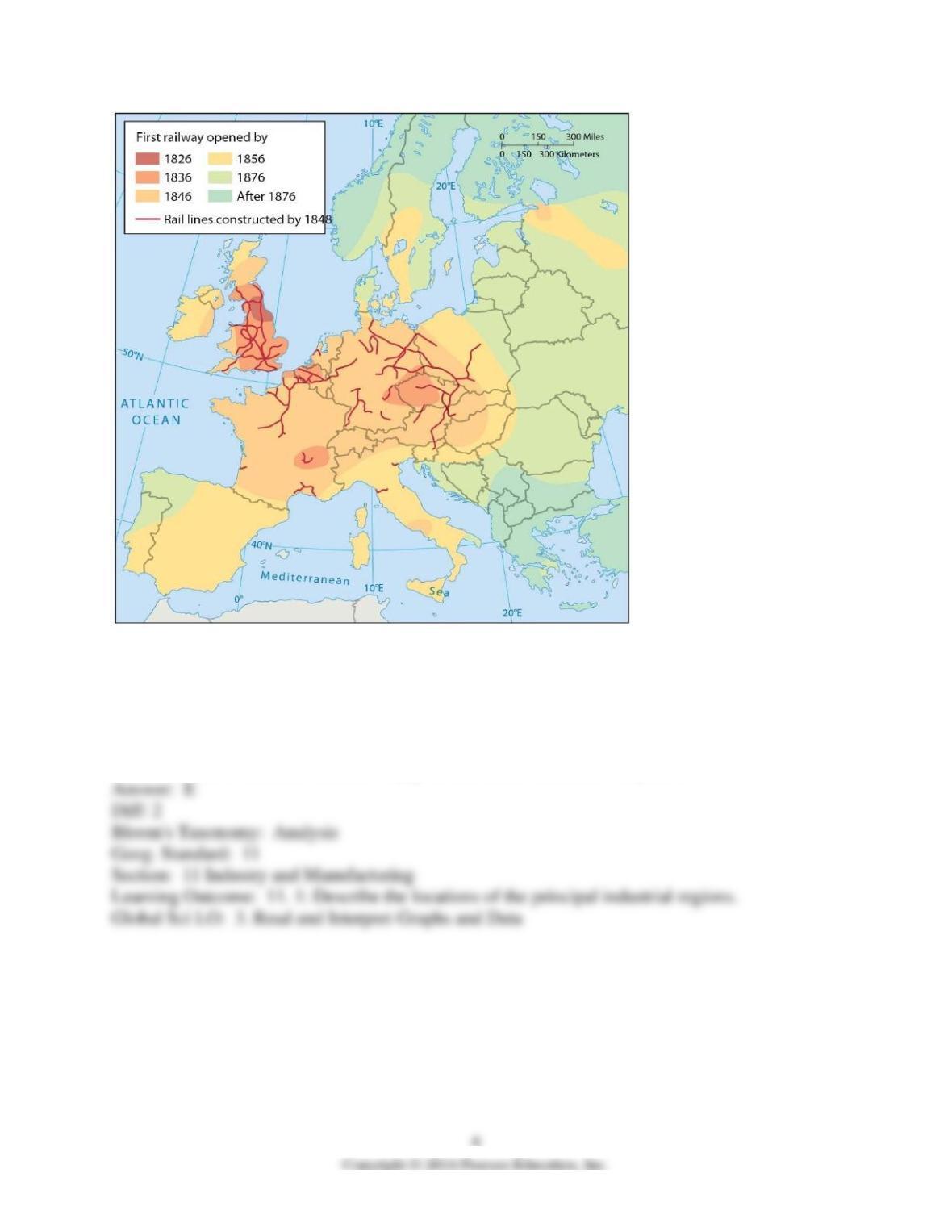
5) This map of railway diffusion indicates that during the Industrial Revolution
A) nearly all of Eastern Europe was connected by rail in 1848.
B) rail lines connected Paris to France‘s southern coast by 1848.
C) France had a more comprehensive rail network than the United Kingdom in 1848.
D) Poland had no rail lines in 1848.
E) rail lines connected London to many parts of the island of Britain by 1848.
6) Given the earlier history of the chemical industry, we can hypothesize that its 20th-century
contributions to the textile industry began to include
A) bleaching and processing.
B) dyeing and water purification.
C) food processing and purification.
D) the creation of synthetic fabrics.
E) bleaching and dyeing.
7) The Industrial Revolution began in
A) Great Britain.
B) Japan.
C) Russia.
D) the United States.
E) the Fertile Crescent.
8) The Industrial Revolution began in
A) the late 1500s.
B) the late 1600s.
C) the late 1700s.
D) the late 1800s.
E) the late 1900s.
9) Prior to the Industrial Revolution, industry was geographically
A) clustered.
B) concentrated.
C) dispersed.
D) random.
E) nonexistent.
10) The most important transportation improvement in the eighteenth century was the
A) canal.
B) automobile.
C) railroad.
D) steam engine.
E) horse collar.
11) Approximately three-fourths of the world’s industrial production is concentrated in three
regions, including which of the following?
A) Eastern North America and Southeast Asia
B) Eastern Europe and southern Europe
C) northwestern Europe and eastern South America
D) East Asia and Southwest Asia
E) eastern North America and northwestern Europe
12) Outside of the three world regions where industry is concentrated, the next two largest
industrial producing countries are
A) India and Pakistan.
B) Brazil and Canada.
C) Russia and Brazil.
D) China and India.
E) Brazil and India.
13) The Po River basin in Italy
A) contains one-fourth of the country’s industry.
B) has cheaper labor compared to southern Italy and the island of Sicily.
C) has expensive hydroelectricity from the Alps but inexpensive nuclear energy from France.
D) is Southern Europe’s newest industrial area.
E) has inexpensive hydroelectricity from the Alps.
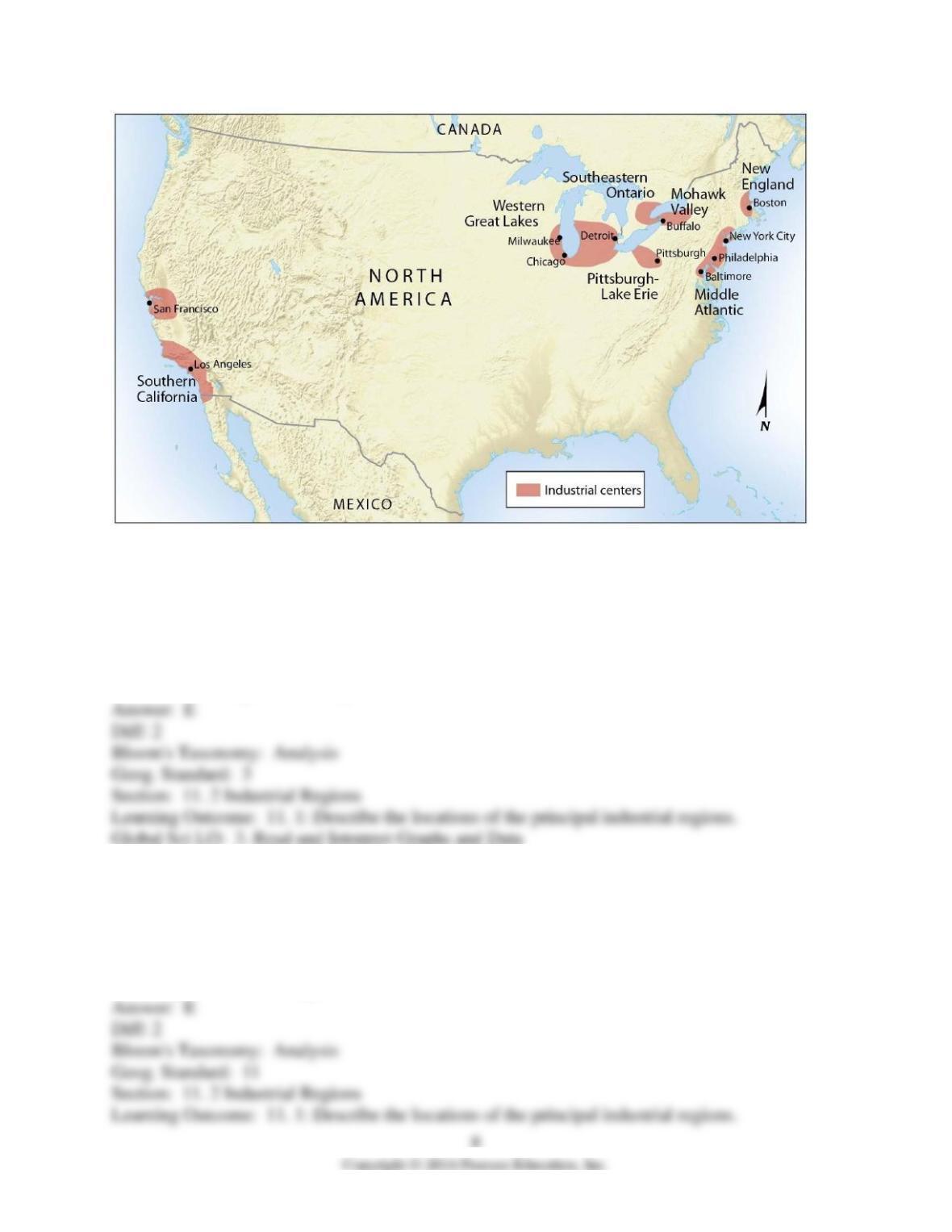
14) The map of North America’s industrial areas shows that
A) industry is dispersed evenly throughout the United States and Canada.
B) the industrial regions of California are more extensive than those of the Midwest and the
Northeast combined.
C) Canada’s far west and the U.S. South have become the continent’s principal industrial zones.
D) Canada’s industrial areas are nearly as extensive as those of the northeastern United States.
E) much of the region’s industry is concentrated around or near the Great Lakes.
15) Western Europe’s principal industrial areas include all but which of the following?
A) the United Kingdom
B) the Rhine-Ruhr valley
C) the Mid-Rhine
D) Northern Italy
E) Portugal and western Spain
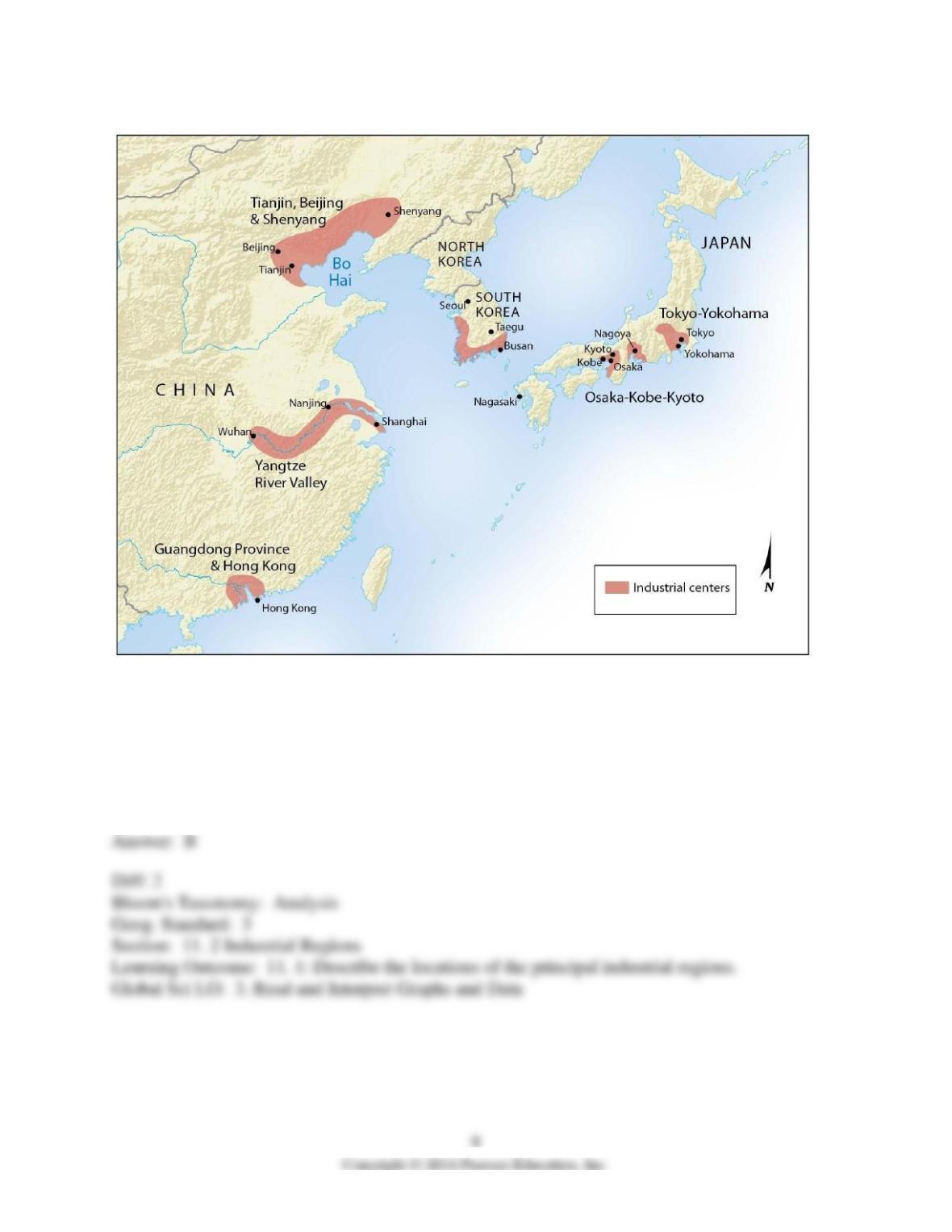
16) The map of East Asia’s industrial areas indicates that the region’s chief manufacturing bases
include
A) the Rhine-Ruhr valley.
B) parts of southeastern China.
C) parts of northwestern China.
D) northern Japan.
E) South Korea.
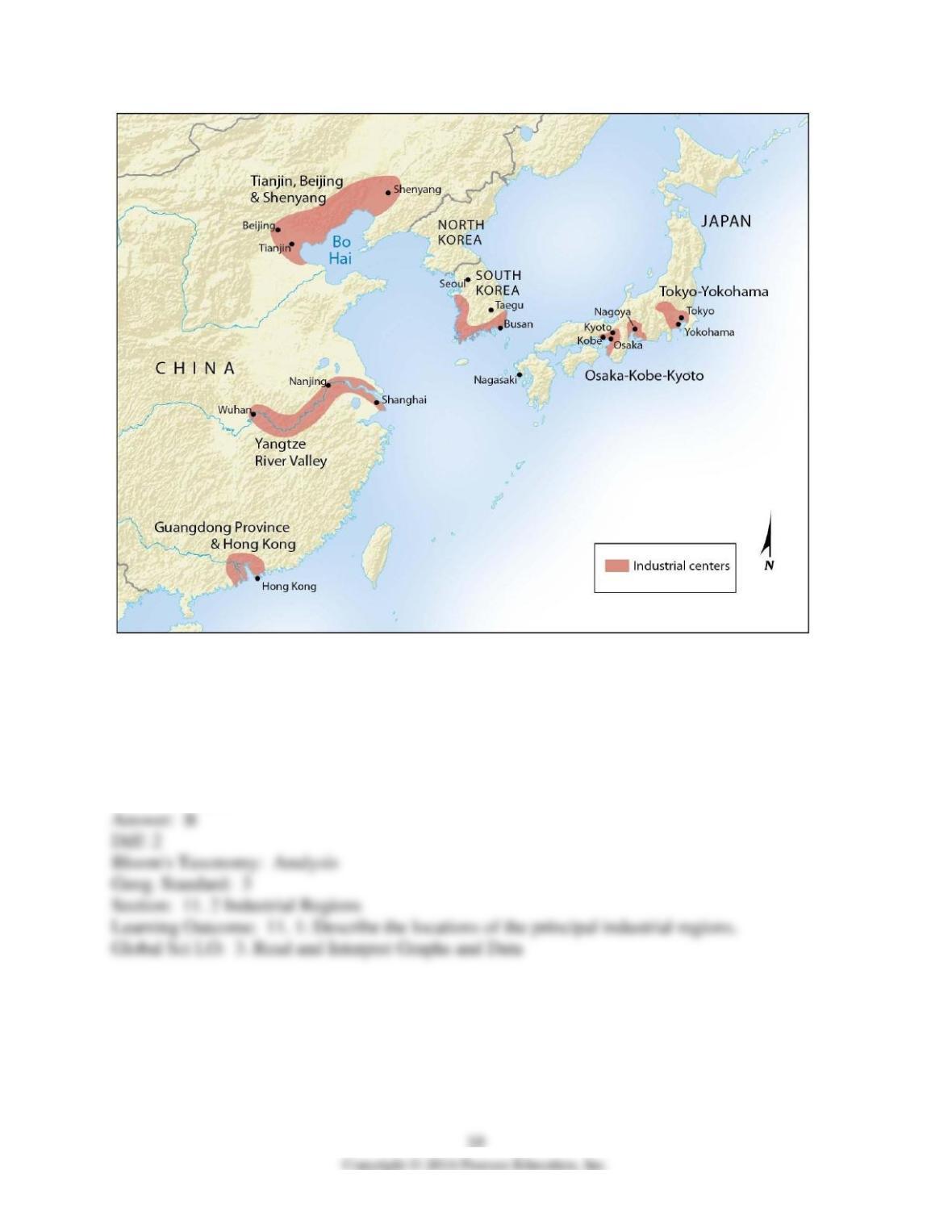
17) The map of East Asia’s industrial areas indicates that the chief concentrations of
manufacturing in the region include
A) the White River valley.
B) the river valley east of Wuhan.
C) the river valley east of Shanghai.
D) the western coast of Japan and eastern coast of Korea.
E) central China.
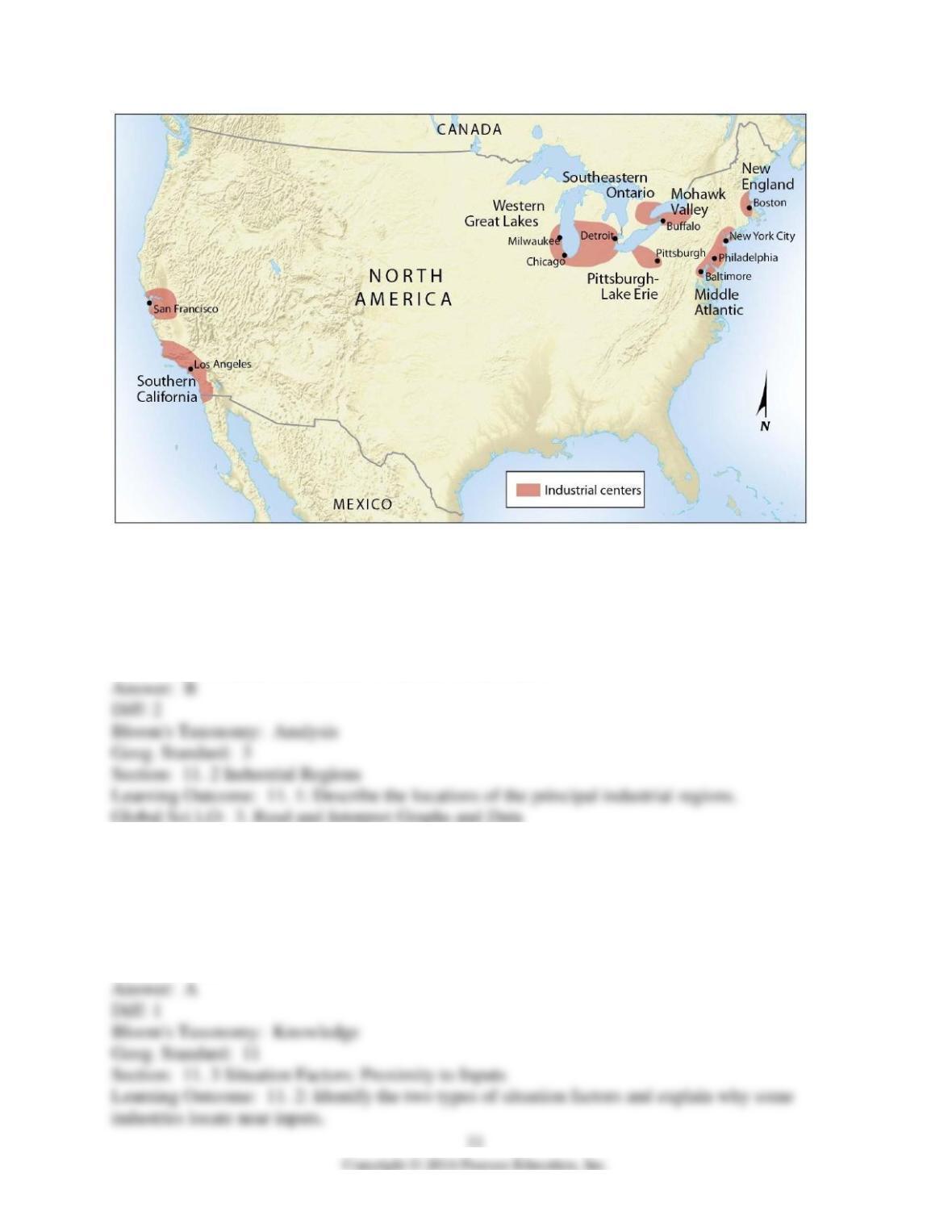
18) According to the map, Canada’s most important industrial area is
A) Vancouver, British Columbia.
B) the St. Lawrence Valley and Ontario Peninsula.
C) the northern shore of Lake Superior.
D) the sea ports of Nova Scotia.
E) the entire southern border shared with the United States.
19) The main source of power for steam engines and blast ovens is produced from
A) coal.
B) dross.
C) iron ore.
D) nuclear power.
E) biomass fuels.
20) What mining region has the most varied mineral deposits of the world, with over 1,000
minerals?
A) the Ural mountains
B) the Tibetan plateau
C) the mountains of central Thailand
D) the Chilean Andes
E) South Africa
21) The only step of the copper production process that is not significantly bulk-reducing is
A) refining.
B) concentration.
C) mining.
D) smelting.
E) ore extraction.
22) The step of the copper production process that involves the crushing and grinding of particles
is
A) concentration.
B) refining.
C) mining.
D) smelting.
E) transportation.
23) The world’s chief source for copper is
A) Chile.
B) Arizona.
C) China.
D) Brazil.
E) Cuba.
24) A copper concentration mill tends to locate near a copper mine because it is a
A) bulk-reducing industry.
B) perishable industry.
C) bulk-gaining industry.
D) specialized manufacturer.
E) fabrication concentration point.
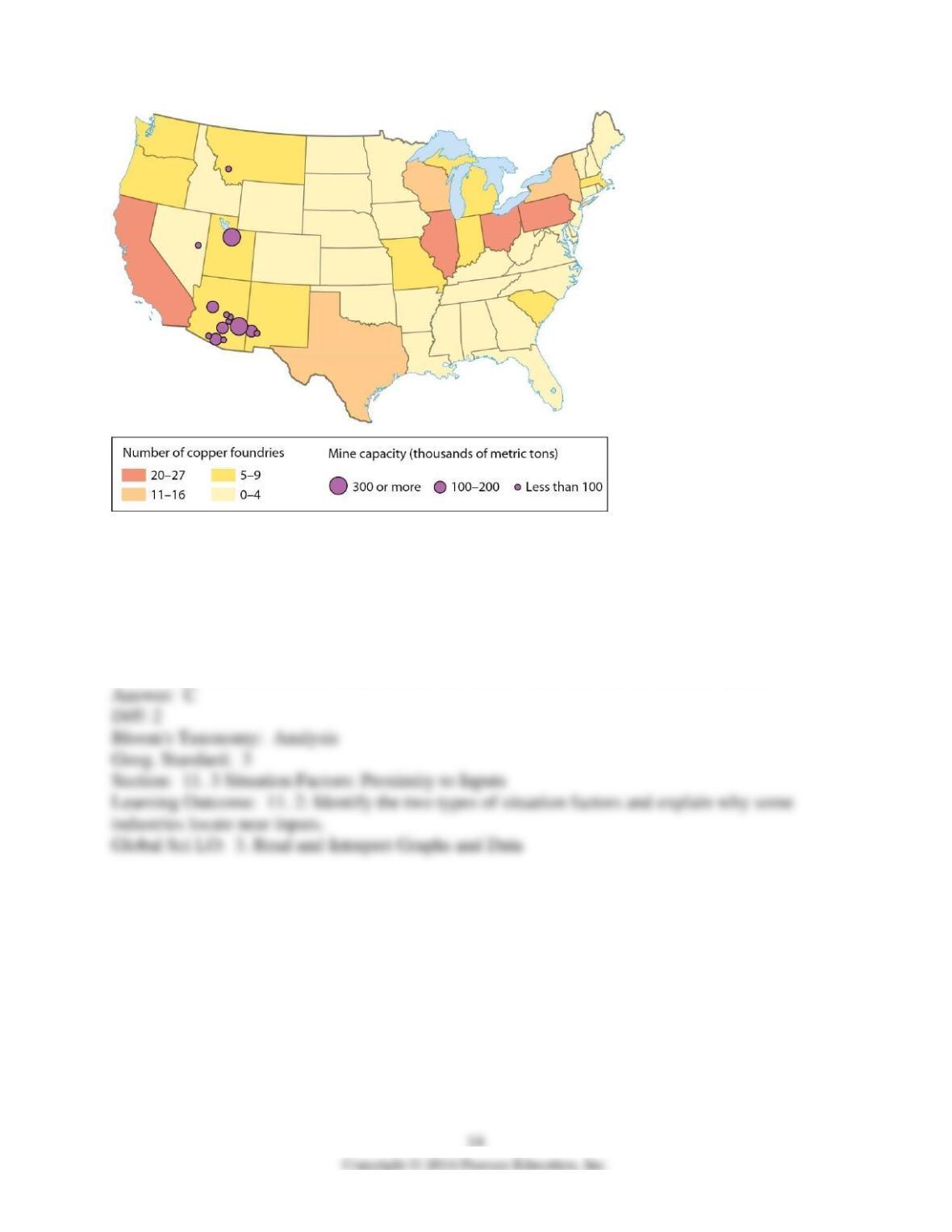
25) An analysis of this map of the copper industry in the United States indicates that
A) New Mexico has more foundries than Texas.
B) more copper is mined in Utah than in Arizona, Nevada, and Montana.
C) the largest numbers of foundries are in California, Illinois, Ohio, and Pennsylvania.
D) the largest numbers of foundries are in California, Illinois, Arizona, Texas, Florida, and
Oregon.
E) the largest numbers of foundries are in Arizona, Nevada, New Mexico, and Montana.
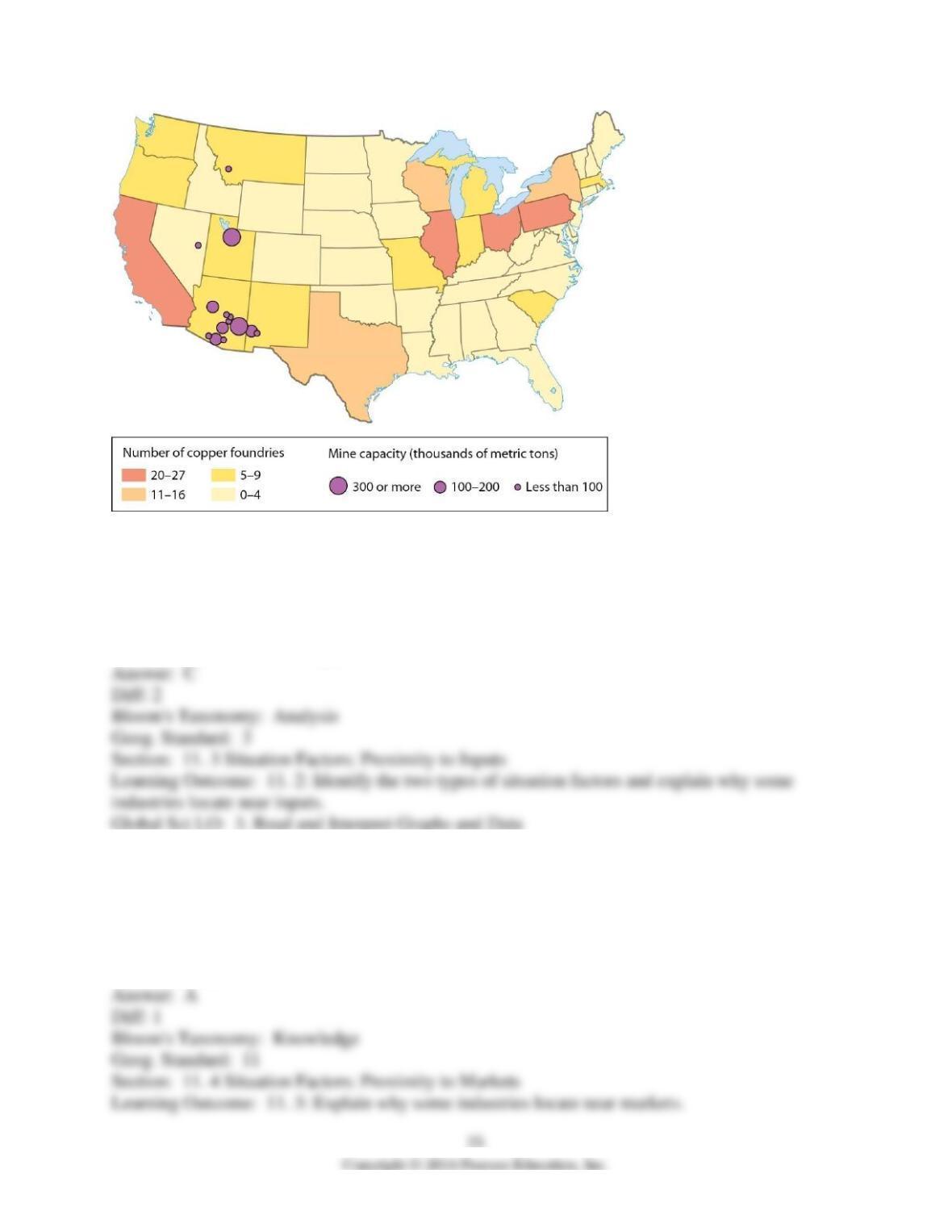
26) An analysis of this map of the copper industry in the United States indicates that
A) New Mexico has more foundries than Texas.
B) more copper is smelted in Utah than in Arizona, Nevada, and Montana.
C) more copper is mined in Utah, Arizona, Nevada, New Mexico, and Montana.
D) the largest numbers of copper smelters are in California, Illinois, Arizona, and Florida.
E) the largest numbers of copper smelters are in California, Arizona, and Utah.
27) Proximity to Russian consumers is the most significant industrial asset of which region?
A) Moscow
B) Kuznetsk
C) Urals
D) Volga
E) Kamchatka
28) Metal fabrication plants are an example of a bulk-gaining industry because
A) the mills are near the mines.
B) separate parts are combined to make more complex and massive products.
C) refineries import most material from other countries.
D) parts suppliers package shipments in bulk containers for processing in the plants.
E) parts suppliers supply components with just-in-time management.
29) Situation costs are critical to a firm that wishes to
A) avoid skilled laborers.
B) minimize production costs inside the plant.
C) minimize transport costs.
D) identify unique characteristics of a particular industry.
E) utilize a new technology.
30) Producers of automobiles select assembly plant locations primarily for their closer access to
A) government subsidies.
B) labor markets.
C) markets for finished automobiles.
D) raw materials.
E) water transportation.
31) Beer bottling is an example of a
A) perishable industry.
B) specialized industry.
C) bulk-gaining industry.
D) communications-oriented industry.
E) labor intensive industry.
32) Fabricated metal production is an example of a
A) perishable industry.
B) specialized industry.
C) bulk-gaining industry.
D) communications-oriented industry.
E) labor intensive industry.
33) Eastern North America became the continent’s manufacturing center in part because it had
access to the continent’s
A) largest markets.
B) most extensive sources of essential raw materials.
C) newest highway systems.
D) most advantageous climate.
E) oceangoing transportation links to Asia.

34) The Chicago area became a significant asset for the Western Great Lakes region owing to its
steel industries and its
A) access to the nation’s transportation network.
B) large market area.
C) greater distance from raw materials essential for the steel industry.
D) skilled labor force.
E) cheap migrant labor.
35) The shift in steel production locations in the United States from the mid-nineteenth century
until the mid-twentieth century can best be described as
A) starting in the Pittsburgh area and then migrating towards the Midwest before ending up on
the East and West coasts, as well as the Chicago area.
B) starting in the Pittsburgh area and then migrating towards the East and West coasts before
moving to the South and Southeast.
C) starting on the East and West coasts and then migrating towards the Midwest before ending
up in the Pittsburgh area, as indicated by the football team called the Pittsburgh Steelers.
D) starting on the East and West coasts and then migrating towards Pittsburgh before ending in
the Midwest.
E) starting in the Midwest and then migrating towards Pittsburgh before ending up on the East
and West coasts.
36) In addition to integrated mills, about one-fourth of U.S. steel production is now attributed to
A) minimills which utilize scrap metal in many U.S. locations.
B) traditional mills in the South and Southeast.
C) minimills which have revitalized the old steel producing center of Pittsburgh.
D) nuclear-pellet generating plants in the Northeast.
E) scrap metal from materials transported to the United States from China.
37) Because the motor vehicle assembly industry is typically described as a bulk-gaining
industry as well as a just-in-time delivery system, the most important factor when selecting a
location for a new Toyota or Honda assembly plant in the United States was
A) minimizing the cost of shipping finished vehicles to its customers.
B) minimizing the cost of shipping inputs and outputs in relation to customers.
C) maximizing delivery time to customers.
D) the location of railroads.
E) the location of waterways.
38) New U.S. automobile assembly plants have been built primarily in the
A) Midwest and South, to minimize national distribution costs and reduce labor competition.
B) Northeast and Midwest, to minimize access to labor markets and maximize access to
Northeastern markets.
C) Sunbelt, to minimize labor costs.
D) West, to maximize access to Japan, South Korea, and China.
E) Southeast, to avoid winter production costs.
39) The U.S. steel industry moved westward in the nineteenth century primarily because of better
access to
A) coal.
B) iron ore.
C) labor.
D) transport.
E) markets.
40) Minimills are more likely than integrated steel mills to select locations because of access to
A) government subsidies.
B) unskilled labor.
C) markets.
D) raw materials.
E) fluid capital.
41) A company which uses more than one ________ will often locate near break-of-bulk points.
A) mode of transport
B) consumer market
C) raw material
D) type of labor
E) energy supply
42) In order to become a global industrial power, Japan had to overcome which of the following
problems?
A) high labor costs
B) abundant energy sources
C) distance from consumers
D) weak consumer demand
E) proximity to China