
Chapter 11: Stockholders’ Equity
80. With respect to the statement of cash flows,
a. retirement and repurchase of stock is a financing activity.
b. a stock split is a financing activity.
c. a stock dividend is an investing activity.
d. the declaration of a cash dividend account is an operating activity.
81. Which of the following transactions has an effect on the statement of cash flows?
a. The sale of preferred stock
b. The declaration of a cash dividend
c. A small stock dividend
d. A large stock dividend
82. Which of the following is reported as a financing activity?
a. Declaration of dividends
b. Sale of preferred stock
c. Conversion of preferred stock to common stock
d. Stock split
83. Which of the following is reported as a financing activity?
a. Payment of cash dividends
b. Declaration of cash dividends
c. Stock dividend
d. Stock split
84. Which of the following is true?
a. The sale of stock to stockholders is an investing activity.
b. The repurchase of stock from stockholders is an investing activity.
c. The declaration of stock dividends is a financing activity.
d. The payment of cash dividends is a financing activity.

Chapter 11: Stockholders’ Equity
85. Which of the following is true?
a. Companies usually disclose cash flow per share on their financial statements.
b. Companies usually disclose the sales price of each individual stock transaction on their financial statements.
c. The issuance of a stock dividend is an investing activity.
d. Financing activities can be inflows or outflows of cash.
86. In 2015, Dickens Company had a beginning balance in its Cash Dividend Payable account of $5,000 and an ending
balance of $4,000. During 2015, the only dividends Dickens declared were $46,000 in cash to the common
stockholders. How much cash was paid to the common stockholders?
a. $45,000
b. $47,000
c. $46,000
d. $ 1,000
87. [APPENDIX] Which of the following is true concerning a sole proprietorship?
a. It is a separate legal entity.
b. It may have more than one class of stock outstanding.
c. It is owned by one or more persons.
d. The separate entity concept applies.
88. [APPPENDIX] When an individual wishes to form a sole proprietorship, he or she does so by
a. filing a petition with the IRS.
b. purchasing stock in the proprietorship.
c. filing corporate paperwork with the state.
d. contributing cash or other assets.
89. [APPENDIX] When the owner of a sole proprietorship withdraws assets from the business for personal use
a. it is treated like a noncash dividend.
b. it is illegal because the assets belong to the separate entity, the proprietorship.
c. it would be recorded as a loss by the proprietorship.
d. it is recorded as a reduction of owner’s equity.
Chapter 11: Stockholders’ Equity
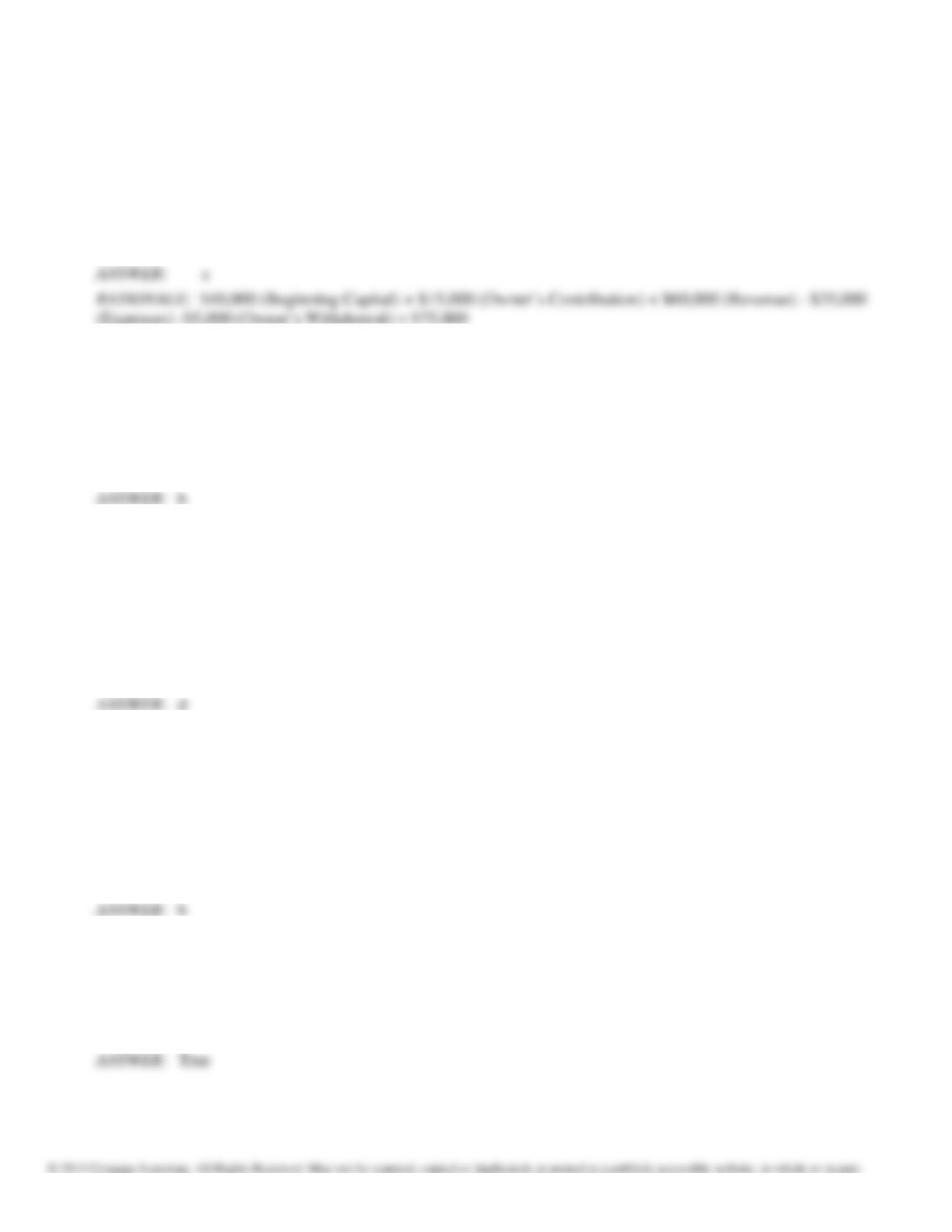
90. [APPENDIX] Gordon Vending, a sole proprietorship, had the following balances and transactions during 2015:
beginning capital, $40,000; contribution of cash to the business by the owner, $15,000; revenue, $60,000; expenses,
$35,000; withdrawal by the owner, $5,000. What is the amount of the ending capital balance?
a. $40,000
b. $60,000
c. $75,000
d. $85,000
91. [APPENDIX] Which of the following statements regarding partnerships is true?
a. Partnerships have two owners.
b. The partnership ends when a new partner is added.
c. The partnership is responsible for its own taxes.
d. The partnership is a separate legal entity from its owners.
92. [APPENDIX] Which of the following statements regarding partnerships is true?
a. Partnerships must register with the federal government.
b. Partnerships pay taxes to the IRS.
c. Partners must register with the state government.
d. Partners must abide by the separate entity concept and keep their personal assets separate from the partnership
assets.
93. [APPENDIX] Debbie and Alex formed a new partnership. The partnership agreement specified that income should
be allocated in a 2-to-1 ratio, with Debbie receiving the larger portion. If revenue for the first year was
$90,000 and expenses were $60,000, how much would be allocated to each partner?
a. Debbie – $45,000; Alex – $45,000
b. Debbie – $20,000; Alex – $10,000
c. Debbie – $60,000; Alex – $30,000
d. Debbie – $40,000; Alex – $20,000
94. Under IFRS, an item such as a convertible bond must be separated into two parts, showing one part in the Liability
category and the other part in the Stockholders’ Equity category.
a. True
b. False

Chapter 11: Stockholders’ Equity
95. All issued stock is outstanding.
a. True
b. False
96. Stockholders‘ equity is composed of three parts: contributed capital, earnings retained in the business, and dividends
paid.
a. True
b. False
97. The participating feature of stock allows stockholders to sell stock back to the company.
a. True
b. False
98. Preferred stock receives first preference on voting rights.
a. True
b. False
99. The cumulative feature of stock allows the firm to eliminate a class of stock by paying the stockholders a specified
amount.
a. True
b. False
100. When stock is issued for cash, only the par value of the stock should be reported in the stock account.
a. True
b. False
101. When stock is issued for a noncash asset, the par value of the stock is the best indicator of the value of the asset.
a. True
b. False
102. Treasury stock is stock that has been issued, but not currently outstanding.
a. True
b. False

Chapter 11: Stockholders’ Equity
103. When treasury stock is reissued and the cost is less than the reissue price, the difference increases additional paid–
in capital.
a. True
b. False
104. Treasury stock is reported as a reduction in stockholders’ equity.
a. True
b. False
105. The Treasury Stock account should be considered an asset account.
a. True
b. False
106. When treasury stock is resold for an amount less than its cost, the difference between the sales price and the cost is
deducted from the Additional Paid-In Capital—Treasury Stock account or the Retained Earnings account (if the
Additional Paid-In Capital—Treasury Stock account does not exist).
a. True
b. False
107. If 20,000 shares are authorized, 15,000 shares are issued, and 500 shares are held as treasury stock, a cash dividend
of $1 per share would amount to $15,000.
a. True
b. False
108. Cash dividends become a liability to a corporation on the date of record.
a. True
b. False
109. When the board of director‘s declares a cash or stock dividend, this action decreases Retained Earnings.
a. True
b. False

Chapter 11: Stockholders’ Equity
110. Stock dividends involve the issuance of additional shares of stock.
a. True
b. False
111. Stock dividends reduce the par value of the stock.
a. True
b. False
112. A 15% stock dividend will increase the number of shares outstanding but the book value per share will decrease.
a. True
b. False
113. A stock split is similar to a stock dividend in that it results in additional shares of stock outstanding and is nontaxable.
a. True
b. False
114. Stock dividends affect the par value per share of the stock.
a. True
b. False
115. A 2-for-1 stock split increases the par value per share.
a. True
b. False
116. An accounting transaction is not recorded when a corporation declares and executes a stock split.
a. True
b. False
117. None of the Stockholders’ Equity accounts are affected by the stock split.
a. True
b. False

Chapter 11: Stockholders’ Equity
118. All changes in all stockholders’ equity accounts must be shown in the Stockholders’ Equity section of the balance
sheet.
a. True
b. False
119. The statement of stockholders‘ equity is useful in evaluating a company’s liquidity.
a. True
b. False
120. The all-inclusive income approach requires that all events and transactions that affect income should be reported on
the income statement to help prevent the manipulation of income.
a. True
b. False
121. The FASB has allowed certain items to be reported directly to stockholders’ equity in an effort to mitigate the
possibility of income fluctuating widely from period to period.
a. True
b. False
122. Comprehensive income is the increase in net assets resulting from all transactions occurring during an accounting
period except stockholders’ investments and dividends.
a. True
b. False
123. A company may prepare a statement of retained earnings instead of a statement of stockholders’ equity if the only
changes in the stockholders’ equity accounts that occurred during the year are earnings and dividends.
a. True
b. False
124. Book value is a measure of the market value of the stock.
a. True
b. False

Chapter 11: Stockholders’ Equity
125. Book value indicates the rights that stockholders have, based on recorded values, to the net assets in the event of
liquidation.
a. True
b. False
126. The issuance of stock is reported as a financing activity.
a. True
b. False
127. The payment of dividends is a financing activity.
a. True
b. False
128. [APPENDIX] A partnership can be owned by one or more entities or individuals.
a. True
b. False
129. [APPENDIX] A balance sheet of a sole proprietorship includes only the business assets and liabilities, not the
personal assets of the owner.
a. True
b. False
130. [APPENDIX] A sole proprietorship is a separate entity for legal purposes.
a. True
b. False

Chapter 11: Stockholders’ Equity
Select the best answer from the list below to complete statements 1-11 that follow.
authorized shares
treasury stock
book value per share
issued shares
stock dividend
par value per share
outstanding shares
additional paid–in–capital
market value per share
stock split
dividend payout ratio
retained earnings
131. The number of shares sold or distributed to stockholder are .
132. An arbitrary amount that is stated on the face of the stock certificate is .
133. The number of shares issued less the number of shares held as treasury stock are
______________________________.
134. The maximum numbers of shares a company may issue are .
135. Net income that has been earned by the corporation but not paid out as dividends are
______________________________.
136. The amount received for each share of stock in excess of par value is .
137. Stock issued by the firm, but then repurchased and not retired is ________________________.
138. The annual dividend amount divided by the annual net income is .
139. Distribution of additional shares of stock and reduction of the par value of the stock is
______________________________.
140. The selling price of the stock as indicated by the most recent stock transaction is
___________________________________.
Chapter 11: Stockholders’ Equity
141. Assuming no preferred stock exists, total stockholders‘ equity divided by the number of shares of common stock
outstanding is equal to ________________________________________.
142. A drawing account is sometimes referred to as a ______________________.
143. The characteristic where each partner is personally liable for the debts of the partnership is known as
_____________________.
144. The document that specifies how much the owners will invest, what their salaries will be, and how profits will be
shared in a partnership is known as a .
145. A ________________ allows the firm to eliminate a class of stock by paying the stockholders a specified
amount.
146. A allows preferred stockholders to share on a percentage basis in the distribution of an
abnormally large dividend.
Chapter 11: Stockholders’ Equity
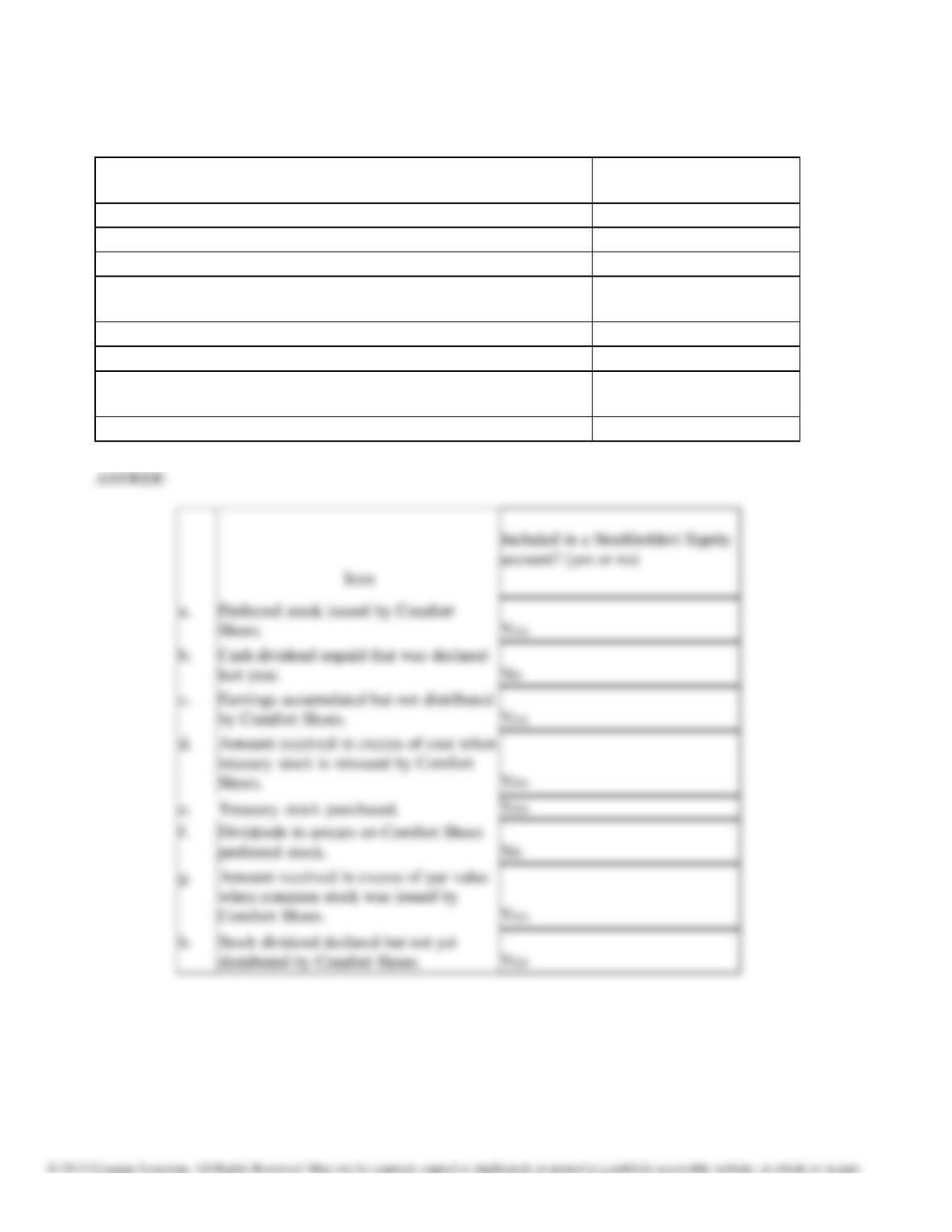
147. Comfort Shoes had the following items included in its accounting records. In the space provided, indicate whether
each of the items listed is included in an account in the stockholders’ equity section of the balance sheet.
Item
Included in a Stockholders‘
Equity account? (yes or no)
a. Preferred stock issued by Comfort Shoes.
b. Cash dividend unpaid that was declared last year.
c. Earnings accumulated but not distributed by Comfort Shoes.
d. Amount received in excess of cost when treasury stock is reissued
by Comfort Shoes.
e. Treasury stock purchased.
f. Dividends in arrears on Comfort Shoes preferred stock.
g. Amount received in excess of par value when common stock was
issued by Comfort Shoes.
h. Stock dividend declared but not yet distributed by Comfort Shoes.
Chapter 11: Stockholders’ Equity
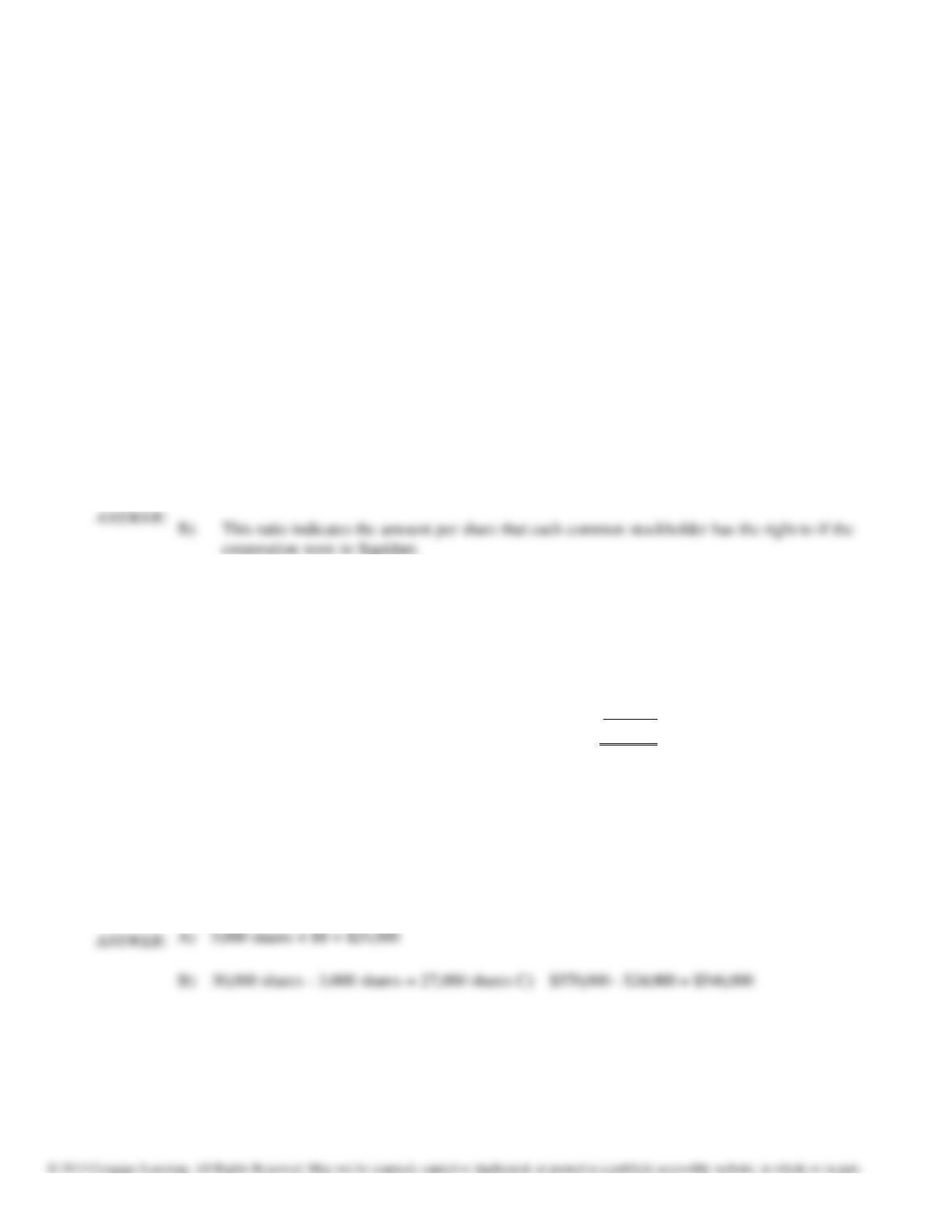
148. The Lobster Shanty had the following account balances at December 31, 2015:
Retained earnings
$52,000
Treasury stock, 500 common shares at cost
(10,000)
Common stock, $1 par value, 10,000 shares authorized, 4,000 shares outstanding
4,000
Cash dividends payable—common
6,000
Additional paid–in capital—common
1,200
Additional paid–in capital-treasury stock
900
Common stock dividend distributable
6,200
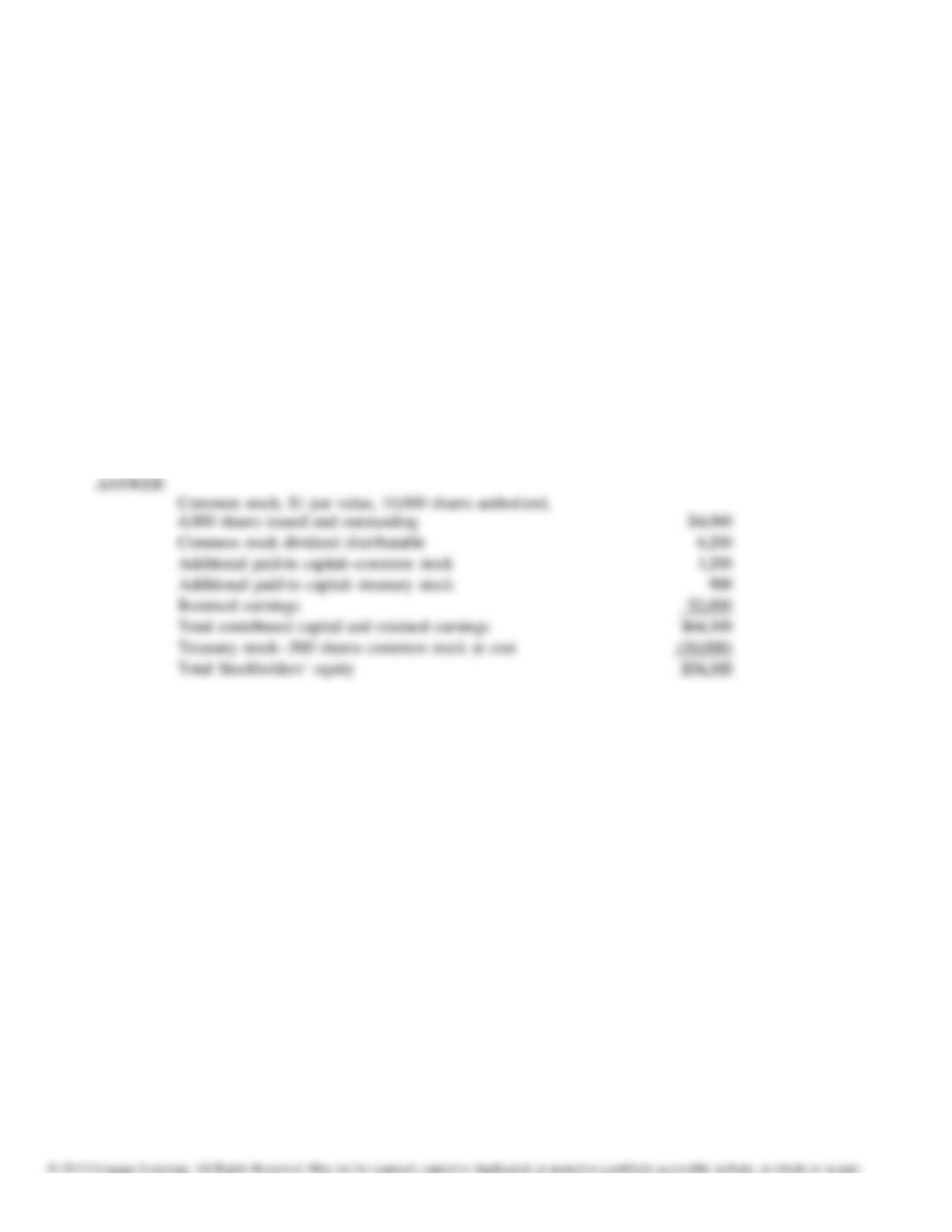
Prepare the stockholders’ equity section of the balance sheet for The Lobster Shanty at December 31, 2015.
The Lobster Shanty
Stockholders’ Equity Section of the Balance Sheet
at December 31, 2015
Chapter 11: Stockholders’ Equity
149. Big Surf Shop provided the following information from its 2015 financial statements:
Total Assets $655,000
Total Liabilities 225,000
In addition, the stockholders‘ equity section of the balance sheet showed:
Preferred stock, 10%, $2 par value, 10,000 authorized, 8,000 issued
and outstanding,$5 liquidation value $16,000
Common stock, $4 par value, 20,000 shares authorized, 10,000 issued and outstanding 40,000
The common stock had a year–end market price of $24.
A) Calculate the book value per common share at year-end.
B) Indicate the usefulness of this ratio for Big Surf Shop.
A) Total stockholders’ equity = $655,000 – $225,000 = $430,000
Book value = ($430,000 – $40,000)/10,000 = $39
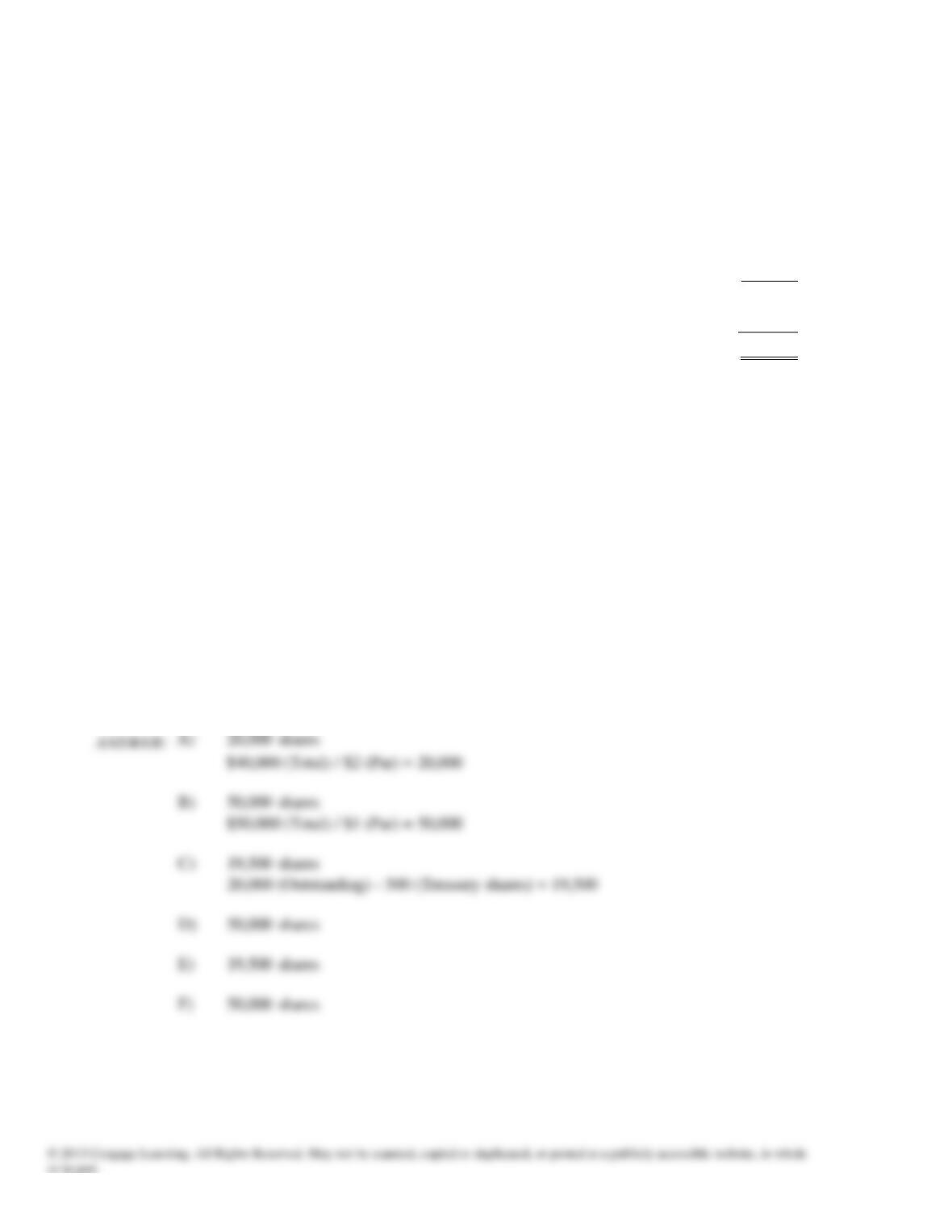
150. The Stockholders’ Equity section of Stallion Tack Shack balance sheet on January 1, 2015, appeared as follows:
Common stock, $5 par, 30,000 shares issued and outstanding
$150,000
Additional paid–in capital—common
120,000
Retained earnings
300,000
Total stockholders’ equity
$570,000
On March 1, 2015, Stallion reacquired 3,000 shares of common stock at $8 per share. Answer the following
questions:
A) What amount would be reported on the March 31, 2015, balance sheet for treasury stock?
B) What is the number of outstanding shares at March 31, 2015?
C) How much is total stockholders‘ equity to be reported on the March 31, 2015 balance sheet?
Chapter 11: Stockholders’ Equity
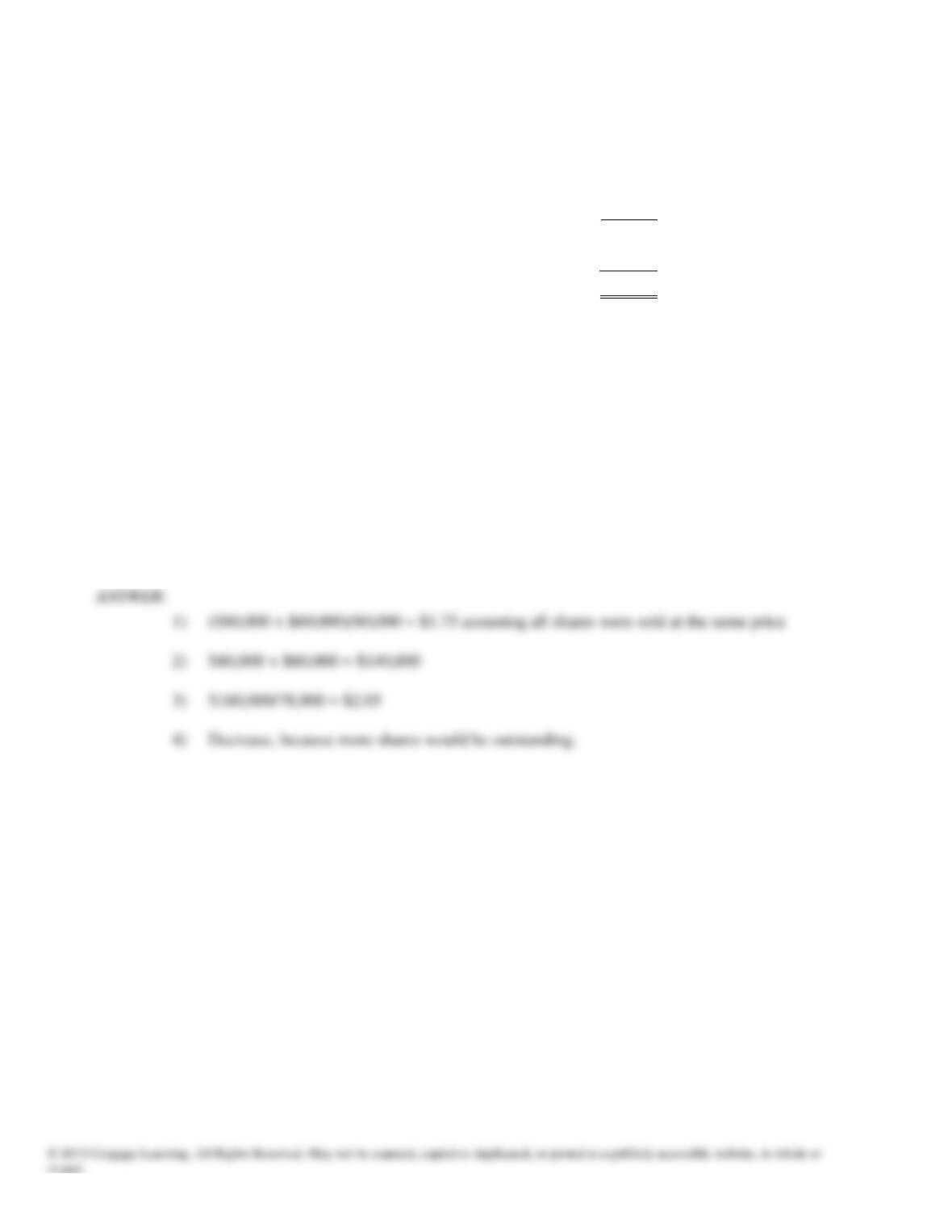
151. Reddy Parts reported the following information at December 31, 2015:
Preferred stock, 12%, $1 par, 50,000 shares authorized, issued, and outstanding;
cumulative; non-participating; callable at par value
$50,000
Common stock, $2 par, 30,000 shares authorized
40,000
Additional paid–in capital—common
50,000
Retained earnings
30,000
Total contributed capital and retained earnings
$170,000
Less: Treasury stock (500 common shares at cost)
(5,000)
Total stockholders’ equity
$165,000
Answer the following questions for Reddy Parts by placing the correct response in the space provided.
___________ A) How many shares of common stock are issued?
___________ B) How many shares of preferred stock are issued?
___________ C) How many common shares are outstanding?
___________ D) How many preferred shares are outstanding ?
___________ E) How many of the common shares will receive dividends if an when they are
paid?
___________ F) How many of the preferred shares will receive dividends if and when they are
paid?
Chapter 11: Stockholders’ Equity
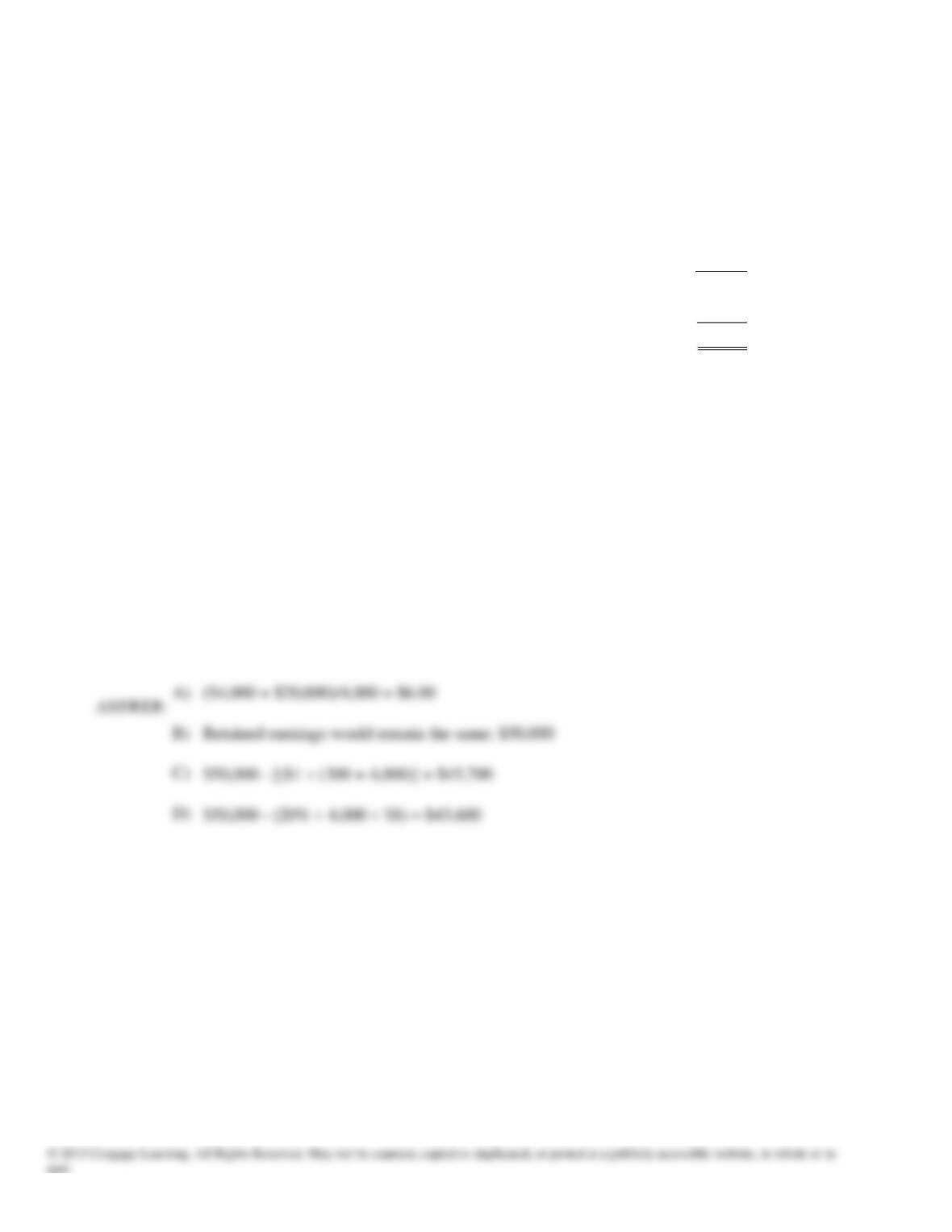
152. Overton Supply reported the following information at December 31, 2015:
Common stock, $1 par, 100,000 shares authorized
$80,000
Additional paid–in capital—common
60,000
Retained earnings
40,000
Total contributed capital and retained earnings
$180,000
Less: Treasury stock (2,000 common shares at cost)
(20,000)
Total stockholders’ equity
$160,000
Answer the following questions for Overton Supply.
1) Assuming that all shares were sold at the same price, how much did each share of common stock
originally sell for?
2) What is the total amount of contributed capital at December 31, 2015?
3) What is the amount of the book value per share at December 31, 2015?
4) Would the book value per share increase, decrease, or remain the same, if the company declared a
2-for–1 stock split on December 31, 2015? Explain.
Chapter 11: Stockholders’ Equity
153. The stockholders’ equity section of Augusta, Inc. is as follows:
Preferred stock, 7%, $10 par, 1,000 shares authorized, 300 shares issued
$3,000
Additional paid–in capital—preferred
9,000
Common stock, $1 par value, authorized 15,000 shares, issued 4,000 shares
4,000
Additional paid–in capital—common
20,000
Retained earnings
50,000
Total contributed capital and retained earnings
$86,000
Less: Treasury stock (1,000 common shares at cost )
(6,000)
Total stockholders‘ equity
$80,000
The market price of the stock on December 31, 2015, was $8 per share. Answer the following independent
questions:
A) Calculate the average amount at which each share of common stock was initially sold.
B) What balance will be in the retained earnings account immediately after the declaration of a 2- for–1
stock split?
C) If a cash dividend of $1 per share was declared to both common and preferred stockholders, what
would be the balance in retained earnings immediately after the declaration?
D) What balance will be in the retained earnings account immediately after the declaration of a 20%
common stock dividend on December 31, 2015?
Chapter 11: Stockholders’ Equity
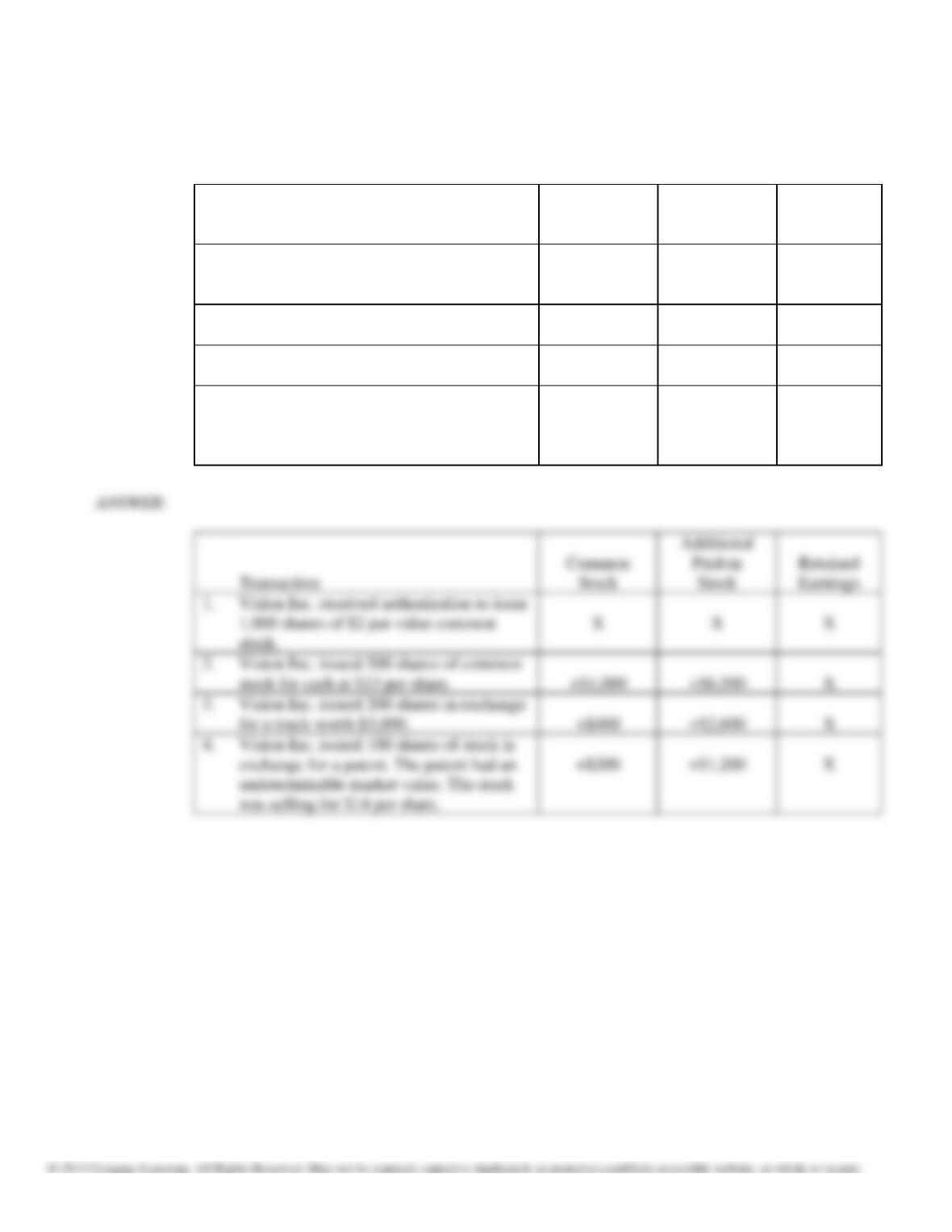
154. Given below are several transactions for Vision Inc. In the space provided, indicate the impact on each of the
stockholders‘ equity accounts given, by placing the dollar amount and either a plus sign (+) or a minus sign (-) in the
box provided. For each account in which there is no effect, place an X in the box.
Transaction
Common
Stock
Additional
Paid-in
Stock
Retained
Earnings
1.
Vision Inc. received authorization to issue
1,000 shares of $2 par value common
stock.
2.
Vision Inc. issued 500 shares of common
stock for cash at $15 per share.
3.
Vision Inc. issued 200 shares in exchange
for a truck worth $3,000.
4.
Vision Inc. issued 100 shares of stock in
exchange for a patent. The patent had an
undeterminable market value. The stock
was selling for $14 per share.
Transaction
2.
Vision Inc. issued 500 shares of common
3.
Vision Inc. issued 200 shares in exchange
for a truck worth $3,000.
4.
Vision Inc. issued 100 shares of stock in
undeterminable market value. The stock
Chapter 11: Stockholders’ Equity
155. Below are two transactions for Navaho Co.
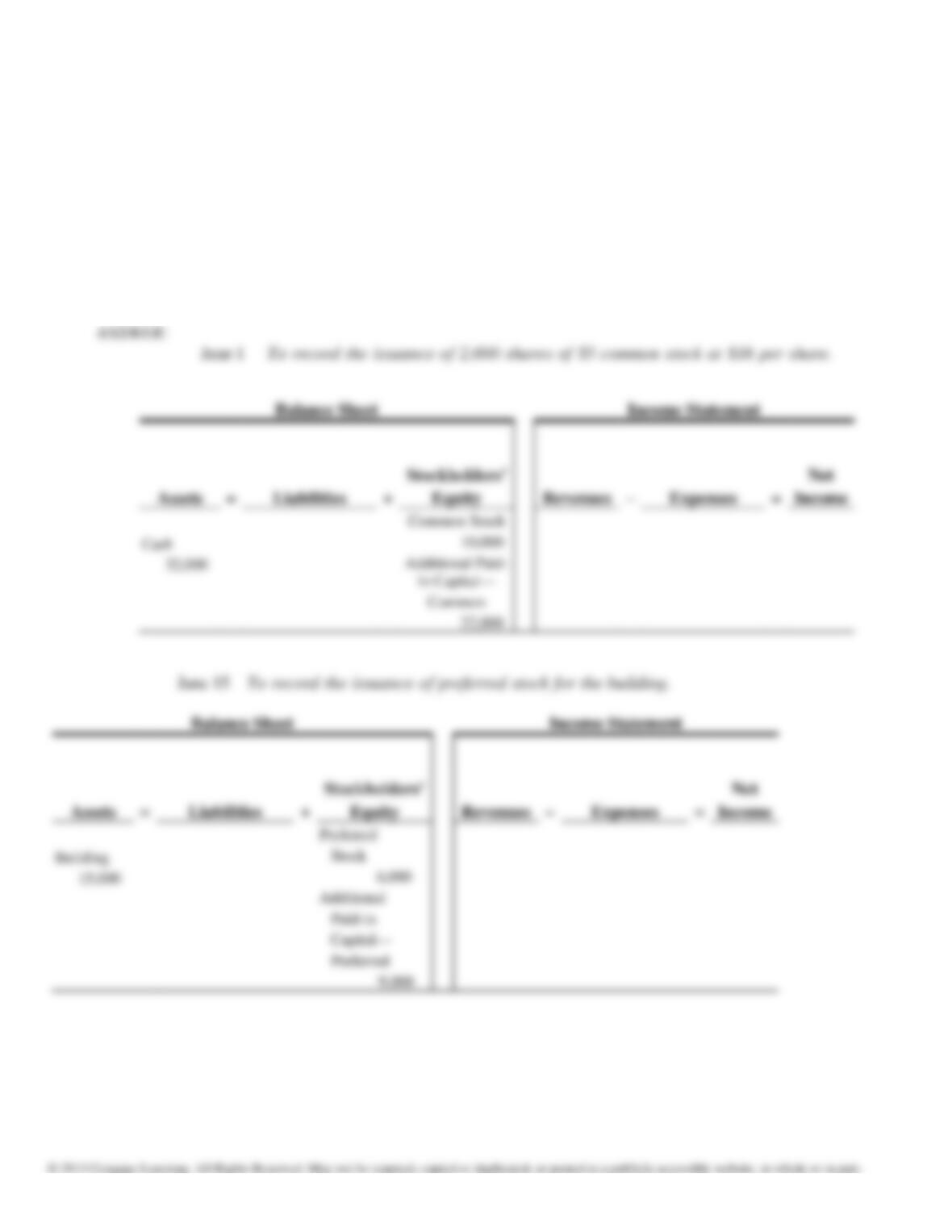
1. On June 1, Navaho Co. issued 2,000 shares of $5 par common stock for $16 per share.
2. On June 15, Navaho Co. issued 1,200 shares of $5 par preferred stock to acquire a building. The stock is not
widely traded, and the current market value of the stock is not evident. The building has recently been appraised by
an independent firm as having a market value of $15,000.
REQUIRED: For each of these transactions, identify the accounting equation effects on Navaho Company‘s
books.
Chapter 11: Stockholders’ Equity
156. The Stockholders‘ Equity section of Sea Scape, Inc.‘s balance sheet on January 1, 2015, appeared as follows:
Common stock, $2 par, 20,000 shares issued and outstanding
$40,000
Additional paid–in capital—common
120,000
Retained earnings
300,000
Total contributed capital and retained earnings
$460,000
Less: Cost of treasury stock (10,000 shares)
(80,000)
Total stockholders‘ equity
$380,000
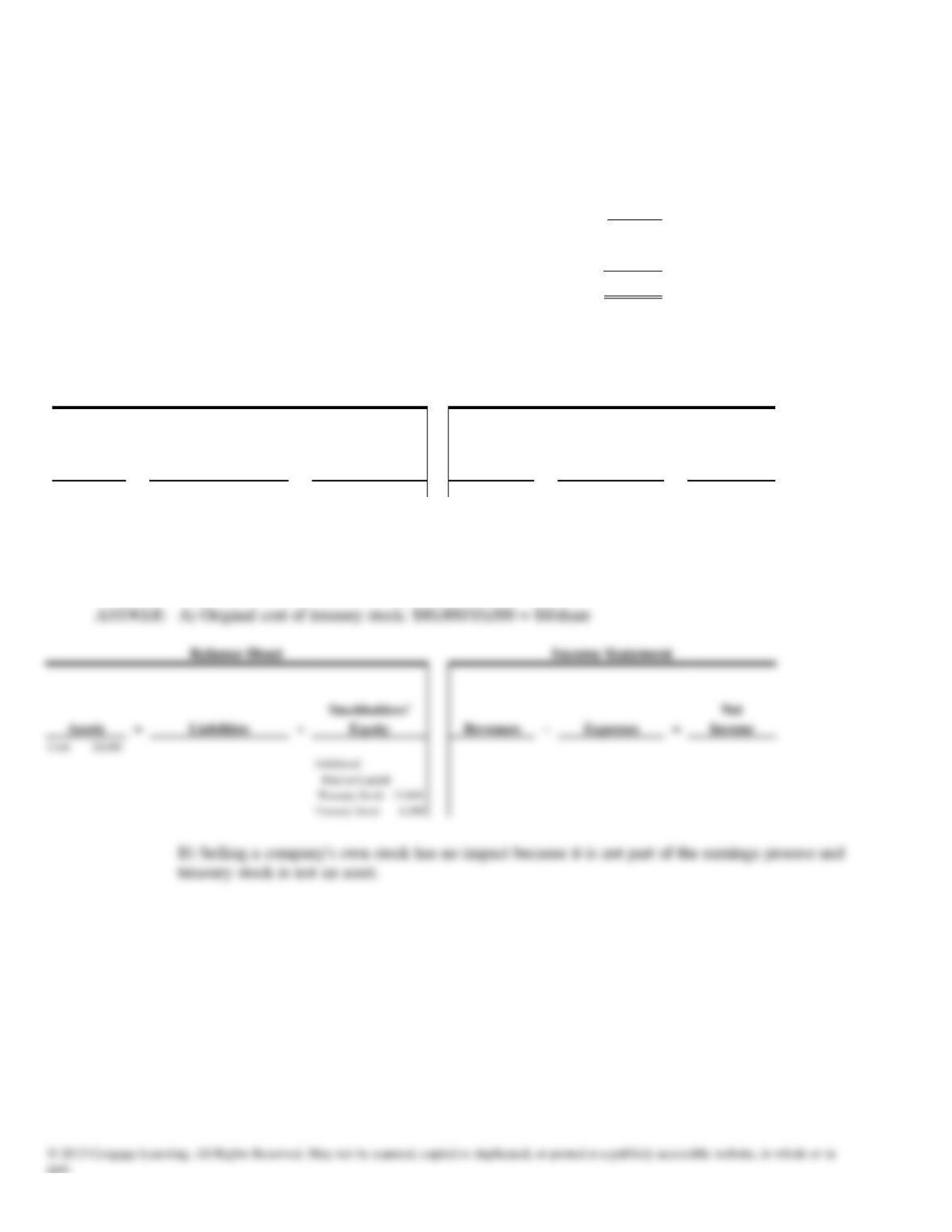
A) On March 1, 2015, Sea Scape resold 800 shares of treasury stock at $25 per share.
What is the effect of the March 1 transaction on the accounting equation?
Balance Sheet
Income Statement
Assets
=
Liabilities
+
Stockholders’
Equity
Revenues
–
Expenses
=
Net
Income
B) Why is the excess of the sales price of the 800 shares of treasury stock over the cost
not reported on the income statement?
Income Statement
=
Liabilities
+
Revenues
–
Expenses
=
Chapter 11: Stockholders’ Equity
157. Assume that the Stockholders’ Equity section of Cherokee Company’s balance sheet on December 31, 2015,
appears as follows:
Common stock, $10 par value, 1,500 shares issued and outstanding
$15,000
Additional paid-in capital—Common
17,000
Retained earnings
11,000
Total stockholders’ equity
$43,000
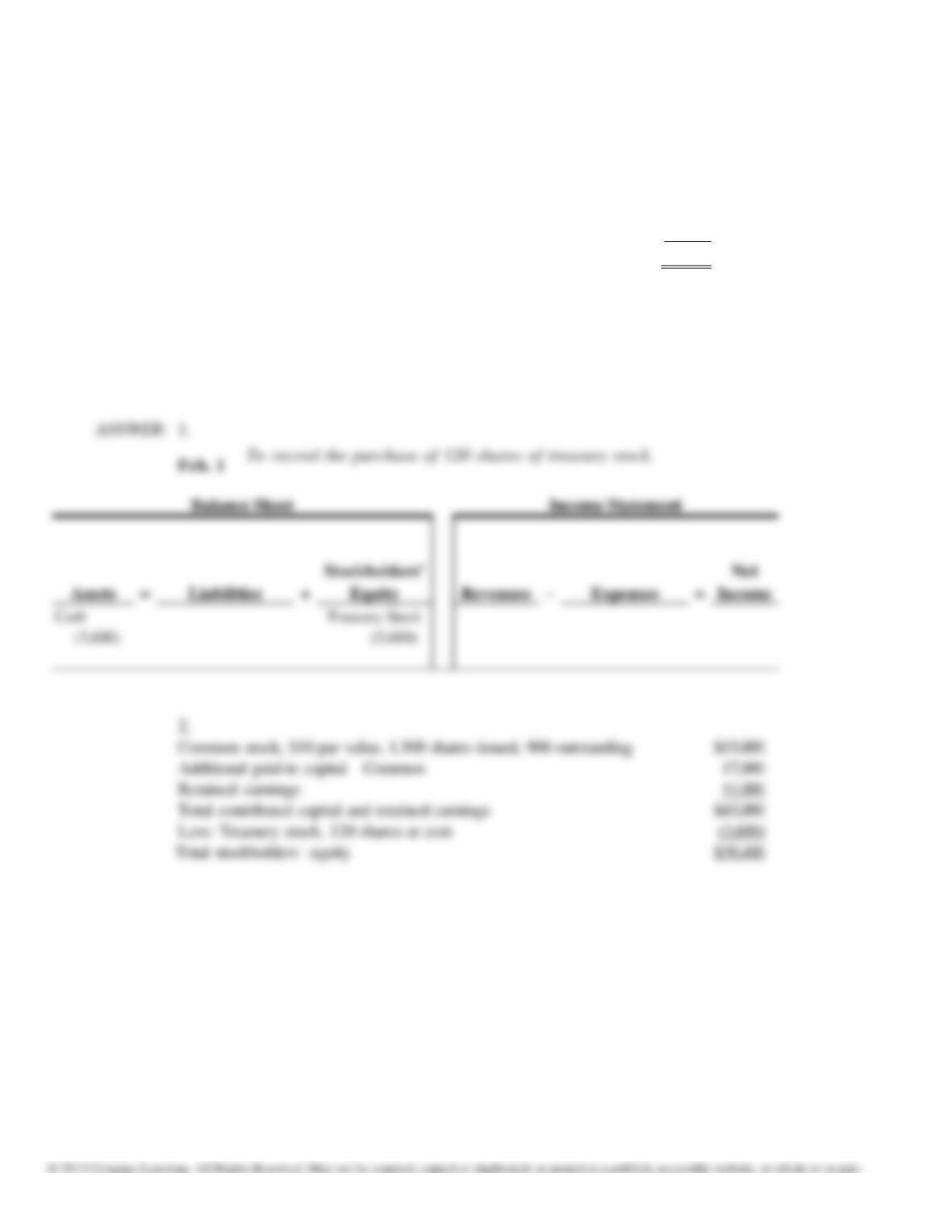
1. If on February 1, 2016, Cherokee buys 120 of its shares as treasury stock at $30 per share, what are the
accounting equation effects on Cherokee‘s books?
2. How with the Stockholders’ Equity section of Cherokee’s balance sheet appear on February 1, 2016, after the
purchase of the treasury stock?