Larson_Calculus_10e ch11sec06
MULTIPLE CHOICE
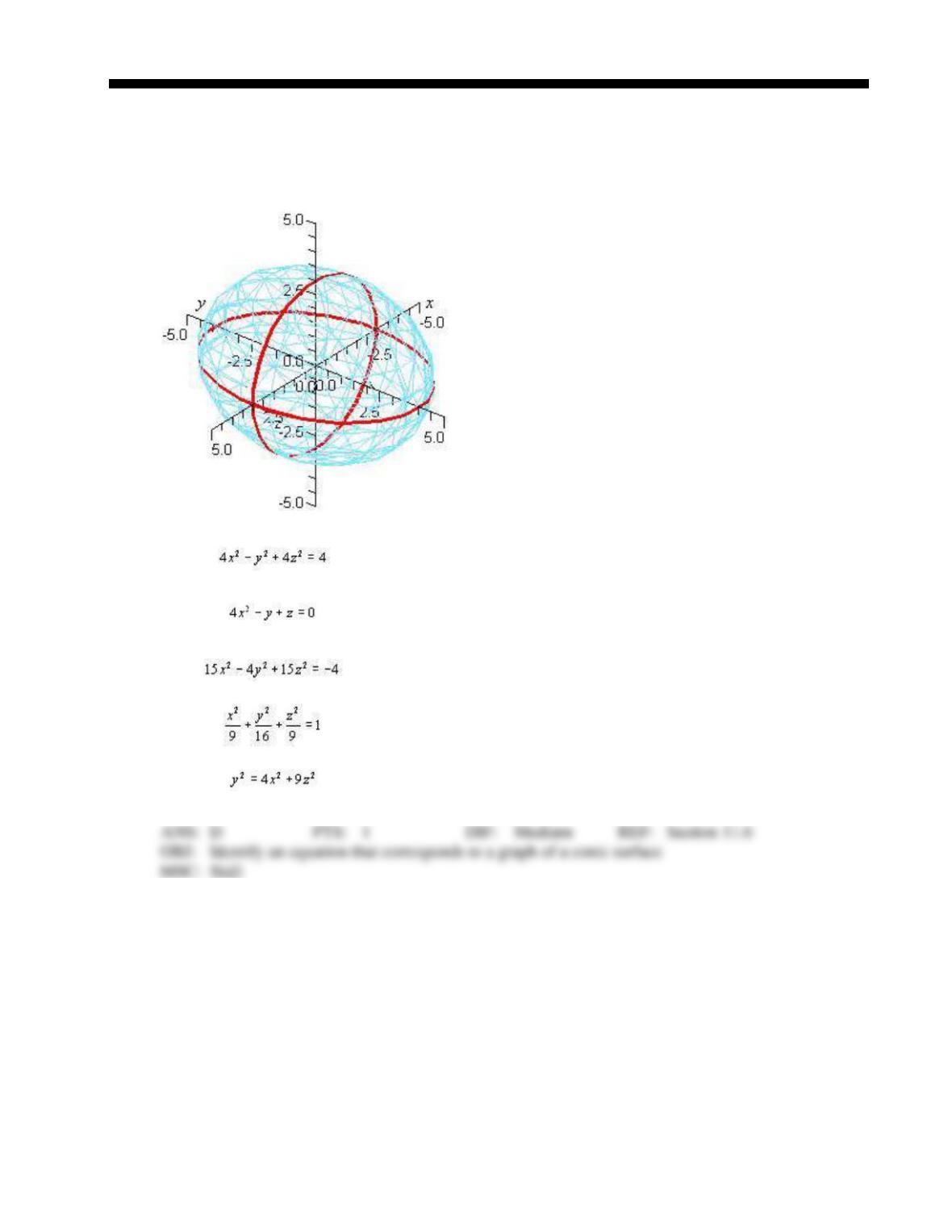
1. Identify the equation of the following graph.
a.
b.
c.
d.
e.
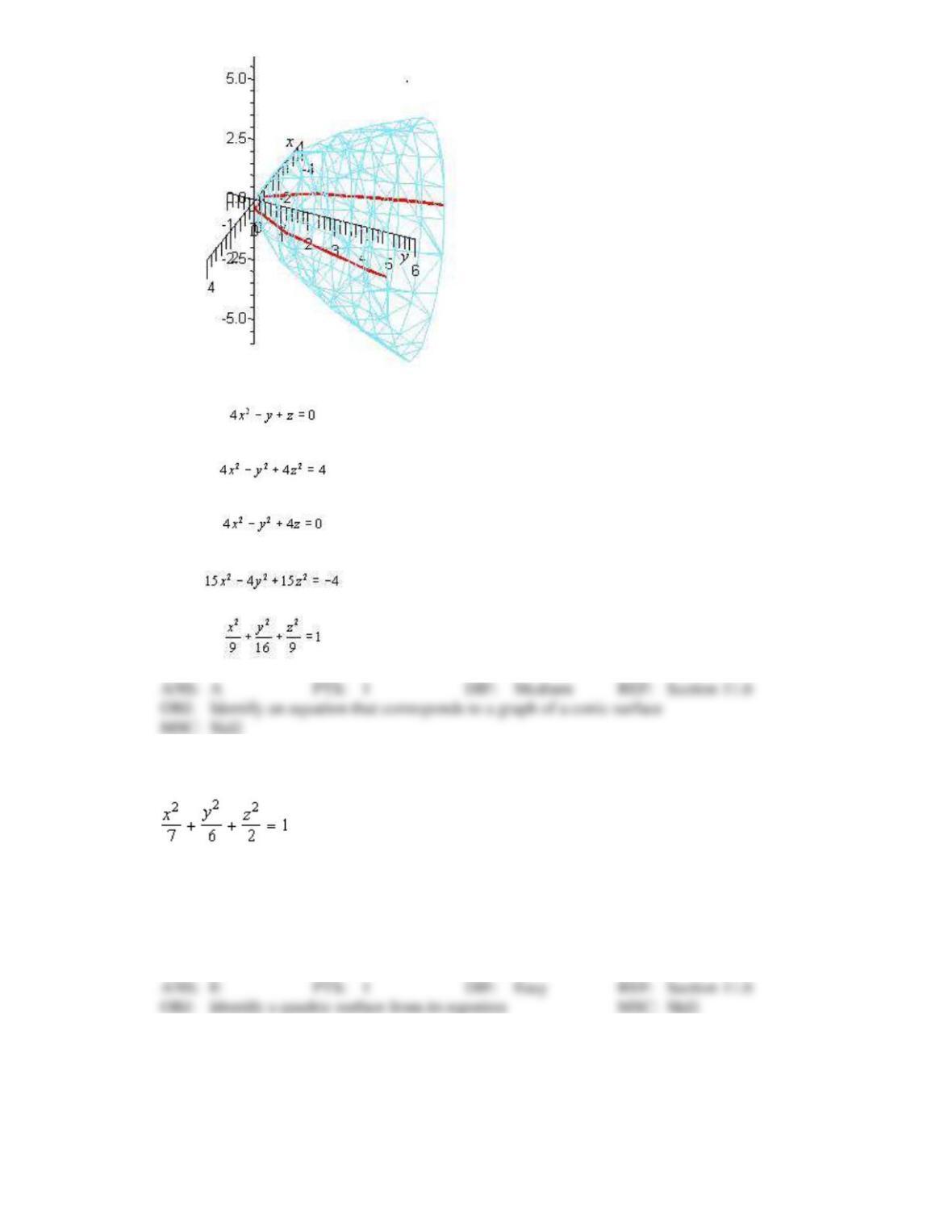
2. Identify the equation of the following graph.
a.
b.
c.
d.
e.
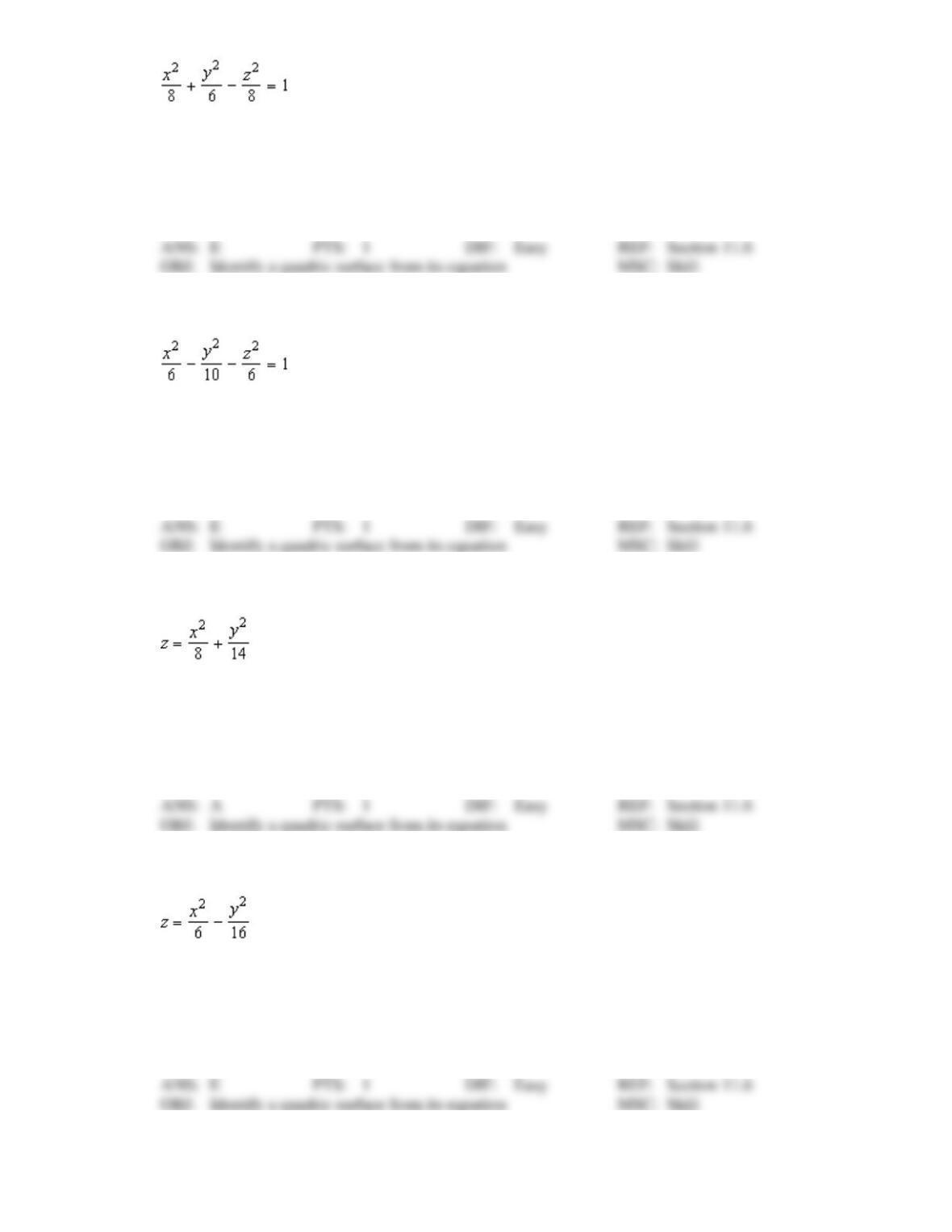
3. Identify the following quadric surface.
a.
hyperboloid of one sheet
b.
elliptic cone
c.
hyperboloid of two sheets
d.
elliptic paraboloid
e.
ellipsoid
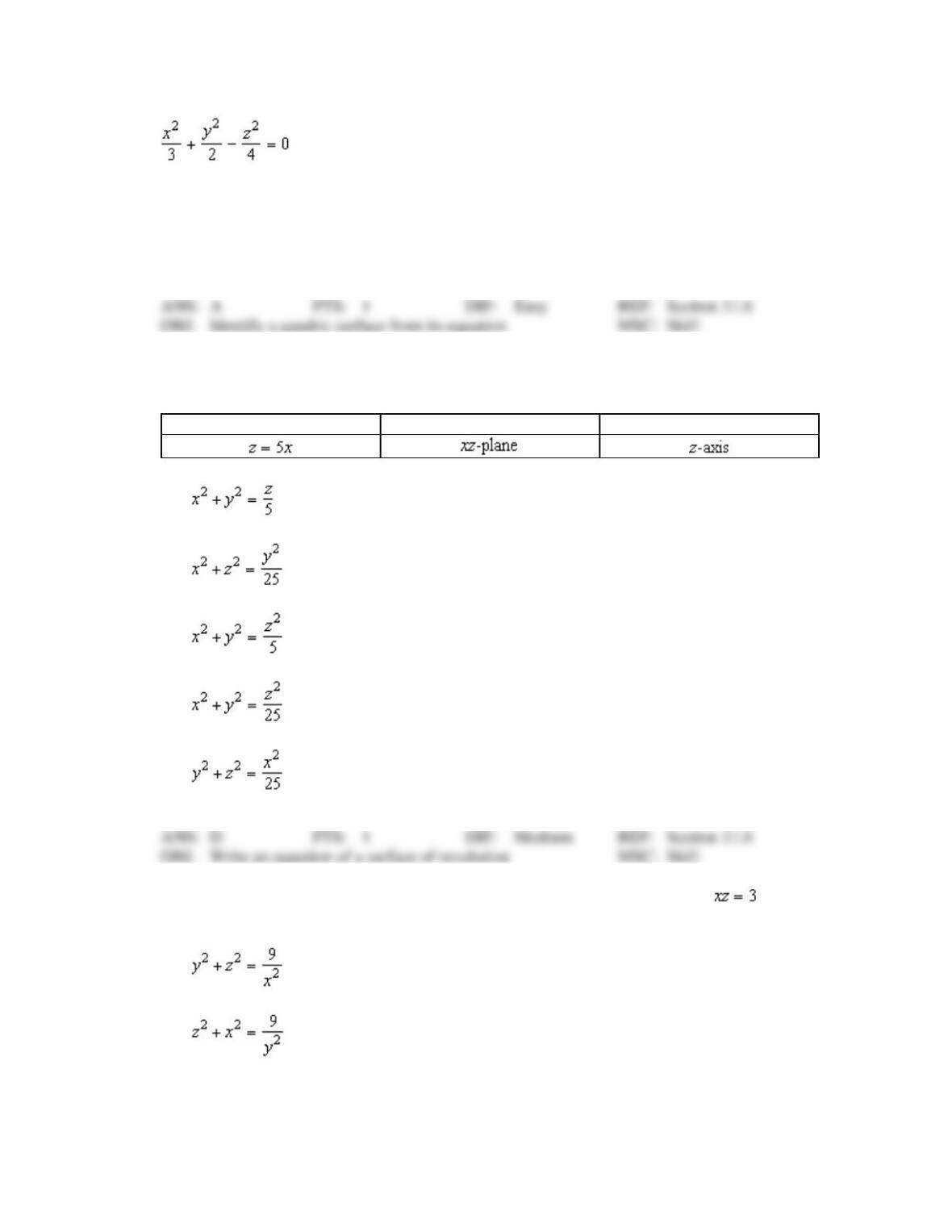
4. Identify the following quadric surface.
a.
hyperboloid of two sheets
b.
elliptic cone
c.
ellipsoid
d.
elliptic paraboloid
e.
hyperboloid of one sheet
5. Identify the following quadric surface.
a.
ellipsoid
b.
elliptic cone
c.
elliptic paraboloid
d.
hyperboloid of one sheet
e.
hyperboloid of two sheets
6. Identify the following quadric surface.
a.
elliptic paraboloid
b.
elliptic cone
c.
hyperboloid of two sheets
d.
hyperboloid of one sheet
e.
ellipsoid
7. Identify the following quadric surface.
a.
hyperboloid of one sheet
b.
elliptic cone
c.
elliptic paraboloid
d.
hyperboloid of two sheets
e.
hyperbolic paraboloid
8. Identify the following quadric surface.
a.
Elliptic cone
b.
Hyperboloid of two sheets
c.
Elliptic paraboloid
d.
ellipsoid
e.
Hyperboloid of one sheet
9. Find an equation of the surface of revolution generated by revolving the curve given below in the
indicated coordinate plane about the given axis.
Equation of Curve
Coordinate Plane
Axis of Revolution
a.
b.
c.
d.
e.
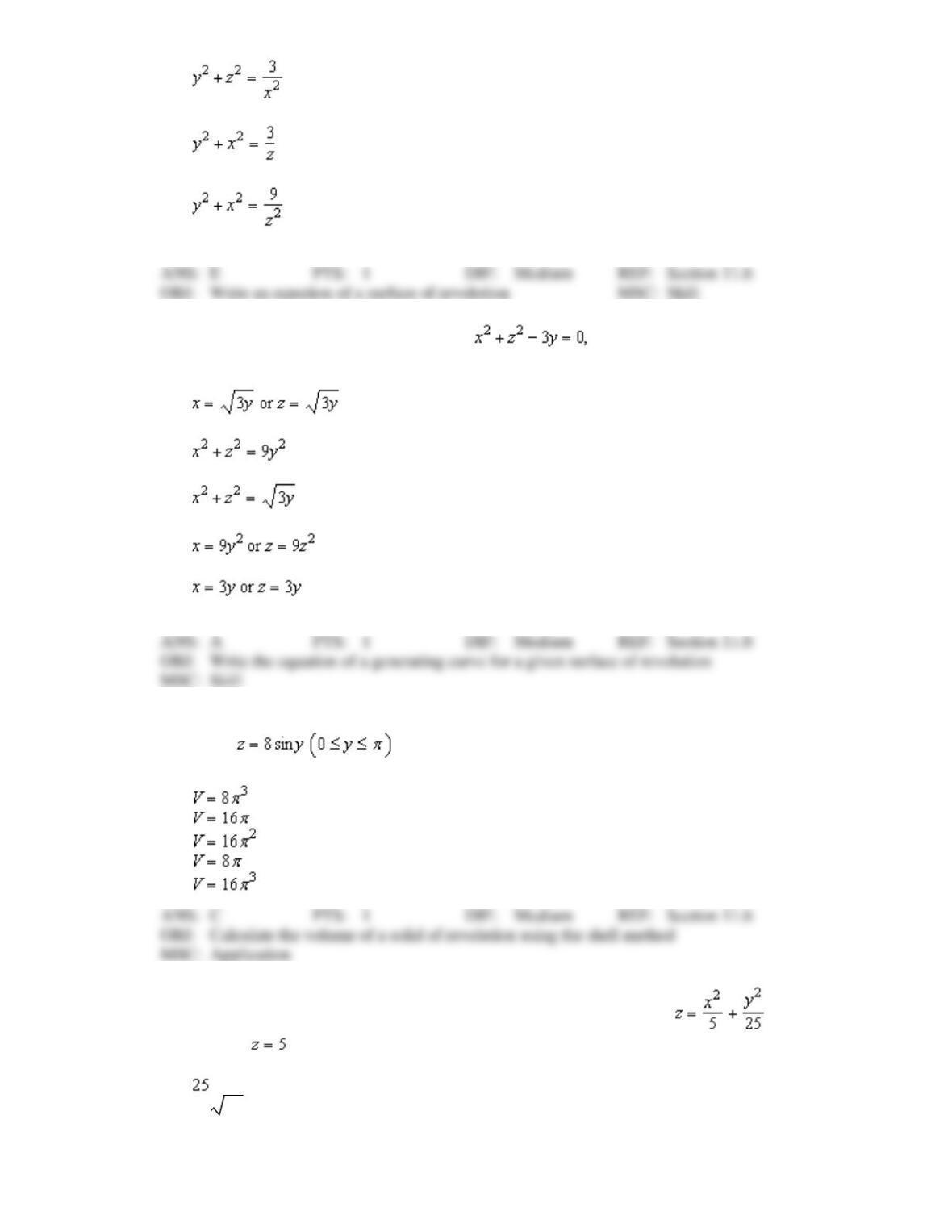
10. Find an equation for the surface of revolution generated by revolving the curve in the xz–plane
about the z–axis.
a.
b.
c.
d.
e.
11. Given the equation of a surface of revolution find the equation of its generating
curve in the yz–plane rotating about the y–axis.
a.
b.
c.
d.
e.
12. Use the shell method to find the volume of the solid below the surface formed by revolving
the curve about the z-axis and above the xy–plane.
a.
b.
c.
d.
e.
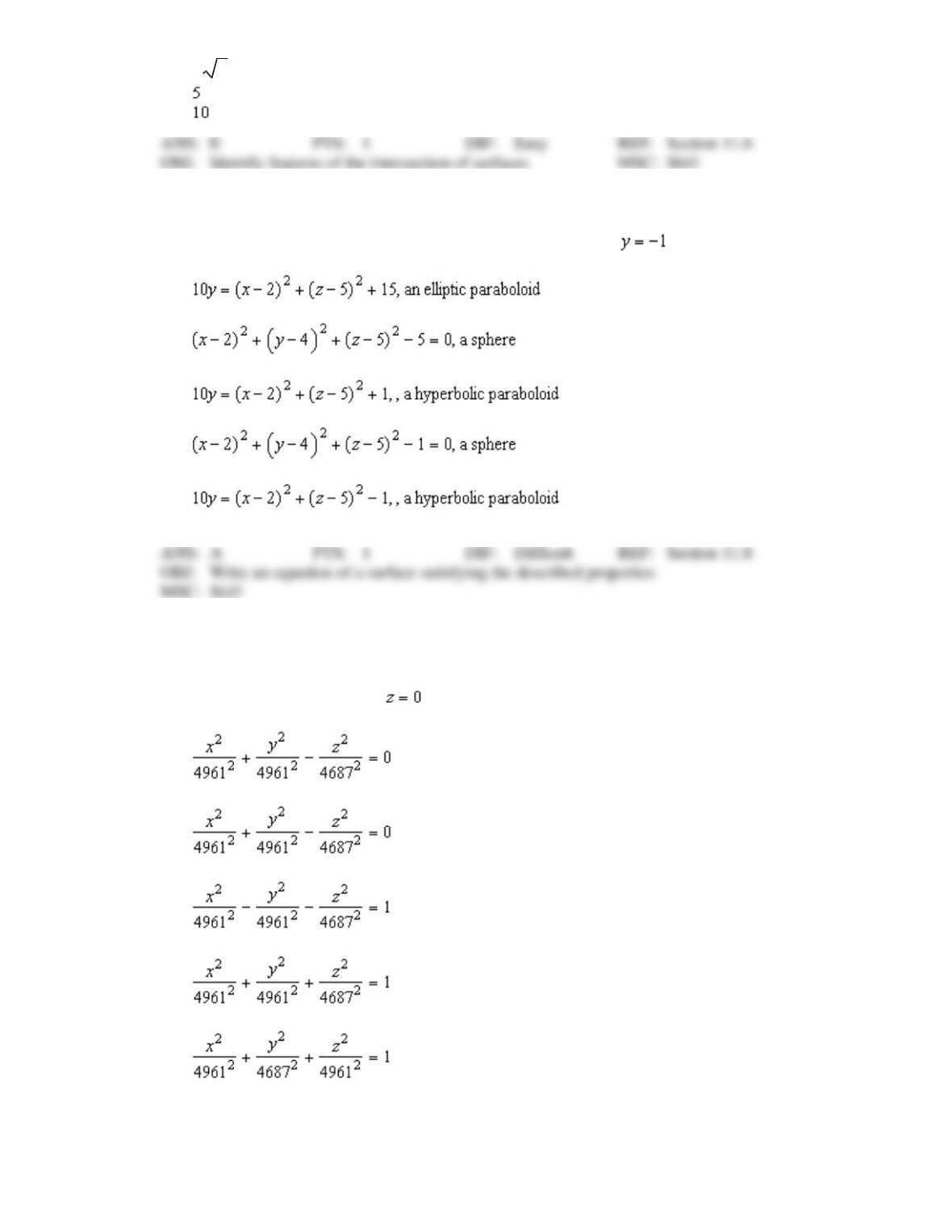
13. Find the length of the minor axis of the ellipse generated when the surface is intersected
by the plane .
a.
b.
10 10
c.
d.
e.
14. Find the equation of the surface satisfying the conditions, and identify the surface.
The set of points equidistant from the point (2, 4, 5 ) and the plane .
a.
b.
c.
d.
e.
15. Some planet is an oblate ellipsoid rather than a sphere because of the forces caused by its
rotation. The equatorial radius of this planet is 4961 miles and the polar radius is 4687 miles.
Find the equation of the ellipsoid. (Assume that the center of a planet is at the origin and that
the trace formed by the plane corresponds to the equator.)
a.
b.
c.
d.
e.
5 5
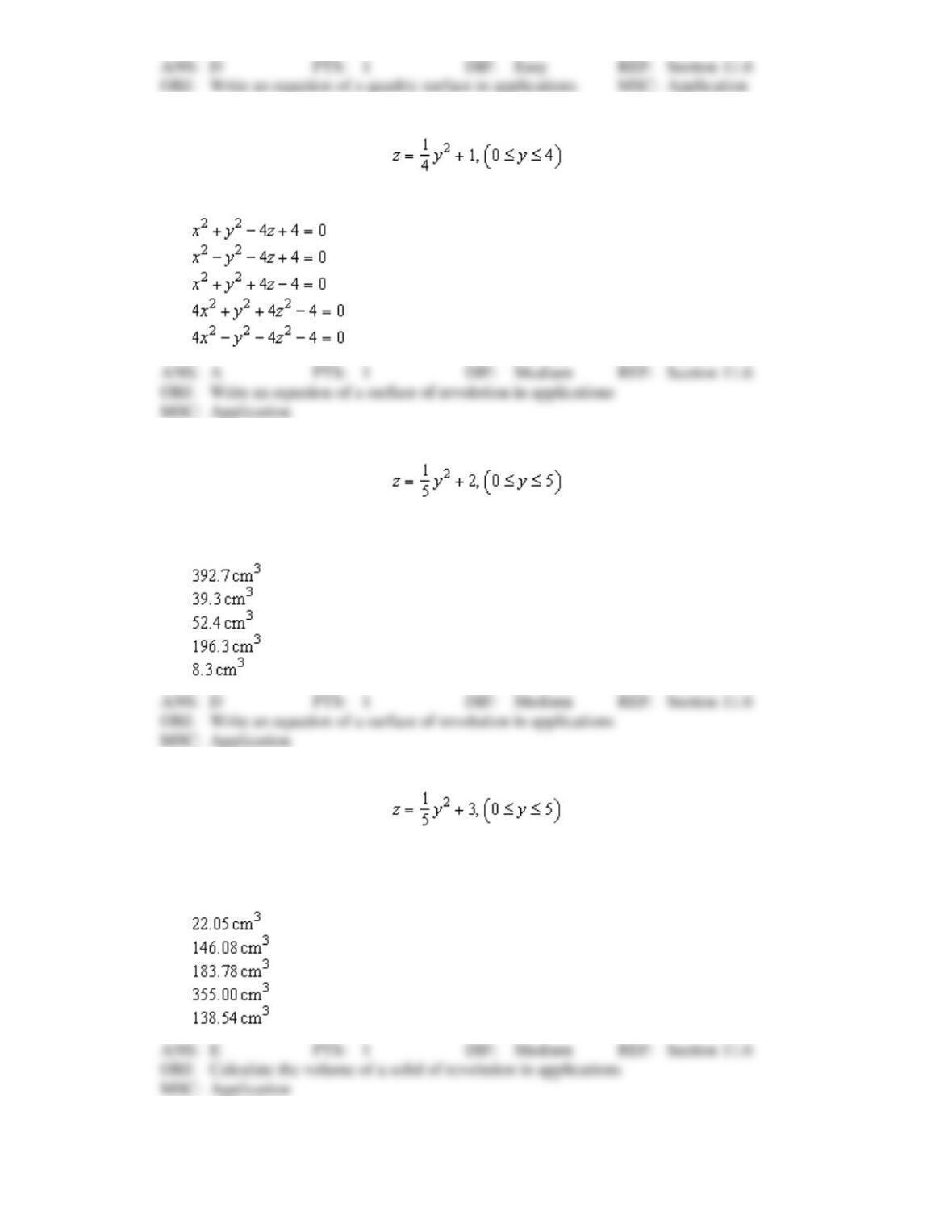
16. The top of a rubber bushing designed to absorb vibrations in an automobile is the surface of revolution
generated by revolving the curve in the yz-plane about the z-axis. Find an
equation for the surface of revolution.
a.
b.
c.
d.
e.
17. The top of a rubber bushing designed to absorb vibrations in an automobile is the surface of revolution
generated by revolving the curve in the yz-plane about the z-axis. All
measurements are in centimeters and the bushing is set on the xy-plane. Use the shell method to find its
volume. Round your answer to one decimal place.
a.
b.
c.
d.
e.
18. The top of a rubber bushing designed to absorb vibrations in an automobile is the surface of revolution
generated by revolving the curve in the yz-plane about the z-axis. The
bushing has a hole of 4 centimeters in diameter through its center and parallel to the axis of revolution.
All measurements are in centimeters and the bushing is set on the xy-plane. Find the volume of the
rubber bushing. Round your answer to two decimal places.
a.
b.
c.
d.
e.