
Exam
Name___________________________________
MULTIPLE CHOICE. Choose the one alternative that best completes the statement or answers the question.
1)
All of the following bacteria are gram–positive. Which does NOT belong with the others?
1)
A)
Actinomyces
B)
Mycobacterium
C)
Listeria
D)
Corynebacterium
E)
Bacillus
2)
Caulobacter are different from most bacteria in that they
2)
A)
have stalks.
B)
are gram–positive.
C)
are gram–negative.
D)
are motile.
E)
lack cell walls.
3)
Which of the following is the best reason to classify Streptococcus in the Lactobacillales?
3)
A)
found in dairy products
B)
Gram reaction
C)
rRNA sequences
D)
fermentation of lactose
E)
morphology

4)
You have isolated a bacterium that grows in a medium containing an organic substrate and nitrate
in the absence of oxygen. The nitrate is reduced to nitrogen gas. You can be sure that this bacterium
is
4)
A)
gram–positive.
B)
a photoheterotroph.
C)
using anaerobic respiration.
D)
a photoautotroph.
E)
a chemoautotroph.
5)
Which of the following statements about the causative agent of Rocky Mountain spotted fever is
FALSE?
5)
A)
It is transmitted by ticks.
B)
It is an intracellular parasite.
C)
It is gram–negative.
D)
It is in the genus Rickettsia.
E)
It is found in soil and water.
6)
Both Beggiatoa and the purple sulfur bacteria use H2S. These bacteria differ in that Beggiatoa
6)
A)
uses H2S for a carbon source.
B)
belongs to the gammaproteobacteria.
C)
uses H2S for an energy source.
D)
uses light energy.
E)
is a heterotroph.

7)
Escherichia coli belongs to the
7)
A)
spirochetes.
B)
actinomycetes.
C)
green sulfur bacteria.
D)
gram–positive bacteria.
E)
proteobacteria.
8)
The nonsulfur photosynthetic bacteria use organic compounds as
8)
A)
carbon sources.
B)
electron donors to reduce CO2.
C)
oxygen sources.
D)
energy sources.
E)
electron acceptors.
9)
Salmonella, Shigella, Yersinia, and Serratia are all
9)
A)
gram–negative facultatively anaerobic rods.
B)
endospore–forming bacteria.
C)
pathogens.
D)
fermentative.
E)
gram–positive aerobic cocci.
10)
Which of the following is NOT an enteric?
10)
A)
Shigella
B)
Escherichia
C)
Enterobacter
D)
Salmonella
E)
Campylobacter

11)
You have isolated a prokaryotic cell. The first step in identification is a(n)
11)
A)
Gram stain.
B)
DNA fingerprint.
C)
endospore stain.
D)
flagella stain.
E)
lactose fermentation test.
12)
Which one of the following bacteria does NOT belong with the others?
12)
A)
Escherichia
B)
Bacillus
C)
Lactobacillus
D)
Streptococcus
E)
Staphylococcus
13)
The crab industry needs female crabs for growing more crabs. What bacterium might be used to
ensure development of female crabs and shrimp?
13)
A)
Neisseria
B)
Acinetobacter
C)
Gemmata
D)
Wolbachia
E)
Pelagibacter

14)
A primary difference between cyanobacteria and purple and green phototrophic bacteria is
14)
A)
electron donor for CO2 reduction.
B)
color.
C)
energy source.
D)
cell type.
E)
cell wall type.
15)
All of the following bacteria are motile. Which does NOT have flagella?
15)
A)
Salmonella
B)
Pseudomonas
C)
spirochetes
D)
Escherichia
E)
helical bacteria
C
16)
Which of the following bacteria are responsible for more infections and more different kinds of
infections?
16)
A)
Streptococcus
B)
Neisseria
C)
Salmonella
D)
Pseudomonas
E)
Staphylococcus
A
A

17)
You have isolated a bacterium that grows in a medium containing only inorganic nutrients.
Ammonia is oxidized to a nitrate ion. This bacterium is
17)
A)
gram–negative.
B)
a photoheterotroph.
C)
a photoautotroph
D)
using anaerobic respiration.
E)
a chemoautotroph.
18)
Mycoplasmas differ from other bacteria in that they
18)
A)
are gram–negative.
B)
are acid–fast.
C)
lack a cell wall.
D)
are motile.
E)
grow inside host cells.
19)
Burkholderia was reclassified from the gammaproteobacteria to the betaproteobacteria because
19)
A)
it causes melioidosis.
B)
it grows in disinfectants.
C)
it is a gram–negative rod.
D)
its rRNA sequence is similar to that of Neisseria.
E)
it causes infections in cystic fibrosis patients.
20)
Which one of the following bacteria does NOT belong with the others?
20)
A)
Campylobacter
B)
Pseudomonas
C)
Salmonella
D)
Bordetella
E)
Burkholderia

21)
Thiobacillus oxidizes inorganic sulfur compounds and reduces CO2. This bacterium is a
21)
A)
photoautotroph.
B)
chemoautotroph.
C)
gammaproteobacteria.
D)
chemoheterotroph.
E)
photoheterotroph.
22)
Which of the following genera is an anaerobic gram–negative rod?
22)
A)
Bacteroides
B)
Treponema
C)
Neisseria
D)
Staphylococcus
E)
Escherichia
A
23)
Which of the following are found primarily in the intestines of humans?
23)
A)
endospore–forming rods
B)
facultatively anaerobic gram–negative rods
C)
gram–negative aerobic rods and cocci
D)
aerobic, helical bacteria
E)
gram–positive cocci
B
24)
Which of the following bacteria does NOT belong with the others?
24)
A)
Staphylococcus
B)
Halobacterium
C)
Methanobacterium
D)
Halococcus
E)
Sulfolobus
A
B
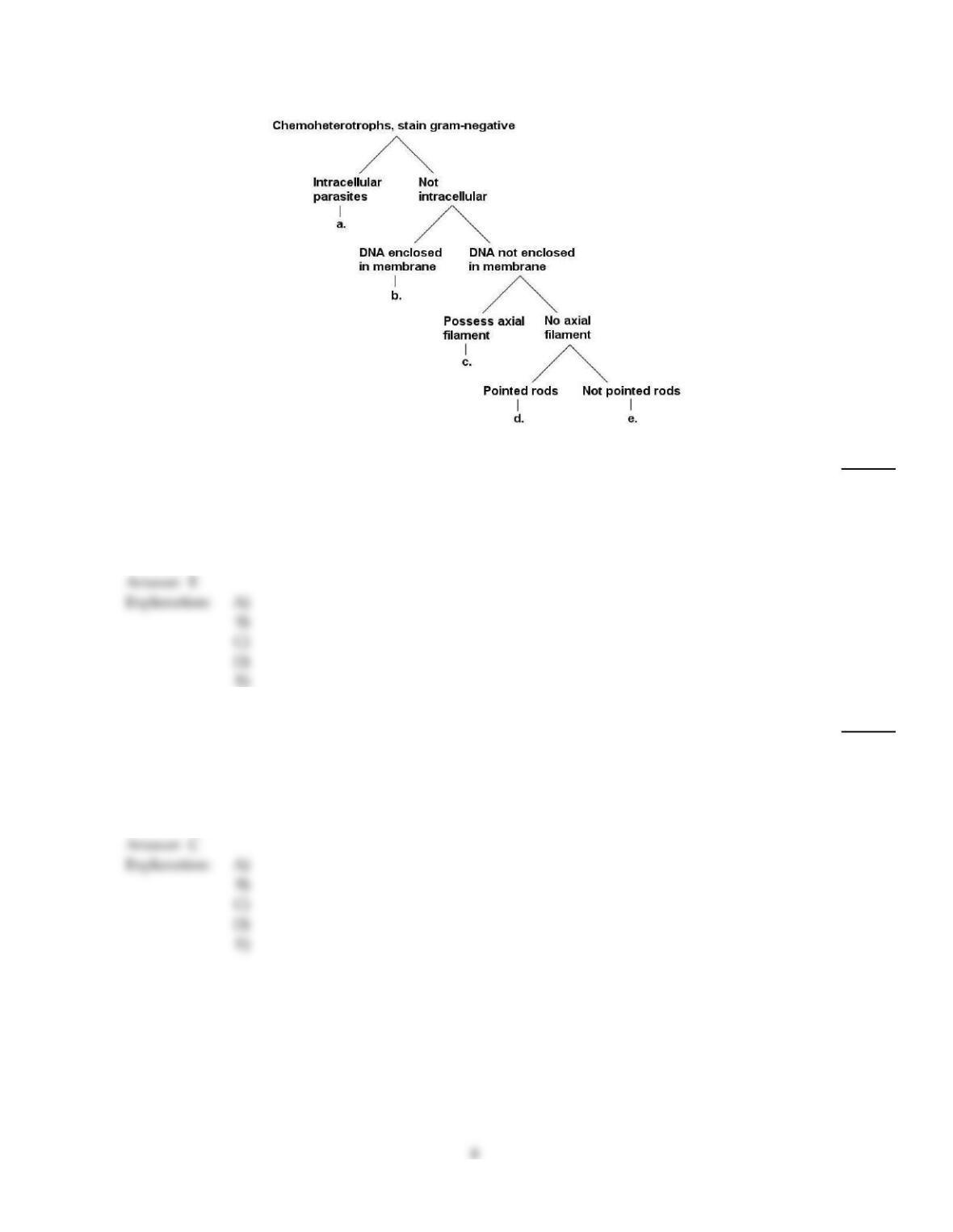
Figure 11.1
25)
What is group “c.” in the key shown in Figure 11.1?
25)
A)
fusobacteria
B)
chlamydiae
C)
planctomycetes
D)
bacteroidetes
E)
spirochaetes
26)
Which of the following is NOT a characteristic of Neisseria?
26)
A)
gram–negative
B)
oxidase–positive
C)
requires X and V factors
D)
cocci
E)
Some species are human pathogens.

27)
Which of the following pairs is mismatched?
27)
A)
mycobacteria acid–fast
B)
Pseudomonas gram–positive
C)
aerobic, helical bacteria gram–negative
D)
spirochete axial filament
E)
enterics gram–negative
28)
You have isolated an aerobic gram–positive, endospore–forming bacterium that grows well on
nutrient agar. To which of the following groups does it most likely belong?
28)
A)
bacillales
B)
deltaproteobacteria
C)
phototrophic bacteria
D)
gammaproteobacteria
E)
The answer cannot be determined based on the information provided.
A
29)
Which of the following form conidiospores?
29)
A)
spiral and curved bacteria
B)
anaerobic gram–negative cocci
C)
endospore–forming gram–positive rods and cocci
D)
actinomycetes and related organisms
E)
rickettsias
D
30)
Which of the following is NOT a characteristic of spirochetes?
30)
A)
helical shape
B)
gram–negative
C)
found in the human oral cavity
D)
possess an axial filament
E)
easily observed with brightfield microscopy
E
B

31)
You have isolated a gram–positive rod. What should you do next?
31)
A)
endospore stain
B)
lactose fermentation
C)
enterotube
D)
flagella stain
E)
Gram stain
32)
Which of the following pairs is mismatched?
32)
A)
actinomycetes reproduce by fragmentation
B)
archaea extremophiles
C)
chemoautotrophic bacteria fix atmospheric nitrogen
D)
Cytophaga a gliding, nonfruiting bacterium
E)
dissimilatory sulfate–reducing bacteria produce H2S
33)
Which of the following lacks a cell wall?
33)
A)
Clostridium
B)
Mycobacterium
C)
Nocardia
D)
Borrelia
E)
Mycoplasma
34)
Streptomyces differs from Actinomyces because Streptomyces
34)
A)
is a bacterium.
B)
produces conidia.
C)
forms filaments.
D)
makes antibiotics.
E)
is a strict aerobe.

35)
Which of the following do you expect to be MOST resistant to high temperatures?
35)
A)
Bacillus subtilis
B)
Streptococcocus pyogenes
C)
Neisseria gonorrhoeae
D)
Staphylococcus aureus
E)
Eschericia coli
36)
Borrelia is classified as a spirochete because it
36)
A)
possesses an axial filament.
B)
is transmitted by ticks.
C)
is aerobic.
D)
is a pathogen.
E)
is a rod.
37)
Which one of the following does NOT belong with the others?
37)
A)
Wolbachia
B)
Rickettsia
C)
Staphylococcus
D)
Coxiella
E)
Ehrlichia
38)
Which of the following bacteria is gram–positive?
38)
A)
Pseudomonas
B)
Bacteroides
C)
Salmonella
D)
Rickettsia
E)
Streptococcus

39)
Which of the following bacteria is gram–negative?
39)
A)
Staphylococcus
B)
Corynebacterium
C)
Bacillus
D)
Treponema
E)
Mycobacterium
40)
Which of the following is NOT a characteristic inherent of the non–endospore–forming
gram–positive rods?
40)
A)
carry out fermentative metabolism
B)
lack cell walls
C)
nonpathogenic
D)
are aerotolerant
E)
display a branched filamentous morphology
41)
Actinomycetes differ from fungi in that actinomycetes
41)
A)
are chemoheterotrophs.
B)
cause disease.
C)
lack a membrane–bounded nucleus.
D)
are decomposers.
E)
require light.
42)
Rickettsias differ from chlamydias in that rickettsias
42)
A)
form elementary bodies.
B)
are enterics.
C)
are gram–negative.
D)
require an arthropod for transmission.
E)
are intracellular parasites.

43)
Requirements for X and V factors are used to identify
43)
A)
Haemophilus.
B)
Pseudomonas.
C)
Staphylococcus.
D)
Escherichia.
E)
Neisseria.
44)
Which of the following pairs is NOT correctly matched?
44)
A)
elementary body Escherichia
B)
heterocyst cyanobacteria
C)
myxospore gliding bacteria
D)
endospore Clostridium
E)
endospore Bacillus
45)
Staphylococcus and Streptococcus can be easily differentiated in a laboratory by which one of the
following?
45)
A)
Gram stain reaction
B)
cell shape
C)
ability to cause disease
D)
glucose fermentation
E)
growth in high salt concentrations
TRUE/FALSE. Write ‘T’ if the statement is true and ‘F’ if the statement is false.
46)
The human body is typically free of archaeal species.
46)
47)
The deinococci can be categorized as extremophiles.
47)

48)
The Gram stain is not suitable for identifying members of the Archaea.
48)
49)
The majority of bacterial species on Earth have not been successfully cultivated.
49)
50)
Currently, no members of Archaea have been linked to human disease.
50)
51)
All gram–negative bacteria are classified as proteobacteria.
51)
52)
Two distinguishing factors of the epsilonproteobacteria that they are motile and microaerophilic.
52)
53)
Photosynthetic organisms always produce oxygen gas as a metabolic byproduct.
53)
54)
Myxobacteria are classified as actinobacteria due to fungal–like lifestyle.
54)
55)
Bacterial predators such as Bdellovibrio are members of the betaproteobacteria.
55)
ESSAY. Write your answer in the space provided or on a separate sheet of paper.
56)
The use of culture–independent techniques has increased our understanding of microbial diversity without
cultivation. Therefore, do microbiologists still need to attempt to grow new microbial species? Explain.
57)
Explain the rationale for using molecular data for classification, in the place of morphology.
58)
A colleague proposes that the Archaea may be the oldest life forms currently inhabiting Earth. Do you agree?
Explain.
59)
Bacteroides and Escherichia are both gram–negative rods found in the large intestine. Why are they in different
phyla?

Answer Key
Testname: C11
15

Answer Key
Testname: C11