Exam
Name___________________________________
TRUE/FALSE. Write ‘T’ if the statement is true and ‘F‘ if the statement is false.
1) On average, stocks have delivered higher returns than bonds in the long run.
2) In the United States over the long term, small stocks have provided the highest return followed by the large
stocks in the S&P 500.
MULTIPLE CHOICE. Choose the one alternative that best completes the statement or answers the question.
3) Rational investors ________ fluctuations in the value of their investments.
A) are averse to
B) prefer
C) are indifferent to
D) none of the above
4) Stocks with high returns are expected to have
A) high variability.
B) low variability.
C) no relation to variability.
D) inverse relationship with variability
5) Historically, stocks have delivered a ________ return on average compared to Treasury bills but have
experienced ________ fluctuations in values.
A) higher, higher
B) higher, lower
C) lower, higher
D) lower, lower
6) Investors demand a higher return for investments that have larger fluctuations in values because
A) they do not like risk.
B) they are risk seeking.
C) they invest for the long term.
D) none of the above
7) Which of the following investments offered the lowest overall return over the past eighty years?
A) small stocks
B) Treasury bills
C) S&P 500
D) corporate bonds
8) Which of the following investments offered the highest overall return over the past eighty years?
A) Treasury bills
B) S&P 500
C) small stocks
D) corporate bonds
9) Which of the following investments had the largest fluctuations overall return over the past eighty years?
A) small stocks
B) S&P 500
C) corporate bonds
D) Treasury bills
10) Suppose you invested $60 in the Ishares Dividend Stock Fund (DVY) a month ago. It paid a dividend of
$0.70 today and then you sold it for $65. What was your return on the investment?
A) 8.25%
B) 9.00%
C) 9.50%
D) 9.75%
11) Suppose you invested $56 in the Ishares Dividend Stock Fund (DVY) a month ago. It paid a dividend of
$0.37 today and then you sold it for $61. What was your return on the investment?
A) 9.01%
B) 9.98%
C) 9.59%
D) 8.80%
12) Suppose you invested $75 in the Ishares Dividend Stock Fund (DVY) a month ago. It paid a dividend of
$0.50 today and then you sold it for $70. What was your return on the investment?
A) –8.00%
B) –6.00%
C) –7.00%
D) –6.99%
13) Greg purchased stock in Bear Stearns and Co. at a price of $89 per share one year ago. The company was
acquired by JP Morgan at a price of $10 per share. What is Greg’s return on his investment?
A) –88.76%
B) –96.25%
C) –79.00%
D) –85.45%
14) You own shares in Yahoo that were purchased at a price of $21 per share. Microsoft has offered to purchase
Yahoo and buy your shares at a price of $31 per share. What will be your return if you tender your shares to
Microsoft and the deal is completed?
A) 47.62%
B) 33.45%
C) 49.65%
D) 43.34%
15) Suppose you invested $98 in the Ishares High Yield Fund (HYG) a month ago. It paid a dividend of $0.47
today and then you sold it for $99. What was your dividend yield and capital gains yield on the
investment?
A) 0.45%, 1.09%
B) 0.47%, 1.02%
C) 0.47%, 1.08%
D) 1.02%, 1.12%
16) Suppose you invested $100 in the Ishares High Yield Fund (HYG) a month ago. It paid a dividend of $1
today and then you sold it for $100. What was your dividend yield and capital gains yield on the
investment?
A) 2%, 1%
B) 0%, 1%
C) 3%, 1%
D) 1%, 0%
17) Suppose you invested $100 in the Ishares High Yield Fund (HYG) a month ago. It paid a dividend of $2
today and then you sold it for $99. What was your dividend yield and capital gains yield on the
investment?
A) 2%, –1%
B) 2%, 1%
C) –2%, 1%
D) 1%, 2%
18) Your investment over one year yielded a capital gains yield of 5% and no dividend yield. If the sale price
was $119 per share, what was the cost of the investment?
A) $126.25
B) $111.67
C) $113.33
D) $117.25
19) Amazon.com stock prices gave a realized return of 5%, –5%, 10%, and –10% over four successive quarters.
What is the annual realized return for Amazon.com for the year?
A) –1.25%
B) 2.50%
C) 0.00%
D) 1.25%
20) Amazon.com stock prices gave a realized return of 20%, 10%, –10%, and –10% over four successive quarters.
What is the annual realized return for Amazon.com for the year?
A) 6.92%
B) 11.31%
C) 7.91%
D) 10.00%
21) Amazon.com stock prices gave a realized return of 20%, 10%, 10%,and 15% over four successive quarters.
What is the annual realized return for Amazon.com for the year?
A) 60.00%
B) 66.98%
C) 55.00%
D) 71.25%
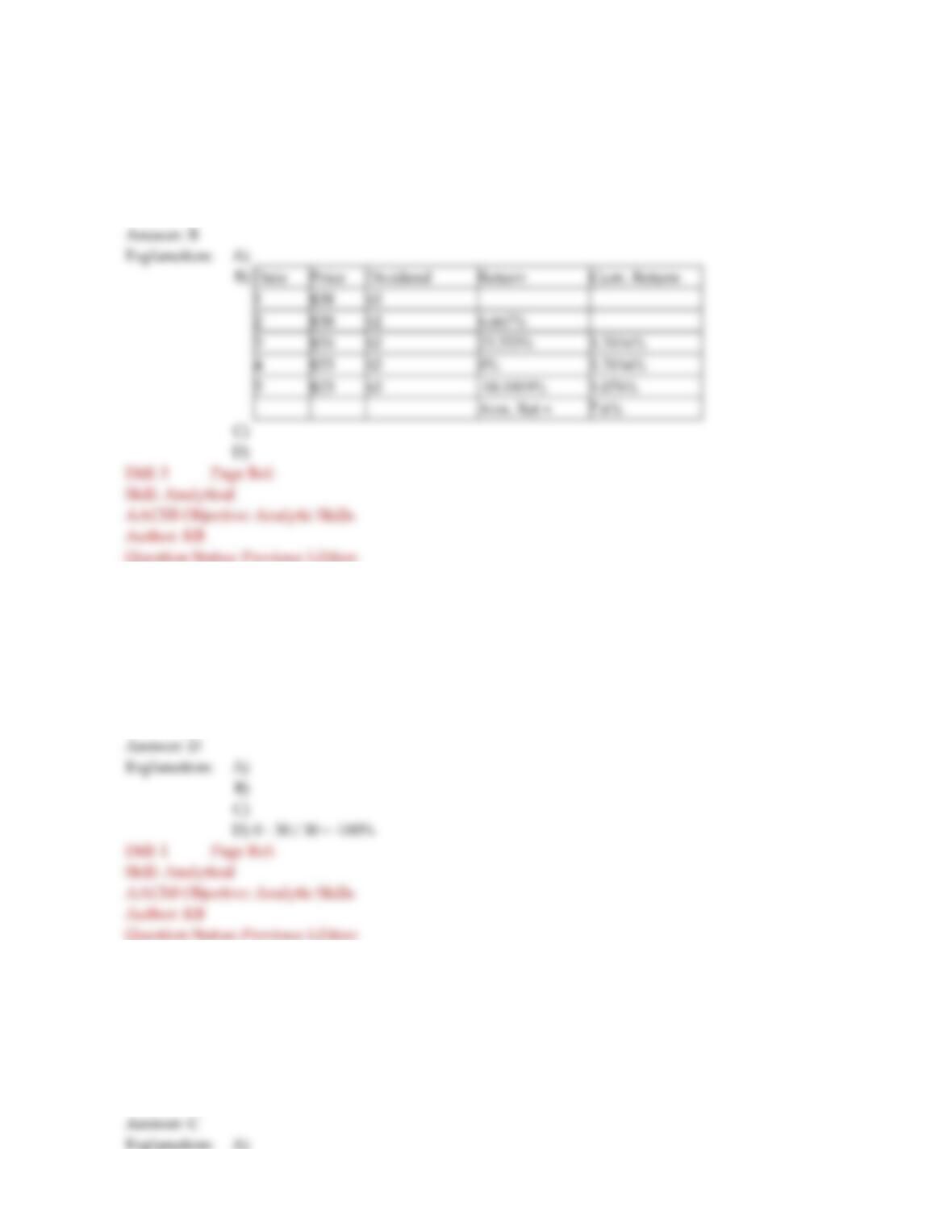
22) IGM Realty had a price of $30, $30, $35, $33, and $25 at the end of the last five quarters. If IGM pays a
dividend of $2 at the end of each quarter, what is the annual realized return on IGM?
A) 8.61%
B) 7.6%
C) 7.10%
D) 8.09%
23) You purchased Enron stock at a price of $30 per share. Its price was $20 after six months and the company
declared bankruptcy at the end of the next six months. The realized return over the last year is:
A) –99%
B) –75%
C) –150%
D) –100%
24) The S&P 500 index delivered a return of 20%, –10%, 25%, and 5% over four successive years. What is the
arithmetic average annual return per year?
A) 12%
B) 15%
C) 10%
D) 11%
25) The S&P 500 index delivered a return of 15%, 20%, 20%, –25% over four successive years. What is the
arithmetic average annual return per year?
A) 8.5%
B) 9.5%
C) 6.5%
D) 7.5%
26) The S&P 500 index delivered a return of 20%, 10%, –25%, and –5% over four successive years. What is the
arithmetic average annual return per year?
A) –5%
B) 0%
C) 5%
D) 3%
27) You purchase a 30–year, zero–coupon bond for a price of $20. The bond will pay back $100 after 30 years
and make no interim payments. The annual compounded return (geometric average return) on this
investment is:
A) 5.31%
B) 6.54%
C) 4.78%
D) 5.51%
28) Suppose that a stock gave a realized return of 20% over a two–year time period and a 10% return over the
third year. The geometric average annual return is:
A) 9.70%
B) 11.20%
C) 14.96%
D) 16.55%
29) If returns on stock A are more volatile than the returns on stock B, the geometric average return of stock A is
________ the geometric average return of stock B when their arithmetic average return is the same.
A) the same as
B) higher than
C) lower than
D) cannot say for sure
30) Suppose the quarterly arithmetic average return for a stock is 5% per quarter and the stock gives a return of
10% each over the next two quarters. The arithmetic average return over the six quarters is:
A) 9%
B) 6.67%
C) 7.5%
D) 10%
31) The geometric average annual return for a large capitalization stock portfolio is 12% for ten years and 5% per
year for the next five years. The geometric average annual return for the entire 15–year period is:
A) 9.95%
B) 9.62%
C) 9.11%
D) 10.23%
32) Bear Stearns’ stock price closed at $100, $105, $56, $30, $2 over five successive weeks. The weekly standard
deviation of the stock price calculated from this sample is:
A) $29.76
B) $50.25
C) $44.43
D) $35.23
33) Ford Motor Company had realized returns of 10%, 20%, 20%, and 10% over four quarters. What is the
quarterly standard deviation of returns for Ford calculated from this sample?
A) 5.77%
B) 5.11%
C) 5.99%
D) 5.00%
34) Ford Motor Company had realized returns of 5%, 15%, –10%, and –5% over four quarters. What is the
quarterly standard deviation of returns for Ford?
A) 9.91%
B) 10.71%
C) 10.31%
D) 11.09%
35) Ford Motor Company had realized returns of 10%, 25%, –20%, and –15% over four quarters. What is the
quarterly standard deviation of returns for Ford?
A) 19.67%
B) 25.32%
C) 21.21%
D) 23.13%
36) The standard deviation of returns of:
I. small capitalization stocks is higher than that of large capitalization stocks.
II. large capitalization stocks is lower than that of corporate bonds.
III. corporate bonds is higher than that of Treasury bills.
Which statement is true?
A) I and III
B) I, II, and III
C) I and II
D) I only
37) Treasury bill returns are 5%, 4%, 3%, and 6% over four years. The standard deviation of returns of Treasury
bills is:
A) 1.51%
B) 1.11%
C) 1.00%
D) 1.29%
38) If asset A’s return is exactly two times asset B’s return, then following risk return tradeoff, the standard
deviatio n of asset A should be ________ times the standard deviation of asset B.
A) 3
B) 2
C) 1
D) 4
39) If the returns on a stock index can be characterized by a normal distribution with mean 12%, the probability
that returns will be lower than 12% over the next period equals:
A) 50%
B) 25%
C) 46%
D) 33%
40) The probability mass between two standard deviations around the mean for a normal distribution is:
A) 66%
B) 90%
C) 75%
D) 95%
41) The Ishares Bond Index fund (TLT) has a mean and annual standard deviation of returns of 7% and 10%,
respectively. What is the 66% confidence interval for the returns on TLT?
A) –5%,10%
B) 7%,10%
C) –3%, 17%
D) –10%,10%
42) The average annual return over the period 1886–2006 for stocks that comprise the S&P 500 is 10%, and the
standard deviation of returns is 20%. Based on these numbers, what is a 95% confidence interval for 2007
returns?
A) –15%,25%
B) –20%,40%
C) –30%, 50%
D) –30%,40%
43) The average annual return over the period 1886–2006 for stocks that comprise the S&P 500 is 12%, and the
standard deviation of returns is 20%. Based on these numbers what is a 95% confidence interval for 2007
returns?
A) –28%, 52%
B) –10%,40%
C) –20%,35%
D) –15%, 35%
44) The average annual return over the period 1886–2006 for stocks that comprise the S&P 500 is 10.5%, and the
standard deviation of returns is 18.5%. Based on these numbers what is a 95% confidence interval for 2007
returns?
A) –18.5%, 18.5%
B) –10%, 10%
C) –26.5%, 47.5%
D) –37%, 37%
45) Which of the following statements is FALSE?
A) The geometric average return is a better description of the long–run historical performance of an
investment.
B) The geometric average return will always be above the arithmetic average return, and the difference
grows with the volatility of the annual returns.
C) The compounded geometric average return is most often used for comparative purposes.
D) We should use the arithmetic average return when we are trying to estimate an investment’s expected
return over a future horizon based on its past performance.
46) If a stock pays dividends at the end of each quarter, with realized returns of R1, R2, R3, and R4 each quarter,
then the annual realized return is calculated as:
A) Rannual = (1 + R1)(1 + R2)(1 + R3)(1 + R4) – 1
B)
Rannual = R1 + R2 + R3 + R4
C) Rannual = (1 + R1)(1 + R2)(1 + R3)(1 + R4)
D)
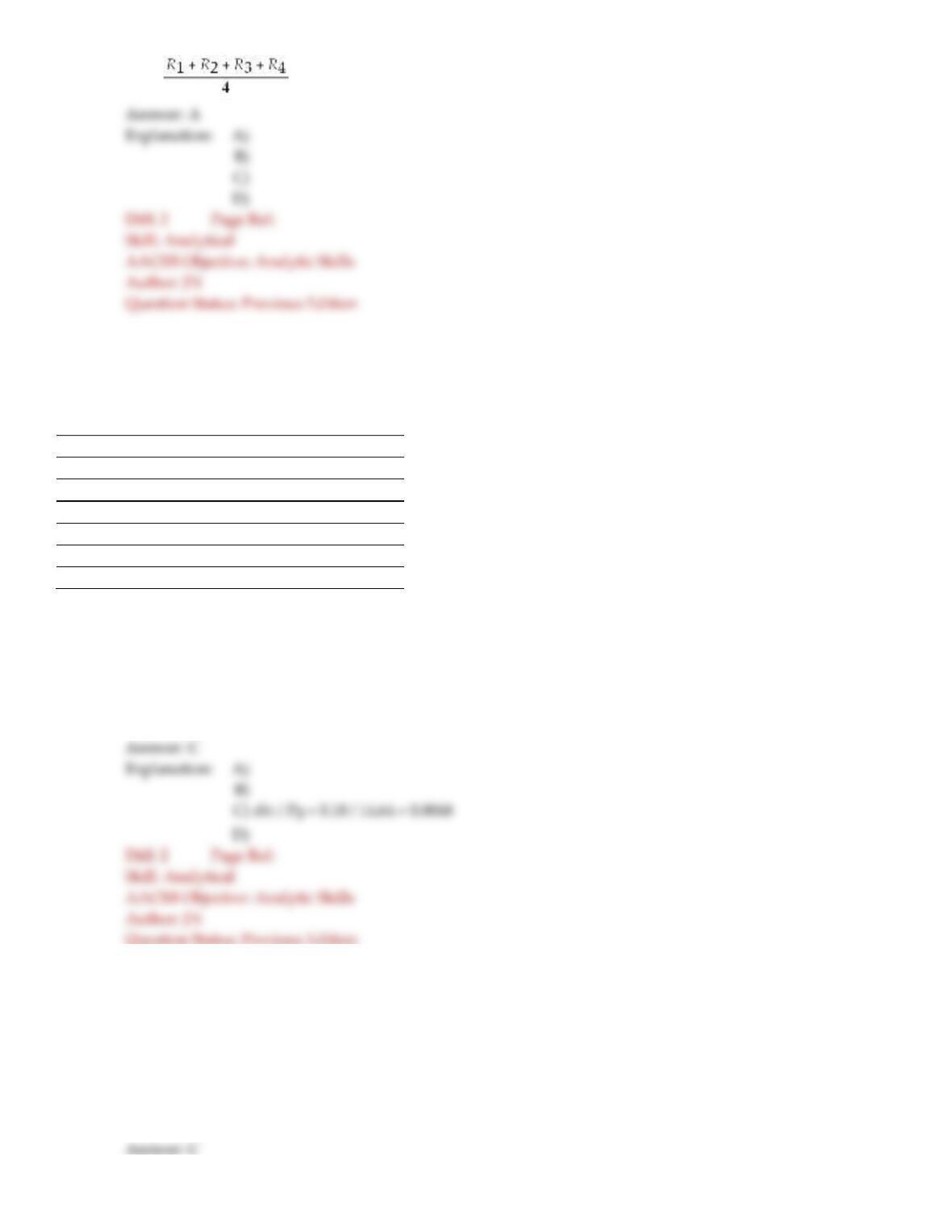
Rannual =
Use the table for the question(s) below.
Consider the following price and dividend data for Ford Motor Company:
Date
Price ($)
Dividend ($)
December 31, 2004
$14.64
January 26, 2005
$13.35
$0.10
April 28, 2005
$9.14
$0.10
July 29, 2005
$10.74
$0.10
October 28, 2005
$8.02
$0.10
December 30, 2005
$7.72
47) Assume that you purchased Ford Motor Company stock at the closing price on December 31, 2004 and sold
it after the dividend had been paid at the closing price on January 26, 2005. Your dividend yield for this
period is closest to:
A) –8.15%
B) –8.80%
C) 0.70%
D) 0.75%
48) Assume that you purchased Ford Motor Company stock at the closing price on December 31, 2004 and sold
it after the dividend had been paid at the closing price on January 26, 2005. Your capital gains rate (yield)
for this period is closest to:
A) 0.70%
B) 0.75%
C) –8.80%
D) –8.15%
49) Assume that you purchased Ford Motor Company stock at the closing price on December 31, 2004 and sold
it after the dividend had been paid at the closing price on January 26, 2005. Your total return rate (yield) for
this period is closest to:
A) 0.70%
B) –8.13%
C) –8.80%
D) 0.75%
50) Assume that you purchased Ford Motor Company stock at the closing price on December 31, 2004 and sold
it at the closing price on December 30, 2005. Your realized annual return is for the year 2005 is closest to:
A) –44.5%
B) –45.1%
C) –47.3%
D) –48.5%
Use the table for the question(s) below.
Consider the following realized annual returns:
Year–end
S&P 500
Realized
Return
IBM
Realized
Return
1996
23.6%
46.3%
1997
24.7%
26.7%
1998
30.5%
86.9%
1999
9.0%
23.1%
2000
–2.0%
0.2%
2001
–17.3%
–3.2%
2002
–24.3%
–27.0%
2003
32.2%
27.9%
2004
4.4%
–5.1%
2005
7.4%
–11.3%
51) The average annual return on the S&P 500 from 1996 to 2005 is closest to:
A) 8.75%
B) 4.00%
C) 7.10%
D) 9.75%
52) The average annual return on IBM from 1996 to 2005 is closest to:
A) 18.2%
B) 16.40%
C) 18.7%
D) 29.9%
53) The average annual return over the period 1926–2009 for the S&P 500 is 11.7%, and the standard deviation of
returns is 20.5%. Based on these numbers, what is a 95% confidence interval for 2010 returns?
A) 1.5%,, 22.0%
B) –8.8%, 32.2%
C) –29.3%, 52.7%
D) –29.3%, 73.2%
54) The average annual return over the period 1926–2009 for the S&P 500 is 11.7%, and the standard deviation of
returns is 20.5%. Based on these numbers, what is a 67% confidence interval for 2010 returns?
A) 1.5%,, 22.0%
B) –8.8%, 32.2%
C) –29.3%, 52.7%
D) –29.3%, 73.2%
55) The average annual return over the period 1926–2009 for small stocks is 22.1%, and the standard deviation of
returns is 22.1%. Based on these numbers, what is a 95% confidence interval for 2010 returns?
A) 11.1%,, 33.2%
B) 0%, 44.2%
C) –22.1%, 44.2%