58. Referring to Table 11.3, the yen cost of purchasing 100 British pounds is roughly:
a.
18,000 yen
b.
19,000 yen
c.
20,000 yen
d.
21,000 yen
Table 11.4. Forward Exchange Rates
U.S. Dollar Equivalent
Wednesday
Tuesday
Switzerland (Franc)
.6598
.6590
30-day Forward
.6592
.6585
90-day Forward
.6585
.6578
180-day Forward
.6577
.6572
59. Refer to Table 11.4. On Wednesday, the 30-day forward franc was selling at a:
a.
1 percent premium per annum against the dollar
b.
2 percent premium per annum against the dollar
c.
1 percent discount per annum against the dollar
d.
2 percent discount per annum against the dollar
c
Moderate
United States – BPROG: Reflective Thinking – BPROG: Analysis
United States – PA – DISC: International trade and fi – DISC: International trade and finance
Reading Foreign-Exchange Quotations
BLOOM’S: Comprehension
60. Refer to Table 11.4. On Wednesday, the 90-day forward franc was selling at a:
a.
0.8 percent premium per annum against the dollar
b.
1.6 percent premium per annum against the dollar
c.
0.8 percent discount per annum against the dollar
d.
1.6 percent discount per annum against the dollar
c
Moderate
United States – BPROG: Reflective Thinking – BPROG: Analysis
United States – PA – DISC: International trade and fi – DISC: International trade and finance
a
Moderate
United States – BPROG: Reflective Thinking – BPROG: Analysis
United States – PA – DISC: International trade and fi – DISC: International trade and finance
Reading Foreign-Exchange Quotations
BLOOM’S: Comprehension
61. Refer to Table 11.4. On Wednesday, the 180-day forward franc was selling at a:
a.
0.6 percent premium per annum against the dollar
b.
1.6 percent premium per annum against the dollar
c.
0.6 percent discount per annum against the dollar
d.
1.6 percent discount per annum against the dollar
United States – BPROG: Reflective Thinking – BPROG: Analysis
United States – PA – DISC: International trade and fi – DISC: International trade and finance
Reading Foreign-Exchange Quotations
BLOOM’S: Comprehension
62. Refer to Table 11.4. Comparing the franc’s forward rates against the franc’s spot rate, the exchange market’s consensus
is that over the period of a forward contract, the franc’s spot rate will:
a.
Depreciate against the dollar
b.
Appreciate against the dollar
c.
Remain constant against the dollar
d.
None of the above
United States – BPROG: Reflective Thinking – BPROG: Analysis
United States – PA – DISC: International trade and fi – DISC: International trade and finance
Reading Foreign-Exchange Quotations
BLOOM’S: Comprehension
63. The offer rate
a.
Is the price at which the bank is willing to sell a unit of foreign currency
b.
Is the price that the bank is willing to pay for a unit of foreign currency
c.
Is synonymous with the spread rate
d.
None of the above
United States – BPROG: Reflective Thinking – BPROG: Analysis
United States – PA – DISC: International trade and fi – DISC: International trade and finance
Interbank Trading
BLOOM’S: Comprehension
64. When the dollar depreciates
a.
U.S. exporters tend to sell more goods in foreign markets
b.
U.S. consumers travel abroad more cheaply
Reading Foreign-Exchange Quotations
BLOOM’S: Comprehension
c.
More foreign tourists can afford to visit the United States
d.
both a and c
65. When the dollar gets stronger
a.
U.S. firms become more competitive in international market
b.
Foreign tourists travel in the U.S. at a higher cost
c.
U.S. inflation increases
d.
U.S. consumers face higher prices on foreign goods
United States – BPROG: Reflective Thinking – BPROG: Analysis
United States – PA – DISC: International trade and fi – DISC: International trade and finance
Reading Foreign-Exchange Quotations
BLOOM’S: Comprehension
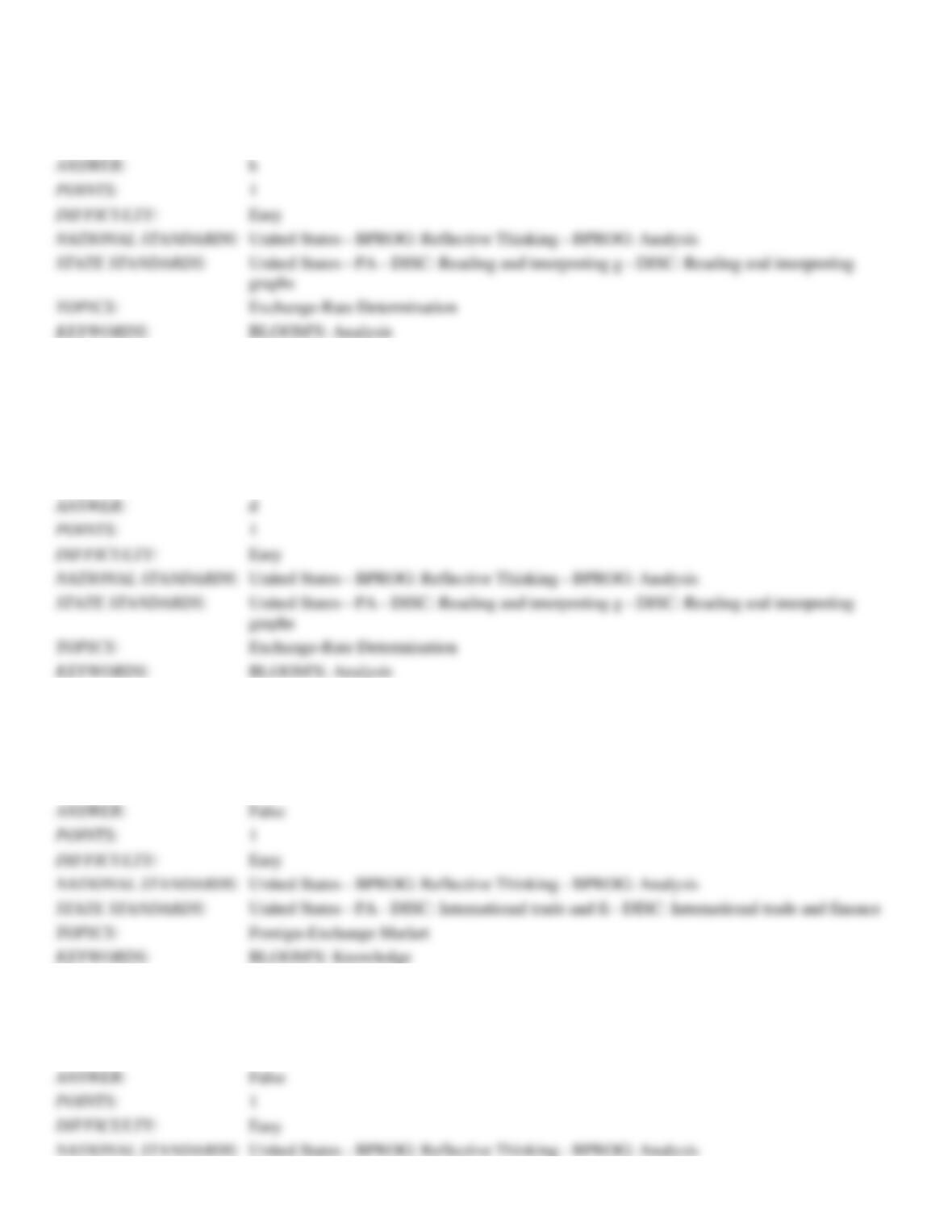
Figure 11.3 The Market for the Euro
66. Refer to Figure 11.3. If the supply curve is represented by S0, the equilibrium exchange rate is
United States – BPROG: Reflective Thinking – BPROG: Analysis
United States – PA – DISC: International trade and fi – DISC: International trade and finance
Reading Foreign-Exchange Quotations
BLOOM’S: Comprehension
a.
$1.20
b.
$1.00
c.
$0.80
d.
$0.60
67. Refer to Figure 11.3. If the supply curve shifts from S2 to S1
a.
the dollar has depreciated relative to the Euro
b.
the euro has appreciated relative to the dollar
c.
the euro has depreciated relative to the dollar
d.
both a and b
Easy
United States – BPROG: Reflective Thinking – BPROG: Analysis
Exchange-Rate Determination
BLOOM’S: Analysis
68. Similar to stock and commodity exchanges, the foreign exchange market is an organized structure with a central
meeting place and formal licensing requirements.
a.
True
b.
False
False
Easy
United States – BPROG: Reflective Thinking – BPROG: Analysis
United States – PA – DISC: International trade and fi – DISC: International trade and finance
Foreign-Exchange Market
BLOOM’S: Knowledge
69. Most foreign exchange transactions are conducted between commercial banks and household customers.
a.
True
b.
False
Easy
United States – BPROG: Reflective Thinking – BPROG: Analysis
Easy
United States – BPROG: Reflective Thinking – BPROG: Analysis
Exchange-Rate Determination
BLOOM’S: Analysis
70. Foreign-exchange brokers help commercial banks carry out foreign exchange trading and maintain desired balances of
foreign exchange.
a.
True
b.
False
True
Moderate
71. A person needing foreign exchange immediately would purchase it on the spot market.
a.
True
b.
False
True
Moderate
72. Most foreign exchange trading is carried out in the forward market.
a.
True
b.
False
False
Moderate
73. Swap transactions among commercial banks involve the conversion of one currency to another at one point with an
agreement to reconvert it back into the original currency at some point in the future.
a.
True
b.
False
Moderate
74. The bid rate refers to the price at which a bank is willing to sell a unit of foreign currency; the offer rate is the price at
which a bank is willing to buy a unit of foreign currency.
a.
True
b.
False
False
Moderate
75. A commercial bank profits from foreign-exchange trading when its bid rate exceeds its offer rate.
a.
True
b.
False
False
Moderate
76. The “spread” is a bank’s profit margin on foreign exchange trading and equals the difference between the bid rate and
the offer rate.
a.
True
b.
False
True
Moderate
77. If Citibank quoted bid and offer rates for the Swiss franc at $.4850/$.4854, the bank would be prepared to buy, say, 1
million francs for $485,000 and sell them for $485,400.
a.
True
b.
False
True
Moderate
78. If Chase Manhattan Bank quotes bid and offer rates for the Swiss franc at $.5250/$.5260, the bank would realize
profits of $1,000 on the purchase and sale of 1 million francs.
a.
True
b.
False
True
Moderate
79. If a Citibank dealer expects the Swiss franc to appreciate against the U.S. dollar, she will attempt to lower both bid
and offer rates for the franc, attempting to persuade other dealers to buy francs from Citibank and dissuade other dealers
from selling francs to Citibank.
a.
True
b.
False
False
Moderate
80. If a Citibank dealer expects the Swiss franc to depreciate in the future, he will lower bid and offer rates for the franc in
order to discourage other dealers from selling francs to Citibank and persuade other dealers to buy francs from Citibank.
a.
True
b.
False
True
Moderate
81. If it takes $0.18544 to purchase 1 French franc, it takes 5.3926 francs to purchase $1.
a.
True
b.
False
True
82. If it takes 113.28 yen to buy $1, it takes $.009624 to buy 1 yen.
a.
True
b.
False
False
Moderate
83. If it takes $1.5515 to buy 1 pound and $0.6845 to buy 1 franc, it takes 2.27 francs to buy 1 pound.
a.
True
b.
False
True
Moderate
84. “Futures” currency contracts are issued by commercial banks and are tailored in size to the needs of the exporter or
importer, while “forward” currency contracts are issued by the International Monetary Market in standardized round lots.
a.
True
b.
False
False
Moderate
85. A foreign currency option is an agreement between a holder (corporation) and a writer (commercial bank) giving the
holder the right to buy or sell a certain amount of foreign currency at any time through some specified date.
a.
True
b.
False
True
Moderate
86. A “call” option gives General Motors the right to sell pounds at a specified price, while a put option gives General
Motors the right to buy pounds at a specified price.
a.
True
b.
False
False
Moderate
87. The demand for foreign exchange is derived from credit transactions on the balance of payments.
a.
True
b.
False
False
Moderate
88. The U.S. demand for pounds is derived from U.S. exports to the United Kingdom, U.K. investments in the United
States, and U.K. tourist expenditures in the United States.
a.
True
b.
False
False
Moderate
89. As the dollar’s exchange value appreciates against the pound, U.S. residents tend to import more British goods and
thus demand more pounds.
a.
True
b.
False
True
Moderate
90. As the dollar depreciates against the peso, U.S. residents tend to import more Mexican goods and thus demand more
pesos.
a.
True
b.
False
False
Moderate
91. The supply of francs is derived from the desire of the Swiss to purchase German goods, make investments in
Germany, repay debts to German lenders, and extend transfer payments to German residents.
a.
True
b.
False
True
Moderate
92. The demand schedule for Swiss francs is always downsloping while the supply schedule of francs is always upsloping.
a.
True
b.
False
False
Moderate
93. The supply schedule of yen has a positive-sloping region which corresponds to the inelastic region on the Japanese
demand schedule for foreign currency.
a.
True
b.
False
Moderate
94. The supply schedule of pesos has a negative-sloping region corresponding to the inelastic region on the Mexican
demand schedule for foreign currency.
a.
True
b.
False
True
Moderate
95. If the Swiss demand for dollars is elastic, a depreciation of the dollar against the franc will lead to a greater quantity of
francs being supplied to the foreign exchange market to obtain dollars.
a.
True
b.
False
True
Moderate
96. If the Swiss demand for dollars is inelastic, an appreciation of the dollar against the franc will lead to a greater
quantity of francs being supplied to the foreign exchange market to obtain dollars.
a.
True
b.
False
False
Moderate
97. If the Swiss demand for dollars is elastic, an appreciation of the dollar against the franc will lead to a greater quantity
of francs being supplied to the foreign exchange market to obtain dollars.
a.
True
False
Moderate
b.
False
98. If the Swiss demand for dollars is inelastic, a depreciation of the dollar against the franc will lead to a greater quantity
of francs being supplied to the foreign exchange market to obtain dollars.
a.
True
b.
False
False
Moderate
United States – BPROG: Reflective Thinking – BPROG: Analysis
United States – PA – DISC: International trade and fi – DISC: International trade and finance
Exchange-Rate Determination
BLOOM’S: Comprehension
99. Movements along the demand schedule for pounds are caused by changes in the pound’s exchange rate.
a.
True
b.
False
Moderate
United States – BPROG: Reflective Thinking – BPROG: Analysis
United States – PA – DISC: International trade and fi – DISC: International trade and finance
Exchange-Rate Determination
BLOOM’S: Comprehension
100. Given an upward-sloping supply schedule of pounds and a downward-sloping demand schedule for pounds, an
increase in the demand schedule causes an appreciation of the dollar against the pound.
a.
True
b.
False
False
Moderate
United States – BPROG: Reflective Thinking – BPROG: Analysis
United States – PA – DISC: International trade and fi – DISC: International trade and finance
Exchange-Rate Determination
101. Given an upward-sloping supply schedule of pounds and a downward-sloping demand schedule for pounds, a
decrease in the demand schedule causes an appreciation of the dollar against the pound.
True
Moderate
United States – BPROG: Reflective Thinking – BPROG: Analysis
United States – PA – DISC: International trade and fi – DISC: International trade and finance
Exchange-Rate Determination
BLOOM’S: Comprehension
a.
True
b.
False
102. Given an upward-sloping supply schedule of pounds and a downward-sloping demand schedule for pounds, an
increase in the supply schedule causes an appreciation of the dollar against the pound.
a.
True
b.
False
True
Moderate
103. Given an upward-sloping supply schedule of pounds and a downward-sloping demand schedule for pounds, a
decrease in the supply schedule causes an appreciation of the dollar against the pound.
a.
True
b.
False
False
Moderate
104. The trade-weighted dollar is the weighted average of the exchange rates between the dollar and the most important
industrial-country trading partners of the United States.
a.
True
b.
False
True
Moderate
True
Moderate
105. If the trade-weighted dollar moves from an index value to 100 to 110, the dollar depreciates by 10 percent against the
trade-weighted averages of the exchange rates of the major trading partners of the United States.
a.
True
b.
False
106. An increase in the trade-weighted value of the dollar indicates a dollar appreciation relative to the currencies of its
major trading partners and a worsening of U.S. international competitiveness.
a.
True
b.
False
True
Moderate
107. With arbitrage, a trader attempts to purchase a foreign currency at a low price and, at a later date, resell the currency
at a higher price in order to make a profit.
a.
True
b.
False
False
Moderate
Arbitrage
108. Arbitrage results in a riskless profit since a trader purchases a currency at a low price and simultaneously resells it at
a higher price.
a.
True
b.
False
True
Moderate
Arbitrage
False
Moderate
109. If the exchange rate is $0.01 per yen in New York and $0.015 per yen in Tokyo, an arbitrager could profit by buying
yen in Tokyo and simultaneously sell them in New York.
a.
True
b.
False
110. Currency arbitrage tends to result in identical yen/dollar exchange rates in New York and in Tokyo.
a.
True
b.
False
True
Moderate
Arbitrage
111. In the forward market, the exchange rate is agreed on at the time of the currency contract, but payment is not made
until the future delivery of the currency actually takes place.
a.
True
b.
False
True
Moderate
112. If the spot price of the Swiss franc is $0.4020 and the 90-day forward franc sells for $0.4026, the franc is at a 90-day
forward discount of $0.0006, or at a 0.2 percent forward discount per annum against the dollar.
a.
True
b.
False
False
False
Moderate
Arbitrage
113. Suppose that Sears owes 1 million yen to a Japanese electronics manufacturer in 3 months. It could hedge against the
risk of a depreciation of the dollar against the yen by contracting to purchase 1 million yen in the forward market, at
today’s forward rate, for delivery in 3 months.
a.
True
b.
False
True
Challenging
114. Assume that Boeing anticipates receiving 20 million yen in 3 months from exports of jumbo jets to a Japanese
airline. The firm could hedge against the risk of a depreciation of the dollar against the yen by contracting to sell its
expected yen proceeds for dollars in the forward market at today’s forward rate.
a.
True
b.
False
False
Challenging
115. A U.S. investor’s extra rate of return on an investment in France, as compared to the United States, equals the
interest-rate differential adjusted for any change in the dollar/franc exchange rate.
a.
True
b.
False
True
Challenging
116. A currency speculator’s goal is to buy a currency at a low price and immediately resell it at a higher price, thus
realizing a riskless profit.
a.
True
b.
False
False
Moderate
117. Stabilizing speculation reinforces market forces by intensifying an appreciation or a depreciation in a currency’s
exchange value.
a.
True
b.
False
False
Moderate
118. What foreign exchange transactions do banks typically engage in?
Easy
119. How is the equilibrium rate of exchange determined?
Moderate
120. Is it possible to trade foreign exchange in the futures market? How does such trading differ from the forward market?
Moderate
121. Where are foreign currency options traded?