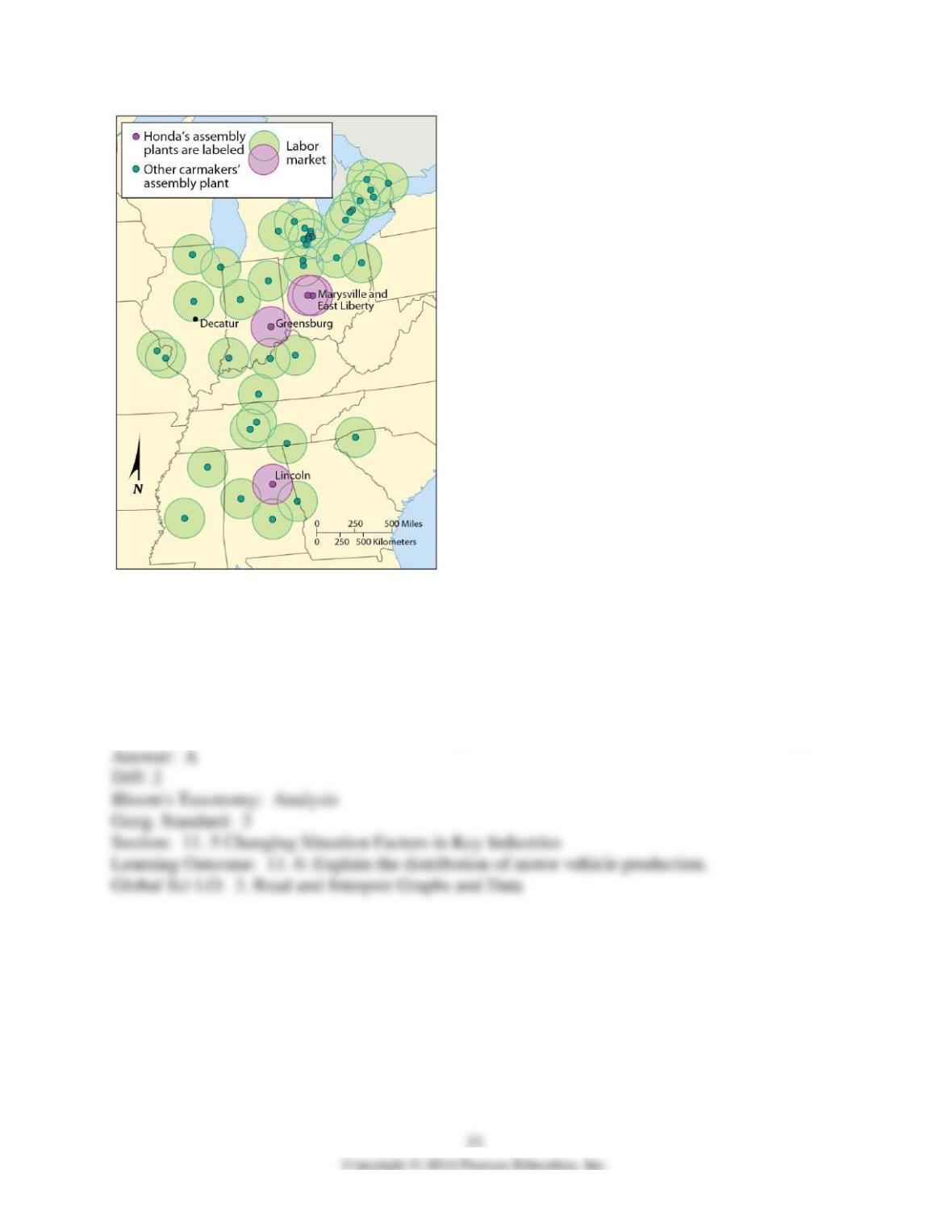
43) As indicated on this map of automobile assembly plants, in an effort to reduce labor
competition and thus keep wages lower, there are only
A) three plants in Tennessee, one in South Carolina, two in Mississippi, and three in Illinois.
B) three plants in the Midwest, four plants in the Northeast, and five plants in the South.
C) two plants in the Midwest and more than 20 in the South.
D) four plants in Tennessee, one in South Carolina, three in Mississippi, and three in Illinois.
E) three plants in Tennessee, three in Kentucky, one in South Carolina, and four in Mississippi.

44) Although transportation costs rise because breaks in transportation, we can surmise that over
very long distances the lowest-cost form of transporting goods is by
A) truck.
B) train.
C) ship.
D) airplane.
E) rocket.
45) Containerization was developed to facilitate long-distance transport by ________ before
transferring to trucks and trains.
A) truck
B) train
C) ship
D) airplane
E) rocket
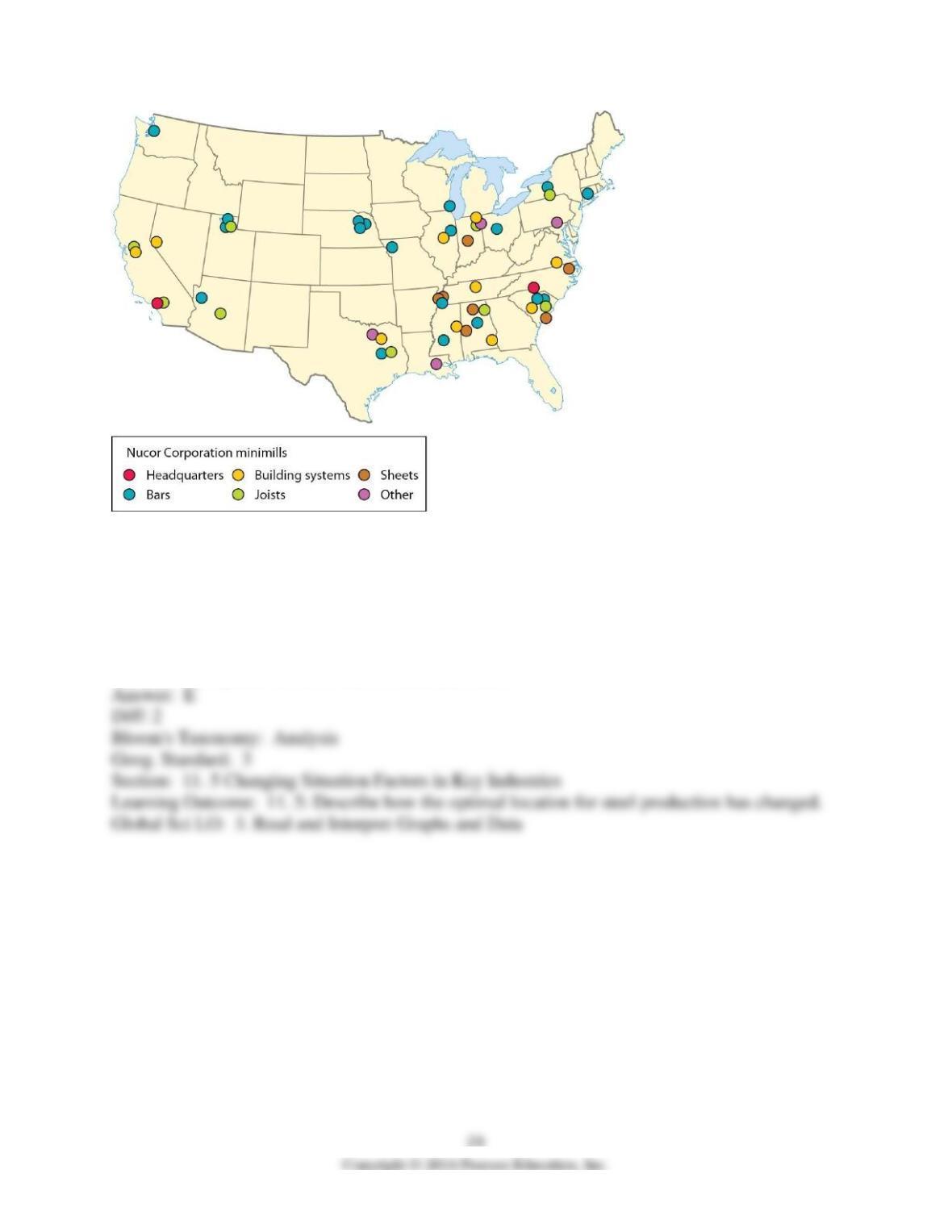
46) As indicated on the map of minimill facilities in the U.S.,
A) minimills are primarily situated close to Northeastern markets.
B) most Nucor operations are concentrated in Mississippi, California, Illinois, Kentucky, and
Maine.
C) most Nucor operations are concentrated in Mississippi, Alabama, North Carolina, and Florida.
D) minimills operate in nearly every U.S. state.
E) Nucor has operations in at least 20 different states.
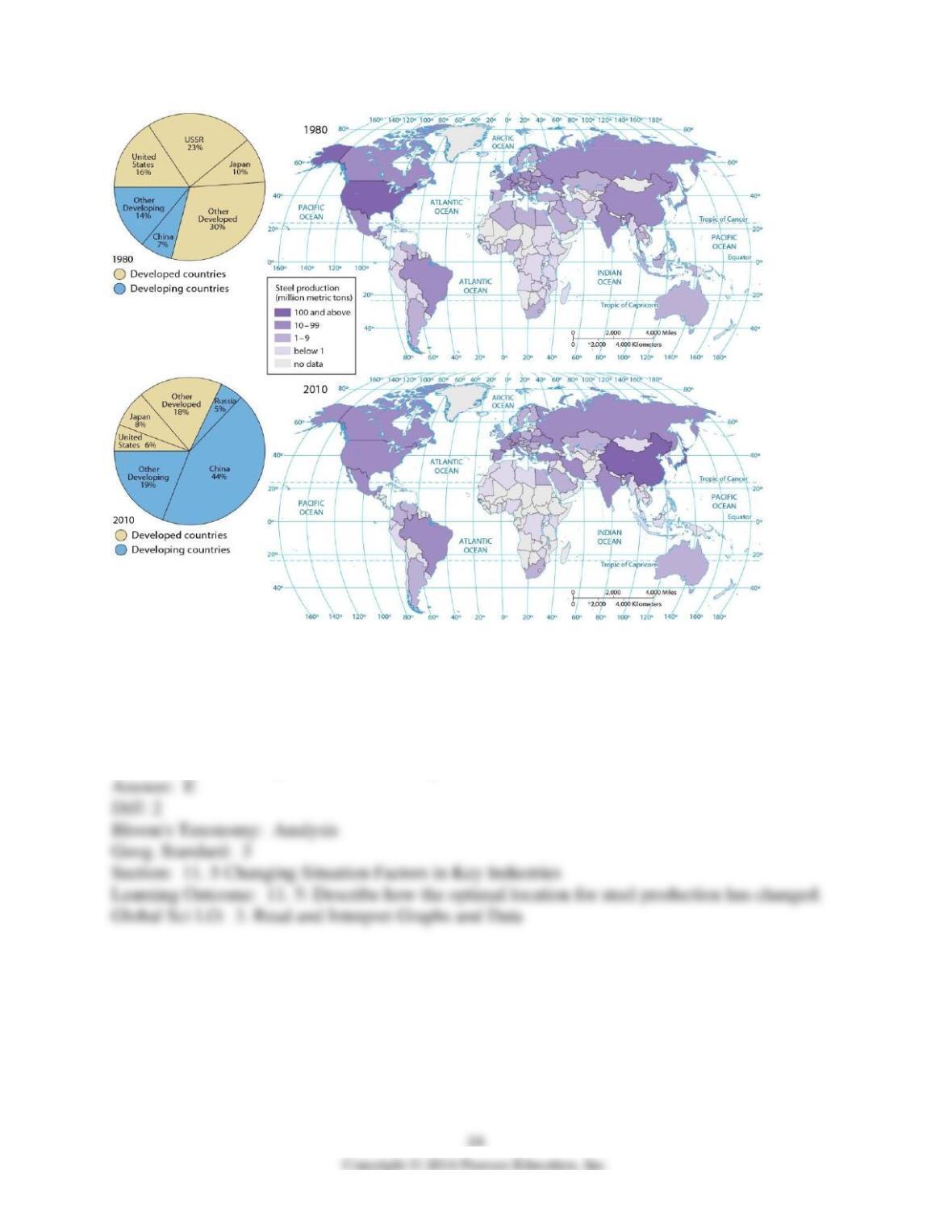
47) According to these charts, the U.S. share of global steel production
A) decreased from 30 percent in 1980 to 18 percent in 2010.
B) decreased from 44 percent in 1980 to 7 percent in 2010.
C) increased from 16 percent in 1980 to 19 percent in 2010.
D) decreased from 16 percent in 1980 to 8 percent in 2010.
E) decreased from 16 percent in 1980 to 6 percent in 2010.
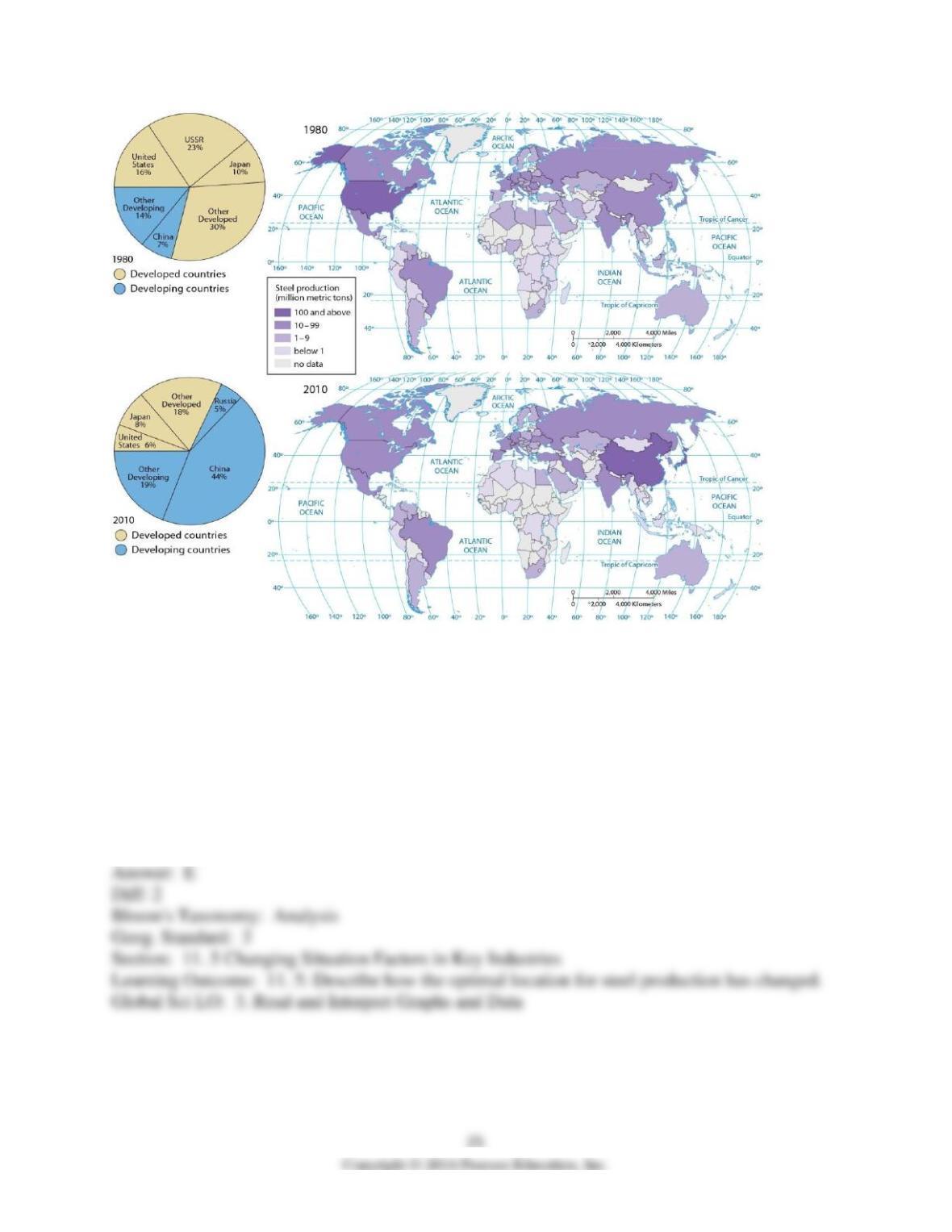
48) According to these pie charts, between 1980 and 2010 the share of global steel production
from developing countries
A) increased from 7 percent to 44 percent.
B) increased from 14 percent to 19 percent of the total, if Russia is considered a developing
country.
C) increased from 5 percent to 23 percent of the total, if Russia is considered a developing
country.
D) decreased from 68 percent to 21 percent, if Russia is considered a developing country.
E) increased from 21 percent to 68 percent of the total, if Russia is considered a developing
country.
49) Although many factory laborers in MDCs are paid $________ per hour, factory laborers in
LDCs may be paid less than $________ per hour.
A) 35; 1
B) 75; 15
C) 35; 10
D) 100; 20
E) 45; 2
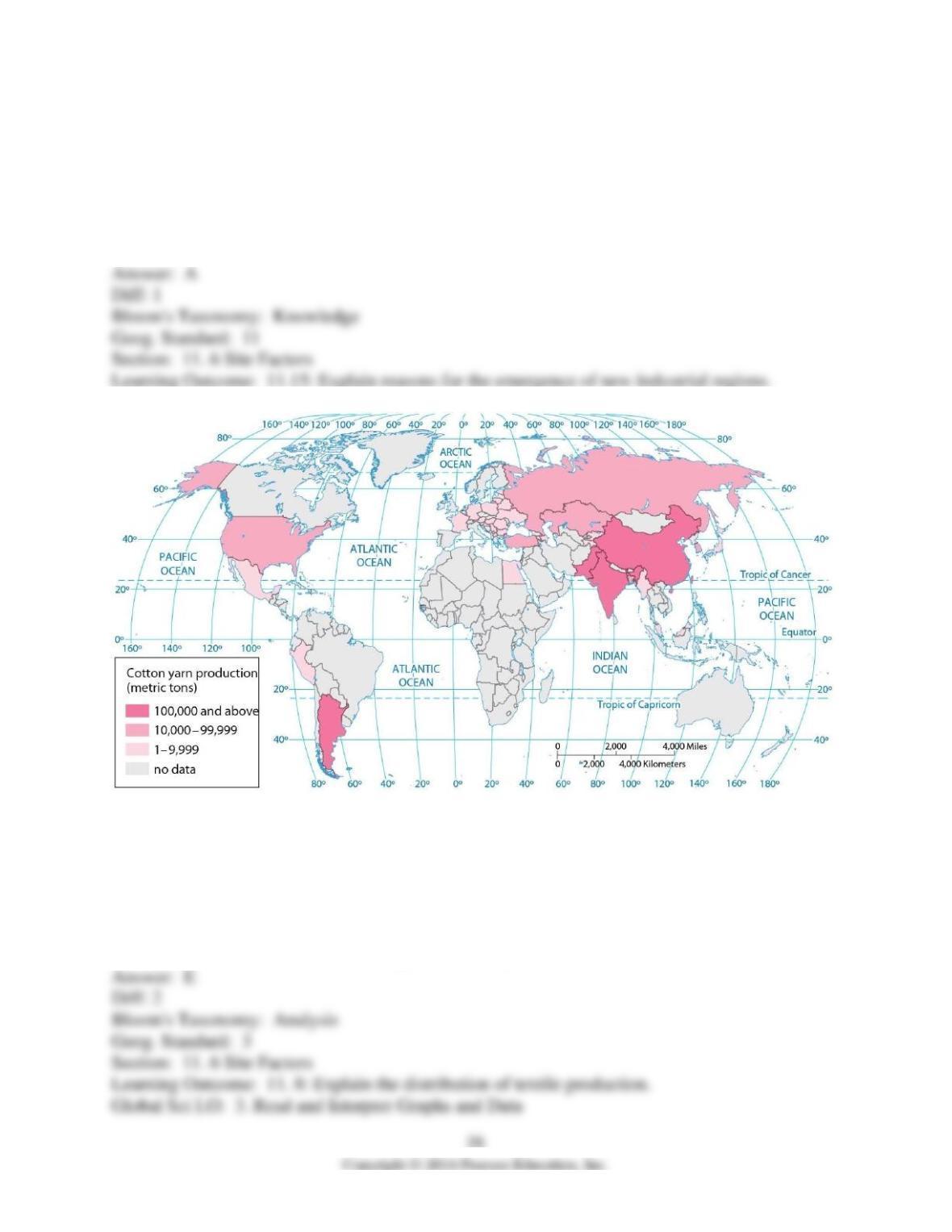
50) According to this map of cotton yarn production, after China, India, and Pakistan the world
leaders in yarn production include
A) Argentina, Russia, and Australia.
B) Argentina, Brazil, Peru, Egypt, the United States, Turkey, Russia, and Australia.
C) Egypt, France, Germany, Belgium, and Poland.
D) Argentina, the United States, Iraq, Iran, and Russia.
E) Argentina, the United States, Turkey, Kazakhstan, and Russia.
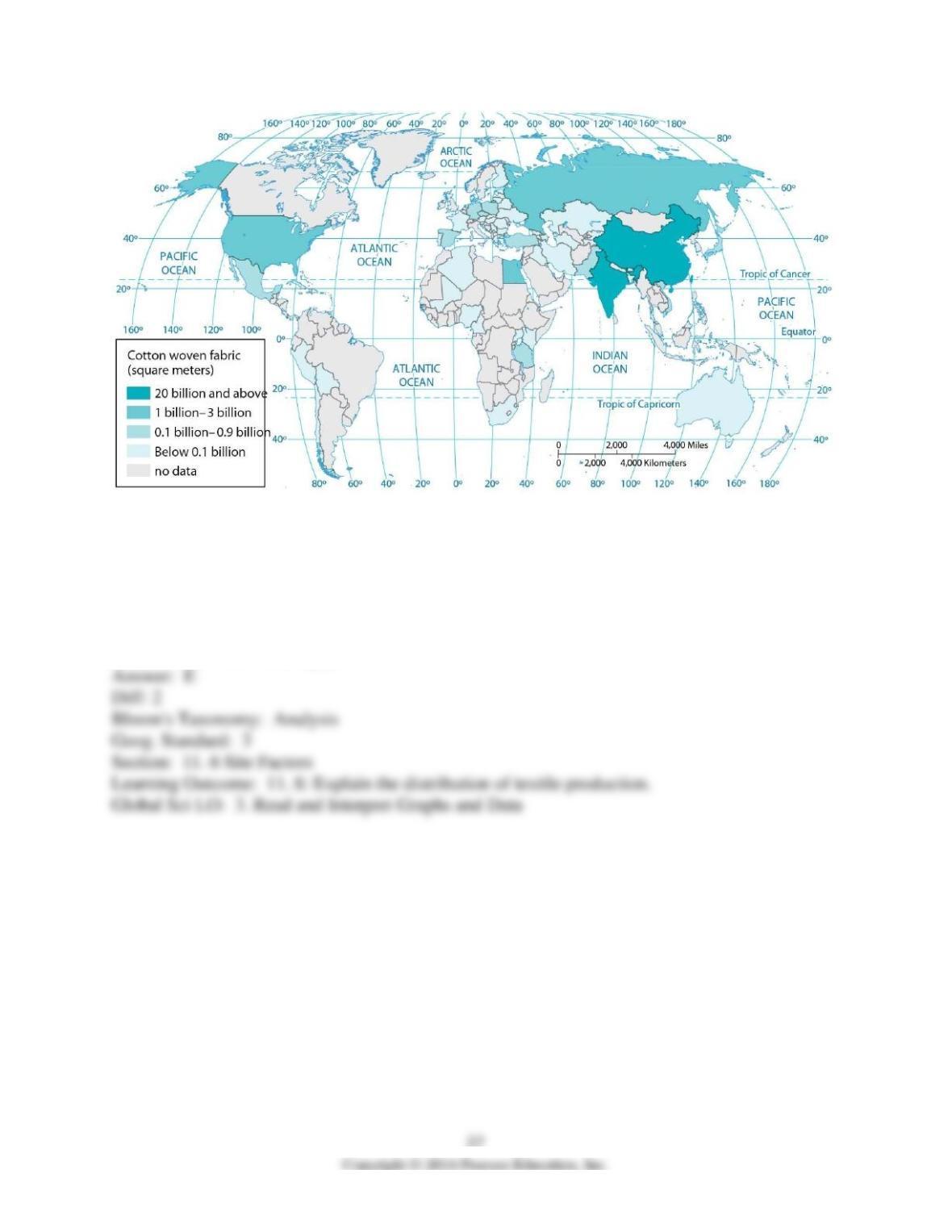
51) According to this map of cotton weaving distribution, between 1 billion and 3 billion square
meters of fabric are produced annually in both
A) the United States and Canada.
B) the United States and Mexico.
C) Russia and Australia.
D) China and India.
E) the United States and Egypt.
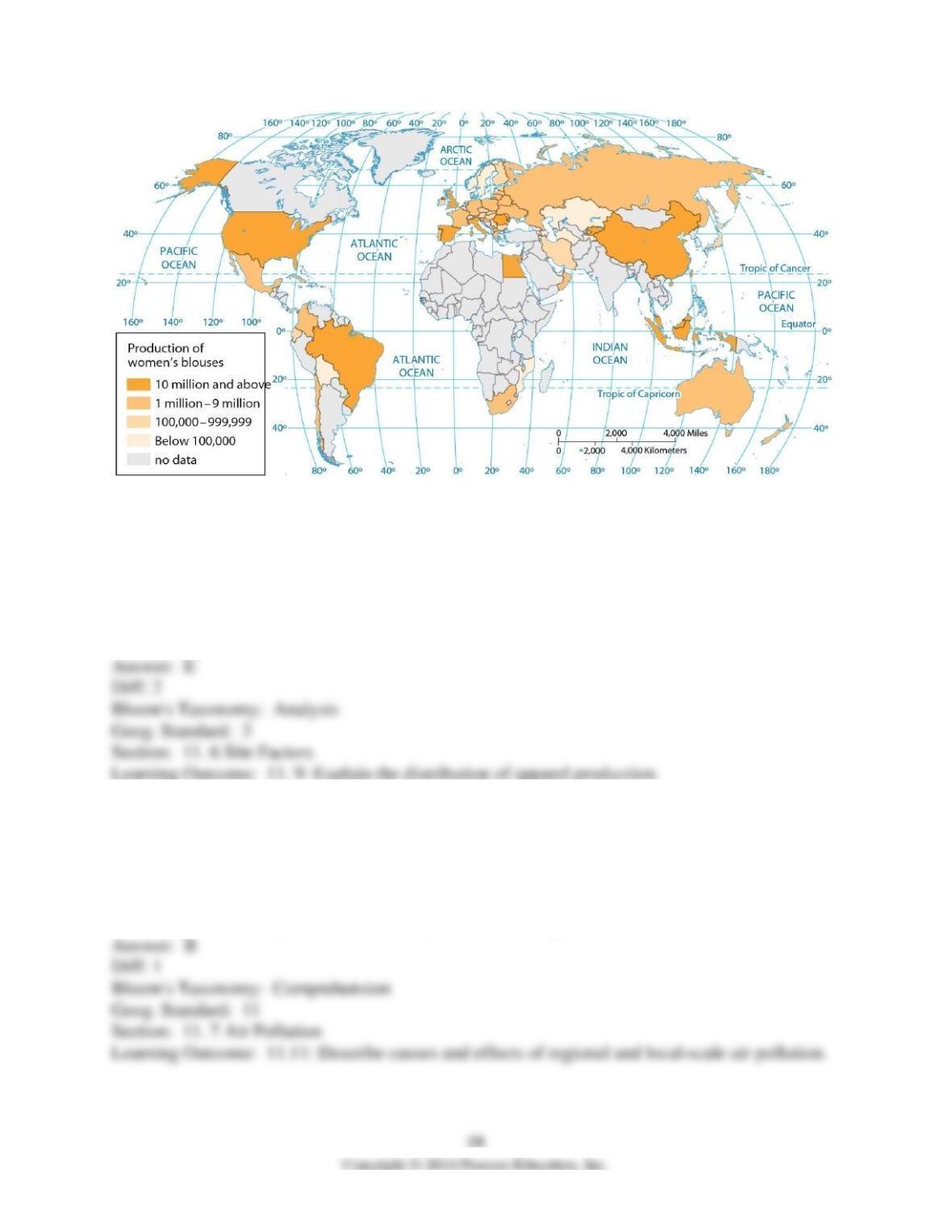
52) As indicated on this map, the world leaders in blouse production include the United States,
China,
A) Russia, South Africa, and Australia.
B) Pakistan, and India.
C) Egypt, Bulgaria, Romania, and Turkey.
D) Mexico, South Africa, and Australia.
E) Egypt, Spain, and Brazil.
53) As a country’s per capita income increases, its per capita carbon dioxide emissions
A) also decrease.
B) also increase.
C) begin to decrease, at first slowly and then rapidly.
D) remain about the same.
E) increase for a few years, then remain stable, and then begin to decrease.
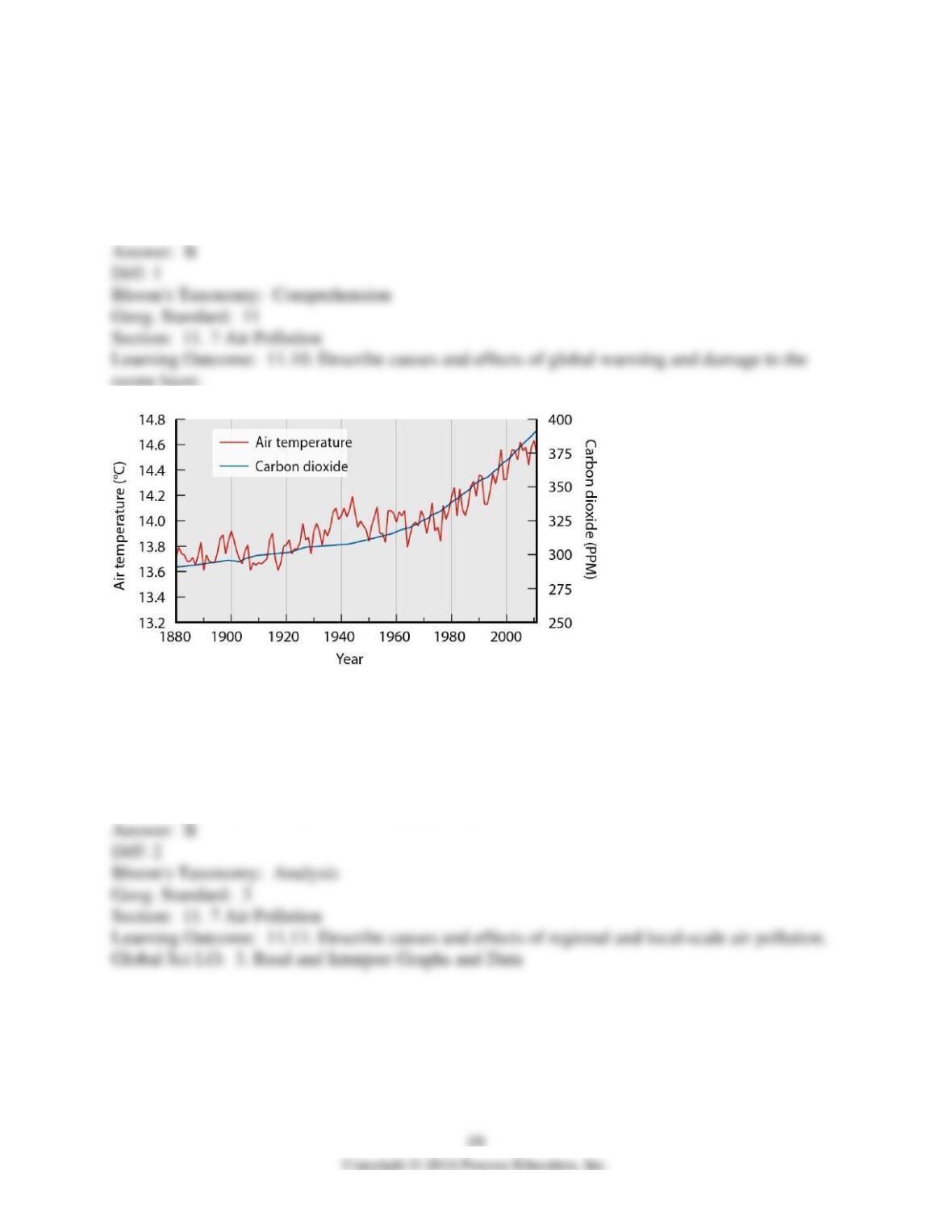
54) The average temperature of Earth’s surface has increased by about
A) 2°C since 1980.
B) 1°C since 1880.
C) 2°C since 1880.
D) 3°C since 1880.
E) 2°C since 1680.
55) According to this graph, carbon dioxide emissions were approximately 300 PPM
A) in the year 1900 and 400 PPM in the year 2000.
B) in the year 1900 and 375 PPM in the year 2000.
C) in the year 1980 and 375 PPM in the year 2000.
D) in the year 1900 and 350 PPM in the year 2000.
E) in the year 1950 and 400 PPM in the year 1980.

56) Compared to other industries, aluminum manufacturers are more likely to locate near sources
of
A) low-cost labor.
B) low-cost coal-fired power plants.
C) low-cost hydroelectricity.
D) aluminum oxide.
E) fluid capital and transportation infrastructure.
57) The Tennessee Valley Authority brought
A) temporary relief in the form of government construction jobs to people in Tennessee in the
1920s and 1930s.
B) irrigation systems to much of the rural South in the 1930s.
C) electricity to much of the rural South, Midwest, and East Coast in the 1930s.
D) electricity to much of the rural South in the 1930s.
E) electricity to much of the rural West, South, and Midwest in the 1930s.
58) Despite the risks to the environment, the U.S. Gulf Coast has become an important industrial
area because of
A) shrimp trawling and seafood processing.
B) just-in-time inventory management.
C) proximity to markets in Southwest Asia.
D) access to oil imports from Mexico and Venezuela.
E) access to oil and natural gas fields.

59) In Western Europe, ________ has experienced the most rapid manufacturing growth since
the late twentieth century, especially after joining the European Union.
A) Denmark
B) Germany
C) France
D) Italy
E) Spain
60) Both Europe and the United States have seen interregional shifts of manufacturing, but one
difference is
A) in the United States, government policies have encouraged relocation.
B) in Europe, government policies have encouraged relocation.
C) the concentration of industries in Europe and diffusion in the United States.
D) the concentration of industries in the United States and diffusion in Europe.
E) movement to the west in Europe and to the east in the United States.
61) Twenty-three U.S. states have so-called “right-to-work” laws that
A) are more numerous and anti-union in northern states than in southern states.
B) send a powerful signal to employers that workers have the right to join a labor union, whether
or not this unionization might cause inconveniences for management.
C) make it much more difficult for employers to limit wages, cut health benefits, and stop unions
from forming.
D) fight the efforts of factory management to break unions and keep future unions from forming.
E) cause a great deal of trouble for labor unions attempting to organize workers and bargain with
employers.
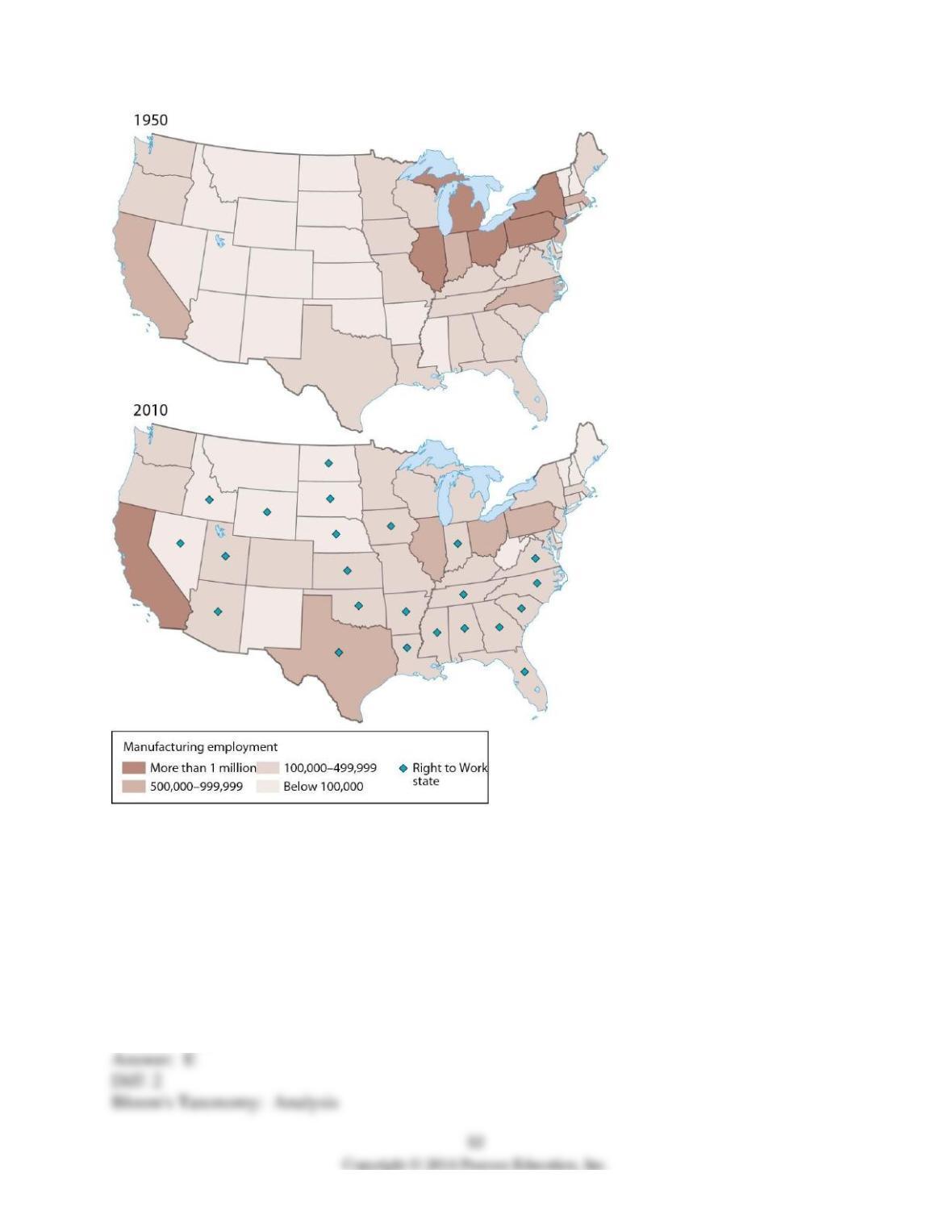
62) An analysis of these maps showing changes in U.S. manufacturing from 1950 to 2010
indicates that
A) the percentage of manufacturing jobs remained largely unchanged.
B) the number of manufacturing jobs increased in nearly all “right-to-work” states.
C) the number of manufacturing jobs in Indiana increased when it became a “right–to-work”
state.
D) the number of manufacturing jobs increased in most “right–to-work” states and decreased in
most other states.
E) the number of manufacturing jobs increased in California and Colorado, which are not “right-
to-work” states.

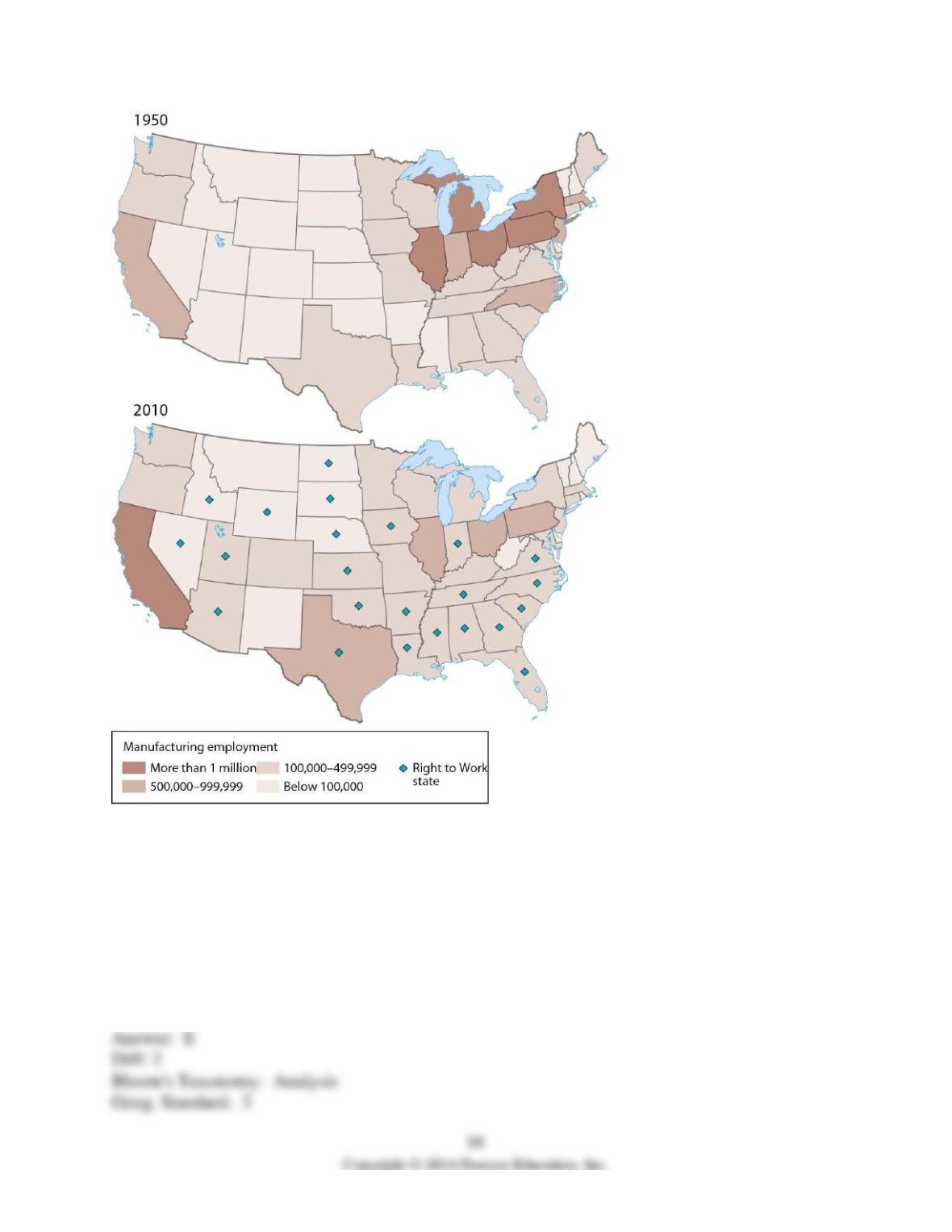
63) An analysis of these maps showing changes in U.S. manufacturing from 1950 to 2010
indicates that
A) the percentage of manufacturing jobs increased in California.
B) the percentage of manufacturing jobs decreased only in the Midwest and Northeast.
C) the number of manufacturing jobs increased only in “right-to-work” states.
D) the number of manufacturing jobs increased markedly in Ohio, Michigan, New York, and
Pennsylvania.
E) the number of manufacturing jobs decreased markedly in Ohio, Michigan, New York, and
Pennsylvania.
64) Mexico’s maquiladora plants
A) must operate far from the U.S.-Mexico border.
B) employ more than five million laborers.
C) have an advantage of proximity to Latin American markets.
D) have an advantage of proximity to U.S. markets.
E) have grown in number as factories have been closed in China.
65) Mexico’s maquiladora plants
A) are distributed evenly across central Mexico.
B) rely on high tariffs that suppress U.S. sales.
C) are using obsolete production processes compared with most U.S. assembly plants.
D) may be taking advantage of lax environmental enforcement.
E) cannot find enough laborers to manufacture products in northern Mexico.
66) Maintaining control over all phases of a highly complex production process, as opposed to
outsourcing, is known as
A) vertical integration.
B) the new international division of labor.
C) convergence.
D) right-to-work.
E) outsourcing.
67) The new international division of labor reflects the growing importance of
A) outsourcing.
B) vertical integration.
C) access to raw materials.
D) new infrastructure.
E) just-in-time inventory management.
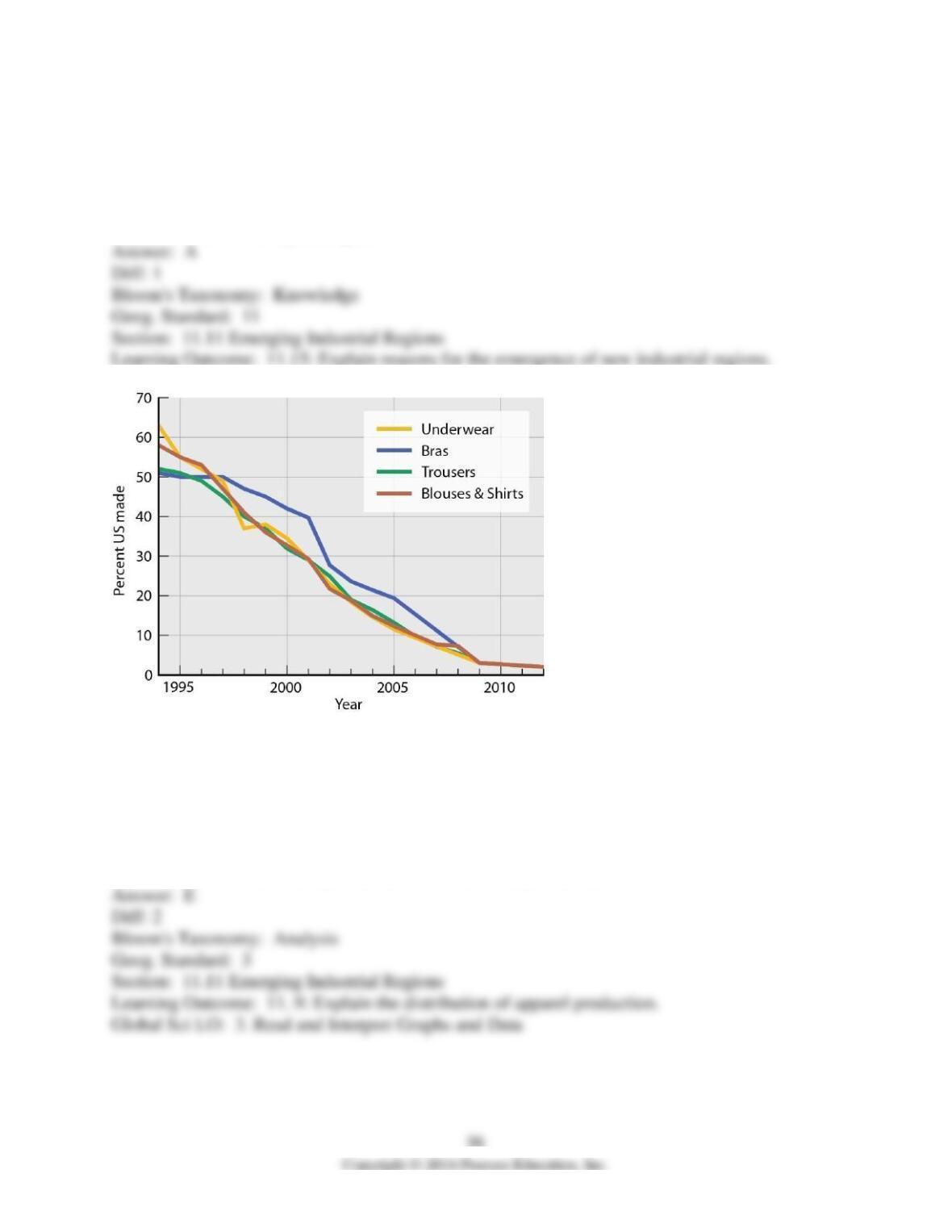
68) This chart regarding U.S.-made clothing indicates that the percentage of U.S.-made blouses
and skirts being sold
A) decreased from about 38 percent in 2000 to about 3 percent in 2010.
B) decreased from about 25 percent in 2000 to about 5 percent in 2010.
C) decreased from about 25 percent in 2000 to about 3 percent in 2010.
D) decreased from about 30 percent in 2000 to about 1 percent in 2010.
E) decreased from about 32 percent in 2000 to about 3 percent in 2010.
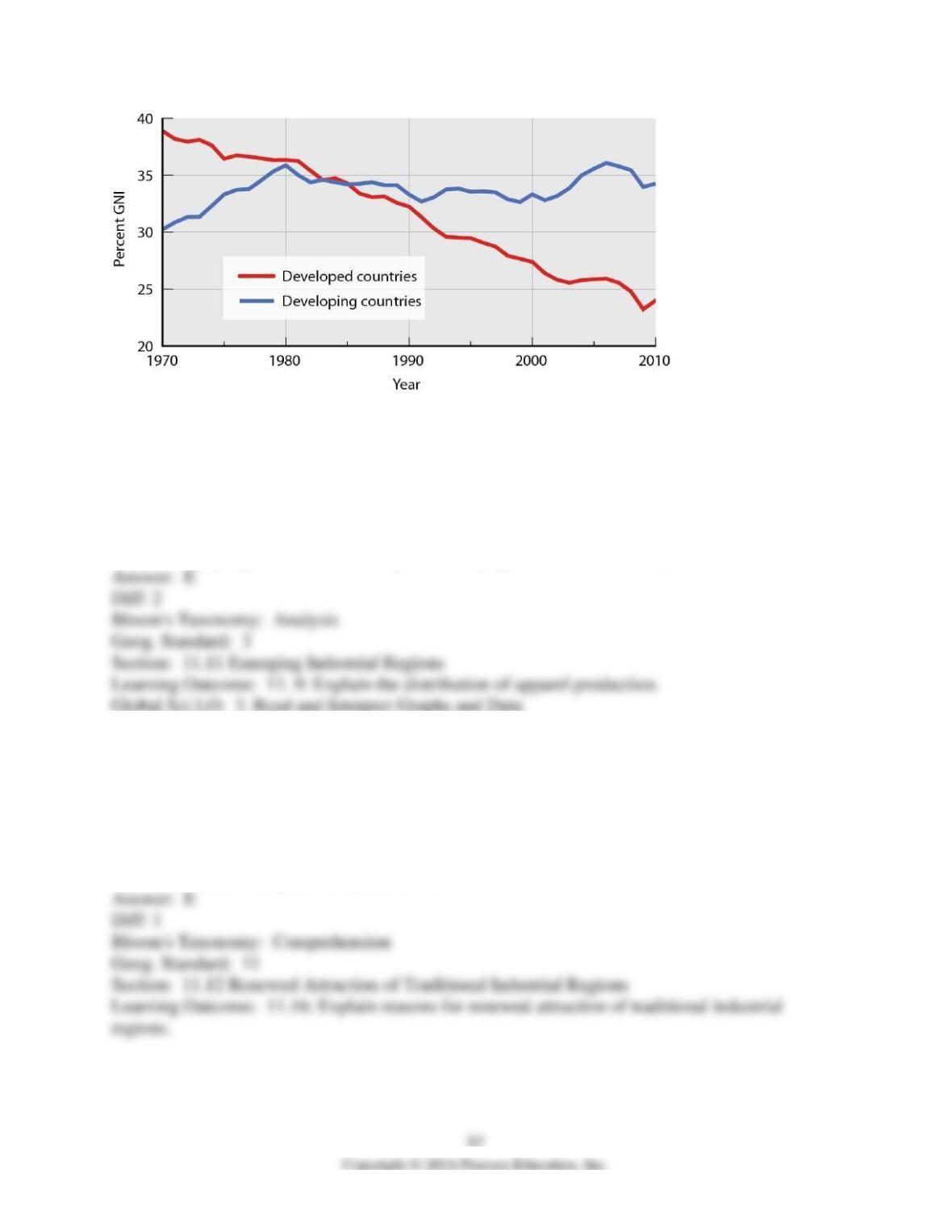
69) The chart on manufacturing value as a percentage of GDP indicates that the share of
manufacturing in developed countries
A) began to be surpassed by manufacturing in developing countries in the mid-1990s.
B) was less than manufacturing in developing countries in the mid-1970s.
C) was greater than manufacturing in developing countries in the late 1980s.
D) was roughly equal to manufacturing in developing countries in the early 1990s.
E) was roughly equal to manufacturing in developing countries in the early 1980s.
70) What two location factors influence more industries to remain in the northeastern United
States and northwestern Europe?
A) global communications and fluid capital
B) cheap labor and high consumer demand
C) availability of raw materials and cheap energy
D) fluid capital and advantageous tariffs
E) skilled labor and rapid delivery to market