Chapter 11 Test Bank KEY
1. A single union firm in a competitive industry otherwise comprised of nonunion firms
2. A union wage advantage is less likely to occur where
3. Union workers receive more compensation than otherwise similar nonunion workers. This fact
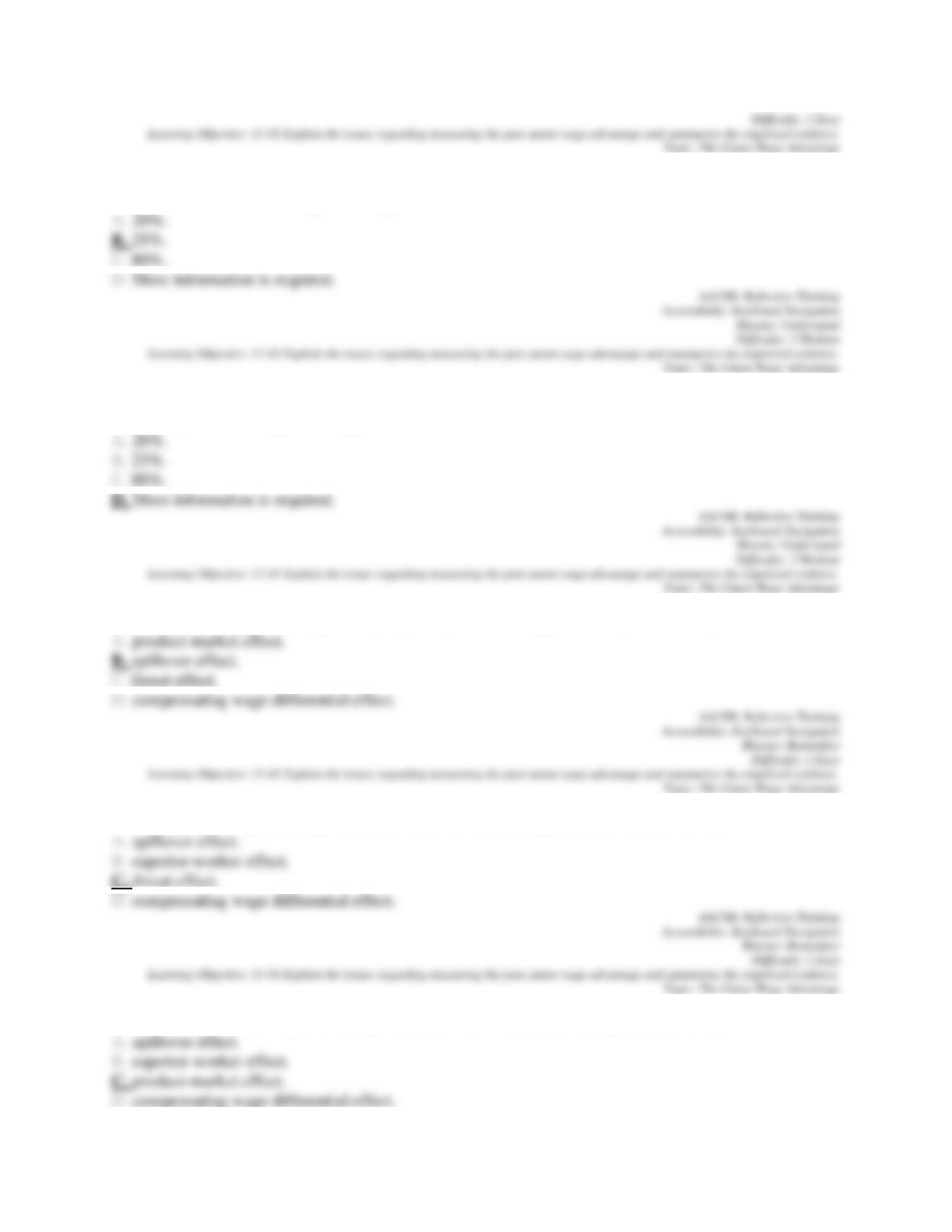
4. If Wu is the union wage and Wn is the nonunion wage, the pure union wage advantage is
5. If union workers in a given occupation are paid $20 per hour while nonunion workers receive $16 per
hour, the measured union wage advantage is
6. If nonunion workers in a given occupation are paid $16 per hour while union workers receive $20 per
hour, the pure union wage advantage is
7. The nonunion wage rate may fall as the result of a union wage increase because of the
8. The nonunion wage rate may rise as the result of a union wage increase because of the
9. The measured union wage advantage will understate the pure advantage because of the

10. Suppose the union wage rate rises. The “spillover effect” suggests that the nonunion wage rate should
_____ the “threat effect” suggests that the nonunion wage rate should _____.
11. “The union wage advantage is understated because nonunion wages rise as consumer demand shifts
away from relatively higher priced union produced goods.” This describes the
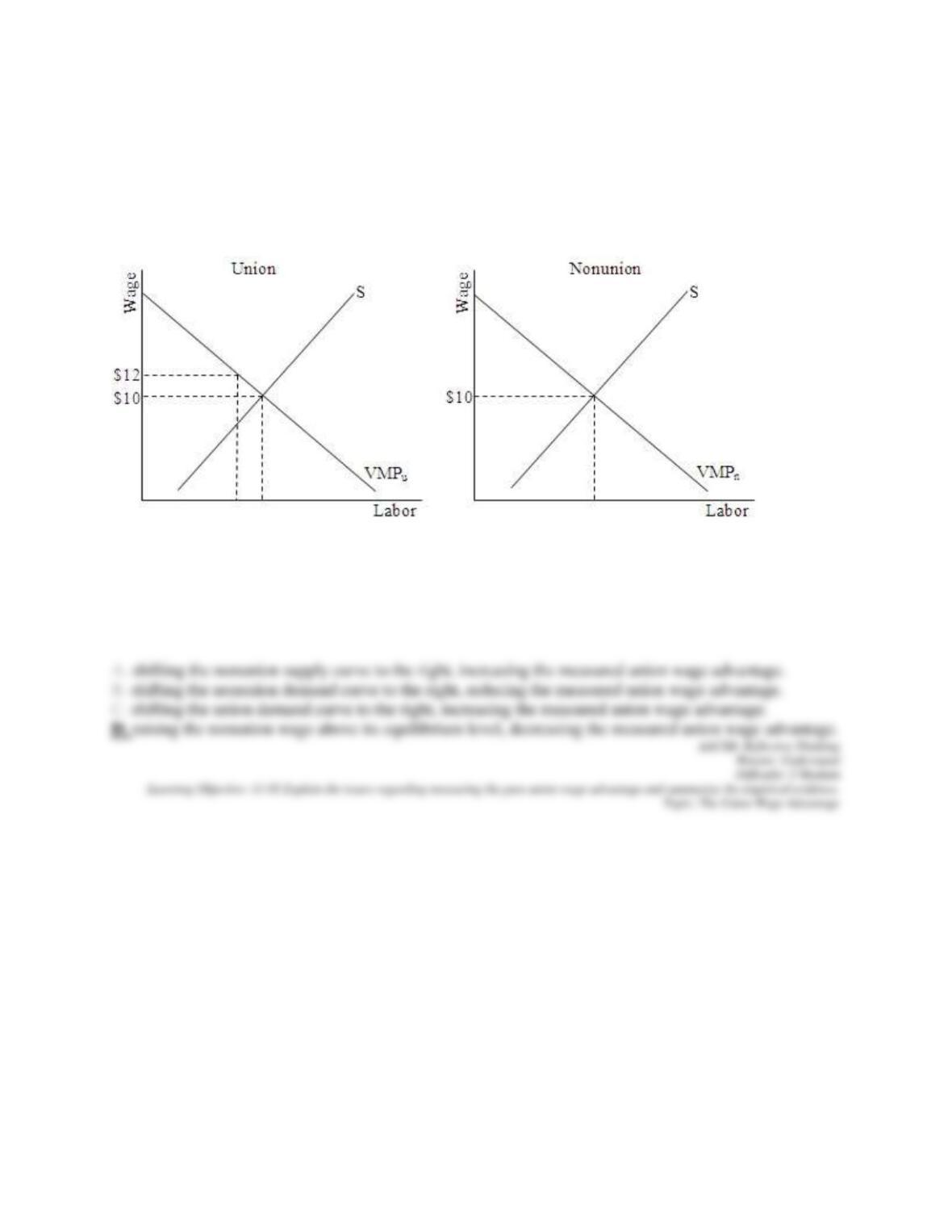
12. Refer to the following diagram. Wages in both the union and nonunion sectors are initially $10. The
union then negotiates a wage rate of $12. The post-negotiation nonunion wage is not yet known.
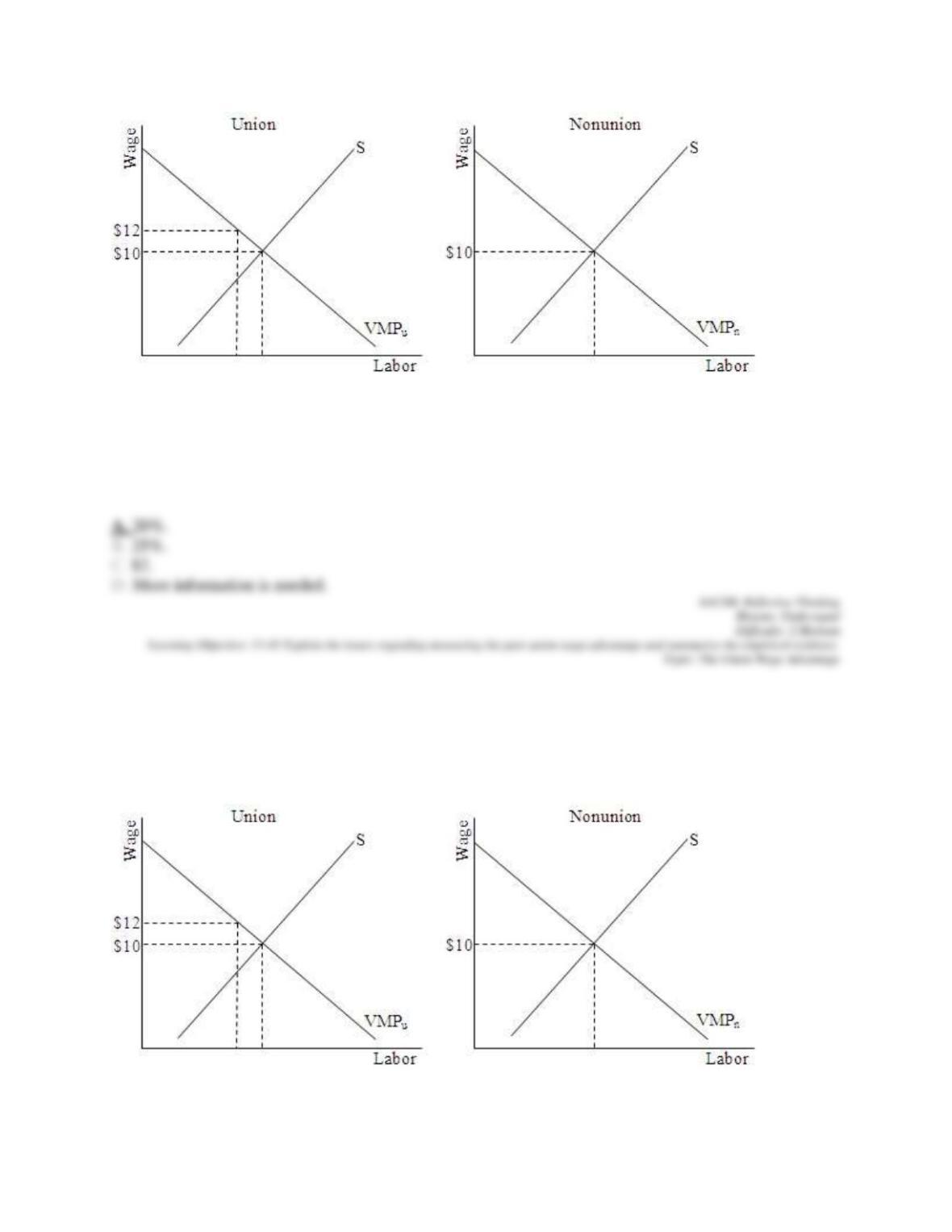
The pure union wage advantage in this market is
13. Refer to the following diagram. Wages in both the union and nonunion sectors are initially $10. The
union then negotiates a wage rate of $12. The post-negotiation nonunion wage is not yet known.
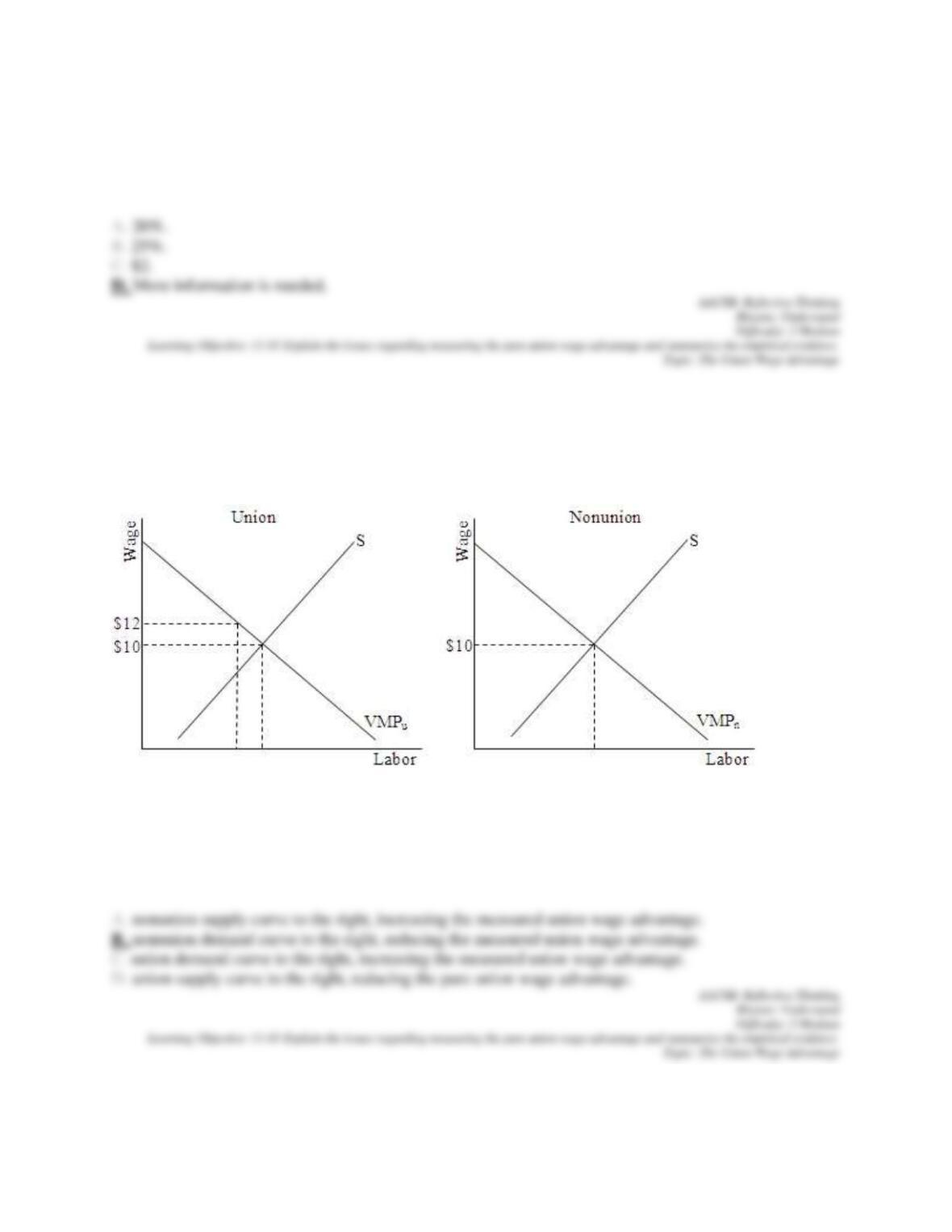
The measured union wage advantage in this market is
14. Refer to the following diagram. Wages in both the union and nonunion sectors are initially $10. The
union then negotiates a wage rate of $12. The post-negotiation nonunion wage is not yet known.
The product-market effect would be modeled by shifting the
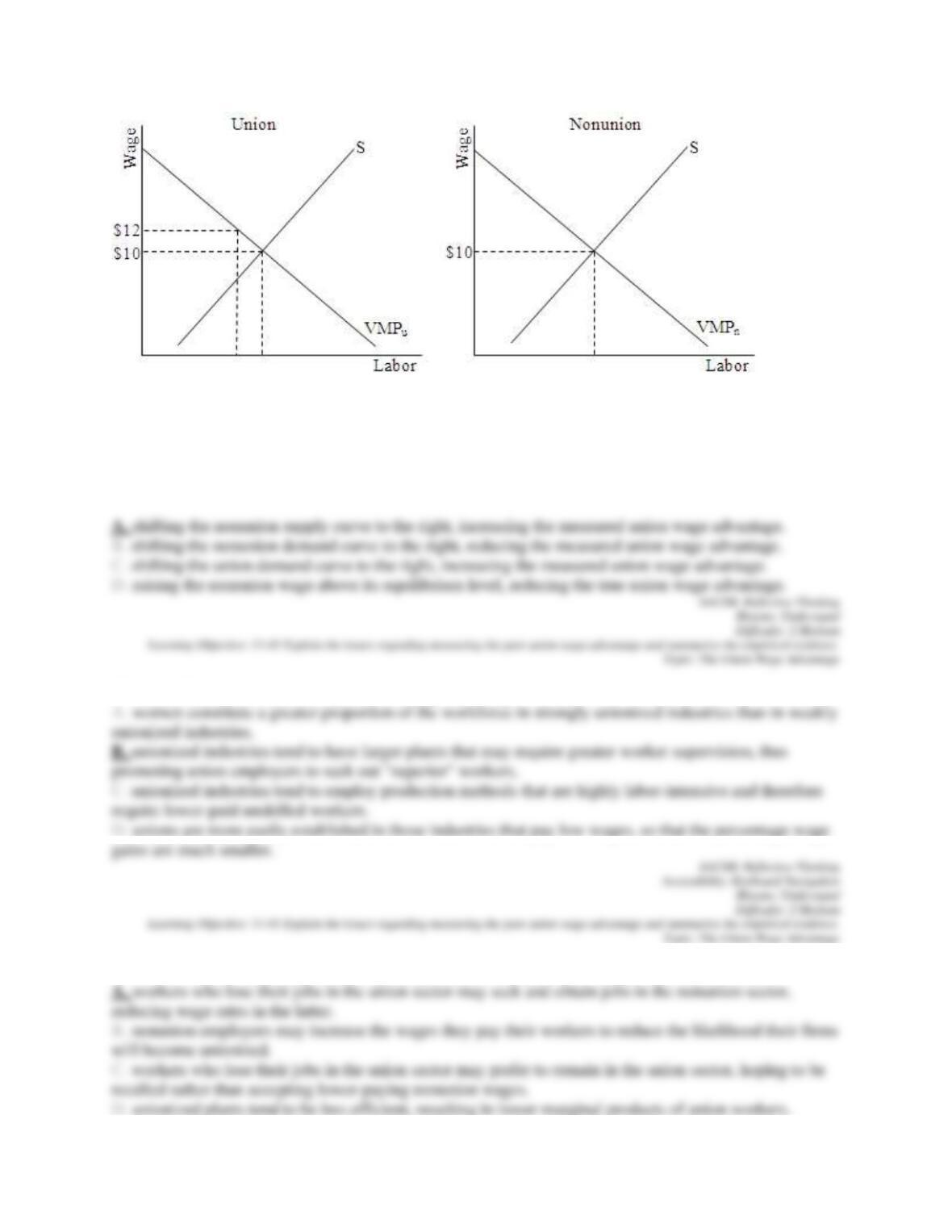
15. Refer to the following diagram. Wages in both the union and nonunion sectors are initially $10. The
union then negotiates a wage rate of $12. The post-negotiation nonunion wage is not yet known.
The threat effect would be modeled by
16. Refer to the following diagram. Wages in both the union and nonunion sectors are initially $10. The
union then negotiates a wage rate of $12. The post-negotiation nonunion wage is not yet known.
The spillover effect would be modeled by
17. It is difficult to measure the pure union wage advantage because
18. The measured union wage advantage may overstate the pure union wage advantage because
19. Hirsch and Macpherson estimate the overall union wage advantage to be approximately
20. Empirical research suggests that the union wage advantage in the public sector, compared to the
private sector, is approximately
21. The union wage advantage
22. Which one of the following is a true statement?
23. The union wage advantage tends to
24. Which one of the following is a true statement?
25. Which one of the following does not help to explain why union workers receive more fringe benefits
than nonunion workers?
26. Unions may reduce economic efficiency by
27. Unions may increase economic efficiency by
28. Unions may increase productivity by
29. By reducing labor turnover, unions may increase productivity because a lower turnover rate
30. Which one of the following observations supports the argument that unions increase productivity?
31. As a percentage of total work-time, the average amount of work-time lost because of strikes annually
is typically
32. Compared to other industrial countries, such as Canada, France, Italy, and the United Kingdom, the
incidence of strikes in the United States is
33. Work-time lost as a result of a strike
34. The adverse effects of a strike on other associated industries and consumers are likely to be
35. The allocative efficiency loss associated with unions arises because
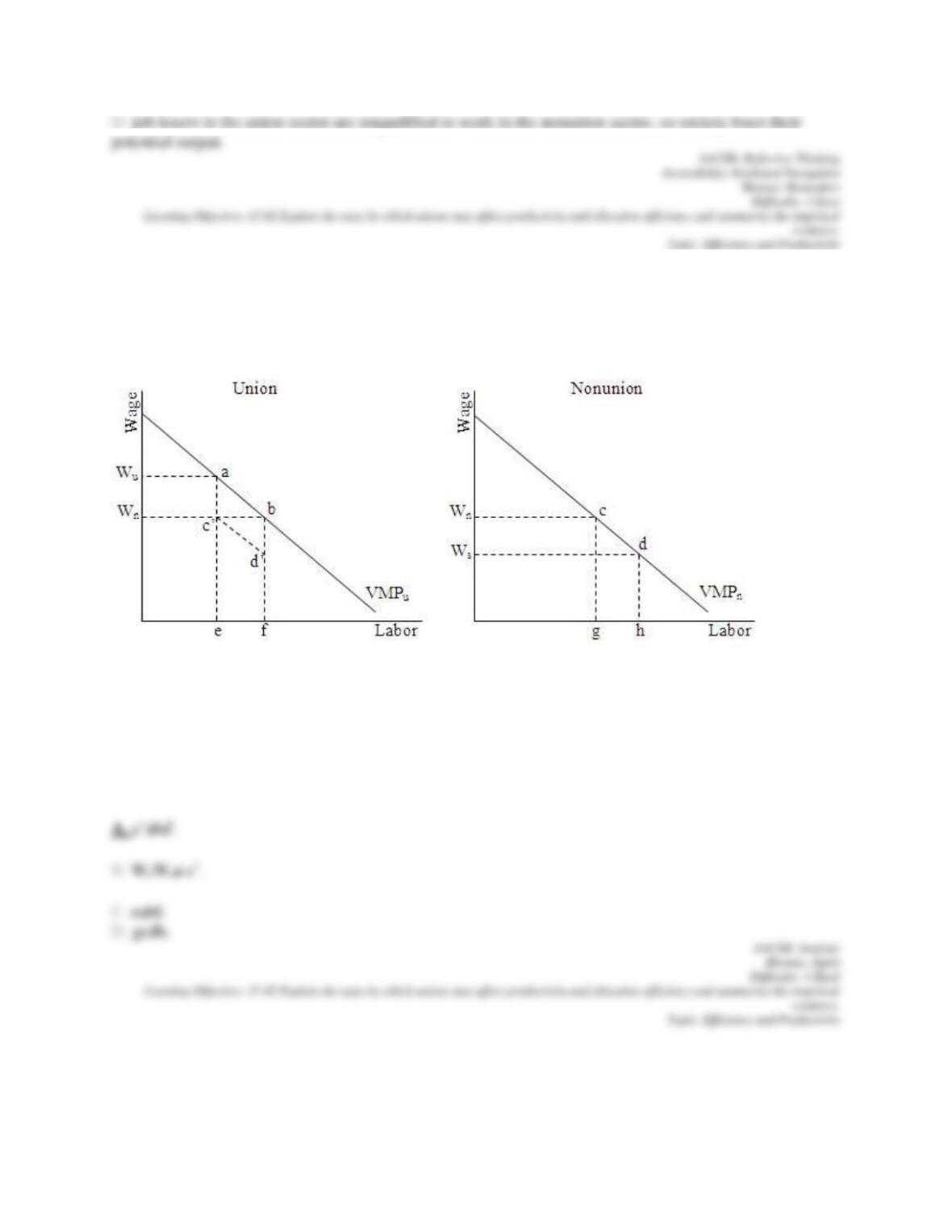
36. Refer to the following graph, in which all product markets are assumed to be competitive.
Assume the two labor demand curves are identical and that all union workers who lose their job as a
result of the union wage increase from Wn to Wu find jobs in the nonunion sector. The area corresponding
to the efficiency loss is
37. Refer to the following graph, in which all product markets are assumed to be competitive.
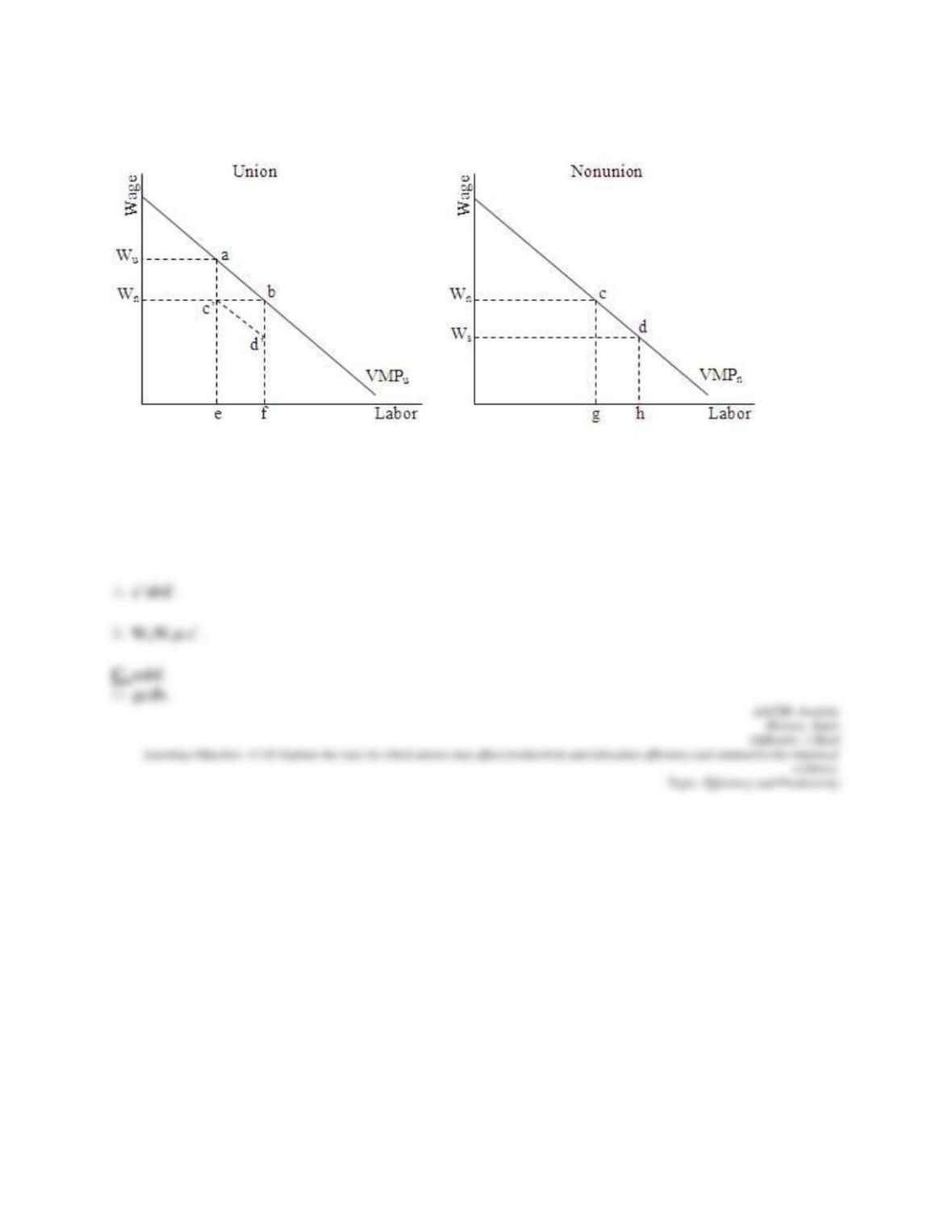
If all displaced union workers opt to remain in the union sector hoping to be recalled, the area
corresponding to the efficiency loss of the union wage increase is
38. Refer to the following graph, in which all product markets are assumed to be competitive.
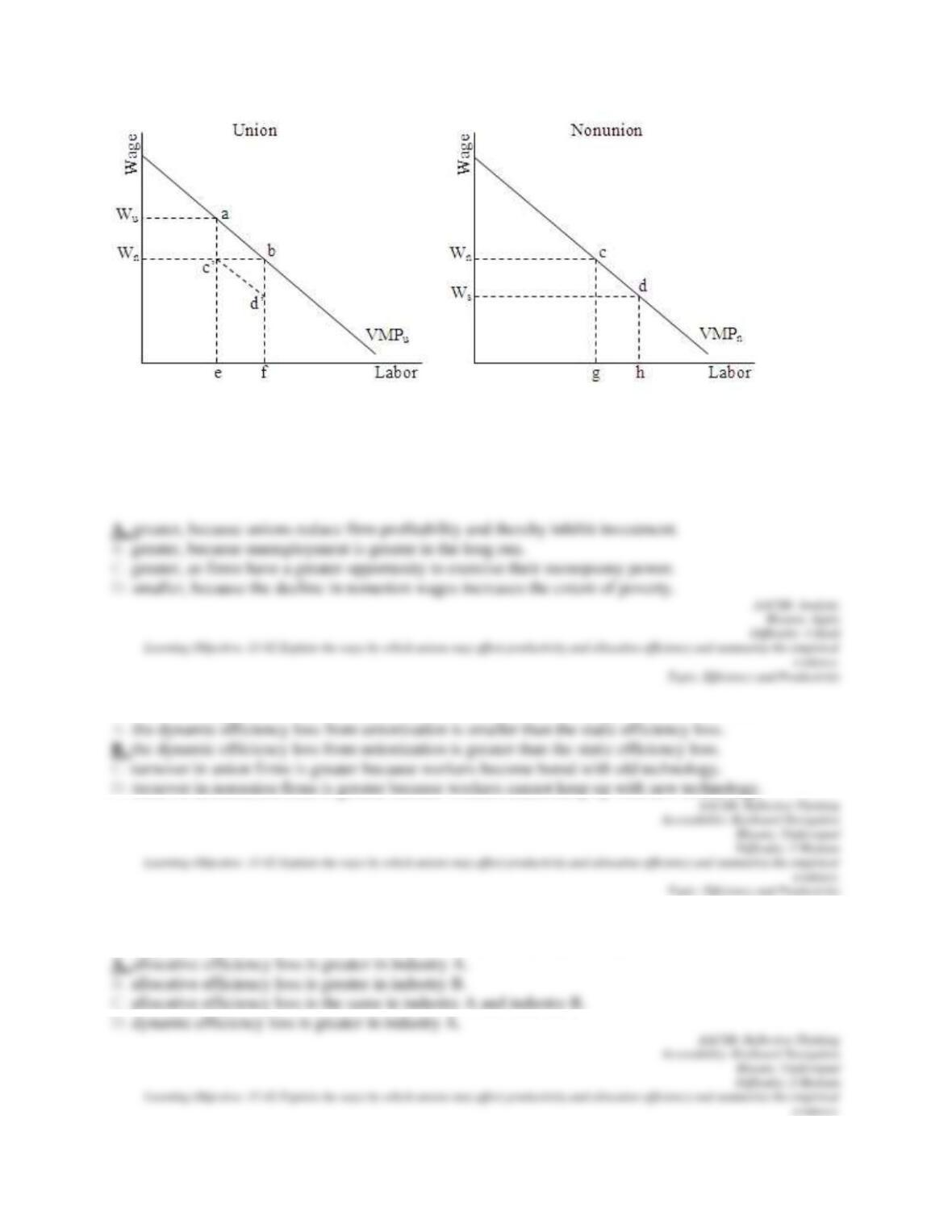
The allocative efficiency loss implied by the diagram is a static, short-run loss. Compared to the static
loss, the dynamic, long-run loss is probably
39. Evidence suggests that unions reduce firm profitability and discourage investment, so that
40. In industry A, all displaced workers remain in the union sector waiting to be recalled. In industry B,
all displaced workers seek work in the nonunion sector. All else constant, the
Topic: Efficiency and Productivity
41. All of the following suggest that unions may improve productivity and efficiency except:
42. Regarding unions and productivity, empirical results show that
43. Which of the following statements is supported by empirical evidence?
44. Empirical estimates generally show that unions reduce
45. Evidence indicates that, on balance, union wage policies tend to
46. There is a general consensus among economists that
47. Overall, unions have generally
48. Which of the following best describes the events following the deregulation of the trucking and airline
industries by 1980?
49. In their study of the Bridgestone/Firestone tire recalls, Krueger and Mas find that
50. Fallick and Hassett suggest that the tendency of union firms to merge with union firms can be
explained by their finding that
Chapter 11 Test Bank Summary
Category
# of Ques
tions
AACSB: Analytic
3
AACSB: Reflective Thinking
47
Accessibility: Keyboard Navigation
41
Blooms: Apply
3
Blooms: Remember
32
Blooms: Understand
15
Difficulty: 1 Easy
32
Difficulty: 2 Medium
15
Difficulty: 3 Hard
3
Learning Objective: 11-
01 Explain the issues regarding measuring the pure union wage advantage and summariz
e the empirical evidence.
26
Learning Objective: 11-
02 Explain the ways by which unions may affect productivity and allocative efficiency a
nd summarize the empirical evidence.
20
Learning Objective: 11-03 Describe the effects of unionism on firm profitability.
1
Learning Objective: 11-04 Describe how unions may affect earnings inequality.
1
Learning Objective: 11-
05 Assess the impact of unions on inflation, employment, unemployment, and the share
of national income paid as wages.
2
Topic: Distribution of Earnings
1
Topic: Efficiency and Productivity
19
Topic: Firm Productivity
1
Topic: Other Issues: Inflation, Unemployment, and Income Shares
2
Topic: The Union Wage Advantage
27