Chapter 11: Depreciation, Depletion, Impairment, and Disposal
Exhibit 11-05
Wilson is preparing his tax returns using the MACRS convention. The following information relates to the purchase of an
asset on January 1, Year 1.
MACRS Depreciation as a Percentage of the Cost of the Asset
Year of Life
3
5
7
10
1
33.33%
20.00%
14.29%
10.00%
2
44.45%
32.00%
24.29%
18.00%
3
14.81%
19.20%
17.49%
14.40%
4
7.41%
11.52%
12.49%
11.52%
5
11.52%
8.93%
9.22%
6
5.76%
8.92%
7.37%
7
8.93%
6.55%
8
4.46%
6.55%
9
6.56%
10
6.55%
11
3.28%
Cost
$ 105,000
Estimated Economic Life
7
Estimated residual value
$ 15,000
Depreciation for Financial Statements
straight-line
MACRS life
5
MACRS Method
200%-declining-balance
100. Refer to Exhibit 11-05, what amount of depreciation would be recorded on the income tax returns for year 3?
a.
$12,096
b.
$21,000
c.
$33,600
d.
$20,160
d
1
Easy
ACCT.WHAL.16.11.1 – LO: 11.1
United States – BUSPORG: Analytic
United States – OH – Default City – AICPA: FN-Measurement
Chapter 11: Depreciation, Depletion, Impairment, and Disposal
101. Refer to Exhibit 11-05, what amount of depreciation would be recorded on the income tax returns for year 5?
a.
$6,048
b.
$15,000
c.
$12,096
d.
$0
c
1
Easy
ACCT.WHAL.16.11.1 – LO: 11.1
United States – BUSPORG: Analytic
United States – OH – Default City – AICPA: FN-Measurement
102. Refer to Exhibit 11-05, what amount of depreciation would have been recorded in Wilson’s books for year 3?
a.
$18,000
b.
$12,857
c.
$20,160
d.
$15,000
b
1
Easy
ACCT.WHAL.16.11.1 – LO: 11.1
United States – BUSPORG: Analytic
United States – OH – Default City – AICPA: FN-Measurement
Chapter 11: Depreciation, Depletion, Impairment, and Disposal
103. The following are a list of terms:
______
1
depletion
______
2
useful life
______
3
depreciation base
______
4
double-declining-balance method
______
5
rational method of cost allocation
______
6
salvage value
______
7
depreciable cost
______
8
amortization
______
9
activity method
______
10
declining-balance method
______
11
systematic method of cost allocation
______
12
service life
Required:
Match each term with the appropriate definition by entering the letter from below into the blank in the table above.
a.
The allocation of costs as they relate to copyrights, patents, and trademarks.
b.
Based on the decline in the asset’s service potential each period.
c.
Calculated based upon a formula rather than an arbitrary manner.
d.
Can be measured in units, hours, or time.
e.
A constant rate applied to the book value of the asset.
f.
Based upon the amount of use versus time periods.
g.
The allocation of costs related to natural resources.
h.
The difference between the original cost of the asset and an estimate of its
residual value.
i.
Uses two times the straight-line depreciation rate applied to the book value of
the asset at the beginning of each period.
j.
The amount of time the company expects the asset to be viable.
k.
Computed as: Asset Cost – Estimated Residual Value
l.
The expected book value at the end of the depreciation period.
104. Peanut Company purchased a machine on January 1, 2016, for $100,000 with a $20,000 salvage value and an eight-
year useful life. The company uses double-declining-balance depreciation.
Required:
Compute the depreciation expense (to the nearest whole dollar) for 2016 and 2017.
105. Green Vegetable Mfg. Co. purchased equipment on January 1, 2016, at a cost of $800,000. The equipment is
expected to have a service life of ten years, or 40,000 hours, and a residual value of $70,000. During 2016, the
equipment was operated for 5,000 hours, and during 2017, it was operated for 7,000 hours.
Required:
Fill in the blanks below with the depreciation expense (to the nearest whole dollar) for this machine in 2016 and
2017 under each of the following depreciation methods:
2016
2017
a.
Straight-line method
__________
__________
b.
Activity method (hours)
__________
__________
c.
Double declining balance method
__________
__________
d.
Sum-of-the-years’-digits method
__________
__________
ANSWER:
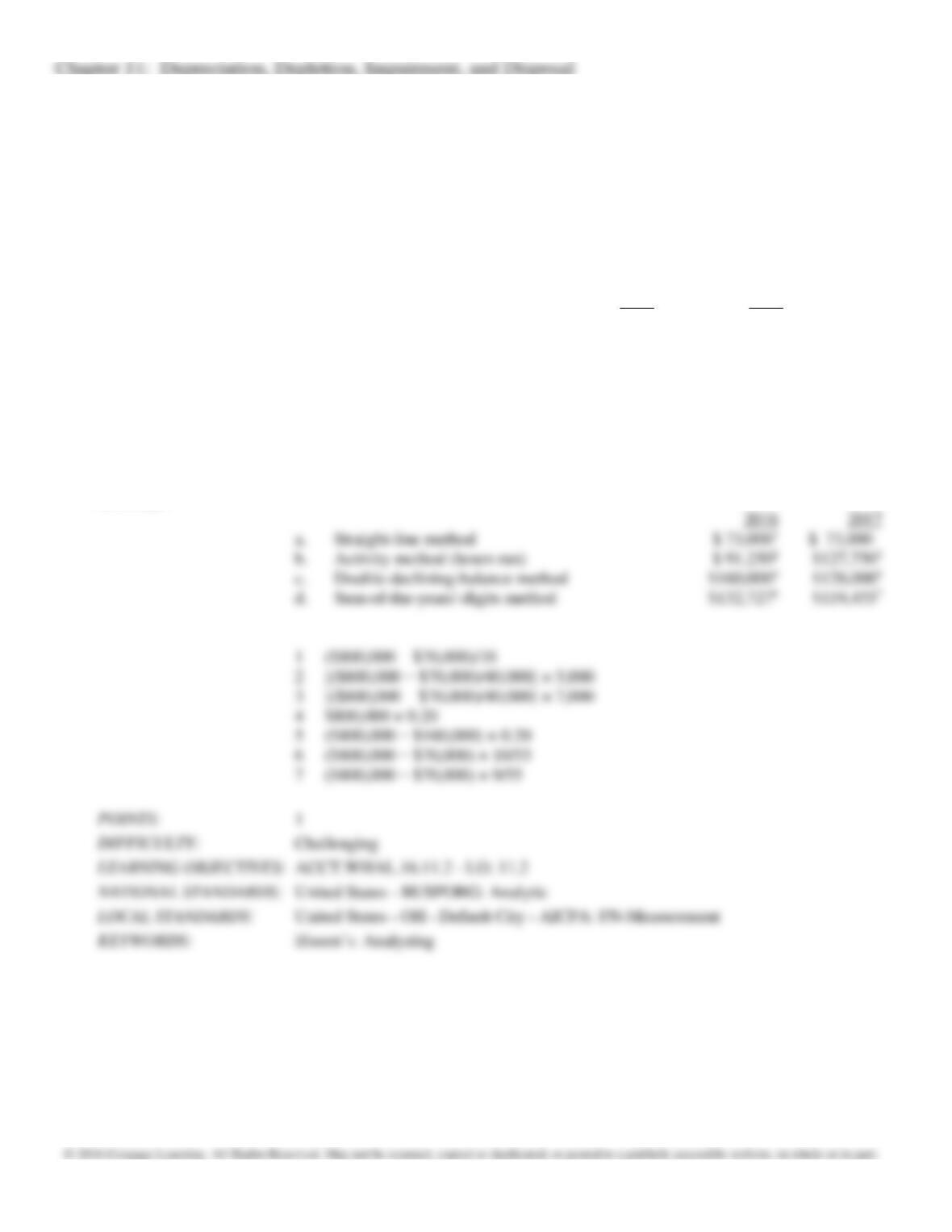
$ 73,000
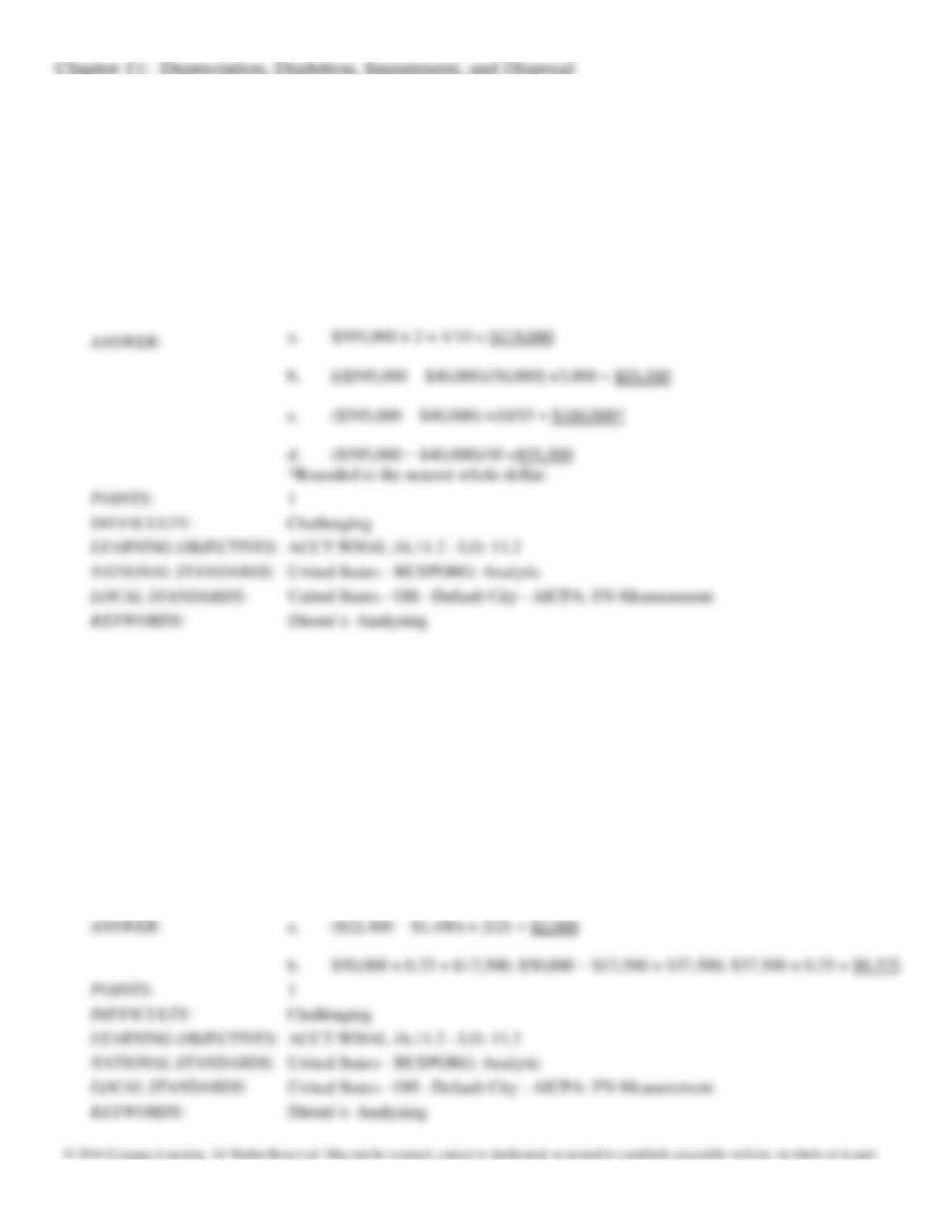
106. The Jefferson Co. purchased a machine on January 1, 2016. The machine cost $595,000. It had an estimated life of
ten years, or 30,000 units, and an estimated residual value of $40,000. In 2016, Jeffries produced 3,000 units.
Required:
Compute the depreciation charge for 2016 using each of the following methods:
a.
Double-declining-balance method
b.
Activity method (units of output)
c.
Sum-of-the-years’-digits method
d.
Straight-line method
a.
b.
c.
d.
107. Consider the following:
a.
Regent Corp. bought a machine costing $22,400 on January 1, 2016. A six-year life was
estimated, and a $1,400 residual value was expected. The sum-of-the-years’-digits
depreciation method was used.
Compute depreciation expense for 2020.
b.
The company bought a machine costing $50,000 on January 1, 2016 A six-year life was
expected, and residual value was estimated to be $8,000. The 150%-declining-balance
depreciation method was used.
Compute depreciation expense for 2017.
a.
($22,400 − $1,400) × 2/21 = $2,000
b.
$50,000 × 0.25 = $12,500; $50,000 − $12,500 = $37,500; $37,500 × 0.25 = $9,375
1
Challenging
ACCT.WHAL.16.11.2 – LO: 11.2
United States – BUSPORG: Analytic
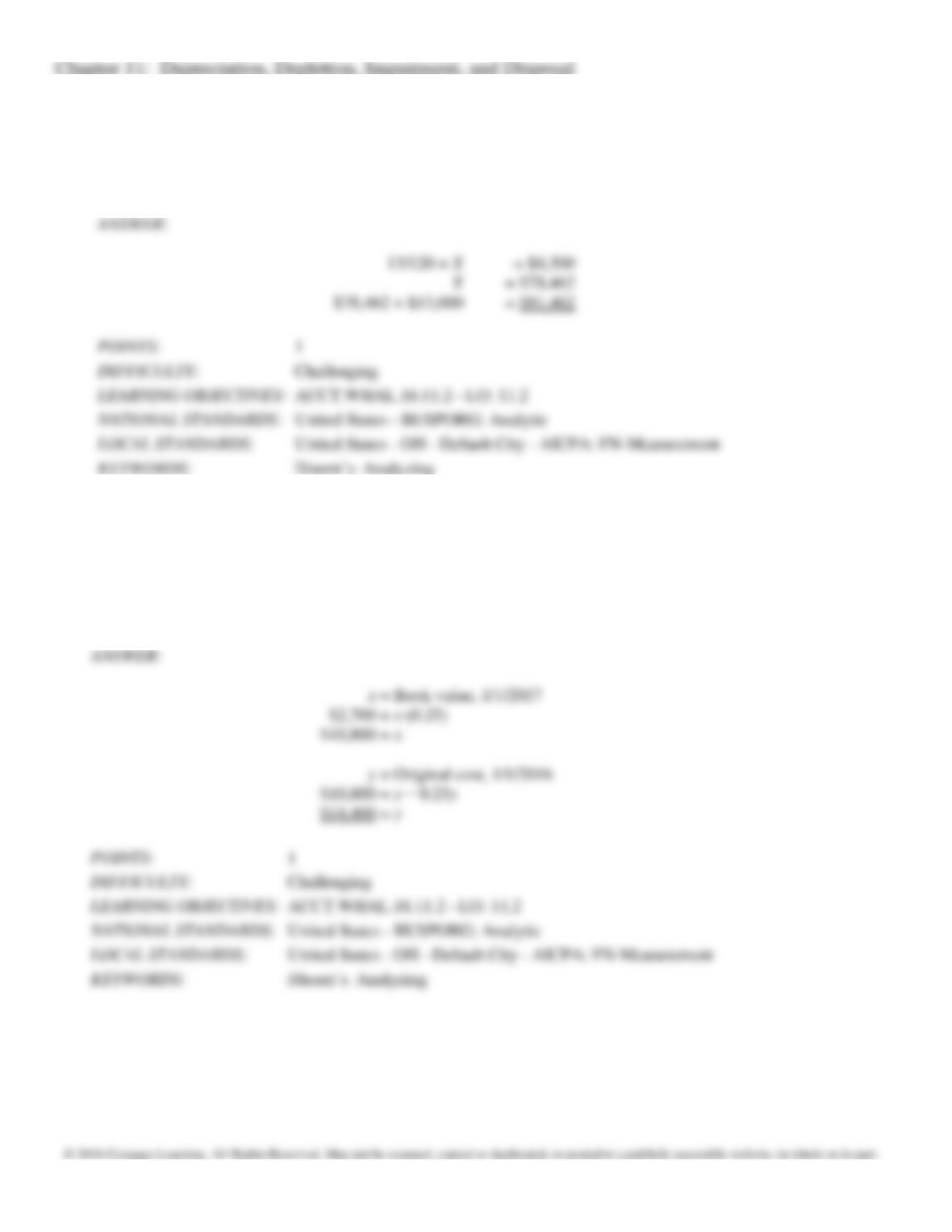
108. On January 1, 2016, Paradise Hotels and Spa’s purchased a machine. Residual value was estimated to be $13,000 after a 15-yea
Required:
Compute the cost of the machine.
109. On January 1, 2016, Major purchased a machine that had an estimated useful life of six years and $5,000 residual
value. The depreciation on this machine was $2,700 in 2017 using the 150%-declining-balance depreciation method.
Required:
Compute the cost of this machine.
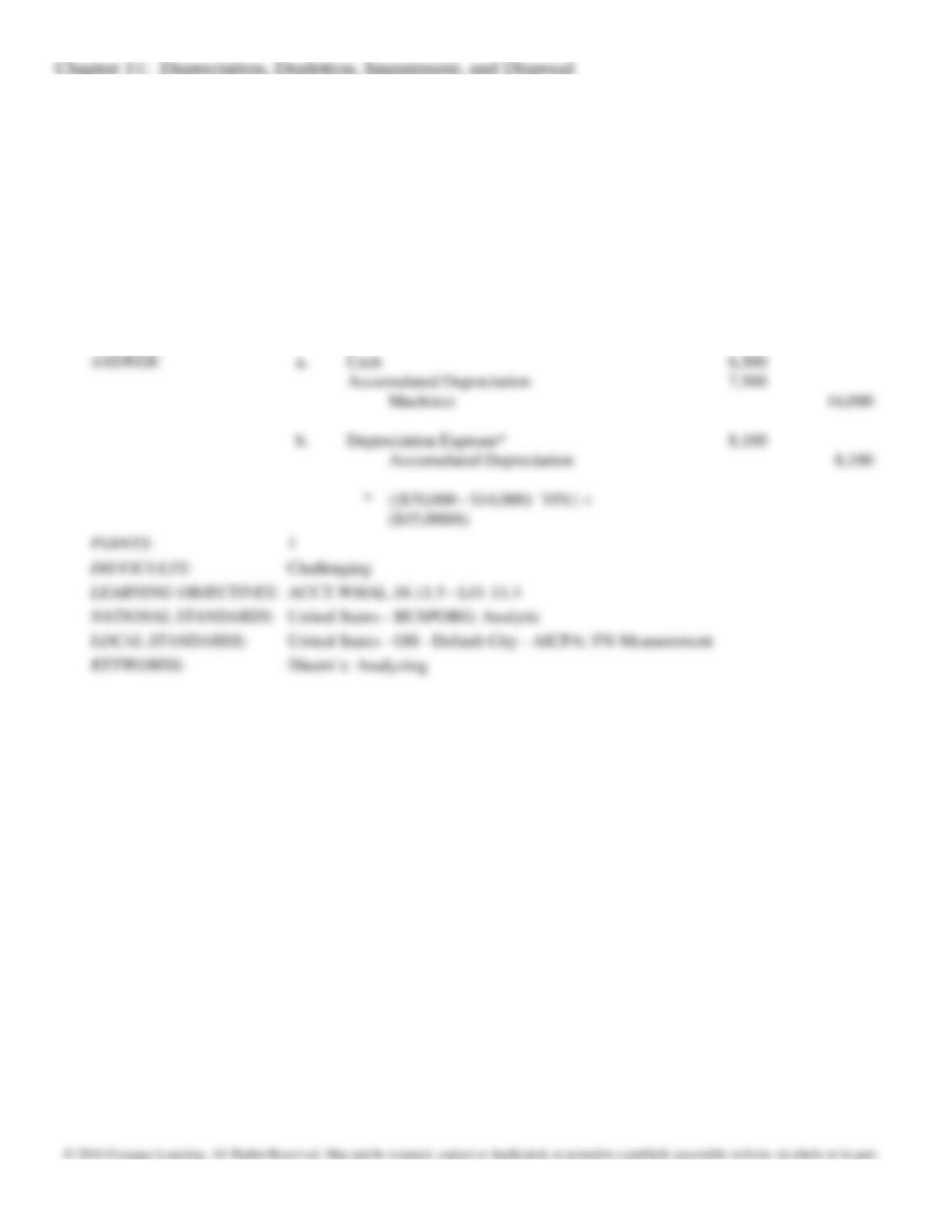
110. On January 1, 2016, World Inc. purchased five machines at a cost of $14,000 each. The company adopted the group
(straight-line) depreciation method, using an eight-year life with a $2,800 salvage value per machine. Correct
depreciation was recorded in 2014 and 2015. On January 1, 2018, one of the machines was sold for $6,500. On
January 3, 2018, a new unrelated piece of equipment was purchased for $15,000 with no salvage value and a six-year
life. It will be depreciated using the straight-line method.
Required:
Prepare appropriate journal entries for
a.
January 1, 2018
b.
December 31, 2018, to record depreciation expense
Challenging
United States – OH – Default City – AICPA: FN-Measurement
111. Javlin Farms purchased three new tractors for $25,000 each. Javlin expects the tractors to have a useful life of 6 years
and a residual value of $5,000. One of the tractors has not performed as expected, so Javlin sold the tractor after 2
years for $18,000. Javlin sold the remaining tractors for $5,000 at the end of the 6 years. Javlin uses group
depreciation on a straight-line basis.
Required:
a.) Prepare the journal entry for the purchase.
b.) Prepare the journal entry for the first and second year’s depreciation.
c.) Record the journal entry for the disposal of the tractor.
d.) Record the journal entry for the third year’s depreciation.
112. On January 1, 2015, the Wintergreen Co. acquired three assets that it intends to combine into a single account and
depreciate using the composite depreciation (straight-line) method. The assets have the following characteristics:
Asset
Cost
Residual Value
Life
1
$150,000
$19,500
5 years
2
190,000
4,000
7 years
3
52,500
2,700
4 years
Required:
a.
Determine the composite rate for depreciation of these assets.
b.
Why did Wintergreen Co. use a composite rate than a group depreciation rate?
113. Information for heterogeneous assets A, B, and C of America Health and Fitness Club is provided below. The
company uses composite depreciation for these assets.
Estimated
Residual
Estimated
Asset
Cost
Value
Life
A
$100,000
$10,000
9 years
B
60,000
4,000
8 years
C
40,000
8,000
4 years
Required:
a.
Calculate the composite depreciation rate.
b.
Journalize the sale of Asset C for $28,000 after two full years of use.
8,000
40,000
1
Challenging
ACCT.WHAL.16.11.5 – LO: 11.4
United States – BUSPORG: Analytic
United States – OH – Default City – AICPA: FN-Measurement
114. On January 1, 2016, Check Co. bought a machine for $15,000. Residual value was estimated to be $1,400 and a five-
year life was used for straight-line depreciation. On January 1, 2018, it was estimated that the total life from
acquisition date should have been six years and residual value should have been estimated at $600.
Required:
Compute depreciation expense for 2018.
115. Consider the following:
a.
Peters Co. bought a machine for $15,790 on July 1, 2015. The estimated life of the
machine was seven years, and salvage value was estimated to be $782. The straight-line
depreciation method was used.
Compute depreciation expense for 2015.
b.
Peters Co. bought a machine costing $30,492 on January 1, 2016. A six-year life was
estimated with no salvage value. The sum-of-the-years’-digits depreciation method was
used.
Compute depreciation expense for 2020.
c.
Peters Co. bought a machine costing $62,000 on January 1, 2016. Salvage value was
estimated to be $2,000, a five-year life was determined, and 150%-declining-balance
depreciation was used.
Compute the amount that would be in the accumulated depreciation account on December
31, 2017.
Chapter 11: Depreciation, Depletion, Impairment, and Disposal
116. On April 20, 2016, Maskell Co. purchased an asset costing $66,000 with a useful life of nine years and a residual
value of $6,000. The company uses sum-of-the-years’-digits depreciation.
Required:
Compute depreciation expense for 2016 using the
a.
nearest whole month method
b.
nearest whole year method
c.
half-year convention method
($66,000 − $6,000) × 8/12 × 9/45 = $8,000
b.
($66,000 − $6,000) × 9/45 = $12,000
c.
117. The Roberto Company purchased a limo for $75,000 on October 10, 2016. The limo has a salvage value of $5,000
and an eight-year useful life. The company uses double-declining-balance depreciation.
Required:
Compute depreciation expense for 2016 using the
a.
nearest whole month method
b.
nearest whole year method
c.
half-year convention method
b.
c.
118. On January 1, 2016, the Mills Car Repair Company acquired equipment at a cost of $55,000. At that time, the
equipment was estimated to have a residual value of $5,000 at the end of an estimated five-year service life. During
2016 and 2017, the company recorded straight-line depreciation on the equipment.
Required:
Prepare all the journal entries for 2018 relating to the equipment for each of the following independent situations
(ignoring income taxes):
a.
Assume that the company switched to sum-of-the-years’-digits depreciation at the
beginning of 2018 with a new estimated remaining life of four years.
b.
Assume, instead, that at the beginning of 2018, the equipment is determined to have a five-
year remaining service life. Straight-line depreciation will still be used.
c.
Assume, instead, that at the beginning of 2018 the company discovered that it had
erroneously ignored the estimated residual value in the computation of its depreciation for
2016 and 2017.
Accumulated Depreciation –
($55,000 – $5,000) ´ 2/5
b.
Depreciation Expense
Accumulated Depreciation –
Equipment
Retained Earnings
Accumulated Depreciation –
119. On January 2, 2016, China Co. bought a machine for $400,000 with a salvage value of $20,000 and a four-year
useful life. Straight-line depreciation was used. However, during 2016 and 2017, depreciation expense was
erroneously calculated using a $50,000 salvage value. The error was discovered in 2018 after the 2017 books had
been closed.
Required:
Prepare the correcting entry in 2018.
120. On January 1, 2016, Bauer Co. had purchased a machine for $60,000. This machine had an estimated service life of
eight years and an estimated residual value of $4,000. It has been depreciated by the straight-line method since
acquisition. On January 1, 2019, it was determined that the remaining service life for this machine was nine years
and that the residual value would be $3,000.
Required:
Record the depreciation expense for 2019.