Chapter 11
Currency Risk Management
Note: In the sixth edition of Global Investments, the exchange rate quotation symbols differ from previous
editions. We adopted the convention that the first currency is the quoted currency in terms of units
of the second currency.
For example, €:$ = 1.4 indicates that one euro is priced at 1.4 dollars. In previous editions we used
the reversed convention $/€ = 1.4, meaning 1.4 dollars per euro.
All problems in this test bank still use the old convention and have not been adapted to reflect the
new quotation symbols used in the 6th edition.
◼ Questions and Problems
1. A German corporation finalized a sale to a Thai client on April 15. The German corporation will
deliver some gardening equipment on May 31 and will be paid 345 million baht on June 30. The
current spot exchange rate is 40 baht/euro. The German corporation is worried about a depreciation
of the baht in the coming two months and wishes to sell those baht forward against euros.
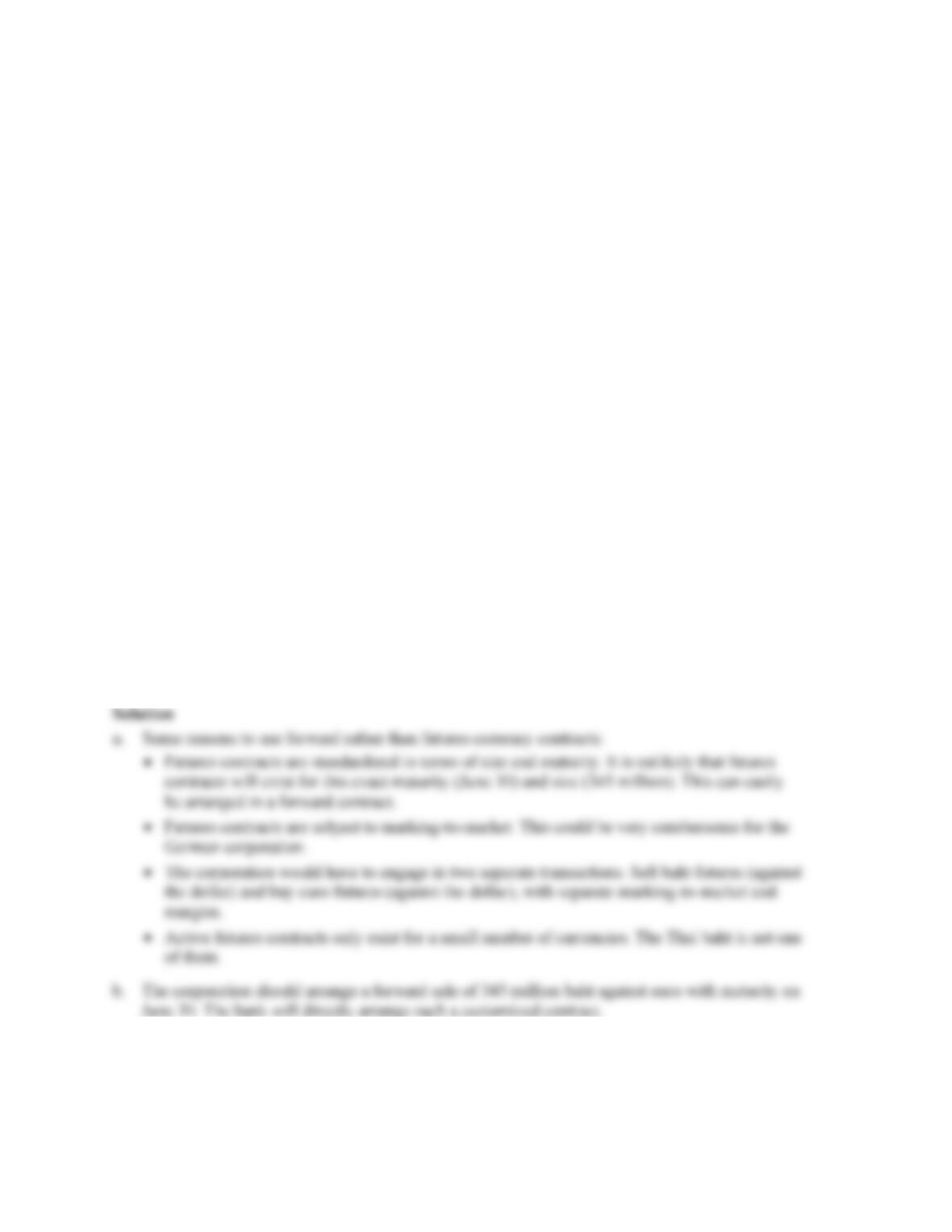
a. Give some reasons why the German corporation should use forward rather than futures currency
contracts.
b. Exactly what contract should the German corporation arrange with its bank?
Chapter 11 Currency Risk Management 159
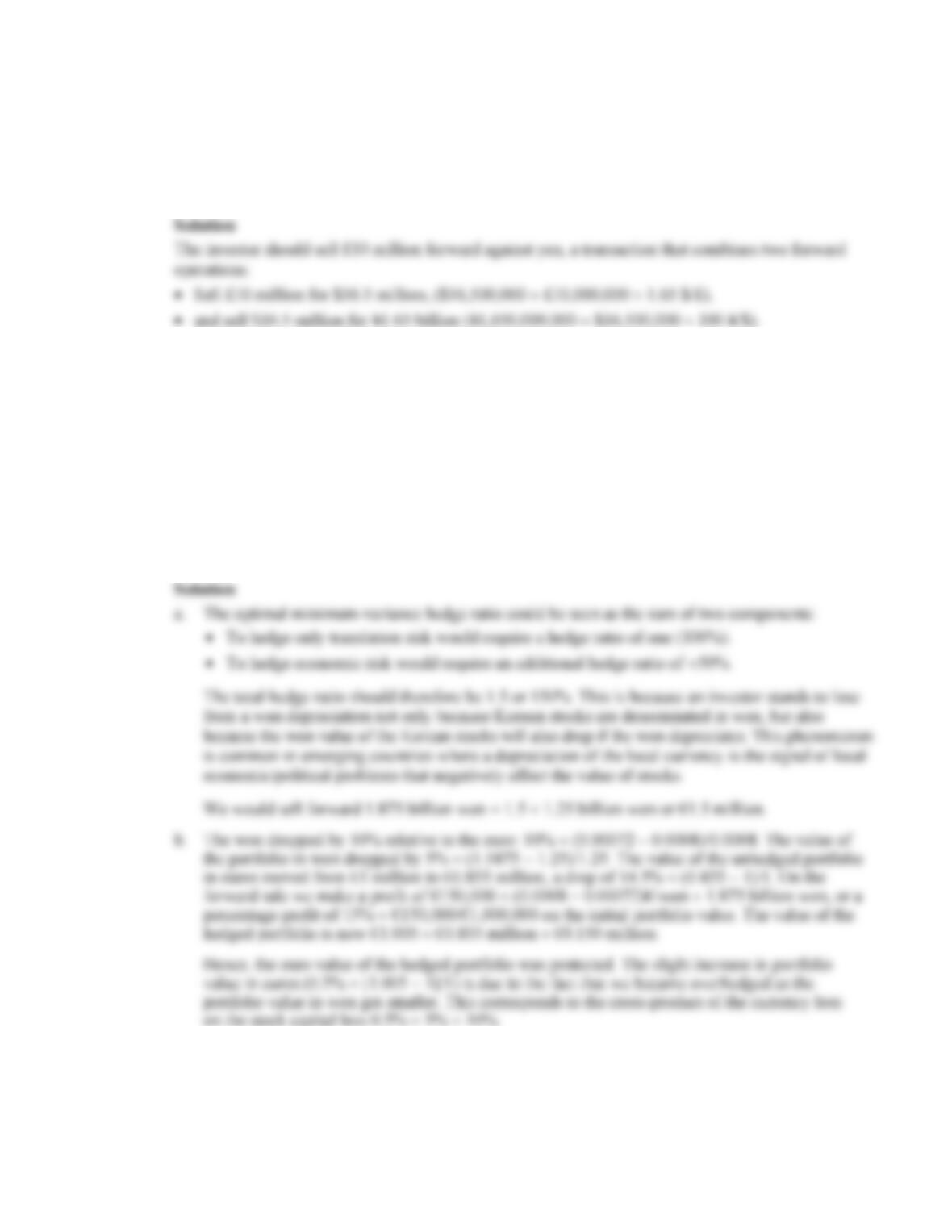
2. A Japanese investor holds a portfolio of British stocks worth £10 million. The current three-month
dollar/pound forward exchange rate is $/£ = 1.65, and the current three-month yen/dollar forward
exchange rate is ¥/$ = 100. What position should the Japanese investor take to hedge the pound/yen
exchange risk?
3. An Italian investor owns a portfolio of South Korean stocks worth 1.25 billion won. The current spot
and one-month forward exchange rates are 1,250 won/€ (one won = 0.0008 euro). Interest rates are
equal in both countries. You are worried that some rumor about the bankruptcy of a major local bank
could lead to a strong depreciation of the won. You have observed that Korean stocks tend to react
negatively to a depreciation of the local currency (won). A broker tells you that a regression of
Korean stock returns (measured in won) on the €/won percentage exchange rate movements has a
slope of +0.50. In other words, Korean stocks tend to go down by 0.5% when the won depreciates
by 1%.
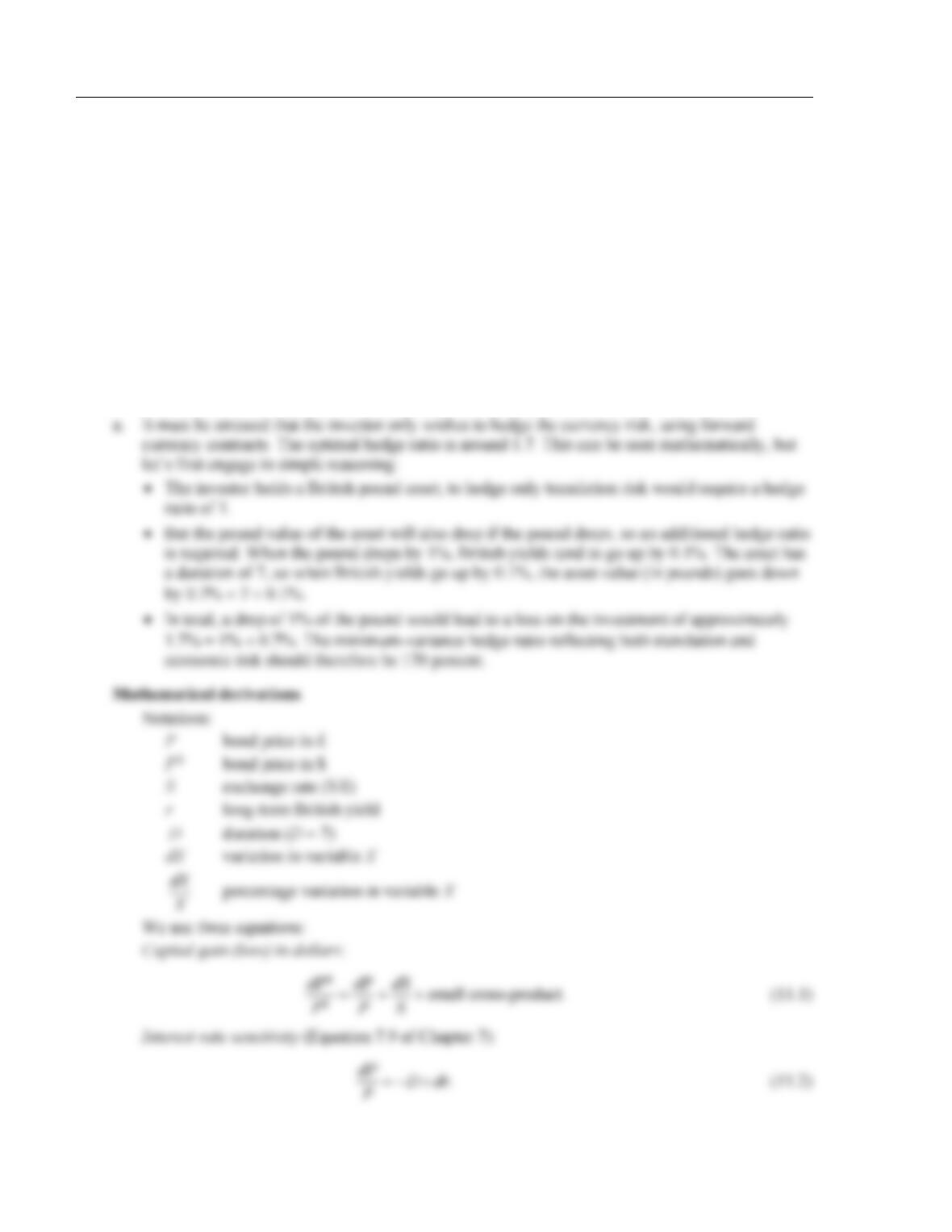
a. Discuss what your currency hedge ratio should be.
b. A month later, your Korean stock portfolio has gone down to 1.1875 billion won and the spot and
forward exchange rates are now 0.00072 €/won. Analyze the return on your hedged portfolio.
160 Solnik/McLeavey • Global Investments, Sixth Edition
4. An American investor holds a British bond portfolio worth £100 million. The portfolio has a duration
of 7. She fears a temporary depreciation of the pound but wishes to retain the bonds. To cover this
risk, she decides to sell pounds forward. She has observed that the British government tends to adopt
a “leaning-against-the-wind” policy. When the pound depreciates, British interest rates tend to rise to
defend the currency. A regression of “variations in long–term British yields” on “percentage $/£
exchange rate movements” has a slope coefficient of −0.1. In other words, British yields tend to
go up by 10 basis points (0.1%) when the pound depreciates by 1% relative to the dollar.
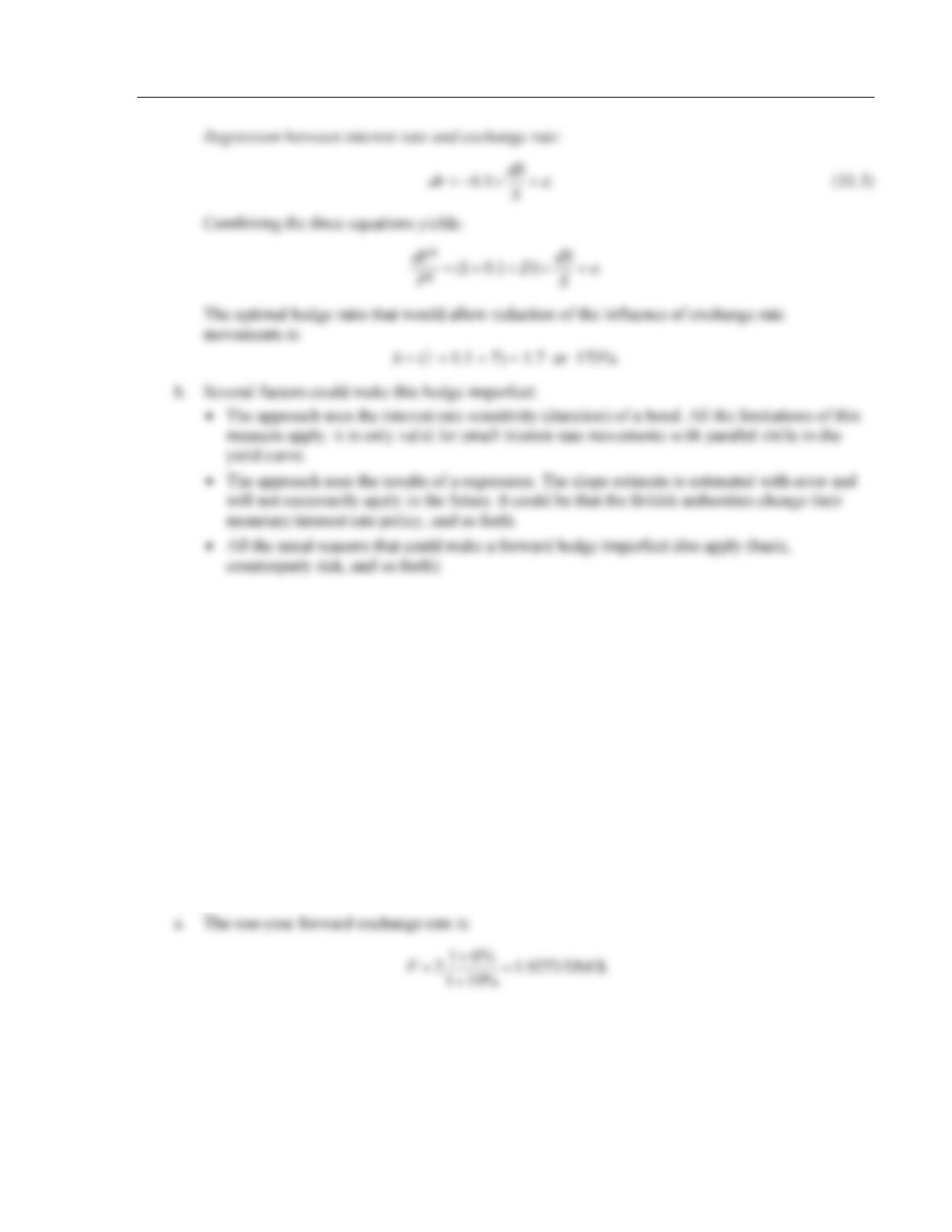
a. What should be the optimal hedge ratio used by the investor if she wishes to reduce the
uncertainty caused by exchange risk? (The investor uses only forward currency contracts to
hedge this risk, not bond futures contracts.)
b. Detail the factors that could make this hedge imperfect if the depreciation of the pound
materializes.
Solution
Chapter 11 Currency Risk Management 161
5. Back in 1990, East Germany was in the process of merging into West Germany. Its national currency
was to be replaced by the Deutsche mark (DM). A U.S. dollar-based investor has a portfolio worth
DM 100 million in German bonds. The current spot exchange rate is 2 DM/$. The current one-year
market interest rates are 6% in DM and 10% in dollars. One-year currency options are quoted in
Chicago with a strike price of 50 U.S. cents per DM; a call DM is quoted at 1 U.S. cent and a put
DM is quoted at 1.2 U.S. cents; these option prices are for one DM.
You are worried that the integration of East and West Germany will cause inflation in Germany and a
drop in the DM. So, you consider using forward contracts or options to hedge the currency risk.
a. What is the one-year forward exchange rate DM/$?
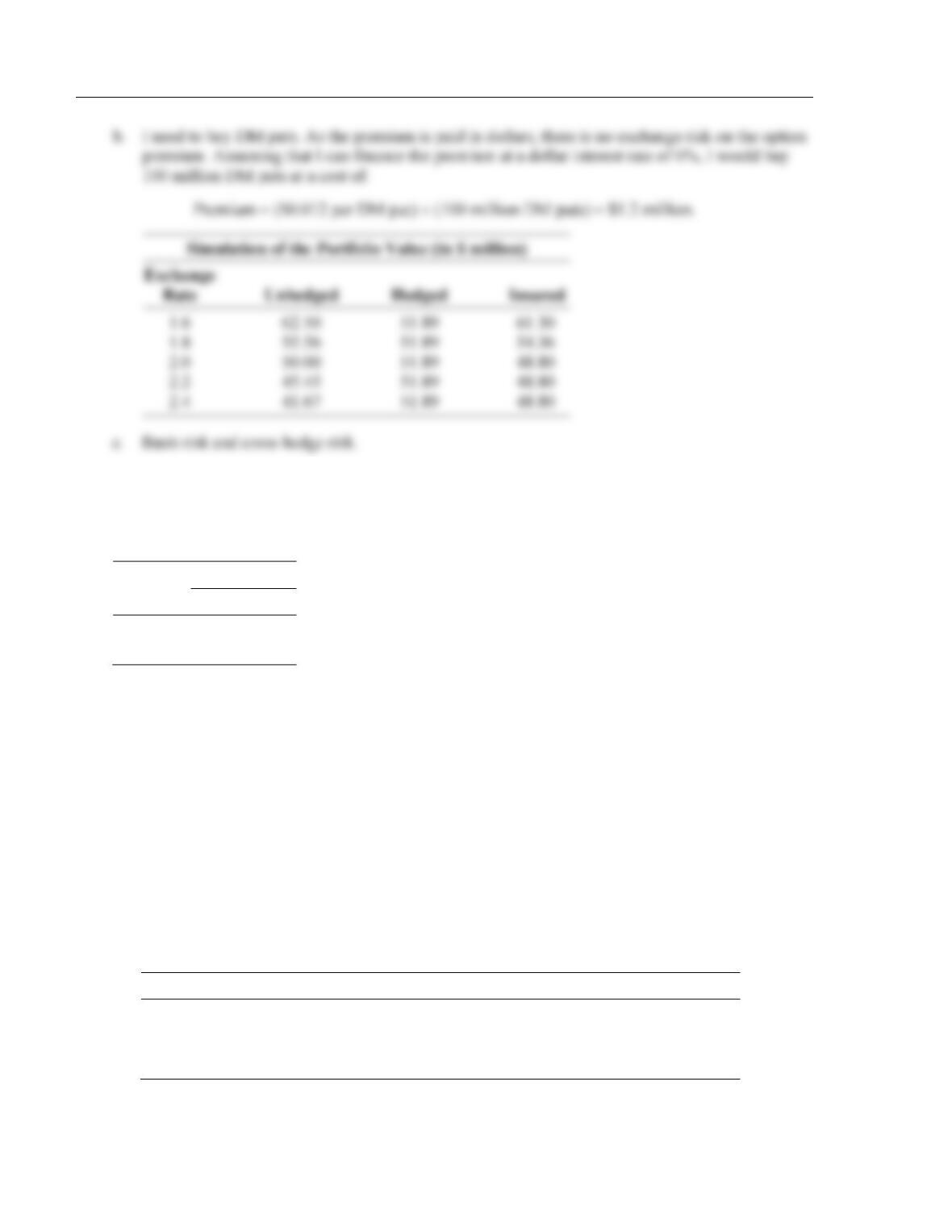
b. Simulate the dollar value of your portfolio assuming that its DM value stays at DM 100 million;
use DM/$ spot exchange rates equal in one year to: 1.6, 1.8, 2, 2.2, and 2.4. First consider a
currency forward hedge, then a currency-option insurance.
c. What could make your forward hedge imperfect?
Solution
162 Solnik/McLeavey • Global Investments, Sixth Edition
6. Today is April 1st and you’re French. You hold $1 million worth of American securities. You fear a
depreciation of the dollar. The spot exchange rate is 0.80 $/€ or 1.25 €/$. The forward rate maturing
July 1 is 1.255 €/$. Currency options on the euro are traded in Chicago. They are options on 1 euro,
maturing July 1 and whose prices (premium and strike) are given in U.S. cents in the following table:
Strike
Premium
Call
Put
80
2
2
85
0.2
5.4
If you hedge using a forward contract, the bank requires no deposit. If you buy options, you must sell
some of your U.S. securities in order to buy these options. You assume that your securities will keep
exactly the same value on July 1.
a. You decide to hedge. What will be the euro value of your portfolio on July 1?
b. You decide to insure your portfolio using currency options. Do you need to buy/sell calls €/
puts €?
c. Assume that you use options with a strike of 80 U.S. cents. How many options do you need to
insure perfectly your portfolio?
d. Same question with options with a strike of 85?
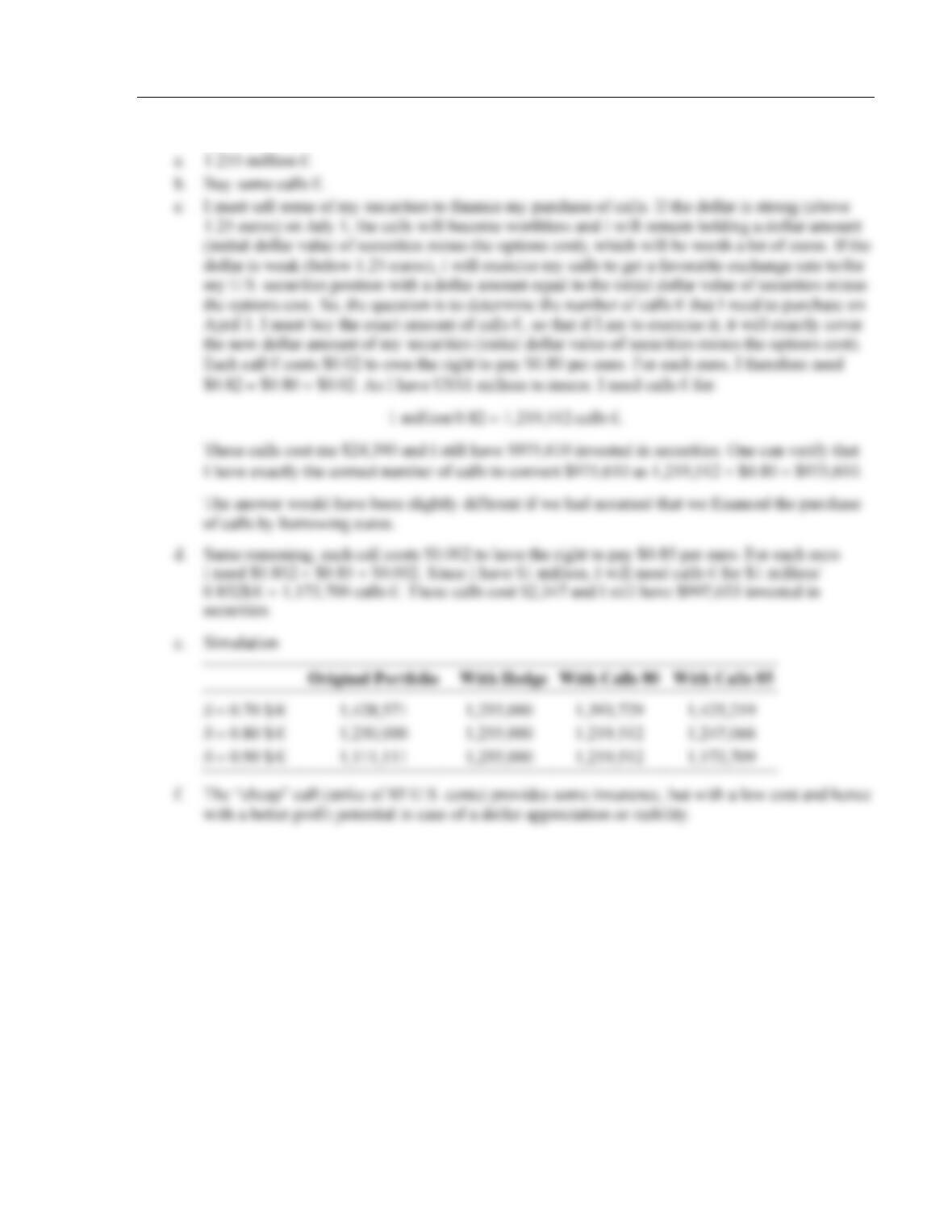
e. Simulate the results of your hedge and insurance with the two options if the spot exchange rate
on July 1 is equal to 0.70 $/€, 0.80 $/€, and 0.90 $/€. Fill the following table with the value of the
portfolio in euros:
Portfolio Value in Euros on July 1:
Original Portfolio
With Hedge
With Calls 80
With Calls 85
S = 0.70 $/€
1,428,571
S = 0.80 $/€
1,250,000
S = 0.90 $/€
1,111,111
f. What is the best choice if you think that the chances of the depreciation of the $ are very weak
but still exist.
Unhedged
Chapter 11 Currency Risk Management 163
Solution
7. An American investor believes that the dollar will depreciate and buys one call option on the euro at
an exercise price of 110 cents per euro. The option premium is 1 cent per euro, or $625 per contract
of 62,500 euros (Philadelphia):
a. For what range of exchange rates should the investor exercise the call option at expiration?
b. For what range of exchange rates will the investor realize a net profit, taking the original cost
into account?
c. If the investor had purchased a put with the same exercise price and premium, instead of a call,
how would you answer the previous two questions?
164 Solnik/McLeavey • Global Investments, Sixth Edition
Solution
8. An Italian importer will be paid $1 million in three months (March). He must decide whether to sell
$1 million forward or to buy currency options for that amount.
The current market prices are as follows:
Exchange rates: Spot $/€ = 1.10
Three-month forward: $/€ = 1.11
Call euro March 110 U.S. cents: 1.5 U.S. cents per €.
Put euro March 110 U.S. cents: 1.0 U.S. cents per €.
What are the differences between the strategies of selling currency forward and buying currency
options?
Solution
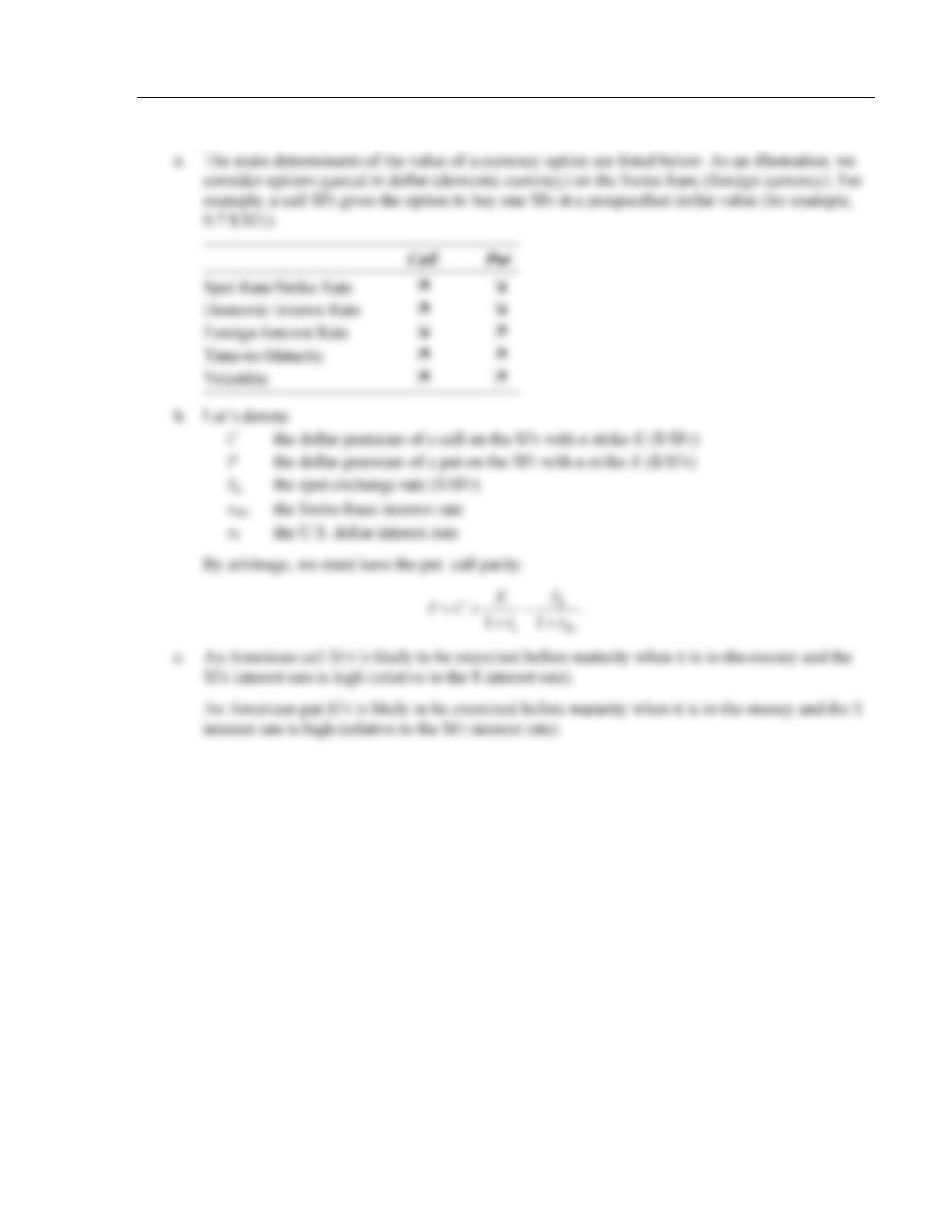
9. What are the major determinants of the value of a currency option (call and put)?
a. Briefly justify each determinant and its direction.
b. What is the relation between a currency put and a currency call (put–call parity)?
c. In what circumstances would an American-type option be exercised before expiration?
(You may provide an example to illustrate your answers.)
Chapter 11 Currency Risk Management 165
Solution
10. On April 1, an Australian investor decides to hedge a U.S. portfolio worth $10 million against
exchange risk using AUD call options. The spot exchange rate is AUD/$ = 2.5 or $/AUD = 0.40.
The Australian investor can buy November calls AUD with a strike price of 0.40 U.S. cents per
AUD at a premium of 0.8 U.S. cent per AUD. The size of one contract is AUD 125,000. The delta
of the option is estimated at 0.5.
a. How many AUD calls should our investor buy to hedge the U.S. portfolio against the AUD/$
currency risk?
b. A few days later the U.S. dollar has dropped to AUD/$ = 2.463 ($/AUD = 0.406) and the dollar
value of the portfolio has remained unchanged at $10 million. The November 40 AUD call is
now worth 1.2 cents per AUD and has a delta estimated at 0.7. What is the result of the hedge?
c. How should the hedge be adjusted?
166 Solnik/McLeavey • Global Investments, Sixth Edition
Solution
11. An American portfolio manager wishes to increases her exposure to Japanese stocks by $10 million
without taking much foreign exchange risk. The spot exchange rate is ¥100 per dollar. She considers
several alternatives:
• Exchange Traded Funds (ETFs) are listed on the Tokyo stock exchange. The ETF is a traded fund
that tracks the TOPIX index. Each share has a value of ¥1,000.
• Futures contracts are available on the TOPIX index. Each contract is for ¥1,000 times the index.
The current futures price of the TOPIX index is 1,000. The margin deposit per contract is ¥50,000.
• At-the-money call options on the TOPIX index are available. Each contract is for ¥1,000 times the
index. The premium on the call is ¥60 per index or ¥60,000 per contract.
What strategy could she adopt using those contracts?
Chapter 11 Currency Risk Management 167
Solution
12. An asset manager has a mandate to manage a European equity portfolio for a U.S. pension client. The
portfolio size is $100 million. The benchmark is some European equity index with a 50% currency
hedging target. But the currency management is delegated to a currency overlay manager. The
geographical breakdown of the portfolio on January 1 is as indicated below:
By Country
Value
in Local Currency
Value
in Dollars
British Stocks
£10 million
$15 million
Euroland Stocks
€20 million
$23 million
Swiss Stocks
SFr 1.4 million
$1 million
Total
$38 million
a. Assume that the currency overlay manager is neutral on currencies (that is, does not have specific
forecasts on exchange rate). What would you expect the currency overlay manager to do on this
portfolio?
b. Assume now that the currency overlay manager is bullish on the euro and pound but bearish on
the Swiss franc (relative to the dollar). What kind of actions are you expecting from the currency
overlay manager?
168 Solnik/McLeavey • Global Investments, Sixth Edition
Solution
13. Project: Collect some monthly data over ten years for the following prices: Japanese, German, and
British stock and bond indexes; the dollar exchange rates of their respective currencies.
a. Using a regression between asset returns and percentage currency movements, calculate for each
asset class the minimum-risk currency hedge ratio for an American investor.
b. Same question assuming that you are a German investor. Are the conclusions different?
Now collect some data on Argentinean, Chilean, and Brazilian stock indexes and their respective
currencies.
c. Using a regression, calculate for each asset class the minimum-risk currency hedge ratio
assuming that you are an American investor.
d. Are your conclusions similar to those obtained for developed markets? Why?