Chapter 11 – Sexual Reproduction and Meiosis
Clarify Question
•
What is the key concept addressed by the question?
•
What type of thinking is required?
•
What key words does the question contain and what do they mean?
Gather Content
•
What do you know about meiosis? How does it relate to the question?
Consider Possibilities
•
What other information is related to the question? Which information is most useful?
Choose Answer
•
Given what you now know, what information and/or problem solving approach is most
likely to produce the correct answer?
Reflect on Process
•
Did your problem-solving process lead you to the correct answer? If not, where did the
process break down or lead you astray? How can you revise your approach to produce a
more desirable result?
Chapter 11 – Sexual Reproduction and Meiosis
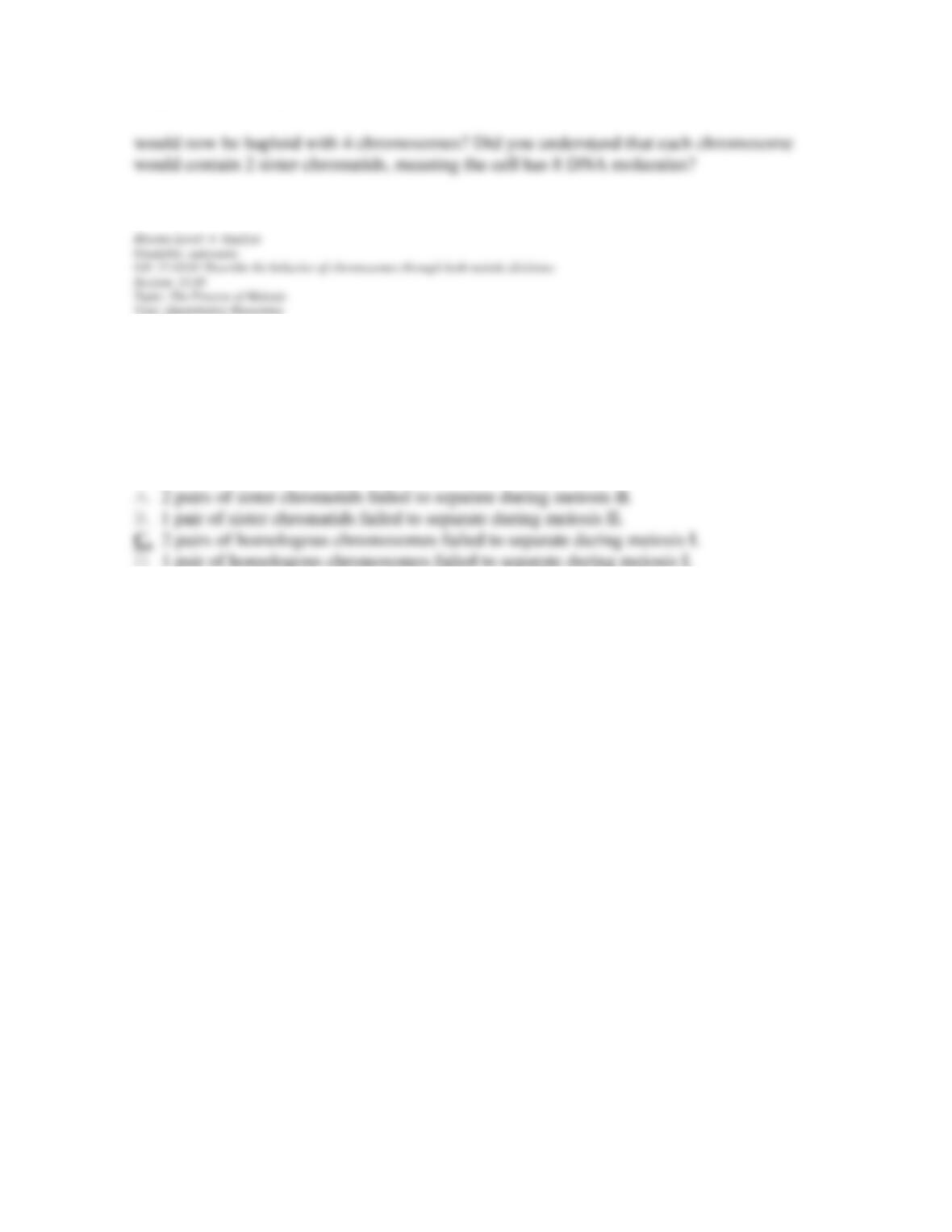
53. Non-disjunction is the failure of homologous chromosomes to separate during meiosis I,
or the failure of sister chromatids to separate during meiosis II or mitosis. As a result, both
homologous chromosomes or both sister chromatids migrate to the same pole of the cell. This
produces daughter cells with an imbalance of chromosomes. A cell biologist examines the
final products of meiosis in an earthworm (2n=36) and finds 2 cells with 20 chromosomes,
and 2 cells with 16 chromosomes. Most likely this was because
Chapter 11 – Sexual Reproduction and Meiosis
Clarify Question
•
What is the key concept addressed by the question?
•
What type of thinking is required?
•
What key words does the question contain and what do they mean?
Gather Content
•
What do you know about non-disjunction? How does it relate to the question?
Consider Possibilities
•
What other information is related to the question? Which information is most useful?
Choose Answer
•
Given what you now know, what information and/or problem solving approach is most
likely to produce the correct answer?

Chapter 11 – Sexual Reproduction and Meiosis
Reflect on Process
•
Did your problem-solving process lead you to the correct answer? If not, where did the
process break down or lead you astray? How can you revise your approach to produce a
more desirable result?
Chapter 11 – Sexual Reproduction and Meiosis
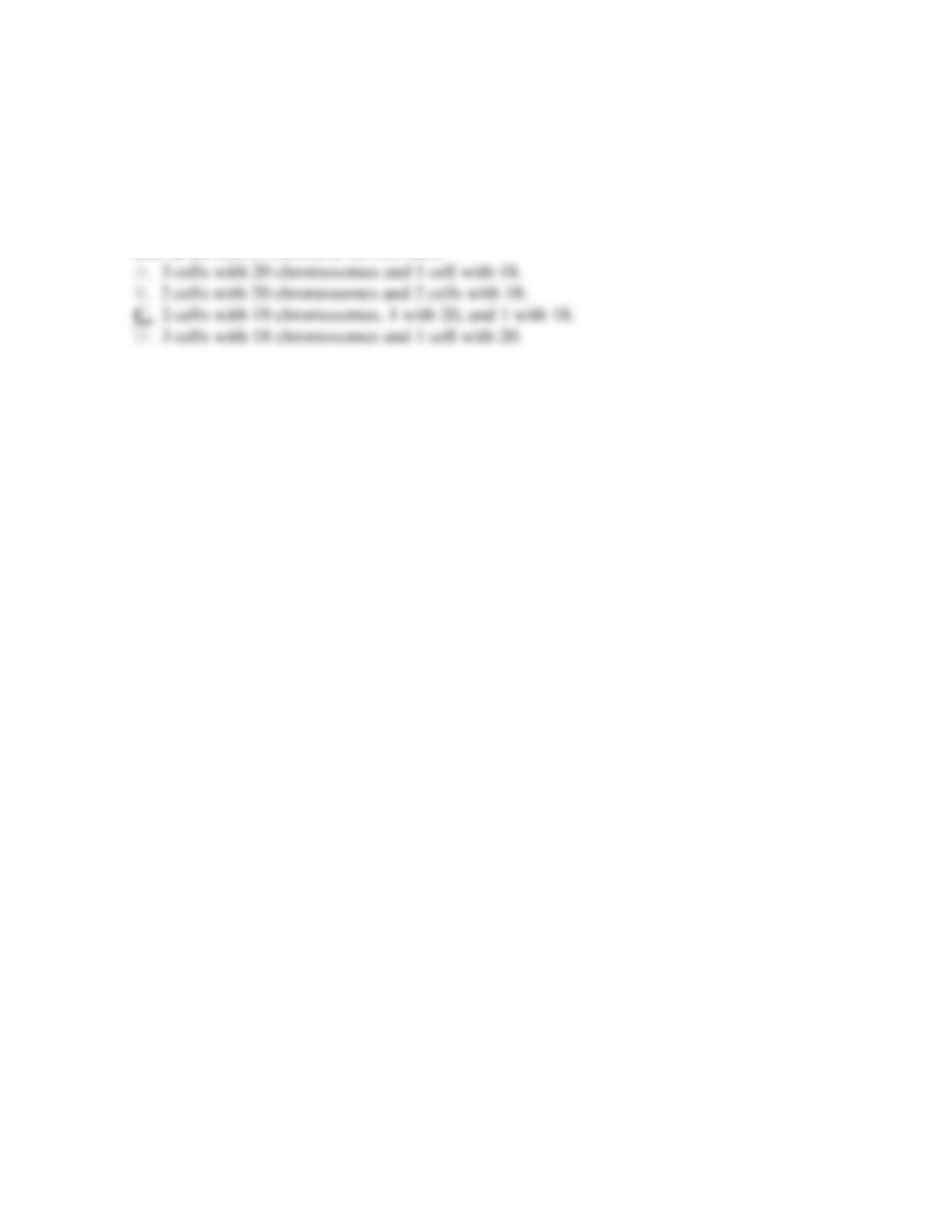
54. Non-disjunction is the failure of homologous chromosomes to separate during meiosis I,
or the failure of sister chromatids to separate during meiosis II or mitosis. As a result, both
homologous chromosomes or both sister chromatids migrate to the same pole of the cell. This
produces daughter cells with an imbalance of chromosomes. If 18 pairs of sister chromatids
segregate normally during meiosis II in cats (n=19) but we have non-disjunction of 1 pair,
then at the end of meiosis II we will have
Chapter 11 – Sexual Reproduction and Meiosis
Clarify Question
•
What is the key concept addressed by the question?
•
What type of thinking is required?
•
What key words does the question contain and what do they mean?
Gather Content
•
What do you know about non-disjunction? How does it relate to the question?
Consider Possibilities
•
What other information is related to the question? Which information is most useful?
Choose Answer
•
Given what you now know, what information and/or problem solving approach is most
likely to produce the correct answer?

Chapter 11 – Sexual Reproduction and Meiosis
Reflect on Process
•
Did your problem-solving process lead you to the correct answer? If not, where did the
process break down or lead you astray? How can you revise your approach to produce a
more desirable result?
Fill in the Blank Questions
55. A cell biologist examines a diploid cell from a particular species of during metaphase of
mitosis and determines that 8 centromeres are present. Based on this finding, how many
centromeres should be present in a single cell from this species during anaphase II of
meiosis?
Chapter 11 – Sexual Reproduction and Meiosis
Clarify Question
• What is the key concept addressed by the question?
• What type of thinking is required?
• What key words does the question contain and what do they mean?
Gather Content
• What do you know about centromeres? How does it relate to the question?
Consider Possibilities
• What other information is related to the question? Which information is most useful?
Choose Answer
• Given what you now know, what information and/or problem solving approach is most
likely to produce the correct answer?
Reflect on Process
• Did your problem-solving process lead you to the correct answer? If not, where did the
process break down or lead you astray? How can you revise your approach to produce a
more desirable result?

Chapter 11 – Sexual Reproduction and Meiosis
56. A cell biologist examines a diploid cell from a particular species of butterfly during
prometaphase of mitosis and determines that 10 centromeres are present. Based on this
finding, how many chromatids should be present in a single cell from this species in
metaphase I of meiosis?
Chapter 11 – Sexual Reproduction and Meiosis
Clarify Question
• What is the key concept addressed by the question?
• What type of thinking is required?
• What key words does the question contain and what do they mean?
Gather Content
• What do you know about the number of chromatids in a cell? How does it relate to the
question?
Consider Possibilities
• What other information is related to the question? Which information is most useful?
Choose Answer
• Given what you now know, what information and/or problem solving approach is most
likely to produce the correct answer?
Reflect on Process
• Did your problem-solving process lead you to the correct answer? If not, where did the
process break down or lead you astray? How can you revise your approach to produce a
more desirable result?

Chapter 11 – Sexual Reproduction and Meiosis
Multiple Choice Questions
57. Meiosis results in a reassortment of maternal chromosomes (inherited from the mother)
and paternal chromosomes (inherited from the father). If n=4 for a given species, and ignoring
the effects of crossing over, what is the probability that a gamete will receive only paternal
chromosomes?
Chapter 11 – Sexual Reproduction and Meiosis
Clarify Question
•
What is the key concept addressed by the question?
•
What type of thinking is required?
•
What key words does the question contain and what do they mean?
Gather Content
•
What do you know about independent assortment? How does it relate to the question?
Consider Possibilities
•
What other information is related to the question? Which information is most useful?
Choose Answer
•
Given what you now know, what information and/or problem solving approach is most
likely to produce the correct answer?
Reflect on Process
•
Did your problem-solving process lead you to the correct answer? If not, where did the
process break down or lead you astray? How can you revise your approach to produce a
more desirable result?
Chapter 11 – Sexual Reproduction and Meiosis
58. A cell in G2 before meiosis begins, compared with one of the four cells produced at the
end of meiosis II, has
59. In meiosis, sister kinetochores are attached to the same pole of the cell during meiosis I,
and sister chromatid cohesion is released during anaphase II. What would be the likely result
if sister kinetochores were attached to different poles of the cell during meiosis I and sister
chromatid cohesion was released during anaphase I?
Chapter 11 – Sexual Reproduction and Meiosis
Clarify Question
•
What is the key concept addressed by the question?
•
What type of thinking is required?
•
What key words does the question contain and what do they mean?
Gather Content
•
What do you know about separation of sister chromatids? How does it relate to the
question?
Consider Possibilities
•
What other information is related to the question? Which information is most useful?
Choose Answer
•
Given what you now know, what information and/or problem solving approach is most
likely to produce the correct answer?
Reflect on Process
•
Did your problem-solving process lead you to the correct answer? If not, where did the
process break down or lead you astray? How can you revise your approach to produce a
more desirable result?

Chapter 11 – Sexual Reproduction and Meiosis
Check All That Apply Questions
60. Sister chromatids move to opposite poles of the cell during (Check all that apply.)
_____ anaphase I of meiosis