Chapter 11: Depreciation, Depletion, Impairment, and Disposal
121. On January 1, 2016 Hill Bowling purchased equipment for $3.5 million. The equipment is being depreciated by the
straight-line method over 10 years with no residual value. In 2020, new advanced bowling equipment has come on
the market. As a result, Hill believes the bowling equipment currently being used is going to become obsolete
quicker than anticipated, so Hill wants to complete an impairment test on that equipment. Hill estimates that the net
cash flows from using the current equipment will be $250,000 per year for the next five years. Hill also expects it
could sell the current equipment immediately for $25,000. Hill uses a 14% discounted rate to evaluate other projects
of this nature.
Required:
Complete the Impairment test for Hill Bowling.
PV of $1.519
PV of an annuity 3.433
FV of $11.925
FV of an annuity 6.610
122. On January 1, 2016, Travis Company purchased machinery costing $3,000,000. The company uses straight-line
depreciation assuming the machinery’s useful life to be 10 years and its residual value to be $600,000.
At the end of 2019, the company felt that technological advances had caused an impairment of its machinery and that
the remaining useful life of the machinery was only four years. The company estimates the machinery will generate
cash inflows of $850,000 and cash outflows of $100,000 over each of the next four years. The company uses a 15%
rate of return to evaluate capital budgeting projects.
Required:
a.
Determine if an impairment loss has occurred. (Show all calculations).
b.
Challenging
United States – BUSPORG: Analytic
Calculate the amount of any impairment loss to be recognized. The present value of an
annuity is 2.85498; present value of $1 is 0.57175; and future value of annuity is 4.99338.
123. On April 1, 2016, an uninsured machine was totally destroyed in an accident at Rogers manufacturing plant. The
machine had been acquired on January 1, 2013, at a cost of $70,000. It was expected to have a useful life of seven
years and a residual value of $7,000. Rogers depreciates machines using the straight-line method and computes
depreciation to the nearest whole month. No depreciation has been recorded in 2016.
Required:
Record the 2016 depreciation expense and the disposal of the machine.
124. Jonas Company purchased a photocopier that cost $15,000. The copier was expected to last for 1.25 million copies.
In the first year of service the copier produced 180,000 copies, in the second year 250,000 copies and in the third
year it had produced 175,000. The company decided to sell the machine for $6,500 in the third year.
Required:
1) Record the purchase and the three years of depreciation.
2) Record the subsequent gain or loss on the disposal of the machine.
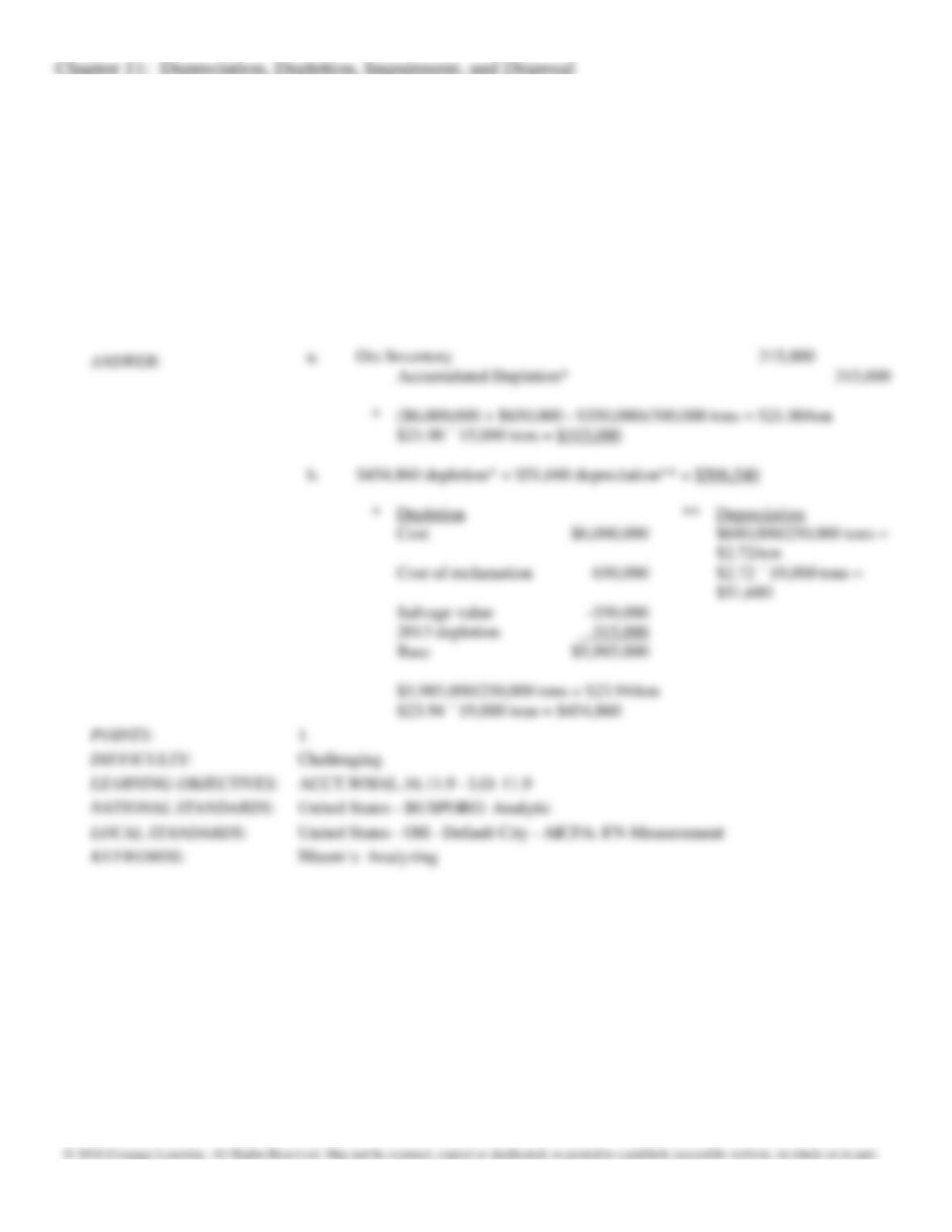
125. On January 1, 2015, the Jones-Smith Corp. acquired a parcel of land for $6,000,000 from which it expects to extract
300,000 tons of coal over the next ten years. Afterwards, the land will be reclaimed at an estimated cost of $650,000
and sold for an estimated $350,000. In 2016, a building was constructed on the mine site at a cost of $680,000. It is
estimated that the building will have zero residual value when mining is completed.
During 2015, 15,000 tons of ore were mined, and in 2016, 19,000 tons of ore were mined. At the beginning of 2016,
the estimated amount of ore remaining was revised to 250,000 tons.
Required:
a.
Prepare the depletion entry for 2015.
b.
Determine the total amount of inventoriable costs to be recorded in 2016.
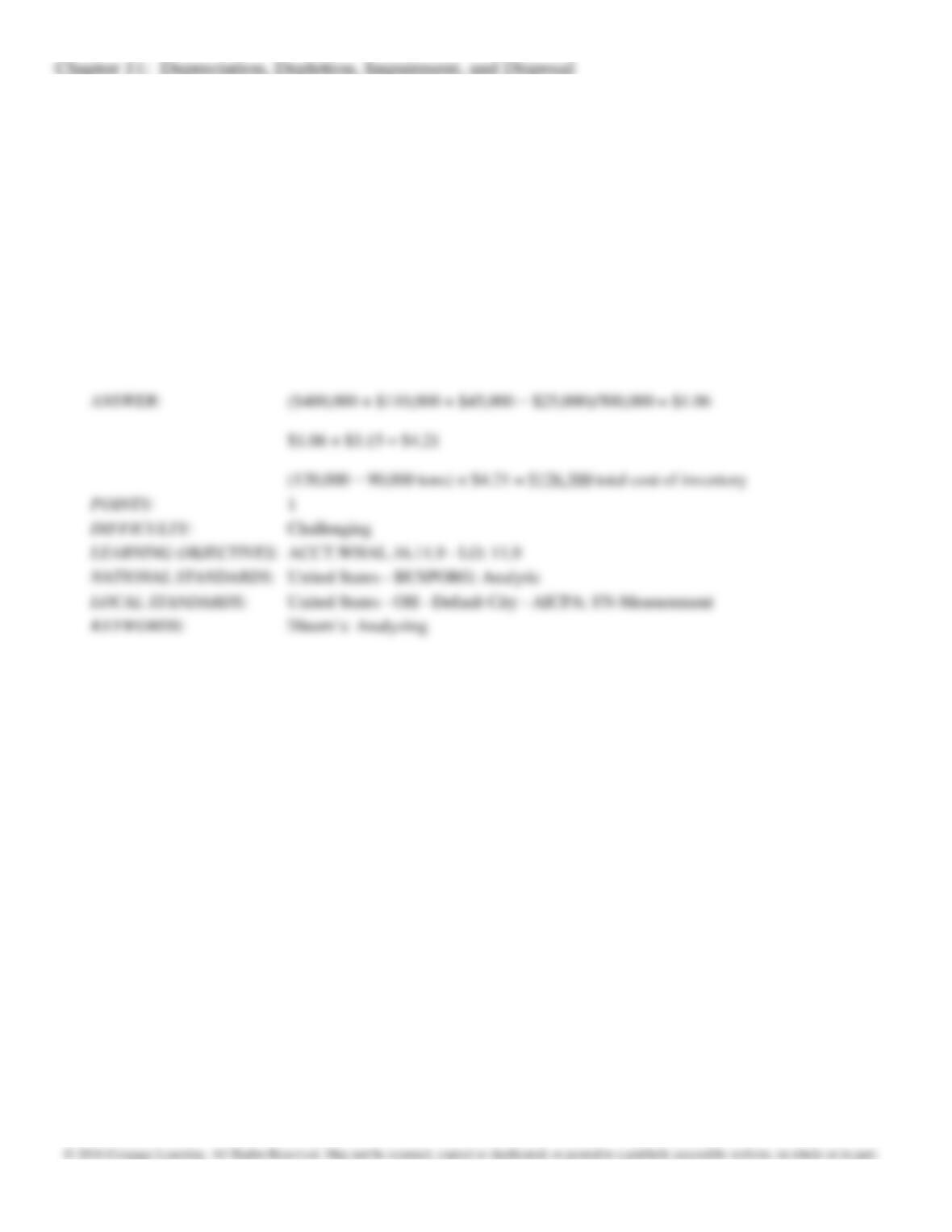
126. Information concerning a mine is as follows:
Costs of production (excluding depletion)
$3.15 per ton
Number of tons sold this year
90,000 tons
Development costs incurred
$45,000
Residual value of land after mining
$25,000
Estimated number of tons of ore to be mined
500,000 tons
Cost of the land
$400,000
Number of tons mined this year
120,000 tons
Cost of restoring property after mining is completed
$110,000
1
Challenging
ACCT.WHAL.16.11.9 – LO: 11.9
United States – BUSPORG: Analytic
United States – OH – Default City – AICPA: FN-Measurement
Required:
Compute the total cost of inventory at the end of the year.
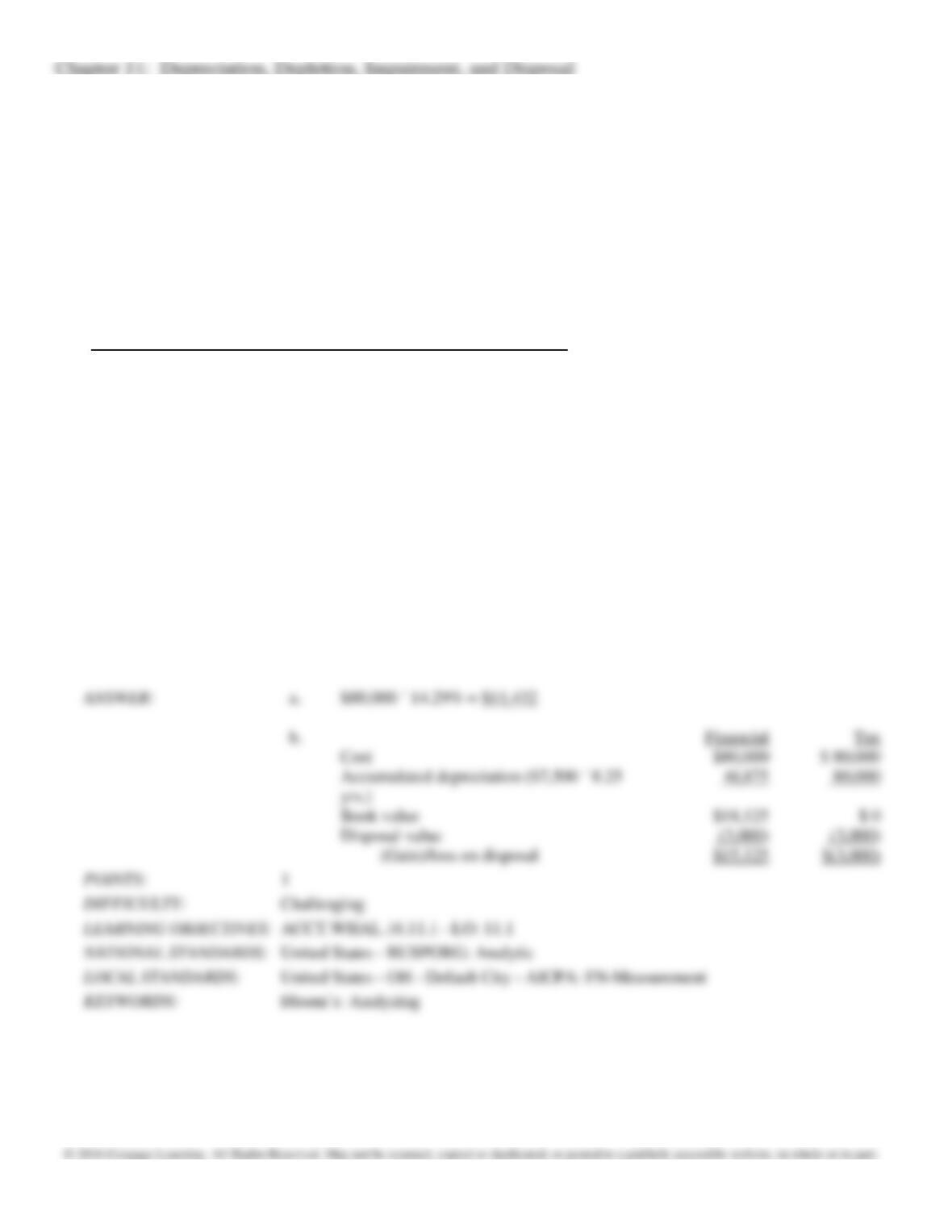
127. On January 1, 2015, Smith-Jones Company purchased office furniture for $80,000. Other data on the purchase
include the following:
Estimated useful life
10 years
MACRS life
7 years
Estimated residual value
$5,000
Financial statement depreciation
Straight-line
MACRS depreciation
200% declining balance
The MACRS Depreciation table is as follows:
MACRS Depreciation as a Percentage of the Cost of the Asset
Year of Life
3
5
7
10
1
33.33%
20.00%
14.29%
10.00%
2
44.45%
32.00%
24.49%
18.00%
3
14.81%
19.20%
17.49%
14.40%
4
7.41%
11.52%
12.49%
11.52%
5
11.52%
8.93%
9.22%
6
5.76%
8.92%
7.37%
7
8.93%
6.55%
8
4.46%
6.55%
9
6.56%
10
6.55%
11
3.28%
Required:
a.
Compute the depreciation deduction for the 2015 tax return.
b.
1
ACCT.WHAL.16.11.1 – LO: 11.1
United States – BUSPORG: Analytic
United States – OH – Default City – AICPA: FN-Measurement
Assume the asset is sold on April 1, 2023 for $3,000. Compute the gain/loss on disposal for
both financial reporting and tax reporting.
Year
Year
$ 30,000.00
$ 28,800.00
$ 6,430.50
128. The MACRS Depreciation table is as follows:
MACRS Depreciation as a Percentage of the Cost of the Asset
Year of Life
3
5
7
10
1
33.33%
20.00%
14.29%
10.00%
2
44.45%
32.00%
24.49%
18.00%
3
14.81%
19.20%
17.49%
14.40%
4
7.41%
11.52%
12.49%
11.52%
5
11.52%
8.93%
9.22%
6
5.76%
8.92%
7.37%
7
8.93%
6.55%
8
4.46%
6.55%
9
6.56%
10
6.55%
11
3.28%
Required:
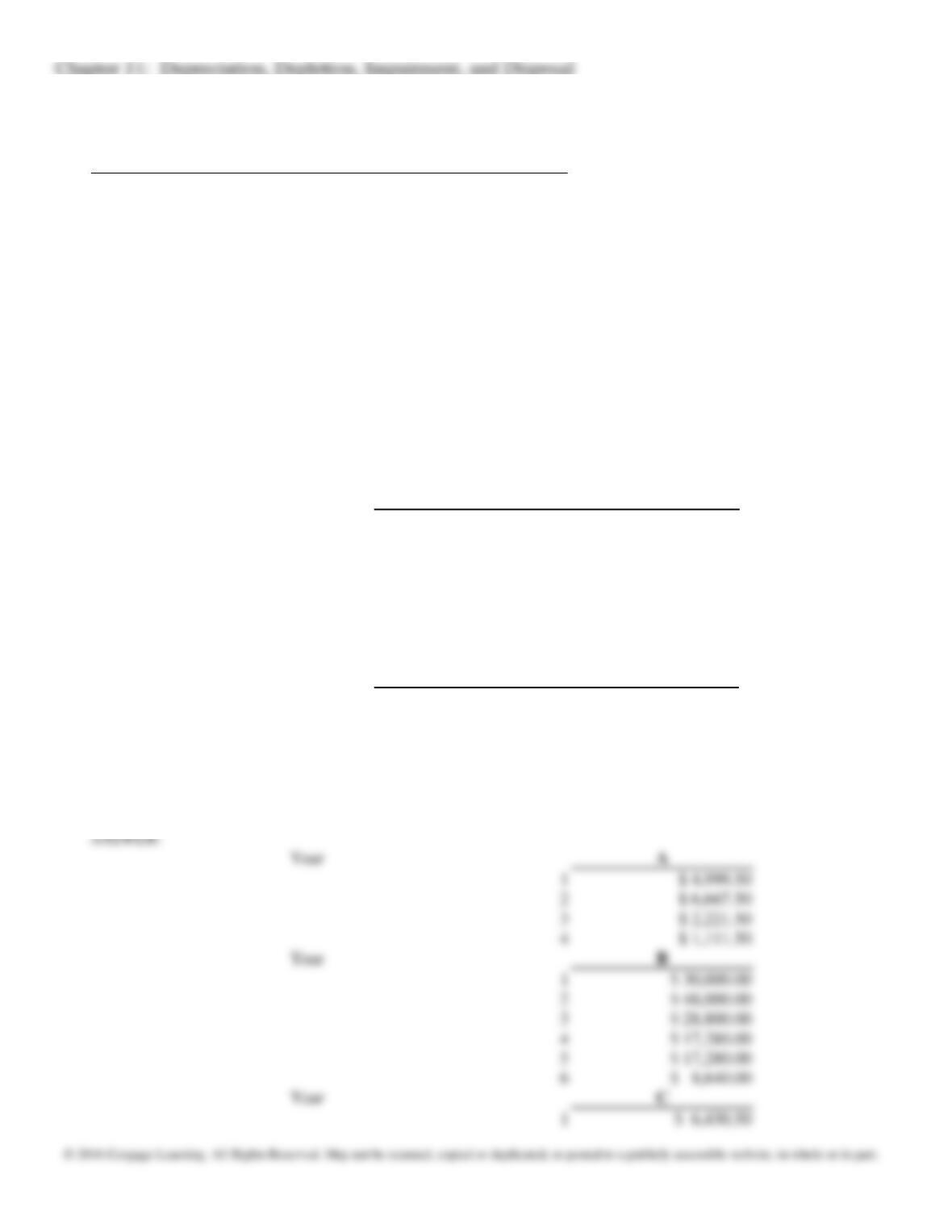
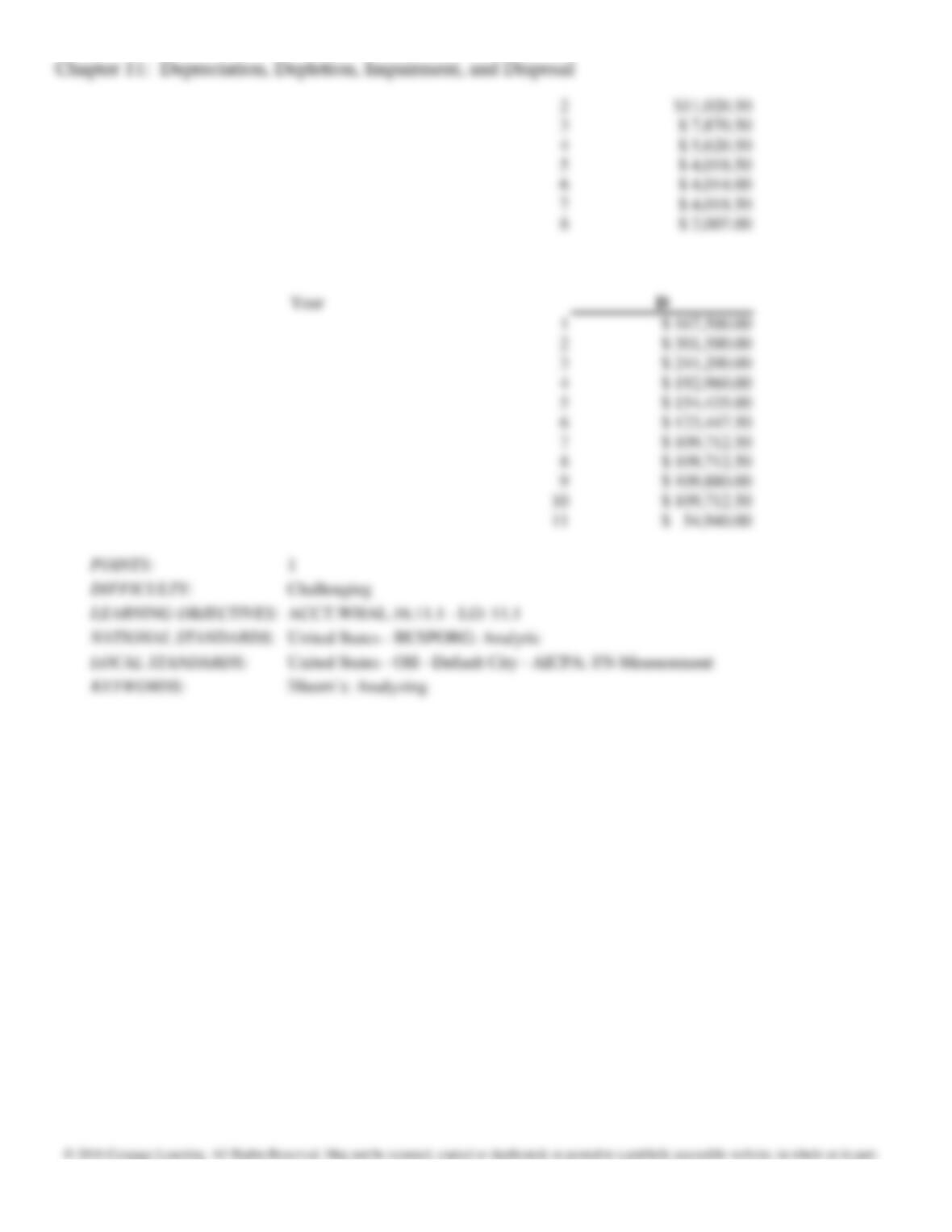
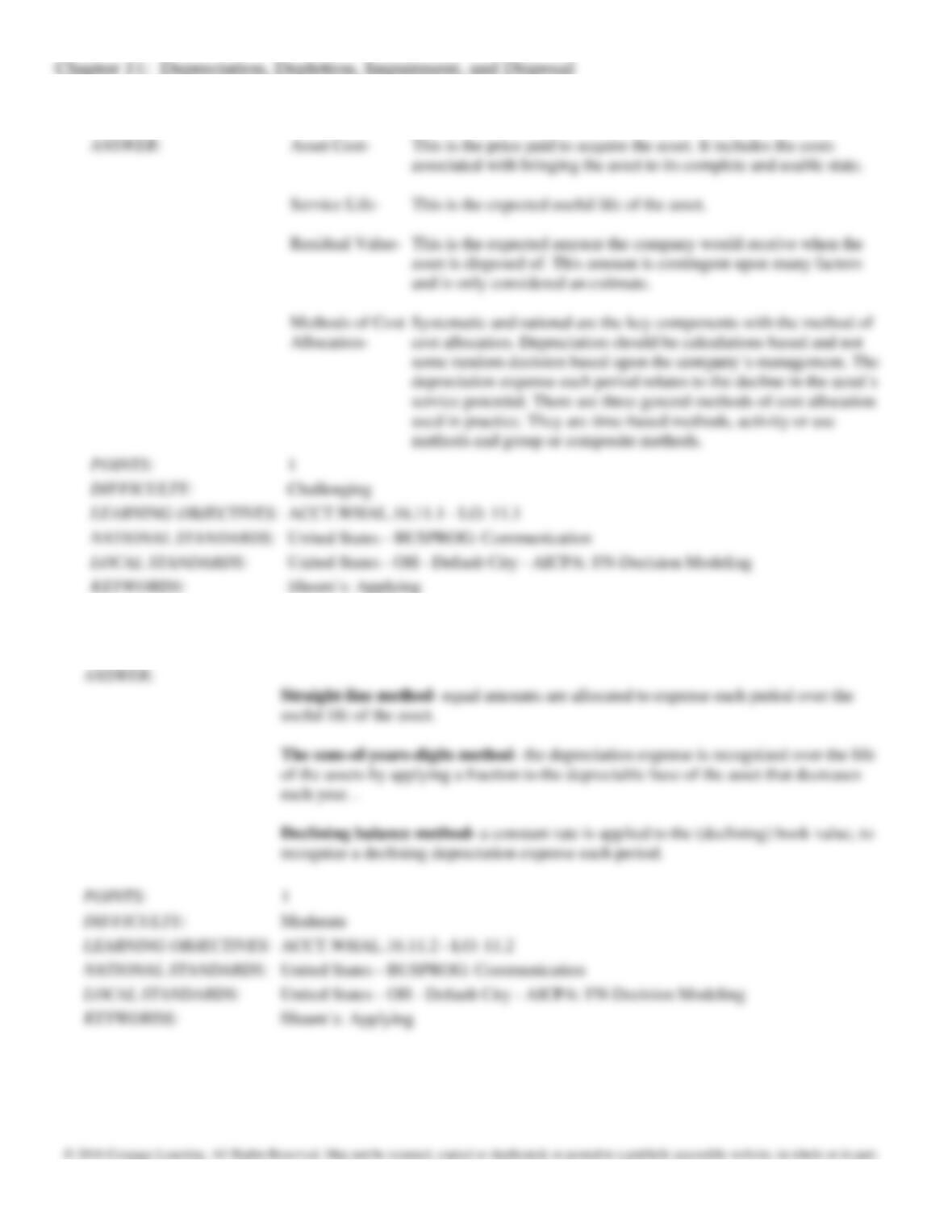
Using the MACRS Depreciation table calculate each year of depreciation for each independent situation.
A
B
Cost
$ 15,000
$ 150,000
Estimated Economic Life
5
10
Estimated residual value
$-
$ 20,000
Depreciation for Financial Statements
straight-line
straight-line
MACRS life
3
5
MACRS Method
200%-declining-balance
200%-declining-balance
C
D
Cost
$ 45,000
$ 1,675,000
Estimated Economic Life
7
15
Estimated residual value
$ 3,000
$ 50,000
Depreciation for Financial Statements
straight-line
straight-line
MACRS life
7
10
MACRS Method
200%-declining-balance
200%-declining-balance
129. What four factors must be considered in the computation of depreciation? Provide a brief description of each.
130. List the time based methods of cost allocation, provide a brief explanation of each.
131. Making intercompany comparisons is equally as important to insiders as to outsiders. What two measures can
provide investors and analysts with information regarding a company’s property, plant, and equipment?
132. Companies can apply composite depreciation to a grouping of dissimilar assets. What procedures must be followed?
133. What disclosures are required by GAAP for depreciation?
134. When accounting for long-lived assets, companies may make modifications in the procedures related to computing
depreciation for specific assets. Companies may change depreciation methods or may change an estimate of the
service life of the assets.
Required:
Describe how these two types of accounting changes are to be handled.
135. Assets from time to time become impaired. GAAP requires companies to review their assets for impairment. This
review should take place whenever events or circumstances indicate the carrying value of the asset may not be
recoverable. Provide three examples of events or circumstances which may cause a company to review their assets
for impairment.
136. As part of its normal activities, a company sells or disposes of assets. What steps are necessary in order to report the
results of an asset disposal?
137. What costs can be capitalized as part of the cost of a natural resource?
138. In what three respects does the computation for depreciation for federal income tax purposes and financial reporting
purposes differ for assets purchased after 1987?
139. The straight-line and accelerated depreciation methods differ significantly in the amount and timing of the
depreciation expense recognized and reported each year.
Required:
Discuss the factors that should be considered when choosing between the straight-line and accelerated depreciation
methods.
140. It has been suggested that repair and maintenance costs should be considered when selecting a depreciation method.
Required:
Discuss the reasoning behind this assertion and explain how it would be implemented.
141. In 2015, the Hermes Corporation failed to record $8,000 in depreciation expense. The error was discovered in May
of 2016.
Required:
Make the appropriate journal entry in the books of Hermes Corporation in the year 2016. Explain the impact of the
error correction on the Hermes’ 2016 net income.
142. Generally, IFRS require asset impairments to be recorded sooner than U.S. GAAP requires recognition.
Required:
Discuss the differences between IFRS and GAAP procedures for identifying and measuring asset impairments, and
explain why the IFRS approach is likely to result in write-downs sooner.
143. GAAP now requires that impairment losses be recognized when they occur, in order to reflect the fair value of
productive assets in the company’s financial statements.
Required:
Discuss three of the concerns that some accountants have about this practice.