Chapter 11: Strategic Cost Management
100. Lavalier Company developed the following budgeted life-cycle income statement for two proposed products.
Each product’s life cycle is expected to be two years.
Product AA
Product BB
Total
Sales
$400,000
$350,000
$750,000
Cost of goods sold
300,000
200,000
500,000
Gross profit
$100,000
$150,000
$250,000
Period expenses:
Research and development
(100,000)
Marketing
(75,000)
Life-cycle income
$ 75,000
A 12 percent return on sales is required for new products. Because the proposed products did not have a 12
percent return on sales, the products were going to be dropped.
Relative to Product BB, Product AA requires more research and development costs but fewer resources to market
the product. Sixty-five percent of the research and development costs are traceable to Product AA, and 40 percent
of the marketing costs are traceable to Product AA.
If research and development costs and marketing costs are traced to each product, life-cycle income for Product
BB would be
a. $70,000.
b. $90,000.
c. $105,000.
d. $150,000.
Chapter 11: Strategic Cost Management
101. Luminous Company sells a product for $450 per unit. Its market share is 25 percent. The marketing manager feels
that the market share can be increased to 33 percent with a reduction in price to $390. The product is currently
earning a profit of $72 per unit. The president of Luminous Company feels that the $72 profit per unit must be
maintained. What is the target price per unit?
a. $378
b. $450
c. $318
d. $390
102. Luminous Company sells a product for $450 per unit. Its market share is 25 percent. The marketing manager feels
that the market share can be increased to 33 percent with a reduction in price to $390. The product is currently
earning a profit of $72 per unit. The president of Luminous Company feels that the $72 profit per unit must be
maintained. What is the original cost per unit?
a. $390
b. $450
c. $378
d. $318
103. Dot Company sells a product for $225 per unit. Its market share is 20 percent. The marketing manager feels that
the market share can be increased to 30 percent with a reduction in price to $195. The product is currently earning
a profit of $36 per unit. The president of Dot Company feels that the $36 profit per unit must be maintained.
What is the target price per unit?
a. $195
b. $225
c. $189
d. $159
104. Dot Company sells a product for $225 per unit. Its market share is 20 percent. The marketing manager feels that
the market share can be increased to 30 percent with a reduction in price to $195. The product is currently earning
a profit of $36 per unit. The president of Dot Company feels that the $36 profit per unit must be maintained. What
is the original cost per unit?
a. $225
b. $195
c. $159
d. $189
Chapter 11: Strategic Cost Management
105. Dot Company sells a product for $225 per unit. Its market share is 20 percent. The marketing manager feels that
the market share can be increased to 30 percent with a reduction in price to $195. The product is currently earning
a profit of $36 per unit. The president of Dot Company feels that the $36 profit per unit must be maintained. What
is the target cost per unit?
a. $159
b. $195
c. $189
d. $225
106. The manufacturing which reduces inventory levels because production is geared to demand is called:
a. Traditional
b. Conventional
c. Extraordinary
d. JIT
107. Traditional manufacturing uses which of the following philosophies of quality control?
a. zero defects
b. total quality control
c. acceptable quality level
d. both a and b
108. Which of the following is a trait of a traditional manufacturing system?
a. push-through system
b. value-chain focus
c. total quality control
d. high employee involvement
109. Which of the following is NOT a trait of a traditional manufacturing system?
a. push-through system
b. short-term supplier contracts
c. value-added focus
d. total quality control

Chapter 11: Strategic Cost Management
110. Which of the following is a trait of a JIT system?
a. push-through system
b. significant inventory
c. buyers’ market
d. large supplier base
111. JIT manufacturing differs from traditional manufacturing in all of the following ways EXCEPT
a. the treatment of direct materials and direct labor for product costing.
b. the level of inventories.
c. the approach to quality control.
d. the physical layout of the manufacturing process.
112. JIT manufacturing uses which of the following philosophies of quality control?
a. just-in-case (JIC)
b. acceptable quality level (AQL)
c. total quality control (TQC)
d. both a and c
113. Which of the following is NOT a trait of a JIT system?
a. acceptable quality level
b. long-term contracts
c. multi-skilled labor
d. high employee involvement
114. The goal of total quality control is
a. to have less defective material than good material.
b. to permit defects as long as they do not exceed a certain level.
c. to have zero defects.
d. both b and c.
115. The approach to quality control which attempts to achieve zero defects is called:
a. traditional
b. acceptable quality level
c. total quality control
d. marginal control

Chapter 11: Strategic Cost Management
116. the traditional approach of permitting defects to occur as long as they do NOT exceed a certain level is called
a. Total quality control
b. Zero defects
c. Acceptable quality level
d. Both a and c
117. If traditional manufacturing is used, which of the following is considered direct costs?
a. setup costs
b. direct labor
c. maintenance of machinery
d. inspection costs
118. In a JIT manufacturing environment, product-costing information is used mainly for all of the following EXCEPT
a. product costing of inventory for financial reporting purposes.
b. pricing decisions.
c. product profitability analysis.
d. make-or-buy decisions.
119. Which of the following manufacturing costs is assigned to products in a traditional environment using direct
tracing?
a. supervision
b. materials
c. repairs and maintenance
d. energy
120. Which of the following manufacturing costs is assigned to products in a traditional and JIT environment using
direct tracing?
a. direct materials
b. direct labor
c. operating supplies
d. both a and b

Chapter 11: Strategic Cost Management
121. If JIT manufacturing is used and each manufacturing cell produces a single product, which of the following
is considered a direct product cost?
a. inspection costs
b. materials
c. setup costs
d. all of these
122. If JIT manufacturing is used and each manufacturing cell produces a single product, all of the following
are considered direct product costs EXCEPT
a. overtime wages for cell workers.
b. the salary of the plant supervisor.
c. the salary of the cell supervisor.
d. all of these.
123. Which of the following manufacturing costs is assigned to products in a traditional and JIT environment
using allocation?
a. insurance and taxes
b. direct labor
c. supervision (department)
d. custodial services
124. Which of the following manufacturing costs is assigned to products in JIT environment using direct tracing?
a. material handling
b. repairs and maintenance
c. custodial services
d. all of these
125. Which of the following manufacturing costs is assigned to products in a traditional environment using driver
tracing?
a. direct labor
b. direct materials
c. energy
d. insurance
Chapter 11: Strategic Cost Management
126. Which of the following manufacturing costs is assigned to products in a JIT environment using allocation?
a. cafeteria services
b. equipment depreciation
c. insurance and taxes
d. operating supplies
127. Prior to installing a JIT system, Grindstone Company used machine hours to assign maintenance costs to its
three products of 4-inch, 6-inch, and 9-inch insulation. The maintenance costs totaled $432,000 per year. The
machine hours used by each product and the quantity produced of each product are as follows:
Machine Hours
Quantity Produced
4-inch
5,000
15,000 rolls
6-inch
12,000
12,500 rolls
9-inch
7,000
11,200 rolls
After installing JIT, three manufacturing cells were created and the cell workers were trained to perform
maintenance. Maintenance costs for the three cells still totaled $432,000; however, these costs are now traceable to
each cell.
Cell, 4-inch
$125,000
Cell, 6-inch
175,000
Cell, 9-inch
165,000
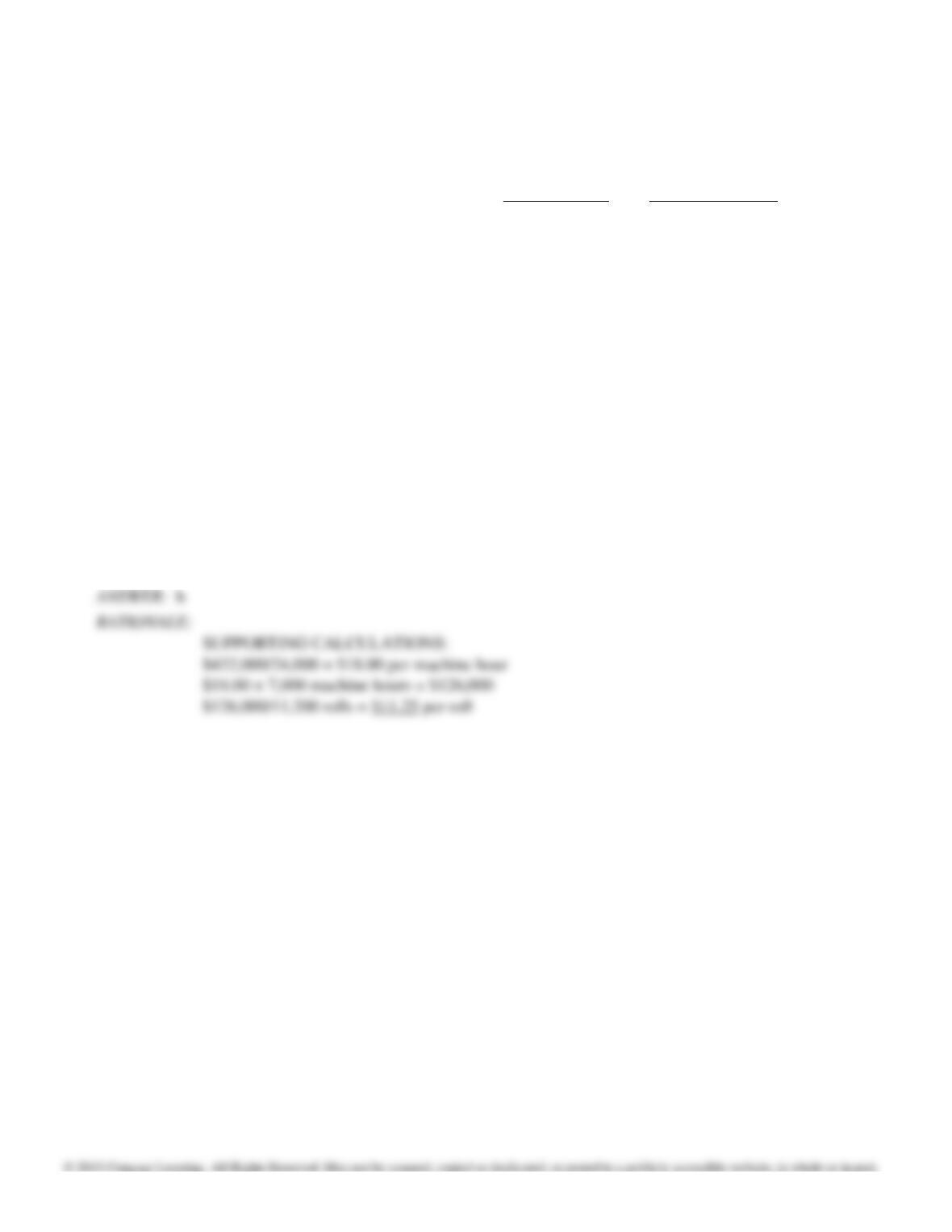
The maintenance cost per roll of 4-inch insulation before JIT is installed would be
a. $11.25.
b. $6.00.
c. $7.75.
d. $3.00.
Chapter 11: Strategic Cost Management
128. Prior to installing a JIT system, Grindstone Company used machine hours to assign maintenance costs to its
three products of 4-inch, 6-inch, and 9-inch insulation. The maintenance costs totaled $432,000 per year. The
machine hours used by each product and the quantity produced of each product are as follows:
Machine Hours
Quantity Produced
4-inch
5,000
15,000 rolls
6-inch
12,000
12,500 rolls
9-inch
7,000
11,200 rolls
After installing JIT, three manufacturing cells were created and the cell workers were trained to perform
maintenance. Maintenance costs for the three cells still totaled $432,000; however, these costs are now traceable to
each cell.
Cell, 4-inch
$125,000
Cell, 6-inch
175,000
Cell, 9-inch
165,000
The maintenance cost per roll of 9-inch insulation before JIT is installed would be
a. $7.75.
b. $11.25.
c. $14.00.
d. $30.00.
Chapter 11: Strategic Cost Management
129. Prior to installing a JIT system, Grindstone Company used machine hours to assign maintenance costs to its
three products of 4-inch, 6-inch, and 9-inch insulation. The maintenance costs totaled $432,000 per year. The
machine hours used by each product and the quantity produced of each product are as follows:
Machine Hours
Quantity Produced
4-inch
5,000
15,000 rolls
6-inch
12,000
12,500 rolls
9-inch
7,000
11,200 rolls
After installing JIT, three manufacturing cells were created and the cell workers were trained to
performmaintenance. Maintenance costs for the three cells still totaled $432,000; however, these costs are now
traceable to each cell.
Cell, 4-inch
$125,000
Cell, 6-inch
175,000
Cell, 9-inch
165,000
After installing JIT, the maintenance cost per roll of 6-inch insulation is
a. $8.67.
b. $12.85.
c. $14.00.
d. $17.00.
130. A firm that has implemented JIT had the following transactions:
1. Materials were purchased on account for $40,000.
2. Materials were placed into production.
3. Actual direct labor costs were $6,000.
4. Actual overhead costs were $40,000.
5. Conversion costs applied were $42,000.
6. All work was completed for the month.
7. All completed work was sold.
8. The variance is recognized.
What will be the entry to record material purchases using the traditional approach?
a. Materials and In Process Inventory 40,000
Accounts Payable 40,000
b. Materials Inventory 40,000
Accounts Payable 40,000
c. Accounts Payable 40,000
Materials and In Process Inventory 40,000
d. Accounts Payable 40,000
Materials Inventory 40,000
Chapter 11: Strategic Cost Management
131. A firm that has implemented JIT had the following transactions:
1. Materials were purchased on account for $40,000.
2. Materials were placed into production.
3. Actual direct labor costs were $6,000.
4. Actual overhead costs were $40,000.
5. Conversion costs applied were $42,000.
6. All work was completed for the month.
7. All completed work was sold.
8. The variance is recognized.
What will be the entry to record material purchases using the backflush approach?
a. Materials and In Process Inventory 40,000
Accounts Payable 40,000
b. Materials Inventory 40,000
Accounts Payable 40,000
c. Accounts Payable 40,000
Materials and In Process Inventory 40,000
d. Accounts Payable 40,000
Materials Inventory 40,000
132. A firm that has implemented JIT had the following transactions:
1. Materials were purchased on account for $40,000.
2. Materials were placed into production.
3. Actual direct labor costs were $6,000.
4. Actual overhead costs were $40,000.
5. Conversion costs applied were $42,000.
6. All work was completed for the month.
7. All completed work was sold.
8. The variance is recognized.
What will be the entry to record material placed into production using the traditional approach?
a. Materials and In Process Inventory 40,000
Work-in-process Inventory 40,000
b. Materials Inventory 40,000
Accounts Payable 40,000
c. Work-in-Process Inventory 40,000
Materials and In Process Inventory 40,000
d. Work-in-Process Inventory 40,000
Materials Inventory 40,000
Chapter 11: Strategic Cost Management
133. A firm that has implemented JIT had the following transactions:
1. Materials were purchased on account for $40,000.
2. Materials were placed into production.
3. Actual direct labor costs were $6,000.
4. Actual overhead costs were $40,000.
5. Conversion costs applied were $42,000.
6. All work was completed for the month.
7. All completed work was sold.
8. The variance is recognized.
What will be the entry to record materials placed into production using the backflush approach?
a. Materials and In Process Inventory 40,000
Work-in-process Inventory 40,000
b. Materials Inventory 40,000
Accounts Payable 40,000
c. Work-in-Process Inventory 40,000
Materials and In Process Inventory 40,000
d. No entry is required
134. A firm that has implemented JIT had the following transactions:
1. Materials were purchased on account for $40,000.
2. Materials were placed into production.
3. Actual direct labor costs were $6,000.
4. Actual overhead costs were $40,000.
5. Conversion costs applied were $42,000.
6. All work was completed for the month.
7. All completed work was sold.
8. The variance is recognized.
Which of the following would NOT be an entry under the backflush system, assuming the second trigger point is
the completion of goods?
a. Materials and In Process Inventory 40,000
Accounts Payable 40,000
b. Work-in-Process Inventory 40,000
Materials Inventory 40,000
c. Conversion Cost Control 46,000
Wages Payable 6,000
Accounts Payable 40,000
d. Cost of Goods Sold 82,000
Finished Goods Inventory 82,000
Chapter 11: Strategic Cost Management
135. Prior to installing a JIT system, Clarendon Company used machine hours to assign maintenance costs to its
three products of 6-inch, 8-inch, and 11-inch insulation. The maintenance costs totaled $400,000 per year. The
machine hours used by each product and the quantity produced of each product are as follows:
Machine Hours
Quantity Produced
6-inch
12,000
31,250 rolls
8-inch
20,000
25,000 rolls
11-inch
18,000
12,000 rolls
After installing JIT, three manufacturing cells were created and the cell workers were trained to perform
maintenance. Maintenance costs for the three cells still totaled $400,000; however, these costs are now traceable to
each cell.
Cell, 6-inch $100,000
Cell, 8-inch 120,000
Cell, 11-inch 180,000
The maintenance cost per roll of 8-inch insulation before JIT is installed would be
a. $20.00.
b. $16.00.
c. $9.33.
d. $6.40.
Chapter 11: Strategic Cost Management
136. Prior to installing a JIT system, Clarendon Company used machine hours to assign maintenance costs to its
three products of 6-inch, 8-inch, and 11-inch insulation. The maintenance costs totaled $400,000 per year. The
machine hours used by each product and the quantity produced of each product are as follows:
Machine Hours
Quantity Produced
6-inch
12,000
31,250 rolls
8-inch
20,000
25,000 rolls
11-inch
18,000
12,000 rolls
After installing JIT, three manufacturing cells were created and the cell workers were trained to perform
maintenance. Maintenance costs for the three cells still totaled $400,000; however, these costs are now traceable to
each cell.
Cell, 6-inch $100,000
Cell, 8-inch 120,000
Cell, 11-inch 180,000
After installing JIT, the maintenance cost per roll of 6-inch insulation would be
a. $1.28.
b. $3.20.
c. $2.84.
d. $2.56.