Exam
Name___________________________________
MULTIPLE CHOICE. Choose the one alternative that best completes the statement or answers the question.
1)
The term ________ refers specifically to geologic mountain building.
1)
A)
orogenesis
B)
orthogonal
C)
orogneisses
D)
orthogeny
2)
A horst is ________.
2)
A)
an uplifted block bounded by two reverse faults
B)
a downdropped block bounded by two normal faults
C)
a downdropped block bounded by two reverse faults
D)
an uplifted block bounded by two normal faults
3)
The mountains and valleys of the Basin and Range Province of the western United States formed in
response to ________.
3)
A)
tensional stresses and normal–fault movements
B)
strike–slip faulting and hanging wall block uplifts
C)
normal faulting and horizontal compression
D)
reverse faults and large displacement, thrust faulting
4)
The Black Hills of South Dakota are a good example of a(n) ________.
4)
A)
anticline
B)
dome
C)
basin
D)
syncline
1
5)
A thrust fault is best described as ________.
5)
A)
a low–angle, reverse fault
B)
a near vertical, strike–slip fault
C)
a steeply inclined, oblique–slip fault
D)
a vertical, normal fault
6)
Which one of the following is an example of an isostatic movement?
6)
A)
uplift of areas recently covered by thick, continental ice sheets
B)
numerous aftershocks associated with deep–focus earthquakes
C)
arching of strata at the center of a dome
D)
stream downcutting following a drop in sea level
A
7)
The ________ are a geologically old mountain range folded and deformed during the Paleozoic.
7)
A)
Alps in Europe
B)
Rockies in the western United States
C)
Cascades in the northwestern United States
D)
Appalachians in the eastern United States
D
8)
In thrust faulting, ________.
8)
A)
horizontal, tensional stresses drive the deformation
B)
the hanging wall block slips downward along the thrust fault
C)
the crust is shortened and thickened
D)
grabens develop on the footwall block
C
2
A
9)
Folded limestones that occur high in the Himalayas were originally deposited as sediments in a
________.
9)
A)
Cenozoic fault basin between Africa and Arabia
B)
late Paleozoic syncline north of the Tibetan Plateau
C)
deep ocean trench along the southern margin of India
D)
marine basin between India and Eurasia
10)
The concept that rocks of the crust and upper mantle are floating in gravitational balance is known
as ________.
10)
A)
isotropy
B)
isostasy
C)
isomonism
D)
isobration
11)
A graben is characterized by ________.
11)
A)
a footwall block that has moved up between two normal faults
B)
a hanging wall block that has moved up between two reverse faults
C)
a footwall block that has moved down between two reverse faults
D)
a hanging wall block that has moved down between two normal faults
12)
Large circular downwarped structures are called ________.
12)
A)
anticlines
B)
domes
C)
synclines
D)
basins
13)
A good example of a present–day, passive continental margin is the ________.
13)
A)
east coast of the Japanese Islands
B)
west coast of South America
C)
north flank of the East Pacific Rise
D)
east coast of North America
3
14)
Tensional forces normally cause which one of the following?
14)
A)
strike–slip faults
B)
normal faults
C)
reverse faults
D)
thrust faults
15)
A transform fault is ________.
15)
A)
the rift bounding faults on a mid–ocean ridge
B)
a strike–slip fault that forms the boundary between tectonic plates
C)
a dip–slip fault connecting an anticline with a syncline
D)
a reverse fault that steepens into a thrust fault
16)
A(n) ________ fault has little or no vertical movements of the two blocks.
16)
A)
stick slip
B)
strike slip
C)
dip slip
D)
oblique slip
17)
In a normal fault ________.
17)
A)
the footwall block below an inclined fault plane moves downward relative to the other block
B)
the hanging wall block above an inclined fault plane moves downward relative to the other
block
C)
the hanging wall block below an inclined fault plane moves downward relative to the other
block
D)
the footwall block above an inclined fault plane moves upward relative to the other block
18)
The ________ in California is the boundary between the North American and Pacific plates.
18)
A)
San Francisco normal fault
B)
Sierra Nevada frontal fault
C)
San Andreas strike–slip fault
D)
San Luis Obispo thrust fault
4
19)
A(n) ________ is a thick accumulation of sediments and small, tectonic blocks formed of material
scraped off a descending, lithospheric plate.
19)
A)
accretionary–wedge complex
B)
continental shelf, terrain complex
C)
subterranean–accumulation complex
D)
mass movement complex
SHORT ANSWER. Write the word or phrase that best completes each statement or answers the question.
20)
The east coast of North America is a good example of a(n) ________ tectonic margin.
20)
passive
Word Analysis. Examine the words and/or phrases for each question below and determine the relationship among the
majority of words/phrases. Choose the option that does not fit the pattern.
21)
a. dome b. anticline c. monocline d. basin
21)
22)
The ________ mountains in North America were formed by a continent–continent collision
in the Paleozoic.
22)
23)
A(n) ________ fault develops in response to horizontal, tensional stresses in crustal rocks.
23)
24)
A circular to elliptical structure developed by upward arching of the central strata is a(n)
________.
24)
25)
Fault–block mountains occur in regions dominated by ________ faulting.
25)
26)
In a thrust fault, the hanging wall moves ________ relative to the footwall, and the fault
plane is oriented at a(n) ________ angle.
26)
27)
________ are fractures showing little or no movement of the rocks on either side.
27)
5
Word Analysis. Examine the words and/or phrases for each question below and determine the relationship among the
majority of words/phrases. Choose the option that does not fit the pattern.
28)
a. elastic b. ductile c. brittle d. monocline
28)
29)
Any accreted crustal fragment that has a geologic history distinct from that of the adjoining
fragments is termed a(n) ________.
29)
30)
Are horsts and grabens bounded by normal or reverse faults?
30)
31)
A circular to elliptical structure developed by downwarping of the central strata is a(n)
________.
31)
Word Analysis. Examine the words and/or phrases for each question below and determine the relationship among the
majority of words/phrases. Choose the option that does not fit the pattern.
32)
a. normal fault b. reverse fault c. thrust fault d. strike–slip
fault
32)
33)
a. Himalayas b. Andes c. Appalachians d. Alps
33)
TRUE/FALSE. Write ‘T’ if the statement is true and ‘F’ if the statement is false.
34)
Terrane accretion generally occurs along a divergent boundary between a continental plate and an
oceanic plate.
34)
35)
Normal faults form in response to horizontal, tensional stresses that stretch or elongate the rocks.
35)
36)
In a reverse fault, the hanging wall block moves up relative to the footwall block.
36)
6
37)
The Himalayan Mountains and Tibetan Plateau are still rising today as Eurasia slides beneath the
Indian subcontinent.
37)
38)
Fractures in rock that have not involved any fault slippage are called joints.
38)
39)
Horizontal, compressive deformation involves shortening and thickening of the crust.
39)
40)
Accretionary wedges develop along subduction zones where sediments and other rocks are
scraped off a descending plate and piled against the leading edge of the overriding plate.
40)
41)
Terranes are commonly associated with fault–block mountains.
41)
42)
A graben is an upraised block bounded by two reverse faults.
42)
ESSAY. Write your answer in the space provided or on a separate sheet of paper.
Critical thinking and discussion questions. Use complete sentences, correct spelling, and the information presented in
chapter 11 to answer the questions below.
43)
A region is characterized by numerous anticlines and synclines. There are also several faults present that appear
to have formed at the same time as the folding. Without looking at any details, what type of faults would you
assume them to be? Why?
44)
Describe the characteristics of regions dominated by fault–block mountains such as the Basin and Range. What
is their relationship to plate tectonics and why don’t they create large–scale areas of orogenesis like
Andean–Type margins or continental collisions?
7
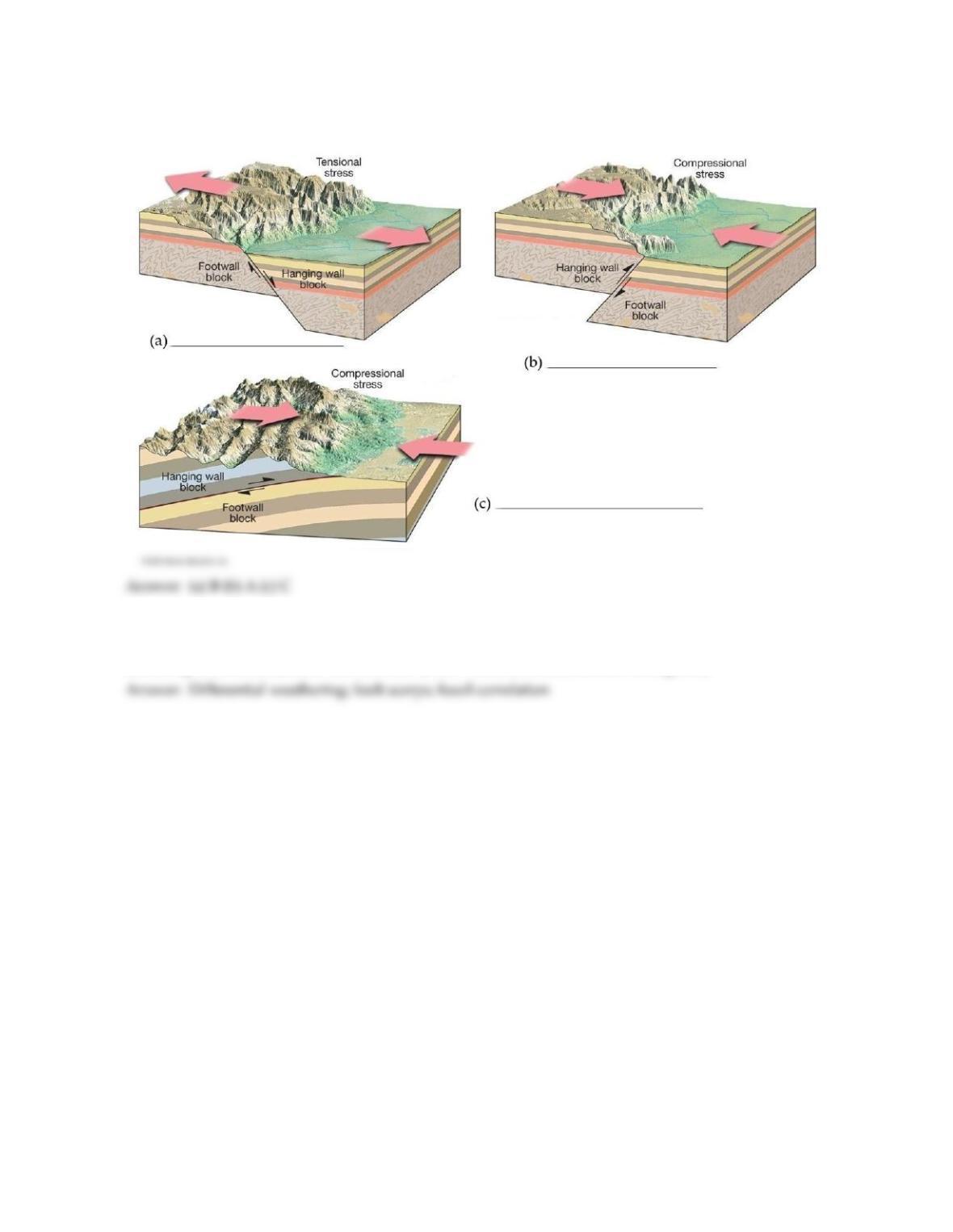
45)
Carefully study each illustration below to determine the type(s) of geologic structure(s) it contains. Match each
one to the correct answers listed.
A. Reverse Fault B. Normal Fault C. Thrust Fault
46)
A fault is observed in a road cut, but there are no obvious rocks units to correlate on either side of the fault to
determine relative movement. How else might you determine or even infer whether the hanging wall has
moved up or down relative to the footwall? (Hint: Think of fossils, tectonic setting, etc.)
8
Answer Key
Testname: C11
9